"I am 3/4ths Canadian, and one 4th New Englander - I had ancestors on both sides in the Revolutionary war." - Elizabeth Bishop
____________________________________________

Monday, July 5, 2010

FIRST ENCOUNTER XXI: From Texas to Great Village, by Adrianne Berry

My first encounter with Bishop was in 1996. I had returned to the University of Texas at Arlington to finish up a Master’s Degree (in English) that I’d left dangling several years earlier. When it came time to start thinking about my thesis, I approached my favorite professor, Dr. Tim Morris. We discussed several ideas, and I headed off to the library with the notion that I would write my thesis on some aspect of Emily Dickinson and her poetry.

When I got to the library I ran across Becoming Canonical in American Poetry, a book Dr. Morris had recently published that focused on the work of four poets: Walt Whitman, Emily Dickinson, Marianne Moore, and Elizabeth Bishop. Wait a minute. Who was this Elizabeth Bishop? I was in grad school and didn’t remember ever reading anything of hers. I checked the book out and took it to Dr. Morris. He explained that Bishop had a relatively small but important body of work that more and more critics and scholars were beginning to recognize. He recommended that I look at both her poetry and her prose, but that I begin with her poem “The Moose.” He was right. I read it over and over. Poetry had never made me feel this way! I was transported to that long-ago bus, watching the changing scenery, listening to the gossip, and witnessing with the other passengers the wonder of nature that brought the bus to a halt. I didn’t have to read anything else to help me make up my mind. Bishop became my thesis subject.

Now that may have technically been my “first encounter,” but my first immersion (yes, a baptism, if you will) happened when I met Sandra Barry. While researching my thesis I ran across a paper on Bishop that Sandra had presented at Vassar. I found her paper on the Internet and somehow found Sandra’s phone number (I don’t believe she had email until shortly after this time). I wanted to talk to this Bishop scholar about the paper she’d presented and see if she could point me to more information about Elizabeth Bishop. I contacted Sandra, we began corresponding, and I discovered that Sandra delighted in sharing her knowledge about Bishop. She was a great help with my thesis, but even beyond that, we began to develop a friendship. We corresponded frequently (by then both by mail and email), and in 1998, my then 17 year old daughter and I traveled to Nova Scotia and got the “Sandra Barry Deluxe Bishop Tour.” Wow! This is where my interest in Elizabeth Bishop changed into my love of Elizabeth Bishop.

Sandra introduced me to the little girl Bishop, her kinfolk, the town, the school, the churches, the people, the bay, and the province that colored Bishop’s world and helped forge the lens through which she would view the rest of her life. I was able to complete my pilgrimage by visiting the Bishop house in Great Village, even though it was owned by Paul Tingley, a private owner, at the time. During this visit to the house in Great Village, I grasped the importance of this special place, and I gained a whole new insight into its impact on Bishop’s psyche.

I was able to return to Nova Scotia again in 2006 with my husband, Eldon, and we are planning a trip in the summer of 2011 to celebrate the EB centenary. We are also fortunate and proud to be shareholders in the EB house. However, I must say that without Sandra Barry, it is doubtful I would have ever gone from Elizabeth Bishop encounter to Elizabeth Bishop immersion. Thank you, dear Sandra.

In the years since completing my degree, I’ve taught middle and high school English, and I’ve been a high school librarian for the last seven years. One thing I can proudly say is that I have introduced Bishop’s poetry to many Texas students who might never have found her. And I’ve made sure to have copies of The Collected Prose and The Complete Poems: 1927-1979 on the shelves of the libraries I’ve managed. No doubt there are other Elizabeth Bishop first encounters out there just waiting to happen!

[See Adrianne's own blog about life in Texas: "Seeing the Good."]

Monday, June 28, 2010

FIRST ENCOUNTER XX: My First (Un)Official Encounter with Bishop and Beyond, by Camille Roman

My first meeting with Elizabeth Bishop occurred about the time of her death in the Fall of 1979. I consider it to be “unofficial” because I was not familiar with her poetry and did not understand her importance until I learned about her death. Many decades later, I discovered that Kathleen Spivack, the instructor of my poetry-writing seminar held during that fall at the Radcliffe Institute in Cambridge, knew Bishop very well. In fact she was a close friend as well as frequent table tennis partner.

Then in the Spring of 1986 I found Bishop on the syllabus of my doctoral seminar in Postmodern American Poetry at Brown University. It was very early in Bishop studies; and Tom Travisano’s first book on Bishop had just been published. So Mutlu Konuk Blasing’s decision was a major pioneering move, which resulted in what I consider to be my “official” first encounter with Bishop’s poetry. Only much later did I learn that Bishop had spent a great deal of time at Brown with the students in Portuguese and Brazilian Studies and that another major Bishop scholar, George Monteiro, had been one of the founders of this field there. Given Bishop’s enjoyment of the students, it did not surprise me to discover that Brown had given Bishop an honorary doctorate.

When I began work on my dissertation, I decided to include Bishop. Fortunately I was able to organize a dynamic committee composed of Blasing as the director with Monteiro as my second reader. Then I invited another Brown faculty member, the well-respected poetry scholar Susanne Woods to join the committee; and she graciously accepted. Finally, I added a fourth reader from outside of Brown, Patricia Yaeger, now the PMLA editor, but then at Harvard University and later at the University of Michigan. She had just published a major book in feminist studies that included Bishop.

After I accepted a tenure-track position at Washington State University on the West Coast, I began teaching Bishop immediately in my graduate seminars on mid-twentieth-century American poetry. As I considered developing Elizabeth Bishop’s World War II-Cold War View, my book for tenure, I returned to two poems from my seminar with Blasing: “Visits to St Elizabeth’s” by Bishop and “Daddy” by Plath. They inspired me to begin thinking about both World War II and the Cold War together. At that time I also contacted Thomas Travisano, president and founder of The Elizabeth Bishop Society, and he was very gracious. I had attended the first organizing meeting of the society at MLA and therefore knew about him from that session, which was held in the suite of Lorrie and Barry Goldensohn (Lorrie also, of course, became a major Bishop scholar). From that point forward Tom and I have conversed frequently about Bishop and other mutual projects both alone and with many other leading Bishop scholars, critics, friends, students, biographers, and supporters.

Presently I am looking out at the breathtaking skyline of Portland, Oregon, where Bishop located Nova Scotian friends during her teaching assignments at the University of Washington and her stays in San Francisco – and just before she began teaching and living in her native New England. I am completing this reflection about my initial conversations with her and thinking about her further. She remains very much a part of my life. Tom, Steven Gould Axelrod (another major Bishop scholar who also read my book on Bishop in manuscript form), and I are completing the third volume of The New Anthology of American Poetry that will include her writing.


Camille Roman is the author of Elizabeth Bishop's World War II-Cold War View (Palgrave) and a board member of the Elizabeth Bishop Society. Currently, she is completing volume three of The New Anthology of American Poetry with Steven Gould Axelrod and Thomas Travisano and is co-editing a large project on Robert Frost and Ernest Hemmingway with Suzanne del Gizzo.

Friday, June 25, 2010

Nova Scotia Connections -- St. James Church


St. James Presbyterian Church, circa turn of the 20th century

Anyone who has gone to Great Village will tell you that, in addition to the enormous tides in nearby Cobequid Bay, the most immediately impressive thing about the village, as one approaches and passes through, is St. James United Church. As it did in Elizabeth Bishop’s childhood, when it was the Presbyterian church, so it continues today to loom large over the community, its 112 foot steeple, still topped by a lightning rod. The steeple and lightning rod are visible from all elevations surrounding the village, looking, as Elizabeth Bishop wrote in “In the Village,” “like one hand of a clock pointing straight up.”

Invoking the startling and electric image of the lightning rod (which is, after all, a conduit between the wildly elemental and the solid dark earth – a way to channel mysterious and dangerous power) in relation to the deep tragedy of her mother’s illness and breakdown, Elizabeth Bishop sets the tone – a singular note – of her aesthetic universe, as she transforms her mother’s scream into art: “Its [the scream’s] pitch would be the pitch of my village. Flick the lightning rod on top of the church steeple with your fingernail and you will hear it.”

The Bulmer home sits diagonally across the road from the church, literally in its tall shadow. Bishop had quite a lot to say about this church and its parishioners. She remarked that she was as familiar with the structure as she was with her grandmother. She admired its Gothic architecture, regarded it as “dazzling” and “high-shouldered and secretive.” She remembered playing hide-and-seek among its non-flying buttresses and swinging on the double chains that hung between white wooden pillars that surrounded the grassy yard (the buttresses still invite hide-and-seek, but the pillars and chains are gone). She heard its bell, which had been cast in Boston, ringing for worship and as a fire alarm. That bell still startles and impresses when it is rung on Sunday mornings to call the congregation to service. She watched her Baptist grandmother sit by her kitchen window on Sunday mornings watching her Presbyterian neighbours arrive and leave, and later gently gossiping with her Baptist neighbours about them at afternoon services. When her playmate Gwendolyn Patriquin died, the eleven year old Bishop was not allowed to go to the funeral, but she secretly looked through the parlour window, watching the mourners dressed in black. Suddenly, she had a vision, tied subconsciously to her struggle to understand her mother’s own mourning and disappearance, of Gwendolyn’s tiny coffin abandoned in front of the church. This waking dream triggered a flood of grief and a “howl” that echoed her mother’s scream.

In 1962 Bishop received a copy of the recently published History of Great Village, put together by the local Women’s Institute. She was fascinated by many things in this wonderful community history and she read it cover to cover, though she was already familiar with much of it through family stories and oral tradition.

The section on “Church History in Great Village” reveals that the first Presbyterian Church in the village, built in 1845, was even more impressive than the current one: “The new church was 75 feet long, 50 feet wide and would seat 1200 people.” Its opening on 30 July 1845, drew “the largest crowd of strangers ever seen at a religious gathering in Great Village.” It received its bell, cast in Boston, in 1871.

In 1882 this grand edifice “was destroyed by fire with all its furniture, including its sweet bell, its lamps and beautiful chandelier and the Bibles and Hymn Books and Pulpit and pews.” In an unfinished poem now collected in Edgar Allan Poe and the Juke Box, Bishop remembered that the church had been struck by lightning. Is that what caused the fire? It might explain the prominent ornate lightning rod on its replacement.

Undeterred, the congregation immediately constructed another church, slightly smaller but still grand, which opened in 1883, “The main building is 55 feet by 40 feet, with a wing on each side and gable 4 feet from the pulpit, projecting 9 feet by 20 feet.” The bell was sent back to Boston, repaired and returned.

In the 1880s, Great Village, and many communities along the shores of Cobequid Bay and Minas Basin, were shipbuilding centres. One of the remarkable features of this church, designed by the architect J.C. Dumaresq, is that the roof of the sanctuary is in the shape of the inverted hull of a sailing ship. It also has unusual painted walls.

When interest in Elizabeth Bishop began to coalesce in Nova Scotia in the early 1990s, one of the first gestures the community made was to erect a plaque in her memory. In thinking about where to put such a commemoration, public access being a primary consideration, the unanimous decision was to place it on St. James United Church. The unveiling ceremony took place one sunny summer afternoon in 1994. The bronze plaque was cast at the Lunenburg Foundry, which had probably made the fittings for some of the sailing ships built in Great Village. While the gathering was not as large as those for the openings of both churches, the Bishop commemoration drew people from all over the province.

Elizabeth Bishop was fascinated by churches and church architecture her whole life. Ultimately, she bought a house of her own in Ouro Prêto, Brazil, a city with thirteen baroque churches. She said that she could see six or seven of them from her balcony. Sitting in St. James’s beautiful sanctuary on that now long ago day, listening to readings of Bishop’s work and talk about her deep connection to the village, it was easy to see why St. James so impressed the little girl. It loomed not only over her literal village, but loomed large in her imagination. In a very late poem, “Santarém,” the Brazilian city’s “church, the Cathedral, rather,” deeply impressed her. The fact that it “had / been struck by lightning” found its way into the poem, one of her most beautiful Brazilian works. And, by the way, “dazzling” also appears in this poem (“such notions would have resolved, dissolved, straight off / in that watery, dazzling dialectic”), something I only just this moment realized as I put St. James Church and Santarém Cathedral together in my own mind.


Memorial plaque on St. James United Church. Photo by Laurie Gunn. To see some of Laurie’s wonderful photographs of Great Village and the surrounding landscape, visit her website: www.lauriegunnphotos.com.

Bishop in London

If you are planning to be in London in July, you may have the opportunity to attend the UK premiere of a new English translation of Marta Góes' play "A Safe Harbour for Elizabeth Bishop" which will be held in the Purcell Room of the Southbank Centre on Sunday the eighteenth, at three in the afternoon. The play had a limited run in New York in 2006. For ticket information click here. For a description (with photos) of the 2006 New York production, click here.

Monday, June 21, 2010

FIRST ENCOUNTER XIX: How I Got to Know Elizabeth Bishop by Carole Langille

For years, when I lived in New York City, I wanted to visit Nova Scotia because of Bishop's poems. I knew Elizabeth Bishop had spent her early years in Nova Scotia, the province with the musical name, and it was from reading her poems that Nova Scotia took on resonance for me. In one poem, Bishop describes people getting on the bus going to Maine, talking the way people talk in Nova Scotia, boarding at Lower Economies. Where was that? Where was Great Village where mint grew by brooks and when you climbed the hill you could see the top of the elm trees and the long green marshes? I wanted to see Tantramar Marshes, the Bay of Fundy, tamarack trees, sheer water revealing crumbling ribs of marl. She might not have been talking about Nova Scotia in her poem “The Bight” but she may as well have been. I longed to visit Nova Scotia ever since I read her poems, but it wasn’t until my early thirties, when I married a man who was born in this province, that I first visited with him, and then moved here.

“You shouldn’t be living in New York City,” he said to me when we first met. He was right. As soon as we arrived in Nova Scotia, I felt as if I were returning home. And though I am no longer married to this man, I still live in Nova Scotia, the province to which he introduced me.

When my then husband and I first got off the ferry in Yarmouth on a bright Monday morning, and got on the narrow country highway he identified as the 103, I was startled that there weren’t any other cars on the road. “Is there a quarantine, some illness keeping people away?” I asked. “Where is everyone?”

“Welcome to Nova Scotia,” my husband said. Here was this beautiful place, and hardly any people. And those I did meet when I first arrived, at the bank, in the post office, were kind and eager to be help any way they could.

The fact that this province had become my home seemed to me a sign that Bishop and I had a personal connection. Our mothers were both named Gertrude, after all. Bishop had been brought up in Nova Scotia and Worcester, Massachusetts, and I had lived briefly in Worcester when I went to university there. Now I was in Nova Scotia, a couple of hours from where she spent her childhood. When I began going to Quaker Meeting in Centre, Lunenburg County, I noted that the meeting was on Bulmer road. Bulmer was Bishop’s mother’s maiden name. However tenuous the connections, I was motivated to find them.

In Nova Scotia, as I talked with an old woman whose home was near mine and whose family had lived in the area for generations, I heard, with great pleasure the "yes", spoken with an inrush of breath and subtle inflection which Bishop described so well in her poem, “The Moose:”

“Yes..." that peculiar
affirmative. "Yes..."
A sharp, indrawn breath,
half groan, half acceptance,
that means "Life's like that.
We know it (also death)."

Talking the way they talked
in the old featherbed,
peacefully, on and on...

I'd never heard people speak like this before I moved to Nova Scotia nor have I seen it described anywhere other than in Bishop’s poem. It was an even bigger surprise to see what far-reaching effects this poem had.

A decade after moving to Nova Scotia, I took a trip to Scotland to tour as the writer on a children’s book mobile and to give a poetry reading in the small village of Kirkcudbright. At a party after the reading the host mentioned Elizabeth Bishop. I said I was now living in the province where Bishop had lived as a child. We talked about the inrush of breath characterized in “The Moose,” and the host took a collection of poems off his shelf and asked if I'd read the poem aloud. A Scottish poet nodded excitedly as I read the lines about the inrush of breath. Afterward she said she too heard people talk like that in certain rural areas of Scotland, although she'd never before seen it written about in verse or prose. Bishop's subtle observation, detailed in a poem, traversed continents.

I have always found that Bishop's acute attention to detail so particularizes a setting that I am immediately able to place myself within it. And because she describes experience with almost obsessive attention, I am compelled to scrutinize my own world as well. Her poems are restrained and distilled, with great concentration on rhythm and sound. Yet beneath Bishop’s disciplined control, the reader can’t help but be aware of the poet’s passion and ache, even a certain wild urgency that seethes beneath her contained lines.

I had the good fortune to hear Elizabeth Bishop read once, when I lived in New York City. I was in an M.F.A program then, studying with John Ashbery, when he told the class that Bishop would be reading at the Guggenheim Museum. My close friend Soren, who was also in the class, wasn’t able to come, so I asked another friend who lived near the museum to meet me. I remember looking around the packed room and feeling quietly ecstatic.

“All these people love poetry,” I said to my friend, who was not a poet.
“I suppose so,” she said vaguely, and a little surprised.

All through the reading, the feeling of being at a major event with one of our greatest poets persisted, even when Bishop read inaudibly, staring at the page, and I could not hear the poems. I was content just to see her, to look at the dress she wore, to observe how she stood, the way she smiled. I didn't know that she was ill at the time, or that this would be her last reading in New York City. Reading a biography many years later I discovered that this precise, meticulous poet had been an alcoholic for much of her life and in and out of hospitals during her last few years.

“Poor darling,” my friend Soren said when she learned this. She too loved Bishop.

After I graduated and long before I came to Nova Scotia, I was living in the suburbs of New York City when I learned that Elizabeth Bishop had died. She’d been alone in her home in Boston when she had a brain aneurysm. I cried when I heard the news. Ever since I’d started reading her work I’d always entertained the hope of studying with her. Now I would never even get to talk with her.

I find her poems full of tenderness. In her work the particular is transformed into the universal. Such narrow focus enlarges the world. Certainly it enlarges mine. Her poems make me want to be more generous, more accurate, more alert. Not only does her work inspire me, when I read her poems I feel deep kinship and love for her. Perhaps because, in poem after poem, her precise observation is itself an act of love.

[Carole Langille is the author of three books of poetry and a collection of short stories. Poems from her collection Late in a Slow Time have been set to music by the composer Chan Ka Nin and will be on Duo Concertante's next cd.]

Sunday, June 20, 2010

Two Versions of a Setting of Bishop's "I am in Need of Music"

This performance of David L. Brunner's setting of "I am in Need of Music" by the Vista Murrieta High School Chamber Choir (Murrieta, California) has just appeared on YouTube:


It has led me in turn to the following performance, with full orchestration, by the 2009 TMEA Texas All-State Mixed Choir:


From there one may go on to find many other versions... How blessed we are to live in a time when so many beautiful musical performances are so readily available!

Thursday, June 17, 2010

Nova Scotia Connections -- "In the Village" in The New Yorker

There are still a few people in Nova Scotia who knew Elizabeth Bishop, principal among them is her first cousin, Phyllis Sutherland. Being fifteen years younger than Bishop, Phyllis’s own first memory of her cousin is seeing a teenager doing cartwheels in the driveway of Elmcroft (the Bowers’s family home), something which deeply impressed the little girl. The bulk of Phyllis’s memories connect to a time much later in their lives, when Bishop began visiting Nova Scotia in the 1970s, after having lived for over fifteen years in Brazil (though in the interim, hundreds of letters passed between them and Phyllis’s mother, Grace Bulmer Bowers).

The members of MacLachlan family of Great Village also had strong memories of Elizabeth Bishop, and several members of that family were resident in the village until quite recently. Donald and Alberta MacLachlan were close friends with William and Elizabeth Bulmer, Bishop’s paternal grandparents. One of their oldest daughters, Margaret Motley, was a good friend of Gertrude, Bishop’s mother. Muir MacLachlan, one of the younger sons, was Bishop’s exact contemporary and her classmate in Grade Primary in the Great Village School. Muir and his wife Helen later took over his father’s general store in Great Village and Bishop remembered visiting him there in the 1940s and 1970s. A younger daughter, Donalda, born a couple of years after Bishop, has her own very early memory of seeing little Elizabeth take the cow to pasture, passing by the MacLachlan family home.

Muir features in Bishop’s late memoir “Primer Class,” about going to school in Great Village in 1916-1917. Donald and Alberta feature in “In the Village,” Bishop’s masterpiece of memory about the year of her mother’s breakdown. In that piece the MacLachlans are referred to as “MacLean.” Bishop always had a reason for changing or modifying a name (often more than one reason). In this instance, my theory is the change was made because she never mastered the spelling of MacLachlan (I have come across several variants of it in her letters). Like Bulmer (Boomer, Bulmore, Bullmer, etc.), MacLachlan did legitimately have several spellings, but I think Bishop opted for the simpler “MacLean” as being safe and close enough.

“In the Village” first appeared in The New Yorker in the 19 December 1953 issue. With its rigour about “facts” – its (im)famous fact checking department – I find it interesting that “MacLean” made it through. Perhaps when the complete Elizabeth Bishop/New Yorker correspondence comes out next year (edited by Joelle Biele), there might be some indication whether “MacLean” was ever questioned.

When I first started researching and writing about Elizabeth Bishop, I had the great pleasure and privilege of meeting Margaret Motley, Muir MacLachlan and Donalda Nelson. I remember on one occasion sitting in the wonderful old MacLachlan family home talking with them about Bishop, the Bulmers, their own parents and what Great Village was like during their childhood.

It was a deep loss to Great Village when Margaret and Muir died. I continued to visit Donalda, who lived across the road from her family home, in the lovely old house which had once belonged to the Great Village postmaster Angus Johnson. Recently, Donalda moved to nearby Truro.

I have many wonderful memories of drinking tea with Donalda in her cosy kitchen, talking about music, art, history and Great Village. During one of those visits she told me about one time when Margaret was living in New York City and she opened up an issue of The New Yorker and saw “In the Village.” Recognizing its provenance immediately, she mailed a copy of the issue to her parents. It may very well have been the first way anyone in Great Village saw this story. Bishop was living in Brazil at the time, and while she unfailingly sent signed copies of her books to Aunt Grace and Phyllis, she rarely managed to send the magazines or journals in which her poems appeared.

It was the first time I had heard this story, and you can imagine how interested I was. Donalda got up and went off into another room. A moment later she returned holding the very issue of The New Yorker that Margaret had sent! I nearly fainted. I opened it up and found “In the Village,” and laughed when I saw the cartoon on the opening page, it has a parrot nattering at a television. As I leafed through this treasure, Donalda gently asked, “Would you like to have it?” I nearly fainted again! “Yes,” I said, as calmly as I could manage, “thank you so much.”

What intrigues me about this story is the trajectory: Elizabeth Bishop sits in her Brazilian studio in early 1953 writing “In the Village,” the story about her childhood in Great Village in 1916-1917. She sends it to New York City where it is published in December that year. Margaret Motley of Great Village is living in New York City and opens The New Yorker (perhaps she bought it off the newsstand or perhaps she was a subscriber) and reads the story. She knows it must go back to Great Village. When it arrives it is likely the first moment when Bishop’s vivid memories are tangibly returned to her childhood home. The MacLachlans and Donalda save the issue, treasure it, and decades later, it reappears and is passed on to me. What are the odds? Whatever the odds are, I am most grateful to Donalda for her stewardship not only of this resonate object, but also of her family’s memories of and connections to Elizabeth Bishop.


Cover of the 19 December 1953 The New Yorker.

Monday, June 14, 2010

FIRST ENCOUNTER XVIII: A poem by Phoebe Roper

Rooster
(inspired by Elizabeth Bishop)


At dawn, raucous
and vain
you awake us again
and again -
your song, your sake, your say:
“Wake up! I’m here!”

You hurl words into our sleep
our day
and keep
flaunting that blood crest, throbbing;
arched chest and royal tail
unfurled
you who, each dawn, create the world.

But I admit you did wake up Peter -
terrified into recognition
of his betrayal
unto death
Death, that with His contrition, saved;
forgave and forgave.

Was this a phoenix birth
this rude, rash awakening
of intractable earth
this sudden dark dawn
of shame
no angel song below
just that outrageous
cock crow?


Phoebe Roper, Halifax, N.S.

Monday, June 7, 2010

FIRST ENCOUNTER XVII: Journeys, by Helen Cannon

Before I write of my first meaningful encounter with Elizabeth Bishop, let me tell of my less-than-meaningful exposure with Bishop’s oeuvres and the facts about her life. I’m a woman in her 70’s, having come up in my university literature studies in the 1960’s, when DWPM (Dead White Protestant Males) ruled and reigned. If we studied the token woman writer here and there, it certainly wasn’t Elizabeth Bishop. In fact, if the notion of Canadian literature was acknowledged at all, it was viewed askance as almost an oxymoron.

So, eventually in my literary studies, partly in defiance of that oversight of Canadian women’s letters, I chose to write my Master’s thesis on two Canadian Margarets—Atwood and Laurence. And when I then began teaching at Utah State University, my niche was the writing of prose, not poetry, and when I was allowed to teach literature classes, it was contemporary women’s prose writing that was my focus.

Another salient matter relating to my scant acquaintance with Bishop’s works might seem to be a left-field matter. Why would the fact that my husband and I have been avid subscribers to and comprehensive readers of The New Yorker magazine for going on 50 years now, and that when I taught Creative Non-Fiction (another unfortunate rubric—who wants to write in a “non” genre?) I used The New Yorker as text, be of relevance here? Anyone who knows the course of Bishop’s writings has to know that this magazine was her primary venue—for both her poetry and her prose writings. So I came to her writing, not through my undergraduate literature classes, but fortuitously and serendipitously, as I happened upon her lovely, provocative works in those illustrious pages. As these prose and poetry items appeared, I came to acknowledge this major talent, but I can’t really single one out—neither prose nor poetry—as being my pivotal “First Encounter.”

If there was one New Yorker piece that discursively taught me about Elizabeth Bishop in ways my formal education had not, it was Dana Gioia’s “Studying with Miss Bishop,” (September 15, 1986). I identified very much with that lovely essay, since teaching was of utmost importance to me then, and as Gioia described Miss Bishop as a teacher, I could fully align my teaching philosophy with hers, even though she was a recognized and established poet teaching at Harvard, and I was a nobody teaching at a university in the hinterlands of the West. Both of us stubbornly chose to be out-of-step with the current pedagogy. Both of us found a good dictionary the best teaching aid to recommend to our students—better than all the deconstructionist and postmodernist analysis that was newly in vogue. I can still quote from Gioia’s praiseful essay, word for word, and I still hold to Bishop’s against-the-grain pedagogy as it was described by one of her admiring students: “…One did not interpret poetry; one experienced it. …One did not need a sophisticated theory. One needed intelligence, intuition, and a good dictionary. There was no subtext, only the text.” Gioia had begun his tribute by telling of how “While Northrop Frye, who was visiting Harvard that year to deliver the Norton Lectures, drew audiences of nearly a thousand for his class on myth and literature, Miss Bishop, I was to learn, rarely attracted more than a dozen unenthusiastic undergraduates. Her manner was at odds with the academic glamour of Harvard, her conversation was not designed to impress…”

So my first encounters are random and diffuse and hard to pinpoint—that is until something happened in the most tangible of ways to bring about what now seems to me like the most remarkable of miracles. Let me explain.

My then colleague, Anne Shifrer, a poet and teacher of poetry at our university, understood and appreciated the poetry of Elizabeth Bishop in ways I was just beginning to discover. Anne had traveled to Nova Scotia in the interest of furthering her studies of Bishop’s works—had visited the Bulmer home and the gas station and other Bishop landmarks. Earlier, at a Bishop conference at Vassar, Anne had made a firm and fond connection with the independent scholar and poet, Sandra Barry. Out of that meeting grew a remarkable literary correspondence—a true correspondence course on Canadian letters in general and Bishop studies in particular. Those letters from Sandra to Anne were so informative and fine that we decided they would make a core resource for a class we were scheduled to teach—better than any text on Canadian literature that we could identify. So with Sandra’s permission, those letters became required reading for our course, along with primary materials—representative poems and prose works, as Bishop herself advised. Furthermore, Anne’s love for Bishop’s poetry was entirely contagious. I was already becoming a convert, but the momentum and imagination that Anne inspired made something wonderful come to pass.

Anne and I had proposed to our department’s curriculum committee that we create and team-teach a class on contemporary Canadian women’s literature. I would teach the prose, and Anne would teach the poetry. So here we were, a couple of ingénues trying to introduce to students works that we had just barely discovered ourselves. But Anne had sufficient intrepidity in her vision, daring, and imagination that when she saw a Canadian embassy notice offering grants for study in Canada, she boldly suggested that we apply. Together then, we wrote a proposal to that embassy, and, unlikely as it had seemed to me, somehow we won the grant to study Canadian Women’s literature in situ—something I wouldn’t even have dared dream had it not been for Anne. In addition to our Canadian Embassy travel grant and matching monies from our university and from our own English Department, we also had been awarded a $1000 grant from the Women’s Studies Program for course enhancement. So, that summer of 1997, we readied ourselves for three weeks of study in Eastern Canada in ways no graduate study program anywhere could provide, and in ways I could never repay. Here, at last I found my first true encounter with the works of Elizabeth Bishop by way of first-hand time with one of the very best Bishop scholars, traveling with her in the country that Bishop loved and wrote of—even from Brazil and other far-flung places. This was Bishop’s heart’s home, no matter how far afield she traveled. The seminal importance of actually being there—in Bishop country—is hard to fully convey. James Merrill captures some of that necessity in his poem, “Overdue Pilgrimage to Nova Scotia Elizabeth: Bishop 1911-1979,” as it appeared in the October 23, 1989 New Yorker magazine:

Your village touched us by not knowing how.
Even as we outdrove its clear stormlight
A shower of self-belittling brilliants fell.
Miles later, hours away, here rooms are full
Of things you would have known: pump organ, hymnal,
Small-as-life desks, old farm tools, charter, deed,
Schoolbooks…

—All circa 1915, like the manners
Of the fair, soft-spoken girl who shows us through.
Although till now she hasn’t heard of you
She knows things you would have known by heart
And we, by knowing you by heart, foreknew. …

Closer to both art and what we are
Than the gush of nothings one outpours to people
On the correspondence side of bay and steeple,
Whose dazzling whites we’ll never see again,
Or failed to see in the first place. Still, as the last
Suds glide, slow protozoa, down the pane
We’re off—Excuse our dust! With warm regards,—
Gathering phrases for tomorrow’s cards.

Not until I myself stood in the upstairs garret where the little Elizabeth heard her mother’s scream did I fully understand just how perfectly “In the Village” captured that place and those feelings. “She stood in the large front bedroom with sloping walls on either side, papered in wide white and dim gold stripes…” We stood there and the lines were made manifest… “Heavens, I recognize the place, I know it!” Other lines can never again be merely abstract descriptions: “September rain falls on the house/ In the failing light, the old grandmother/ sits in the kitchen with the child/ beside the Little Marvel Stove,/ reading the jokes from the almanac/ laughing and talking to hide her tears…”

Sandra took us to that very house—a house little changed since Elizabeth had lived there as a child. At the time of our visit, the home was owned and lived in by Paul Tingley, a man who respected the provenance and history of his home and its village and who, most of all, caught something of Sandra’s vision and so was willing, because of Sandra, to allow her to bring inquiring folks into his home.

Our witnessing wasn’t limited to Great Village. We traveled the "Moose Route" and met Bishop’s cousin Phyllis (Sutherland). At Acadia University, we saw and even touched some of the fonds. I can still almost feel the fragile thinness of the pages of the Bulmer family bible on display there—“Everything only connected by ‘and’ and ‘and’…”

Those ands still suggest the endlessly generative nature of Elizabeth Bishop’s poetry, so that a “first encounter” cannot stop with first, but leads inevitably to what follows. “First” can never stand alone…

***

Helen Cannon is a retired English literature professor, who taught at Utah State University in Logan, Utah.

Thursday, June 3, 2010

Nova Scotia Connections -- Tradition and Modernity


Horse-drawn wagon in Great Village, circa turn of the 20th century

Elizabeth Bishop’s poem “Manners,” with its epigraph “For a Child of 1918,” speaks about her close bond with her maternal grandfather, William Bulmer, and about the how his traditional way of life was being affected by the changing modern world, represented in the poem by automobile.

William Bulmer, a tanner, currier and shoemaker, continued to ride his horse-drawn wagon right up until he died in 1930, that is, he remained faithful to old ways of artisanship and the home-made. While he undoubtedly drove in automobiles, he never owned one. Elizabeth Bishop’s vivid memories of her beloved “Pa” (as she called him) centre on his quiet, gentle and patient practices of craft and oral tradition.

In the poem, grandfather and granddaughter trundle through Great Village on his wagon greeting everyone they meet with a courteous hello and good day – even shouting to the people inside noisy automobiles which speed by in clouds of dust. Being on the wagon means that they were part of the community, there was no separation from others, unlike those contained inside automobiles, a technology that advanced civilization but that also divides us from each other.

Elizabeth Bishop’s childhood in Great Village occurred during World War I. I have already written about how the war intersected in strange and profound ways with Bishop’s maternal family (see Nova Scotia Connections: The War Was On, parts 1 and 2). This “Great War” marked a cataclysmic shift in the world, on all levels of existence, which can be defined and characterized in many ways (countless books have been written doing so). One of the ways to characterize this time was as a tension-filled dialectic between Tradition and Modernity.

Even in Great Village, in rural Nova Scotia, this dynamic played out in many ways and the young Elizabeth Bishop observed and absorbed some of the dialogue/debate between these two cultural and existential forces. Decades later she acknowledged the impact of World War I on her own life and poetic practice, describing herself to Anne Stevenson as a “late, late post-World War I generation poet.” I have argued elsewhere that Elizabeth Bishop had her own life-long dialogue between tradition and modernity, which I believe was set during her formative years in Great Village, a dialogue which helped shape the kind of poet she became.

In “Manners,” Bishop presents this dialogue in a quiet, gentle and patient manner. She does not tell us what she is doing, she simply shows us in the juxtaposition of Pa Bulmer’s wagon and the speeding automobiles. Just as William Bulmer stayed true to his old-fashioned way of life, Bishop’s maternal uncle, Arthur Bulmer, a tinsmith, embraced the new order. He was one of the first people in Great Village to get a Model-T Ford, along with the fellow who delivered the mail and the village doctor. In a memoir of her uncle, “Memories of Uncle Neddy,” Bishop observed: “Uncle Neddy got his Ford somehow, and the younger daughter [Hazel], fifteen or so, with long curls just like Mary Pickford’s, drove it hell-for-leather, expertly.”

As the spectacle of an unprecedented war loomed over the world in the 1910s, each person, each family, each community, engaged and came to terms with personal and cultural change as best they could. Elizabeth Bishop always respected traditional ways and sought to connect with and understand them regardless of where she was in the world. She engaged and came to terms with the modern, uncertain world and its pervasive technological change – not always with equanimity, sometimes with resignation, but always with curiosity. Sometimes the seemingly innocuous or trivial has an abiding affect on our lives and so it was with wagons and automobiles, realities of daily life and metaphors for philosophical positions. Elizabeth Bishop’s special brilliance is the way she held dualities like this one in fluid connection, how, as she wrote in “Santarém,” such ideas always, for her, “dissolved, straight off” in a “watery, dazzling dialectic.”


Dr. T.R. Johnson and his automobile, circa 1910s

Monday, May 31, 2010

FIRST ENCOUNTER XVI: A reminiscence of Elizabeth Bishop, by David Staines

Distinguished Canadian literary critic and scholar David Staines teaches at the University of Ottawa. He met Elizabeth Bishop in the 1970s when they were both teaching at Harvard University. Shortly after her death in 1979, Canadian Poetry published his tribute to Bishop (No. 7, Fall/Winter, 1980). David has very kindly given us permission to excerpt the following from that tribute.

****

I first met Elizabeth in the early seventies. Literature naturally formed the major topic of so many wonderful conversations, and she spoke often of her childhood, her Nova Scotia years, her explicitly Maritime writings, her recollection of the gentlemanly kindness of her grandfather in “Manners,” the haunting evocation of a young child’s first exposure to death in “First Death in Nova Scotia,” the majestic description of “Cape Breton,” the poignant veiled autobiography of “In the Village.”

Often Elizabeth took me to a large granite warehouse, Lewis Wharf, on the Boston waterfront. Here she had brought a fourth-floor apartment in the gutted 1830 building and was designing her new home. Following her example, I donned the required hardhat as she led me through the construction. With a balcony overlooking the harbour she had returned to the sea of her childhood. She reminded me, then and in subsequent years, that there had been regular boat service between Boston and Nova Scotia. For her and for so many Maritimers Nova Scotia and New England were part of the same long eastern coast. Distinctions between Canadian and American were superfluous.

When Northrup Frye was Charles Eliot Norton Professor of Poetry at Harvard, he told me of his eagerness to meet Elizabeth. And she too had mentioned her own desire to meet this visiting Canadian. Accordingly I arranged a small dinner for the Fryes and Elizabeth. The shyness of the guests made the initial conversation tentative and sparse, but when Elizabeth asked about the driving conditions during Frye’s childhood (“Which side of the road did they drive on in New Brunswick?”), the critic with memories of his Moncton upbringing and the poet with memories of her rural Nova Scotia formed an instant friendship. On other meetings we talked of Canadian literature, for Elizabeth was familiar with many writers and eager and willing to read more. She knew the work of many poets, among them E.J. Pratt, A.M. Klein, and P.K. Page, and even some of the younger writers, including Margaret Atwood and Michael Ondaatje.

When I was teaching Canadian literature courses at Harvard, Elizabeth playfully threatened to audit some of my lectures. She never did attend, though we spoke often on the telephone and over lunch about Canadian writers. I gave her volumes of fiction and poetry, and she repaid me with the informed reflections on their quality. Her criticism was sometimes complimentary, more often harsh though kind, for she applied to all writing, whether it was Canadian, her own, or that of her young students, the same demand for perfect clarity of thought and expression....

****

DAVID STAINES is a professor of English at the University of Ottawa. Born in Toronto, he received his B.A. from the University of Toronto and his M.A. and Ph.D. from Harvard. He is a founding member of the Scotiabank Giller Prize Advisory Board and he also serves as General Editor of the New Canadian Library and Editor of The Journal of Canadian Poetry.


To learn more about David Staines see his website: www.davidstaines.com

Monday, May 24, 2010

FIRST ENCOUNTER XV: Bishop and saudade, by Corey Clawson

Six years ago, I elected to devote two years of my life to missionary work following my freshman year of college. Totally removed from my comfort zone, I found myself in Minas Gerais in Brazil, absorbing by a new language and history. I was instructed to “love the people” and understanding the culture seemed the most logical way to do so. In my time there, I came to view Brazil as more than a splotch on a map, as something living — a complex organism with a tri-racial heritage, deep natural beauty, and problems of poverty and violence. A new and abiding desire to understand materialized within me. I entered an introductory literary analysis course two years later. The first poem I encountered flipping through the pages of one of the course’s texts — Elizabeth Bishop’s “Under the Window: Ouro Prêto” — described a city and segment of Brazilian culture I knew quite well. Initially, I simply wondered why an American poet would be so interested in Brazilian culture, but I soon found myself so enthralled with class discussions on this and Bishop’s other Brazil poems that they continued one-on-one with the professor following each class period.

Finally, one day, she (Dr. Anne Shifrer) said to me, “Corey, this is something you need to pursue. In a matter of weeks, you’ve completely changed my understanding of Bishop, a poet I’ve studied for decades because you’ve shared experiences as a fellow American in Brazil.” In that moment, she showed me that the insights I’d gained while studying Bishop and Brazil were just as important to her as they were to me. This realization gave my life new depth and focus. I knew I needed to continue working with these texts and sharing their power and beauty with others.

By the end of that semester, we had outlined a project to examine saudade (a unique concept of longing in Brazilian culture that I came to understand as a missionary). Over the course of two years, this project evolved into an undergraduate thesis, three different presentations at literature and Latin American Studies conferences, a guest lecture on Bishop in an upper-division course, and an undergraduate research grant funding related research on the poet’s childhood in Nova Scotia.

Now, preparing my applications for graduate school, I am excited to be a part of a new generation of Bishop scholars and have a number of topics on my radar including other aspects of Brazilian culture in Bishop’s work and her relationship with May Swenson, a native of my hometown.


***

Check out Corey Clawson's thesis at: http://digitalcommons.usu.edu/honors/5/

Friday, May 21, 2010

Nova Scotia Connections -- "Large Bad Picture"

It has been a little while since I did a Nova Scotia Connections. Even though I have endless subjects to cover, sometimes I find it difficult to choose one. As those who know me understand, I have so much to stay about any given topic, that deciding where to begin and end can be problematic. To this point, I’ve allowed circumstances and my own inclinations to mix and decide which topic I will settle on. Truly, I often don’t know until I sit down what I will write. For the past few weeks, however, one subject has started popping up and seems to be asking to be written about a little bit; but this subject is a very big one for Elizabeth Bishop – and I have been having a difficult time trying to decide what to write first. Part of the issue with this subject is that I am not the only person to have worked on it, in terms of researching and writing about it for publication. My dear friend and colleague Lilian Falk has also spent many years delving into this important person in Elizabeth Bishop’s maternal family collective – I am hoping that starting off this subject will prompt her to write something for this blog. I realize that, like the World War I subject, this one will be multi-part, though just how it will unfold, I haven’t yet decided.

Perhaps you have guessed by the title what, or rather, who I’m talking about: George Wylie Hutchinson (1852-1942), Elizabeth Bishop’s great-uncle, one of Elizabeth Hutchinson Bulmer’s brothers (she was Elizabeth Bishop’s maternal grandmother). George Hutchinson was a painter, illustrator and photographer, who had a remarkably interesting life, a subject worthy of study. Elizabeth Bishop was well aware of Great-Uncle George and his two brothers (John Robert and William Bernard – I will definitely be writing about them, too, in the future). All were still alive during her childhood years in Great Village. Indeed, George Hutchinson lived to nearly 90 and was in communication with his sister right up until she died in 1931.

Elizabeth Bishop grew up looking at Hutchinson paintings, his portraits and seascapes hung on the walls in the Bulmer family home. Indeed, Hutchinson was sending little water-colours to his sister and nieces right into the 1930s. We are fortunate to have a few Hutchinson paintings at Acadia University, a few which were left in Nova Scotia after Elizabeth Bulmer died. But Hutchison work is also found in interesting places in the United States and the United Kingdom. I could write at length about George Hutchinson and his importance to Elizabeth Bishop, but I will limit myself here to commenting on one aspect of their connection. Not surprisingly or accidentally, Elizabeth Bishop, who was fascinated by visual art, has two important poems based on George Hutchinson paintings. Interestingly, these poems span her entire career: the first, “Large Bad Picture,” was published in her first book North & South in 1946; the second, “Poem,” was published in her last book Geography III in 1976. The poems address many subjects and themes, one of which is the position of the artist vis-á-vis the worlds of “commerce and contemplation,” as she writes in “Large Bad Picture.”

As tempting as it is to go off on a tangent of explication and interpretation of the poem, I will forebear and give you an actual glimpse of the painting itself, a painting which imprinted deeply in Bishop’s mind. The painting is a large canvas, a seascape of Labrador. Though the poem does not indicate it, the painting was done by a young George Hutchinson – perhaps even as a teenager. He spent some years as a cabin boy in the 1860s and painted several large canvases based on his experiences. Bishop would have first seen this painting hanging in the house in Great Village. It may have been the only place she saw it, however, perhaps not. When the Bulmers died in 1930 and 1931 respectively, much of the content of their house went to their youngest daughter, Mary Bulmer Ross, who lived in Montreal. Mary acquired quite a few Hutchinson paintings, including “Large Bad Picture.” Elizabeth Bishop visited Aunt Mary on a number of occasions over the course of her life.

When Mary died in 1970, the paintings were inherited by Mary’s oldest child, Elizabeth Ross Naudin. Elizabeth and her husband Ray knew Bishop fairly well, having lived in Brazil in the early 1960s, while Bishop was resident there. They lived in Florida during the final decades of their life. Both died in 2008. I met Elizabeth and Ray in the late 1990s and had a correspondence with Elizabeth. Elizabeth kindly sent me a photograph of “Large Bad Picture” and that is what I include below. As far as I know, this painting has never been exhibited. Alas, I am no longer sure where the painting is. I did not know any of Elizabeth and Ray’s daughters, so have lost touch with the family.

As I mentioned above, George Hutchinson had a remarkable life, and over the next year or so, I will write about him (and his brothers) and Bishop’s connection to him, and invite Lilian Falk to contribute postings about this fascinating (if not famous) artist. In the 1960s, Elizabeth Bishop wrote to Anne Stevenson about her great-uncles. Of them she said, and I am paraphrasing, that the Hutchinsons “had brains”, “talent” and were “eccentric.” She identified her own penchant for travel and seafaring in this family – particularly her great-grandfather, the master mariner who was shipwrecked. But the Hutchinson great-uncles also sailed the seven seas and wrote about their travels to places as far flung as India and Russia. Stay tuned for more of their story.


Seascape by George Wylie Hutchinson, circa 1870s, subject of Elizabeth Bishop’s poem, “Large Bad Picture.”

Monday, May 17, 2010

FIRST ENCOUNTER XIV: Discovering Elizabeth Bishop, by Peggy Walt

It was the early 90’s when I first learned about Elizabeth Bishop and her connection to Nova Scotia. Determined to find the actual date, I recently read through my old work diaries, and found a note from Wednesday, January 27, 1993, indicating that I had talked to Peter Sanger about Bishop and then later in the day had a meeting with my boss, the late Allison Bishop, (no relation) about EB (“AB re. Eliz. Bishop”). Similar notes followed on February 2, 16, 24, 25, 26 and March 1, when I recorded having been “working on Bishop.” On March 8 (flash ahead to an International Women’s Day connection?) I recorded working again on the “Elizabeth Bishop Report.”

I loved working for Allison Bishop — he was so encouraging and supportive of me. I remember him calling me into his office and asking me if I had ever heard of a poet named Elizabeth Bishop. I’m sure I looked blank and said, “Sorry, no, it doesn’t ring a bell.” It wasn’t the first time that I had wondered if my English degree from Mount Allison was standing me in good stead! I offered to find out who she was. I am pretty sure Allison mentioned a connection to Nova Scotia, and that Bishop had won the Pulitzer Prize — in my English major smugness I thought, “pretty sure I would have heard of this person if she’d won a Pulitzer Prize.” I remember going to the library (no Internet!) and researching EB, and thinking, “How could I not have read this person? How could I not have known who she was?” I made notes (and also thought how lucky I was to have a job where I got paid to go to the library to look up famous writers!).

I have a definite memory that the first thing I read by Elizabeth Bishop was prose, and that I was immediately and forever overwhelmed by her writing. Again, questions: why hadn’t I studied her in university? was she American? Canadian? Maritimer? I have no recollection whatsoever of any English professor ever mentioning her name. Did I take the wrong courses?

I’m not positive, but I think it might have been “In the Village” that I first read. I was completely gob-smacked and I felt an immediate connection with my family experiences in rural Nova Scotia (Cumberland County, Pugwash, Malagash and Great Village areas).

I also remember thinking that if the prose was that good, the poetry must be amazing, but not wanting to read it “too soon.” I read about Elizabeth’s mother, and thought how tragic it was that she had never left the Nova Scotia Hospital. Where was the movie about Elizabeth Bishop? I needed to know more.

Somewhere in my research, I learned about a Halifax friend of EB’s, Zilpha Linkletter. I wondered if she had been present when Bishop received her honorary degree from Dalhousie University, and then realized sadly that the same year the degree was awarded, 1979, was the year of Elizabeth’s death.

Much to my surprise, I found out that Zilpha was still alive and living on Robie Street, in a house that was directly opposite mine, behind my across-the-way neighbour’s house. I considered visiting her. Would she tell me her remembrances of EB? But what would I say? Just showing up at her door and stating that I was a government employee who’d become increasingly obsessed with all things Bishop wouldn’t really do, would it? I asked my neighbour if she knew an older lady living behind her. “Oh, Zilpha?” she replied. “Yes, she lives there, but I haven’t seen her out for a while.” I knew time was passing and I so wanted to talk to her. I have a strong recollection of walking home from work after a day of thinking about Bishop, pausing in front of that Robie Street house, dithering about what to do and, then, doing nothing and coming home. Now I wish I’d followed my impulses, as Zilpha Linkletter has passed away in 2001 and the opportunity to converse with her is gone.

The EB report had to do with a proposal that the Province purchase and take ownership of a significant collection of Bishop-related items in Nova Scotia that were being made available for sale. The fear was that these items would permanently leave the country as there were institutions eager to add them to their existing Bishop collections. I told Allison, and he very much agreed, that we should really try to hang on to the objects if possible. There was much liaison, appraisal of the items, negotiations with the various partners involved in making this happen. I had met Sandra Barry by this time and she more fully explained to me EB’s connection and the importance of these family paintings, photos, letters and other objects to the Province. Sandra immediately impressed me with her vast and intimate knowledge of all things Bishop, and her sincere desire to let her fellow Nova Scotians in on the EB story. I learned a lot from Sandra — about Bishop herself, her still living family members in Nova Scotia, and the legions of her fans all over the world who wanted to come and see where she hailed from (visions of Japanese tourists seeking the Great Village Holy Grail….á la Anne of Green Gables…). The collection, eventually purchased by the Province through the Public Archives of Nova Scotia, came to reside at Acadia University, where it is on permanent loan.

Allison felt that something else should be established in Nova Scotia and worked very hard with others who had in interest in creating the Elizabeth Bishop Society of Nova Scotia. He was a quiet, behind the scenes kind of man and his efforts were tireless to help fledgling initiatives like this get off the ground. Others in the cultural community weren’t so sure — I remember being scolded about the fact that Elizabeth Bishop was a dead American poet and there were living Nova Scotian writers who couldn’t get enough provincial government support to work on their writing, that we shouldn’t be paying any attention or giving money to EB until this situation was resolved in favour of the living creative artists. I saw the point, but I felt it was also important to honour Bishop as one of our own, to make people understand why we should be reclaiming her. I was very excited when the EB Symposium took place at Acadia in 1998.

Along the way I continued reading Bishop bit by bit, like picking one’s way through a box of delicious chocolates, I didn’t rush it. I read the poems slowly, each one something to savour and reflect on.

Flash forward about 10 years. My infatuation with Bishop had grown, and I’d met others who were likewise indoctrinated. Yet, despite many wonderful projects and efforts to make EB more of a household name in Nova Scotia, I kept mentioning her to people who didn’t know about her. My choir, the Aeolian Singers, was casting around for a theme for an International Women’s Day concert (March 8!), and I suggested Bishop to our Artistic Director, Jackie Chambers (who initially didn’t know EB either, but who caught on fast!). We decided to approach singer/songwriter Susan Crowe about helping us to create an EB themed concert.

Susan, it turned out, was already an enthusiastic fan (“Elizabeth Bishop? I love Elizabeth Bishop!”). In March 2005, we presented Impersonations of an Ordinary Woman onstage to an appreciative audience at the Rebecca Cohn, a collaborative collage featuring singers, musicians, actors and the choir.

The concert was a lot of organizational work and a big success. The Globe and Mail covered it. CBC recorded it. Stephen Pedersen reported in the Halifax Herald his astonishment that, in this day and age, poetry could move people to jump to their feet. And, while I typed Elizabeth’s biography, program notes, press releases, and contemplated her photos, I wondered what EB herself would have made of it all. I felt a strong presence over my left shoulder at the computer — hopefully if it was EB, she was pleased with our efforts.

I think I visited the Elizabeth Bishop House for the first time with Susan (who, with Sandra and eight other people bought it in 2004). I will never forget the feeling of connectedness I had when I entered it, especially, on walking into what had been the young Elizabeth’s bedroom. Then I truly knew, yes, this is a Maritime house and, yes, she is one of us. And, “the echo of a scream,” haunted me when I thought of that house for many days afterwards.

And now, the centenary — what a wonderful bringing together of so many who love and celebrate EB’s place with us!

I’m sure that my Bishop connections will continue to lead me down new paths and to other interesting folks, and that more will learn, as I did, that a most astounding writer lived amongst us for a time, and never forgot this place that we are all blessed to call home.


Flyer for "Impersonations of an Ordinary Woman" -- the Aeolian Singers concert.

Friday, May 14, 2010

"In the Village": The Elizabeth Bishop Centenary Writing Competition

“I was five. My grandmother had already taught me to write on a slate my name and my family’s names and the names of the dog and the two cats. Earlier she had taught me my letters, and at first I could not get past the letter g, which for some time I felt was far enough to go. My alphabet made a satisfying short song, and I didn’t want to spoil it…. By the time school started, I could read almost all my primer, printed in both handwriting and type, and I loved every word. First, a frontispiece, it had the flag in full color, with ‘One Flag, One King, One Crown’ under it. I colored in the black-and-white illustrations that looked old-fashioned, even to me, using mostly read and green crayons.”

[Elizabeth Bishop, “Primer Class,” The Collected Prose, New York: Farrar, Straus, and Giroux, 1984.]

Learning to read and write is arguably the single most important primary education for any writer. Elizabeth Bishop had a particularly vivid recollection of the process which brought her to this uniquely human accomplishment. Her earliest memories of learning to read and write are set in her grandmother’s kitchen in the house in Great Village, quickly followed by her first formal pedagogical experience at the Great Village School. Both buildings still stand and continue to foster the language and literary arts.

***

Part of the Elizabeth Bishop Society of Nova Scotia’s mission is to raise awareness of Elizabeth Bishop’s connection with Nova Scotia, and also to encourage young people to read Bishop’s work. Part of the vision of the Elizabeth Bishop Centenary celebrations in Nova Scotia is not only to mark this important anniversary and honour Elizabeth Bishop’s life and art, but also to have Nova Scotian artists of all disciplines and ages pay tribute to Bishop with the creation of new work. Elizabeth Bishop’s art continues to have relevance and influence in the world, and to extend the legacy of that relevance and influence, creating new works of art inspired by her art seems appropriate and exciting.

In the discussions the EBSNS had to decide what projects it would sponsor itself to mark Elizabeth Bishop’s 100th birthday, a writing competition, with a focus on Nova Scotia students from Elementary to Senior High, quickly became the first choice. The society felt a writing competition was an good way to fulfill its mission and the centenary’s vision: bring more young people to Bishop’s poetry and stories and foster creativity and artistic excellence.

The Elizabeth Bishop Society of Nova Scotia recently announced “In the Village”: The Elizabeth Bishop Centenary Writing Competition. The competition will officially open for submissions on 15 September 2010 and close on 15 March 2011. Winners will be announced in June 2011 and awards will be presented at an Arts Festival to take place in Great Village, 19-21 August 2011.

Much more information, including Guidelines and Entry Form, about this writing competition can be found can be found on the EBSNS website: www.elizabethbishopns.org – click on the “Writing Competition” link in the menu. Also on the website, you can listen to Halifax storyteller Claire Miller read Elizabeth Bishop’s story “In the Village” (click the audio file link provided on this page).

The EBSNS will have an official launch for the writing competition in September 2010 both in Halifax and Great Village. Stay tuned for more information about this and other centenary events.

Monday, May 10, 2010

FIRST ENCOUNTER XIII: Reading Bishop -- Remembering the Art of Losing, by Neil Besner

In the summer of 1990, I was at a conference in Quebec City with my colleague and friend David Staines. We were sitting in the very comfortable bar in the lobby of the Chateau Frontenac, an old and ornate hotel, getting ready to meet with an Oxford U.P. colleague to discuss a short story anthology we were co-editing when I heard a couple speaking Portuguese nearby. Whenever I hear Portuguese – Brazilian Portuguese – in North America, it’s been a reflex of mine to say hello, ask where people are from, etc., and that’s what I did, coming back to David ten minutes later. He was excited. “I didn’t know you spoke Portuguese that well,” he said. I still didn’t understand his excitement; he knew I’d grown up in Brazil. “Do you know Elizabeth Bishop’s work?” he asked. I told him I knew the name, but didn’t know her poetry.

The Oxford colleague, Richard Teleky, arrived. David mentioned Bishop again; Richard knew her work well. I didn’t think much of this. We were more preoccupied, or at least I was, with the table of contents for the anthology.

The next day, at the conference, at Carleton University, David and I were at the book display. He walked over to a shelf of anthologies, took one down, leafed through it, and hurried back. “Read this,” he said.

It was “One Art.” I remember, vividly, standing by some off-white shelves with the anthology in my hand. I also remember an obscure pounding in my chest – a sensation I was often to have over the next several years as I read Bishop, first the Complete Poems, then prose, letters, The Diary of Helena Morley, etc. (I thought to myself, often, of Dickinson’s remark about her sense of a poem about to explode in her head.) The obscure pounding sensation still occurs; no other poet has this effect on me. And the less I understand it, the better. (Although the art of losing isn’t hard to master.)

Neil Besner teaches at the University of Winnipeg.

Sunday, May 9, 2010

Nova Scotia Connections -- "The War was on." -- Part Two

The War was already well under way when Gertrude Bishop brought Elizabeth Bishop back to Nova Scotia in April 1915. Elizabeth remained in Great Village until October 1917. The chronology of this time, connected as it is to world events, only touches the surface of the intersection of public and private experience. Themes such as patriotism, mourning, commemoration (public) and guilt, grief and loss (private) – all issues Elizabeth Bishop dealt with in her writing – are only hinted at in this list. One of the elements missing is another list: the names of the young Great Village men, who Bishop had watched mobilize and march through the village in their exotic highland brigade uniforms. She watched them leave, many never to return. The six-year-old was fascinated by their ceremonial dress: the full highland regalia of the 193rd Highland Brigade. The chronology continues:

Late April 1915 - Gertrude and Elizabeth return to Great Village.

“The six terrible days” of the Second Battle of Ypres (Gwyn, 149), Canadian troops’ first major engagement and first encounter with mustard gas. The reality of war hits home: more than 6,000 Canadian casualties; 66 officers and 1,784 other ranks killed (Gwyn, 160).

7 May 1915 - Lusitania torpedoed off Ireland; 2,000 die, including “numerous Canadians.” (Gwyn, 157)

23 June 1915 - Frank Elwood Bulmer, son of Arthur and Mabel Bulmer, dies at the age of two months. His death is the subject of “First Death in Nova Scotia.”

November 1915 - Gertrude visits New Brunswick and Massachusetts. Elizabeth remains in Great Village.

January-February 1916 - 193rd Battalion, authorized and designated a Highland Brigade Battalion, recruits from the six eastern counties of Nova Scotia: Cumberland, Colchester, Hants, Pictou, Antigonish and Guysborough (Hunt, 130). Bishop refers to the 193rd in “The Country Mouse,” “In Nova Scotia the soldiers, some of whom I actually knew, wore beautiful tam-o’-shanters with thistles and other insignia on them. When they got dressed up, they wore kilts and sporrans” (Collected Prose, 28). The Battalion mobilizes in May and embarks in October (Hunt, 131).

21 February 1916 - Battle of Verdun begins. “Nineteen sixteen was the year when the war stopped being an aberration and turned into a constant, a nightmare.” (Gwyn, 295)

March 1916 - Gertrude suffers a violent episode triggered by a “business paper” relating to the custody of Elizabeth. Her Nova Scotia Hospital case file records that Gertrude believes she is going to die for her country and that she is the cause of the war.

May 1916 - Gertrude goes to Massachusetts for medical treatment. Elizabeth remains in Great Village.

20 June 1916 - Gertrude voluntarily admits herself to the Nova Scotia Hospital, Dartmouth, N.S., where she remains until her death on 29 May 1934. Elizabeth does not see her mother again after June 1916. “In the Village” and the unfinished “Reminiscences of Great Village” recall events from May 1915 to June 1916.

July-November 1916 - The eight battles of the Somme, including an engagement by the Newfoundland Regiment at Beaumont-Hamel, in which only 68 of the 801 members of the regiment survive (Gwyn, 304). Bishop visits Newfoundland, still a British colony, in 1932. Newfoundland becomes a province of Canada in 1949.

July 1916-September 1917 - Elizabeth lives in Great Village with her maternal grandparents, William and Elizabeth Bulmer. “Sestina” is about this period.

Fall-Winter 1916-1917 - Elizabeth attends the Great Village school. “Primer Class” recalls this experience.

February 1917 - Elizabeth sick with bronchitis.

6 April 1917 - United States enters war.

9 April 1917 (Easter Monday) - Canadian troops capture Vimy Ridge. Some historians view this victory as a rite of passage to Canadian nationhood, “Canada became a nation.” (Gwyn, 343); but it came at great cost: 10,602 casualties, 2,600 of them fatal. The massive Canadian National Memorial at Vimy Ridge invokes “The Spirit of Canada,” “the cloaked and hooded figure of a woman, standing alone overlooking the Douai Plain.” (Gwyn, 343)

In “Reminiscences of Great Village” Bishop re-names her mother “Easter.”

circa 12 September 1917 - John and Sara Bishop arrive in Great Village.

circa 11 October 1917 - John and Sara Bishop and Elizabeth leave Great Village and return to Worcester. “The Country Mouse” recalls Bishop's time living with her paternal grandparents.

July-October 1917 - Passchendaele. “The Great War reached its nadir of horror.” (Gwyn, 389). Canadian troops see action in October with 15,634 casualties (Gwyn, 400).

6 December 1917 - Halifax Harbour Explosion. Most powerful man-made explosion to date, caused by the collision of the French munitions ship, Mont Blanc, and the Belgian relief ship, Imo. Over 1,600 die instantly, more than 9,000 wounded; immediate area of destruction 325 acres; impact felt as far away as Cape Breton (Kitz, 26). Nova Scotia Hospital, especially women’s wards, receives heavy damage, but no deaths and functions as a station for treating wounded. Massachusetts organizes largest single relief effort, sending a train loaded with supplies, doctors and nurses on the night of the 9th. (Kitz, 84) Blizzard hits the city on the 7th. (Kitz, 71). Newspapers headlines in Toronto, “HALIFAX CITY WRECKED.” (Gwyn, 411)

5 February 1918 - Elizabeth visits dentist’s office in Worcester, and experiences extreme dislocation. It becomes the subject of “In the Waiting Room” over 50 years later.

May 1918 - A seriously ill Elizabeth - “I felt myself aging, even dying” (Collected Prose, 31) -taken to live with Aunt Maude in Revere, MA. “Manners” is dedicated “For a Child of 1918.”

August-November 1918 - “The Hundred Days.” Final assaults and breakthroughs by Allies.

11 November 1918 - Armistice.

Fall-Winter 1918-1919 - Spanish Influenza epidemic. It “killed more than died in the war.” (Gwyn, 485). Bishop’s Aunt Grace, a nurse, helps care for the sick in Massachusetts during the epidemic. Bishop does not contract the Influenza.

1919 - Demobilization and return of Canadian troops from Europe.

8 August 1919 - Elizabeth returns to Nova Scotia for the first time since her removal in October 1917. She and Aunt Grace travel aboard the steamer North Star, which grounds off Yarmouth, N.S. All passengers and cargo are safely removed. The ship is lost; Bishop’s shipwreck.


Great Village cenotaph, erected in the 1920s. Remembrance Day services are held every 11 November at this memorial, which is now in a location nearby this original site.

*****
Works cited

Bishop, Elizabeth. The Collected Prose. New York: Farrar, Straus, Giroux, 1984.
Craig, John. The Years of Agony 1910/1920. Toronto: Natural Science of Canada Limited, 1977.
Gwyn, Sandra. Tapestry of War. Toronto: Harper Collins Publishers Ltd., 1992.
Hunt, M. Stuart, ed. Nova Scotia’s Part in the Great War. Halifax, N.S.: The Nova Scotia Veteran Publishing Co., 1920.
Kitz, Janet. Shattered City. Halifax, N.S.: Nimbus Publishing Ltd., 1989.
Mathieson, William D. My Grandfather’s War. Toronto: Macmillan, 1981.
Spires, Elizabeth. “The Art of Poetry, XXVII: Elizabeth Bishop.” Conversations with Elizabeth Bishop. George Monteiro, ed. Jackson, MI: University Press of Mississippi, 1996, 114-132.
Stokesbury, James L. A Short History of World War I. New York: William Morrow and Company, Inc., 1981.
Wells, H.G. The Outline of History, Vol. II. Garden City, NY: Garden City Books, 1920 (1960).

Wednesday, May 5, 2010

An Apology

"Don't blame you, don't blame me, blame that man behind the tree," to paraphrase the late Governor Huey B. Long of Louisiana...


"The mail-boxes are never collected so one has to go to the Post Office; and there there are glue-machines which are frequently incopacitated by their own glue so that one gives up and goes to the woman who runs a stamping-machine, even if the stamps are much nicer... I don't believe I've made that at all clear, but you'll be able to gather that mailing a letter here is quite an undertaking and actually what I do most of the time is hand my letters over once a week here to a friend who is going to Rio to mail them for me."

[from a letter to Marianne Moore, written (if not mailed) from Samambaia, Petropolis, Brazil, March 3, 1952 -- history does not record (apparently) when it arrived in Brooklyn...]


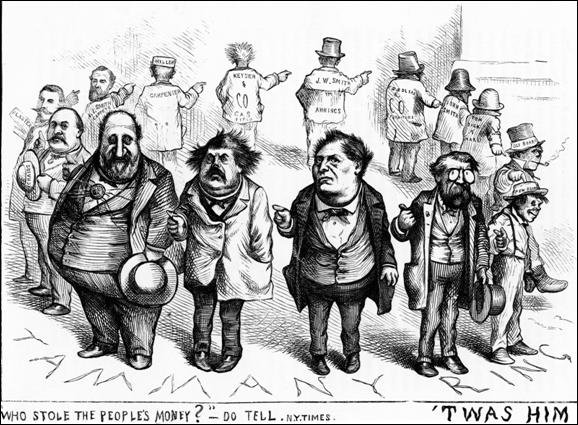
Sandra will have apprised this establishment's patrons of the various and sundry Technical Difficulties (tm)-- actually not sun-dry at all but fairly damp, only occasionally exposed to the sun at all, in fact, since the weather in southern Indiana has been unseasonably chock-a-block with thunderstorm and flood this spring -- which have assailed your humble servant during his sojourn amongst our Neighbours to the Southwest (tm). My experiences with the local phone company, the local internet service provider, my modem manufacturer, the folks who hold the second mortgage on my laptop, and the all-too-numerous additional personages requiring arcane rites of propitiation and self-abasement before they will even point an accusatory finger at the next potentially-responsible party on my list would make the corrupt politicians in the classic depiction of Tammany Hall which opens this post seem like innocent children playing ring-around-the-rosey by comparison. I take comfort in the thought that Bishop, too, often experienced analogous difficulties trying to communicate with "the outside world" during her travels.

Be that as may be, I have forwarded a partial collection of "This Day in Bishop" materials for May to Sandra, who will post them as circumstances permit while I am drawing water and hewing stone in the wilds of the Hoosier State. My mother and I do make occasional pilgrimages thirty or forty miles to the south, to the University of Evansville, and on those occasions I will avail myself of the hospitality of that gracious institution to post additional reflections on Bishop's work.

Thank you all for your forbearance.

Best wishes,

John Barnstead

Monday, May 3, 2010

FIRST ENCOUNTER XII: It was music and fear that brought me to Elizabeth Bishop, by Claire Miller

In 2005 the Aeolian Singers decided to celebrate International Women’s Day by honouring Elizabeth Bishop. The concert was the brainchild of Susan Crowe and the Aeolians’ artistic director, Jackie Chambers. Their intention was not to present a biography of Bishop, but instead to offer a selection of poetry, songs, and dramatic scenes, which would evoke the work and places of Bishop's life. As a choir member, I was asked to read one of the poems.

At that time I did not know who Elizabeth Bishop was and, although I am a lover of the rhythms and sounds of language, I really was not much of a poetry reader. So the thought of presenting a poem to an audience, out loud, by a poet I was not familiar with, in the company of well-known musicians and actors, on the big stage of the Rebecca Cohn Auditorium, was,to say the least, terrifying.

I was assigned “Song for a Rainy Season,” and although I was given a copy of the poem well in advance, I decided I needed to know more about Elizabeth Bishop. I began, of course, on the internet, looking for clues about Bishop, her life and her writing, and I visited the public library. The amount of information seemed over-whelming. Then I took myself to the bookstore, where I found a copy of The Complete Poems. And so I read and read. But still I wondered how to interpret this particular poem emotionally and vocally, especially as, the more I read, the more I whined to myself, “Oh, I'd rather read another poem!” or even “I don't want to do this!”

But then, as I kept on reading and thinking, I realized that the poems of Elizabeth Bishop were accessible and understandable, meaningful and relevant, even to a poetry novice like me. The images were both exotic and familiar, from far away yet close to home. And when I returned to “my” poem, I could feel the dampness almost as I do here on an August afternoon; I could imagine a great rock covered with lichen like those protruding from the steep cliffs of the river near my former Eastern Shore home; I could hear Bishop’s Brazilian owl just as I've heard owls in our Maritime woods. I found my own way to understand and speak her words.

And so the concert came — an enchanting evening of music, readings, performance — presented before an attentive audience. And Elizabeth Bishop captured at least one more heart.

Since that night I seem to have encountered Elizabeth Bishop in so many places, even in popular movies and novels. I have read more and learned more. I have taken her poems to circles of women, I have given her Complete Poems to friends, and I read her words at my mother's funeral. She has become part of my life.

Claire Miller has been telling stories professionally for over 20 years. She has told them throughout the Maritimes, in schools and libraries, in intimate living rooms and on the concert stage. {Editorial insertion: Check out the EBSNS website and look under “Writing Competition” and hear Claire reading Bishop’s story “In the Village.”}


Aeolian Singers website: http://www.aeoliansingers.ca/

Sunday, May 2, 2010

Elizabeth Bishop and "the mails"

Yesterday's "Today in Bishop" was an excerpt of a letter from Robert Lowell, written on 1 May 1964. Exactly a decade later, he wrote Bishop another, somewhat shorter letter. Yes, I know it is 2 May, but I am supposing that Lowell posted this 1974 letter to Bishop on 2 May (I don't know that, of course, but I will believe it for now, allowing me to post it today). In 1964 Bishop was living in Brazil. In 1974 she was back in the US. One of her regular topics of discussion in letters from Brazil was the quirks of Brazilian mails -- often with amusing accounts of trips to the post office. Complaining about the mails and the post office, like complaining about the weather, is something Canadians also like to do. However, while the weather still comes in for constant discussion, "the mails" are dimming in our discourse, primarily because writing and posting actual letters (pen to paper, envelopes, stamps, etc.) is rapidly fading from daily practice. Emailing and texting have taken over. But these mediums have their own quirks and frustrations. Thus, my taking on "Today in Bishop." John is in the US. This physical distance means nothing in cyberspace, but only if internet connections work. He scarcely missed a beat with "Today in Bishop" while en route, and quickly was able to establish internet service when he reached his destination. However, as they used to say on the radio and television when signal problems occurred, he is "currently experiencing technical difficulties." This problem necessitated a telephone call to alert me. So, I am taking up the "Today in Bishop" task until he has them resolved.

When John told me he was creating the "Today in Bishop" feature on the blog, I was amazed. "Can you do that?" I asked. "Sure," said John. And if anyone could, it was John. He has been at this task for a couple of months now and my amazement continues. He compiles a list for the month in advance and I am sure has May's list in hand, but I do not have his file (and there is no way for him to email it to me). Combing through the published and unpublished Bishop letters I have on hand, I was unsuccessful in finding something for 2 May. Looking through documents in any certain way, one notices things you might not notice looking through them in another way. For example, I noticed in the Bishop/Lowell letters that Bishop wrote to Lowell three times on 3 May (years apart, but there it was, 3 May). So, tomorrow I'll have lots to choose from! Also, I found the 1 May repeat of Lowell for 1964 and 1974.

I decided that "in a pinch," as Bishop once wrote, one improvises or invents something -- and since we are having trouble with our version of "the mails" I could justify the slight editorial indiscretion.

The fact of the matter is, I will not be able find things as John finds them. Suzie and I owe a huge debt to John, as he is the heart of this blog project. He set it up and keeps it going in a most amazing way. I am very tentative and unsure about this realm. I've been told by many people, "Oh, it is so easy." Maybe so, but not for me. John has taken the lead and has created an interesting and valuable site. Not only is he a gold mine of information, but he has a firm grasp of the technical side of things. Whenever I've asked him to modify the site, he simply does it. We will be adding more things to this blog over the next two years, so, do stay tuned.

For now, I'll muddle along and hope that his "techncial difficulties" will be resolved soon. I wonder what Bishop would have thought of this medium. Yesterday I hosted a gathering at the EB House in Great Village: a Halifax book club many of its members reading Bishop for the first time. In the dining room of the house is a beautiful old manual typewriter, not Bishop's of course, but like one she would have used. Part of the discussion was about the use of manual typewriters, all those present being old enough to have learned how to type on them. Amazingly, Bishop used them her whole life, typing thousands of pages, then taking some of those pages, putting them in envelopes and posting them -- what happened next: waiting, waiting for them to reach their destinations, waiting to receive replies. We don't want to wait anymore.


Typewriter at Elizabeth Bishop House. Photo by Chris Reardon.