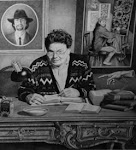
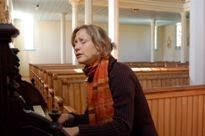
"I am 3/4ths Canadian, and one 4th New Englander - I had ancestors on both sides in the Revolutionary war." - Elizabeth Bishop
____________________________________________

Monday, August 23, 2010

FIRST ENCOUNTER XXVI: A Moose and A Mouse, by Jonathan Ellis

My first encounter with Elizabeth Bishop was through a letter, or rather a series of letters. As an undergraduate at Oxford I attended one of the smallest colleges at the university. Established by the Franciscans in the thirteenth-century, its students were first exiled from Oxford during the Reformation. In the early twentieth-century the friars were allowed back again. Initially only men were admitted to study Theology. In my day the college was mixed though we still only studied arts subjects. And there were only thirty of us, ten or so in each year. There was just one proper academic, a Capuchin friar who taught (no surprise) Theology. As an English undergraduate, I was thus permanently “farmed” elsewhere, usually onto brilliant but completely overworked postgraduate students.

In my final year, fed up of not being allocated a tutor until week three or four of each semester, I decided to find my own supervisor for a dissertation on American poetry. I contacted the poet Tom Paulin who replied that he was “too busy” but recommended a fellow poet, Jamie McKendrick. In a short letter he agreed to take me on and suggested we meet in a pub in town to discuss my ideas. I recall talking a lot about Emily Dickinson and Sylvia Plath. A few days later another letter followed. “Have you ever read Elizabeth Bishop?” I’d never even heard of Elizabeth Bishop at that point. So off I dutifully went to the library to borrow the Complete Poems.

I remember reading the poems not in Oxford but in my grandmother’s house near Liverpool where I was staying for a week over the Christmas holidays. Like most reading experiences, the place where I first read Bishop was an important feature of my response to her writing. Some fourteen years later, reading Bishop has always in some ways meant remembering my Nan who died the summer after.

I read the Complete Poems in one, or at most two sittings. I found North & South intriguing but, as the title warns, also a little cold to the touch. My favourite book was certainly Geography III. Every poem seemed perfect there. I don’t think I’ve changed my mind on that score. I’m not sure what I loved most about Bishop’s poetry first, probably the sound of her mind thinking. As someone who often speaks before or even as I am making my mind up, I was amazed by a poet who was able to do so in sonnets and sestinas.

When I got back to Oxford I looked to see what other writings by Bishop I could find. On a day trip to Stratford-upon-Avon to watch Midsummer Night’s Dream, I remember buying The Collected Prose in a bookshop. I read it on a train ride to and from Durham. One Art had also just been published a few years earlier. It felt like a very expensive book to me then but by that point I had to keep reading. I devoured it in bed at night.

Before handing in the dissertation, we were allowed to give our supervisor two or three drafts. For some reason, I kept referring to “The Moose” as “The Mouse.” This was in the days when essays were still mostly handwritten, so the error could not be blamed on an eccentric computer spellchecker. Somehow, I don’t think the poem would work as well with a mouse… The animal in question certainly wouldn’t be as “high as a church.” “Moose NOT Mouse,” my supervisor scribbled in the margin with I like to think amusement.

I was awarded an A-- for the dissertation. When I was an undergraduate, each grade could have three pluses or minuses attached, from A + + + down to D ---. I hope the two minuses were not for further animal mistakes. Following Jamie McKendrick’s advice not to study contemporary poetry at Oxford, I moved to do a PhD at Hull University. Generous support there allowed me to encounter Bishop in other places, in Brazil and Nova Scotia particularly. In 2008, my college at Oxford closed again for the second time in its history, the Catholic Church in Britain deciding the running of a college to be too much of a burden.

My first encounter with Bishop was not there, however, or even in the library where I first saw her book, but on a grey December day on my grandmother’s bed, the rain falling as in “Sestina” like the sound of a “teakettle’s small hard tears.” Each time I read or write about Bishop, I wonder whether I am simply redrawing and remembering another version of that (now) inscrutable house. Encountering Bishop my own Nan’s voice is certainly “recognizable, somewhere.”

It goes without saying that my favourite poem is “The Moose”, NOT “The Mouse.”

[Jonathan Ellis is the author of Art and Memory in the Work of Elizabeth Bishop (Ashgate). He lives in Sheffield, England, an hour or so from Bulmer (North Yorkshire) where Bishop’s Nova Scotian relatives must have lived once upon a time (Bulmer, like Great Village, once had a blacksmith’s). He is currently organising a series of talks on letter writing, including one on Bishop and Lowell by Irish poet Paul Muldoon.]

Friday, August 20, 2010

Nova Scotia Connections: Artists in the House

Is an artist born or made, or some combination of the two? Will any natural inclination (artistic or otherwise) survive even if there is nothing in a person’s environment to foster that inclination? Reading the biographies of artists, one tends to come away thinking, probably — as many artists have struggled in the face of great obstacles to pursue their art (in a way, overcoming is a necessary rite of passage for artists, part of the definition of what an artist is). But artists who garner biographies are the famous, “successful” ones, or those who crashed and burned spectacularly, awesome in their failures or tragic in their short lives.

Are there others who possess ability but cannot rise above the many immense forces that impinge on our lives, forces often beyond our control? Thinking for a moment of how many people have lived and now live on the earth, one would also tend to think: probably. Sometimes even highly evolved and conscious natural inclination is not enough to push through the difficulty.

From all the reading I have done about Elizabeth Bishop, from all research I have done about her childhood and family, I believe that she was a born artist. This view may seem simple-minded and obvious, but a question then arises (the answer to which is beyond scientists, philosophers, psychologists, theologians …): what is the origin of innate ability? (pure genetics? divine gift? utter chance?) Who knows. Does it matter?

We know that Elizabeth Bishop faced great obstacles, deep trauma, at far too early an age: the death of her father when she was eight months old; the illness and permanent hospitalization of her mother when Bishop was five; a dramatic removal from Nova Scotia, the only place she had known as home, when she was six, which resulted in her own serious illness when she was seven. If anything could prevent someone from fulfilling the promise of an innate ability, such trauma certainly could (indeed, the residual affect of these and other events and circumstances was a life-long struggle with alcohol and serious depression). But, in the end, it did not happen. Why? Again, probably an unanswerable question.

In the midst of, in spite of and, even, because of all the obstacles, Elizabeth Bishop managed to create lasting art, art that continues to affect lives in profound and positive ways. Her “tiny tragedies and grotesque grieves,” as she called them in “To a Tree,” a poem written in 1927 when she was sixteen, somehow did not prevent her from building on her innate ability and creating an artistic legacy of such influence that she herself would be surprised to see it, surprised because she more than once referred to herself as “a poet by default.”

For over twenty years I have looked into the events, circumstances and environment of Elizabeth Bishop’s early childhood and tried to trace how that time in her life affected her adulthood, and how that time in her life affected her art. My effort has been only partial and fragmentary because the mystery of any life cannot be fully reconstructed after death; the mystery of all art is definable only to a certain point. One of the things I have recovered from the extant record of Elizabeth Bishop’s life and art is the fact that on her mother’s side there was a rich artistic inheritance that, in my view, contributed both to her innate inclination and to the environment in which she grew up. As the saying goes, Elizabeth Bishop came by her artistic ability and interest in the arts honestly.

My “Nova Scotia Connections” contribution to this blog is one small way of showing something of this context and process. I have, however, not yet really addressed Elizabeth Bishop’s maternal family, the Bulmer-Hutchinsons, a multi-generation collective about which she was highly aware from the first years of her life. In this collective were a number of artists and she knew them directly or heard stories about them. This born artist had active precedence in her ancestral and immediate family — that is, there were artists in her house from the very beginning. Indeed, there were a number of professional artists who had fascinating, adventurous, even controversial lives. Elizabeth Bishop may be the most famous artist in her family, but she emerged from a lineage lively with all manner of creative and expressive endeavour. Her good education at Walnut Hill School and Vassar College built on a foundation that had been laid long before she was born.

Elizabeth Bishop held conflicting views about the artists in her family and sometimes spoke ambivalently about them, but she also held them in her mind for her entire life. Their lives were examples to emulate or cautionary tales to heed. The most prominent of these artists were her Hutchinson great uncles, her grandmother’s brothers: George Wylie Hutchinson, John Robert Hutchinson and William Bernard Hutchinson. Over time, I will share some of the stories about them, stories Bishop heard (indeed, I learned some of them from her remaining family in Nova Scotia, stories still being told) and stories that were uncovered in my research. In their day, these men had some stature and notoriety. The latter quality in particular fascinated Bishop; she, not disparagingly, called them “eccentric.” Their artistic lives were filled with intensity and mystery. They were three Victorian men who did not live what we might think of as typical Victorian lives.

For now, I will begin by introducing John Robert Hutchinson (a Baptist missionary who lived in India for some years, a translator, novelist, historian and bookseller — a writer with a dark secret that will be revealed in time), introduce him by copying out a poem he wrote in 1882, while a student at Acadia University in Wolfville, Nova Scotia, published in The Acadia Athenaeum in April that year.

Elizabeth Bishop owned several of John Robert’s novels, which she once referred to as “bad” — perhaps in the same way that she described one of Great Uncle George’s paintings as “Large Bad Picture.” She may have thought the same thing about this poem, if she had read it, though its theme is one she thought and wrote about many times. Its direct invocation of the natural world, especially to “The Sea & Its Shore” (one of her titles), would have resonated deeply. Besides, she was a not infrequent user of “O” (her most famous use, perhaps, even includes an exclamation mark and italics: “an oh! of pain”). It is also worth noting that John Robert’s father (Bishop’s master mariner great-grandfather, Robert Hutchinson) was lost at sea in 1866, when his son was only eight years old.


To Solitude
by Rev. John R. Hutchinson
Jan. 28, 1882

Within the shadow of the rocky land
I went my way beside the sober main,
And trace my tardy steps along the sand,
And seek thee, seek thee, solitude in vain.

Across my view the bending vessels fly
While sea-gulls battle with the quickening gale,
The Clouds scud quickly o’er the leaden sky,
The lightning flash reveals the billow pale.

On me the moaning, moaning, of the deep
Rolls now instinctively a chilling fear;
Awed earth, wild sky, made sea together creep
Affrighted by the unseen Presence near.

Old Ocean knows no care whose murky light
Can form a suited covering for thy face:
In all the mansions of Eternal night
For thee, O Solitude, is found no place!

***

I reach a sombre wood, and far intrude
Into its shady depths with aimless feet;
“Within this leafy temple, Solitude,
Sure though inhabitest with influence sweet.”

The greenest moss invites to soft repose;
Un-numbered leaves their breathless voices raise;
While mellowed light reveals a sad days’ close,
And all combine to hymn thy lovely praise.

Down yonder bank a lengthening shadow creeps,
Then o’er the book and up the gentle hill;
The light has died; that shadow never sleeps,
But falls on me when all the trees are still –

The gloomy shade of thought knows no rest
But whirls and maddens like an angry sea,
And in the cavern of my aching breast
Leaves no abode, O Solitude, for thee.


John Robert (above) and his first wife Charlotte (below), with their missionary colleagues, are seated on the far right. My thanks to Acadia University Archives for this photograph, which is found in a publication called The Beacon Light. This photograph was taken only a few years after John Robert wrote this poem.

Wednesday, August 18, 2010

Bishop in Russia

Did you have your reservations from the start?
Questions of travel (whether South or North)
two most intentional cities (Brasilia dowagered
St. Leninburg some time ago in this regard)
and two rivers - one where
almost no one rows,
the other where, when
blessing the fleet,
iced stork
priests stand, the jetty
droning Good
Samaritan Death -
were, you wagered,
all too close to being
in fine straits -
the sort of stark places
Finland (or Newfoundland inland) looks
pretty triste (like Nova Scotia) on the way
over to but utterly beautiful
on the way back from
a flower of cultivation or civilization
salt licks,
the last frozen rose
had you arrived
six months to either side
or ten years to the month before,
when in the pre-Hecuban thaw
lamp-high drifts imploded
in Akhmatovian loaves
and balls of frostbound,
spellbound snow.
Mandelstam, floundering
on its cadaverous macadam sidewalks,
called it Petropolis, transparent, green,
the city where that "we will bury you"
referred not to Nikita and the West,
but to an erstwhile lover and the sun.
"One almost envies them a bit - who feel
that they are so important, and perhaps
they are, those Russian poets. Anyway,
the party seems afraid of them, whereas
I doubt that any poet (maybe Pound -
poor wretched Pound! - ) has ever really bothered
the US government, or all that much..."
It's been a kind of blessing, I expect,
that though we taught for two years in the same
brick building in the Yard (albeit you
went to the basement, not the second floor)
we never met. Imagine my chagrin,
if you had thought I just might be the "John"
you'd gotten such perturbing letters from!
And as your plane wrote slant across the sky
disturbing letters that a wedge of cranes
you saw when craning backward seemed to match
in contre-jour against witch-hazel branches
the stewardess brought supper on a tray:

Puddled pillows
stepping stones became
steep in tardy snow:
discarded after-dinner mints
in two linen rows
where spilt milk flows.
Subtle? Silly? Who knows
to what laughable lengths we'll go
to make a point.
All the same -
huddled weeping willows,
moths, flame -
we still make sense:
the sort that hints
some larger joint
adventure than chance
governs events.

February 1996

Monday, August 16, 2010

Antiques in Great Village

While spending the weekend with the author of our next "First Encounter" and his lovely family, I had the good fortune to picnic in Great Village with them on the banks of the river just below the filling station and the pergola with its panels devoted to Elizabeth Bishop and the history of Great Village. After our lunch Mark and I scoured the antique shops -- there are three in close proximity, one (Great Village Antiques) right next door to Bishop House, one right next door to it (Clair's Classics), and one just across the street (Pete's Place Antiques, otherwise known as the Onslow Trading Company) -- and acquired the components that have gone into our first Cornell Box. We've decided to call it "...And Looked and Looked Our Infant Sight Away."

Here are three pictures:


Thursday, August 12, 2010

Nova Scotia Connections: Roads and Cars


"Welcome to Great Village" sign on Highway 2

One of Elizabeth Bishop’s most famous poems is “The Moose,” about a bus journey from Great Village to Boston, which began on a road (Highway 2) that runs along the shore of Cobequid Bay and Minas Basin at the extreme eastern end of the Bay of Fundy. This highway eventually shifts to one which crosses the Isthmus of Chignecto, the land mass that prevents Nova Scotia from being an island, that connects the province to New Brunswick. The route continues into New Brunswick where the iconic “homely as a house” moose is encountered. The poem ends with the bus starting off again into the night — and we know from two fragmentary, unfinished poems (“Back to Boston” and “Just North of Boston” – both found in Edgar Allan Poe and the Juke-Box: Uncollected Poems, Drafts, and Fragments, pp. 166-167) that Elizabeth Bishop took this long drive on a number of occasions (in later years, she more often departed from Maine, where she spent time in the 1970s).

Elizabeth Bishop arrived in and left Nova Scotia in a variety of ways during her lifetime. Early on, she and her family came and went via steamers, which plied the waters between Boston and Yarmouth and in those early days, they would have taken the train through the Annapolis Valley to Halifax and then from the city to Londonderry Station. They could also travel the entire route by train, from Boston through Maine and southern New Brunswick, again, stopping at Londonderry Station. From the station, a horse and wagon or a Model T provided transportation to Great Village.

Bishop wrote about this final leg of these long trips (the ride in from Londonderry Station) in an unfinished novel she began in the 1930s: “They went down, down, with a hairpin turn into the village proper, past the lit-up post office and across the large new bridge over the river. This was the river…and once over it the “village” began….”

By the 1970s, the steamers were replaced by ferries, which left from Portland and arrived in Yarmouth. Bishop took this route at least once during this decade, and while she could have taken the train through the province, she in fact drove the highways from Yarmouth to Great Village, along the French Shore, through the Annapolis Valley and the central part of the province.

During her visits to Nova Scotia in 1946 and 1947, when she spent time on the South Shore and Cape Breton Island, driving the roads and highways was the way she reached her destinations (specifically, Lockeport and Breton Cove). Likely, she took the bus to both destinations.

During her childhood years in Great Village, Bishop would have known the roads in and around Great Village quite well — an evocative description of one of those roads is found in “In the Village,” where she recounts the task of taking Nelly, the family cow, to pasture, along a road locally knows as “Scrabble Hill Road.” This route was an intimate pathway for Bishop and she retained vivid memories of it (she hadn’t seen it for over 20 years when she wrote “In the Village”).


Scrabble Hill Road, circa 1920s


Scrabble Hill Road continues on into the Cobequid Mountains, into Cumberland County, to places such as Williamsdale and River Philip, where her maternal grandfather and his family were from. Bishop remembered that when she was a child her grandfather’s cousins would appear like magi, descending out of the hills, once or twice a year with bear meat and venison in the back of their trucks.

While living in Brazil, Bishop often wrote in her letters about the wild drives with Lota on the roads from Rio to Petrópolis and Ouro Prêto. When she went back occasionally to the United States during the 1950s and 1960s, she was shocked by the proliferation of “clover leafs” — that is, the emergence of interstate and other major highways. As a child she bore witness to the beginning of the shift away from traditional ways of travel (wagon, ship, train), to the ubiquity of the automobile, which eventually brought the scars of asphalt and concrete.

Among many other things, her poem “Manners” speaks quietly about the “motoring craze” that was starting to take hold of the wider culture, even at the time of World War I — she was witnessing the onset of this transformation and knew it meant something significant, even if she wasn’t quite sure what it was.

When people visit Elizabeth Bishop’s childhood home in Great Village, many are surprised by how busy the road is. The house sits right on Highway 2, which is the route described in “The Moose.” For decades it was the only road directly to the northern part of Nova Scotia. In the 1960s and 1970s a leg of the “Trans Canada Highway” was constructed, but even that became obsolete and now a big divided toll highway spines its way across the top of the mountain.


Great Village seen from the top of St. James United Church. Elizabeth Bishop's childhood home on right, behind lilac bush.

Though long superseded, Highway 2 remains a busy route, especially in the summer. What must be remembered is that in Bishop’s day, this road was also busy. It might have been dirt, the traffic might not have been much motorized; but it was the main land artery to the north. Bishop would sit at the window in the parlour looking out at the village, watching all the traffic go by.

Bishop herself owned cars during her life: a sporty MG in Brazil, a Volkswagon Bug in San Francisco. Her letters, stories and even poems are sprinkled with comments and complaints about bad drivers, traffic, roads and automobiles. She was in car accidents — one of them, in France in the 1930s, was especially tragic. Living so close to a busy road, her maternal family had tales of accidents and unexpected visitors — one story told of a fellow who crashed right outside the door, his injuries severe enough that her grandparents took him in and nursed him back to health. Her story “A Trip to Vigia” must be one of the most delightful “road trip” stories ever written. Her poem “Filling Station” nods to an early manifestation of that other ubiquity connected to cars. How often does one encounter “gasoline” in Bishop? If you start looking, you will be surprised (it closes “The Moose”).

Bishop understood the romance and the dangers of cars and roads. Her sense of place allowed not only for the wonders of geography and natural landscape, but also for the presence and affect of humanity in and on the environment — and while she often despaired of the blight of highways (the constant threat that four-lane highways would dissect Lota’s Flamenco Park in Rio made them both deeply angry), roads are everywhere in Bishop’s actual and imagined world, perhaps in part because from her earliest years, right outside her door in Great Village, was a busy road that took her to and from home.


Aerial view of the centre of Great Village

Monday, August 9, 2010

FIRST ENCOUNTER XXV: Waiting...? by Jane Finlay-Young

I was introduced to Elizabeth Bishop twice. The first time, briefly, seven or eight years ago when a friend of mine, Annie Jacobsen, loaned me a copy of Geography III. That very same copy sits beside me as I type — one of the many books I inherited from Annie after she died. Her name is printed distinctly in black ink on the first blank page.

That first encounter, I turned the page past her name and looked at the list of books that Bishop had published. Seven books! How did I not know this poet? Was she still alive? I scanned front and back, but there was no author blurb, no hint of her origins or nationality or age. I turned the page again, past the picture of globe and compass and book and inkwell and the prestigious stamp of Farrar, Straus and Giroux. Past the Copyright page — this was the 9th printing! Past ‘For Alice Methfessel’. Past the ‘Contents’ page — ten poems over fifty pages. And into the “First Lessons in Geography”. Which was not a poem. It was an excerpt from a child’s geography book.

I thought to myself: well, this woman is surely preoccupied with place, with direction, with location. And perhaps with childhood, too.

And then I turned the page again and stumbled into the waiting room. In that first encounter, “In the Waiting Room” was the only poem I could absorb. I read it over and over and over trying to get at what was moving me, drawing me in. It was a whole world, the world of the child, full of wonder and fear and mystery.

I knew that world completely — I had spent four years writing my first novel in that world, a novel for adults whose narrator was a child. From the simple language, to the mysterious meandering of the child-mind where the inside and outside of little Elizabeth are intertwined, to the beautifully simple yet profound questions about self, to the fear of loss of self, to the wonder of the universe around her — all of it so honest, so true.

I knew nothing of Bishop then, but I could sense loss in the poem. Loss as a child experiences it, completely and without rationalization. Loss that disorients and breeds fear and dislocation.

Many years later, not long after I had moved to Halifax I met Sandra Barry. Sandra was my second introduction to Bishop.

We met, on a late Fall day, so that Sandra could give me the key to Bishop House. My friend Anne (another Anne bringing me close to Bishop!) and I were going for a few days to write. Sandra and I arrived bundled in coats and hats and mitts (arctics and overcoats!), our glasses fogged with cold. We shook hands, sat down, and Sandra said: so, you know about Bishop? I was embarrassed; I was going to be a house guest and I knew nothing about my host. I knew one of her poems, I said, but admitted reluctantly, I knew nothing about her.

Well.

What ensued was the most fascinating of conversations — about Bishop and specifically about Bishop and her mother, Gertrude.

Bishop lost her mother, to mental illness, when she was five years old, just as I had lost my mother, also to mental illness, when I was six — that is what I recognized; loss at an early age, loss of a mother.

We talked about many things, but what I remember most is talking about Bishop being taken from Great Village, the place she last saw her mother, and about the effect that would have on a child. How would her mother find her upon her return if she wasn’t where her mother last saw her!

I said goodbye to Sandra, key in hand, and headed to EB House eager to be within the walls of the place Bishop last saw her mother and no doubt waited, and waited in vain, for her to return. As I had waited for years for my own mother — in the waiting room trying to stop the sensation of falling off the round, turning world into cold, blue-black space.

****

Jane Finlay-Young is a writer of fiction and non-fiction and a lover of poetry. She is the author of the novel From Bruised Fell, and co-author (along with the aforementioned Annie Jacobsen) of Watermelon Syrup. She is working on a memoir about her foray into Orthodox Judaism. She lives in Halifax, N.S.

Thursday, August 5, 2010


An Afternoon with Binnie Brennan


A fund-raiser for the Elizabeth Bishop House


Where: Elizabeth Bishop House, Great Village, N.S.

(8740 Highway # 2, right across from Wilson’s)


When: Sunday 29 August 2010, 1:00-4:00 p.m.


Spend the afternoon talking about writing, music, photography, about life and art with Halifax author and musician


Binnie Brennan


Space is limited to 15 people so don’t wait.


Suggested gift $30.00

Reservations will be taken on a first come basis, and they will go fast!!

Light refreshments (tea, coffee, punch, savouries and sweets)

RSVP ASAP to reserve a place

Sandra Barry, slbarry@ns.sympatico.ca 902-429-6385


*****


Binnie Brennan received her earliest musical training at age five. A graduate of Queen’s University’s School of Music, Binnie also pursued studies at the Vienna Hochschule für Musik. Her teachers include Tibor Vaghy, Susan Lipchak, and Siegfried Fuehrlinger. Binnie has been a member of Symphony Nova Scotia since 1989; she is also an enthusiastic chamber musician.

Co-winner of the 2009 Ken Klonsky Novella Contest, Binnie has been published in several literary journals. Her novella, Harbour View, was published by Quattro Books in the fall of 2009; in 2010 it was shortlisted for an Atlantic Book Award. Binnie has attended the Humber School for Writers and other Canadian writing workshops, where she has worked with writers such as Alistair MacLeod, MG Vassanji, and Sheree Fitch. In 2007 Binnie’s story A Spider’s Tale was adapted for the stage in Halifax, where it received critical and popular acclaim.

Although born and raised in Toronto, Binnie’s Maritime roots stretch over many generations, and they deeply inform her writing. Binnie lives in Halifax with her husband and two children.

(Binnie maintains a website at www.binniebrennan.com where she keeps a blog mostly to do with her writing life, with occasional peeks at her musical life and other bits and bobs that catch her interest.)

Sunday, August 1, 2010

Where the Old Filling Station Was

My but it's clean!
Streamlined, its signs truncated
like the elm next door – ATM -
("atmosphere?" you might’ve speculated) --
but at least there's COFFEE left,
white weave on an oval of Delft blue weft,
its first syllable looming
soft as in "CA-sa Mariana",
Walcott soft, softer even than rumours
relayed in Lowell's pseudo-southern drawl,
softer certainly than the cot somebody left
against the wall in your old bedroom,
where the skylight's secured from the wind
with a pair of snub-nosed scissors
left by some roomer put to rest at last here.

Signs of the times left about just everywhere.
The yellow diamond for CAUTION you'd swear
from a distance was meant to say YIELD
to agnostics: black arrow picking out the plaque
on Saint James's Church, or maybe the church itself,
with its dentil moulding, and still somewhat hopefully spired.
Caddy-corner from here and off in the shade
the Great Village & District Volunteer Fire Brigade
has CIVIC NO SIGNS FOR SALE. Just PHONE
668-2314. But perhaps you'd as soon Myles left
you alone? Is he the letter carrier, too, on foot since the last
of three loved autos went? Or has he been put out
to pasture? Was all this heaven-sent?
Anyhow, last Sunday morning he played the Lord God
in The Potter and the Clay -- an experiment: a mod-
ern service, "not something we normally do," said the pastor.
Coming here is like coming to your senses, only faster:
sight striated by the parlour window's chequerboard
of bubbly, wavy glass, with certain panes too perfect, flat,
clear; sounds of central heating but lately acquired.
"Feel free to make an entry" on the cover of the house journal
somebody left on a shelf, this house once hauled
from Scrabble Hill and left now across from --

My but it's clean!
Like the view of a sky from the kitchen window
or E. M. Forster's Machine --
WILSONS GAS STOPS -- a windrow of tire-tracked snow
where somebody left a portasign of that No Name yellow
repeated evidence has proved you can't not look at.
It was cold when poor Tony was left without his jacket
to set its black block letters, one by one.
Fetch from its battered tin bucket the squeegee
left there to do the windshield of Mrs. Layton's car,
or later (so, so, so much later), leaving all that aside,
stare out over Minas Basin and the dikes the French
left behind, their outskirts defeated yellow,
dim against the bright sky of a high window.

Great Village – Halifax
19 February – 9 March 2005

[from John A. Barnstead, And Other Poems, (Bedford: Peregrination Press, 2007), pp. 99-100.]

Saturday, July 31, 2010

Nova Scotia Connections: The Elmonte House


The Elmonte House in Great Village was built in 1899 to replace the Londonderry Hotel, which was destroyed by fire on 5 December 1898. The Londonderry Hotel had stood on the same site since 1861. Indeed, there had been public houses and inns in the Great Village area since 1807. The convergence of roads in Great Village made it a stopping place for many travellers.

The Elmonte, built and operated by Mr. and Mr. Ralph Smith, was a gracious establishment, three stories high, with large airy, elegantly furnished rooms. Its dining room rivalled the best hotels in Truro and Halifax. One of the hotel’s unique features was the “Sample Room,” a long, low building where travelling salesmen brought their wares to display. Merchants from miles around stopped in to view these wares and place orders. The Elmonte also burned, in 1932 – and with it went a long tradition of hoteliers in Great Village. This tradition was revived when the Blaikie House Bed and Breakfast was established.

In mid-September 1917, Elizabeth Bishop’s wealthy paternal grandparents, John and Sarah Bishop, arrived in Great Village intent on taking their granddaughter back to Worcester, MA. Being the standard to which they were accustomed, the Bishops resided at the Elmonte for several weeks before departing with Elizabeth in October.

Elizabeth Bishop never directly mentions the Elmonte House in her published writing, but, because she was an inveterate traveller her entire life, she spent a good deal of time in hotels in many locations. Often when in New York City, she stayed in residential hotels. In her fable-like story “In Prison,” which explores the idea that we all inhabit some kind of prison and that the key to a productive life is to find the right kind of prison to inhabit, the narrator notes, “The hotel existence I now lead might be compared in many respects to prison life, I believe: there are the corridors, the cellular rooms, the large, unrelated group of people with different purposes in being there that animate every one of them; but it still displays great differences.” (Collected Prose, 182)

The narrator’s catalogue of the kinds of “decorations” that adorn hotel rooms (“unattractive wallpaper,” “Turkey carpets,” “brass fire extinguishers,” and so on) might have been inspired by the New York City hotels she frequented in the 1930s, when she wrote this story. For example, one of Bishop’s extant visual images is a drawing of her room at the Murray Hill Hotel in New York City, done on hotel stationary, with its elegant stamp, around which Bishop has drawn the picture (so that the ornate stamp looks like an ornament on the dresser). The picture is dominate by a large upholstered chair and a floor lamp. The close perspective of the drawing gives a sense of confinement, such as the narrator seeks in “In Prison,” in those “cellular rooms.”

However, one can’t help but wonder if the Elmonte House was an essential prototype for the idea of “hotel” in Bishop’s iconography, especially given that a major part of its clientele were those travelling salesmen, who brought all manner of wares from the four corners of the world to merchants and customers in Great Village. Bishop encountered a similar hotel in Ouro Prêto, Pouso do Chico Rey owned by her friend Lilli Correia de Araújo. It was from a window in this hotel that Bishop watched and overheard passers-by stop at a fountain: “The seven ages of man are talkative / and soiled and thirsty.” (Complete Poems 154). The thirst at the Elmonte would have been quenched with water, too, as Great Village was a strong temperance town!

One other aspect about the Elmonte which would have intrigued Bishop was that it burned. Many buildings burned in Great Village over the decades (which was not that unusual in Nova Scotia): the first Presbyterian church, one of the early filling stations, various barns, and various hotels, including the Elmonte. Fire is another central image in Bishop – it arcs a trajectory across her entire life from the Great Salem Fire in 1914 and the fires following the Halifax Harbour Explosion in 1917, to the fires caused by fire balloons during Carnaval in Brazil in the 1950s and 1960s. Bishop was not in Nova Scotia the year the Elmonte burned, but she would have heard about it from her Aunt Grace, who was living there at the time.

Most of us pay little heed to hotels, but for Bishop, with her “no detail too small” obsession, even places of transience – or especially places of transience – always caught her attention. And when those places of transience had existed for years, or eons (the Elmonte, Murray Hill, Chico Rey and its fountain), all the more intriguing to her restless eye “looking, looking, looking” for some place of permanence.


****

Ed. note: I have added links for the Blaikie House and the Murray Hill above. I assume the latter link is to the same building Bishop knew, though these days it is what is called a "boutique hotel." Lilli's Pouso do Chico Rey is no longer operating, but there is a hotel called Pouso do Chico Rei in Ouro Preto, and I link to it, simply to give a sense of that glorious city, which I had the privilege of visiting in 1999. The little inn in which I stayed during that trip, which was just down the road from Bishop's own house, Casa Mariana, was delightful, but unfortunately I have forgotten its name.

Monday, July 26, 2010

FIRST ENCOUNTER XXIV: The Art of Losing, by Heather Jessup

I’m sure that in my undergraduate American Poetry class we read Elizabeth Bishop’s poetry in that red-covered anthology. I’m sure I read “One Art” before I moved to Montréal; but, like so many things that we encounter at a younger age that are good for us — asparagus, afternoon naps, silence, bike-rides — I had to return to “One Art” again, when I was a bit older, to figure out its inherent beauty and wisdom.

I arrived in Montréal from Vancouver during the hottest ember of August. The moon hung so low and bright in the sky it might have touched the tip of the cross on Mont Royal. I had carefully packed up all of my worldly possessions: the beginnings of a novel manuscript; an encouraging letter from a writer I admired; a Las Vegas T-shirt that my friend’s mom had worn in the ‘70s with real glass rhinestones; all of my journals. I parked the car in front of a friend’s apartment on Boulevard de Maisonneuve. The soundtrack in the tape deck had been perfect. Songs about departures and summer wheat and skies with stars. I had left behind a broken heart in Vancouver. This new life was going to be good

“The art of losing isn’t hard to master,” Bishop tells us. And I guess that’s why I didn’t really understand “One Art” before. I hadn’t really lost anything. Sure, in my own life I had made it to the first stanza: I had lost door keys, a badly-spent hour; I had even lost “places, and names, and where it was you meant to travel,” and Bishop was right, it hadn’t brought disaster. But I don’t think I actually read this poem, really read it, until my first week at Concordia University in Montréal, where I was starting my master’s degree, in a life-changing class called Poetry’s Arguments.

After stopping in to say hello at that friend’s house the first night I arrived in Montréal, we went to peer down at the street signs to see whether or not I was allowed to park the car where it was (those who have parked on Montréal streets know how confusing this can be). When we stood on the balcony looking down we saw a man, a broken car window, and the entire contents of the car being carried into an alley. We ran down the spiralling stairs and into the street, but all of it was gone by the time we reached the pavement. Everything I had saved and prepared to begin life across the country had been taken. My novel manuscript, that encouraging letter, the sparkly Las Vegas T-shirt, all of my journals.

Unlike in stanza three of “One Art”, I had not lost “my mother’s watch” nor my “next-to-last, of three loved houses,” but I had lost quite a bit: part of my heart in Vancouver, and now everything I owned, right there beneath that big silver moon on Boulevard de Maisonneuve.

A few weeks later I sat in Poetry’s Arguments. I heard Bishop’s “One Art” for what felt like the first time, finally really listening to that last stanza: “the art of losing’s not too hard to master” she repeats again, faltering in her rhythm, “though it may look like (Write it!) like disaster.” There are seventeen drafts of “One Art” in the Vasser College Archive. Seventeen drafts! I have written in my class notes. (Which, at this stage as a writer, now seems entirely possible). I also have written in those notes, the form of the villanelle is a poetic constraint that allows Bishop to bring a sense of major sorrow into reality. Not only was Bishop able to constrain her own sorrows in this poem, she was also, somehow, able to soften mine.

Like so many of the encounters posted on this Elizabeth Bishop centenary site, Bishop’s poetry came into my life through literature classes and the recommendation of remarkable teachers. (What would we all do without those remarkable teachers?). But Bishop’s words stay with you, like the repeated refrain of the Villanelle, turning life over and over like a worried stone.

When I had the immense fortune to stay at the Elizabeth Bishop House in Great Village, and to lie on the patchwork quilts in Elizabeth Bishop’s tiny turquoise childhood room, my novel (the one started, stolen, and resurrected) was sitting in stacks of paper on the kitchen table below. I had a cup of tea in my hand. I was reading another collection of poetry, Brian Bartlett’s The Watchmaker’s Table, and I came across the poem “On listening to a first-year student read Bishop’s ‘One Art’”. Bartlett’s poem ends: “Does she know it’s a gift, this euphony?/ “One Art” held in the breath of Stephanie.” I imagined all of the students who will have the losses of “One Art” befall them (after all, we will all have these “disasters”) and how the worried refrain of Bishop’s villanelle might, years later, sustain them.

***

Heather Jessup’s first novel, The Lightning Field, is forthcoming with Gaspereau Press in the fall of 2011. She is a doctoral student in English Literature at the University of Toronto.

[ed. note: Heather promised us a "First Encounter" post some time ago, and it arrived the other day. It is one of those lovely synchronicities that her meditation on "One Art" crosses paths with John's meditation on the same poem. This convergence was entirely unplanned. In the not too distant future, we will be posting information about an open call photographic exhibit being organized for EB100 by photographer Roxanne Smith and ViewPoint Gallery in Halifax, N.S. -- it will be asking photographers to meditate on "One Art" as well.]

Sunday, July 25, 2010

Sunday Wonder Question: Two Arts -- Bishop and Frost? -- with a small excursus on Cristina Peri-Rossi...

[What follows is prompted by the mention of Bishop's "To a Tree" in Michael Hood's lovely "First Encounter" last Sunday. It appeared in a slightly different form in the Newsletter of the Elizabeth Bishop Society of Nova Scotia in the Spring, 2001 issue. -- JAB]

"Poetry is what is lost in translation," Robert Frost remarked slyly, but for someone of my generation and national origin, poetry can sometimes seem to be Frost in translation. Perhaps it seemed so, or came to seem so, to Elizabeth Bishop in 1927, when she wrote "To a Tree". Had she seen, one wonders, the July issue of the Yale Review that year, and been moved to respond to Frost's "Tree at my Window"? Or did she learn of its existence only after writing her own poem?

Oh, tree outside my window, we are kin,
For you ask nothing of a friend but this:
To lean against the window and peer in
And watch me move about! Sufficient bliss

For me, who stand behind its framework stout,
Full of my tiny tragedies and grotesque grieves,
To lean against the window and peer out,
Admiring infinites'mal leaves. [1]

* * *

Tree at my window, window tree
My sash is lowered when night comes on;
But let there never be curtain drawn
Between you and me.

Vague dream-head lifted out of the ground,
And thing next most diffuse to cloud,
Not all your light tongues talking aloud
Could be profound.

But tree, I have seen you taken and tossed,
And if you have seen me when I slept,
You have seen me when I was taken and swept
And all but lost.

That day she put our heads together,
Fate had her imagination about her,
Your head so much concerned with outer,
Mine with inner, weather. [2]

What a windfall this juxtaposition would be for the poetics of coincidence! Is the grotesquerie of 'grieves' as a pun on 'greaves', for example, to be taken as a criticism of the ambiguities of Frost's 'sash', -- just a saucy sixteen-year-old sassing an elder? Or is this one of those archetypal encounters Poetry is so fond of: two looks... Two Look at Two... two poems translating each other...

Bishop translates Frost again in one of the first letters we have [August 14, 1947] from her correspondence with Robert Lowell. She breaks off mid-sentence because she has been called away to see a calf being born in the pasture behind the house. "You come, too", that letter never quite says; instead, it ends by telling Lowell (and us, now) what Frost does not: "The calf's mother has started to moo, and the cow in the next pasture is mooing even louder, possibly in sympathy. It seems that if they take the calf away immediately, then they don't have the trouble of weaning it. It will drink out of a dish, says Mr. McLeod; he has promised to call me when they try it the first time." [3]

There are some who would say that translators are Mr. McLeods, but I think it is both kinder and more accurate to call them cows in the next pasture. The metaphor is refined by considering other cows in Bishop's poetry: the cow standing in the dugout in "Santarém", say, "quite calm, chewing her cud while being ferried, tipping, wobbling, somewhere, to be married," [4] keeping the Tapajós and the Amazon from intermingling in their dazzling dialectic. Or the tiny cows in the water meadow in "Poem", two brushstrokes each, but confidently cows, munching their way ever nearer to that crisp and shivering iris - is it shivering with cold, or with fear of being devoured? Frost has his bovinities as well. Any translator on the prowl for those lovely windfall poems that seem at the touch of a pen to have dropped effortlessly from the branch of one language to the stubbled field of another, -- even harder to find than, say, Capote's windfall pecans ("among the concealing leaves, the frosted, deceiving grass"), [5] -- has a visceral understanding of "The Cow in Appletime".

Both Frost and Bishop, I suspect, would object to being called Wobblies, but it is the calm confidence that both display when oscillating between two enormities which is one of their chief affinities as poets -- Frost the poet of the semi-revolution, climbing black branches up a snow-white trunk toward heaven, till the tree will bear no more but dip its top and set him down again, the poet who comes to recognize himself, perhaps, (in "On Being Idolized") in the tottering of that new-born calf, and makes the poem containing it the introduction to his collected volumes; -- Bishop the poet of shadows taken for shallows, mammoth man-moths, the compass needle wobbling and wavering, undecided. Only when they come to death do they diverge: Frost may return if dissatisfied with what he learns from having died, while Bishop's rainbow bird, freed from the narrow bevel of the empty mirror, flies wherever it feels like, unimpressed by the ambiguities of the word 'bound' in Frost's line "I'm bound - away!"

Bishop gives her most detailed characterization of Frost in a letter to Randall Jarell (February 25, 1965):

[...] I think, if you will take it the way I mean it, that you are the real one and only successor to Frost. Not the bad side of Frost, or the silly side, the wisdom-of-the-ages side, etc. - but all the good. The beautiful writing, the sympathy, the touching and real detail, etc. Also your psychology is, of course, much in advance of Frost's! Not his kind of idealized "lost world" of the small farmer at all - which may look as if it leaves me with nothing much of him left, and yet it does, and if I were a more skillful critic I think I could really write quite a piece on this. You're both very sorrowful, and yet not the anguish-school that Cal seems innocently to have inspired - the self-pitiers who write sometimes quite good imitations of Cal! It is more human, less specialized, and yet deep. [6]


On the other hand, she is not above a wicked epithet: in a letter to Robert Lowell (October 30, 1958) she writes "Frost - the Bad Gray Poet." Her sharpest gibe, though, is tied again to the nature of what is lost in translation. She reassures Lowell about his potential Brazilian audiences (March 30, 1959):

One good idea I think is to have the poems you intend to quote or read mimeographed, to hand out to the audience. They are amazing linguists, of course, but poetry is hard to get the first time. Just the poems - not the lecture itself. Spender made that mistake - gave them the whole lecture to read while he read it and the audience felt quite insulted. I suppose one should just speak a bit more slowly and clearly than usual. (Frost did marvelously, of course - the Brazilians got his every joke.) [7] [My italics -- JAB]


Bishop's "One Art" is, in its own way, a poem about translation. Here is the original and two Russian versions (one could characterize the differences among Bishop, Frost, and Capote by the differences in the trips to Russia each of them made), followed by back-translations as literal as I can make them:

The art of losing isn't hard to master;
so many things seem filled with the intent
to be lost that their loss is no disaster.

Lose something every day. Accept the fluster
of lost door keys, the hour badly spent.
The art of losing isn't hard to master.

Then practice losing farther, losing faster:
places, and names, and where it was you meant
to travel. None of these will bring disaster.

I lost my mother's watch. And look! my last, or
next-to-last, of three loved houses went.
The art of losing isn't hard to master.

I lost two cities, lovely ones. And, vaster,
some realms I owned, two rivers, a continent.
I miss them, but it wasn't a disaster.

--Even losing you (the joking voice, a gesture
I love) I shan't have lied. It's evident
the art of losing's not too hard to master
though it may look like (Write it!) like disaster.

Простая наука

Забвенье - как проста наука эта!
Предметы исчезают - сами будто,
И их уход еще не гибель света.

Теряй всегда. Смирись со всем. Пусть где-то
Утерян ключ, истрачена минута, --
Забвенье - как проста наука эта!

Теряй быстрее, больше, и совета
Послушай: позабудь пути-маршруты
Далекие: они не драма света.

Дома последнего моего лета,
А может предпоследнего - падут. О,
Забвенье! Как проста наука эта...

Теряла города и лица: нету
Вселенных и миров; ищу их всюду,
Но и они все ж не источник света.

-- И даже ты. (Шутливостью согретый
твой жест люблю.) Тебе я лгать не буду:
Забвенье - не сложна наука эта,
Хотя и кажется: она - погибель света. [8]

A Simple Science

Oblivion - how simple this science is!
Objects disappear - as if by themselves,
And their departure is still not the end of the world.

Lose always. Become reconciled with everything. So what if somewhere
A key is lost, a minute is spent, --
Oblivion - how simple this science is!

Lose faster, more, and listen
To advice: forget ways, distant
Routes: they are not the world's drama.

The houses of my last summer,
Or perhaps the one before - fall. Oh
Oblivion! How simple this science is...

I lost cities and faces: gone
Are universes and worlds; I seek them everywhere,
But even they are nevertheless not the source of light.

--And even you. (I love your gesture,
Warmed by joking.) I won't lie to you:
Oblivion - this science isn't complicated,
Although it seems: it is the end of the world.


Одно искусство

Потерь искусство не замысловато;
такое множество вещей изнемогало
потерянными быть, что не беда увидеть их утрату.

Теряйте каждый день. В темпе токкаты
потерянных дверных ключей тот час, где время застывало;
потерь искусство не замысловато.

Потом терять беритесь больше и быстрее во стократно:
места, и имена, и то, куда предназначалось
вам отправляться. Ничто из этого не принесет утрату.

Я потеряла матери часы. И посмотри! Куда-то
последний или предпоследний дом из трех домов любимых сник;
потерь искусство не замысловато.

Я потеряла пару городов, мне милых. И когда-то
присвоенные мною царства, также две реки и материк;
скучала я по ним, но это не была фатальная утрата.

И даже потеряв тебя (шутливый голос твой и мимику,
которую люблю), все сказанное остается в силе. Ты уже привык
к тому, что потерять -- искусство не замысловато.

Хотя, заметь, потеря может быть похожей на фатальную утрату. [9]

One Art

The art of losses is not intricate.
Such a multitude of things have grown faint
in being lost, that it is no misfortune to see their loss.

Lose every day. At the tempo of a toccata
of lost door keys is the hour where time froze;
the art of losses is not intricate.

Then undertake to lose more and faster by a hundred times:
places, and names, and where it was
you were to go. Nothing of this will bring loss.

I lost Mother's watch. And look! Somewhere
the last or next to last of three loved houses vanished;
the art of losses is not intricate.

I lost a pair of cities, dear to me. And a realm
once acquired by me, also two rivers and a continent;
I missed them, but it was not a fatal loss.

And even having lost you (your joking voice and the mimicry
which I love), everything said remains in force. You are already used
to losing - the art isn't intricate.

Although, take note, a loss can look like a fatal loss.

* * *

Native speakers of English can see, I think, the cost in translation, although the precarious purchase gained can be clear only to someone who knows Russian. Whether one totters on a brink with the generalities of the first, clinging to the beauty of 'наука' ['science'] with its allusions to Osip Mandelstam's "Я изучил науку расставанья" ["I have studied the science of parting"] in his poem "Tristia", or wobbles in the direction of the greater detail of the second (sometimes too great a detail, for the translator, forced to specify the gender of the 'You' of the poem, has chosen the masculine form), gasping at the many different words Russian has to convey the nuances of what we have only the word 'loss' to express, or grasping at them like straws, one cannot but admire the balancing act.

There is a second art, though - not the juxtaposition of "equivalents", as Bishop's and Frost's tree poems might be taken to be, but the one Bishop pursued in her first letter to Lowell. This is the art at work in Uruguayan writer-in-exile Cristina Peri Rossi's short story "El arte de la pérdida", [10] which combines "One Art" with "In the Waiting Room" and takes a quick trip beneath the trans-gendering rainbow (I shall resist the temptation to refer to it as the "Bi-Frost Bridge", and trust readers are correspondingly grateful) to examine the anxiety of the masculine. Peri Rossi, by grasping the nature of the loss of identity in "In the Waiting Room" in the gasped 'oh!', moves beyond the concerns of the word-by-word to those of the Secret that sits in the middle and knows.

Ten years ago, when I wrote this essay, only four of Bishop's poems had been translated into Russian, as far as I had been able to determine: "Armadillo", "Insomnia", "Over 2,000 Illustrations and a Complete Concordance", and "One Art". Now there are many, many more, including at least eight different versions of "One Art". An image from the first of the four pioneering efforts, however, may serve as well as any to represent a last correspondence of the two arts, of writing poetry and translating it:

"the paper chambers flush and fill with light
that comes and goes, like hearts."

Why not pair them, as they steer between the kite-sticks of the Southern Cross, with Truman Capote's "...I keep searching the sky. As if I expected to see, rather like hearts, a lost pair of kites hurrying toward heaven."? [11]


NOTES

[1] Elizabeth Bishop, The Complete Poems, 1927-1979, (New York: Farrar, Straus, Giroux, 1983), 192.

[2] Robert Frost, The Poetry of Robert Frost, (New York: Holt, Rinehart, and Winston, 1969), 251.

[3] Elizabeth Bishop, One Art. Letters Selected and Edited by Robert Giroux, (New York: Farrar, Straus, Giroux, 1994), 147.

[4] "Santarém" can be considered a kind of translation of Bishop's remarks in that first letter to Lowell: if we let the calf be the matte white wasps' nest, then Mr. McLeod is Mr. Swan...

[5] Truman Capote, A Christmas Memory, (New York: Random House, 1956), 15.

[6] Elizabeth Bishop, One Art, 432. Anna Akhmatova was also put off by what she termed Frost's "farming streak", while Frost thought her "very grand and very sad".

[7] Elizabeth Bishop, One Art, 370.

[8] Translated by Boris Leivi [http://spintongues.vladivostok.com/Bishop.html]

[9] Translated by Anna Zhdanova.

[10] Cristina Peri Rossi, Una pasión prohibida, (Barcelona: Seix Barral, 1986), 129-142. English translation: "The Art of Loss" in Cristina Peri Rossi, A Forbidden Passion, (Pittsburgh: Cleis Press, 1993), 105-114.

[11] Truman Capote, A Christmas Memory, (New York: Random House, 1956), 45.

Sunday, July 18, 2010

FIRST ENCOUNTER XXIII: Encountering Bishop, by Michael Hood

I believe pretty much with certainty, that the first encounter I had with Elizabeth Bishop was by way of reading selections of her poetry included in an anthology (red cover, I believe — hmmm!) edited by Al Poulin, Jr.: Contemporary American Poetry. Al had been a student, and later, a teacher at the college I attended during the 1960s, and too, the moderator of the literary magazine (The Canticle — I contributed one poem ) and drama club (The Friars Club — I had minor roles in two plays).

I next encountered Elizabeth Bishop via her poem, “To A Tree.” I included it as one of a series of poems that I made use of as part of my creative writing class for students at the secondary school level of education — Bishop needs to get into the classroom at the lower levels of public education — and too, as part of my poetry sections when teaching English as an Adjunct in one of the colleges in Worcester, Massachusetts.

My third encounter with Bishop came about in 1997 at which time I accepted an invitation by Laura Jehn Menides, currently Professor Emeritus of English at Worcester Polytechnic Institute (WPI), to serve as one of several assistant editors treating scholarly papers connected to the lengthy “Elizabeth Conference and Poetry Festival” held in Worcester, Massachusetts in 1997. Later they were brought together in book form: “In Worcester, Massachusetts”: Essays on Elizabeth Bishop.

While serving in an editorial capacity in reading the conference papers, then, I fell into reading a bodily amount of Bishop-written poetry and creative prose, and prose materials examining both her life and her works. As a result I found myself being drawn closer into Bishop’s life. My particular interest of concern at the time (still is) was the lack of attention given to her childhood and youth. More specifically, information and possible creative output (mature or otherwise) relating to and/or coming from a major American poet during particularly sensitive years, as in her pre-adolescent and adolescent period in Revere, Massachusetts: 1918–1925; her time in Saugus, Massachusetts: 1925–1930 (intermittingly in the late part of the 1920s); and too, her summer time at Camp Chequesett (Cape Cod) during some of these same years. Not satisfied, then, with limited information and limited creative showing during what I call her “gap years,” I followed through with a series of visits to Revere and Saugus. These visits ultimately led me to write “Elizabeth Bishop: The Revere and Saugus, Massachusetts Experience.” This paper was presented at Case Western Reserve University as part of a conference celebrating Bishop and other literary artists, and later published in The Worcester Review, Volume XX1, Numbers 1 & 2, 2000.

Tidbits of Encountering

I would note that on each visit I made to Revere I would read and re-read Bishop’s unfinished memoir narrative about her Revere experience: “Mrs. Sullivan Downstairs” (located in Vassar College Special Collections holdings on Bishop). Sometimes I would carry out my readings of her narrative in front of her 55 Cambridge Street house, at other times on each side and in the back of the house, and still at other times across the street at the back and side entrances to the dwelling wherein once lived the character Barbara Hunt, Bishop’s sometimes playmate, who appears in “Mrs. Sullivan Downstairs.” I even read sections of the unfinished narrative in the entrance passageway of the dwelling (located on Mountain Avenue). On my trips I never got to directly meet any Sullivans residing at that address. However, at the entrance doorway on one of my trips I did get to briefly converse with a female voice through a closed door setting. The woman said that Mr. Sullivan was not home and chose not to identify herself. The man who lived next door to the Sullivans said a Mr. Sullivan was alive but not at home, was quite ill and was currently in the hospital. Also, during my Bishop-Revere Experience, I was to discover in the local newspaper, The Revere Journal, that Bishop was listed as having made the Honor Roll while attending junior high school in Revere. This is particularly interesting since it is generally presented that she received little formal education preceding her entry into private schools at the secondary level. And too, correction of photo misidentification of the Bishop residence and the residence of Barbara Hunt in Bishop’s “Mrs. Sullivan Downstairs,” also came about as a result of my Revere adventure. Lastly, during my last visit to Revere, I unexpectedly (talk about encounter) met with the current owners of the house wherein Bishop and Maud and George Shepherdson resided, and too, received a brief tour of the interior of the house. Neat.

My early visits to Saugus had me knocking on doors and asking questions and taking notes of residents living in the immediate area or vicinity of where Bishop and the Shepherdsons had resided: 20 Sunnyside Avenue. I also meandered around to get a feeling of the land as it presented itself in its natural state. Out of this came my imaginative reconstruction of the physical environment that surrounded Bishop during her residence on Sunnyside Avenue: wooded area, pond…. I also visited where the Cliftondale (an area in Saugus) branch library in Saugus was located in relation to the Shepherdson-Bishop residence: comfortable walking distance for Maud and the not-always healthy Bishop. I also checked town records and old newspapers: great aids. And too, I had the occasion to unexpectedly (again, talk about encounter) meet and talk with a Saugus resident who remembered George Shepherdson (“Mr. Shepherdson”) — he had a garden, she said, and shared with her family the fruits of his labors. She also noted that George Shepherdson collected rent from her parents on behalf of someone, but she could not recall the name (interesting).

And finally, I encountered Bishop in Uxbridge via Saugus! As I said earlier, during my early visits to Saugus, I knocked on many doors, some while in pursuit of specific information, and others while in pursuit of general information. At some now unremembered point in time I received, anonymously, in the mail, a Saugus High School transcript reflecting Elizabeth Bishop’s Freshman high school subjects, grades, attendance, and conduct, etc., during the course of the 1925–1926 school calendar year. The succeeding year she entered a private school. Up to this point it had been understood that her high school record for the school year 1925–1926 had been destroyed. In investigating this point I was to learn that student records need only stay in existence for a given number of years and then, at the discretion of authorities, could be destroyed, or SAVED.

*I must note that my numerous visits to Revere and Saugus Massachusetts, inclusive of countless area points outside the immediacy of 55 Cambridge Street (Revere) and 20 Sunnyside Avenue (Saugus), has allowed for my reason and imagination to compatibly work together to sharpen my analytical and creative skills with respect to my current undertaking of imaginatively filling in the “gap years” of Bishop at a creative level, and via my own mode and style. I am currently working on Bishop within this framework and suspect I will continue to do so for some time to come. My hope is to encounter Bishop creatively, time and time again, and in doing such, bring about a more fully developed range of appreciation of her.

Friday, July 16, 2010

Nova Scotia Connections: The Post Office

One of the enduring images in Elizabeth Bishop’s story “In the Village” is of the child taking the package across the bridge to the post office. The package, put together by her grandmother, was sent to Bishop’s mother in the sanatorium in Dartmouth, N.S. The address on the package was written “in purple indelible pencil, on smoothed-out wrapping paper. It will never come off.” (Collected Prose, p. 271)

Elizabeth Bishop was only five years old when these packages started going to the hospital. Such a painful introduction to the purpose of the postal service might have been cause enough for most of us to avoid it for the rest of our lives, but the opposite was the case for Bishop. She was a life-long letter writer (and sender of packages). During an era when letter writing was still the custom, she was as fine a practitioner of the epistolary art as anyone. She loved sending and receiving mail, even as the first mail she sent was the painful “care package” to her ill, hospitalized mother.

Bishop’s description of the post office errand is both poignant and funny. She was fascinated by the post office building itself, which “sits on the side of the road like a package once delivered by the post office” (CP, 272). The post office was a gathering place for the community, as “the mails” were the primary mode of communication into and out of the village. The post office in Great Village had telegraph capacity during Bishop’s childhood. There were also some telephones in the village in the 1910s. But mail, delivered by the Canadian Pacific Railway, was the vital link. And, unlike today, it was picked up and delivered several times a day.

The postmaster during Bishop’s childhood was Angus Johnson. Born in River John in 1852, he took over postmaster duties in 1889 and remained on the job well into the twentieth century. Bishop remembered him as “very old, and nice. He has two fingers missing on his right hand where they were caught in a threshing machine.” She was intrigued by his “navy-blue cap with a black leather visor, like a ship’s officer” (CP, 272).

She knew that he knew where the package was going (indeed, everyone in the village knew). His gentle sympathy was not lost on the small child, “Yes. Yes. Your grandmother is very faithful.”

So beloved was Angus Johnson by the whole community that in 1933 he was honoured by a large gathering at St. James United Church, where he received a gold-headed cane for his years of devoted service. He also received a poetic encomium from Mrs. Peter Hall, which might have made both Elizabeth Bishop and Robert Burns smile. In part it read (and was recited on the occasion):

God’s blessing on ye Pastie man,
Ah Angus ye’er a prince o’man
To sort like you –
A bonnier lad I dinna ken.
God bless ye mon.

A happier mon I dinna see
Tho’ sometimes ye gang aft a-gley
And send our missives hither and yon
And say us nay.
But we forgive ye, bless ye’er hairt
Fra’ day to day…. (History of Great Village, 142)

Angus Johnson represented an essential human decency for Bishop. He was courteous and kind; he was the walking wounded; he was a figure of benign authority. He was master of his own little nativity: “Mr. Johnson looks out through the little window in the middle of the bank of glass-fronted boxes, like an animal looking out over its manger. But he is dignified by the thick, beveled-edged glass boxes with their solemn, upright gold-and-black-shaded numbers. Ours is 21” (CP, 272-273).

The original post office building, the one where Bishop took the packages, is no longer standing in Great Village, but the community still has a “very small” post office building just up the road from the original site. When the old post office was dismantled, the grill-work containing the “glass-fronted boxes” was transferred to the new location. You can still see who has mail and who doesn’t when you go there. You can still see box 21.


The original grill-work of the Great Village post office.

Monday, July 12, 2010

FIRST ENCOUNTER XXII: Somebody Loves Us All, by Susie DeCoste

As I wrote my MA thesis in creative writing at UNBSJ a few years ago, my supervisor recommended that I read a Maritime poet, Elizabeth Bishop. She directed me to an anthology of Atlantic poetry as a place to start: Coastlines: The Poetry of Atlantic Canada. For my thesis, I was writing a series of poems about a woman fiercely attached to her place who also feels drawn to new horizons in travel. I read Bishop’s Questions of Travel as the title seemed suited to my interests in the project that motivated my reading. I saw connections between my manuscript and Bishop’s traveler versus her homebody—which excited me—and I fell in love with the title poem. I noticed, of course, poems about Nova Scotia: “First Death in Nova Scotia,” and “Sandpiper,” but I took for granted that Bishop was originally from the Maritimes, and didn’t think more of it for some time.

My larger, driving questions about Bishop that continue to motivate me really began during the first year of my PhD in Ontario (I’m now nearing the end of year three). There, I found Bishop in a course on twentieth-century American literature. I was confused about her listing on the course, though. After reading her poetry in Coastlines, and thinking of her as a Maritime poet also interested in travel, I was convinced she was from Nova Scotia and that she was Canadian. The professor went through each of the course texts, providing a brief synopsis to help us in choosing our slots for seminars. When it came to Geography III, I asked: “Isn’t she a Maritime poet?” The answer was simple: “No, I don’t think so.” I immediately signed up for the seminar on Bishop, and then read Geography III very closely. I found “Poem,” and “The Moose” and my initial question remained unanswered: “Isn’t she a Maritime poet?” I presented a seminar, went on to write my term paper on poetics in Geography III, and then I developed it into a conference paper.

Now I find myself continually asking how and whether Bishop is a Nova Scotian poet. When I decided on Bishop as a dissertation topic in Canadian literature, delving into questions about Bishop’s relationship to place, I began reading more and more of Bishop’s work, becoming more and more receptive to Bishop’s writing, and more enthralled by it. But, to be clear, my interests are not merely in the particular ways Bishop is categorized.

What I value in poetry is what Bishop delivers without fail. Perhaps these values stem back to a certain creative writing assignment: “be reticent about emotion, but verbose in description.” What a difficult feat for a writer: use description that understates emotion, but at the same time allow the emotion to be present, and to arise in a reader.

I recently presented at a student and faculty research discussion group, where the presenting professor—after discovering my research interests—confessed that he could never get into Bishop. He found her too cold, and lacking in emotion. But I find her reticence, the ability to show intense emotion as if it were a caged animal, to be part of her writing’s allure. And I think it so much more skilled to restrain from the over-emotional in moments of intense pain, or joy. Each time I read “One Art,” I think what a gift it is to all readers who now have loss articulated so deftly. And, there was a period of time when “First Death in Nova Scotia” and “Filling Station” never failed to bring a tear to my eye. When I found out that “Filling Station” was about a gas station in Great Village, I found it so fitting that my favourite of her poems would be grounded in Nova Scotia.

While reading Bishop’s letters recently, I found one that she wrote to a publisher who wanted to include footnotes to help students understand her work. She wrote to him: “…I’d let students figure out—in fact I TELL them—the cans are arranged to say so-so-so, etc., so I don’t think that has to be explained. However—most of them might well not know that so-so-so was—or still is in some places—the phrase people use to calm and soothe horses.” Who’s to say she doesn’t calm us when we read the line, along with those high-strung automobiles? I don’t see how the final line of that poem could be any warmer or more caring. Here is the final stanza:

Somebody embroidered the doily.
Somebody waters the plant,
or oils it, maybe. Somebody
arranges the rows of cans
so that they softly say:
Esso-so-so-so
to high-strung automobiles.
Somebody loves us all.

*****
Susie DeCoste is writing a PhD dissertation on Elizabeth Bishop’s Nova Scotia poems and questions of Maritime literary regionalism. She tutors and teaches writing at the Nova Scotia College of Art and Design, and teaches children’s literature through distance education at the University of Waterloo. Her poems have appeared in journals in Canada and Ireland.

Friday, July 9, 2010

Nova Scotia Connections: Bulmer Family Bible

The sources of any work of art are both visible and invisible, even to the artist creating it. There are those who feel that art is its own independent reality, requiring no search for sources, that trying to locate the sources of art is a reductive or diminishing process. Part of the argument goes: art must be engaged on its own intrinsic terms and any apparent or hidden underpinnings are beside the point. Yet others (including me) argue that there is no art without life and lived experience (as illusory as they might be) and that knowing the sources is an interesting way to encounter and enter a work of art. Both sides of this argument (even as simplistically as I’ve described them here) can be argued convincingly. A discrete encounter with a poem, story, novel, painting, photograph, sculpture, song, outside any knowledge of the artist and the creative process can be completely meaningful. (The “First Encounter” feature on this blog relates a number of such sudden, unexpected events). Yet, arguably, one of the defining characteristics of our species is our curiosity about how things come to be, about how they work, about what things mean beyond what is apparent.

Elizabeth Bishop described herself as a “naturally curious” person, and she was interested in a vast range of subjects and objects. Many of her poems emerge out of a direct engagement with objects, which are contemplated and puzzled over in many ways. Of course, she questions her own engagement with the world of things, the subjectivity and inadequacy of her own and of all contemplation; but in the end, these object poems – from “The Map” to “The Moose” – stand; she sent them into the world. It is not too much to suppose that the actual things which triggered the creative process, which are so intensely observed and commented on, really mattered to Elizabeth Bishop. It is not too much to suppose that in engaging the actual things that we can uncover new layers, resonances and meanings. How this happens is as individual as each reader, so it behooves anyone presuming to analyze such engagement not to be reductive or categorical. As Bishop wrote in “Santarém,” all rigid dichotomies simply dissolve in “a dazzling dialectic.”

One of Bishop’s early poems has the exceptionally long title “Over 2,000 Illustrations and a Complete Concordance” – indeed, it is her longest title (the only other that comes close is “View of the Capitol from the Library of Congress.” “Over 2,000 Illustrations…” has been written about at length by many literary critics, scholars and academics. It is one of her first deep examinations of a perennial Bishop theme: travel (through both time and space).

The directly identifiable primary source for this poem still exists: the Bulmer Family Bible, given to Bishop’s maternal grandparents as a wedding present in 1871 by Mary Elizabeth Black Hutchinson Gourley, Elizabeth Hutchinson Bulmer’s mother. Its publishing information includes: New Devotional and Practical Pictoral Family Bible, Chicago: The National Publishing Co., 1870.


This bible was a central object in the Bulmer family home when Bishop was a child. As an object, it is impressive, a tome of over 1,000 pages with an elegant embossed leather cover with gold lettering quite worn away now. It is filled with etchings depicting the stories in the bible and providing historical information (for example, there is a marvellous section on the plants and animals of the Holy Land). Essentially, a one-volume encyclopedia.

I saw this intensely resonant object when I first visited Phyllis Sutherland in the early 1990s. I was thrilled beyond words when I opened the cover and turned to the title page to find all the words in the title of “Over 2,000 Illustrations…” embedded in the elaborate text and images offered on that page.


One of the first ways Elizabeth Bishop began her travels, which she so intimately yet ironically recounts, ponders and questions in the poem, was directly in this object (travels begun in her imagination), by looking at and through this book. When she grew up and began to make her own decisions about where she wanted to travel, she carried with her the memory and the lessons offered in the illustrations in this bible.

In “Over 2,0000 Illustrations...,” Elizabeth Bishop acknowledges the way her “infant sight,” which studied the pictures in this book carefully, over and over again, meshed and merged with the adult who observed the world around her with a more questioning eye. She identifies the centrality of her own nativity, “a family with pets,” a collective of individuals who influenced not only in infancy, but throughout her life.

Even the most in depth analysis serves only to throw a dim light on the power of lived experience and the way it sources the creative process and art. Many people, including myself, have written about “Over 2,000 Illustrations and a Complete Concordance,” but we have only approximated (never fully identified or isolated) the core energy and mystery of this and other Bishop poems. On some level the fact that the Bulmer Family Bible exists may not matter at all, but the experience of actually seeing this object, looking at it and reading it next to the poem, creates a curious and wonderful synergism. Elizabeth Bishop did the same thing and from that looking and pondering emerged art.

*****

The Bulmer Family Bible was saved and passed on by the women in the Bulmer family: Mary Hutchinson Gourley, Elizabeth Hutchinson Bulmer, Grace Bulmer Bowers, Phyllis Bowers Sutherland. It now resides in the Bulmer-Bowers-Hutchinson-Sutherland family fonds at Acadia University.