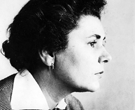
"I am 3/4ths Canadian, and one 4th New Englander - I had ancestors on both sides in the Revolutionary war." - Elizabeth Bishop
____________________________________________

Monday, February 7, 2011

First Encounter XXXI — Discovering Elizabeth by Rita Wilson

I came to Elizabeth Bishop late — and roundabout. Strange for an English major — to have missed making her acquaintance. Even stranger for a reader who immersed herself in Canadian literature after arriving in Nova Scotia decades ago. Strange but true.

Sable Island introduced me to Bishop. Zoe Lucas was “doing” an afternoon at the Elizabeth Bishop house. I went to hear Zoe, who I had met on a Sable Island trip. Backdrop to the fascination of Sable Island stories were the black typewriter and Maud’s painting of Great Village, the curious hook hanging from the dining room ceiling and the picture of young Elizabeth hanging on the wall. And Sandra Barry, who took us upstairs and told a few stories of her own, dispensing Bishop magic.

Bishop began to insinuate herself in my life. A few poems at first, then a chance night’s sleep in her Great Village bedroom. (Johanna Skibsrud, who I’ve known since she was born, was spending January 2010 at the Bishop house. Her mother and I went to a reading at Mo’s.) I read “In the Village” that next morning, sitting on the couch in the living room, whose windows look out on the Presbyterian church across the street.

More poetry. More prose. More “afternoons” at the Bishop house. I took my daughter, Catherine, recently graduated from university, to an afternoon in which Sandra enchanted us with Bishop stories. As we walked down the porch steps, Catherine asked, “Why didn’t I read Bishop in school?” (She had gone to school in Nova Scotia from grade Primary through grade 11.)

That question was a challenge and a spark. I had been an elementary teacher in Nova Scotia and knew how much kids would love Bishop’s words and story. The fact that she had been a child right here, right in Great Village, and that she had written about that experience — it opened a door. A door that opened right into her grandparent’s house, with the walls, the windows, the objects that she describes in such detail in her work.

I spent a week in Great Village last November, immersing myself in Bishop. I listened to her words on tapes and CD’s. I read her poetry and prose. I read other people’s words about her life and her work. I moved from room to room, wondering what I was seeing that she would have seen. I walked through the village, tracing her path as she guided the cow to pasture, mailed my own letters at the post office where Box 21 still exists, crossed the iron bridge to the schoolyard, walked on past the Baptist church, past her doctor’s house.

I tried to imagine Great Village then, in the early 1900’s, to imagine Elizabeth then, to imagine how to convey both to today’s children. Bishop’s words paint a vivid picture of her world there, both exterior and interior — a starting point.

And then, it was time to wash sheets, put books back on shelves, leave the key for the next person, say goodbye to the house — until the next time. I wrote this poem as I was leaving:

Goodbye Elizabeth Bishop

Goodbye, Elizabeth Bishop’s house.
Goodbye, Gammie and Pa
and the kettle that steamed tears.

Goodbye, echo of the blacksmith, Mate,
creating rings for little girls
out of a single nail.

Goodbye, “slp” whispering river,
the iron bridge above
ringing the sound of horse and buggy.

Goodbye, glass fronted Box 21,
set in your wooden postal case,
waiting for letters.

Goodbye, Hills Store,
with those pink and blue shoes,
that she coveted.

Goodbye, Miss Spencer’s house—
the milliner
whose hats sat in the window.

Goodbye, Chisholm’s fields.
Such a distance, it seems,
for a little girl steering her cow with a stick.

Goodbye, lambs in the cemetery,
where she gathered flowers
while Pa scythed the grass around the graves.

Goodbye, to the memory of that little girl,
catching bees in foxglove,
number 8 “shreeking” on her slate,
while she sat on the back step.

Goodbye, to that scream,
vibrating always in the background.

Goodbye, Elizabeth Bishop.

{Ed. note: This is our first "First Encounter" in awhile, but we are hoping to post more as the year unfolds. This encounter is temporally special because Rita is this week again at the Elizabeth Bishop House working on a children's book about Bishop's childhood in Great Village. She will be in residence on Bishop's actual 100th birthday, 8 February.}

Thursday, February 3, 2011

Nova Scotia Connections: Let the Celebrations Begin!

It is hard to believe that the Elizabeth Bishop Centenary year has arrived! – and the first of our many EB100 events are set to begin here in Nova Scotia next week – and not only in Nova Scotia, but events will also be happening in Worcester and New York City and many other places around the world where devoted readers and fans will mark this milestone of her birth and celebrate her life, work and legacy.

So many people in Nova Scotia have been working and planning for this year. I have been deeply involved myself in this planning and I am amazed by the response from dozens and dozens of artists and Bishop fans in Nova Scotia; excited by the wonderful, creative, inspiring projects, activities and events that will happen. I feel an immense gratitude for all the interest, support and engagement by so many people.

John, Suzie and I started this blog about a year ago now. It has been great fun working on it, building it into a truly interesting Bishop site. We’ve been delighted by how many people have visited and come back regularly to check out what we’re posting. We have endless ideas about what to do on this blog – the only impediment has been TIME, or lack of it. But we will keep adding to it throughout the year and we hope you will keep visiting.

I want to thank John for his wonderful “Today in Bishop” and “Today’s Video” – I suspect there are more than a few people like me out there in the Bishop world who have become addicted to seeing what he will come up with for tomorrow!! This inspired aspect of the blog is a tremendous amount of work. I hope John knows that it has brought and will continue to bring delights and insights to many people.

My own postings to the blog have been less frequent than I would like since 2011 rolled in because I’ve been caught up in the planning and preparation for our big launch events next week (the Sixth Annual Elizabeth Bishop Birthday Party and EB House fund-raiser on 6 February; the EB100 launch on 8 February; and the “Elizabeth Bishop in Words and Music” concert with Suzie LeBlanc and Symphony Nova Scotia on 10 February).

As I write this little post on the evening of 2 February, Nova Scotia is in the midst of what has quickly been dubbed the Ground Hog Day Storm of 2011 – well over a foot of snow already down and more still falling. Like most places west of us, we are in winter’s grip. We hope that people in Halifax and around Nova Scotia who can get into the city will be ready for the lively Bishop events we are offering next week, definitely a way to help dispel the winter doldrums! John, Suzie and I are looking forward to seeing everyone next week.

People keep asking me how I feel about how things have developed, unfolded and evolved. The days are so busy right now, I haven’t had much time to reflect on the fact that Nova Scotian artists have embraced Elizabeth Bishop and are helping to make the centenary celebrations wonderful. I am of course tremendously excited. Through all this effort and creativity, we hope to make many more people in Nova Scotia aware of Elizabeth Bishop and her brilliant art and her deep and abiding connection to her childhood home.

We are doing other publicity about the EB100 celebrations in Nova Scotia – radio, print, electronic. You will see some of the results of this publicity in various ways on the blog and our websites. A lovely recent development is a little print ad we had designed that will appear in Nova Scotia Tourism’s Festival & Events Guide 2011. Last summer/fall we worked with a young man from Newfoundland, Jody Burry, who has a design company in Halifax called Fogo Creative. Jody designed our wonderful EB100 logo. The response to it has been tremendously positive. When the opportunity for the ad came up, we asked Jody to design it. It is so lovely that I wanted to share it with you all.


As I’ve listed above, the first EB Centenary event happening is the birthday party on Sunday, 6 February (two days before her actual 100th birthday and our official EB100 launch – John has put up a reminder about the launch on the right hand side of the blog). It is the sixth year for the party, which from the beginning has encouraged costumes (“come as your favourite Bishop character or creature”). We have had some wonderful creations. Recently, a friend sent me a photograph taken at the first EB Birthday Party and EB House fund-raiser in 2006. I wanted to share it with you because it is such fun, and shows the wild imaginations of those who attend. Of course, it is the bus from “The Moose”!!


We are so looking forward to seeing all of you who can come. And if you do an EB centenary event in your own city, town, village or home, let us know! Happy 100th birthday Elizabeth Bishop!!! DISSOLVE IN A DAZZLING DIALECTIC!!!

Monday, January 31, 2011

Call for Papers

The Worcester Review Celebrates
the Centennial of Elizabeth Bishop
1911 – 2011


Submissions are invited for the Elizabeth Bishop Centennial Edition of the Worcester Review. The editors are particularly interested in papers concerning individual poems by Elizabeth Bishop.

From “Three Poems”


All passionate words that meet the mind’s approval
The heart rejects and will not listen to.
Even those chosen not from love, but art or science,
The heart sits in his echoing house
And would not speak at all.


Deadline: May 10, 2011
Send articles to: The Bishop Centennial, Edward R. Cronin, c/o The Worcester Review,
I Ekman St., Worcester, MA 01607 USA.

For more information: Barbnbob3@netscape.net

Thursday, January 27, 2011

Our Chicago Correspondent Writes:

Poetry Off the Shelf Elizabeth Bishop’s Correspondence with The New Yorker

Poetry Off the Shelf
Elizabeth Bishop’s Correspondence with The New Yorker

Thursday, February 17, 2011, 6:00 PM

University of Chicago
Home Room
International House
1414 East 59th Street
Free admission

In a program that will appeal to scholars and emerging writers alike, we celebrate the centennial of Elizabeth Bishop’s birth with a behind-the-scenes look at her correspondence with The New Yorker. From 1934 to 1979, Bishop submitted dozens of poems, stories, and essays to The New Yorker. Although much of her early work was rejected, by the time of her death in 1979 it was met with regular acceptance and praise. In their letters, Bishop and her editors discuss typography, the placement of commas, and the fact-checkers’ questions while sharing the details of their lives. The friendships they developed sustained Bishop, but her relationship with the magazine strained when she attempted pieces that were more experimental or involved her sexuality or love for Lota de Macedo Soares. Yet no matter how much she struggled with The New Yorker in private, she was grateful for her editors’ insightful reading and steady support. Actors will read the parts of Bishop and her editors, while Joelle Biele, editor of Elizabeth Bishop and The New Yorker: The Complete Correspondence (Farrar, Straus & Giroux, 2011), will provide narration and answer questions.

Co-sponsored with the University of Chicago’s Program in Poetry and Poetics

Sunday, January 23, 2011

SPREADING THE WORD...


The official launch of the Elizabeth Bishop Centenary Celebration is fast upon us. Here is a preview of the rack card we will be distributing at all the upcoming events here in Nova Scotia. (Click through the image above for a larger view -- the printed card will be 4" by 9"). If you are "from away" and would like to have one as a souvenir, please write us with your snail-mail coordinates. We'll be delighted to send you a copy. Our mailing address is bishopcentenary@gmail.com.

We hope as many of you as possible will come to Nova Scotia to help us celebrate!

Dissolve in a Dazzling Dialectic!

Friday, January 21, 2011

Elizabeth Bishop at 100


Poets and scholars gather to pay tribute to Elizabeth Bishop.

Poems will be read, reminiscences offered.

A not-to-be-missed literary event!

Participants include Frank Bidart, Peter Campion, Dan Chiasson, Henri Cole, Bonnie Costello, Maggie Dietz, David Ferry, Erica Funkhauser, Jonathan Galassi, Jorie Graham, Melissa Green, Saskia Hamilton, George Kalogeris, Gail Mazur, Christopher Ricks, Peter Sacks and Lloyd Schwartz.

Thursday, February 10th at 7 p.m. in the Jacob Sleeper Auditorium, CGS, 871 Commonwealth Avenue, Boston, Massachusetts.

Reception to follow.

Co-sponsored by the Humanities Foundation and the College of General Studies at Boston University, AGNI, the Poetry Society of America and Farrar, Straus, and Giroux.

Please contact Meg Tyler (mtyler@bu.edu, (617) 358-4199) with any questions.

Tuesday, January 18, 2011

Bishop on the BBC

Poet, broadcaster and Bard of Barnsley Ian McMillan presides as the novelist and screenwriter William Boyd celebrates the works of poet Elizabeth Bishop for the centenary of her birth, on BBC Radio 3's much-loved cabaret of the word, The Verb, which returns to the Radio Theatre on Friday 11 February 2011. Tickets to attend the broadcast in person are available. Further information is available at

Sunday, January 16, 2011


Here is the fabulous poster for "Elizabeth Bishop in Words and Music," Suzie LeBlanc's concert with Symphony Nova Scotia, conducted by Bernard Gueller, on 10 February 2011 at 7:30 p.m. This is the third jewel -- the sparkling diamond -- in our tiara of kick-off events for the Elizabeth Bishop Centenary. Go to SNS's website for information about getting tickets. Don't wait, they are selling fast!

This concert will be the world premiere of settings of a number of Elizabeth Bishop poems by three fabulous Canadian composers: Emily Doolittle, Alasdair MacLean and Christos Hatzis. This is the first time, we believe, that Canadian composers have set Bishop's poems -- and what a trio of composers we have involved -- diverse and brilliantly gifted. Then to have our own amazing Suzie LeBlanc perform these songs, done especially for her, is a rare delight! Suzie and the composers will be talking about these works in other places as the next few weeks pass, but I wanted to say, as someone who has dreamed of having Canadian settings of Bishop's work for years, how thrilled I am that this whole event is happening. We must all be grateful to Suzie and the composers for creating it, and to Symphony Nova Scotia, especially Maestro Gueller, for bringing this music into the 2010-2011 season of SNS, to help celebrate EB100. And what fun we'll have as Maestro Gueller conducts Beethoven's rousing FIFTH in the second half. Bishop would smile at such startling juxtapositions; her life was filled with unusual convergences, combinations and creative endeavours. Espace Musique/CBC are involved, too (stay tuned for more information of what they will be doing). How exciting is this!!?? I can barely contain myself. What a week it is going to be: lots of food and birthday cake, lots of fabulous artists, incredible new work, all in the celebration of Elizabeth Bishop and her 100th birthday. Wish you all could "come flying" and join the party.

Thursday, January 13, 2011

Official Launch of EB100 Celebrations in Nova Scotia

Elizabeth Bishop Centenary celebrations will be officially launched in Nova Scotia in just under a month. Our annual birthday party (6 February) is part of these launch celebrations, as well as "Elizabeth Bishop in Words and Music," a wonderful Symphony Nova Scotia concert (10 February) featuring our own wonderful Suzie LeBlanc and the work of three amazing Canadian composers: Emily Doolittle, Christos Hatzis and Alasdair MacLean. In between these two exciting events, we will have our official launch of the whole year, taking place on Elizabeth Bishop's actual birthday, 8 February 2011. The press release below gives all the details.

********

Official Launch of EB100
The Elizabeth Bishop Centenary in Nova Scotia, 20
11


~ DISSOLVE IN A DAZZLING DIALECTIC!! ~

February 8, 2011, marks the 100th birthday of the Pulitzer Prize winning poet Elizabeth Bishop. This great poet had deep roots in and an enduring connection with Nova Scotia, her childhood home. Throughout the year the Elizabeth Bishop Society of Nova Scotia and many artists and arts groups will be celebrating Elizabeth Bishop’s life, art and legacy with a series of wonderful tributes, events and activities.

OFFICIAL LAUNCH: A WEEK OF EXCITING EVENTS

On February 8, 2011, the EBSNS and the artists involved in EB100 events will officially launch the Elizabeth Bishop Centenary Celebrations in the Atrium at Pipa Restaurant, 1685 Argyle Street, Halifax, Nova Scotia, from 5:00 to 7:00 p.m. Hors d’oeuvres. Cash bar.

You are invited to join the celebration and hear about the many amazing Elizabeth Bishop events and activities that will take place throughout 2011. Meet some of the wonderful artists (singers, writers, painters, film-makers, composers, photographers, etc.) who will be on hand to talk about their EB100 work.

Some of the fabulous EB Centenary artists who will be present include: Suzie LeBlanc, Dinuk Wijeratne, Susan Crowe, Anne Simpson, Roxanne Smith, Linda Rae Dornan, Adrian Hoffman, Lisa Lindo, John Plant — and many more!!

This launch is part of a week of activities, which also includes:

The annual Elizabeth Bishop Birthday Party and Elizabeth Bishop House fund-raiser, taking place on Sunday, February 6, 2011, 1:00 to 4:00 p.m., at the Writers Federation of Nova Scotia, at 1113 Marginal Road, Halifax, N.S.

“Elizabeth Bishop in Words and Music,” a Symphony Nova Scotia concert featuring renowned soprano Suzie LeBlanc, on Thursday, February 10, 2011, at 7:30 p.m., at the Rebecca Cohn Auditorium, Dalhousie Arts Centre.

~ A YEAR OF CELEBRATIONS ~

EB100: The Elizabeth Bishop Centenary celebration in Nova Scotia will be a series of events and activities (concerts, lectures, exhibits, readings, kitchen parties, tours, publications, etc.) Because Bishop was born on 8 February 1911 and died on 6 October 1979, events will occur throughout the province and across this time span, but four points during the year — winter, spring, summer and fall — will bring a particular concentration of activity.

In addition to the events in Great Village and Halifax, many artists — writers, musicians, painters, film-makers, photographers, actors, dancers, artisans, etc. — arts groups and universities in Nova Scotia will create events to mark the centenary.

The Elizabeth Bishop Society of Nova Scotia is Canada’s only society devoted to celebrating the life and art of the poet Elizabeth Bishop. Educating Nova Scotians and the world about her deep and abiding connections to the province is its purpose.

Our other websites:

Elizabeth Bishop Society of Nova Scotia:
http://www.elizabethbishopns.org

Elizabeth Bishop Centenary Events website:
http://elizabethbishopcelebration.ca

Sunday, January 9, 2011

Elizabeth Bishop's 100th Birthday Party in Halifax, Nova Scotia

Below is the announcement for the Sixth Annual Elizabeth Bishop Birthday Party in Halifax, Nova Scotia. It is sponsored by the Elizabeth Bishop House. I think I can speak for those who have attended in years past (and can do so even if I am the person who organizes this gathering), it is a lot of fun. We have had some fabulous costumes over the years and I am looking forward to the delightful, imaginative creations that will appear this year. Prize for best costume is time at the EB House. We always have wonderful readers and readings and this year is no exception. There will be a big cake. Lots of other food. There will be wonderful door prizes. Wish you all could "come flying" and be part of the fun in this most important year of all for those of us who love Elizabeth Bishop and her work.

We will soon be posting more notices about the official launch of Nova Scotia's Elizabeth Bishop Centenary Celebrations (events happening on her actual birthday, 8 February, and on 10 February). Much excitement during the dark days of a Maritime winter.

☼♥♥♥♥♥♥♥♥♥♥☼♥♥♥♥♥♥♥♥♥♥☼

♥♥♥ELIZABETH BISHOP’s 100th Birthday Party♥♥♥

This event is part of the Elizabeth Bishop Centenary (EB100) Celebrations

Celebrate Elizabeth Bishop’s Birthday
Date: Sunday, 6 February 2011
Time: 2:00 – 4:00 p.m.
Place: Writers’ Federation of Nova Scotia
1113 Marginal Road (behind Garrison Beer, just up from Pier 21)

♥♥♥♥♥

Help Heat Her Home
(a fund-raiser for the Elizabeth Bishop House Artists’ Retreat)

♥♥♥☼♥♥♥

Come as your favourite Bishop character or creature, or just come as What You Will. Don’t let Manners inhibit you. Come as The Man-Moth or The Moose. Have The Wit to be The Fish or The Armadillo. You might need The Patience of an Angel to be The Unbeliever or The Prodigal, but please, come flying!!

Don’t wait for The End of March or A Cold Spring. Dispel the mid-winter blues! Come for the readings, come for the birthday cake, come for the prizes (best costume is a weekend at the EB House!!). Who knows, you might end up Exchanging Hats!!!

The Colder the Air the warmer the welcome!

Readers include: John Barnstead, Sandra Barry, Susie DeCoste, Claire Goulet, Carole Langille, Suzie LeBlanc, Scott MacDougall, Lorri Neilsen Glenn, Peter O’Brien, Rosalee Peppard, Anne Simpson, Donna Smyth and Gillian Thomas.

Light refreshments

RSVP Sandra at: slbarry@ns.sympatico.ca

☼♥♥♥♥♥♥♥♥♥♥♥♥♥♥♥♥♥♥♥♥♥☼

Two glimpses of a past EB Birthday party, 8 February 2007


Drawing by Halifax painter and illustrator Richard Rudnicki

Thursday, January 6, 2011

"In Worcester, Massachusetts": Centennial Celebration Events

Starting January 3rd and throughout 2011, the Worcester County Poetry Association (WCPA) will celebrate the centenary of Worcester native Pulitzer prize winning poet, Elizabeth Bishop (1911-1979). Although she did not live very long in Worcester, Bishop wrote two of her most compelling works about the city, works that helped put Worcester on the literary map of the U.S. Her well-known poem, “In the Waiting Room” begins “In Worcester, Massachusetts” and ends by again naming the city. And her long prose memoir, “The Country Mouse,” details her stay, at age 6 and 7, in her grandparents’ house on Main Street, when she went to Gates Lane School, explored the area and the house like a cat, and often felt lonely and out of place in the city—like the country mouse in the fable.


To honor Bishop in this, her centennial year, WCPA will sponsor, or co-sponsor, many events--readings by local as well as internationally known poets, talks by Bishop scholars, discussions , gatherings of poets, performances of new works, musical settings of Bishop’s poems, and a special, commemorative, birthday party—all open to the public, and most of them free of charge.


On Monday, January 3 at 7:30 pm, poet and scholar Bob Cronin read from his work and discussed Bishop’s influence on contemporary poetry. Francine D’Alessandro hosted this program of firsts: the first event in the Elizabeth Bishop Centenary, the first reading in the Monday Poetry Series, held at First Unitarian Church, Bancroft Room, 90 Main Street, Worcester

On Monday, January 10 at 7 pm, NOW at the Women’s Issues Book Group hosts “Elizabeth Bishop in Brazil,” an informal discussion of The More I Owe You, Michael Sledge's recent, highly-praised novel. Sledge imagines Bishop’s 17 years in Brazil with her friend and lover, prominent city planner Lota de Macedo Soares. This event is being held at the Barnes & Noble Bookstore, Worcester.

February events include a ceremony at Bishop’s gravesite in Worcester’s Hope Cemetery, a dinner at a Brazilian restaurant on Shrewsbury Street, a 100th birthday party at Anne Marie Lucci’s Street Beat venue, and at Carle Johnson’s 4th Saturday Poetry Night, an open mic and a featured poet, all of whom will start their reading with a Bishop poem.

During each month in 2011, WCPA will organize at least one Bishop event. In March, for example, WCPA collaborates with Master Singers of Worcester and the Worcester Women's History Project in a Tuckerman Hall program of choral music based on the writings of famous American women writers, including Elizabeth Bishop. Other months will bring musical settings of Bishop poems by composers Elliott Carter and JB Menides. There will be lectures by established scholars on a variety of topics, including Bishop’s prose writings, her dealings with editors of the New Yorker Magazine, and her correspondence with poet Robert Lowell.

Many events will feature talented local poets, especially those who have won prizes or have published a book. Michael Hood, for example, author of Cranberry Smoke, has written a new series of poems in the voice of young Elizabeth Bishop and will use the poems to show Worcester’s teachers how to introduce their students to the famous Worcester-born poet. There will be a day-long celebration of Worcester’s poets and poetry-- with readings, exhibits, music, chapbooks, and broadsides—at Worcester’s Hanover Theatre. Plans call for this day to culminate in readings on the Hanover Theatre stage by two or three nationally known poets with ties to Elizabeth Bishop.

Tuesday, January 4, 2011

"In the Village": The Elizabeth Bishop Centenary Writing Competition 2011 -- Still time to enter!!!

There is still plenty of time to enter the writing competition sponsored by the Elizabeth Bishop Society of Nova Scotia. The deadline is 15 March 2011. For all the details, visit the EBSNS website: www.elizabethbishopns.org – on the website you will find an electronic brochure, competition guidelines and entry form. You can also able listen to a reading of Bishop’s wonderful story “In the Village,” read by Halifax storyteller Claire Miller, the inspiration for the competition.

Here is some of the information about the competition:

“There are the tops of all the elm trees in the village and there, beyond them, the long green marshes, so fresh, so salt. Then the Minas Basin, with the tide halfway in or out, the wet red mud glazed with sky blue until it meets the creeping lavender-red water. In the middle of the view, like one hand of a clock pointing straight up, is the steeple of the Presbyterian church. We are in the ‘Maritimes’ but all that means is that we live by the sea.” -- from Elizabeth Bishop, “In the Village”

Pulitzer Prize winning poet Elizabeth Bishop was born in Worcester, MA, on February 8, 1911. Her father died when she was 8 months old and her mother, who was from Great Village, N.S., was permanently hospitalized when Elizabeth was 5 years old. Elizabeth’s earliest years were spent with her maternal grandparents in Great Village, and then with a maternal aunt in Revere, MA. She attended Vassar College in the 1930s. She published her first book, North & South, in 1946 and her last book, Geography III, in 1976. She was Poetry Consultant (now Poet Laureate) at the Library of Congress in 1949-1950. In 1951 she travelled to Brazil where she then lived for 15 years. In the 1970s she returned to the U.S. and taught at Harvard University. Elizabeth died on October 6, 1979. She is buried in Hope Cemetery in Worcester.

February 8, 2011, marks Elizabeth Bishop’s 100th birthday. The Elizabeth Bishop Society of Nova Scotia and many other arts groups and artists in the province and elsewhere will celebrate this centenary. Why should we mark the birthday of a poet long dead? Art is one of the enduring expressions of what Elizabeth Bishop described as “the human situation.” Elizabeth Bishop’s art – her poetry, stories, letters and paintings – continue to be read and admired. More importantly, they continue to influence artists today.

The Elizabeth Bishop Society of Nova Scotia is committed to raising awareness about Elizabeth Bishop’s connection to Nova Scotia, inside and outside the province, especially among young people. With the approach of the Elizabeth Bishop centenary, it was decided to foster this awareness with a Writing Competition, the details of which are found in this brochure and on the EBSNS website: www.elizabethbishopns.org

~~~

Even as she was a world traveller who did not return to Nova Scotia to live (though she continued to visit up until her death), Elizabeth Bishop’s memories of her childhood in Great Village were vivid and profoundly shaped her world view. One of her most famous works, a story which is considered a masterpiece, is “In the Village,” about the earliest years of her life. It affirms the significance of her childhood in all her art. It is a story about identity and the power of experience, memory and imagination.

Elizabeth Bishop once wrote, “Home-made, home-made! But aren’t we all?” What is it about the place you are from that makes you the person you are? What is it about your experiences and memories that will shape who you will become? Thinking about all that it means (family, community, society, country), how does home affect your dreams and imagination? How does home inspire you?

“In the Village”: The Elizabeth Bishop Centenary Writing Competition, 2011, is a one-time, short prose writing competition sponsored by the Elizabeth Bishop Society of Nova Scotia to celebrate her 100th birthday. Inspired by her story “In the Village,” this competition asks participants to write about their own sense of place and identity, to tap experience, memory and imagination, the sources of art.

Entries can be autobiographical or fictional, prose stories or prose poems. The idea is for each writer to explore or describe feelings, things, people or events about home and family, place and time that have affected your life and connect you to the world.

The Writing Competition was launched on 15 September 2010. Entries will be accepted until 15 March 2011. Judging will occur during April and May. Winners will be announced on 15 June 2011. Prizes will be awarded at a three-day Elizabeth Bishop Centenary Writers’ Festival in Great Village, N.S., 12-14 August 2011. Winners and all competition participants are invited to attend the festival, but must do so at their own expense. Winners will receive their prizes and read their winning submissions. If winners are unable to attend, prizes will be shipped.

~~~

There is no entrance fee for the competition. Only one submission per person. All submissions must be mailed and accompanied by an entry form – no email submissions accepted. Submissions must be postmarked no later than March 15, 2011. Only winners will be notified. Winners will be announced on the EBSNS website and in the media prior to the Writers’ Festival. Submissions will not be returned.

Categories:
Elementary (Grades 4-6) – 500 words maximum
Junior High (Grades 7-9) – 1000 words maximum
Senior High (Grades 10-12) – 1500 words maximum
Post-Secondary – 2000 words maximum
Open (19 years and older) – 2000 words maximum

See Guidelines for list of prizes.

The EBSNS will provide an audio reading of “In the Village” on its website, which will be posted in the on 1 April 2010. For entrants who wish to read the story, it is available in Elizabeth Bishop, The Collected Prose, Farrar, Straus, Giroux: http://us.macmillan.com/fsg.aspx, as well as at bookstores and online booksellers.

Guidelines and Entry Form can be found on the EBSNS website: www.elizabethbishopns.org

For more information about the competition and festival contact:
Laurie Gunn at ebwritingcomp@gmail.com

The EBSNS thanks the Robert Pope Foundation, the Colchester Regional Development Agency and Nova Scotia Tourism, Culture and Heritage for their financial support.

Thursday, December 30, 2010

Nova Scotia Connections: The Elizabeth Bishop Society of Nova Scotia, an international organization

It dawned on a few of us at a recent meeting of the Elizabeth Bishop Society of Nova Scotia (EBSNS), a meeting to talk about EB100 plans, that we hadn’t yet posted anything directly about the society on this blog. There is a link to the EBSNS website in the list of permanent links (down this page on the right) and a few posts have announced EBSNS centenary activities, such as “In the Village”: The Elizabeth Bishop Centenary Writing Competition (check out the EB100 link for references to these posts). It “behooves” us, as Bishop wrote in “The Imaginary Iceberg”, however, to make note of the society more fully.

Visitors to the blog have been steadily increasing since it appeared early in 2010. John has made a couple of reports about this increasing traffic. It struck us that perhaps all these visitors, especially those from outside of Canada, might not realize that the EBSNS is an international organization. Being the EBS of Nova Scotia might suggest that membership is limited to Nova Scotia or Canada, but that is certainly not the case.

The average yearly membership of the EBSNS runs around 125. Though not large, this membership has a remarkable diversity. It is comprised not only of academics, but also of a wide range of people from all walks of life (artists, scientists, teachers, students and doctors, all of whom are passionate fans of Bishop’s work). And there are members from around the world — from the United States, Brazil, Japan, the United Kingdom, the Czech Republic and so on.

You don’t have to live in Nova Scotia to be a member of the EBSNS!

The EBSNS was formed in 1994 by an eclectic group of people who realized that Bishop’s connection to Nova Scotia deserved recognition and celebration — and who also were committed to raising awareness and educating Nova Scotians and the world about her deep roots and enduring bond with her childhood home. The EBSNS has always been centred in Great Village (i.e., there has always been people from the village on the EBSNS Board and most of the society’s events take place in the village), but its reach extends out to the world.

Elsewhere on this blog, I have written about my involvement in those early years of the EBSNS. One thing I would like to say about the society is that even with a relatively small, though remarkably steady, membership, the EBSNS has accomplished a great deal and it is a credit to the dedication of its board and membership — and a testament to the love and admiration for Bishop and her art — that is has lasted for so long.

A few highlights/achievements:
* Publication of a yearly newsletter
* Publication of a number of pamphlets and brochures
* Publication of Expulsion from Paradise: Elizabeth Bishop, 1927–1957, by Thomas Travisano, Anchorage Press, 1995 (the text of the “Elizabeth Bishop Memorial Lecture, delivered in Great Village in the summer of 1995. Sadly, this booklet is out of print.)
* Publication of Elizabeth Bishop: An Archival Guide to Her Life in Nova Scotia (1996), by Sandra Barry (sadly, this is out of print, but much of it is online at Acadia University)
* Publication of Elizabeth Bishop’s Great Village: A Self-Guided Tour (2005), by Sandra Barry and Scott Dickson (definitely not out of print – see the EBSNS website to order)
* Financial contribution to the purchase of the Bulmer-Bowers-Hutchinson-Sutherland family fonds (Elizabeth Bishop’s maternal family collective), which was deposited at Acadia University, Wolfville, N.S., 1996–1997
* Involvement with first Elizabeth Bishop symposium in Nova Scotia, “Divisions of the Heart,” held at Acadia University, Wolfville, N.S., September 1999, and out of which came Divisions of the Heart: Elizabeth Bishop and the Art of Memory and Place, Gaspereau Press, 2001 (this book is still available through the publisher).
* Construction of pergola-style historical display in Great Village, in partnership with the Great Village Historical Society
* EBSNS website, spring 2009
* Commissioning of setting of “Brazil, January 1, 1502,” by Dinuk Wijeratne, for EB100 celebrations
* EB Centenary blog, March 2010
* EB Centenary events website, autumn 2010
* “In the Village”: The Elizabeth Bishop Centenary Writing Competition, 2011
* Elizabeth Bishop Centenary Arts Festival, 19-21 August 2011


Ribbon-cutting for the Heritage pergola, showing the Elizabeth Bishop panels, Great Village, June 2007

Over the years, the EBSNS has been involved in a number of special is events in Nova Scotia, besides our Annual General Meetings:
* The Elizabeth Bishop Memorial Lecture, by Thomas Travisano, Great Village, 1995.
* Elizabeth Bishop Symposium, Acadia University, Wolfville, September 1999
* “In the Village” Day, Great Village, September 2008
* “Brazil in Great Village” Day, Great Village, October 2009

With the arrival of 2011 and the EB Centenary, the raison d’être of the EBSNS has converged with an increasing global interest in Bishop. As the United States and Brazil (as well as other countries around the world) mark this important anniversary, Nova Scotia/Canada, with the support of the EBSNS, will mark it as well, staking our claim more strongly to our part of this great poet.

This brief profile is meant to highlight the purpose and activities of the EBSNS. As a co-founder, past President and current Secretary, I am proud of all that the EBSNS has accomplished. The EBSNS is taking the Elizabeth Bishop Centenary to renew its commitment to educating Nova Scotians and the world about her abiding connection with her childhood home. Events in 2011 will produce a number of legacy projects for the EBSNS. Stay tuned to learn what they will be.

JOIN THE EBSNS!

Another purpose for this post is to remind all our visitors that you are welcome to become a member of the EBSNS, no matter where you live in the world. A one-year membership is only $10. A three-year membership is only $25.00. And for all new members, joining in 2011, the EBSNS is offering a copy of Elizabeth Bishop’s Great Village: A Self-Guided Tour for half price, that is $5.00. Membership also brings with it our annual newsletter and the deep gratitude of the Board for your support of the society and its continuing activities.

Go to the EBSNS website and click on the membership link in the menu. You can pay online if you like, or the old-fashioned way, by mail. The EBSNS is a registered Canadian charity, so it can issue tax receipts for donations, but only for Canadians.

Sunday, December 12, 2010

Nova Scotia Connections: Christmas

John’s 10 December “Today in Bishop” and “Today’s Video” inspired this Nova Scotia Connections about Bishop and Christmas. When I think of Bishop and Christmas, one of the first things that comes to my mind is that she never liked this holiday, something she said/wrote many times in letters to family and friends.

Having lost her parents so early and having no siblings, this family holiday was fraught from the beginning. I wonder what her first Christmas was like: December 1911 — with her father dead only a few months and her widowed mother deeply grieving. Bishop was only ten months old, so too young, really, to have direct memory of it – but it is not hard to imagine how sad this time was for her and her mother and to suppose this sadness somehow sunk deeply into her. Without language, it would be hard to articulate such sorrow, which would have been visceral, rather than intellectual, of the body rather than the mind.

She spent most of her childhood Christmases with her maternal family, either in Nova Scotia (with her grandparents) or Revere (with her aunt and uncle), and there was some delight in these holidays; but they were always mixed with the looming shadow of her hospitalized mother. Bishop writes a remarkable memory of one Christmas in Great Village in the memoir of her Uncle Arthur Bulmer, “Memories of Uncle Neddy.” This account is full of both humour and anxiety, an experience that brought to Bishop a complex meld of conflicting emotions. The memoir is the adult recounting a memory, with the perspective of time and experience, but the story still holds much of the wonder and surprise that the child felt decades before:

“One memory, brief but poignant, like a childhood nightmare that haunts one for years, or all one’s life, the details are so clear and so awful, is of a certain Christmas. Or maybe it was a Christmas Eve, because it takes place after the lamps were lit — but of course it grew dark very early in the winter. There was a large Christmas tree, smelling overpoweringly of fir, in the parlor. It was rather sparsely decorated with colored paper chains, strings of tinsel and popcorn, and a very few glass balls or other shiny ornaments: a countryfied, home-made tree, chopped down and brought fresh from the snow-covered ‘commons.’ But there was a few little silver and gold baskets, full of candies, woven from strips of metal by ‘the blind children,’ and clips holding twisted wax candles that after many warnings were finally lit. One of my aunts played ‘Holy Night’ on the piano and the candles flickered in time to our singing.

“This was all very nice, but still I remember it as ‘the Black Christmas.’ My other grandparents, in the States, had sent a large box of presents. It contained woollen caps and mufflers for Billy and me, and I didn’t like them at all. His set was dark blue and mine was gray and I hated it at sight. There were also mittens and socks, and some of these were red or blue, and the high black rubber boots I’d wanted, but my pair was much too big. Laid out under the tree, even by flickering candlelight, everything looked shapeless and sad, and I wanted to cry. And then Santa Claus came in, an ordinary brown potato sack over his shoulder, with the other presents sagging in it. He was terrifying. He couldn’t have been dressed in black, but that was my impression, and I did start to cry. He had artificial snow sprinkled on his shoulders, and a pointed red cap, but the beard! It wasn’t white and woolly at all, it was made of rope, a mass of frayed-out rope. This dreadful figure cavorted around the room, making jokes in a loud, deep, false voice. The face that showed above the rope beard looked, to me, like a Negro’s. I shrieked. Then this Santa from the depths of a coal mine put down his sack that could have been filled with coal, and hugged and kissed me. Through my sobs, I recognized, by touch and smell and his suddenly everyday voice, that it was only Uncle Neddy” (Bishop: Poems, Prose, and Letters, Library of America, 630-631)

This “Black Christmas” was undoubtedly December 1916, the year Bishop’s mother went into the Nova Scotia Hospital. That the Bulmer family was sad, that the five-year-old Bishop was picking up on all this sadness, is no surprise. As with all the adults in her life at this time, on both sides of her family, the attempt to keep daily life as normal as possible, in the midst of much uncertainty and sorrow, was good intentioned but not successful.

Christmas in our culture sets up great expectations of love and peace and happiness — but the reality is that for many people, this holiday is one of the most difficult of the year. Bishop carried the sorrow of her earliest Christmases with her for decades, and often the strain of this sorrow was so great she often ended up in hospital herself. When Bishop reached Brazil and settled there with Lota de Macedo Soares, when she found what became the most secure home of her adult life, at least for well over a decade, when she was in the midst of a busy household with children, family, friends, pets, and neighbours, her Christmases became less fraught, even as she never really came to a full accommodation with this holiday.


This photograph of the tree in front of St. James United Church in Great Village, N.S., taken by Rebecca Colwell a few weeks ago, is so lovely, I wanted to keep it up for a little while longer.

***

During the 1950s and 1960s, from Brazil, Bishop wrote many letters to her Aunt Grace and there was always a Christmas letter, sent early or mid-December containing monetary remembrance for her beloved aunt — or she would order a fancy box of candy or some nice wine from a Boston shop and have it sent to Grace wherever she staying (sometimes in Ontario, sometimes in Nova Scotia, sometimes in Florida, sometimes in Massachusetts — Grace loved to “gallivant,” as Bishop wrote). On 15 December 1958, Bishop wrote a letter, from which I have excerpted a relevant passage, which shows that by this time, some of the old sorrow and fears of Christmas had eased, even if they never completely disappeared, that she had found her own traditions and practices to mitigate the dark memories of ancient sadness.

“You ask me if it’s warm at Christmas here...it has been the hottest November in 33 years —around 104 in Rio most of the time. (That is HOT.) Up here of course it never gets like that, but I never remember it being so hot, and we have been taking two dips in our pool every day, instead of the usual one, making sherbets all the time — it’s the season for wonderful pineapples, mangoes, etc. — We’ve had a lot of company, too — everyone trying to get away from the Rio heat. On the 22nd we are going away to Cabo Frio (“cold cape”) for ten days — the fishing-place we went to last year — friends of ours have a nice house there, on the beach. There is nothing to do but go swimming, fishing a bit, but it is beautiful scenery and we like it and it gives the maids a rest from us and us from them ... (I’ve been giving the smallest black baby here whooping-cough shots. I’d give them both Salk shots, too, if I could get the serum — it’s hard to get here.)

“When we stay home we do have a tree, of sorts — a tropical plant called graveta that blooms on the rocks at this time of year — it’s a huge thing, six or eight feet high, like a Christmas tree, more or less — anyway, with candles it is very striking, and we usually send a boy up the cliffs to cut us the biggest one he can find (we located one through binoculars one year!). But of course isn’t Christmassy at all. This year we are taking a ham with us as our contribution to our stay and will bake it and decorate it there, and I’m taking along a chocolate cake and tins of cookies! But we’ll probably spend the day swimming and lying in hammocks...” (Elizabeth Bishop Papers, Vassar College Special Collections)

I expect there are a few Maritimers in cold December who think that spending one’s Christmas swimming and lying in hammocks is the best way to end the year!


World’s tallest floating Christmas tree, Rio de Janeiro.

Ed. note: I did a little internet search for graveta, but could not find what this plant might be. Anyone who knows, please send along a comment. Instead of Bishop’s Brazilian Christmas tree, I found an image of Rio de Janeiro’s spectacular 85 metre (28 storey) floating Christmas tree, which according to Guiness World Records is the tallest floating Christmas tree in the world. What would Bishop have thought of it, I wonder! According to the internet, this image is sourced from a site: www.sea-way.org.

A bit of business, because of the holidays:

I will be taking a break from Nova Scotia Connections until early in 2011 – the Elizabeth Bishop Centenary year! John, Suzie and I will be away, but I am hoping to keep the “Todays” going as much as possible. John has collected items for the remainder of the year and it will be up to me to post them, and I will do my best. We’ll get back underway in earnest as 2011 rolls in. It is going to be a banner year for Bishop here in Nova Scotia and around the world. Stay tuned!

Merry Christmas and Happy New Year!

Tuesday, December 7, 2010

Our New YouTube Channel...

Today we're launching a new resource for the upcoming Elizabeth Bishop Centenary Festival: our own YouTube channel, ElizabethBishop100. It provides convenient, organized access to the almost two hundred videos on YouTube inspired by EB's life and works, as well as giving us a presentation space for the various interviews, performances, conference panels, and the myriad other EB100 activities we expect to be recording for posterity during 2011. We hope you'll find it informative and entertaining.

Please consider subscribing to the channel, which will then be able to notify you automatically when new material is posted. The URL is:

http://www.youtube.com/user/ElizabethBishop100

Come visit us often, and dissolve in a dazzling dialectic!

Friday, December 3, 2010

FIRST ENCOUNTER XXX -- On Finding the Elizabeth Bishop-New Yorker Correspondence, by Joelle Biele

I found the Elizabeth Bishop-New Yorker papers soon after I started my dissertation. I made my way through the library stacks, taking books off the shelves, and underneath a listing for the New York Public Library’s Berg Collection, which specializes in English and American literature, there was this entry: “Manuscripts Division.” That was it. I remember wondering what it could mean, so I asked a librarian. We talked a bit, and when she learned I was planning on visiting the Berg during spring break, she suggested I also go to the Manuscripts Room. “It’s just down the hall.”

I love the Manuscripts Room. I love the big, heavy tables and the green lamps. I love the glass cabinets and narrow stairs. The Manuscripts Room is at the far end of the main reading room behind tall, locked doors. I rang the bell, checked in, and asked the librarian if there were any Bishop papers in their collection. He said he didn’t think so, so I asked what papers he had. He told me they had recently finished cataloging The New Yorker Records. I ordered some boxes and sat down.

The Manuscripts Division stores its papers in the library basement and only has access to the freight elevator at certain times of day. Eventually, the doors opened and a young man wheeled in a small trolley with cardboard boxes of all shapes and sizes. My order was the tall gray boxes, big enough for several file folders standing up. I signed one out, brought it back to the table, and opened the top. Inside, flipping past folders labeled “Arno, Peter” and “Benchley, Robert,” I saw “Bishop, Elizabeth.” I pulled it out, having no idea what was inside.

Over the course of that spring break, I read the entire correspondence, year by year, box by box, trolley by trolley. Once I realized what the letters were, the insights they provided into Bishop’s writing process and the process of bringing a poem into print, I wanted to shout to everyone in the room, “LOOK! Look at THIS!” But I did not. I went downstairs to the pay phones and called my boyfriend. He listened quietly, supportively as I started talking non-stop about Elizabeth Bishop, and he has continued to listen to me, help me, talk about, write about my favorite poet ever since.


***
Joelle Biele is the editor of Elizabeth Bishop and The New Yorker: The Complete Correspondence and author of White Summer. A Fulbright scholar in Germany and Poland, she has received awards from the Poetry Society of America and the Maryland State Arts Council. Her essays on Bishop appear in American Poetry Review, Antioch Review, Gettysburg Review, and New England Review. She has taught American literature and creative writing at the University of Maryland, Goucher College, the University of Oldenburg, Germany, and Jagiellonian University, Poland.

Elizabeth Bishop and The New Yorker: The Complete Correspondence is due out in February 2011 from Farrar, Straus, Giroux. Check out excerpts online. You can also read more about Joelle's discovery of Elizabeth Bishop here.

Wednesday, December 1, 2010

Our Woman in China

Korkor Amartefio (Ghana) and Megan Williams (Canada)
exchanging gifts
at the International Cultural Industries Forum
Beijing

[Megan Williams is Secretary of the International Network for Cultural Diversity and freelance arts consultant to the Elizabeth Bishop Centenary Festival Committee. She presented an Elizabeth Bishop Centenary Pencil to her Ghanaian colleague Korkor Amartefio, International Network for Cultural Diversity Steering Committee member and Associate Director of the Institute for Music Development, who in turn presented Megan with a lovely CD of Ghanaian music. We are very grateful to Megan for her efforts to spread the news about the EB100 Festival during her trip to China.]

[The coveted Elizabeth Bishop Centenary Pencil is available upon application to the EB100 Festival Committee, which applications will be viewed with especial favour should they be accompanied by submissions to our "First Encounters" Department ~~ JB].