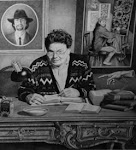
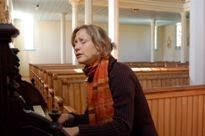
The following is the beginning of a multi-part deep read of one of Elizabeth Bishop’s most iconic and beloved poems, “The Moose,” which will appear in my Nova Scotia Connections feature.
~~~~~
Often like the poet who creates it, a poem can have a history as fascinating as a life itself. Each of Bishop's poems has its own biography. Bishop believed that life and art are connected. Her artistic development and creative process reflect this belief. What follows is the story of “The Moose,” where it came from and how it proceeded to be written, read and published. Like all stories, this account is partial or approximate, as it is impossible to know all the mysterious leaps between thought and action.
In 1946 Elizabeth Bishop returned to Nova Scotia after an absence of sixteen years. She spent most of July and part of August on the south coast of the province, at Lockeport (also known as Ragged Islands), where she began writing the poem “At the Fishhouses,” a poem with its own interesting biography. Towards the end of August Bishop went back to Great Village, her first glimpse of the heart of her motherland since her mother had died. Bishop stayed at Elmcroft, the Bowers’s family farm, her beloved Aunt Grace having married William Bowers over twenty years before. Arriving in Great Village triggered a flood of memory and a profound reconnection with the landscape, which Bishop had travelled so far away from in the previous decade.
Bishop’s stay in Great Village was unexpectedly shortened by pressing business in the U.S., and she had to leave much sooner than she planned. (Bishop returned to Nova Scotia in 1947 and 1951.) Her need to depart suddenly necessitated her taking the bus, which in those days still connected travellers to the New England States. She boarded the bus one night outside Elmcroft and headed back to Boston. A couple of days later, finally back in New York City, Bishop wrote a letter to her friend and mentor, the poet Marianne Moore. Words tumbled out of her, words which clearly show the impact this reunion with her motherland had on her heart and mind ─ and, as it turned out, on her poetry.

Elmcroft, The Bowers's family farm (circa 1940s, with its elms, now, sadly, "dismantled")

Acadian Lines bus schedule, 1946
Bishop’s visit to Great Village and encounter with its rich, sad, simple landscape; her observations of the busy farm where “something is always happening”; her sudden departure; the journey by bus through Nova Scotia and New Brunswick; the encounter with the moose ─ all these elements combined to trigger the idea, inspiration and intention to write a poem. In this series of moments in time are the seeds of “The Moose.” But this poem had its own long journey, its own life, to lead. (This letter also holds sources for other works, such as “In the Village” and her unfinished Sable Island piece, but these are separate stories.)

Elizabeth Bishop at the time of her bus trip, mid-1940s
The archive of Bishop's papers held at Vassar College reveals that she was a meticulous reviser of her poems, that poems often went through many drafts (sometimes dozens) before she felt they were complete and ready for publication. Many poems never reached this stage and remain buried in her private papers until Alice Quinn edited them for Elizabeth Bishop: Edgar Allan Poe & the Juke-Box (2006).
Brett Millier, Bishop's first biographer, writes that “the poem that eventually became ‘The Moose’ took rough shape in Elizabeth’s mind relatively quickly” (Life and the Memory of It, 183) after her 1946 visit to Nova Scotia; but it was not until “the spell of writing she managed in 1956-1957” that “the earliest extant drafts” of the poem emerged (288).
For the next nearly fifteen years, Bishop continued to work on this poem, which she told Aunt Grace would be dedicated to her. She wrestled with the meter, rhyme scheme and images, managing only slowly to find just the right combinations. It was not until 1972 that Bishop decided to make a final effort to finish it. She agreed to read a poem for the Phi Beta Kappa ceremony at Harvard University on 13 June 1972, and decided she would read “The Moose.” She hoped this deadline would spur her on to finish this poem which seemed determined not to be finished.
The final effort was an intense struggle, as Millier records:
Completing “The Moose” under deadline was deeply stressful for Bishop and she always said she hated the result, remarking that she had “almost collapsed” from the effort (Millier 466). After the Phi Beta Kappa reading, Bishop wrote to Aunt Grace:
As Millier writes, Bishop “found it funny that she had been introduced as reading a poem called ‘The Moos,’ and Alice [Methfessel] heard one student say that ‘as poems go ─ it wasn’t bad’.” (465-66)
“The Moose” is a poem about journeys: the journey to and from places, the journey from birth to death, the journey which is the creative process. Each of these journeys is “long” (even if in real time it takes place in a breath or a blink). Each of these journeys is connected to “Eternity.” The writing of this poem took Bishop twenty-five years. Most poems do not take that long to write (this is a long time even for Bishop). Yet great poems, even when completed and published, seem always to be writing themselves over and over again, seem always to be journeying on, even when the poet is long gone.
This brief biography describes aspects of the creation of “The Moose” ─ the apparent source for the poem (a 1946 visit to Nova Scotia) and the struggle Bishop had to understand its shape (a poem after all has its own imperatives, demands and requirements which are often a surprise even to the poet). While 1946 was the point when the poem itself took actual shape, the deeper origins of the poem go much farther back in time and place. “The Moose” is one of Bishop's most quintessential Nova Scotia poems. It is filled with memory. Remembering is another journey in our lives. The memories in “The Moose” are of Bishop's childhood in Great Village: what she saw, heard, tasted, touched, smelled; and how she responded to and felt about it all. The deeper origins of “The Moose” are the landscape, people, traditions and language of Bishop’s Great Village. What will follow in subsequent posts is a close read of the poem itself, which explores some of these deeper sources.
~~~~~
Often like the poet who creates it, a poem can have a history as fascinating as a life itself. Each of Bishop's poems has its own biography. Bishop believed that life and art are connected. Her artistic development and creative process reflect this belief. What follows is the story of “The Moose,” where it came from and how it proceeded to be written, read and published. Like all stories, this account is partial or approximate, as it is impossible to know all the mysterious leaps between thought and action.
In 1946 Elizabeth Bishop returned to Nova Scotia after an absence of sixteen years. She spent most of July and part of August on the south coast of the province, at Lockeport (also known as Ragged Islands), where she began writing the poem “At the Fishhouses,” a poem with its own interesting biography. Towards the end of August Bishop went back to Great Village, her first glimpse of the heart of her motherland since her mother had died. Bishop stayed at Elmcroft, the Bowers’s family farm, her beloved Aunt Grace having married William Bowers over twenty years before. Arriving in Great Village triggered a flood of memory and a profound reconnection with the landscape, which Bishop had travelled so far away from in the previous decade.
Bishop’s stay in Great Village was unexpectedly shortened by pressing business in the U.S., and she had to leave much sooner than she planned. (Bishop returned to Nova Scotia in 1947 and 1951.) Her need to depart suddenly necessitated her taking the bus, which in those days still connected travellers to the New England States. She boarded the bus one night outside Elmcroft and headed back to Boston. A couple of days later, finally back in New York City, Bishop wrote a letter to her friend and mentor, the poet Marianne Moore. Words tumbled out of her, words which clearly show the impact this reunion with her motherland had on her heart and mind ─ and, as it turned out, on her poetry.

Elmcroft, The Bowers's family farm (circa 1940s, with its elms, now, sadly, "dismantled")
I thought you might be interested in hearing a little about some of my farm experiences. I stayed first for a month at a little inn on the south shore among the “Ragged Islands,” then I visited in Halifax off and on for a while, and then I went back to Great Village, where my mother came from and where I lived when I was little. My aunt lives on an enormous (for that part of the country) farm about three miles from the Village. It is always described as the most beautiful farm on the Bay of Fundy, and I think it must be. You know about the Bay of Fundy and its tides, I imagine, that go out for a hundred miles or so and then come in with a rise of 80 feet. The soil is all dark terra-cotta color, and the bay, when it's in, on a bright day, is a real pink; then the fields are very pale lime greens and yellows and in the back of them the fir trees start, dark blue-green. It's the richest, saddest, simplest landscape in the world. I hadn't been there for so long I'd forgotten how beautiful it all is ─ and the magnificent elm trees. One of the hugest right behind my grandmother's old house in the Village is known as “the Landmark Elm.”
On the farm they raise pigs, potatoes, strawberries, supply the local dairy with most of its milk and cream, etc., and they used to raise race horses but they only have two now ─ the sulky racing variety. But I wanted to tell you about Pansy, the children's pony. She's a Sable Island pony, a breed that's supposed to have developed all by itself from a shipload of horses that was wrecked long ago on Sable Island (where great-grandfather was wrecked too). They're not much bigger than a Shetland, but better shaped, more like real horses, and beautiful velvety thick hair. They think that Pansy is over thirty years old. Aunt Grace and I went out to the pasture to see her and when she came over to the fence Aunt Grace lifted up her mane and it is all gray underneath ─ like a woman's hair combed not to show. She used to have lots of tricks: she’d walk right in the kitchen and put her front hoofs up on the back of a chair to beg for a doughnut. And my aunt said, “And she knew where the cookie jar was, too, and she’d follow me right in the pantry after the cookies.” The children even took her upstairs one day to see another aunt of mine who was sick in bed. They used to drive her to school every day in the winters in a little sleigh and sometimes when it was terribly cold they'd bring her in in the mornings and harness her beside the kitchen stove. All the schoolchildren used to take their lunches out and eat them with her in the minister's barn, where she stayed, and my cousin said, “She’d eat anything but oranges.”
I've always loved those big farm collies, haven’t you? ─ the present generation wait along the side of the roads for the buses to stop and their owners to get off. There are two now at my aunt's, an old one named Jock, and his son, whom he's trying to teach to herd cows, etc., and getting quite disgusted with because he will bark and run around too much. Jock is supposed to be such a wonderful cow herder that other farmers come and borrow him when they lose their cows in the woods. One day while I was there a man drove in in an old sedan and said a few words to my Uncle Will, who just said “Jock!” and opened the car door. Jock, apparently knowing exactly what was wanted of him, got in the back seat and sat up looking very pleased. He went thirty miles down the bay and found seven cows and was driven home that night looking very tired and complacent.
I went to call on a family in the Village, the MacLaughlins [sic: MacLachlan], and as I came up Mr. Mac was coming out of the barn with another farm collie ─ a very old one, his face was all white. He came up to me wagging his tail but barking in a very loud rather hollow-sounding way and Mr. Mac said to him, “Stop it, Jackie!” and then to me, in a sort of polite aside behind his hand, “He's stone deaf.” We went in the house and as soon as I sat down Jackie promptly brought in a very old small bone and dropped it at my feet. Mrs. Mac shouted at him, “That's very hospitable of you, Jackie, but take it away!” and then said to me in the same polite aside, in a lowered voice, “He’s stone deaf.” I asked how old he was and they said about fifteen. “Yes,” said Mrs. Mac. “Last winter they said we'd never keep him through the winter. But he had a very good winter, yes, a very good winter, didn't he, Don? He went to the woods with Don every day, and he only had rheumatism in one leg.” And they both sat back and looked at him admiringly. Meanwhile we were all sitting on straight kitchen chairs, while the beautiful big gray cat lay sleeping in the nice padded rocking chair....
Donald and Alberta MacLachlan and their family, circa 1930s
But of course being kind to animals is a very minor part of the farm life there. It is such hard work, I don't see how my aunt stands it at all ─ she is really one of the best and nicest people I know. There are so many people around all the time, coming and going, something is always happening, the cows get in the corn or the milking machines break down, distant relatives arrive unexpectedly for dinner, etc. ─ but she keeps going somehow and is always cheerful and funny. Fortunately, all the sons, stepsons, hired men, etc., seem to adore her.
My plan was to take a room at a nearby farm so that I could have a little peace and privacy to work in, and stay on a few weeks. But the deed to the Key West house had to be signed right away, and in the U.S., for some legal reason, so I had to leave. I came back by bus ─ a dreadful trip, but it seemed most convenient at the time ─ we hailed it with a flashlight and a lantern as it went by the farm late at night. Early the next morning, just as it was getting light, the driver had to stop suddenly for a big cow moose who was wandering down the road. She walked away very slowly into the woods, looking at us over her shoulder. The driver said that one foggy night he had to stop while a huge bull moose came right up and smelled the engine. “Very curious beasts,” he said.... (One Art: Letters, 139-141)


Acadian Lines bus schedule, 1946
Bishop’s visit to Great Village and encounter with its rich, sad, simple landscape; her observations of the busy farm where “something is always happening”; her sudden departure; the journey by bus through Nova Scotia and New Brunswick; the encounter with the moose ─ all these elements combined to trigger the idea, inspiration and intention to write a poem. In this series of moments in time are the seeds of “The Moose.” But this poem had its own long journey, its own life, to lead. (This letter also holds sources for other works, such as “In the Village” and her unfinished Sable Island piece, but these are separate stories.)

Elizabeth Bishop at the time of her bus trip, mid-1940s
The archive of Bishop's papers held at Vassar College reveals that she was a meticulous reviser of her poems, that poems often went through many drafts (sometimes dozens) before she felt they were complete and ready for publication. Many poems never reached this stage and remain buried in her private papers until Alice Quinn edited them for Elizabeth Bishop: Edgar Allan Poe & the Juke-Box (2006).
Brett Millier, Bishop's first biographer, writes that “the poem that eventually became ‘The Moose’ took rough shape in Elizabeth’s mind relatively quickly” (Life and the Memory of It, 183) after her 1946 visit to Nova Scotia; but it was not until “the spell of writing she managed in 1956-1957” that “the earliest extant drafts” of the poem emerged (288).
For the next nearly fifteen years, Bishop continued to work on this poem, which she told Aunt Grace would be dedicated to her. She wrestled with the meter, rhyme scheme and images, managing only slowly to find just the right combinations. It was not until 1972 that Bishop decided to make a final effort to finish it. She agreed to read a poem for the Phi Beta Kappa ceremony at Harvard University on 13 June 1972, and decided she would read “The Moose.” She hoped this deadline would spur her on to finish this poem which seemed determined not to be finished.
The final effort was an intense struggle, as Millier records:
The poem that Elizabeth read was a patched together draft, and after the reading she made several major changes. Some of these The New Yorker version reflected, but most came too late for the July 15 publication date. The changes were made for the Geography III printing three years later, and it remains one of her most revised poems. (466)
Completing “The Moose” under deadline was deeply stressful for Bishop and she always said she hated the result, remarking that she had “almost collapsed” from the effort (Millier 466). After the Phi Beta Kappa reading, Bishop wrote to Aunt Grace:
What has really prevented me from coming [to Nova Scotia] was that I had to give the Phi Beta Kappa poem here this year ─ that was day before yesterday ─ and I had to get the damned poem written, first. This is a very long one, about Nova Scotia ─ the one I said was to be dedicated to you when it is published in a book. It is called “The Moose.” (You are not the moose.) It was very successful, I think ─ it was broadcast here sometime yesterday ─ I missed it, thank goodness ─ and will be in The New Yorker. I'll send you a copy. But it took me weeks to get it done and I almost had a collapse worrying for fear it wouldn=t be done on time. (One Art, 568)
As Millier writes, Bishop “found it funny that she had been introduced as reading a poem called ‘The Moos,’ and Alice [Methfessel] heard one student say that ‘as poems go ─ it wasn’t bad’.” (465-66)
“The Moose” is a poem about journeys: the journey to and from places, the journey from birth to death, the journey which is the creative process. Each of these journeys is “long” (even if in real time it takes place in a breath or a blink). Each of these journeys is connected to “Eternity.” The writing of this poem took Bishop twenty-five years. Most poems do not take that long to write (this is a long time even for Bishop). Yet great poems, even when completed and published, seem always to be writing themselves over and over again, seem always to be journeying on, even when the poet is long gone.
This brief biography describes aspects of the creation of “The Moose” ─ the apparent source for the poem (a 1946 visit to Nova Scotia) and the struggle Bishop had to understand its shape (a poem after all has its own imperatives, demands and requirements which are often a surprise even to the poet). While 1946 was the point when the poem itself took actual shape, the deeper origins of the poem go much farther back in time and place. “The Moose” is one of Bishop's most quintessential Nova Scotia poems. It is filled with memory. Remembering is another journey in our lives. The memories in “The Moose” are of Bishop's childhood in Great Village: what she saw, heard, tasted, touched, smelled; and how she responded to and felt about it all. The deeper origins of “The Moose” are the landscape, people, traditions and language of Bishop’s Great Village. What will follow in subsequent posts is a close read of the poem itself, which explores some of these deeper sources.


 Posts
Posts