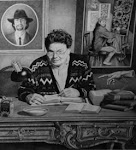
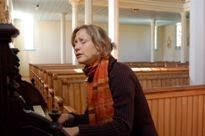
"I am 3/4ths Canadian, and one 4th New Englander - I had ancestors on both sides in the Revolutionary war." - Elizabeth Bishop
____________________________________________

Saturday, October 29, 2011

Green Notebook Entry: October 29, 2008

“Only dimly did I hear the pupils’ re-sigh-tations of capital cities and islands and bays,” Harold Cooke, a student at the Great Village School, is reading aloud from “Primer Class” as we slip into a high-backed pew at what is now St. James United Church, caddy corner from Elizabeth Bishop’s childhood home. The front has been painted fairly recently, but the sides are peeling, and perhaps a visit from the steeplejack would not be amiss. Funds are needed, too, for the next panels in the Great Village Pergola Heritage Project, and we are here to help raise them, as part of the “Word in the Village” celebration held the last weekend in September. “I must go into the classroom now and join in the usual morning” – a pause as Harold catches his breath –“ songs.” A paragraph or so later we are descending the steps past the village children’s prize-winning haikus and cinquains about manners, stories of their own first days at school, and a framed photo of one of Uncle – no, Great Uncle George’s paintings. We’re going to the church hall, where a lovely corn-chowder-with-or-without-onion lunch, with biscuits and homemade strawberry jam, will be provided at a small charge for the benefit of the Great Village Community Association.

Afterwards, summoned by the tolling of the recast and rehung church bell, we return to the sanctuary to listen to “In the Village”. The walls of the sanctuary are painted in trompe-l’oeil stone blocks with somewhat disproportionately diminutive keystones over the arches. The central arch bears the motto “Worship the Lord in the beauty of holiness,” with the word ‘the’ carefully centered at its apex. It has no keystone. Today Bishop’s portrait as a child has been blown up and placed over the left-hand slotted board that in the old days would have borne two figures: the amount of last week’s collection and that of a year ago. Balancing it on the other side of the arch is the hymn-board: nos. 506 (“Take My Life and Let It Be”) and 544 (“In Gratitude and Humble Trust”).

Sandra Barry, tutelary spirit for matters Bishop in Great Village, begins by reading lines from “One Art”, to prepare us for the unfortunate, unavoidable last-minute absence of CBC Radio One Mainstreet’s Carmen Klassen. There will be six readers, she tells us, and we shall proceed without intermission “right straight through”, as Bishop did the National Geographic of February 1918 (a copy of which, found in a second-hand shop in Evansville, Indiana, and purchased for a song, is kept now in the drawer of the desk in the library of her childhood home, caddy-corner across the road).

The reading begins. At once we are more aware than ever before of the music of Bishop’s prose: “Swiss skies – horizon – rims of eyes” as Anne Simpson reads. The story doesn’t suffer from disruption when the voices change, as we feared it might, -- whether from Lisa Lindo’s beautiful contralto to Alexander MacLeod’s deep baritone, or from Brian Bartlett’s New Brunswick twang to Susan Crowe’s lovely vowels and consonants, so familiar from her songs. A deepening, echoing silence fills the church as Susan reads from her thick edition with its two dangling book marks. The light from the green lamp on the pulpit catches the interlocking rings of her earrings, so that they flash figure-eights as her head moves. Clang. Slp. Tears come to our eyes (I asked afterwards – I wasn’t the only one) when we reach the sentence It sounds like a bell buoy out at sea.

The reading stops. There is silence, and then there is long applause. Later there will be an old-fashioned ham and baked bean supper that has to be moved (on next to no notice) to the Legion Hall because so many more than expected will be there. We make our way down the aisle. At the back there are portraits of all the ministers since Saint James was founded and Presbyterian – an early one is just a blank frame, since no picture could be located, but Dr. Gillespie is there, round-faced, and somehow slightly sanctimonious or sinister without his black straw sailor. “That was good, eh?” says a woman in a lime green jacket with its collar upturned. We head outside.

Monday, October 24, 2011

REMINDER for our Massachusetts Readers

Monday, October 24 - Tom Travisano

Editor of
Words In Air: The Complete Correspondence
between Elizabeth Bishop and Robert Lowell

As part of the Elizabeth Bishop Centenary Thomas Travisano will read at Fitchburg State University (Miller Oval, Miller Hall, Highland Avenue, Fitchburg) on Monday, October 24th. The reading will take place between 3:30 and 4:30 p.m. The author of the first book-length study of Elizabeth Bishop's poetry, he is also the president of the U.S. Elizabeth Bishop Society.

Sunday, October 23, 2011

REMINDER for Our Saint Louis Readers

Elizabeth Bishop and The New Yorker: Reading and Reception Oct 23, 4-6 p.m.

Washington University Libraries and the St. Louis Poetry Center will present a program featuring the poetry of Elizabeth Bishop on Sunday, October 23 from 4 to 6 p.m. in Wilson Hall, Room 214, on Washington University’s Danforth Campus. A reception will follow in the Ginkgo Reading Room in the nearby Olin Library. Joelle Biele, the editor of Elizabeth Bishop and The New Yorker: The Complete Correspondence, published this year, will be joined by Mary Jo Bang, Lorin Cuoco, William Gass, Carl Phillips and Catherine Rankovic in a reading of poems by Elizabeth Bishop and her correspondence with the venerable The New Yorker magazine.

Elizabeth Bishop (1911 – 1979) is acknowledged as one of America’s greatest poets. She graduated from Vassar College in 1934 and published her first book of poetry, North & South, in 1946. Her other books include A Cold Spring, which won the Pulitzer Prize, Questions of Travel, which was awarded the National Book Award, and Geography III, which won the National Book Critics Circle Award.

Bishop published the vast majority of her poems in the pages of The New Yorker. Her relationship with the magazine went back to 1933 and continued until her death in 1979. During forty years of correspondence hundreds of letters passed between Bishop and her editors. Their correspondence provides an unparalleled look into Bishop’s writing process, the relationship between a poet and her editors, the internal workings of The New Yorker, and the process of publishing a poem.

Reader Bios
Mary Jo Bang is a professor of English at Washington University and the author of six books including Apology for Want and Elegy, which won the 2007 National Book Critics Circle Award. Her most recent book is The Bride of E. Bang is at work on a translation of The Inferno.
Joelle Biele, the editor of Elizabeth Bishop and The New Yorker, is also the author of White Summer. She’s been a Fulbright scholar and has received awards from the Poetry Society of America and the Maryland State Arts Council.
Lorin Cuoco is a consultant for the St. Louis Poetry Center. She is the editor of six books including The Writer in Politics, Dual Muse: The Writer As Artist, the Artist As Writer and Literary St. Louis: A Guide. She founded the International Writers Center at Washington University with William Gass.
William Gass, the David May Distinguished University Professor Emeritus in the Humanities at Washington University, is the author of short stories, novels and essays, which have garnered three National Book Critics Circle Awards. His other awards include the Lannan Lifetime Achievement Award, the first PEN/Nabokov Award and the Truman Capote Award. His books include The Tunnel, Reading Rilke and A Temple of Texts. His latest collection of essays, Life Sentences, will be published in January 2012.
Carl Phillips, a professor of English at Washington University, is the author of eleven books of poetry, including Speak Low and A Quiver of Arrows: Selected Poems 1986 – 2006. Other books include a translation of Sophocles’s Philocetes and Coin of the Realm: Essays on Life and the Art of Poetry. His most recent book of poetry is Double Shadow. Among his awards are the Theodore Roethke Memorial Foundation Poetry Award, the Kingsley Tuft Poetry Award and the Thom Gunn Award for Gay Male Poetry.
Catherine Rankovic has taught creative writing since 1989 at Washington University, where she received a Master of Fine Arts in writing. A former full-time journalist, she has published four books including most recently Meet Me: Writers in St. Louis. Her poems and essays have appeared in Boulevard, The Iowa Review, The Missouri Review and River Styx. She received the Missouri Biennial Award and Academy of American Poets Award.

Washington University Libraries’ Department of Special Collections has been collecting materials for its Modern Literature Collection since 1964 and now represents more than 175 authors including Samuel Beckett, William Gass, James Merrill, Howard Nemerov, Sylvia Plath, May Swenson and Mona Van Duyn. Of special interest for this program is the correspondence between May Swenson and Elizabeth Bishop, made up of more than 250 letters.

Collaborating with the University Libraries is the St. Louis Poetry Center, still thriving at sixty-five and serving those who love and write poetry. The oldest organization of its kind west of the Mississippi River, the center presents the monthly Poetry at the Point at the Focal Point and Observable Readings at the Schlafly Bottleworks, both in Maplewood. The center also holds monthly workshops at the University City Public Library and sponsors contests and outreach programs in schools and prisons. www.stlouispoetrycenter.org.

WHO: Mary Jo Bang, Joelle Biele, Lorin Cuoco, William Gass, Carl Phillips and Catherine Rankovic
WHAT: Elizabeth Bishop and The New Yorker reading and reception
WHERE: Wilson Hall 214 (program) and Olin Library (reception)
WU campus map at: parking.wustl.edu/parkingmap_2010.pdf
WHEN: 4:00 – 6: 00 p.m., Sunday, October 23, 2011
ADMISSION: Free
SPONSOR: Washington University Libraries (http://library.wustl.edu) and the St. Louis Poetry Center (www.stlouispoetrycenter.org)

Wednesday, October 12, 2011

"One Art" at ViewPoint Gallery

This is a video of the discussion amongst the artists who contributed work to the photographic exhibition "One Art" at the ViewPoint Gallery in Halifax, Nova Scotia on the afternoon of Sunday, September 11, 2011. The moderator is Roxanne Smith.

Sunday, October 2, 2011

Filmmaker John D. Scott shares a documentary project

From the Magpie Productions Proposal for "Elizabeth Bishop and the Art of Losing"

I. The Stories

Genius

This is the story of one of twentieth century's best poets. She won many prizes and honours, including the Pulitzer Prize and two Guggenheims. Since her death in 1979, admiration for Elizabeth Bishop’s keen craftsmanship and unpretentious, accessible, conversational style has broadened and deepened to the point where she is now considered by many to be the very best poet of her generation and one of the most influential poets on modern writers. Central to Elizabeth Bishop’s story was her ability (and her struggle) to express profound, universally held feelings with an interplay of rhythm, story and the distinct, arresting images that made the commonplace seem magical. This is a story of someone who was a genius with words.

The Search for Home

Equally, if not more compelling, is her personal story. Elizabeth Bishop suffered from profound misfortune. Her father died when she was an infant. And then when Elizabeth was five years old her mother went mad and was committed for the remainder of her life to a sanitorium in Dartmouth, Nova Scotia. Elizabeth spent the pivotal moments of this extremely anguished childhood with her grandparents in Great Village, Nova Scotia. Though a desperate time her life, Elizabeth developed a deep connection to the colourful characters, the oral traditions and the sense of community that she felt in this town. From the people and the rhythms of this place came a resonating affirmation of who she was. And later, her time here worked as a muse to Elizabeth’s unsentimental and playful, poetic voice, giving rise to heightened, and at times magical visions of this place. In fact, much of her greatest work re-imagines scenes from Nova Scotia, including the poems “First Death in Nova Scotia,” “The Moose,” “The Map,” “Cirque D’Hiver,” “Sandpiper” and the short story “In the Village.” Shortly after her mother was committed to the hospital Elizabeth was forced to leave her mother’s hometown in Great Village and went to live with relations in “the Boston States.” This was a very unhappy move and it began a life-long trend in her life of moving from one place to the next. This move set in motion a quest for that same sense of “home” she once felt in that community. This search, and its roots in her time in Great Village, Nova Scotia is the central story element of this documentary.

Mastering the Art of Losing

And what comes of this search? Despite her success as a poet, Bishop’s life was difficult. Enormously sensitive and shy, and troubled by a sense of not belonging, she became an alcoholic who nearly killed herself on a few occasions. She did have good friends but her love relationships tended to end badly – and in one instance suicide. Because of all her anxieties and her exceptionally high standards she was only able to finish one-hundred-and-one poems in four very slim books of poetry. (Her famous poem “The Moose,” for example, took twenty-five years for her to write.) Furthermore, in the latter part of her life she taught poetry composition at Harvard University but she was an uninspiring, awkward teacher who students felt was out of touch, and who other faculty dismissed as an intellectual lightweight. And while her poetry won prizes she was not well-known or well-loved by the public. Her poetry was criticized for being "out-of-date" cold and impersonal. In short, viewed from a distance, her personal and professional life can be interpreted as a series of elaborate failures and losses.

Near the end of her life, at a point where one of her great loves leaves her, Bishop, writes what will become her most-loved poem, "One Art." "One Art" is considered one of the greatest villanelles ever written and re-asserts Bishop as one of the best poets of her generation. But it is more than great writing: the poem also contains great wisdom. It starts by introducing the quixotic phrase “the art of losing" and asserts teasingly that one can easily master it. But of course, how one master’s “losing” is a real question for Bishop, who as we know was orphaned early in life, and, who almost kills herself in the aftermath of the break-up that sparks the poem.

For Bishop, writing the poem becomes a part of the answer. While writing the poem, which went through multiple iterations, she ingeniously adapts her (supposedly) impersonal and cold style, to a style that remains disciplined and beautifully crafted, but also subtly reveals more about her own suffering. She allows herself to be vulnerable despite her own natural reticence and shyness, and in so doing, reveals herself to her readership, but also to herself. It gives her greater perspective on the contradictions of her own life. It helps reveal how her public persona (in her poetry and her presentation of herself) is so controlled, and her private persona is at times desperately reckless and out of control – especially when she is drinking. The act of reconciling these two worlds in her poetry (for the first time) forces her into greater insight into her own denial about her suffering. This in turn, gives her insight into how she might be able to lose with grace. So nearly despite herself, and despite years of denial and suffering she learned at the very end of her life how to cope with great loss. It’s a great triumph. Understanding how to cope with loss is the abiding theme of this documentary. I think it's a story that many of us can relate to.

One Art

The art of losing isn't hard to master;

so many things seem filled with the intent

to be lost that their loss is no disaster.


Lose something every day. Accept the fluster

of lost door keys, the hour badly spent.

The art of losing isn't hard to master.


Then practice losing farther, losing faster:
places, and names, and where it was you meant
to travel. None of these will bring disaster.


I lost my mother's watch. And look! my last, or

next-to-last, of three loved houses went.

The art of losing isn't hard to master.


I lost two cities, lovely ones. And, vaster,

some realms I owned, two rivers, a continent.

I miss them, but it wasn't a disaster.


---Even losing you (the joking voice, a gesture

I love) I shan't have lied. It's evident

the art of losing's not too hard to master

though it may look like (Write it!) like disaster.

--Elizabeth Bishop


II. Story Structure

The Dual Narrative

The main story will begin with Elizabeth’s experiences in Great Village, Nova Scotia starting in 1916 and take us through her transient lifestyle through much of her adulthood. The second narrative (told concurrently) will start in 1971 when she is teaching at Harvard and will end when she dies suddenly of a brain aneurysm in 1979. This structure is appealing because we start with two Elizabeths, one who is five and the other who is sixty and this conceit helps create thematic congruities between the developing awarenesses of both Elizabeths. Also, this structure permits each story to come to a climax at a peak in Bishop’s own emotional turmoil (the suicide of her great love Lota in 1967) and when her other great love Alice Methfessel leaves her in Boston in 1975 and prompts the writing of “One Art.” The movie will build into the climax, her poem “One Art” that she writes in a state of deep existential worry. And then it will conclude with the unexpected grace period of feeling “home” at the end of her life from 1975 until her death in 1979.

The Poems

Each scene will end on a poem whose inspiration comes from the tensions of the time period being described. And thus the poetry will not only be an aesthetically pleasing and rewarding study of genius, it will deepen the emotional content of her life-story. Here are two examples:


III. Style, Approach and Point of View

Poetic License

The beauty of Bishop’s poetry is that it is so loaded with the spirit of the moment, in the fragmentary, in the lush, in the juxtaposition of contrasting images and in the point of view of its subjects. What’s needed to make this come alive is a lyrical visual style to conjure this world into the cinematic. The movie needs to make use of the expressive tools that can come with the cinematic voice including techniques like time exposure, time-lapse photography, play with screen size and aspect ratio, multiple-exposure, slow motion, and play with differing levels of saturation. The result will be both expressive and suggestive as befits the poems themselves. The world of the poetry will have a magical or a heightened point of view that will contrast with the more traditional feel of the narrative segments. The two poems that I have interpreted already Sandpiper” and “One Art” are not how they will appear in the final production but initial sketches where I am beginning to uncover some of the formal properties of the interpretations that I will employ in the final project.

Eschewing Over-Analysis

While there will be interviews with people who knew Elizabeth Bishop to help tell her story but there will be few if any literary interpretation of the poems by experts. While the visual poetics of the film will be informed by research related to critical interpretations of the work, the meanings of the poems will be inflected by the shots and styles used to express them and the narrative of her life that surrounds the poem. This will work because Bishop’s style is very conversational and accessible which lends itself to this kind of approach. Also, I believe leaving a certain openness and room for interpretation will actually help the poems feel more alive to our audience than would a narrow definitive interpretation provided by an academic or another poet.

Embracing Re-enactment Where Needed

While some of the story can be told using photographs, visual coverage of the sites, and historical footage, the two centering moments in the movie in Great Village, Nova Scotia and Boston will have moments that need to be tastefully re-enacted for them to have the kind of presence that is needed to tell the story.

[John D. Scott is Associate Professor of Documentary Studies and Production, in the Roy H. Park School of Communications at Ithaca College. His 2007 documentary on Nova Scotian poet John Stiles, Scouts are Cancelled, was nationally broadcast dozens of times on the CBC Documentary Channel, and received numerous awards. Learn more about his EB project, and sign up for e-mail updates, at www.magpieproductions.com. John welcomes feedback on all aspects of the project.]

Thursday, September 22, 2011

“Home of the Long Tides”: The Elizabeth Bishop Centenary Closing Celebrations – Part Three

The third event for the EB100 finale is “I am in need of music”: A Tribute to Elizabeth Bishop, Sunday, 2 October 2011, 3:00 p.m., St. James United Church, Great Village, N.S.

Featuring:
Suzie LeBlanc – soprano
Jocelyne Fleury – mezzo-soprano
Blue Engine String Quartet
John Plant – pianist
Harry Thurston – poet

An Elizabeth Bishop tribute, with an eclectic programme of new Elizabeth Bishop works, contemporary and classical repertoire presented by some of Nova Scotia’s most accomplished artists – with a multi-media twist!

World premiere performances of two settings of Elizabeth Bishop poems, "Sunday 4 A.M." and "In the Middle of the Road," by Canadian composer John Plant. A Canadian premiere of “I am in Need of Music” by American composer Ben Moore.

World Premier of "Sandpiper" (video) produced by Pink Dog Productions of Halifax, N.S.

Music by Rebecca Clarke, Alasdair MacLean, Fanny Mendelssohn, Astor Piazola, Robert Schumann, Dindy Vaughan and Kurt Weill performed by Suzie LeBlanc, Jocelyne Fleury, John Plant and Blue Engine String Quartet.

Readings of Elizabeth Bishop poems by poet and naturalist Harry Thurston.


Tickets can be purchased online at the Elizabeth Bishop Society of Nova Scotia website, at the Masstown Market and Great Village Antiques, or reserved with Sandra Barry at slbarry@ns.sympatico.ca.

A Gallery of the Artists

Suzie LeBlanc

Jocelyne Fleury


Blue Engine String Quartet

John Plant

Harry Thurston

Wednesday, September 21, 2011

“Home of the Long Tides”: The Elizabeth Bishop Centenary Closing Celebrations – Part Two

The second event for the EB100 finale is “The Moose” Route: A guided bus tour of the Bay of Fundy. This trip takes place on Saturday 1 October 2011. It leaves from the Great Village School at 10:00 a.m. and returns there around 6:00 p.m.

This tour has been inspired by Elizabeth Bishop’s beloved poem “The Moose,” which describes a bus ride along the Fundy shore, on her way back to Boston. It travels through the heart of Elizabeth Bishop’s childhood home.


Not sure we'll see any moose, but we'll be looking!

This tour covers lots of ground: Elizabeth Bishop and her art, life and the memory of it; geology, geography and landscape; fabulous cuisine; tide and tidal life; sailing ships and history. With the narration, knowledge and insights of our expert guide: poet and naturalist Harry Thurston. Find out more information about Harry in the post below, especially about the publication of his new book: The Atlantic Coast: A Natural History.


Harry Thurston on the Bay

A comfortable deluxe touring coach is being supplied by Perry Rand/The Bus Boys, from Cambridge, N.S. (http://www.thebusboys.com/) in a comfortable deluxe touring coach.


We will be stopping for lunch at Wild Caraway, an exciting new restaurant in Advocate, N.S. (http://wildcaraway.com)

The cost of this tour is $45, which includes lunch. Space is limited and pre-registration is required. For more information and to register, contact Sandra Barry slbarry@ns.sympatico.ca

Tuesday, September 20, 2011

“Home of the Long Tides”: The Elizabeth Bishop Centenary Closing Celebrations -- Part One

The first event for the EB100 finale, is “Tidal Life”: An Illustrated Talk about the Bay of Fundy, by poet and naturalist Harry Thurston. This event takes place at Alumni Theatre, Cumming Hall, Nova Scotia Agricultural College, Truro, N.S., on Friday, 30 September 2011, at 7:00 p.m. There is no admission fee.

A native of Yarmouth, Nova Scotia, Harry Thurston is the author of twenty books of poetry and non-fiction. Tidal Life, A Natural History of the Bay of Fundy is in print two decades after it was first published. It was the recipient of the Evelyn Richardson Prize for non-fiction. A Place Between The Tides, A Naturalist’s Reflections on the Salt Marsh, was given the Sigurd Olson Nature Writing Award for 2005 in the United States. His New and Selected Poems, Animals Of My Own Kind, appeared from Vehicule Press (Montreal) in 2009. His most recent book is just out -- see the description below!! He is currently working on a memoir about trout fishing with his father.

Harry was involved in a recent CBC TV Land & Sea documentary about the Bay of Fundy, which you can see at this link:
http://www.cbc.ca/landandsea/2011/05/bay-of-fundy.html

The Nova Scotia Agricultural College (NSAC) is a specialized university providing technical, undergraduate and graduate education in agriculture and its related disciplines. NSAC’s high quality research and scholarship generates knowledge and solutions for healthy, sustainable societies. Diverse teaching, outreach and international activities help train future leaders for rural industries and communities in Atlantic Canada and around the world.

We are delighted that NSAC is hosting this event, because of its important place in scientific research in Nova Scotia, and its prominent education and economic role in Colchester County.

***
Hot off the press!
The Atlantic Coast: A Natural History
Harry Thurston’s new book, from Greystone Books
(http://www.dmpibooks.com/greystone-books)
in partnership with the David Suzuki Foundation.


We are all the more thrilled to have Harry be such a central part of the EB100 closing celebrations with the news of the publication of this new contribution to Canada’s nature and natural history canon.

An authoritative and fascinating exploration of the natural history of the east coast of North America.

The North Atlantic coast of North America—commonly known as the Atlantic Coast—extends from Newfoundland and Labrador through the Maritime Provinces and the Northeastern United States south to Cape Hatteras. This North Atlantic region belongs to the sea. The maritime influence on climate, flora, and fauna is dominant—even far inland. This is where the great northern boreal forests intermingle with the mixed coniferous-hardwood forests farther south and where the cold, iceberg-studded Labrador Current from the Arctic and the warm Gulf Stream of the tropics vie for supremacy.

Filled with stunning photographs, the book includes chapters on the geological origins of this region, the two major forest realms, and the main freshwater and marine ecosystems and also describes the flora and fauna within each of these habitats. Finally, it looks at what has been lost but also what remains of the natural heritage of the region and how that might be conserved in future.
Written by the Atlantic region’s best-known nature writer, The Atlantic Coast draws upon the most up-to-date science on the ecology of the region as well as the author’s lifetime experience as a biologist and naturalist. It is both a personal tribute and an accessible, comprehensive guide to an intriguing ecosystem.

October 2011
ISBN 978-1-55365-446-9
Hardcover
7 1/2" x 10"
336 pages
25 b&w illustrations, 120 colour photographs
Nature / Natural History
$45.00 CAD

*************************

Parts Two and Three of "Home of the Long Tides": The Elizabeth Bishop Centenary Closing Celebrations will be posted in this week. Stay tuned! For more information go to the EBSNS website.

Sunday, September 18, 2011

Elizabeth Bishop Centenary Celebrations – A few reflections

As the Elizabeth Bishop Centenary comes to a close (hard to believe the autumnal equinox is almost here!), over the next weeks and months, we will be reflecting on the many celebrations, and gradually putting up material (particularly video) that has been created during the year. John has been our trusty videographer, and has accumulated a lot of footage, which he has already started to post on the blog and on our YouTube channel. An example of this is below – the video of our July reading of “These Fine Mornings” – Joelle Biele’s adaptation of the Elizabeth Bishop/New Yorker correspondence. Joelle herself has posted an audio-only recording of that reading on her website: www.joellebiele.com.

What I want to say about that reading, that event, was that it was great fun for me – and I think my fellow readers (John, Suzie LeBlanc and Harry Thurston) had fun, too. We had virtually no rehearsal (just one quick read through a few days beforehand), so it was a spontaneous effort, more or less – but the letters are incredibly lively and funny, the editorial process they describes so revealing, that it was a real pleasure and privilege to be part of it. I hope you can see how much fun we and the audience are having. To be able to do the reading in the sanctuary of St. James United Church in Great Village, the “high-shouldered and secretive” church that loomed over Bishop’s childhood, was also a privilege.

The biggest EB100 event in Nova Scotia (bigger even than the wonderful symposium in June) was the EB100 Arts Festival in August. John has already started to post some video of it on the YouTube Channel, and there is more to come. All of this takes time, of course – but we have lots of interesting material to share.

The Arts Festival was a roaring success and we will be seeing the impact of it in Nova Scotia for some time to come. Congratulations must go out to Joy Laking and Laurie Gunn and the Arts Festival Committee – all their hard work paid off wonderfully.


While the festival was the biggest event, it was not the last event. We are planning an official finale to the EB100 celebrations, to take place from 30 September to 2 October: “Home of the Long Tides”: The Elizabeth Bishop Centenary Closing Celebrations. You can find all the information about this event on the Elizabeth Bishop Society of Nova Scotia website: www.elizabethbishopns.org – and over then next few days, I will be posting information about each of the activities taking place during that weekend. We chose this time because it is near the anniversary of Elizabeth Bishop’s death, 6 October. As we began at the time of her birth, 8 February, we thought it appropriate to culminate our activities in early October.

While “Home of the Long Tides” is the big finale for the EBSNS, it is not the final event of the EB100 year – and we will continue to let you know about events and activities being planned. There will also be legacy projects emerging from EB100, for example, we will be publishing the winners of the Writing Competition, and, again, we will let you know about these projects as they unfold.

Reminder

Photograph by Laurie Gunn


This afternoon (Sunday, 18 September 2011) at 2:00 p.m. Sandra Barry will present "Contemplating Elizabeth Bishop's 'One Art'" at ViewPoint Gallery, 1272 Barrington Street, Halifax, Nova Scotia. Her talk is part of the photography exhibit One Art: Responses to "One Art" by Elizabeth Bishop.

Wednesday, September 14, 2011

“These Fine Mornings: Elizabeth Bishop and The New Yorker”

These Fine Mornings is a one-act play by Joelle Biele, editor of Elizabeth Bishop and the New Yorker: the Complete Correspondence. It tells the story of Elizabeth Bishop and The New Yorker using excerpts from letters between Bishop and editors Charles Pearce, Katharine White, and Howard Moss. Woven between their correspondence are letters Bishop wrote to friends, internal magazine documents, poems, and questions and answers that appear on proofs. Actors do more than one voice.

The play was first read at the University of Chicago's International House and hosted by the Program in Poetry and Poetics and the Poetry Foundation. Directed by Bernard Sahlins, it featured Linda Kimbrough as Elizabeth Bishop, Bruce Jarchow as the narrator, Suzanne Petri as Katharine White, and Tim Kazurinsky as Charles Pearce and Howard Moss.

These Fine Mornings is being read by contemporary poets at a number of venues as part of the celebration of the centenary of Bishop's birth. Here is a link to an audio recording of the Great Village performance in July:


And here is a video recording:


Wednesday, September 7, 2011

CALL FOR PAPERS

International Conference: DAZZLING DIALECTICS: BRAZIL IN THE EYES OF ELIZABETH BISHOP


International ConferenceCongresso Internacional

DAZZLING DIALECTICS: BRAZIL IN THE EYES OF ELIZABETH BISHOP

DESLUMBRANTE DIALÉTICA: O BRASIL NO OLHAR DE ELIZABETH BISHOP

November 9-12, 2011

Ouro Preto/Mariana

Minas Gerais, Brazil

In 2011, the birth centenary of Elizabeth Bishop is celebrated in many countries through recitals, poetry readings, academic meetings and other events. Her life and poetry are particularly related to three countries: the United States, Canada, and Brazil. In Brazil, besides the centenary, there is an additional reason to make this event significant: sixty years of the poet’s arrival in the country, an opportune occasion for re-readings of her work. Such re-readings will enable us to evaluate the poet’s relation with Brazil expressed in her poetry, prose, and vast correspondence.

The International Conference “DAZZLING DIALECTIC: BRAZIL IN THE EYES OF ELIZABETH BISHOP” has the purpose of gathering scholars interested in Elizabeth Bishop’s work. The event, which includes lectures, round-tables, panels, and readings has the intent to discuss the writer’s work, as well as its relevance in Brazil and abroad.

The event will address the following themes related to the author:

  • Her poetic work and correspondence;
  • Her work as translator;
  • Translations of her work;
  • Historical and biographical issues related to her life and work;
  • Her interactions with Brazilian, American and Canadian Modernists;
  • Gender issues: the poet and her contemporaries;
  • Brazil in her work;
  • Bishop and other travelers in Brazil.

Submissions:

  • University professors, scholars and graduate students (MA and doctoral programs) can apply to present papers in panel sessions.
  • Undergraduate students can apply to present posters.
  • Deadline for submission and application fee payment: October 9th.

To submit your proposal:

1. Send an abstract of your paper or poster (maximum 200 words), in Portuguese or English, including information about your institutional affiliation, area of interest, address, telephone, and e-mail to congressobishop@gmail.com.

2. Make the deposit at Banco do Brasil, branch 3610-2, account # 51437-3, and send a copy of the receipt by e-mail tocongressobishop@gmail.com. For international participants, payment is due on the first day of the event.

Registration fees:

1. Participation with presentation of papers or posters

Categories Up to 09/25 Up to 10/09
University Professors and scholars R$80,00 R$120,00
Graduate Students R$40,00 R$60,00
Undergraduate Students R$20,00 R$30,00

2. Participation without presentation of papers or posters

Categories Up to 09/25 Up to 10/09
University Professors and scholars R$40,00 R$60,00
Graduate Students R$20,00 R$30,00
Undergraduate Students R$10,00 R$10,00

Certificates may only be issued upon payment of registration fee.

Information: congressobishop@gmail.com

http://congressobishop2011.wordpress.com

Organização/Organization committee:

Maria Clara Versiani Galery (UFOP)

Sandra Regina Goulart Almeida (UFMG)

Guiomar de Grammont (UFOP)

Elzira Divina Perpétua (UFOP)

Maria Clara Bonetti Paro (UNESP- Araraquara)

Maria Lúcia Milléo Martins (UFSC)

Regina Przybycien (UFPR/Universidade Jaguielônica de Cracóvia)

Ricardo Sternberg (University of Toronto)

Realização/Promoting institutions:

Universidade Federal de Ouro Preto

Universidade Federal de Minas Gerais

Apoio/Support:

Programa de Pós-Graduação em Letras: Estudos da Linguagem (UFOP)

Programa de Pós-Graduação em Letras: Estudos Literários (UFMG)

Tuesday, September 6, 2011

Our São Paulo Correspondent Writes --

Um Porto Para Elizabeth Bishop -- A Safe Harbour for Elizabeth Bishop

Em dezembro de 1951, uma poetisa norte-americana genial e deprimida desembarcou de um cargueiro no porto de Santos para uma breve escala turística e viveu no Brasil uma aventura pessoal que durou 15 anos. Esta peça é o encontro entre essa poetisa e o Brasil exuberante e inquieto dos anos 1950 e 1960.

[In December, 1951, a great but discouraged American poet disembarked from a cargo ship at the port of Santos for a brief tourist stopover, and then lived a personal adventure in Brazil that lasted 15 years. This play is about the encounter between the poet and Brazil in the exuberant and troubled years of the 1950s and 1960s.]

Playwright: Marta Góes.
Director: José Possi Neto.
Starring Regina Braga.
October 22-23 (Saturday and Sunday), 8:00 p.m. (No Teatro)
SESC Santo André
Rua Tamarutaca, 302 (Santo André)
Tel: (11) 4469-1200
The play runs for 80 minutes
Box Office prices: from R$ 5,00 to R$ 20,00
(Tickets available on the network INGRESSOSESC beginning September 30 at 2:00 p.m.)

Our Denver Correspondent Writes --

Two-weekend Lighthouse Writers Intensive Workshop: Elizabeth Bishop and the Art of Seeing

No poet has a finer eye than Elizabeth Bishop. The depth and precision of her seeing, and the extraordinary richness of her descriptions, are unsurpassed in American poetry. In this two-weekend reading-as-a-writer course, we’ll study what makes Bishop’s visual perception so remarkable, and we’ll explore ways to bring that level of seeing into our own work. Students will be asked to write one poem in response to Bishop's work and to memorize one Bishop poem. Our text will be the recently released POEMS.

This class is open to writers of all genres.

It will meet on two consecutive weekends:
December 3, 4, 10, and 11, from 1 to 4 PM.

Instructor: John Brehm, MFA
Starts: 12/03/2011
Time(s): 1:00 PM to 4:00 PM

Cost: $285.00 members / $315.00 non-members
Location: Lighthouse Attic - Attic (3rd Floor)
1515 Race Street, Denver, CO 80218

Sunday, September 4, 2011

Great Village Welcomes the World at the Elizabeth Bishop Centenary Arts Festival

From 19 to 21 August 2011, Great Village, N.S., was a bee hive of activity. Hundreds of people flocked to the village to be part of the EB100 Arts Festival. People from the community and along the Fundy Shore, from all over Nova Scotia, from many parts of Canada and throughout the United States, and from the far corners of the world – from Australia to Brazil to Ireland – converged in the village for a big birthday party. Everyone gathered for one reason: to celebrate the life, art and 100th birthday of Elizabeth Bishop. A truly festive atmosphere, helped by the great weather, reigned supreme for three days.

Traffic jams in Great Village during the festival. Photograph by Grant Dickie of Great Village Antiques.

To try to account for all the bustle and fun would take many posts. John has begun to put up some video that he shot during those days – over time, more of it will appear, giving a glimpse of some of what happened. I have wanted to write something ever since the festival ended, but as soon as it was over, I went immediately into planning for the next EB100 events (one of which is already underway: the ViewPoint Gallery “One Art” exhibition, information about which has already been posted). We are planning a big EB100 finale, which will take place from 30 September to 2 October, which is fast approaching! Information about it will be posted very soon.

I do want to reflect a little, though, on those three days in August, when the world arrived at the doorstep of Great Village, gathered because of a curiosity about, keen interest in or utter devotion to Elizabeth Bishop. I want to thank the EBSNS and the Fundy Shore communities for embracing the festival so wholeheartedly. The main organizers of the event, Joy Laking and Laurie Gunn, brought together a phenomenal group of volunteers. They all deserve a standing ovation for their hard work and their lively, warm hospitality. I want to thank all the artists (authors, musicians, actors, painters, film-makers) who participated in a myriad of ways. Their creative energy and their amazing artistry were tremendous tributes to and honourings of Bishop. I want to thank the over 70 English as a second language summer school students from the Nova Scotia Agricultural College in Truro, N.S., who came out to help build cardboard boats and float them in Logan Spencer’s pond. What a parade they made through the village carrying their boats and flags. I want to thank the Great Village Farmers Market for adding that truly “home-made” touch to Saturday.

Building the cardboard boats on the lawn of St. James United Church. Photo by Grant Dickie of Great Village Antiques

Without a doubt, the most popular activity (which is saying a great deal because every event or activity was fully attended) was the horse and wagon rides, up and down Scrabble Hill Road. Gordon Lewis, who represented “Pa” (Bishop’s maternal grandfather William Bulmer, think of the poem “Manners”), and Beth Terry who portrayed Elizabeth Bishop and provided a lively, lovely reminiscence of the village during the rides, deserve our heartfelt gratitude. There was also a delightful “Little Miss Elizabeth Bishop” at home in her grandparents’ house, portrayed by April Sharpe, with her mother Patti as “Gammie,” Bishop’s maternal grandmother. A costumed Dick Akerman offered historic walking tours, giving all who walked with him a deep understanding of the fascinating past of the village. Everyone entered into the spirit of that long ago time, but most of all they warmly welcomed the hundreds of people who rode the wagon, visited the house or wandered the village.

The workshops, author readings, village tours and concerts; the community lunch, supper, tea and receptions; the old-time church service; the wagon, boats, costumes, books, banners, baskets; the paintings and films were the trigger for all sorts of wonderful connections between and among people – everyone who came had one thing in common: Elizabeth Bishop – and she brought about connection with people from near and far. Bishop the world traveler who had an abiding tie with her family, her village and Nova Scotia was the catalyst for all manner of new connections, which will continue for years to come. Great Village was the site of this energized activity for three wonderful days in August 2011.

P.S. It is also important to thank our funders for their support. It was heartening to have funding from three levels of government: Canadian Heritage; the Province of Nova Scotia through Communities, Culture and Heritage, as well as Economic and Rural Development and Tourism; and the Municipality of Colchester, as well as the Colchester Regional Development Agency. Local businesses donated: Masstown Market, Oxford Frozen Foods, Wilson’s Fuel, Lowland Gardens. The Robert Pope Foundation, the Charles and Mary MacLennan Foundation, the Fundy Foundation. Individuals: Joy Laking, Suzie LeBlanc, Randall Sargent, Dick Lemon. If I have forgotten anyone, it is unintnentional. Our gratitude for all support is immense.