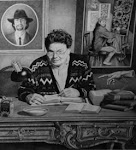
"I am 3/4ths Canadian, and one 4th New Englander - I had ancestors on both sides in the Revolutionary war." - Elizabeth Bishop
____________________________________________

Monday, January 26, 2015

A Note from Our Friends Fox & Coyote

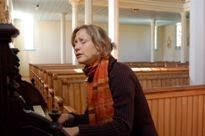
Constant readers from amongst the Patronage-at-Large will recollect with pleasure a recent "Today's Video" by the group Fox & Coyote, in which they performed a song inspired by EB's "Letter to New York." I wrote to them asking if they could provide a little background about themselves and their process of composition. Here is their reply:

A dear friend gave the poem to me. She lived in NYC at the time, and we had exchanged a number of letters -- so EB's poem was especially poignant because of that. I imagined my friend doing all the things that EB mentions in her poem, especially riding in a taxi through/around Central Park. The bookending lines stuck with me most, though:

In your next letter I wish you'd say
where you are going and what you are doing

and

nevertheless I'd like to know
what you are doing and where you are going

Those lines were so true to me -- that's exactly what I wanted to know: the details of my friend's life because that's what you miss out on when geographically separated.

I alluded to these bookending lines in my lyrics with "Desert sands beneath, could you tell me where you are and where you're going?" It felt so much like this NYC friend of mine was with me all the time -- the sands underneath my feet -- but it also felt like she was so fleeting, which is why I mention things like "Your heart beats under my feet; I want to be underneath" and "I had a plan for you and me. I drew it in the desert sands; it blew away so easily." It was most likely my own perceptions and context, but when I read EB's poem, I felt some desperation in her words. I tried to echo that in my song.


Fox & Coyote is made up of four semi-awkward and semi-hilarious people whose lives, like most people, are pulled in so many directions. One of those pulls is Fox & Coyote -- because we love creating with each other, and because we love each other. We're also pulled by romances, our jobs (which some of us like, and some of us don't), friends who live far away, families that live pretty close, and a bunch of other things like whether we should brush our teeth in the morning. These are the things that we write music about.

Somehow, and with much gratitude for each other, we make time to write indie rock songs played on folk instruments, meaning that we're an indie folk band. Or something. We like making dinner together and communicating over dinner with pregnant pauses, meaningful looks, weird jokes, crude hand gestures, and sometimes by talking. I guess that's what happens when you spend a lot of time with small group of people. 


[You can listen to some of Fox & Coyote's music at www.foxandcoyote.bandcamp.com].


Fox & Coyote - "Elizabeth Bishop,"
A Tiny(er) Desk Concert


Saturday, January 17, 2015

Four Years On, Thirteen After, Fifty-Five To Go...


Another Art

So many times we misremember poems.
For years I thought Frost's "Mending Wall" had spelt
those upper, sun-spilt object lessons 'bowlders' --
at least that's how they were on page two twelve
of Untermeyer's sixth, combined edition.
Or take the different ways the high school students,
fulfilling arcane AP class requirements
in hopes of IBDs, the IV League,
and ABDs (or even Ph.D.s)
have mangled EB's villanelle "One Art."
I posted one the other day from Youtube:
"ThePrancingPainter" with her turtleneck
that matched her lipstick (not her horn-rimmed glasses);
a task she "had to do for English class."
She belted out the 'is': "IS no disaster,"
then "where it was you meant to visit" ['travel!'],
and worst of all the final line, when after
a "Write it" flaccid as a Kellogg's cornflake
(floating in a bowl and taking movies?)
the final overwhelming, universal
catastrophe was shot down with the "A"
her teacher (she feels certain) ought to give her
for memorizing such a dorky poem.
In short, she didn't really bowl me over.
And yet, and yet... I cannot look inside her,
or see the grandma fifty-nine years hence
remove her horn-rimmed glasses to look back
on losses yet unlisted, milk yet spilt,
and think of when she stood before the camera
and said the words, although she can't remember
 just how that poem went, or what the name was
that awful teacher had, who'd been so nasty
one January morning nine years after
 -- to the day it was -- he'd lost his Dad.

 January 17, 2011

Thursday, January 8, 2015

Our Toronto Correspondent Writes...

Los Angeles–based, German-born painter Silke Otto-Knapp comes to the Art Gallery of Ontario in Toronto this spring with Land lies in water, an exhibition of twenty-nine paintings, including a portrait of Elizabeth Bishop, in whom she has had an abiding interest. The exhibition opens on February 14, 2015.  Ms. Otto-Knapp will give a talk on her work at the gallery on March 18, 2015.  A selection of her work may be viewed here.

Saturday, January 3, 2015

Lifting Yesterday – A Chapter Two Supplement: The Oral Tradition and Translation

In 1999 I attended a Bishop conference in Ouro Prêto, Brazil. A trip of a life-time for me, the memories of which remain vivid “after — how many years?” The paper I presented was about Bishop’s translation of Mina Vida de Menina (The Diary of ‘Helena Morley’). My focus was on how Bishop incorporated her own idiom, received in large measure from her childhood in Nova Scotia, into the translation, with special focus on her grandmother’s influence. Below is an excerpt from this paper, which was never published. If you are interested in reading the whole paper, I am offering a pdf of it gratis, part of the supplement to Lifting Yesterday.
Casa Mariana (Bishop's Ouro Preto house) with poinsettia tree. Photo by yours truly, September 1999
********************************************************
Excerpt from: “‘It Really Happened’: The Confluence of Elizabeth Bishop’s Nova Scotia and The Diary of ‘Helena Morley’

....What we read in the Diary is what might be called the first transcription of oral tradition to written language. Listen to how Bishop translated it: “She told us the story” (5), “telling stories about people” (9), “he told some very funny stories” (16), “one of my father’s stories” (19), “the story of her confession” (21), “the story of the owl” (27), “a story of the old days” (71), “the children tell stories” (73), “mama told a story” (95), “we begin to tell stories” (131), “make up some story” (138), “I like mama’s stories better than papa’s” (140), “Reginalda...knows the most stories” (140), “our aunts amuse us by telling stories” (158), “I like the stories about the old days better” (158), “he told me the story” (179), “mama tells stories of bygone days” (224), “sometimes she tells us stories” (275). And there are many more examples.

The Diary is also filled with a wonderful array of aphorism, one of the vital elements of the oral tradition which survives even in highly text-bound North American culture. Listen to how Bishop translated this element: “God helps more surely than getting up early” (265); “From day to day God smooths the way” (214); “Nothing comes free; money makes the mare go” (226); “The unlucky can’t cry forever” (108); “Marriages and shrouds are made in Heaven” (154); “A crooked stick can’t be straightened” (127); “What the eye doesn’t see the heart doesn’t feel” (43); “The fingers of the hand aren’t all the same” (37); “You must have been born with a caul” (103); “The place is a regular asylum” (188); “Those who have children will never have full bellies” (187).

While she tried to remain true to the tone and texture of the original, Bishop incorporated a good deal of her own colloquialism and idiom into the translation. I offer only one interesting example — there are many. One of Bishop’s favourite words was “awful” (and its variations). Listen to how many ways Bishop brings it into the translation: “awfully sorry,” “awfully funny,” “perfectly awful,” “how awful,” “awful things,” “something awful,” “an awful lot,” “this awful fault,” “that awful dentist,” “it’s awful,” “the rice is awful,” “it must be awful,” “so awful,” “awful uproar,” “really awfully bad,” “too awful,” “an awful shock.” And, again, there are many more examples.

The reason these forms of expression (story, aphorism, idiom) appealed to Bishop was because they went straight back to her own childhood. Great Village at the turn of the twentieth century was a world where written language and texts played major roles, but this place and time remained in many ways a highly oral culture — itself structured around storytelling and aphorism as the medium for education, entertainment and individual and communal creativity. People, places and events were known through what was said about them — the past, present and future were contemplated in the kitchens, parlours, churches and schoolrooms not only through words on a page, but through monologue, dialogue, experiential and expressive oral tradition.

Perhaps the most important nexus of oral tradition in Bishop’s and Helena’s childhood worlds was grandmother. In 1958 Bishop wrote to her maternal aunt, Grace Bulmer Bowers: "'The Diary' is doing pretty well, I think....It was hard to make it sound natural and quite often when I got stuck about how to translate some of the grandmother’s remarks or expressions, and I couldn’t translate them literally, I’d try to think of what Gammie would have said! I think it worked pretty well." (12 March)

Victoria Harrison has pointed out the way Bishop merged one of Gammie Bulmer’s favourite phrases, “Nobody knows,” with Dona Teodora’s way of speaking (176) — there are several examples of this particular confluence in the Diary: “Grandma said that all that is a mystery, that we never really know these things for sure” (102); “Nobody knows what it was” (199); “Nobody knows what she wants” (132); “God knows what he’s doing” (211). Helena herself adopts the phrase, “Nobody knows what a person is like inside” (65).

However, the link between these two grandmothers is apparent almost every time we encounter Dona Teodora in the Diary. Though Gammie Bulmer was not a wealthy widow with a houseful of ex-slaves, she was the matriarch of a large family, the arbiter of family disputes, the hostess of a regular stream of visitors (relatives and friends), a participant in the charitable activities of the community, a devout practitioner of her faith and a partly rational, partly credulous believer in the mysteries of life and death. Though smaller, Gammie Bulmer’s home was in many ways similar to Dona Teodora’s chácara, “a house with extensive gardens, or even a small farm, but not necessarily in the country” (Diary xxxv). These homes were the centre of family life. Moreover, besides “Nobody knows,” both women had a store of other aphoristic utterances. And with one of these, we see directly the practice Bishop described to Aunt Grace. One of Dona Teodora’s favourite exclamations was, “Forte coisa!” which Bishop tells us in a note literally means “Strong thing” or “Fine thing.” Bishop chose to substitute the literal English translation — which diminishes the complex connotation of the Portuguese — with one of Gammie Bulmer's actual phrases, “I never in my born days!”
*********************************************************
Again, if you would like to read the entire paper, let me know and I can send you the pdf. I also want to reiterate, you can subscribe for Lifting Yesterday at any point. The cost is $25.00 for ten pdfs, which can be sent all at once, or once a month. Contact me at slbarry@ns.sympatico.ca.
*********************************************************
A Great Village Update
 Our Great Village correspondent Patti Sharpe sent these photos the other day. Earlier this week, the old Great Village bridge was finally completely dismantled. The iron structure was lifted, impressively, and set on the ground, where the beams were cut up (we all assume for scrap). The end of an era, as this dear old bridge has been on this site for well over 100 years. As Bishop might say, “Good-bye to the bridge.”
Photos taken by Harold Sharpe


Thursday, January 1, 2015

Happy New Year! Exciting News from the EBSNS

The Elizabeth Bishop Society of Nova Scotia was thrilled to learn that our Honorary Patron Suzie LeBlanc has been made a Member of the Order of Canada! Check out this link for the full list of recipients:
(http://www.gg.ca/document.aspx?id=15922&lan=eng).

The EBSNS Board and members congratulate Suzie for this much deserved recognition. We are so proud of her.
Suzie will be singing some of her Elizabeth Bishop songs in Victoria, B.C., on 18 April 2015 (http://victoriasymphony.ca/concerts/a-celebration-of-poetry-i-am-in-need-of-music/ ). Before that, in mid-February she will sing some of these songs and her popular Acadian songs in New Brunswick. For details of Suzie's 2015 schedule, see her website (http://suzieleblanc.com/site/ )

***************************************************************
!THE ELIZABETH BISHOP FESTIVAL!

The other exciting news: On Saturday, 8 August 2015, the EBSNS will present The Elizabeth Bishop Festival,” a one-day arts extravaganza, in Great Village, N.S. Inspired by Elizabeth Bishop’s eclectic interest in and love of all the arts, this festival will draw together artists of all disciplines from across Nova Scotia who will participate in a wide variety of activities. This festival is a celebration of Nova Scotia’s rich cultural heritage and artistic practices.
Planning for the festival is underway and the EBSNS will make regular announcements on the blog about the artists who will participate and the programme over the next seven months. Mark THE ELIZABETH BISHOP FESTIVAL “In the Village,” 8 August 2015, on your calendars!!

Join us for a day of celebration, inspiration and fun. We’ll have the banners up and the welcome mat out – we look forward to seeing you there! 
April Sharpe is the young Great Village artist who created the permanent banner that is displayed in Great Village every summer. She is wearing a t-shirt with the image used for the EB100 banner in 2011.

Sunday, December 28, 2014

An Elizabeth Bishop House Resolution

2014  is waning and it is time to reflect on another busy year. I often have people ask me what is happening with the EB House, have we had any offers? We have had some interest in the house since announcing early in the spring that we intended to sell, but no firm offers yet. When we decided to put the house on the market, we recognized that there were many factors involved in this process, factors affecting the outcome we want, many beyond our control. So, our modus operandi has been patience. Most good things take time.
EB House, December 2014 (photo by Brenda Barry)
The primary outcome is to sell the house to the right person(s), someone who will love and take care of the house as we have endeavoured to do for the past decade. The EB House, as an artist retreat, emerged organically out of our desire to share this dear old place with as many people as we could, in a manageable way. Its next chapter will emerge, I believe, equally organically, whether it remains a retreat or becomes a private home again. The house will decide.

So, as the turn of the year rapidly approaches, the EB House resolution for the coming year is to continue to be as attentive and thoughtful as we can in our efforts to find this “right person.” We will certainly let you know when that happens.
 Elizabeth Bishop House dining room with photo of EB on the wall (photograph by Brenda Barry)

(Note: Check out the link at the top of the News section for a recent article about the house written by Robert Everett Green and published in the Globe & Mail.)

Elizabeth Bishop knew well enough that life was an “untidy activity” – and there is always surprise, the unexpected. For example, the exceptional equinoctial flood in September – a deeply distressing event, yet, in the end, the EB House came through it just fine, and in some ways in better shape as a result of the repairs.

The EB House has always been the centre of a real community: the owners, our family and friends, the artists who have stayed, the people of Great Village who have supported it steadfastly. This community, the “EB network,” rallied in September and helped with the post-flood restoration in a remarkable way. The link below, an earlier post from November, gives a list of the contributors to the EB House Yard Restoration effort.

I want thank these people, again, for their tremendous support. So many have given so much in many ways over the years. Whoever buys the EB House will learn quickly what wonderful a place Great Village is and how much good will surrounds this dear old place.

My final visit to Great Village and the house for 2014 happened yesterday. Below are two photos of that visit, taken by my sister Brenda Barry.
When I saw this photograph, I immediately thought of Bishop’s description in “In the Village,” “…the church is dazzling. It is high-shouldered and secretive; it leans back a little.” I am looking forward to the opening of "In the Village Cafe" in the spring.
Layton’s store, now an antique shop. Note the "Esso" sign in the window! Windows like mirrors!

Stay tuned, I will be posting some exciting Bishop news and further updates about my Bishop book as 2015 begins to roll along. Happy New Year.

Sunday, December 21, 2014

Merry Christmas and a Happy New Year

Today is the winter solstice and the holidays are upon us. This post is a brief update about the Elizabeth Bishop House. I won't say the final one, because I said that earlier in the fall and it wasn't; but  likely it will be the last before the turn of another year. Last week I visited Great Village partly because I wanted to drive across the new bridge, which is now open. The photos below were taken by me.
It is a strange experience not to have to slow down and, as was often the case, stop before crossing. The old bridge is slowly being dismantled -- for me, a sad sight; but such is the way of progress.

I also went to check on the condition of the front yard at the EB House: rather a mess. The altered trajectory of the road (because of the bridge) has resulted in less front yard. The new shoulder of the road is much wider and has intruded well into the little yard that was there (there was a time, 100 years ago, when the EB House had quite a good front yard, which was actually above the road; but the road was gradually widened and raised and claimed more of the yard). I was disappointed with the mess that the Department of Transportation has left and hope that their intention is to grade the gravel and tidy up this mess.
My intention is to contact DOT and ask what will be done. DOT has control of land extending in around 30 feet from the centre line of the road, which actually would take up most of the front yard anyway. But leaving such a mess is unacceptable. It is our intention to do some landscaping in the spring, so what you see in these photos will alter -- I hope in part with the help of DOT.

What an autumn it has been in Nova Scotia, a heavy rain storm just about every week, starting with the one on 22 September that resulted in what I call the Equinoctial Flood in Great Village. All our rivers remain much higher than they normally are at this time of year. And the forecast is calling for another deluge with mild temperatures on Christmas Day (rivers will flood again) -- quite a different scenario than last winter, when we were already weeks into snow and cold.

Wherever you may be this holiday, I wish you all the blessings of the season.

Photo by Rebecca Colwell

Tuesday, December 16, 2014

Lifting Yesterday – A Chapter One supplement : Nova Scotia and the “Boston States”

In January 2003, Tom Travisano invited me to participate on a panel about Elizabeth Bishop and the “Boston States,” given at an American Literature Association conference in Boston, MA, in May 2003. Below is part of my presentation. I dedicated it to Muir MacLachlan of Great Village, who died on 3 January 2003, at the age of 92.
               
I have written at some length about the close historical ties between the Maritimes and New England, about the rôle this geo-political, socio-economic interconnection played in Elizabeth Bishop’s childhood and adolescence.1 The metaphor I have used most frequently is that of migration – the continuous toing and froing between both regions, so regular in certain eras that it seemed a force of nature, it seemed as regular as tide. It was so for Elizabeth Bishop: “First, she had come home, with her child. Then she had gone away again, alone, and left the child. Then she had come home. Then she had gone away again, with her sister; and now she was home again....So many things in the village came from Boston, and even I had once come from there. But I remembered only being here, with my grandmother.” (Collected Prose 252, 254)

The idea of the “Boston States” is inextricably linked to the Maritimes. It is a Maritime phrase. It has lost much of its currency and relevance in today’s globalization, yet even in my childhood I remember it being used. When I was three my parents took a trip (still frequently done then), to the “Boston States” to visit Nova Scotia friends who had moved to Worcester.

I decided the best way to convey the organic quality of this ebb and flow in Bishop’s life was to write a kind of litany. I have chosen to frame this litany impressionistically. The facts are multiple and highly intertwined, fascinating in themselves but too involved to recount here. So I offer a poetic version instead. Keep in mind that Elizabeth Bishop knew a great deal about each of the relatives I mention, knew their stories. The “here and there” of this litany was her earliest “total immersion.” She was a full participant (willing and unwilling) in the tide of life between these regions. My apologies to Elizabeth Bishop for my awkward narrative (as opposed to lyrical) lines:

Her ancestors sailed from England
for every reason imaginable,
sailed towards the future, which is now
the unreclaimable past.
Fosters trace to William the Conqueror.
Bulmers trace to before William the Conqueror.
Bishops and Hutchinsons trace beyond memory.
Somewhere, so far back,
hidden in the folds of Fales, Meade, Hooper and Black,
the lines diverged from the seven clan mothers.
Somewhere, not so far back, the codes held
in these bones and blood washed up
on nearby shores: colonies of wilderness,
colonies of hope, colonies of construction
and deconstruction, and every ancestor must account.
Fosters trace to Massachusetts.
Bulmers trace to Nova Scotia.
Bishops trace to Prince Edward Island.
Hutchinsons trace to New Brunswick.

The matrix is artisans – weavers, farmers,
carpenters, tanners; seamstresses, gardeners,
healers, cooks – crafting from scratch
(she once wrote “in a pinch”) new lives
“in unthought of ways,” new ideas forged
from molten iron (the too hot imagination),
cooled into judges, deacons and politicians
with obedient or not so obedient wives.

The circle constricts towards the centre;
the trajectories lie in closer proximity.
What force in nature brings together
disparate lives as though on purpose?
She would have said “wanderlust.”
It must be a gene.

The matrix set inside a vast historical pattern
because the sea is the first highway,
an element of motion older than all pilgrims
combined. Its paradigm is tide. Time.

The wanderlust kept alive by the Hutchinsons
– master mariners and missionaries who sailed
around the Horn, sailed to Egypt,
to India and back to England. Sailed and spoke
the journeys – this line was the artists: writers,
translators, painters, orators.
Her affinity was always with the artists,
who settled and never settled, who appeared
and vanished, because that is what artists do.

John Bishop emigrated from Prince Edward Island
to Rhode Island to Massachusetts. He married
Sarah Foster; their large family included William.

William Bulmer took a young man’s tour
of New England, then settled in Nova Scotia.
He married Elizabeth Hutchinson;
their large family included Gertrude.

All the ancestral inclinations converged here,
at the turn of the twentieth century,
in a moment (lost to the record)
when this William and this Gertrude met.
It all happened for this one reason
(why not?) – it all happened for every
other reason imaginable or unimaginable,
remembered or lost. Is there a reason
to choose a nexus, study it,
realize, as she did,
truth is an imaginary iceberg,
visceral, looming, cold?
Her study of the consequences
of this lost moment lasted a lifetime.

Begin again: to Boston to Boston to train
as a nurse; home again, home again
because she was ill. Back to Boston
where he was ill; she nursed him
back to health.

The bond can only be imagined: She fled
to Great Village afraid of the power
of her love. He followed her to Great Village
determined to declare the power of his love.
In 1908 they were married. They sailed
to Jamaica, to Panama for their honeymoon.
Back in Massachusetts they lived and loved
their only child into being.
1911 was a year of life and death (isn’t every year?).
1911 began the back and forth of her imagination;
life began like a cradle rocking. Rocking gently
on the sea between worlds, both worlds home,
neither world home. She said the poet
“carries home within.”

Is there a reason
to choose? Let the rocking continue
her whole life: aboard the North Star
(ponder all the shipwrecks); aboard
the Königstein, the Normandy, the Britannic,
the Exeter, the Bowplate, the Jarlsberg,
the Prince of Fundy. Life began en route:
steam back and forth between Yarmouth
and Boston, ride the “unk-etty” train
between Londonderry Station and Boston,
motor the to and fro in early Fords and Chevrolets,
sit in the long bus limbo on trips between
Great Village and Boston. Occasionally fly,
if you have to.

Great-grandparents did so.
Grandparents and great-uncles did so.
Maternal aunts and girl cousins did so.
Even Uncle Arthur, who never went anywhere
in his life, drove from the village to Boston
once or twice, to visit his daughters.
Look at him, he ended up in Brazil,
like she did. Willingly
and unwillingly she came to and left
Nova Scotia. Willingly
and unwillingly she came to and left
Massachusetts. Patterns as old as her ancestors,
as new as her own next breath.
Lost and found words were mantras,
she called them “first syllables,”
which vanished from her tongue
like her father and mother from her life.
Where does the historian, the biographer,
the critic, the artist locate the initial conditions,
the uncanny convergences, the accidents?
In her lines, in her vision (“look,” that is),
in her memory, which lift the weight
of uncountable yesterdays, as far back
as William the Conqueror,
and as close as old men named Muir.

*****
1. Sandra Barry, “Invisible Threads and Indivdual Rubatos: Migration in Elizabeth Bishop’s Life and Work.” In “In Worcester, Massachusetts” Essays on Elizabeth Bishop. ed. Laura Jehns Menides and Angela G. Dorenkamp. New York: Peter Lang, 1999, pp. 59–73.

Saturday, December 13, 2014

The new bridge in Great Village is open

Great Village has received an early Christmas present with the opening of the new bridge. Even though this new structure has been something of a controversial issue for the village, that the bulk of the construction is done is truly a positive thing as winter approaches. The photos I am sharing were taken by Patti Sharpe, who has so kindly provided many images of the village this fall, at the time of the September flood and for the progress of the new bridge construction. Thanks so much, Patti, for taking such interesting photographs.
For Elizabeth Bishop, crossing the old bridge was where the village began for her. Here we are crossing the new bridge.
Someone took the time to think about the design of this rather out-sized new bridge. These decorative panels turn it from being just a piece of infrastructure to an actual aesthetic element in the village. Since it is at the very centre of the community, the heart of the village, it is nice to see that the person responsible for its "look" cared enough to add what, in my view, amounts to a sculptural detail.
As the EBSNS and others in the village have realized, the pergola is now too close to the road and access to it has been seriously reduced. Discussions about moving it have already begun and will continue through the winter. We'll be making an announcement about its relocation in 2015.
The dismantling of the old bridge has already begun. There is something quite sad, in my view, of this change. Inevitable as it is, this old bridge has been the entry into the village for over 100 years. Removing it will require the bridge being lifted off its moorings and set on the ground, so that the metal can be cut up.
As one comes off the bridge into the village, the view is more or less the same, if seen from a slightly different angle. My hope is that those who travel this road will heed the speed limit of 50km through the village (those of us who have spent time there know that some people don't), as the angle of the turn and the presence of two utility poles right in this trajectory cause concern. Time will tell. One hopes all will be well.
Nova Scotia has had yet another nor'easter that brought copious amounts of rain, causing serious flooding in many parts of the province. The Great Village River flooded, but, fortunately, Colchester County was not one of the worst places. Still, we have had one of the wettest autumns in a long time -- a season for ducks, indeed.

Thursday, December 11, 2014

“perfect! But—impossible.” Lifting Yesterday’s infelicities

Elizabeth Bishop was known to work on a poem for years until it reached her high standard of completion, before she would allow it to be published. Once a poem was published, she tended to leave it alone. The large body of unfinished and unpublished poems left when she died attests to many things (not enough time, for example – the big issue for most of us these days), including the rigours of composition, her (to adapt one of her phrases) “Efforts of Perfection.” As perfect as the craft of Bishop’s poems tend to be, often what Bishop wrote about were imperfect things – she understood the foibles of humanity, the flaws in our intentions, and just the downright messiness of life: all that “untidy activity.”

As a freelance editor, I have high standards for the technicalities of text; but I also know how difficult it is to proofread manuscript text – and especially one’s own text. Often, you can’t see the forest for the trees. As hard as I tried to proofread Lifting Yesterday, I have heard from my most careful reader that some typos exist in Chapter 1 (and I am sure elsewhere). I am not surprised. I am a little embarrassed. But there you have it – imperfection. If the errors run to only typos, I will be happy. I have tried to minimize factual errors, but likely there are some of those, too (unintentional – if I am not sure, I do try to say I am not sure). Interpretation is another highly subjective matter. We all are entitled to our opinions. I hope it is clear that what I have done in Lifting Yesterday (right or wrong as it may be) has been done respectfully.

I thank my forbearing readers as they navigate through this text and come across what I hope is only the occasional typo. I like to think of these infelicities as the Navajo flaws (the tiny imperfections deliberately woven into the beautiful blankets, because nothing in life is absolutely perfect).

 "All the untidy activity continues, / awful but cheerful."
Arthur Bulmer's service station (first a "Red Indian," later a "Texaco") under construction in Great Village, circa 1920s.
P.S. I wrote about Elizabeth Bishop and imperfection some years ago, an essay entitled: “‘The Price of Fame’: Elizabeth Bishop seen through which lens?” which was requested by someone but, in the end, the piece did not serve the purpose. It has remained in a virtual drawer ever since. If anyone is interested in reading this essay, just send me an email and I’ll send it to you, gratis. If you are interested in Lifting Yesterday, read the terms of my offer on that page of this blog. I would love to hear from you.

Monday, December 8, 2014

Some Lifting Yesterday Thank Yous

Since presenting my offer for Lifting Yesterday, I have heard from a number of friends and even a couple of strangers, who have subscribe. Thank you, to all who have expressed interest in the book and willingness to wade through the text on the screen. Most subscribers have opted for the “once a month” delivery, but a few intrepid souls have chosen to get the files all in one whoosh. My hope and wish is that my subscribers will enjoy the read and find something of interest and relevance, perhaps even resonance, in the pages.

My intention over the next year is to post some additional, hopefully interesting information relating to the particular chapter I am sending out that month. Even though I have already started sending out the Introduction and Chapter One, which is about Great Village in particular and about landscape/place in general, this post is primarily about an important source for the book as a whole – specifically about two people to whom I owe a profound debt of gratitude. Without their support of my work on Bishop, Lifting Yesterday would never have come into being. Both of these people are gone now, and I miss them greatly; but their impact on my life endures.

I am speaking of Elizabeth Bishop’s first cousin Phyllis Sutherland, and Phyllis’s daughter, Miriam Sutherland. I met them both in 1991 and they welcomed me into their home and family and through them I learned a great deal about the intriguing Bulmer-Hutchinsons. Phyllis was in possession of a substantial archive of family material (which is now housed at Acadia University Archives), and she gave me ample access to it. Over several years I catalogued it. Miriam and I were almost exactly the same age. She was born three days before me in the same year/month. It always pleased Miriam that she was older than me. Miriam was one of the most special people I have ever met. She had the warmest heart of anyone I know and a phenomenal memory for names, and could remember who the people in those old photographs were better than her mother.
I want to acknowledge their importance in the existence of Lifting Yesterday (Phyllis was one of the handful of people who read the entire manuscript in the late 1990s and accepted my interpretation of Gertrude Bulmer Bishop, which meant a great deal to me). I found a couple of old photographs, which I wanted to share. Thank you Phyllis and Miriam!
(l to r) Wallace (Bud) Bowers, Lois Bowers, Phyllis Sutherland and Maria Lucia Martins, 2010
Miriam Sutherland and Sandra Barry looking at Bulmer family photographs, 1992

I also want to reiterate, if you are interested in Lifting Yesterday, you can subscribe any time. I can accept not only cash or cheque (Canadian and US), but I am also able to accept e-transfers (in Canada only) and overseas wire transfers. The cost is $25.00. Stay tuned for further updates.

Friday, December 5, 2014

Yet another update about the EB House

I visited Great Village the other day to check on the progress of the road/bridge work and its impact on the Elizabeth Bishop House front yard. As you will see from the photos below (taken by yours truly this time -- so not as good as Patti's and Brenda's photos), the site is still somewhat deconstructed, though progress is visible. You can tell from the photo of the front yard that the Department of Transportation has intruded on the small front lawn that was always there, to widen the shoulder of the new section of road. I was a bit disheartened by the mess, but since the work is not yet completed, we must wait to see the final impact. It is clear that we will need to do some landscaping of both sides of the driveway, but this work will not happen until the spring. The front lawn also still has gravel deposits from the flood, so it is not looking its best. We will remedy that next spring. The bridge itself is paved and some sort of elaborate railing is being installed. What a change it will be when the old bridge comes down -- but, I suppose soon everyone will be used to this modern addition to the village.
 
 
I was heartened to see the lovely big Christmas tree in front of the church, put up by the Great Village Garden Club. It is a cheering sight on these dark nights of late fall.
Yesterday morning (Thursday, 4 December 2014), after another day of heavy rain, the sky was clear and the sunrise was beautiful. This view looks out over the back pasture towards the river.
Stay tuned for another update about Lifting Yesterday: Elizabeth Bishop and Nova Scotia, coming sometime next week. As well, the Elizabeth Bishop Society of Nova Scotia will be holding "The Elizabeth Bishop Festival" -- a one-day artistic extravaganza in Great Village on 8 August 2015 -- mark that day and stay tuned for announcements of the artists who will be there and the activities that will happen. Exciting!

Monday, December 1, 2014

The story of "Lifting Yesterday" — by Sandra Barry

My first article about Bishop was published in 1991. By the middle of that decade, I was fully immersed in the Bishop world — giving talks and delivering papers at conferences, participating in the EBSNS, taking visitors to Great Village to show them Bishop’s childhood home. I was also actively researching Bishop’s connections to Nova Scotia.

My mother died early in 1997 and later that year, with the generous financial and moral support of Canadian historian Alison Prentice, I was able to devote a stretch of time to writing my most substantial work about Bishop, what I call a biographical study, Lifting Yesterday: Elizabeth Bishop and Nova Scotia. I completed the manuscript sometime in 1998–1999. At the time, I thought it might be possible to publish it.

For a few years I approached publishers and submitted proposals for consideration. I can’t recall how many publishers I approached, but it might have been about half-dozen. All said no. The university presses said it was too long. The trade publishers said it was too scholarly (too many notes). I began to realize that the issues were complex. Initially, Bishop was not a subject of much interest in Canada. She was perceived as a dead American poet, whose Canadian connection was with the peripheral Maritimes. I was told by Penguin Canada that their marketing people didn’t think they could market it. It surprised me to hear that they had so much say, as much or more than editors, about what to publish. I was very new to this whole game and, I suppose, naïve.

I came to realize that another obstacle was the hybrid nature of the manuscript. It is part biography, history, genealogy and literary criticism. Being neither fish nor fowl, publishers didn’t know where to slot it. There were other issues: biography is a niche genre in the small Canadian marketplace; the biographer is almost as important as the subject of the biography. You get the idea. The effort to interest someone, anyone, in it proved futile at that time.

I talked with some friends, colleagues and acquaintances about what to do. Some echoed that it was too long — but from my perspective as someone who loves to read biography, and who has read dozens of FAT ones in my life, I didn’t see how it was possible to write a short biography of anyone, let alone such a complex person as Bishop. The first biography about Bishop, by Brett Millier, was a substantial book.

Some people urged me to do whatever it took (meaning, cut it), but I was resistant to this option because, for me, I had said what I wanted to say about Bishop in the way I wanted to say it. I chose the structure based on how I actually saw Bishop’s life and art: that is, not as a conventional chronological narrative, but thematically, as a quirky non-linear equation. The shape and format of the manuscript reflected my very argument, in the way that form is necessary to create a poem and understand its meaning.

Some people suggested I divide it up and pitch it to publishers as two volumes. If they wouldn’t publish one volume, I couldn’t see them wanting to publish two or three. One person who read it (and I am grateful to the handful of people who read the whole thing) suggested that I present it as a “collective biography” — I thought this a good idea and have since often described it in this way.

After several years of trying, I put the manuscript aside. I continued to research, write and talk about Bishop. Indeed, with each passing year I got deeper into the Bishop world. But I stepped away from the manuscript for some time. As I tell people, Bishop scholarship is not the only thing I have done — or do — and I was involved in a number of other creative and scholarly projects (as well as freelance editing work).

In 2004 my younger sister, Donna, died. With part of the legacy she left me, I decided it was time I had a website. In 2005, my good friend Scott Dickson designed one for me. Part of the content of the site was what I had now taken to calling my “big Bishop book.” Scott put early versions of the introduction, and chapters 1 and 2 on the site (this website is now defunct, thanks to Bell Aliant). I never got around to adding more chapters. Re-engaging the manuscript in this way made me think, again, about the possibility of publishing it — so, in the mid-2000s I took up the effort. Interest in Bishop in Canada had increased somewhat, so I thought the reception of this subject would be more favourable. Again, I don’t remember how many publishers I approached (perhaps three or four — and not the ones I had approached in the late 1990s). My strategy was a combination of cold submissions and approaches based on an introduction by someone (as was the case the first time). Again, all said no, more or less for the same reasons as before.

I did not persist with this round of appeals for as long as I did the first time. I resigned myself to the fact that the manuscript was not publishable. For the most part, I didn’t really care. When I re-read the manuscript in 2005 (after several years of not looking at it), I found that I still liked what I had written. I did some revision and added new information I had come across, but, more or less, I had written what I wanted to write, said what I wanted to say, in the way I wanted to say it, and, truly, there is real satisfaction in doing so.

I had set up my own imprint after my sister died, Joe Heron Press, which I was using for hand-made, limited edition booklets, broadsides, and other formats for my own poetry. Part of the sales of these creations went to causes that mattered to me. It struck me that I might do a similar thing with my big Bishop book: that is, print and bind the manuscript and offer it to the people I knew were interested. I actually spent over a year setting this up: getting estimates for costs, publicizing the project and asking people to subscribe (I got about 100 subscribers – no money changed hands). But, by 2008 I again let the whole thing drop. Part of the reason why was because I and a group of Bishop fans had come together to buy Bishop’s childhood home in Great Village, late in 2004. I took on the administration of the house and the artist retreat that we set up there, and several years into this endeavour, both were consuming a great deal of my time, energy and resources. Also by 2008, I began what became a major project focused on celebrating Elizabeth Bishop’s centenary in 2011. Serious work on EB100 (as we came to call it) was well underway by 2009, and continued into 2013, with several substantial legacy projects.

Part of my personal contribution to EB100 was publishing, through Nimbus Publishing in 2011, an introductory biography about Bishop, Elizabeth Bishop: Nova Scotia’s “Home-Made” Poet. I guess this book proved I could write “brief,” as opposed to “big,” about Bishop. Nimbus refers to this book as a pictorial biography. It is short and filled with images.

I am actually quite pleased with this little book, which is thoughtfully designed and serves the purpose for which it was intended: to introduce Nova Scotians to Bishop and her connections with the province. In some ways, this brief account of her life and work is about as much as most people want to read in this world of rapid, fragmentary and transitory communication; our attention spans having been shaped by the sound byte and the Wikipedia page. I told people that I would buy the book for its photographs. Indeed, in no other book is there collected as many images about Bishop’s life as there are in this little book. This book is still in print.

With all the hype from EB100, friends asked me, “Why don’t you try again to find a publisher?” I no longer have any interest in doing so. When I put part of the manuscript online back in 2005, I saw the value of the online world as a way of reaching a wide audience. I am by no means adept with electronic communication. I do email and blog a bit, c’est tout. With all the “devices” available to us, I still have only a desktop computer, and I feel suspicious of the wholesale immersion in electronic information technologies. However, I saw, in my simple-minded way, even back then, that the internet was an effective way to communicate, to share information. I even saw it as a kind of “publishing” — that is how I saw the creation of my website, which Scott did, by the way, from scratch, writing code. There were no fancy web or blog design sites then like today.

I have always taken an independent path, operating outside institutions. This independent path has also influenced my thinking about publishing. Some of my work has been published in conventional ways, but, mostly, I have remained on the side of the self-published, which in the 1990s was seen in the wider world as, essentially, failure. I didn’t see it that way, but what did I know?

With the explosion of the internet, with intense economic and social pressures, conventional publishing and book selling are changing rapidly in the twenty-first century. Even if the powers that be in the literary world (e.g., the Writers Union of Canada, the League of Canadian Poets, the many professional editors’ associations) still regard conventional publishing as the marker of true success, many people see this position as increasingly dubious. Even as the internet remains a kind of “wild west” of content, increasingly, there is material of serious intent and substance found only there. The gate-keepers no longer quite know where the gate is, since it is shifting every few years, or few months, or few weeks. I think of the ubiquity of e-books, tablets, smart phones. I think of the many academic journals that are now only available online.

When the intensity of the Elizabeth Bishop Centenary eased late in 2013, I began to think about my big Bishop book again, and decided that I would re-visit and reformat it and make it available electronically as a pdf, or, rather, as a series of pdfs. Personally, I read as little as possible on screens. But I see the value, for example, of having a searchable electronic text, and a way of passing around text that is easier and quicker than the old-fashioned way: loaning out one’s precious books.

Here it is the end of 2014. I have lived with my big Bishop book for so long that now I need to do something with it. I do not believe it is definitive, by any means; but there is information in it that is found no where else in Bishop scholarship. The EB100 blog seemed like the logical place to offer it, as this site has an audience open to learning more about Elizabeth Bishop and her connections to Nova Scotia. When I thought about printing/binding/selling it by subscription, I went to the Bishop estate and explained my plan. I received permission from the estate to proceed. Essentially, the book would not be “published” or “marketed” in any conventional way. A permission fee was paid (kindly by an American Bishop scholar friend of mind), even then beyond my budget. Thus, the estate knows what I have done, so I feel no qualm about sharing this manuscript in this manner.

Modus Operandi

If you are interested in Lifting Yesterday: Elizabeth Bishop and Nova Scotia, and want to receive the pdfs, let me know and I will put your name on a subscription list. My email address is: slbarry@ns.sympatico.ca.

I must charge a fee. I hope that what I am asking is reasonable: $25.00 (no tax) for all pdfs. I need payment first (cheque or cash), before I can send it. My mailing address is: P.O. Box 235, Middleton, Nova Scotia, B0S 1P0, Canada.

I can send you all ten pdfs at once (as well as the “Works Cited”), or I can send one pdf file at the beginning of each month, starting at the time of subscription. Please indicate your preference. You can subscribe any time.

At the beginning of each month, I will post a notice on the EB100 blog to say that a new chapter is ready. I will also offer something additional that relates to the chapter that is available that month.

Thank you kindly for your interest. Sandra Barry