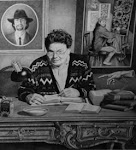
"I am 3/4ths Canadian, and one 4th New Englander - I had ancestors on both sides in the Revolutionary war." - Elizabeth Bishop
____________________________________________

Monday, February 9, 2015

Suzie LeBlanc will sing at The Elizabeth Bishop Festival on 8 August 2015

To mark Elizabeth Bishop’s 104th birthday, which was yesterday, the Elizabeth Bishop Society of Nova Scotia is making an exciting announcement. In fact, this will be the first in a series of regular announcements about The Elizabeth Bishop Festival to take place on 8 August 2015 in Great Village, Nova Scotia.

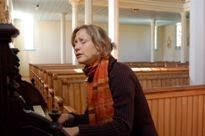
We commence with the exciting news that renowned soprano Suzie LeBlanc (http://suzieleblanc.com/site/) will present the festival’s evening concert. Suzie is the Honorary Patron of the Elizabeth Bishop Society of Nova Scotia and recently received the Order of Canada. Her CD “I am in need of music” (http://www.musiccentre.ca/node/77772), settings of Elizabeth Bishop poems by four Canadian composers (Emily Doolittle, Christos Hatzis, Alasdair MacLean and John Plant) won an East Coast Music Award and was a finalist in the Lieutenant-Governor’s Masterworks Arts Award, both in 2014.
We are thrilled that Suzie will be presenting:

MUSIC FROM THE 45TH PARALLEL NORTH
The 45th parallel north crosses Nova Scotia, New-Brunswick, New York, Maine, New Hampshire, as well as France and Italy. It crosses many other places in Asia and Europe, but we will focus on places that have a connection to the French Acadian settlers of the Cobequid region in the 17th and 18th centuries. The 45th parallel can also be connected to Elizabeth Bishop, who had a profound interest in geography, maps and places, and who lived in areas crossed by this latitude.

The performers :
Suzie LeBlanc, soprano
David Greenberg, violin
(http://www.davidgreenberg.ca/)
Nick Halley, percussion and keyboard
(http://www.nickhalley.com/)
Kiya Tabassian, setar and percussion
(http://constantinople.ca/musiciens/kiya-tabassian-3/?lang=en)

Though not the first time Suzie has performed in Great Village, it is an honour that she will bring to “Wille Les Cadets” (as Great Village was known to the Acadians) her ancestral music, mixed with music from across the 45th Parallel.

The Acadians in Great Village
“The French were said to have prosperous settlements at Masstown, Chignoise, Debert, Great Village and Little Dyke, also a small village of six or seven families up the Folleigh River, three and one-half miles from Glenholme. These villages comprised the territory the Indians named Cobequid, “End of Flowing Water”; there were mills at Chignoise (now Belmont), one at Great Village, and another at Debert. About two hundred and fifty families were residing in Cobequid at the time of the expulsion in 1755.” (History of Great Village, Women’s Institute, 1960, page 17).

The History of Great Village also notes that the Acadian families in Cobequid were deported on 5 September 1755, part of one of the darkest chapters in the history of Nova Scotia. In 1948, in Great Village, part of an original Acadian dyke was uncovered on the share of “Farr Marsh.”

As a child, Elizabeth Bishop was told of the presence of Acadians in Great Village and read Longfellow’s famous epic poem Evangeline. Though not of the same scope or sorrow, Bishop often referred to herself as an exile, and told Alexandra Johnson that the poet carries “home” with her, as many of the Acadians did as they spread across the globe. Some returned to Acadie (Nova Scotia) and we are delighted that Suzie will return to Great Village and bring such an exceptional trio of musicians with her.

**********
As mentioned above, this is the first of a series of posts about The EB Festival. We will be profiling many of the artists who will be participating and describing some of the many activities that will happen that day. We will be setting up a Festival Facebook page and a Twitter account. There is lots to come. Stay tuned! You will want to be "In the Village" on 8 August 2015!

Sunday, February 8, 2015

Happy Birthday!


On Elizabeth Bishop's one hundred fourth birthday perhaps I may be permitted a few lines about one of the great joys this blog has brought to me personally: the continuing opportunity to while away an hour or so out of each twenty-four, enjoying a Miracle for Breakfast. Not (or not only), as you will surmise, the poem of that name, but the quotidian wonder of le petit déjeuner or the Full English itself, bolted down in haste or savored at leasure, but always, always with her writing at my elbow and her language lingering in my mind.

Certainly Miss Bishop did not neglect the most important meal of the day in her work. I don’t just mean there on the wrong balcony with its buttered crumb of bread and single drop of very hot coffee, or in her “Breakfast Song,” or the sad account in her story “The Country Mouse” of munching soda crackers while her maternal grandfather made his way to the dining car for breakfast as she was being spirited away to Boston from the beloved Great Village of her childhood. Her correspondence, too, is littered with breakfast trays and marmalades (the former having been upset by foraging cats with consequential burnt noses, the latter her sine qua non: “…breakfast without marmalade isn’t breakfast, to me,” as she once wrote to her Aunt Grace, although admitting that “my last batch isn’t very good – in Rio I could get grapefruit and different kinds of oranges – here one can just get the local oranges and limes and they don’t have nice skins”), Ovaltine and Cuban coffee (freshly-ground just in time for every meal), occasional oatmeals when the bread ran out in Brazil, and even bacon in cans (yuck!...). None of these things, though, is exactly what I have in mind.

No, I’m afraid I must confess that I am not, in contrast to Bishop’s estimation of literary scholar Wallace Fowley, that rare person who can sit at the breakfast table and not talk about aesthetics. They are frequently in my thoughts when, week after week after week, – fifty two slithery little volcanoes' worth of them – I spend a pleasant few minutes each morning looking through whatever Bishop or her many friends and correspondents might have written on that particular day years or decades ago, searching out quotations for “Today in Bishop.”

Oh, the things I learn! – the dietary habits of the red-legged Seriema, or the odd fruiting patterns of the Jabuticaba tree, for example. And the characters I meet! – the tiny lisping poet cheerleader (“Give me an ‘ETH’!”) during an S-T-R-I-K-E at San Francisco State University (March 10, 1969), or the equally short and almost as pathetic little thirteen year old boy who the next day (but four years earlier) peddled Bishop in Brazil “a crude potato-peeler, cruder flint gadget for lighting the gas-stove, a blue plastic barrel to keep something in, and a huge dead-looking cake of yellow soap, like a small monument, that I'm sure the maid will turn up her nose at,” to mention just two. Painters I might never otherwise have looked at, novelists I might never have read, music I might never have listened to, recipes I might never have botched – all in rich abundance and often comical juxtaposition.

And speaking of botched recipes: this morning I woke up in an especially foul mood, as it had suddenly occurred to me late last night just as I was subsiding into blessed unconsciousness that I had unaccountably forgotten to get eggs during my weekly Saturday foray to the Oakland City, Indiana IGA to purchase the few staples I require to survive in the culinary wilderness that is very rural Hoosierdom, thereby condemning myself five or six hours thence to cold cereal grown soggy in skim milk instead of enjoying a lovely, toothsome, butter-glazed omelette aux fines herbes.

Or so I thought...

For imagine my astonishment and gratitude as I staggered through the kitchen to find in the midst of clamorous birds and matin bells and white gold skies, smack dab in the middle of the dawn-lit Sunday dining room table, a beautiful blue-glass-lined silver dish containing three of the freshest, loveliest, most ovoid answers to the riddle of which came first that one could possibly imagine. My heart fluttered, and then I drew closer...

and then I stared again, and then rubbed the last remaining crumbs of sleep from my eyes, and then stared again, and then I looked and looked my infant sight away...

A thousand words could not describe what I spied next, inscribed on the surface of each gleaming white shell. Fortunately, in this age when one really can see oneself in freshly-washed dishes, ever-encroaching technology means that a pocket camera is always to hand. I shall, therefore, allow the picture below to speak for me:

http://www.egglandsbest.com/product/classic-eggs/


All best wishes,

John Barnstead

Saturday, January 31, 2015

Lifting Yesterday -- A Chapter Three Supplement: Meeting the Family

One of the delights of looking deeply into someone’s life is the connections that come, often unbidden, often unexpected. Elizabeth Bishop had a fascinating immediate maternal family and an intriguing set of ancestors. (I am sure her paternal side was interesting, too, but my research has focused on her maternal side.) One of my favourite of her relatives was one of her great-uncles, the painter George W. Hutchinson. As Chapter Three of Lifting Yesterday tries to convey, the connections between him and Bishop were many and complex, some quite direct and literal, some rather oblique and mysterious.

It was too bad that Bishop never met her great-uncle – I am sure they would have hit it off, as George Hutchinson had a wonderful sense of humour and a truly curious sort of life. I have been looking into his life with my friend and colleague Lilian Falk since the early 1990s. Lilian was one of those wondrous synchoronicities that happen – and I am most grateful that George, in is own strange way, brought us together.

I have also had the great pleasure of connecting with several people in the U.K. who have a direct line of descent from George. First, perhaps ten years ago now, came Pat and Graham Kench. Pat is the great-niece of Lily Yerbury, George’s second wife. The Kenches visited Nova Scotia in June 2011 and they brought with them a remarkable self-portrait George did in 1914, when he was in his early 60s. It hangs in the EB House, and eventually will go to Acadia University.
Second, about three years ago, came Jayne Lawrence, one of George’s great-grandchildren. She is the daughter of Gordon (Hutchinson) King, who was the son of Victor Jubilee (Hutchinson) King, who was one of George’s youngest sons. Jane provided me with important material she had located in her family research. Thank you Jayne. She also sent me a dear painting done by her father, Gordon – especially for me – a treasured possession.
 
Third, late last year, came Matthew Hutchinson, the son of Marty Hutchinson, who was the son of Benjamin Hutchinson, George’s oldest child. Matthew has kindly sent to me a number of photographs, one of them the earliest image of George Hutchinson I have ever seen – a very young man, probably at the beginning of his illustrating career in the 1880s. Matthew has kindly given me permission to post this image of George, the first time, I think, that it has been publicly shown. George had a way with a moustache!
From all of these wonderful people, I have learned a great deal about George Hutchinson, and with each discovery, it became clearer that George’s life was full, complex and deeply interesting in its own right, not just to his great-niece Elizabeth Bishop.

You can learn more about George Hutchinson by subscribing to Lifting Yesterday. It is still possible to do so – go to the “Lifting Yesterday” link at the top of the page to find out how to subscribe.

Over the years I have written essays about George Hutchinson’s connection to Bishop. My first essay was presented at the first Bishop symposium to be held, at Vassar College, in September 1994. Most of that essay was integrated into Chapter Three of Lifting Yesterday. My collaboration with Lilian Falk triggered another essay, “What’s in a Name: The Gilbert Stuart Newton Plaque Error” (which, in spite of its title, is indeed about George Hutchinson). This latter essay was published in Acadiensis in the Autumn 1995 issue. I have a pdf of this file if anyone is interested. Or you can find it in the Acadiensis archives: http://journals.hil.unb.ca/index.php/Acadiensis/index.

Lilian Falk wrote a wonderful essay about George Hutchinson’s illustrating career, which was presented to the Royal Nova Scotia Historical Society and appeared in its Journal in Vol. 9, 2006. My name is included as co-author, but it is primarily Lilian’s work. I can send this as a pdf, too. Lilian co-wrote an intriguing essay about George, “George Hutchinson, a Canadian Illustrator of Robert Louis Stevenson’s Treasure Island,” which appeared in Canadian Children’s Literature (now Jeunesse Journal), Vol., 25:4, No. 96, 1999. The journal’s site is searchable if you register, so it can be found there.

Tuesday, January 27, 2015

A Memory of Congonhas


John’s Sunday “Today in Bishop,” which invoked Congonhas, triggered a vivid memory of my brief visit there in September 1999, that trip of a lifetime to attend a Bishop conference in Ouro Prêto -- a group of us went by bus to Rio afterwards and we stopped at several places on the way, including Congonhas. I went searching through my “Brazil trip” photo album and found pictures I took of the Twelve Prophets by Aleijadinho – pictures taken with one of those disposable cameras (I was no photographer!). I have scanned two and wanted to post them here.

It just so happens that today the heart of Bishop’s world -- New England, Maine and the Maritimes -- is in the grip of a serious blizzard. As I look out my window the snow is thick and “falling” horizontally on fierce wind. So, it is nice to contemplate that time sixteen years ago: the glorious blue sky, the quite powerful statues gazing off, seeing who knows what, the good friends who wandered around with me amazed that we were there. In the mid-1960s, after being in Brazil for over a decade, Bishop had a bout of “nostalgia for the North” – I think she’d have been glad to be in Rio on a day such as today, when you can’t see the nose in front of your face, as the saying here goes. Sometime soon, I will post something about my favourite Aleijadinho sculputure, which I saw in Mariana. Stay safe!