Starting today (Wednesday, July 25, 2018) coffee, tea, and freshly baked treats will be on offer in the sanctuary of St. James Church of Great Village! Stop by and learn about the history of Great Village while enjoying some great food!
Wednesday, July 25, 2018
Treats in Great Village! From our Friends at Saint James Church --
Starting today (Wednesday, July 25, 2018) coffee, tea, and freshly baked treats will be on offer in the sanctuary of St. James Church of Great Village! Stop by and learn about the history of Great Village while enjoying some great food!
Monday, July 16, 2018
Letters to Aunt Grace, Part 72: Family matters continue
This long delayed post will conclude Bishop’s letter of 18
October 1960. After the rather lengthy, perhaps slightly obsessive analysis of
her cousin’s strange, stand-offish behaviour, a dense paragraph that filled
nearly one half of the page on which is was typed, Bishop suddenly stopped.
This interruption was signalled in the text by an empty line set off from the
previous dense paragraph and then the sentence:
“Stop — to take a large stinging [this word scribbled by
hand above the type] out of my brassiere —”
(Perhaps this Paraponera clavata, one of the nastiest stinging ants
in Brazil, is the kind Bishop mentions.
Click the link to see all kinds of Brazilian ants!)
in Brazil, is the kind Bishop mentions.
Click the link to see all kinds of Brazilian ants!)
Bishop was nothing if not literal and immediate, and this
delightful interjection (not, I suppose, delightful for her!) would have given
Grace a chuckle and brought her niece’s daily life really close. Bishop did not
offer any report of being stung, so the removal was done before any injury.
One might think this interjection would shift Bishop’s focus
and she would turn to other things, but family matters continued to dominate —
though she did acknowledge that she “must stop wondering and go down and see
what there is for Marietta’s
(the sister’s) lunch.” If cousin Elizabeth was “baffling,” Lota’s sister was
her own sort of trial. Thought “2 years younger than Lota, with two sons and
two baby grandchildren,” Marietta
was “a nervous wreck.” Whatever the cause of this condition, Bishop told Grace
that “we always get so tired when she comes to visit!”
This somehow prompted Bishop to remember to say, “I hope you
are keeping well and taking your medicine” and inquiring about her aunt’s leg.
Which in turn made her report that she had once again “had a letter from Aunt
Florence from another nursing home,”
writing about her “circulation troubles.” Florence gave no reason for the move so
Bishop was “waiting to hear from the cousins about what really happened and how
she is.” In the end, all Bishop could say about this difficult, cranky, elderly
relative was “poor thing.”
Winding down this epistle, Bishop once again urged Grace to
write and wistfully concluded: “I wish it weren’t so far away and expensive for
you to visit me — I don’t think you’d stall like my cousin, would you?”
She signed off with her usual “much love,” but before she
sealed the missive in its envelope, she added a postscript “after lunch” to
update the cousin issue. She reported that she “finally got Ray at his office —
bright & cheerful as ever.” She confirmed they had moved and had no
telephone, “but HE could call, after all.” Bishop and Lota were still waiting
to get the maple syrup the Naudins had transported, which Ray mentioned, “Aha!”
wrote Bishop, “I’ll send you a check next time.” Surely Grace didn’t want any
reimbursement. Bishop also reported that they had “made another date, for the
29th” for their visit, “maybe he’ll be able to get a company car.” Bishop had
reached her limit though: “I’ve been inviting them & telephoning them for 5
months,” she scribbled in her almost indecipherable hand at the bottom of the
page. She swore it was “the last time I’m going to try.” She quite rightly
noted: “don’t they know the young are supposed to make the effort to see the
OLD?”
Bishop’s next letter was typed on 29 October, the day of the
proposed visit. The cousin saga continued and will be the subject of the next
post.
Sunday, July 15, 2018
Elizabeth Bishop Society of NS participates in Truro's Pride Parade
The weather cooperated and the turn out was great, and a fun time was had by all who participated in Truro, N.S., third annual Pride Parade, including members of the Elizabeth Bishop Society of Nova Scotia. Here are a couple of images taken by Mickey Rigby, which show just how colourful the celebration was. Thanks to April Sharpe, summer student and tour guide in Great Village, for pitching the idea to participate and helping to bring it about. Thanks to all the EBSNS supporters for getting involved.
(EBSNS President Patti Sharpe on the far right. EBSNS board member Laura Sharpe (and summer student at the Bass River Museum) to her left. Great signs!!
Here is the whole EBSNS contingent looking colourful, indeed. That is the instigator April on the far left. Patti reported: "The parade was a big success, well attended. It was a lot of fun to be part of it all and everyone was in the best of spirits with lots of music and dancing." Bravo.
(EBSNS President Patti Sharpe on the far right. EBSNS board member Laura Sharpe (and summer student at the Bass River Museum) to her left. Great signs!!
Here is the whole EBSNS contingent looking colourful, indeed. That is the instigator April on the far left. Patti reported: "The parade was a big success, well attended. It was a lot of fun to be part of it all and everyone was in the best of spirits with lots of music and dancing." Bravo.
Tuesday, July 10, 2018
EB turns up in interesting places
A few of us over the years have paid attention to Bishop’s
appearance in unusual places: films, young adult novels, television shows and
so on. Her words have appeared as epigraphs in fiction and non-fiction books.
Her poems have been read on the big screen. (All of these appearances are
outside the major treatments of her by composers, visual artists, documentary
film makers, fellow poets, and the literary critical industry around her.)
Indeed, John has been locating and posting some of these
interesting and strange places where Bishop or her art have found a unique
place.
I think a whole study could be done about the way Bishop’s
art has infiltrated other art and even mainstream cultural expression. I
suppose it is so for many other poets, such as Dickinson and Frost; but for
those of us who love Bishop’s work, it is fun to come across her in places where
one isn’t looking for her.
Recently, my sister read Brad Kessler’s 2006 novel Birds in Fall: A Novel, which uses the
tragedy of the 1998 Swiss Air crash off the coast of Nova Scotia as a
foundation for a fictional story about the families who lost loved ones in that
terrible disaster. She excitedly showed me a spot near the end of the book
which includes a passing but clearly knowledgeable reference not to Bishop’s
art but to her life.
The reference is near the bottom of the page.
Brad Kessler, a very interesting fellow, who clearly spent
time in NS before (perhaps even during) the writing of this novel. His novel
came to us via Heather Killen, who owns a wonderful used bookstore in Berwick, N.S.,
called Shelf Life. I had not heard about it before – when I am done with it, I
will pass it on to Laurie Gunn to put in the EB House – it only seems
appropriate.
Friday, July 6, 2018
EB House Tours -- Summer, 2018
April Sharpe is working for the St. James Church of Gt. Village Preservation Society for the summer as a historical interpreter both at Elizabeth Bishop House and the Saint James Church. She will be doing tours of the Elizabeth Bishop House on Saturdays at 2pm with the exception of July 14th. She will also be offering tours of EB's Great Village on Thursdays at 2 pm.
Parking is available at the church. April can be found upstairs in the church most days with the exception of Mondays and Tuesdays. Thank you, April, for your dedication to Elizabeth Bishop's legacy!
Monday, July 2, 2018
BBC Radio 3 Programmes about Elizabeth Bishop
Here are some links to BBC Radio 3 programmes about Elizabeth Bishop and her works --
[1] Elizabeth Bishop's 'Large Bad Picture' -- Episode 2 of Five Poems I wish I had Written, with poet, editor and teacher Don Paterson.
[2] The Loves of Elizabeth Bishop -- Episode 4 of The Love that Wrote its Name, with novelist Neel Mukherjee.
[3] Colm Toibin on Elizabeth Bishop, Mammoth Cloning, Fareed Zakaria.
[1] Elizabeth Bishop's 'Large Bad Picture' -- Episode 2 of Five Poems I wish I had Written, with poet, editor and teacher Don Paterson.
[2] The Loves of Elizabeth Bishop -- Episode 4 of The Love that Wrote its Name, with novelist Neel Mukherjee.
[3] Colm Toibin on Elizabeth Bishop, Mammoth Cloning, Fareed Zakaria.
Friday, June 29, 2018
Letters to Aunt Grace, Part 71: More cousin talk
Bishop turned next, from the account of Lota’s sister, house
and the new beehive oven, to her own family in the 18 October 1960 letter,
specifically to her cousin Elizabeth Naudin, who was then living in Brazil with her
husband Ray and their young daughters. Bishop had been making overtures to Elizabeth for some time,
but finding the reception “rather baffl[ing].” She had to confess to Grace that
she didn’t “know quite what to think of her behaviour.” Bishop couldn’t decide
of her cousin was “cold,” “indifferent,” “or maybe shy, or what.” She reported
to her aunt that she’d “been to see her four times” and “taken presents.”
During the most recent visit “she seemed really friendly at last and even said
she’d like to have me ‘visit’ her for a ‘few days’, which I thought was nice
and homey of her.”
The saying is, actions speak louder than words, and in spite
of this warmer reception, the Naudins sort of vanished, again. Earlier on they
had “left the hotel without leaving any address or number.” Bishop had to
resort to contacting “Ray at his office (a hell of a job) and track her down.”
After the most recent, friendlier visit, she told Grace, her cousin had “done
the same thing again — they’ve moved.” Bishop’s frustration was evident when
she wrote, “although I know which building (unless they didn’t take that
apartment),” she still couldn’t really locate her without the apartment or a
phone number.
Bishop persevered by the old route of trying to get hold of
Ray, which she said she’d been doing “for three days.” After this statement an
ellipsis “…” Silence, it seems.
(Elizabeth Naudin sent me photos of the George Hutchinson
paintings she inherited from her mother Mary Bulmer Ross.
This painting is entitled "Ferry Boat Inn, Walton, 1931.")
Bishop also reported that she had already “called her to
talk to her a dozen times, probably,” but Elizabeth
had “never telephoned once.” That is, she said she had called “the Rio apartment,” which was more or less the same
thing, as Bishop noted to Grace, “where I never am!”
With exasperation, Bishop asked Grace, “Do you suppose she
is shy — she doesn’t seem so, exactly — or what is it?” Grace likely had
no better idea what the issue was, either, at that distance, so Bishop’s
question was probably rhetorical. She wanted to keep giving her cousin the
benefit of the doubt.
Bishop again confirmed that she and Lota had invited them to
visit the house at Samambaia, “over and over again.” Extending the invitation
to the children. But the visit had not yet happened. Bishop wondered aloud that
at first she “thought maybe they thought that bus trip too hard — 1½ hours.”
But she discovered that wasn’t the issue as she learned “they have gone by bus
to visit his sister — a much longer trip.”
(Another George Hutchinson painting owned
by Elizabeth Naudin: "Windmill," 1917.)
Pondering all these circumstances and permutations, Bishop
typed out (you can perhaps feel the extra pressure on the keys): “Maybe it is
very simple — she just doesn’t like me! — or I seem like an old lady to her, or
something.” Having reached that vague conclusion, Bishop declared that she
“honestly” couldn’t “see what more I can do. She acts as if the telephone
didn’t exist.” But the conclusion didn’t end the matter. Bishop continued, “How
does she think I’m going to find her, in a city the size of Rio?”
Grace knew well enough from Bishop’s letters that her niece “almost never” went
to the city, “particularly now that it is summer.” Shifting for the briefest
moment out of this slightly obsessive natter, Bishop observed, in parentheses:
“(There is a water-shortage and I hope for the children’s sake she isn’t in a
part of town without water …).”
That broader observation instantly reverted to more fretting
about what to do: “I’d love to have her come up here.” She extolled to her aunt
the appeal of the house under the mountain: “the children could play in the
brook etc.” Finally, Bishop conceded that she could not read the behaviour, “I
can’t tell whether they really don’t want to or what it is — and now this
vanishing again …”
Bishop had tried calling “at their old apartment” and was
told “they’d left.” “‘Do you know their new number or address?’ [she had asked]
‘No, Senhora.’ And [the maid] hung up.”
Bishop repeated the word that started off the whole
disquisition, “Well, I’m baffled, that’s all.” Because it was family, she said,
“I’ll try once more.” Again, the benefit of the doubt kicked in as Bishop said
with some incredulity, “She doesn’t seem to understand that I don’t live
in Rio.” Visits there were always brief and
focused on tasks, chores, errands: “the bank,” “my teeth,” “etc.” The hurry and
brevity of Rio meant that “it is much more
agreeable to see people up here and I’d like to show her around a bit, too. But
no luck.” And Lota, ever the doting grandmother, “would like to see the
children.”
I had read and transcribed Bishop’s letters to Grace by the
time I met Elizabeth and Ray Naudin in the late 1990s. I knew the degree of
frustration Bishop felt in her efforts to connect with this cousin and her
family. Being a polite Nova Scotian, I never asked Elizabeth
about her time in Brazil
when she met her ‘just starting to be famous’ cousin for the first time. I will
confess, however, I was dead curious. In the afterlife of Bishop, Elizabeth and
Ray Naudin were not at all reluctant to declare their connection to their
lauded relative. Perhaps they had forgotten about the fraught dynamics of their
Brazilian sojourn. And likely Bishop never expressed her frustrations too loudly,
if at all. One puts up with a lot where family is concerned.
(A third Hutchinson painting owned by Elizabeth Naudin:
"Thames Ditton Church," 1932. These and other paintings were inherited
by Elizabeth and Ray's oldest daughter Suzanne.)
Bishop was an orphan in the strictest sense of that word
with the early loss of her parents; but the extended family on both sides
remained a constant through her entire life, even when she was in distant Brazil, even
when the dynamics were fraught. The story of this connection continued as the
letters unfolded, more effort, more bafflement. If Bishop had not cared about
family, she could easily have gone silent. While the art might be the enduring
manifestation of the artist, we all can identify with the “untidy activity” of
daily life and family connections: “awful but cheerful”!
The next post will conclude a letter focused on familial
bonds.
Sunday, June 24, 2018
Another successful EBSNS AGM
Yesterday, an enthusiastic group of EB fans gathered in Great Village for the EBSNS AGM 2018. If you are interested in the business side of things, you can check out the EBSNS website events page by clicking here. This post will offer some of images of the lively gathering.
(Photo by Susan Kerslake)
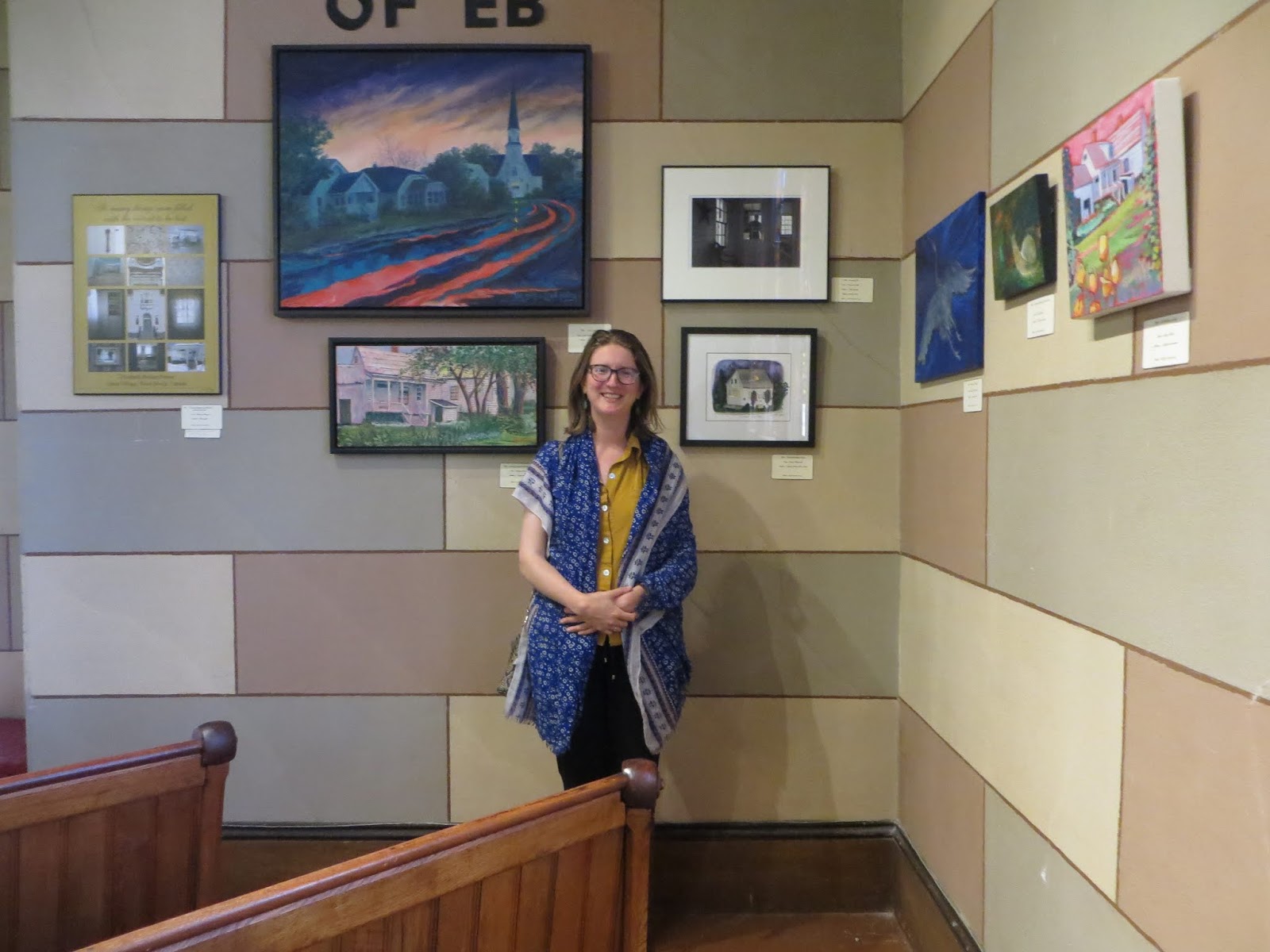
This image shows some of those gathered looking at the new "Echoes of EB" and "Elizabeth Bishop's Beginning's" exhibits. The new art display includes paintings and photographs by: Taiya Barss, Emma FitzGerald, Kathleen Flanagan, Mary Lou Payzant, Richard Rudicki and Susan Tooke. Here is Emma beside her contribution (to her left):
(Photo by Sandra Barry.)
Our guest speaker was Halifax poet and soon to be retired Saint Mary's University professor Brian Bartlett.
(Photo by Susan Kerslake)
After Brian's lively reading from his recently published Ripples Over Branches, the assembled walked to the Elizabeth Bishop House where a brief ceremony took place to mark the designation of the house as a Municipal Heritage property.
(Photo by Susan Kerslake)
The ceremony was presided over by Laurie Gunn (right) and the unveiling done by Colchester County mayor Christine Blair (left). It is exciting to have the house now part of the county's heritage program.
After the ceremony, everyone walked to the Legion for the usual delicious sandwiches and sweets provided by the Fire Brigade Auxiliary.
(Photo by Susan Kerslake)
(Photo by Sandra Barry)
Thank you to all the volunteers who helped make this AGM happen and to all those members and friends who attended. Perhaps the person who came from furthest away was Kay Bierwiler (left), who lives in Massachusetts and was visiting Great Village for the first time. Sandra Barry on the right.
(Photo by Susan Kerslake)
Thank you to the St. James Church of Great Village Preservation Society and Laurie Gunn for their stewardship and care-taking of the Elizabeth Bishop House.
Monday, June 18, 2018
Elizabeth Bishop Society of Nova Scotia AGM -- A Reminder
On Saturday, 23 June 2018, the EBSNS will hold its Annual General Meeting in Great Village. We are excited that besides the business and program outlined on the poster below, a significant and exciting addition to the day's events will be a brief ceremony to mark the designation of the Elizabeth Bishop House a Municipal Heritage Property. The EB House received a provincial heritage designation in the mid-1990s, but this new designation reinforces the importance of Bishop and her childhood home to the village, the county and the province. We hope you can join us on Saturday for the festivities.
Tuesday, June 12, 2018
EB House Featured on CTV
Here us a link to a CTV News segment from June 10, 2018 about the Elizabeth Bishop House, featuring Laurie Gunn and Brian Bartlett:
https://atlantic.ctvnews.ca/video?clipId=1415235
[Please note that the video clip may be preceded by a thirty-second commercial. To restore sound, move the cursor to the bottom of the video frame -- the controls will appear, and you can click on the little loudspeaker icon to adjust the sound to your liking.]
Sunday, June 10, 2018
Letters to Aunt Grace, Part 70: Lota’s house and family
The next subject of Bishop’s letter of 18 October 1960 was a
packed paragraph about Lota’s Samambaia house, with a few observations about Lota’s
family, in this case, her sister.
Bishop began this paragraph by reminding Grace about their
recent trip to “ParatÃ,” adding they had also recently returned from a
second trip: “then we went away for a week again to Cabo Frio, where we go
Christmases.” Bishop had regaled her aunt about these holidays on a number of
occasions, a place where they could “stay in a friend’s beach house.” The
reason for this trip, so outside of their usual routine, was because “Lota was
very much in need of a rest, having such troubles with her family, her lawsuit,
etc.” Bishop didn’t elaborate, except to say that “Lota’s sister” was “now
here, (arguing!).” The tensions with this sibling came in for more
comment at the end of this long letter, but other matters dominated this
paragraph.
The week away had been pleasant, even if it “was a little
too soon in the season, and windy.” They had gone “swimming every day and had
an awfully nice time.” But “the minute we got back people started arriving” and
not just siblings, but “friends of friends, from São Paulo” and then “a bus load of German
architects.” The reason for this group was Lota’s house: “it is a famous piece
of ‘modern’ architecture, you know.” What Bishop did not tell her aunt, but
which she told Robert Lowell in a letter written at the same time was: “Their
bus driver mutinied at our mountain road and Lota made trip after trip — but a
good many of them came up on foot, straight up, for about a mile, and arrived
panting and red and bowing and heel-clicking and hand-kissing — fascinating
long hair-dos — about 3 female architects among them — I lost track in the
hubbub. Some were very nice.” (Words in
Air, 344)
(Lota's house at Samambaia.)
When I read this account in the letter to Lowell, it immediately took me back to
September 1999, when I and a busload of Bishop fans reached the foot of that
same mountain in a tourist bus. Our bus driver “mutinied” too, refusing to take
the vehicle any further. Our host, Zulieka Borges Torrebla, drove the few who
couldn’t walk up that steep incline, but the rest of us walked, just as these
architects had done 39 years before.
(Bishop scholars beginning the walk to the house
under the mountain, September 1999. Photo by Sandra Barry.)
Word had clearly got out because not only were the Germans
arriving, but also “another bus load, American architects this time, coming
this week.” One wonders if they performed the same ritual of shuttling and
hoofing.
(Poet Jeffrey Harrison (left) and Bishop scholar Gary Fountain (right)
part way up the road to the house under the mountain,
September 1999. Photo by Sandra Barry.)
A guest of a different sort was also expected: “tomorrow an
unknown young American poet” was due to arrive for lunch, “and I think his
poetry is so bad that I’m rather dreading that!” Bishop discreetly does not
offer his name. Nor did she yield it in the letter to Lowell. What she does tell Lowell is that this “young man who sent me
the bad poetry” had “called up to say he couldn’t come.” (Words in Air, 344) Undoubtedly, they did connect, as he was a
“Fulbright, teaching at the University,” so he would be around for awhile.
Brett Millier does not identify him in her account of October 1960. His pending
visit had triggered in Bishop a kind of existential weariness in the face of
“so much adequate poetry all sounding just alike and so boring …. And no one really feeling anything much.” (Words in Air, 344)
Part of the reason why they were beset by company was
because “‘Summer’ is beginning and there are always too many people coming and
going.” But competing with all this activity, and offering some solace, was the
fact that “the flower garden has never looked better.” The list of flowers was
impressive: freesias (“absolutely beautiful … all colors of the rainbow”;
lilies; agapanthus blooming “all up the hillside, about three feet tall, white
or blue.” Bishop could always find relief in the natural world around her.
Along with the flowers, the vegetable garden was producing:
“for the first time in my life I am sick of artichokes” because they had “been
eating [them] every night for dinner.”
Finally, the last report in this dense paragraph declared
that the beehive oven they had been constructing was finished: “it is very
picturesque and in a day or two I’ll try it — and probably burn the break black
the first time.” The fellow who had done the actual construction produced “some
of his wife’s bread” because “when Lota showed him mine he said ‘Too
much yeast!’” Bread making clearly has a competitive element., even though
Bishop was confident enough in her newfound bread-making skill to dismiss this
critique: “because it isn’t the size or kind of bread they use.” To each his or
her own.
Winding down this particular track, Bishop observed that if
they stayed home over Christmas (having had their Cabo Frio trip early), “I
think we’ll try roasting a suckling pig” in the oven. Ever the pragmatist and
economist, she noted however that “food,
particularly meat, is getting so expensive here now maybe we can’t afford such
luxuries.”
Bishop then turned back to her own family, not an ancestor,
but her cousin Elizabeth, who was still very much nearby. This subject for the
next post.
Friday, June 8, 2018
A few more photographs
Laurie Gunn recently sent these images of the exhibits set up this year by the EBSNS in St. James Church in Great Village, N.S. Come to our AGM on Saturday, 23 June 2018, starting at 1:30 p.m., in the church and see the displays for yourself. The EBSNS is excited to announce that after the AGM a brief ceremony will be held at the Elizabeth Bishop House, by the Preservation Society and the Municipality of Colchester County, when the house will receive a Municipal Heritage designation. Let us hope for some sunshine and warmth for that day!
(Elizabeth Bishop's maternal family.)
(Echoes of Elizabeth Bishop art gallery exhibit, above and below.)
Thursday, June 7, 2018
A little souvenir
This image just in from Ingrid Jejina, who visited Great Village and attended the Elizabeth Bishop Arts Festival in August 2015. Thanks Ingrid.
Happy writing one and all!
Sunday, June 3, 2018
Elizabeth Bishop's Beginnings exhibit
On 2 June 2018, members of the board of the EBSNS gathered at St. James Church in Great Village to install this year's "Elizabeth Bishop's Beginnings" exhibit and "Echoes of Elizabeth Bishop" gallery exhibit, which will officially open at the AGM on Saturday 23 June. Here are a few photos of what this year's exhibit looks like (we will share photos of the art gallery works at a later date):
(An overview. Photo by Sandra Barry.)
(Some details. Photo by Sandra Barry.)
(Laurie Gunn's lovely "Sandpiper" hooked rug. Photo by Sandra Barry.)
Below is a reminder of the details of the AGM, which will take place in the church at 1:30 p.m., Saturday, 23 June. All are welcome.
Saturday, May 26, 2018
Letters to Aunt Grace, Part 69: Great-Uncle George
Bishop’s next letter to her aunt was typed on 18 October
1960. She opened with an acknowledgement of receipt of a letter from Grace, the
day she had send her previous letter: “Did you notice on the back of the
envelope of my last letter that I’d written I’d just got yours at the P.O.?”
This back and forth was not always in sync, but for Bishop, it didn’t matter
when her aunt’s letters came, they were always welcome. Even so, it took her a
couple of weeks to settle again to write to Grace.
The letter from Grace contained more “family-tree” material.
Bishop was delighted and told her aunt that she was “going to try to put it in
tying” (clearly Grace had sent more holograph) “and maybe even use some of it
in a couple of N.S. stories I’ve been working away at slowly.” This batch of
family material must have focused on the Hutchinson
side of things because Bishop next expressed her delight in a photo that was
included: “I loved the photograph of great-uncle George and dear Lily before
the war.” This was of course George W. Hutchinson, the painter of “Large Bad
Picture” and the “Poem” painting. Lily was George’s second wife, Lily Yerbury.
(George W. Hutchinson and Lily Yerbury Hutchinson, circa 1920s.)
George was still very much alive when Bishop began to travel
to Europe in the late 1930s (he lived until
1942, dying just shy of 90). Twice, Bishop had been in England, near
enough to visit, but never managed to do so. “I am so sorry I didn’t get to see
him the two times I was in London
before the war.” These visits to the land of all her ancestors were both brief
and she noted that “the first time I was sick in bed most of the time.” So, she
lost her chance to see one of her most intriguing relatives.
Bishop remembered a “nice photograph … of him seated outside
his rose-covered cottage” and asked Grace if she still had it. That cottage was
“Thelma” in Clacton-on-sea. In is later years,
George loved growing roses. Bishop wondered, “who has all the paintings now?”
These paintings have dispersed all over, some remaining with the extended
Bulmer family, a good number of them in the possession of Pat and Graham Kench
in England, some remaining with George’s direct descendents, particularly his
great-grandson Matthew Hutchinson (the grandson of George’s son Ben and Ben’s
son Marty). Some of George’s paintings are in the archives at Acadia University
and some in the Art Gallery of Nova Scotia. Bishop would perhaps be amazed by
how widely dispersed his legacy is.
Bishop also remembered “one [Hutchinson painting] Aunt Maud[e] had — a
sort of swampy scene with a gray and white sky — remember it?” Two paintings similar
to this one, are located in the archives at Acadia.
These ponderings prompted her to say, “Sometime I’d love to have one of his
paintings if I could.” She was already in possession of “one tiny water color
he did very late in life — not as good as the earlier ones.” Just what this
painting might be is a mystery. It cannot be the “Poem” painting, which was
done early in his life and is a tiny oil (this painting was sold in 2011 to
Rachel Jacoff of Boston).
As far as I know, it was not in Bishop’s estate when she died.
Perhaps it was the “Poem” painting that Grace sent to
Bishop, to fulfill this request. In any case, Bishop noted, “as you can see —
I’m in the market for any old souvenirs and I love photographs.” Her concern,
however, was that she was “so far away and it isn’t very safe to send things.”
And certainly, she wouldn’t want precious family mementos to go missing. She
concluded that it might be best to wait until “when I do get to visit you….”
(George W. Hutchinson, circa 1890s.)
Before shifting gears to update life in Samambaia, Bishop
asked one more question, about another uncle: “How is Uncle George?” meaning
George Shepherdson, Maude’s husband. Bishop had somehow heard enough about him
in Grace’s letters to remark: “I do hope he has given up driving!” In
parenthesis she added, “And I want that watch, damn it.” She was referring to a
watch that had belonged to her father that George Shepherdson was in possession
of. This watch surfaces again, so perhaps Grace made the effort to act on this
declaration. With such distance between them, it always took real time for
exchanges to occur.
After all this family talk, Bishop turned to daily life up
in the mountains, which will comprise the next post.
Wednesday, May 16, 2018
Letters to Aunt Grace, Part 68: Fire
After her lively account of the Partay trip, Bishop jumped
right into her next subject in the 23 September 1960 letter: bread. In a
previous letter, Bishop had announced to her aunt that she had “been going in
for bread-making” and had found that she was, to her surprise, pretty good at
it. She reiterated that she had thought bread “was much harder to make” than it
turned out to be, and she boasted, “now I make oatmeal bread, raisin bread,
wheat germ (wonderful for toast) etc etc.”
She had also mentioned that she asked Lota to build her an
outdoor oven for the task, because it would help conserve the bottled gas they
had to use for the regular oven. With this letter, Bishop was able to report
much progress in this matter. She wrote, “We are starting our outdoor oven.”
She even drew a little picture in the margin for Grace, to accompany her
description: “bricks and mortar — ours is right on a flat rock that happens to
be near the kitchen, so it doesn’t need any floor, even — just waist-high.”
They could “buy the oven door” already made.
Much to Bishop’s delight, a friend had loaned her “an old
copy of the famous ‘Mrs Beeton’s’ cookbook,” and she found “that in 1897 she
said that an oven exactly like the one we’re building make the best
bread of all.”
Bishop explained further, “You put in a stack of wood, let
it burn up, then scrape the ashes out with a hoe, and put the bread in.”
All of this was, delightfully, “very primitive,” a condition Bishop approved of
immensely.
If they needed to be to conserve the bottled gas, on the
other hand “we have plenty of wood around,” and even better “a man to do the
cleaning out!” Finally, when completed, the oven would be “white-washed” and
Bishop proudly declared it would look “very quaint indeed.”
If fire in the oven wasn’t enough, Bishop then tells Grace,
“This is what they call the ‘month of fires’ here because it is always so dry.”
As a result there were “so many brush fires — I dread it.” This dangerous
season had “so far” not taken any of Lota’s trees, but Bishop noted that the
fires had come “awfully close and every night we can count five or six fires
burning on the mountains around us.” Dreadful indeed! The other concern for
Bishop during this was her asthma “from all the dust and smoke.”
Bishop again sent this letter on the same day she wrote it
because, as she told her aunt, “today’s the big marketing day.” Their
provisions had been depleted because “last Sunday we had five people here, and
five more came unexpectedly for tea,” so she had “a list a mile long” to
replenish.
Ever keen to write about food, Bishop told Grace that this
large gathering of company were served “a big beef and kidney pie” with “stewed
tomatoes (we had too many to use up!)” and for dessert “caramalized pears.”
In case Grace did not know this particular delicacy, Bishop sent her an “easy
to make” recipe: “cut them up in eighths and put them in a very hot
oven” (though perhaps not the beehive version) “with a lot of sugar on top, and
a little butter.” After “about fifteen minutes,” when “they are beginning to
burn and get caramel-y, then you throw on a cup of cream — or you can
skip that.” Simple indeed, but Bishop noted that “everyone thinks they are
something fearfully difficult to do.”
Bishop began to wind down at this point, asking, as usual,
“how is the leg? — and how is the diet, etc.?” This prompted Bishop to note
that “Lota has been gaining a bit and I am very severe with her.” Bread,
beef and kidney pie, caramalized pears — no wonder she was having trouble
getting “into her city clothes.” Bishop assured her dieting aunt that she
enforced “only a salad for lunch, and beef and vegetables for dinner, plus an
orange or two” for their regimen, except, of course, when company came! Scribbled
in the margin, “(& 1 piece of toast for breakfast)” – hard to do with
multiple kinds of bread coming out of that new oven!
The final quick paragraph asked, as always, “Please let me
hear from you.” Bishop also told her aunt, “I’m sending some cards to Ruth
Hill.” Ruth Hill was one of Gertrude Bulmer Bishop’s best friends, who appears
in “In the Village”: “Miss Ruth Hill gives me a Moirs chocolate out of the
glass case. She talks to me: ‘How is she [Bishop’s mother]? We’ve always been
friends. We played together from the time we were babies. We sat together in
school. Right from primer class on. After she went away, she always wrote to me
— even after she got sic the first time’.” (The
Collected Prose 265–66)
Even though she was well over a decade away from Nova Scotia, Bishop not
only stayed in touch with her family, but even her mother’s closest friend.
Bishop quickly noted, “I have another poem about to appear
in the New Yorker”: “Song for the Rainy Season.” “It’s about the house here
where I live — I think you’ll like it.” Admonishing her aunt to “take care of
yourself,” she closed as always, “With much love.”
Only a few weeks passed before Bishop wrote another even
longer letter to her aunt. The next post takes up her October news.
Friday, May 11, 2018
Letters to Aunt Grace, Part 67: Paraty
Bishop’s letter of 23 September 1960 really got underway
after she had dispatched all the updates. The next subject warranted a long
paragraph: “We went to explore a place we’d heard about, called ParatÃ.”(or Paraty). It appears Lota had never gone there herself prior to this visit.
In her inimitable way of engaging place/geography, Bishop offered Grace a description
and account that prefigures her late poem “Santarém.”
She explained to her aunt that it was “a small port that
hasn’t changed a bit for about 200 years.” This continuity appealed to Bishop,
though one wonders if Lota, ever the modernist, enjoyed it as much as Elizabeth. While she knew
change was inevitable, for Bishop, virtue inhered in tradition and the past.
Paraty (as Wikipedia prefers), Bishop wrote, “is right on
the end of a long bay — in fact at high tide the water comes right up the ends
of the streets; and at very high tide, in May, they put planks across
the streets from sidewalk to sidewalk.” (I wonder if that is happening this
month! One can’t help but wonder what affect is sea level rise having?)
Bishop recounted that “a friend of ours went there in May
and went out for a walk at night, carrying a candle … and crossing the
planks.” Perhaps it was this romantic, adventurous story that prompted their
visit.
At the time of Elizabeth
and Lota’s visit, “they [the residents] had had electricity for exactly one
month … and everyone was still very excited about it.” Bishop related that “at
night there were circles of children under every lamp post, just like moths.”
From what I see online, Paraty is now a very popular tourist destination, so
the electricity stayed and expanded, probably exponentially. But in 1960,
Bishop noted that “we were the only car in town, except for one broken
down one, and a few trucks.” “Everyone comes and goes by ferry, twice a week,”
Bishop reported. There was also a bus, “twice a week.”
This place, almost out of time, was small enough so that
“you can walk around” all of it in “ten minutes.” What impressed Bishop most
was that “every single house is perfectly beautiful — but so run down and
poor.”
Interestingly, Bishop noted that one could “buy a huge
house, perfect 18th century — three
floors, beams two feet square, etc — for about $2,000 — huge garden and palm
trees, too.” Does this sound familiar? Five years later, Bishop did buy an 18th
century house in Ouro Prêto, when timing and circumstances were better; but perhaps
here she was already on the look out. Or, perhaps, encountering this real
estate possibility helped trigger the idea that would come to fruition in the
middle of the decade. Millier notes that Bishop paid $3,000 for the house in
Ouro Prêto (370), a city that eventually would be designated a UNESCO World
Heritage site.
Not only did Bishop see the value in buying a house, but she confessed to
Grace, “I’d like to buy the whole town, just to preserve it.” Loving the ocean
and shoreline so much, one might think Bishop might have acted on this urge,
but she noted, “unfortunately, the bay is too shallow, no good swimming, and
I’m afraid it would be hot, etc.” No place is perfect, after all, even in
paradise.
Elizabeth and Lota stayed for a few days. “Our ‘hotel’ was
something,” she observed, an “18th century mansion all divided up by wooden
partitions.” This meant you could “hear everyone sneeze and snore — the
travelling salesmen and us, that was.” Knowing Grace would find it both funny
and charming, Bishop wrote that “the travelling salesmen strolled through the
dining room in their pajamas and brushed their teeth, etc, at a sink in the
corner.” For added effect, Bishop observed: “and the bathroom. Words
fail me.”
Ever the take-command-kind-of-person, Bishop noted that
“Lota put up a good fight, but we never managed to get it repaired.” The
hotel’s “landlady — ‘dona Zezé’” eventually gave them “a bucket of water a few
times a day and we’d flush it.” In spite of these plumbing and privacy
inconveniences, Bishop declared, “But everyone was perfectly charming!”
Not forgetting the cuisine, Bishop observed that she “ate
nothing but fish and bananas for three days” and that the fish was “excellent.”
She was also smitten with the churches: “adorable.” The only downside, the
thing that “ruined” the visit for them, was “the town’s one loud speaker —
(elections are approaching here, too).” Even so, Bishop concluded that “it was
worth the effort,” ending her typed account with a scribble in the margin, “a
long long drive, over dirt roads,” a scribble looking perhaps something like
the dirt roads on which they drove.
Paraty’s eighteenth century heritage and delights, its village
atmosphere, clearly appealed to Bishop even at this stage, and perhaps helped
seed her desire to find her own historic home. Curiously, she did so far
inland, in land-locked Ouro Prêto. Millier notes that it was the “backwardness
and inefficiency [of Ouro Prêto that] charmed her, the way Brazil had charmed her after her struggles with New York.” (370).
Bishop hadn’t finished all her local colour. More of it in
the next post.
Sunday, May 6, 2018
EBSNS Annual General Meeting, 23 June 2018
Come join us for all the activities at this year's Elizabeth Bishop Society of Nova Scotia AGM, on Saturday, 23 June 2018. (Click on poster to enlarge.)
Saturday, May 5, 2018
Letters to Aunt Grace, Part 66: Hot weather and iced tea
Bishop wrote her next letter to Aunt Grace on 23 September
1960, about a month and a half after the August missive. The serious news of
this letter gets going in the third paragraph, but before getting to it, Bishop
worked through where she was in her back and forth with her aunt, and updated
Grace on the usual things. This post will deal with these routine matters, at
the beginning of the letter and will save her fascinating description of a trip
she and Lota took for the next post.
Though not visible in the photocopy of this letter, Bishop
once again apologized for “this awful paper.” Making do was a modus operandi
that she had carried with her from the very place this letter was going, Great
Village (the envelope once again has “Box 21” on it, so Grace was back at the
farm). Better stationary had to wait until her “next trip” to Rio,
where she could “lay in a supply.” Poor writing paper was accompanied by a
dramatic shift in the weather, “It has suddenly grown HOT here … much too
early,” Bishop noted, “so I hope it won’t last.” This sudden heat had sent them
to “our little pool,” which they had just “cleaned up.” After their swim,
Bishop reported, they “then drank iced matté [sic]” (she had to add the accent by hand).
She wondered if her aunt knew about this “South American tea
— they drink an awful lot of it, particularly in Argentina.” Assuming that Grace
would not be familiar with it, Bishop noted, in her inimitable way, “it doesn’t
taste exactly like tea — a bit more like hay, I think — but one gets
quite fond of it.”
Bishop wrote this letter at the house at Samambaia. The recent
back and forth between there and Rio meant, Bishop confessed, that she couldn’t
“seem to find your last letter here perhaps I left it in Rio.”
Added to this toing and froing, Bishop and Lota had recently gone “away for a
few days trip” (more about it in the next post), followed by more time in Rio. The travelling wasn’t finished, “I’ll have to go
back once more next week.” The reason for this return was dental work, “I have
to have a tooth pulled — I’ve been stalling for ages.” Indeed, it
appeared Bishop was doing more than stalling, but seriously avoiding this
necessity.
The final update concerned Elizabeth Naudin. Bishop reported
that she had not managed to see her the last time they were in Rio, “I was too rushed.” But she was “going to call her
up today.” They had connected before the little trip and Bishop could report
that her cousin “seemed much happier, in the apartment — even if it’s only
temporary.” Clearly, the Naudins were still rather unsettled and continued to
resist acting on the repeated invitation from Bishop to visit Samambaia. “They
haven’t been up here yet,” Bishop noted, that underline adding a bit of
force to that tiny word. Bishop lists reasons: 1. “waiting until they get
moved”; 2. “or have a car”; 3. “or have someone to leave the children with,”
even though Bishop had “invited the children, too!” Her bafflement and,
perhaps, frustration barely concealed. Their household was usually host to all
manner of “infant guests,” who “play in the brook all day.
Bishop did say with some relief that “Suzanne was much more
friendly, very talkative — I think she’s quite bright; and the little one is
very funny.” Perhaps it really was that they had been seriously disrupted and
required time to find their bearings. Bishop added that “Suzanne already has a
little Brazilian boy to play with and is speaking a few words of Portuguese.”
South America would be an
adjustment for any Canadian, used to a very different climate, and Bishop ended
this round of updates with an observation that could have explained further the
Naudins’ hesitancy to plunge into too much socializing: “I think poor E is
going to hate this heat.”
Bishop and Lota often escaped the heat with travel and the
next post will be her account of the “few days trip.”
Subscribe to:
Posts (Atom)