Tickets are now available for the Wunderdog Theatre production of Sarah Ruhl's play Dear Elizabeth, which is being performed during the Vancouver Fringe Festival, September 6-16, 2018. Click here for more details.
Tuesday, August 14, 2018
Sunday, August 5, 2018
Upcoming events in Great Village: Suzie LeBlanc and Elizabeth Bodien
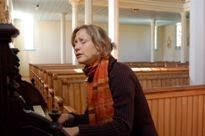
Two exciting events will be taking place in Great Village on 16 and 17 August. First, EBSNS Honorary Patron Suzie LeBlanc will be performing at St. James Church on Thursday evening, 16 August, at 7:30 p.m., part of the Musique Royale summer concert series. Tickets available online or at the door.
(Suzie LeBlanc and Elinor Frey)
Then on Friday afternoon, 17 August, at 2:00 p.m., also at St. James Church, American writer Elizabeth Bodien (who will be in residence at the Elizabeth Bishop House) will give a reading from her most recent collection. Free admission.
All are welcome to come and enjoy exciting performances by these exceptional artists. Happy Summer!
Thursday, August 2, 2018
Letters to Aunt Grace, Part 73: Mixed up life
Bishop’s next letter to her aunt was written on 29 October
1960. If it has a theme, perhaps “mixed up life” might best suit. She reported
to Grace that when she went to post her last letter (18 October), “I found one
from you there — and scribbled so on the back of mine.” That letter told Bishop
that Grace was once again on the move. Bishop mailed her own previous letter
“to G.V. and I hope you got it — you had probably just left.” It was still a
time when mail was routinely forwarded, so Bishop trusted that someone at the
farm in the village would do so.
Before Bishop could respond to the one she’d received on 18
October, she got another letter from her aunt: “your letter of 22nd — day
before yesterday — it came in four days this time — from Weymouth.” Grace was not travelling for
pleasure, but to see Eleanor Boomer Snow, Arthur and Mabel’s eldest daughter,
who was seriously ill, dying of cancer. It was this news that Grace conveyed in
the second letter.
“I am very sorry to hear about poor Ellie — how awful.” Clearly, Grace had
indicated how dire the situation was: “hopeless.” Sadly, the details are lost,
but they were such to prompt Bishop to respond, “she is so small and weak to
have kept going all this time with all that dreadful involvement.”
Bishop was also concerned about Grace: “I am afraid you are
having a pretty grim time of it.” She was glad to hear that Hazel (Ellie’s
sister) “can be with her” and earnestly asked her aunt to “let me know how
things turn out.”
In between receiving the second letter (“day before
yesterday,” that is 27 October) and writing her own on the 29th, they had
finally received all the packages the Naudins had brought, the gifts from Grace
— though they had not received them directly from the Naudins. Bishop explained
the continuing saga of her cousin’s elusiveness later in this letter, but the
convergence of Grace’s epistle with its sad news and the receipt of the gifts,
especially the maple syrup, triggered an intense response, which Bishop
recounted to Grace.
After reminding Grace to let her know “your next address,”
she paused “…” and then wrote: “I dreamed about Ellie off and on last night.”
The news and the maple syrup prompted Bishop to then declare: “Life is so mixed
up — good and bad, comic and tragic.”
She suspected that “the reason why I dreamed was
because I ate so many pancakes with MAPLE SYRUP on them rather late last
night.” Then another ellipsis and a gush: “It is divine.” For Bishop
this gift brought a rush of memory and nostalgia. For Lota, who also delighted
in this gift, it was, as Bishop quoted her, a “taste of those northern woods.”
The vivid memory Bishop chose to recount was from the winter
of 1917: “I remember the time I was little (about six), and in bed with
bronchitis, and Pa put the dishpan filled with snow on the bed and poured boiled maple syrup over it to make
taffy.” Another ellipsis. You can sense Bishop actively remembering and
savouring. She acknowledged the “awful lot of trouble” her aunt had to get the
syrup to them, but assured her that they thoroughly “enjoy[ed] these simple but
rare pleasures!”
It was not the first time Grace had begifted this northern
delicacy, but Bishop declared “this time we are going to keep it all for
ourselves, selfishly.” She reported that “last time we treated various
friends,” but their reluctance this time was because they felt their largesse
was not “properly appreciated.” This time, it was just for “Lota and I and our
friend Mary Morse (who’s with us until her new house is ready to move into).”
Bishop declared that this time they were “going to eat it
all” and reported that their first go came after “a very light dinner on
purpose — just onion soup, first, followed by a huge batch of pancakes and
syrup.” Not surprisingly, after such a long wait and anticipation, Bishop
overdid it and ended up with “nightmares” about Ellie.
After this detailed introduction, Bishop turned from cousin
Ellie and maple syrup back to cousin Elizabeth. That saga will be updated in
the next post.
Tuesday, July 31, 2018
Sunday, July 29, 2018
Wednesday, July 25, 2018
Treats in Great Village! From our Friends at Saint James Church --
Starting today (Wednesday, July 25, 2018) coffee, tea, and freshly baked treats will be on offer in the sanctuary of St. James Church of Great Village! Stop by and learn about the history of Great Village while enjoying some great food!
Monday, July 16, 2018
Letters to Aunt Grace, Part 72: Family matters continue
This long delayed post will conclude Bishop’s letter of 18
October 1960. After the rather lengthy, perhaps slightly obsessive analysis of
her cousin’s strange, stand-offish behaviour, a dense paragraph that filled
nearly one half of the page on which is was typed, Bishop suddenly stopped.
This interruption was signalled in the text by an empty line set off from the
previous dense paragraph and then the sentence:
“Stop — to take a large stinging [this word scribbled by
hand above the type] out of my brassiere —”
(Perhaps this Paraponera clavata, one of the nastiest stinging ants
in Brazil, is the kind Bishop mentions.
Click the link to see all kinds of Brazilian ants!)
in Brazil, is the kind Bishop mentions.
Click the link to see all kinds of Brazilian ants!)
Bishop was nothing if not literal and immediate, and this
delightful interjection (not, I suppose, delightful for her!) would have given
Grace a chuckle and brought her niece’s daily life really close. Bishop did not
offer any report of being stung, so the removal was done before any injury.
One might think this interjection would shift Bishop’s focus
and she would turn to other things, but family matters continued to dominate —
though she did acknowledge that she “must stop wondering and go down and see
what there is for Marietta’s
(the sister’s) lunch.” If cousin Elizabeth was “baffling,” Lota’s sister was
her own sort of trial. Thought “2 years younger than Lota, with two sons and
two baby grandchildren,” Marietta
was “a nervous wreck.” Whatever the cause of this condition, Bishop told Grace
that “we always get so tired when she comes to visit!”
This somehow prompted Bishop to remember to say, “I hope you
are keeping well and taking your medicine” and inquiring about her aunt’s leg.
Which in turn made her report that she had once again “had a letter from Aunt
Florence from another nursing home,”
writing about her “circulation troubles.” Florence gave no reason for the move so
Bishop was “waiting to hear from the cousins about what really happened and how
she is.” In the end, all Bishop could say about this difficult, cranky, elderly
relative was “poor thing.”
Winding down this epistle, Bishop once again urged Grace to
write and wistfully concluded: “I wish it weren’t so far away and expensive for
you to visit me — I don’t think you’d stall like my cousin, would you?”
She signed off with her usual “much love,” but before she
sealed the missive in its envelope, she added a postscript “after lunch” to
update the cousin issue. She reported that she “finally got Ray at his office —
bright & cheerful as ever.” She confirmed they had moved and had no
telephone, “but HE could call, after all.” Bishop and Lota were still waiting
to get the maple syrup the Naudins had transported, which Ray mentioned, “Aha!”
wrote Bishop, “I’ll send you a check next time.” Surely Grace didn’t want any
reimbursement. Bishop also reported that they had “made another date, for the
29th” for their visit, “maybe he’ll be able to get a company car.” Bishop had
reached her limit though: “I’ve been inviting them & telephoning them for 5
months,” she scribbled in her almost indecipherable hand at the bottom of the
page. She swore it was “the last time I’m going to try.” She quite rightly
noted: “don’t they know the young are supposed to make the effort to see the
OLD?”
Bishop’s next letter was typed on 29 October, the day of the
proposed visit. The cousin saga continued and will be the subject of the next
post.
Sunday, July 15, 2018
Elizabeth Bishop Society of NS participates in Truro's Pride Parade
The weather cooperated and the turn out was great, and a fun time was had by all who participated in Truro, N.S., third annual Pride Parade, including members of the Elizabeth Bishop Society of Nova Scotia. Here are a couple of images taken by Mickey Rigby, which show just how colourful the celebration was. Thanks to April Sharpe, summer student and tour guide in Great Village, for pitching the idea to participate and helping to bring it about. Thanks to all the EBSNS supporters for getting involved.
(EBSNS President Patti Sharpe on the far right. EBSNS board member Laura Sharpe (and summer student at the Bass River Museum) to her left. Great signs!!
Here is the whole EBSNS contingent looking colourful, indeed. That is the instigator April on the far left. Patti reported: "The parade was a big success, well attended. It was a lot of fun to be part of it all and everyone was in the best of spirits with lots of music and dancing." Bravo.
(EBSNS President Patti Sharpe on the far right. EBSNS board member Laura Sharpe (and summer student at the Bass River Museum) to her left. Great signs!!
Here is the whole EBSNS contingent looking colourful, indeed. That is the instigator April on the far left. Patti reported: "The parade was a big success, well attended. It was a lot of fun to be part of it all and everyone was in the best of spirits with lots of music and dancing." Bravo.
Tuesday, July 10, 2018
EB turns up in interesting places
A few of us over the years have paid attention to Bishop’s
appearance in unusual places: films, young adult novels, television shows and
so on. Her words have appeared as epigraphs in fiction and non-fiction books.
Her poems have been read on the big screen. (All of these appearances are
outside the major treatments of her by composers, visual artists, documentary
film makers, fellow poets, and the literary critical industry around her.)
Indeed, John has been locating and posting some of these
interesting and strange places where Bishop or her art have found a unique
place.
I think a whole study could be done about the way Bishop’s
art has infiltrated other art and even mainstream cultural expression. I
suppose it is so for many other poets, such as Dickinson and Frost; but for
those of us who love Bishop’s work, it is fun to come across her in places where
one isn’t looking for her.
Recently, my sister read Brad Kessler’s 2006 novel Birds in Fall: A Novel, which uses the
tragedy of the 1998 Swiss Air crash off the coast of Nova Scotia as a
foundation for a fictional story about the families who lost loved ones in that
terrible disaster. She excitedly showed me a spot near the end of the book
which includes a passing but clearly knowledgeable reference not to Bishop’s
art but to her life.
The reference is near the bottom of the page.
Brad Kessler, a very interesting fellow, who clearly spent
time in NS before (perhaps even during) the writing of this novel. His novel
came to us via Heather Killen, who owns a wonderful used bookstore in Berwick, N.S.,
called Shelf Life. I had not heard about it before – when I am done with it, I
will pass it on to Laurie Gunn to put in the EB House – it only seems
appropriate.
Friday, July 6, 2018
EB House Tours -- Summer, 2018
April Sharpe is working for the St. James Church of Gt. Village Preservation Society for the summer as a historical interpreter both at Elizabeth Bishop House and the Saint James Church. She will be doing tours of the Elizabeth Bishop House on Saturdays at 2pm with the exception of July 14th. She will also be offering tours of EB's Great Village on Thursdays at 2 pm.
Parking is available at the church. April can be found upstairs in the church most days with the exception of Mondays and Tuesdays. Thank you, April, for your dedication to Elizabeth Bishop's legacy!
Monday, July 2, 2018
BBC Radio 3 Programmes about Elizabeth Bishop
Here are some links to BBC Radio 3 programmes about Elizabeth Bishop and her works --
[1] Elizabeth Bishop's 'Large Bad Picture' -- Episode 2 of Five Poems I wish I had Written, with poet, editor and teacher Don Paterson.
[2] The Loves of Elizabeth Bishop -- Episode 4 of The Love that Wrote its Name, with novelist Neel Mukherjee.
[3] Colm Toibin on Elizabeth Bishop, Mammoth Cloning, Fareed Zakaria.
[1] Elizabeth Bishop's 'Large Bad Picture' -- Episode 2 of Five Poems I wish I had Written, with poet, editor and teacher Don Paterson.
[2] The Loves of Elizabeth Bishop -- Episode 4 of The Love that Wrote its Name, with novelist Neel Mukherjee.
[3] Colm Toibin on Elizabeth Bishop, Mammoth Cloning, Fareed Zakaria.
Friday, June 29, 2018
Letters to Aunt Grace, Part 71: More cousin talk
Bishop turned next, from the account of Lota’s sister, house
and the new beehive oven, to her own family in the 18 October 1960 letter,
specifically to her cousin Elizabeth Naudin, who was then living in Brazil with her
husband Ray and their young daughters. Bishop had been making overtures to Elizabeth for some time,
but finding the reception “rather baffl[ing].” She had to confess to Grace that
she didn’t “know quite what to think of her behaviour.” Bishop couldn’t decide
of her cousin was “cold,” “indifferent,” “or maybe shy, or what.” She reported
to her aunt that she’d “been to see her four times” and “taken presents.”
During the most recent visit “she seemed really friendly at last and even said
she’d like to have me ‘visit’ her for a ‘few days’, which I thought was nice
and homey of her.”
The saying is, actions speak louder than words, and in spite
of this warmer reception, the Naudins sort of vanished, again. Earlier on they
had “left the hotel without leaving any address or number.” Bishop had to
resort to contacting “Ray at his office (a hell of a job) and track her down.”
After the most recent, friendlier visit, she told Grace, her cousin had “done
the same thing again — they’ve moved.” Bishop’s frustration was evident when
she wrote, “although I know which building (unless they didn’t take that
apartment),” she still couldn’t really locate her without the apartment or a
phone number.
Bishop persevered by the old route of trying to get hold of
Ray, which she said she’d been doing “for three days.” After this statement an
ellipsis “…” Silence, it seems.
(Elizabeth Naudin sent me photos of the George Hutchinson
paintings she inherited from her mother Mary Bulmer Ross.
This painting is entitled "Ferry Boat Inn, Walton, 1931.")
Bishop also reported that she had already “called her to
talk to her a dozen times, probably,” but Elizabeth
had “never telephoned once.” That is, she said she had called “the Rio apartment,” which was more or less the same
thing, as Bishop noted to Grace, “where I never am!”
With exasperation, Bishop asked Grace, “Do you suppose she
is shy — she doesn’t seem so, exactly — or what is it?” Grace likely had
no better idea what the issue was, either, at that distance, so Bishop’s
question was probably rhetorical. She wanted to keep giving her cousin the
benefit of the doubt.
Bishop again confirmed that she and Lota had invited them to
visit the house at Samambaia, “over and over again.” Extending the invitation
to the children. But the visit had not yet happened. Bishop wondered aloud that
at first she “thought maybe they thought that bus trip too hard — 1½ hours.”
But she discovered that wasn’t the issue as she learned “they have gone by bus
to visit his sister — a much longer trip.”
(Another George Hutchinson painting owned
by Elizabeth Naudin: "Windmill," 1917.)
Pondering all these circumstances and permutations, Bishop
typed out (you can perhaps feel the extra pressure on the keys): “Maybe it is
very simple — she just doesn’t like me! — or I seem like an old lady to her, or
something.” Having reached that vague conclusion, Bishop declared that she
“honestly” couldn’t “see what more I can do. She acts as if the telephone
didn’t exist.” But the conclusion didn’t end the matter. Bishop continued, “How
does she think I’m going to find her, in a city the size of Rio?”
Grace knew well enough from Bishop’s letters that her niece “almost never” went
to the city, “particularly now that it is summer.” Shifting for the briefest
moment out of this slightly obsessive natter, Bishop observed, in parentheses:
“(There is a water-shortage and I hope for the children’s sake she isn’t in a
part of town without water …).”
That broader observation instantly reverted to more fretting
about what to do: “I’d love to have her come up here.” She extolled to her aunt
the appeal of the house under the mountain: “the children could play in the
brook etc.” Finally, Bishop conceded that she could not read the behaviour, “I
can’t tell whether they really don’t want to or what it is — and now this
vanishing again …”
Bishop had tried calling “at their old apartment” and was
told “they’d left.” “‘Do you know their new number or address?’ [she had asked]
‘No, Senhora.’ And [the maid] hung up.”
Bishop repeated the word that started off the whole
disquisition, “Well, I’m baffled, that’s all.” Because it was family, she said,
“I’ll try once more.” Again, the benefit of the doubt kicked in as Bishop said
with some incredulity, “She doesn’t seem to understand that I don’t live
in Rio.” Visits there were always brief and
focused on tasks, chores, errands: “the bank,” “my teeth,” “etc.” The hurry and
brevity of Rio meant that “it is much more
agreeable to see people up here and I’d like to show her around a bit, too. But
no luck.” And Lota, ever the doting grandmother, “would like to see the
children.”
I had read and transcribed Bishop’s letters to Grace by the
time I met Elizabeth and Ray Naudin in the late 1990s. I knew the degree of
frustration Bishop felt in her efforts to connect with this cousin and her
family. Being a polite Nova Scotian, I never asked Elizabeth
about her time in Brazil
when she met her ‘just starting to be famous’ cousin for the first time. I will
confess, however, I was dead curious. In the afterlife of Bishop, Elizabeth and
Ray Naudin were not at all reluctant to declare their connection to their
lauded relative. Perhaps they had forgotten about the fraught dynamics of their
Brazilian sojourn. And likely Bishop never expressed her frustrations too loudly,
if at all. One puts up with a lot where family is concerned.
(A third Hutchinson painting owned by Elizabeth Naudin:
"Thames Ditton Church," 1932. These and other paintings were inherited
by Elizabeth and Ray's oldest daughter Suzanne.)
Bishop was an orphan in the strictest sense of that word
with the early loss of her parents; but the extended family on both sides
remained a constant through her entire life, even when she was in distant Brazil, even
when the dynamics were fraught. The story of this connection continued as the
letters unfolded, more effort, more bafflement. If Bishop had not cared about
family, she could easily have gone silent. While the art might be the enduring
manifestation of the artist, we all can identify with the “untidy activity” of
daily life and family connections: “awful but cheerful”!
The next post will conclude a letter focused on familial
bonds.
Sunday, June 24, 2018
Another successful EBSNS AGM
Yesterday, an enthusiastic group of EB fans gathered in Great Village for the EBSNS AGM 2018. If you are interested in the business side of things, you can check out the EBSNS website events page by clicking here. This post will offer some of images of the lively gathering.
(Photo by Susan Kerslake)
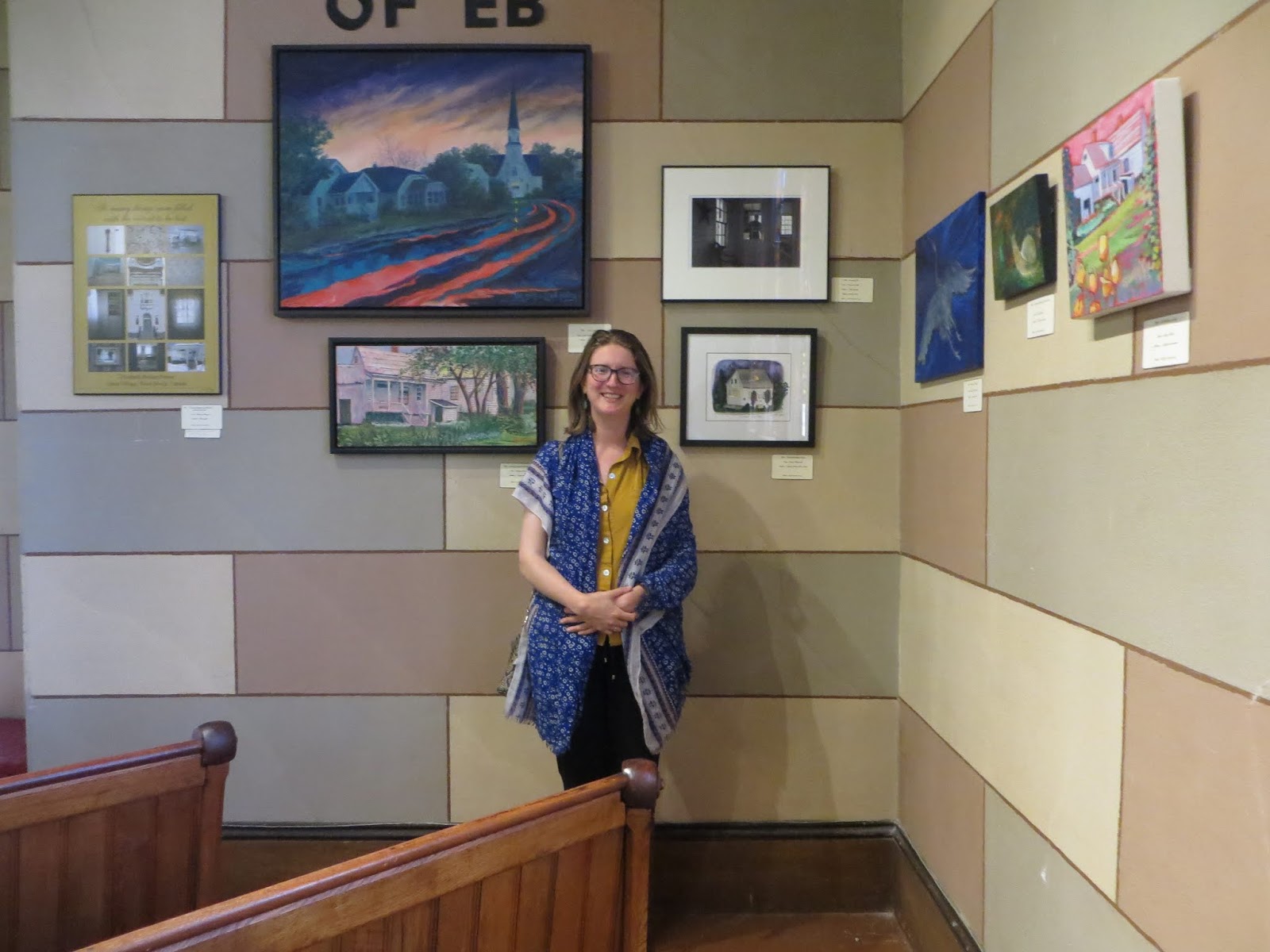
This image shows some of those gathered looking at the new "Echoes of EB" and "Elizabeth Bishop's Beginning's" exhibits. The new art display includes paintings and photographs by: Taiya Barss, Emma FitzGerald, Kathleen Flanagan, Mary Lou Payzant, Richard Rudicki and Susan Tooke. Here is Emma beside her contribution (to her left):
(Photo by Sandra Barry.)
Our guest speaker was Halifax poet and soon to be retired Saint Mary's University professor Brian Bartlett.
(Photo by Susan Kerslake)
After Brian's lively reading from his recently published Ripples Over Branches, the assembled walked to the Elizabeth Bishop House where a brief ceremony took place to mark the designation of the house as a Municipal Heritage property.
(Photo by Susan Kerslake)
The ceremony was presided over by Laurie Gunn (right) and the unveiling done by Colchester County mayor Christine Blair (left). It is exciting to have the house now part of the county's heritage program.
After the ceremony, everyone walked to the Legion for the usual delicious sandwiches and sweets provided by the Fire Brigade Auxiliary.
(Photo by Susan Kerslake)
(Photo by Sandra Barry)
Thank you to all the volunteers who helped make this AGM happen and to all those members and friends who attended. Perhaps the person who came from furthest away was Kay Bierwiler (left), who lives in Massachusetts and was visiting Great Village for the first time. Sandra Barry on the right.
(Photo by Susan Kerslake)
Thank you to the St. James Church of Great Village Preservation Society and Laurie Gunn for their stewardship and care-taking of the Elizabeth Bishop House.
Monday, June 18, 2018
Elizabeth Bishop Society of Nova Scotia AGM -- A Reminder
On Saturday, 23 June 2018, the EBSNS will hold its Annual General Meeting in Great Village. We are excited that besides the business and program outlined on the poster below, a significant and exciting addition to the day's events will be a brief ceremony to mark the designation of the Elizabeth Bishop House a Municipal Heritage Property. The EB House received a provincial heritage designation in the mid-1990s, but this new designation reinforces the importance of Bishop and her childhood home to the village, the county and the province. We hope you can join us on Saturday for the festivities.
Tuesday, June 12, 2018
EB House Featured on CTV
Here us a link to a CTV News segment from June 10, 2018 about the Elizabeth Bishop House, featuring Laurie Gunn and Brian Bartlett:
https://atlantic.ctvnews.ca/video?clipId=1415235
[Please note that the video clip may be preceded by a thirty-second commercial. To restore sound, move the cursor to the bottom of the video frame -- the controls will appear, and you can click on the little loudspeaker icon to adjust the sound to your liking.]
Sunday, June 10, 2018
Letters to Aunt Grace, Part 70: Lota’s house and family
The next subject of Bishop’s letter of 18 October 1960 was a
packed paragraph about Lota’s Samambaia house, with a few observations about Lota’s
family, in this case, her sister.
Bishop began this paragraph by reminding Grace about their
recent trip to “ParatÃ,” adding they had also recently returned from a
second trip: “then we went away for a week again to Cabo Frio, where we go
Christmases.” Bishop had regaled her aunt about these holidays on a number of
occasions, a place where they could “stay in a friend’s beach house.” The
reason for this trip, so outside of their usual routine, was because “Lota was
very much in need of a rest, having such troubles with her family, her lawsuit,
etc.” Bishop didn’t elaborate, except to say that “Lota’s sister” was “now
here, (arguing!).” The tensions with this sibling came in for more
comment at the end of this long letter, but other matters dominated this
paragraph.
The week away had been pleasant, even if it “was a little
too soon in the season, and windy.” They had gone “swimming every day and had
an awfully nice time.” But “the minute we got back people started arriving” and
not just siblings, but “friends of friends, from São Paulo” and then “a bus load of German
architects.” The reason for this group was Lota’s house: “it is a famous piece
of ‘modern’ architecture, you know.” What Bishop did not tell her aunt, but
which she told Robert Lowell in a letter written at the same time was: “Their
bus driver mutinied at our mountain road and Lota made trip after trip — but a
good many of them came up on foot, straight up, for about a mile, and arrived
panting and red and bowing and heel-clicking and hand-kissing — fascinating
long hair-dos — about 3 female architects among them — I lost track in the
hubbub. Some were very nice.” (Words in
Air, 344)
(Lota's house at Samambaia.)
When I read this account in the letter to Lowell, it immediately took me back to
September 1999, when I and a busload of Bishop fans reached the foot of that
same mountain in a tourist bus. Our bus driver “mutinied” too, refusing to take
the vehicle any further. Our host, Zulieka Borges Torrebla, drove the few who
couldn’t walk up that steep incline, but the rest of us walked, just as these
architects had done 39 years before.
(Bishop scholars beginning the walk to the house
under the mountain, September 1999. Photo by Sandra Barry.)
Word had clearly got out because not only were the Germans
arriving, but also “another bus load, American architects this time, coming
this week.” One wonders if they performed the same ritual of shuttling and
hoofing.
(Poet Jeffrey Harrison (left) and Bishop scholar Gary Fountain (right)
part way up the road to the house under the mountain,
September 1999. Photo by Sandra Barry.)
A guest of a different sort was also expected: “tomorrow an
unknown young American poet” was due to arrive for lunch, “and I think his
poetry is so bad that I’m rather dreading that!” Bishop discreetly does not
offer his name. Nor did she yield it in the letter to Lowell. What she does tell Lowell is that this “young man who sent me
the bad poetry” had “called up to say he couldn’t come.” (Words in Air, 344) Undoubtedly, they did connect, as he was a
“Fulbright, teaching at the University,” so he would be around for awhile.
Brett Millier does not identify him in her account of October 1960. His pending
visit had triggered in Bishop a kind of existential weariness in the face of
“so much adequate poetry all sounding just alike and so boring …. And no one really feeling anything much.” (Words in Air, 344)
Part of the reason why they were beset by company was
because “‘Summer’ is beginning and there are always too many people coming and
going.” But competing with all this activity, and offering some solace, was the
fact that “the flower garden has never looked better.” The list of flowers was
impressive: freesias (“absolutely beautiful … all colors of the rainbow”;
lilies; agapanthus blooming “all up the hillside, about three feet tall, white
or blue.” Bishop could always find relief in the natural world around her.
Along with the flowers, the vegetable garden was producing:
“for the first time in my life I am sick of artichokes” because they had “been
eating [them] every night for dinner.”
Finally, the last report in this dense paragraph declared
that the beehive oven they had been constructing was finished: “it is very
picturesque and in a day or two I’ll try it — and probably burn the break black
the first time.” The fellow who had done the actual construction produced “some
of his wife’s bread” because “when Lota showed him mine he said ‘Too
much yeast!’” Bread making clearly has a competitive element., even though
Bishop was confident enough in her newfound bread-making skill to dismiss this
critique: “because it isn’t the size or kind of bread they use.” To each his or
her own.
Winding down this particular track, Bishop observed that if
they stayed home over Christmas (having had their Cabo Frio trip early), “I
think we’ll try roasting a suckling pig” in the oven. Ever the pragmatist and
economist, she noted however that “food,
particularly meat, is getting so expensive here now maybe we can’t afford such
luxuries.”
Bishop then turned back to her own family, not an ancestor,
but her cousin Elizabeth, who was still very much nearby. This subject for the
next post.
Friday, June 8, 2018
A few more photographs
Laurie Gunn recently sent these images of the exhibits set up this year by the EBSNS in St. James Church in Great Village, N.S. Come to our AGM on Saturday, 23 June 2018, starting at 1:30 p.m., in the church and see the displays for yourself. The EBSNS is excited to announce that after the AGM a brief ceremony will be held at the Elizabeth Bishop House, by the Preservation Society and the Municipality of Colchester County, when the house will receive a Municipal Heritage designation. Let us hope for some sunshine and warmth for that day!
(Elizabeth Bishop's maternal family.)
(Echoes of Elizabeth Bishop art gallery exhibit, above and below.)
Thursday, June 7, 2018
A little souvenir
This image just in from Ingrid Jejina, who visited Great Village and attended the Elizabeth Bishop Arts Festival in August 2015. Thanks Ingrid.
Happy writing one and all!
Sunday, June 3, 2018
Elizabeth Bishop's Beginnings exhibit
On 2 June 2018, members of the board of the EBSNS gathered at St. James Church in Great Village to install this year's "Elizabeth Bishop's Beginnings" exhibit and "Echoes of Elizabeth Bishop" gallery exhibit, which will officially open at the AGM on Saturday 23 June. Here are a few photos of what this year's exhibit looks like (we will share photos of the art gallery works at a later date):
(An overview. Photo by Sandra Barry.)
(Some details. Photo by Sandra Barry.)
(Laurie Gunn's lovely "Sandpiper" hooked rug. Photo by Sandra Barry.)
Below is a reminder of the details of the AGM, which will take place in the church at 1:30 p.m., Saturday, 23 June. All are welcome.
Subscribe to:
Posts (Atom)