"I am 3/4ths Canadian, and one 4th New Englander - I had ancestors on both sides in the Revolutionary war." - Elizabeth Bishop
____________________________________________

Monday, April 18, 2022

Review of Jonathan Post’s Elizabeth Bishop: A Very Short Introduction (Oxford University Press, 2022) by Angus Cleghorn

This very long series of over 700 volumes may not always be introductory. Such is the case with this fine book by Jonathan F. S. Post, Distinguished Research Professor of English at UCLA. The writing is clear enough for an introductory reader and compounded by expertise that displays knowledge of English poetic history as well as Bishop’s oeuvre. I was happy to bounce around from poem to poem to consider similarities and developments. A first-year college reader might drop a few balls with the mental pinball machine. Still, I would recommend this book to any reader of Bishop because Professor Post’s insights are fine-tuned with a good ear and extensive poetic foundation. The author cites Eleanor Cook; this book has a similar down-to-earth perceptive mastery that one finds in Cook’s books, such as Elizabeth Bishop at Work.

In order to find references to scholars the reader has to turn to References at the back of the book as there are no in-text citations or footnotes. I found this annoying because I had the sense that some of Post’s information was coming from sources but I could not see any. It makes the pages appear to lack academic integrity. I suppose the Oxford series is aimed at a general reader who prefers not to be weighed down by academic references, but Dr. Post’s academic skills and experience are such that I’d prefer to see where some ideas come from. I’ve always found footnotes cumbersome, but basic in-text citations would help. It wasn’t until I was a few chapters in that I finally turned to page 127 to find References. Nothing in-text leads the reader there.

Upon first reading page 1 from this Very Short Introduction, I was concerned because the first heading is “The Bishop phenomenon,” which is a recognizable title of a well-known essay by Thomas Travisano, and yet there is no citation for it: is this mere coincidence or a gaffe? It is troubling in a book that’s supposed to have authority. Two pages later a poem title was incorrectly printed as “Sub-Tropics” when Bishop’s prose poem series is actually called “Rainy Season; Sub-Tropics.” The first part of the title is crucial in this “vignette,” as Post describes the three substantial prose poems on sub-tropical critters. My growing sense of dread was compounded by repetitious mis-appellations of “Machedo” Soares. Bishop’s lover’s name was elsewhere spelled correctly as Lota de Macedo Soares. Sloppy editing in the Oxford University Press machine. Several pages later Dr. Anny Baumann was described as a “lifelong friend,” however, Bishop only began seeing her in 1947 at age 36 as the “Timeline” at the back notes.

Post began to win me over as he described the “perfect pitch” of speech in “The Moose.” Also, since I had been wondering about the approach taken in this book series, I was relieved to find this in chapter one’s “Biographical beginnings”:


the focus of this Very Short Introduction is to introduce new

readers to her verse, the one truly inexhaustible ‘story’ of

Bishop’s life. From this perspective, biography is an

important first step because places and people, heightened by

memory and travel—those features of inner and outer geography

so crucial to Bishop—are part of the fabric of her verse. (10)


Nice balance there.

It’s the readings of the poems where Post excels. With Bishop’s late autobiographical poem “In the Waiting Room,” Post describes the retrospective narrator’s experience as a “child’s frightening identification of herself as female” while listening to her aunt cry out in pain in the dentist’s office, leading to Bishop’s self-consciousness amidst humanity: “But I felt: you are an I / you are an Elizabeth, / you are one of them. / Why should you be one, too?” Post plays with numbers adeptly:


Yes, ‘one, too’, a female, that is, but as ‘one’ becomes ‘two’, the young

girl, having been made uneasily aware of her body, her gender, and

her connection to others, separates from the child and, assuming

the adult poet’s consciousness, comes into the ‘night and slush and

cold’ of Worcester on the ‘fifth | of February, 1918’. The date

reminds us that ‘The War was on’, outside as well as inside. (13-14)


Complex and accurate. We next read about “Sestina,” also from 1976’s Geography III. I especially like how Post does not try and fill in biographical particulars beyond what the poem offers. There is a tendency in Bishop criticism to inject copious details from the life into the art, which Post does not do, and which is a measure of respect:


We don’t know why the grandmother is crying, although she hints that her

tears are environmental and seasonal, and are possibly connected,

moreover, to a larger world of fate as foretold by the almanac.

Since only the grandmother talks, we’re also not sure of the exact

bond between adult and child, the family ties behind an afternoon

teatime ritual, although the child certainly wishes to please the

grandmother by proudly showing her a drawing of a house. (16)


It’s important for readers to not say too much and make assumptions about the object of the poem’s grief. Is the man with tear-like buttons Bishop’s father or grandfather? It is a child’s drawing so we can’t pinpoint identity beyond the poetic representation. 

Next are “Filling Station” and “First Death in Nova Scotia.” By the end of this very substantial chapter 1 it’s evident that this is no breezy Introduction. “Filling Station” is potentially linked, rightly so, to the gas station across from the Bishop-Bulmer house in Great Village (now Wilson’s). “Somebody loves us all” finishes the poem with potentially divine and parental overtones. “To the psychoanalytic critic, she is a compensatory sign for the mother Bishop lost …” (20). Here we see theoretical framework and, beyond that, interpretation extends to Bishop’s greatest prose story, “In the Village,” which begins with “mother’s wrenching scream” (20). Not many introductory readers will have read “In the Village” but this interpretive reach is necessary to read Bishop’s poetry in connection with the life in her One Art. Post returns to the end of “Filling Station” and its “loves”:


Not all of these contexts are equally persuasive, but one more

suggestion is needed. I think it is possible to read this gesture

rhetorically, that is, on its own terms, as an evocation of hope by

someone momentarily ‘filled’ by what she has seen. Bishop’s poems

often end in an open space, leaving us not so much reaching

irritably after facts as simply recognizing, as in ‘The Moose’, that

‘Life’s like that’. A person, the speaker, moved to questioning the

place of things, including her place in an initially foreign setting

like a messy filling station, can sometimes arrive at a better, more

generous understanding and say just this sort of thing.
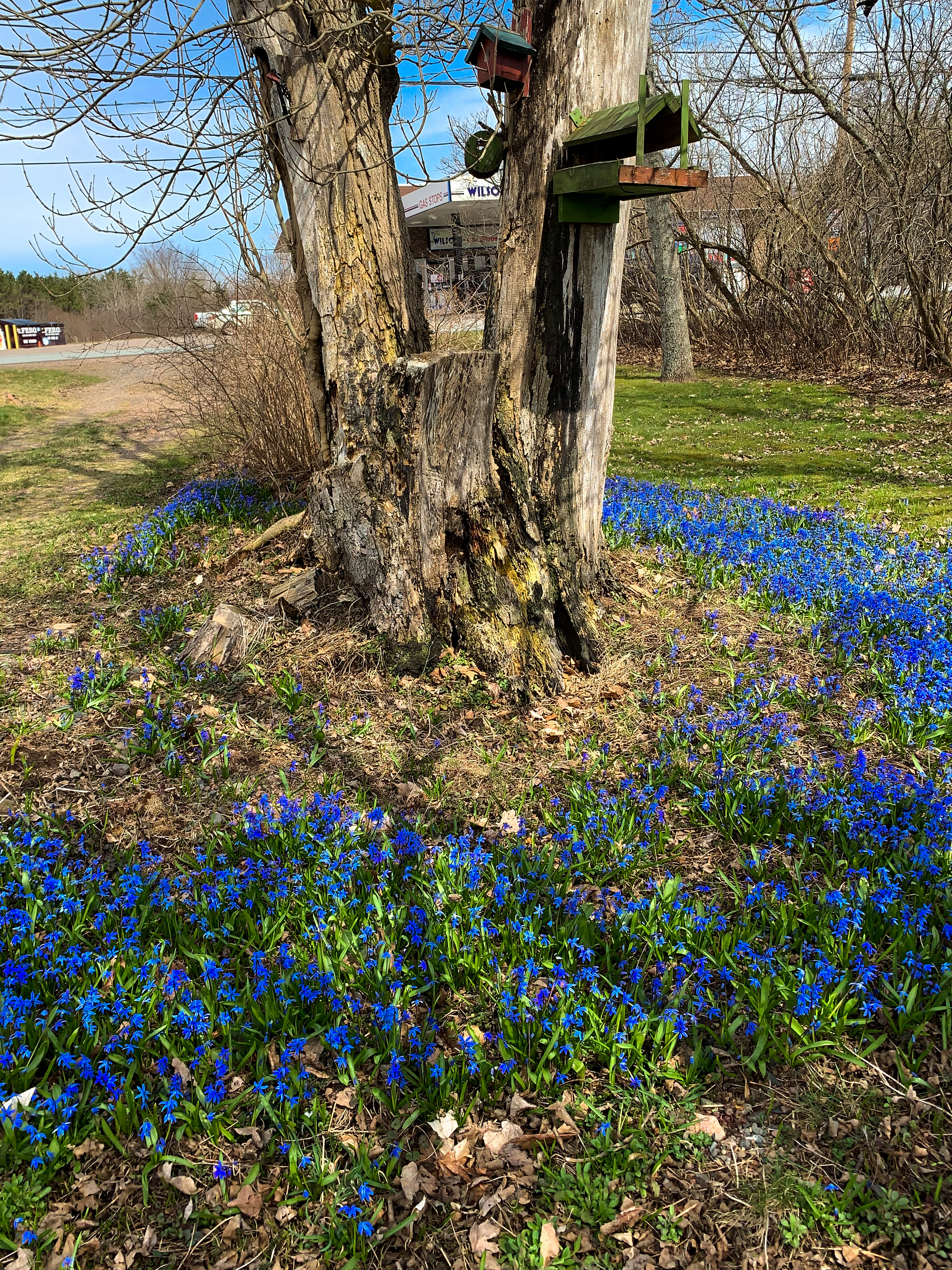

(Scilla in bloom at the Elizabeth Bishop House, April 2022. See Wilson's service station in the background. Photo by Laurie Gunn. Click to enlarge image.) 

Casual expressions of life experience are intrinsic to reading Bishop. Much of the pleasure comes from being an accidental tourist accompanying her travels. This chapter ends by touching on “Questions of Travel”:


But surely it would have been a pity

not to have seen the trees along this road,

really exaggerated in their beauty,

not to have seen them gesturing

like noble pantomimists, robed in pink.


“Yes, surely. Who wouldn’t want to be part of this fantastic venture?” (24) To many readers the appeal of reading Bishop is adventure – geographic and verbal. 

Chapter 2 is on “Formal matters” and here Post really excels. Contemporary readers will appreciate his vast knowledge of the poetic tradition through centuries. “Bishop’s supreme valuation of formal variety as a means to singularity was certainly one of the reasons she was drawn to George Herbert, and perhaps a reason why, rather surprisingly, she never quite embraced Emily Dickinson” (29). It’s important and enjoyable to trace Herbert’s formal inventions as they affect Bishop’s poetic workings. Other influences near and far such as Robert Frost and the Brazilian cordel make their way into Bishop’s variety. Bishop’s collaboration with Marianne Moore is discussed in an excellent reading of “Roosters.” Here again, though, the lack of clear reference is frustrating when Post mentions the poem’s ‘“violence” of tone’ in quotation marks just like that. Not many introductory readers would figure out that this “violence” harkens back to a letter that Bishop wrote about “Roosters” to Moore, or that Thomas Travisano wrote an essay on Bishop’s ‘“violence” of tone’ in Elizabeth Bishop and the Music of Literature (Palgrave 2019). There is no reference at the back of the book for Travisano’s essay, Bishop’s letter, or anything to explain the odd punctuation here. Sloppy editing. 

This is not Post’s fault. He excels as formal reader of all kinds of Bishop poems, such as “Questions of Travel,” in which he brings in the Baroque and Hopkins to pinpoint prosodic iambs, dactyls, extra syllables, spondees, and Anglo-Saxon beat in this poem that to me sounds like water falling. “Here is not description per se, but the act of experiencing in the mind what the eye sees.” This goes back to a reference that is acknowledged in the text to an essay from 1929 by Morris Croll, “The Baroque Style in Prose.” George Lensing has written beautifully about this in a 1995 special issue of The Wallace Stevens Journal focused on Bishop and Stevens. Croll and Stevens depict “a mind thinking,” which is part of this section’s heading.


To some degree Wallace Stevens set the table for his modernist

contemporaries when he wrote in ‘Of Modern Poetry’, ‘The poem

of the mind in the act of finding | What will suffice. It has not

always had | To find: the scene was set; it repeated what | Was in

the script’ (my italics). There is a great deal of Stevens in Bishop;

Harmonium was a book she said she had almost by heart; she

elsewhere spoke of admiring the ‘display of ideas at work’ in his

poetry. And there are lines in her poetry that, without the example

of Stevens, seem unthinkable in their majestic play with

perception: ‘This celestial seascape, with white herons got up as

angels, | flying as high as they want and as far as they want

sidewise | in tiers and tiers of immaculate reflections’ (‘Seascape’).

But ‘if accuracy of observation is equivalent to accuracy of

thinking’, as Stevens himself observed in Adagia, it is Bishop, not

Stevens, who best fulfilled the modernist ideal of poetry as the act

of finding on a human scale in a world of familiar and not so

familiar objects. (42)


Bishop often found the unfamiliar through animals; this otherness helped her sometimes criticize human morality, something she found in Marianne Moore’s poetry


… without condescension, ‘without “pastoralizing” them as [the critic]

William Empson might say, or drawing false analogies’. And in this

‘unromantic, life-like, somehow democratic, presentation of animals’

Moore helped Bishop (who was also aided by her reading of Darwin) to

write about animals and, more broadly, nature from a sympathetic but

not exclusively human-centred perspective …. (51-52)


This enables Bishop’s poetry to be read now as a critique of the Anthropocene age. Sometimes Bishop’s animal poems are more closely linked to humanity, as in “The Armadillo” dedicated to Robert Lowell. Chapter 3 focuses on Lowell and Moore as influential practitioners for Bishop’s animal descriptions. 

One of Bishop’s most critical poetic representations of humanity occurs in “Brazil, January 1, 1502,” which Post discusses with subtlety: “her delving—to redeploy an idiom from ‘The Map’—into the shadows that inhabit the shallows” (55). Those shadows become the forest canopy under which indigenous women retreat while being attacked by rapacious Portuguese colonizers. Post weaves Ovid’s Philomel story from Metamorphoses as well as Shakespeare’s The Rape of Lucrece into the poem’s tapestry to show that Bishop is


appropriating one kind of violence (sexual) through another (artistic),

to reveal a world long familiar to the reader but now seen mysteriously

anew, as only the closely woven fabric of her marvellous art can do.

For Bishop the explorer, coming to terms with the cheerful natural landscape

means coming to understand the sometimes awful footprint of

human history. (59)


Chapter 4 on poetry and painting includes some of Bishop’s paintings from Exchanging Hats by William Benton and continues fine analysis: “We might regard ‘The Fish’ as a painter’s paradise, and also a reader’s” (67). I feel the same way about “Seascape” and “Pleasure Seas.” Excellent examples from “A Cold Spring,” “Santarem,” and “Over 2,000 Illustrations and a Complete Concordance” are canvased. Post precisely notes that only “Large Bad Picture” and “Poem” are technically ‘ekphrastic,’ meaning “a poem about an artwork, usually a painting. The doors open wider if we use ‘ekphrasis’ in the original classical sense of any verbal description of something seen (think ‘Cape Breton’) …” (75). As with many of Bishop’s readers, Post reads “Poem” with delight, as did Howard Moss when he received it at The New Yorker: “I wish I could read a poem like that every day for the rest of my life” (80). 

This book features six illustrations, two of which are photographs by Rollie McKenna somewhat similar to the cover of Elizabeth Bishop in Context, which Post wrote to me that he regretted not having read by the time his book went to press. Chapter 5 on “Love known” begins by finding Thomas Travisano’s 2019 biography Love Unknown an unclear title aside from the allusion to the Herbert poem. For Bishop knew love, as the posthumous poems “It is marvelous to wake up together,” “Breakfast Song” and “Vague Poem (vaguely love poem)” display in different ways. Post does nice work with more subtle expressions of desire such as “Quai d’Orleans” and “Four Poems,” the latter of which he reads as an experimental poem. A section entitled “Still explosions” examines “The Shampoo,” and finds its first stanza perplexing: “Odd to think of lichens exploding” (93). Really? On daily walks I observe lichens on rocks and their various amoebic shapes do burst (perhaps my eyes perceive via Bishop’s painterly descriptions). I can forgive Dr. Post’s different aperture when I read this rich conclusion about the final stanza:


… set off with a dash (for spontaneity) and a comma (for a pause),

the single word ‘Come’, a directive that carries lightly the weight

of an entire tradition of carpe diem poems in English. (Think

Marlowe’s ‘Come live with me’ or Ben Jonson’s ‘Come my Celia,

let us prove | The sports of love.’) And in that directive, we might

fancy Bishop taking control of those loose black hairs in ‘O Breath’

that were flying around, intolerably blown about, and weaving

them into a love-knot about something as domestically simple and

sensual as washing a companion’s hair. (94)


While it may not quite be an entire tradition’s weight, we might also find Emily Dickinson’s dash and comma style here. Earlier in the book Dickinson was understandably downplayed in favour of Herbert, but her signature pauses may figure in “—Come,” and in the delayed foreplay of “Four Poems” and its spaces. After “The Shampoo,” Post finds that another domestic poem about Bishop’s love for Lota de Macedo Soares. “Song for the Rainy Season” “… continues the association of eros and aqua, both life-giving forces in Brazil” (97). 

“Bishop is the great travel poet of our modern era,” chapter 6 begins authoritatively (103). “[L]yric time and leisurely thinking” are observed by Bishop in a 1965 letter to Robert Lowell referring to “Walking Early Sunday Morning.” At the back of the book we can find reference to Roger Gilbert’s influential Walks in the World: Representation and Experience in Modern American Poetry from 1991. Post locates “‘The End of March’ [a]s a ‘walk poem’ along the shore south of Boston …” (104). Complexity overflows from this poem, especially its accumulative ending. As often the case, Wallace Stevens is read into this poem’s mechanics. To me, the whole poem can be read as a dialogue with Stevens’ metrical form and his imagination embodied in lion figures; Post chooses the “lion of the spirit” from “An Ordinary Evening in New Haven.” Back in 1991’s Questions of Mastery, Bonnie Costello discussed Bishop’s use of Stevens’ lion sun while referring to Harold Bloom’s prior interpretations. The richness of “The End of March” and Bishop’s meta-dialogue with Stevens endures — partly because Bishop’s poem is so playful with its “artichoke” crypto-dream house and flaming “grog a l’americaine” Stevens would enjoy, also because readers can choose a suitable measure of rich textural engagement within the basic message of the poem: “Go for a walk, especially along a beach. It might change your mood, your inner weather, for the better” (116). 

From the influential author of “Sunday Morning” to “Bishop’s ultimate Sunday poem,” (117) we go to Santarem where the poet’s mind is in motion again; amidst the “dazzling dialectic” of converging blue and brown rivers, an older Bishop plays with self-correction, as pinpointed in Post’s knowledge of rhetorical figures:


the device of ‘metanoi’, meaning ‘afterthought’, for the first time

she confuses church and cathedral, then again as ‘epanorthosis’

or ‘emphatic correction’, by enjambing the phrase across a stanza

break and adding an exclamation point: ‘the church | (Cathedral,

rather!)’. (117)


And yet everything is so well remembered about this place “in which contemplation wins out over commerce” (119). This subtle use of Bishop’s “Large Bad Picture,” and its dialectical “commerce or contemplation” is doubtfully picked up by many introductory readers, and so it remains an unacknowledged reference. 

Jonathan Post in his epilogue does refer to “the classroom. For a number of years, I taught Bishop in a seminar called, simply, ‘How to Read a Poem’” (120). It is this pleasure that jumps off the page. One feels the company of a master who makes it easy, in his own words,


… because Bishop is so good at taking you through the steps.

First step, look closely; second step, look closer still; third step

look even more closely, but especially now with an eye to where

the poem is going, not to where you think it should be going,

but where its diction, syntax, grammar, and punctuation

lead. This means listening to the poem, bringing the ear out of

hiding in order to help the eye to see and the mind to think.

Bishop’s poems are always about surfaces getting deeper, about

knowledge as process. (121)


She “makes us feel that we’re all there as part of the poem’s creative energy at the moment of its arriving” (123). 

********************

Angus Cleghorn teaches English at Seneca College in Toronto, and once explored the Moose route in Nova Scotia during a stay at the Bishop-Bulmer house in Great Village.


Thursday, April 7, 2022

Reading of Elizabeth Bishop Poems to Mark National Poetry Month

I am honoured to be participating in a reading of Elizabeth Bishop poems at the LaHave River Bookstore on Nova Scotia’s South Shore on 30 April 2022 at 4:00 p.m. I will be joined by three other writers: Janet Barkhouse, Carole Langille and Lisa McCabe. You can learn more about the wonderful LaHave River Bookstore by checking out their website and Facebook page. Hope to see you there.


Monday, March 21, 2022

Review: “Elizabeth Bishop in Context: Glimpsing (and Holding) the Poet’s Messy Universe” by Tristan Beach

Introduction

How far back do you go to find the sources of a writer’s life and work? To ancestry and community? To family and childhood? To education and experience? … Art is, probably, created somewhere in the messy middle… it was so for Elizabeth Bishop, who described life as an ‘untidy activity’ (Sandra Barry, “Chapter 1: Nova Scotia” 17) 

Elizabeth Bishop in Context, edited by Angus Cleghorn and Jonathan Ellis, is a groundbreaking, comprehensive collection of essays that penetrates and reveals numerous facets of Elizabeth Bishop’s life and legacy—observed within and across different contexts. Cleghorn and Ellis write in their introduction, “Contexts do not provide all of the answers to the many questions her poems and stories ask. In some cases, it feels as if they make things messier… What happens when one context contradicts the other? Which context matters more? Why these contexts and not others?” (2). Cleghorn and Ellis do not attempt to answer these questions; rather, they let the collection speak for itself. And, as Sandra Barry notes in her chapter on Nova Scotia quoted above, like “Art,” this collection takes its readers “somewhere in the messy middle,” offering numerous overlapping, contrary, and highly unique ways of seeing, and reading into, the person, poet, philosopher, critic, artist, correspondent, and teacher that was Elizabeth Bishop (17). 

Structuring the Collective

The thirty-five essays comprising the volume were penned by a global collective of scholars, translators, poets, critics, editors, and admirers. Each essay bears a chapter title corresponding with its respective context, and each context is grouped with other similar contexts under a related thematic section. For instance, Part II. “Forms,” contains chapters on literary, visual, and epistolary genres as contexts such as “Lyric Poetry” by Gillian White and “Translation” by Mariana Machová. Likewise, Part V. “Identity,” includes the contexts of social constructs, such as “Gender” by Deryn Rees-Jones and Eira Murphy, as well as the rich realm of symbols and the unconscious, such as “Dreams” by Bonnie Costello. 

These chapters provide nuanced ways of seeing Bishop’s life and legacy: glimpses into the mess that the editors and contributors each contend with. The chapters echo one another in their interpretations either by proximity (in their sequential chapter order) or by examining common primary sources, such as Bishop’s poems and letters—or by drawing on frequently cited criticism and biography. Through these common dimensions each contributor offers numerous similar contextualized frames for glimpsing Bishop. However, while these chapters briefly (few span beyond 12 pages long) resemble one another, many through their dissimilarity appear to enforce the messiness. Thus, collectively the contextualized glimpses of each chapter do not total, nor do they form, a singular image of the poet.

Where one chapter may trace the “apocalyptic threat” of WWII in “At the Fishhouses” (Charles Berger’s “War,” which finds in the poem’s “total immersion” a “dream-vision of the world sliding into extinction” 217), another chapter may note the same poem’s musicality and earthly humor (Christopher Spaide’s “Music,” in which the poem’s “total immersion” is identified as being “lifted” from “interdenominational debates over baptism” 239). Coincidentally, both chapters, despite operating from distinct contexts and even more distant interpretations of the same poetry, appear in the same section, Part IV. “Politics, Society and Culture.” Such separate, yet adjacent, thematically related readings of the same poetry, letters, prose, and other primary sources results in complex, nuanced visions of Bishop’s world—more accurately, her universe—that trend more towards complementing than contradicting.

 Contextualized Glimpses

Among the many contextualized glimpses in the collection are Bishop’s childhood detailed in Nova Scotia (Barry’s “Nova Scotia”), as well as her boisterous, troubled years in Brazil—the literary legacy there being politically mired (Neil Besner’s “Brazil,” Machová’s “Translation,” Maria Lúcia Milléo Martins’s “Brazilian Literature”). Other glimpses can be found in Part III.’s “Literary Contexts,” which includes romanticism, surrealism, modernism, among others. These chapters detail Bishop’s encounters with the different movements, locating through hints or outright declarations in her letters and poems her resistance, dismissal, or embrace of such movements. Also of note is her ambivalence toward psychoanalysis due to several instances of failed psychotherapy as a child but followed by her captivating and complicated friendship with her psychoanalyst, Dr. Ruth Foster (Lorrie Goldensohn’s “Psychoanalysis”). Such ambivalence, typical of Bishop who knowingly held opposites, can be seen in her apolitical public stances yet personal anti-fascist sentiment captured in Berger’s “War,” Steven Gould Axelrod’s “The Cold War,” and Jeffrey Gray’s “Travel.”

These multiple contextualized glimpses into the mess of Bishop’s universe present us with a person whose global influence extends beyond categorization, taking root in our imagination, as Stephanie Burt examines in “Bishop’s Influence,” in Part VI. “Reception and Criticism.” Burt charts Bishop’s far-flung influence—in poetic form, device, attention, subject, and obsession—on American poetry in the 21st century. Just as Bishop’s influence is extensive and her apparent literary descendants numerous, her figure, too, appears multiple, as a collective: we glimpse through Elizabeth Bishop in Context the individual Bishops, the many faces of Bishop that populates this universe. Bishop the social critic, Bishop the alcoholic, Bishop the loyal friend, Bishop the survivor of abuse, Bishop the patient, Bishop the lover.

 Common, Complex Facets

One common facet among many glimpsed across contexts is Bishop’s queerness, which informed much of her attitudes, relationships, and resistance to literary categorization or being lumped into a single movement (she famously resisted being defined as a “woman poet” and disdained much being anthologized as such). As Axelrod notes in “The Cold War,” Bishop’s position as a queer woman cast her as an outsider to American society, vulnerable to McCarthyism through its rampant, homophobic persecution of sexual and gender minorities. Axelrod locates Bishop’s “binary thinking in the service of queer non-conformity” in her poem “View of the Capitol from the Library of Congress” that castigates white, straight, heteropatriarchal nationalism that dominated the American political experience (223). Axelrod finds that although Bishop “had a ‘horror of Communism’,” her “skepticism toward democracy… reflects queer alienation at mid-century as well as forecasting later strains of liberal unease” (223, 224).

Where Bishop’s queerness underlay her political affiliations and attitudes, it also unpinned her complex relationships with other women and her conception of gender. From childhood to late adulthood, her life was enriched by a global network of female relations—aunts, teachers, mentors, students, friends, and partners. In Rees-Jones and Murphy’s “Gender,” the authors chart the impact of these relations on Bishop as a queer poet. They observe that, inspired by her own intimate relationships and with other women while navigating openly homophobic American society, Bishop’s view of gender was highly nuanced and less monolithic or stable. For instance, the authors describe North & South as “a book of sleepy disorientations; … a book which creates a world in which bodies are not fully assembling or coming together” (315). Here, Bishop resists fully, or at least consistently, gendering her speakers and, at times, their subjects—frequently encompassed in an gender neutral “we” (315).

Yet Bishop’s playful, queer explorations, reversals, and deflections of gender roles and norms are further complicated by her whiteness, which Rees-Jones and Murphy identify in poems such as “In the Waiting Room,” in which Bishop, “[setting] herself in a place of difference from the Black women in the National Geographic,” reproduces “hierarchies… in terms of race [that] risk constructing a racist narrative of difference, a narrative which continues in Bishop’s work” (320). Bishop’s politics, queerness, female relations, gender conceptions, and whiteness—however clearly glimpsed or carefully explained—nevertheless add many depths to the mess of her universe.

 Conclusion: Community in Bishop’s Universe

As individual readers of Elizabeth Bishop, we may investigate and grapple with the many faces and forms of Bishop. In solitude and with only the original work in our hands, our glimpses of the poet is ever elliptic, partial, and often outside a community of other ways of seeing. However, Elizabeth Bishop in Context attempts to corral the mess without containing or parsing it, despite the collection’s careful organization that resists a single, dominant gaze. By admitting multiple ways of envisioning Bishop and within a collection that covers an exhaustive (though not complete) amount of ground, we as solitary readers gain this community of thoughtful, incisive glimpses grounded in their respective contexts.

Elizabeth Bishop in Context adds a necessary volume to the steadily growing field of Bishop studies, a field whose community history Thomas Travisano narrates in his titular chapter, “Bishop Studies.” Like other recent volumes, including Bethany Hicok’s Elizabeth Bishop and the Literary Archive and Cleghorn’s own Elizabeth Bishop and the Music of Literature, Elizabeth Bishop in Context further elevates and legitimizes not just Bishop studies writ large but Bishop herself as a literary force worthy of study within and throughout multiple contexts. And as Travisano states in this community of scholars, students, readers, and teachers, “it was precisely by learning to read Bishop’s work in context that Bishop studies emerged as the steadily expanding and influential international field that we know today” (author’s emphasis 382). 


Tristan Beach is a PhD student in Rhetoric and Composition at the University of Nevada, Reno. He received his MFA in Poetry from Goddard College and a BA in English from Saint Martin’s University. He is a member of the board of directors for Olympia Poetry Network and is the poetry editor for Pif Magazine. His creative and critical writings have appeared in Pif, Conium Review, Shantih, The Pitkin Review, and elsewhere

Tuesday, February 8, 2022


HAPPY 111TH BIRTHDAY
ELIZABETH BISHOP!

We hope that like the Hobbits on Bilbo's eleventy-first birthday, you will be partying heartily, and that your fare will be rich, abundant, varied, and prolonged, eventually reaching that delightful stage known as "filling up the corners," when you will take a certain much-loved, well-worn volume down from the shelf, open it at random, and begin your rereading.  Many happy returns of the day!  May we have many merry meetings ahead!  And Dundee Cake, yes, Dundee Cake... Gammie's favourite...


"Now just one little moment, dear Sandra," remarks the Late and Much-Lamented Pernicious the Musquodoboit Harbour Farm Cat's faithful amanuensis and general factotum Barnstead on behalf of his dearly-departed Employer.  "Is that a candied cherry I spy along the edge of that cake in the photo?  Tsk. Tsk. Tsk. Allow me to pontificate for a moment on the subject (and an excellent one it is, too) of proper Dundee Cake... and in the course of my ranting (well, to be more precise, the Late and Much-Lamented Pernicious the Musquodoboit Harbour Farm Cat's ranting -- I am only his humble instrument, conveying but the general tenor of his rather more heated observations) allow me to take you to task as gently and genteelly as may be (no, not Janet Maybee, nor any other member of the currant -er- I mean current Board of Directors) for certain, certain -- well, shall we be generous and call them intemperate remarks you have allowed yourself in this forum with respect to the noble and entirely publicly-minded efforts of certain civic bodies in Scotland to obtain protected status for 'this traditional Scottish cake, a kind of signature for the country, [which] is in the midst of proprietary aspirations by the Scottish government. Heaven forbid someone attempts to claim this confection for another nation! Gammie (Elizabeth Bulmer) was a Maritimer born and very English, but the Yorkshire Bulmer ancestors were close enough to Scotland to have, perhaps, acquired the taste for it. Or, perhaps the general culture of Nova Scotia imprinted this preference on Bishop’s grandmother.' [I have taken the liberty of italicising the offending intemperance in the afore-proceeding quotation -- JAB]  

"A proper Dundee Cake," the Late and Much-Lamented Pernicious the Musquodoboit Harbour Farm Cat's faithful amanuensis and general factotum continues (still on behalf of his dearly-departed Employer) "contains neither candied cherries, nor candied pineapple, nor candied fruit of any kind whatsoever.  It contains raisins, currants, and sultanas -- and generous amounts of  orange rind and Seville Orange Marmalade.  It is not, in short, a "white fruitcake" as the Late and Much-Lamented EB would have it in her letter to her Aunt Grace of January 10, 1957, nor is it an English Christmas cake with its overly-abundant and cloyingly sweet marzipan topping {genteel shudder}  -- no, no, no... it is a perfect balance of the bitter orange and the sweet sultana, enhanced by the crunch of carefully-chosen blanched whole almonds arranged in concentric circles on its otherwise sensibly unadorned surface...."

Sandra looks at her fellow blog-editor in mild disbelief that he would be capable of hijacking her sensibly unadorned photographic tribute to EB for his own nefarious purposes, and observes him to produce from somewhere about his overly-ample person a muffin tin containing something... something... something...  She looks more closely, looks again, and looks her infant sight away...

EB Eleventy-first Birthday
Miniature Dundee Cakes

"Just a little something I've whipped up for the celebration," the Late and Much Lamented Pernicious the Musquodoboit Harbour Farm Cat's faithful amanuensis and general factotum murmurs, modestly refraining from buffing his fingernails on the place where Trudeau-père was wont to place a single rose (a single Rolls Royce being in those sterner days considered something of an extravagance)...

"Hmpph!" hmpphs Sandra in a tone remarkably like unto that of the Late and Much-Lamented Pernicious the Musquodoboit Harbour Farm Cat's dulcet purr.  "Am I not correct in supposing that those whole almonds are supposed to be blanched???  What kind of pseudo-ersatz quasi-Dundee Cake is that???"

The chubby countenance of the Late and Much-Lamented Pernicious the Musquodoboit Harbour Farm Cat's faithful amanuensis and general factotum Barnstead is observed to turn the colour of a candied cherry as he turns to flee from the wrath to come -- in the form of the wraith of the Late and Much-Lamented Pernicious the Musquodoboit Harbour Farm Cat, whose ethereal claws are as sharp as ever they were in life...

Saturday, January 1, 2022


Нерешительность

Fog settles on snow,
despite the appeal of now
numerous choices.

Their toneless soft gowns
gleam in a white symphony's
hazing of cellos

as if plump pea fowl
appointed these choristers
at Canterbury

drained of its colour.
Such ceremonious birds
to begin each day.


Friday, December 24, 2021


Saturday, December 4, 2021

New book about Elizabeth Bishop

Jonathan F.S. Post, UCLA Distinguished Research Professor of English, is the author of the forthcoming book Elizabeth Bishop: A ShortIntroduction from Oxford University Press.

Once it is officially on bookstore shelves, we will take note of it again with a review.


Wednesday, December 1, 2021

Marie-Claire Blais

It has been a great sorrow for us to have learned this morning of the death yesterday of writer, novelist, poet, and playwright Marie-Claire Blais, CC OQ MSRC. Ms. Blais served on the jury which awarded Elizabeth Bishop the Neustadt International Prize for Literature in 1976, and was a keynote speaker at the University of King's College 2011 conference "It Must Be Nova Scotia," held during The Elizabeth Bishop Centenary celebrations.

Tuesday, November 23, 2021

Henri Cole remembers a visit to the Elizabeth Bishop House

American poet Henri Cole spent some time at the Elizabeth Bishop House in Great Village early in July 2021, the first American visitor to stay there after the Canadian government opened the border to vaccinated Americans. The pandemic had kept international artists away for well over a year. Henri wrote a reminiscence of his time in the village and it has recently appeared online with The Paris Review. Exciting.

This past Sunday, CBC TV's program Land and Sea aired a program about the antique shops in Great Village. It can be viewed online on CBC Gem. Another exciting development. Great to have this focus on the village, which has become an antiquing destination. A good deal of attention is paid to Layton's Store and the former St. James Church.
(Great Village seen from the top of St. James Church)

Wednesday, October 6, 2021

Evelyn White reviews new Elizabeth Bishop film

 I Like Negro Voices Anyway

 By Evelyn C. White

As a 1970s era scholarship student at Wellesley College (in Wellesley, Massachusetts) I found myself in the realm of two poets with ties to the leafy enclave about 20 miles outside of Boston: Sylvia Plath (1932-1963) and Anne Sexton (1928-1974).  The former had grown up in the town and in a turn of events worthy of The Twilight Zone television series, I’d once spent an afternoon visiting prison inmates with the late poet’s mother, Aurelia Plath.  I was a sophomore at Wellesley when Anne Sexton (who’d also been reared in the town) committed suicide in nearby (and equally tony) Weston.

At a time when Black authors such as Maya Angelou, Lucille Clifton, Toni Morrison and Alice Walker had begun their arduous ascent in the white, male literary world, I was hard pressed to fully understand why privileged white women writers such as Plath and Sexton had killed themselves.

Indeed in her poem “won’t you celebrate with me,” Lucille Clifton put it this way: “between sunshine and clay, my one hand holding tight my other hand; come celebrate with me that everyday something has tried to kill me and failed.”

Then there was Ntozake Shange who, in her milestone choreopoem “For Colored Girls Who Have Considered Suicide/When the Rainbow Is Enuf,” declared:  “I found god in myself & I loved her/I loved her fiercely.”  I was down with Shange, on the real (as Black folk say). I also empathized (then and now) with those whose sufferings deplete their will to live. 

As for Elizabeth Bishop, it was not until long after her death that I remembered the briny, cherrystone clams that I’d devoured at a seafood shack in the once low-rent Lewis Wharf area of Boston; a district that would later give rise to luxury condos such as the one Bishop purchased in 1973 and where her lover, Alice Methfessel, found her deceased on October 6, 1979 — forty-two years ago, today.

By the mid-1980s, I’d moved to the San Francisco Bay Area where I later crossed paths with  lesbian poet Adrienne Rich.  There, I learned that Rich (whose husband killed himself when their marriage began to falter) had failed to persuade Bishop to come out of the closet.

This brings me to Elizabeth Bishop and The Art of Losing, a documentary by John D. Scott that premiered last month at the FIN Atlantic International Film Festival in Halifax.  I suspect that Bishop scholars will present more substantive critiques.  However, for me, the 84-minute hodgepodge of re-enactments, eerie screams, talking heads, portraits of royalty with moving eyes, and a recurring replica of a dead, slip-clad Bishop sprawled on a floor, provoked an unexpected response: I soon found myself losing interest in Elizabeth Bishop.

And it was not lost on me that Scott, in a humblebrag-ish remark before the film began, shared news that a reviewer had pronounced the release “a masterpiece.” “But I don’t think it is,” he said, with a laugh. Well… 

My reaction to the film stands in stark contrast to my feelings about other Bishop-related offerings. Notably, Welcome to this House (2015) a documentary by Barbara Hammer (1939-2019); Elizabeth Bishop: Nova Scotia’s “Home-made” Poet (2011) by Sandra Barry and the Carmen L. Oliveira book Rare and Commonplace Flowers (1995).

The works are mercifully devoid of the rococo flourishes that, in my view, undermine Scotts effort. Granted, Im not among the Bishop experts whove immersed themselves in every aspect of her life and art. But as a cursory reader of the poet, Id venture that bling — as depicted in excelsis in Scott’s film — was decidedly not Bishop’s modus operandi.   

Consider the observations that Dana Gioia puts forth in his spectacular book: Studying With Miss Bishop: Memoirs from a Young Writer’s Life (2021). “[She] rarely attracted more than a dozen unenthusiastic undergraduates,” Gioia writes about his coursework with Bishop at Harvard University. “Her manner was at odds with the academic glamour of [the school], her conversation not designed to impress. She wanted no worshipful circle of students, and got none.”

He continues: “By the second class, the dozen original students had dwindled down to five. … I remember one rainy afternoon when a flu epidemic had decimated [the campus]. Only one other student besides me showed up for class. … All of us were coughing … and especially Miss Bishop who would still not stop smoking … Had a stranger suddenly been transported into the room, he would hardly have thought this was a seminar at Harvard University. It looked more like three old people in a rest home playing bridge with a dummy hand.”

I’ve got no quibble with those who’ve built careers on the tragedies and triumphs of Elizabeth Bishop.  But set against the backdrop of so-called “racial reckonings” in Canada and the US, I’m hoping that the Bishop canon, as deified by predominately white voices, can begin to expand.

For example, in Amazing Grace: A Life of Beauford Delaney (1998), author David Leeming discusses Bishop’s friendship with the Black, gay Harlem Renaissance painter that James Baldwin revered as a father figure. Noting that Bishop met Delaney at the Yaddo artists’ colony in upstate New York, in 1950, Leeming writes: “Bishop and Beauford shared an interest in the blues, classical music, conversation and drinks.”

He continues: “With Bishop [Beauford] was somehow ‘maternal.’ The two friends would sit in rocking chairs in the area between their studios each afternoon and have a number of drinks before joining the other guests for dinner. Both had symptoms of manic depression — Bishop more acutely so at the time — and they did a great deal of soul sharing.”

I would have had more patience with Elizabeth Bishop and The Art of Losing had the film dialled down on the hocus-pocus and included even a soupçon of info about the poet’s relationship with Delaney who predeceased her, by seven months, at St. Anne’s Hospital for the Insane, in Paris. I can’t help but wonder if they kept in touch.

As for the ongoing veneration of  “One Art” (an admittedly superb villanelle),  I’m mindful that poet Gwendolyn Brooks also delivered a stunning exploration of loss.  Found in her collection A Street in Bronzeville (1945), “The Mother” pre-dated the publication of Bishop’s poem by five years and reads, in part: “Abortions will not let you forget/You remember the children you got that you did not get …You will never leave them, controlling your luscious sigh/Return for a snack of them, with gobbling mother-eye.”

Moreover, in May 1950, Brooks became the first Black person to win a Pulitzer Prize — for her collection Annie Allen (1949). As such, she bested Elizabeth Bishop on the Pulitzer front by six years. Two months before Brooks’ landmark achievement, Bishop rendered her views on the volume in The United States Quarterly Book Review (March 1950).  Her piece read, in part: “Like Miss Brooks’ first book of verse, this explores the life of the Northern urban Negro. … [T]he wildly colored images and symbols shake into a design both stirring and moving.”

Those inclined to venture beyond the standard Bishop tropes presented in Scott’s film should note that the Houghton Library at Harvard boasts a collection of the writer’s books that includes a copy of Annie Allen that Brooks inscribed: “For Elizabeth Bishop, excellent poet and personality, Gwendolyn.” 

Writing about the death of a cherished childhood friend in her acclaimed 1953 story “Gwendolyn,” Bishop declared:  “… Her beautiful name. Its dactyl trisyllables could have gone on forever as far as I was concerned.” In an April 2010 blog entry (“Nova Scotia Connections — Graves and Gwendolyns”), Bishop champion Sandra Barry recounted her discovery of the grave of Gwendolyn Patriquin at the Mahon Cemetery in Great Village, NS. The inspiration for Bishop’s story, Patriquin died at age nine, in 1922.

Brooks and Bishop. “The Mother” and “One Art.” To my mind, there’s a mountain of material that can replace “the scream” as the sine qua non of Bishop’s life — especially in the hands of seasoned writers of colour.  After all, this was a poet who claimed as her favourite line of iambic pentameter, “I hate to see that evenin’ sun go down,” as crooned by Bessie Smith in the W.C. Handy composition “St. Louis Blues.” And in a 1959 letter to May Swenson, Bishop raved about Black singers.

“I haven’t had the time yet to play Odetta all through,” Bishop wrote. “… [B]ut she certainly has an extremely beautiful voice, and of course, I like Negro voices anyway — have most of Bessie Smith, Billie Holiday, etc. … I never heard of this girl before — please tell me what you know about her.” 

Two weeks after attending the premiere of Elizabeth Bishop and the Art of Losing,  I know that I’m grateful for having seen, earlier that day, Ruth Weiss: The Beat Goddess directed by Melody Miller. The exquisite documentary chronicles the life of a largely unheralded writer who, having fled Nazi Germany, melded jazz and poetry in 1950s-era San Francisco. 

Dismissed by the sexist literary honchos of the day, Weiss continued to write poetry and perform (with a jazz band) until shortly before her death last year at age 92. Among other highlights in the film, Weiss shares memories of  Gwendolyn Brooks whom she met, in the late 1940s, while living in a housing complex for artists in the author’s hometown of Chicago.

Dismayed but not surprised by the racial demographics at the screening of Scott’s film, I’d gotten settled in the cinema when a young Black woman took her seat in the row ahead of me. There, in the dim light, before the movie began, I took note of the woman’s face which was framed by beautifully coiffed dreadlocks. Leaning forward for a better glimpse of her features, I channeled a Bishop catchphrase (see: On Elizabeth Bishop by Colm Toibin) and, thunderstruck, thought to myself: “Heavens, could that be Amanda Gorman?”

As God is my witness, I pulled out my cell phone and excitedly dispatched a text to my partner: “Dead ringer for Amanda Gorman just sat in front of me. We are the only Black people here.”

About the Los Angeles-based poet who’d rightly garnered international praise for her crafting and recitation of  “The Hill We Climb” at the January 2021 inauguration of US president Joe Biden, Joanne responded: “And why would she be in Halifax?” Unspoken but inferred in her reply rested the rejoinder — at 9:30 pm on a Monday, during COVID-times? Get a grip, Ev.

Reluctant to risk disappointment, I resisted the urge to gently tap the woman on her shoulder and ask: “Are you …?”  Instead, taking a page from Elizabeth Bishop, I decided to write it!

Halifax resident Evelyn C. White is the author of Alice Walker: A Life. For research purposes, she longs to be driven in a vintage Rolls Royce.

Thursday, September 9, 2021

Panel Discussion about Elizabeth Bishop

Please join us for a light-hearted virtual discussion on how Elizabeth Bishop’s writing has inspired personal journeys. Tues. September 21st, 7-8pm Atlantic (6-7pm Eastern.)

Each panelist, illustrator Emma FitzGerald, filmmaker John D. Scott, academic writer/biographer Thomas Travisano, journalist (and moderator) Lis van Berkel, and poet and writer Rita Wilson has produced work inspired by Elizabeth Bishop’s life and work. Each will share their journey and then we will invite the audience to share their responses to Elizabeth Bishop’s work and/or any of the works produced by the panelists. This event is organized in concert with the feature-length documentary Elizabeth Bishop and the Art of Losing, which has its world premiere as part of this years’ FIN: Atlantic International Film Festival, screening Monday September 20th, at Park Lane Theatre in Halifax, NS at 9:30pm, or virtually (for those in Atlantic Canada) anytime from Sept. 16-23. 

Tickets for the screening can be purchased here

Our hope is that the free and virtual discussion on Tuesday September 21st will have some people present who have viewed the film, though it is not required!

Discussion Starts Tues. September 21nd, 7pm Atlantic (6pm Eastern.)

Where: 

Topic: Discussion on how Elizabeth Bishop’s writing has inspired a personal journey
Time: Sep 21, 2021 07:00 PM Halifax

Join Zoom Meeting

Meeting ID: 928 0126 9587
Passcode: 979275 

 ***********************

Who: 

Emma FitzGerald wrote and illustrated Hand Drawn Halifax, published in 2015, which has set her on a path of recording the stories of places and people in book form. Emma first visited the Elizabeth Bishop House in Great Village for a week-long residency in October 2013. This initial interest led her to travel to Brazil in 2015, and included visits to Bishop's homes in Ouro Preto and Samambaia. In 2019 she illustrated A Pocket of Time: The Poetic Childhood of Elizabeth Bishop (words Rita Wilson, Nimbus publishing).  For Elizabeth Bishop and the Art of Losing, John D. Scott's documentary on the life and work of Elizabeth Bishop, Emma delved into animation for the first time, using reference photos and John's instruction to imagine various moments in Bishop's adult life. 

John D. Scott is a Nova Scotian currently on sabbatical leave as a faculty member and program director for the Documentary Studies and Production degree at Ithaca College in New York. Elizabeth Bishop and the Art of Losing is his second feature-length project and pairs well with Scouts Are Cancelled, a documentary on Nova Scotian poet John Stiles. Scott’s ten-year journey making Elizabeth Bishop and the Art of Losing started with his fascination with Bishop’s search for home after leaving Nova Scotia, and her ultimately victorious struggle to be open and vulnerable in her work. Also, Scott relates a little too well with Bishop’s struggle to finish projects in a timely manner. 

Thomas Travisano is the founding President of the Elizabeth Bishop Society and the author or editor of numerous books and articles featuring Bishop. These include his recent biography Love Unknown: The Life and Worlds of Elizabeth Bishop, as well as Elizabeth Bishop: Her Artistic Development, Midcentury Quartet, and Words in Air: The Complete Correspondence Between Elizabeth Bishop and Robert Lowell. Travisano is co-editor of the three volume New Anthology of American Poetry and of the essay collection Elizabeth Bishop in the 21st Century. He is Professor Emeritus of English at Hartwick College. 

Lis van Berkel (Moderator) has worked in radio and location sound recording, and taught English. She reported on the launch of the Elizabeth Bishop House for the CBC National Arts Report. Lis now lives in the Annapolis Valley where she is slow-writing her first book. 

Rita Wilson is a poet, writer, and teacher, who became absorbed with Bishop after belatedly encountering her work. The result is the children's book: A Pocket of Time: The Poetic Childhood of Elizabeth Bishop, (illustrated by Emma FitzGerald.)

Sunday, August 29, 2021

“Elizabeth Bishop and the Art of Losing” to premiere at FIN Atlantic International Film Festival

EXCITING NEWS! Nova Scotia film-maker John Scott’s documentary “Elizabeth Bishop and theArt of Losing” will premiere at FIN Atlantic International Film Festival on 20 September at 9:30 p.m., at Park Lane Cinemas in Halifax, N.S. You can find out more about the film itself and these important developments through its Facebook page.

The virtual box office for the festival opens on 1 September. Find out how you can get tickets by clicking here. It will be possible to view this film online if you are in Atlantic Canada and not able to attend in person on 20 September.

I am hoping to have someone write a review of the film for the blog, so stay tuned for that – and any other developments about this important project.

Saturday, August 28, 2021

Elizabeth Bishop in Context officially released

The long-awaited Elizabeth Bishop in Context (Cambridge University Press), a collection of essays by a wide range of Bishop scholars across the world, edited by Jonathan Ellis and Angus Cleghorn, is officially out in August 2021. In the near future, we will post a review of this important collection by Bishop scholar Tristan Beach. Until then, you can find out more about this book on the blog set up by the editors by clicking here. 

Wednesday, August 18, 2021

Ten Years Ago Today --

 "Heading to Great Village via Truro on the Acadian Bus early tomorrow morning -- for the three-day EB100 Arts Festival.  If you're within travelling distance you should come -- a play, two concerts, a boat-building contest, writers' workshops, and awarding the prizes for the Writing Competition -- the winner is coming all the way from Australia!... (well, via Europe -- but still...)"

Sunday, August 8, 2021

George Hutchinson painting: Sproughton Mill, Suffolk, England

I have been corresponding with Matthew Hutchinson, the great-grandson of George W. Hutchinson (Elizabeth Bishop’s great-uncle) for some years. Recently, Matthew sent me an image of a George Hutchinson painting I had never seen before.

(Painting by G. Wylie Hutchinson,

Sproughton Mill, Suffolk, England.)

Matthew writes of this image, “My sister Katherine moved to Suffolk a couple of years ago and on one of my visits there we had a look at Sproughton Mill depicted in one of George W.H.’s sketches. As you can see the mill looks much the same but the surrounding trees have grown considerably making it impossible to find the spot that he made the sketch – and with a view of the mill. The old wooden bridge appears long gone.”

(Sproughton Mill, Suffolk, England.

Photo by Matthew Hutchinson.)

When I looked online, I found many images of this picturesque spot, both contemporary and archival, including this lovely postcard image below, showing the wooden bridge still intact.

You can learn more about this building and site by clicking here.

Monday, August 2, 2021

Letters to Aunt Grace, Part 152: Life in the Village, 1947, Grace to Elizabeth 3

Grace continued her letter to her niece with a plea for her to visit: “I hope you like your new Maine Village better than the last. I wish you had come to N.S. first, but do try to come yet & bring Marjorie [Stevens], if she would like to come.” 

In fact, Bishop and Marjorie Stevens spent most of the summer in Nova Scotia, going first to Cape Breton, Breton Cove to be exact, for six weeks, according to Brett Millier (191), and then to Great Village for a month, until “the third week in September.” (Millier 194) 

To reinforce her desire to see her niece, Grace also noted: “Will [Bowers, Grace’s husband] says he will be looking for you both & will be very disappointed if you don’t come.” 

Phyllis Sutherland, who was married and away by this time, showed me the little house, a short distance from the busy Bowers’ farm, where Bishop and Stevens stayed. 

As further inducement, Grace boasted about a pride and joy: “We have a grand garden lots of peas, beans, carrots, beets, greens, lettuce, etc.” All this produce and more meant that Grace had “canned a lot & still am at it. I will soon have my 3rd box of cans used 50 to a box.” A special treat was “a few raspberries today to make a little jam & I’ve put down quite a lot of blueberries.” 

As with many letters, Grace’s now began to wander over various subjects. She noted that “Phyllis & Ern [Sutherland] are still on the Island (P.E.I.).” Ernest Sutherland was a contractor who built houses. She continued, “They want Will & I to stay in New Glasgow with them, next winter, but we haven’t decided what to do yet.” Will Bowers died in 1948, so it is unlikely that they followed through on this offer. 

(The main house at Elmcroft, the Bowers Farm, AUA)

The Bowers’s farm was a major operation and one of its biggest crops was hay, for all the cattle and horses: “We have a very heavy crop of hay this year, the barns are nearly full now & it is about half in I guess.” 

Another turn brought in a friend of Bishop’s whom she had met in New York City: “Dorothy Johnson Linkletter called me up the other day & wanted to know when you were coming home. She has invited your friend Zilpha [Linkletter] to visit her here at her home, but she wants to have her when you are here.” 

I had the great privilege of knowing Zilpha Linkletter, who lived in Halifax. Zilpha was a provincial civil servant for decades. I met her long after she had retired and had a number of very pleasant conversations with her about her memories of Bishop. She was in possession of Bishop memorabilia, including letters, which she highly prized. She had a strong connection to Dalhousie University and was one of the people responsible for helping to get the honorary degree for Bishop that Dalhousie conferred in 1979.

Grace knew that Bishop might need more context for the Great Village link: “Dorothy’s sister Elizabeth [Johnson] is being married in the big church [St. James Presbyterian] next Wed[nesday] (25th). Dorothy came home for it. Toronto I think she lives.” Weddings tend to happen in spring or summer, though middle of the week is a bit odd. This event makes me suppose that Grace’s letter was written sometime in May or June. Bishop was in Cape Breton by July, so this timing seems reasonable. 

This was the other reason Grace was writing to plead a visit: “I told her I didn’t know just when you were coming but perhaps you might be here the last of this month or the first of next.” Grace clearly wanted to see Bishop, even though she had seen her only the summer before: “So do try to come & don’t cut your visit short like you did last year.” Meaning 1946 when Bishop had to head back unexpectedly to sign papers for the sale of her and Louise Crane’s house in Key West.

Grace’s letter was winding down. She shifted again to a relative – a problematic one: “I think George [Shepherdson] goes away the 1st of Sept. & expects to be gone quite a while. George’s wife, Maud Bulmer, died in 1940. He moved back to Amherst, N.S. Perhaps Grace wanted EB to know his movements so she could time her visit to avoid him. Though he had told Grace that “he was coming over before he went, but I don’t look for him now.” 

(Phyllis Sutherland and Grace Bulmer Bowers,
early 1940s, before Phyllis married. AUA.)

The letter ends with a slight complaint, a rare expression for the redoubtable Grace: “Must stop & get ready for bed. I have to get up at 5 a.m. this week, as Rod [Bowers, Grace’s son] goes to work at 6. It’s terribly early to get up. I don’t like it.” The retired nurse who used to do night shifts on a regular basis, was getting older and one can appreciate her desire not to get up so early. 

She signs off with, “Will be looking for you & Marjorie. Love Grace” 

Click here to see Post 151.