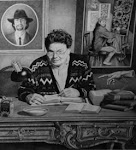
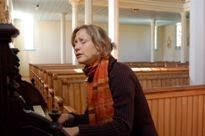
"I am 3/4ths Canadian, and one 4th New Englander - I had ancestors on both sides in the Revolutionary war." - Elizabeth Bishop
____________________________________________

Wednesday, March 31, 2010

Wednesday Wonder Question III: "The End of March"

Stones (and an oystercatcher egg) on Duxbury Beach
I had intended to mark the end of March with remarks on "The End of March," but in researching them I came across an article so comprehensive in its discussion of the poem that I felt abashed by what I'd written so far. Since it appeared just last November and may not have been seen by at least some our readers, I've decided simply to provide this link, and express my gratitude to its author, Joelle Biele, for considerably enlarging my appreciation of the poem.

Monday, March 29, 2010

FIRST ENCOUNTERS VII: John Plant

My first encounter with Elizabeth Bishop took place when I was a high school student in New Jersey, either in Oscar Williams’ A Pocket Book of Modern Verse, or the Caedmon LP which included her reading of “The Fish.” The Williams anthology, a tiny well-packed book whose green cover was dotted with miniscule photographs or paintings of the poets represented, was a lovingly assembled book, one which made it possible to plunge in at random and find something irresistible. As for the recording, what I remember is that her gentle, straightforward, unostentatious reading – the very opposite of Dylan Thomas! – made the triple rainbow at the end so moving, powerful and expressive, filling the room the way they fill the boat.

My encounter with Bishop must coincide with my first visits to Nova Scotia – our family vacationed in Petite Rivière, in the summers of 1961 and 1962, and I am certain that the Williams anthology accompanied me on these trips. I wish I could say that I made the connection of place and poet then, but this does not seem to be the case. However, Nova Scotia imprinted itself on me powerfully. Six years later I dodged the American military draft, and in 1970 my parents bought a cabin by the ocean in West Jeddore, as a place where the whole family could be together. This is where my wife Jocelyne and I live now. The intensity of my first impressions of Nova Scotia remains with me, raising the question: did Bishop set me up for Nova Scotia, or did Nova Scotia set me up for Bishop?

[To learn more about composer John Plant and his work, please visit his website.]

Saturday, March 27, 2010

Nova Scotia Connections -- The Christophian Literary Society

On January 14, 1903, the “Newsy Notes” of Great Village, in the Truro Daily News, reported: “An evening with the Christophian Literary Society ... speaks for our literary taste and culture.” In 1961, Elizabeth Bishop received the Women’s Institute’s newly printed History of Great Village from her Aunt Grace. The item that most intrigued her was about “The Literary Society”:

In the early 1900̓s the Great Village Literary Society was formed. Rev. and Mrs. W.M. Crawford were active in the Organization and fortunately Mr. Crawford’s successor, Rev. A.L. Fraser, brought to the Group a literary interest and knowledge which assured its continuance ....The Society met fortnightly in the homes of the members, to spend the evening reading and discussing great literature. A winter each was spent on Keats, Ruskin, Mrs. Browning, Milton, Shakespeare, Dante, and two winters on Browning and Tennyson ....The Society did not long continue after Mr. Fraser left in 1914, but for ten years at least, each winter the Group had lived with great writers.


After reading this passage, Bishop was prompted to write Grace, “And did you see the item about the old ‘Literary Club’ — I’d like to know how many people in G[reat] V[illage] ever read Browning or Tennyson these days ... and it happens everywhere — culture is dying out completely in small places.” (20 February 1962, Vassar College) Shortly afterwards, she wrote to Robert Lowell:

The saddest thing is the Literary Society (my mother and aunts belonged) in the early 1900̓s .... I imagine no one in that village has opened a Milton or a Browning for years now, and TV aerials rise from the shingles. The dying out of local culture seems to me one of the most tragic things this century — and it’s true everywhere, I suppose — in Brazil, at any rate. (One Art, 407–8)

Why this literary society was called “Christophian” (the Truro Daily News spelled it several different ways, including Kristosophian, Kritisphian, etc.!! – apparently, the locals couldn’t quite figure it out either) is a mystery. Its guiding light was Rev. Alexander Louis Fraser, Presbyterian minister in Great Village from 1905–1914. In his day, Fraser was a well-known and beloved poet, who published many books. Though living elsewhere during Bishop’s childhood in the village, he continued to summer there during the 1910s. Without a doubt, Bishop would have known him, as he was a friend of her grandparents, mother and aunts. Even Uncle George Shepherdson had been treasurer of the society for a couple of years.

The society’s members did not only gather in parlours and sitting rooms for quiet evenings of reading, discussion and reflection, they also organized concerts. An especially popular event was the annual Robbie Burns’ night.

Even though the society was defunct by the time the four-year-old Bishop arrived with her mother in Great Village in 1915, its residue persisted. She had vivid memories of her Aunts Maude and Grace reciting Browning and Tennyson to her throughout her childhood. She remembered her grandfather sitting at night in the parlour reading to the family from Burns, “He had a way of reading Burns — he neither wrestled with the Scotch dialect nor ignored it — he conceded wherever necessary. There was just enough to give it a Scotch flavour ... a drop of red wine into the clear yellow of the lamp-lit evenings.” (Vassar College) Those quiet private readings also brought the memory of her mother’s favourite Burns poem: “O wert thou in the cauld blast,” which Mendelssohn had set, which she requested that her father read in that lamp-lit parlour. Might she have heard it, too, during one of those Burns’ nights? In February 1910, as the Daily News reported, the literary society hosted “A Burns’ Night at Great Village” and part of the ambitious programme was a “Duet & violins” rendering of this wrenching poem:

O, wert thou in the cauld blast
On yonder lea, on yonder lea,
My plaidie to the angry airt,
I’d shelter thee, I’d shelter thee;
Or did misfortune’s bitter storms
Around thee blaw, around thee blaw,
Thy bield should be my bosom,
To share it a’, to share it a’.

Or were I in the wildest waste,
Sae blaek and bare, sae blaek and bare,
The desert were a paradise,
If thou wert there, if thou wert there:
Or were I monarch o’ the globe,
Wi’ thee to reign, wi’ thee to reign,
The brightest jewel in my crown
Wad be my queen, wad be my queen.

Did the daughter understand more of the mother’s (and widow’s) pain hearing these lines spoken quietly by the (grand)father?

Reflecting on the affect of the society in the lives of Great Villagers, Rev. Fraser noted: “We found the little club worth while. We had college graduates, teachers, doctors of medicine, housewives, merchants, school girls. It gave color to their lives, and there are people from Halifax, N.S., to Vancouver, B.C., to recall with pleasure and profit the discovery of great lines and the hearing of great music.”

Elizabeth Bishop’s fear about the dying out of local culture is a valid one even today. However, perhaps she would not be too dispairing. While not many people in Great Village are reading Browning’s or Tennyson’s poems these days, they are more and more reading Elizabeth Bishop’s. In the literary and musical gatherings held now at the Elizabeth Bishop House and in public spaces in Great Village (the church, the legion, the school, the community hall), we not only honour Elizabeth Bishop, a modern-day Keats or Shakespeare, but we also reflect back on the tradition of the Christophian Literary Society. As the Elizabeth Bishop centenary approaches, as many artists of all disciplines prepare to honour and celebrate her continuing relevance and influence, it behooves us all to think about the importance of “great literature” in our lives.

Wednesday, March 24, 2010

Wednesday Wonder Question II: Bishop and Nabokov?

...not Nicholas Nabokov, by the by, who was Vladimir Vladimirovich's cousin, a musician and composer somewhat-more-than-noddingly acquainted with our Bishop (not Morris Bishop, chair of the Department of Romance Literature at Cornell University when Nabokov taught there, "known on campus for his wit and his oratorical panache," [Boyd, 135] nor even M. B.'s wife, Alison Bishop, "a talented painter in a style not unlike the wittier style of Benois or Somov," [Boyd, ibid.] -- both of them close friends of Nabokov (V.) and his wife Vera). No. I have in mind Vladimir Vladimirovich Nabokov himself, author of the notorious Lolita and the notarial Pale Fire. I'd like to speculate here a bit on what Bishop (henceforward "E.") may have found in Nabokov ("V.")'s work, and how that work intersects with hers.

The two writers met, insofar as I have been able to determine, only once in corpore. It happened (if it happened -- it was a large gathering, we are told, so perhaps this was an Akhmatovian non-meeting, two looks exchanged as if by chance across a crowded room, a sea of heads) on Friday, May 25, 1951, sometime between five and eight p.m. The enchanted evening was a ceremony held by the National Institute of Arts and Letters, at which E., V., Brendan Gill, and Randall Jarrell were awarded grants of one thousand dollars apiece. Jarrell describes it in a letter to Sara Starr, inviting her to attend:
You'll probably never see more prominent-authors-sculptors-painters-and-musicians all together; and you'll also get given refreshments and have to listen to an organ prelude by Henry Cowell, a speech by Mark van Doren, and an organ postlude by Virgil Thomson. [Jarrell, 249]
E., Gill, and Jarrell are reported to have read from their work: I wonder what poem or poems E. might have chosen? Later, riding a bus with Jarrell after the ceremony, V. was nonplussed to find that Jarrell did not speak about poetry, but only about the reputations of other poets. [Boyd, 198].

Mentions of V. in E.'s published correspondence are few; of E. in V.'s non-existent. She harrumphs a bit to Robert Lowell about the 1960 elections to the American Academy of Arts and Letters:
Yes, I saw that Mary and Randall got in -- and Levin! -- and Nabokov refused -- and Calder's in, too. I think we might have some quite funny dinners in our old ages, don't you? [Travisano/Hamilton, 318]

A few years later E. writes Lowell about reading Pale Fire with Lota and Mary McCarthy's review of the novel:
PALE FIRE is great fun -- much better to read it first and Mary's review afterwards. Her review is clever, but seems meant for those who don't intend to read the book -- she tells so much! Lota is now working on PALE FIRE -- so much of it depends on plays on words, etc. that she has to get my help once in a while. [Travisano/Hamilton, 418]
In March, 1970, Lowell mentions V.'s novel Ada in his account to E. of accepting the National Book Award in her stead:
Ah, the award! I like to make a cut at boldness occasionally, this I think I had to do. The rather curious jury, due to Rexroth, left Pound off the listings of poets to be considered (Meredith put him on). No one even noticed the omission, but there was a great clamor about Ada and Portnoy not being listed. [Travisano/Hamilton, 669]
While Lowell was indignant about Rexroth's omission of Pound, he may not have been too concerned about the failure to include Ada, in which V. had included a parody of Lowell as the character "Lowden" (Lowell's mother's name was Ada); the two men had previously exchanged swipes in letters to the editor of Encounter, who did not publish any of of them. Lowell's included an attack on Pale Fire; V.'s were counter-thrusts claiming that Lowell was an incompetent translator:
The couplets that Mr. Lowell refers to are not at the end but at the beginning of Pale Fire. This is exactly the kind of lousy ignorance that one might expect from the mutilator of his betters -- Mandelstam, Rimbaud, and others."[Nabokov/Bruccoli, 385]
V. then improved upon this four days later in a substitute reply:
To the Editor:

I do not mind Mr. Lowell's disliking my books, but I wish he would stop mutilating his betters -- Mandelstam, Rimbaud, and others. I regret not having entitled my article "Rhyme and Punishment" [Nabokov/Bruccoli, 386]
E. had tried to spare Lowell just such attacks five years earlier, when she suggested revisions to Imitations, his collection of free translations: "I don't think you should lay yourself open to charges of carelessness or ignorance or willful perversity..." [Travisano/Hamilton, 356]. I wonder if she would have caught the parody of Lowell in Ada -- we know from a letter to Randall Jarrell that she had read both it and Portnoy's Complaint. [Giroux/Schwartz, 867].

I wonder, too, where E. began her reading of Pale Fire. With the Foreword, perhaps? I don't suppose that readers acquainted with her biography can do anything but pause in astonishment when they reach this passage of Kinbote's apologia:
Another tormentor inquired if it was true that I had installed two ping-pong tables in my basement. I asked, was it a crime? No, he said, but why two? "Is that a crime, I countered, and they all laughed. [Nabokov 1962, 7].
Of course, E. had only one ping-pong table, and it was in her dining room, not in the basement. Perhaps, though, E. skipped the Foreword and plunged immediately into the poem itself. What might her reaction have been as she made her way through the poem portion of Pale Fire? Would lines 20-21 have evoked "Trouvée"? Would she have tasted a swift sweet moment of recognition in lines 30-31 ("My eyes were such that literally they / took photographs [...]")? What would she have made of line 86, I wonder ("I was brought up by dear bizarre Aunt Maud")? Would the objects in Aunt Maud's room have brought Marianne Moore to mind? -- Maud's room, like Moore's eventually was to be, has been kept intact:

"[...] Its trivia create
A still life in her style: the paperweight
Of convex glass enclosing a lagoon,
The verse book open at the Index (Moon,
Moonrise, Moor, Moral), the forlorn guitar,
The human skull; and from the local Star
A curio: Red Sox Beat Yanks 5-4
On Chapman's Homer
, thumbtacked to the door." [lines 91-98]

Manners and morals, morals as manners... Moore might well have come to E.'s mind again when she reached lines 243-244: "[...] LaFontaine was wrong: / Dead is the mandible, alive the song." V.'s fictive poet John Shade, or his persona in the poem, had a clockwork toy that brings to my mind at least the one portrayed in "Cirque d'Hiver" -- Shade's is a tin boy trundling a tin wheelbarrow, who comes to life in the poem's final lines. Did the 'trk' at the end of line 470 recall the 'slp' of the river in "In the Village"? Did the 'Click. Clunk.' of the horseshoes being tossed (in line 991), the last one described as "leaning against its lamppost like a drunk" (in line 992), summon the click of the dredge in "The Bight", and perhaps a vision of Nate, a parodic echo of the Clang from "In the Village"?

These, though, are only some bezeled pebbles on the End of March beach that is Pale Fire. I think what would most have struck E.'s fancy would have been the poem's central conceit: Shade's near-death vision of a white fountain, his excitement when his vision seems confirmed in a newspaper article; alas, the confirmation vanishes when the 'white fountain' of the report turns out to have been a misprint for 'white mountain' -- or does it?

Life EVerlasting, based on a misprint!
I mused as I drove homeward: take the hint,
And stop investigating my abyss?
But all at once it dawned on me that this
Was the real point, the contrapuntal theme;
Just this: not text, but texture; not the dream
But a topsy-turvical coincidence,
Not flimsy nonsense, but a web of sense.

It was just such a newspaper misprint that gave E. her Man-Moth. Did she think of her moon, the Man-Moth's moon, -- so battered and shiny when Lota, her hair freshly washed, asks for help with a word in the poem ("What's grimpen?") from the next room, -- but now in "The Man-Moth" just battered, just a small hole at the top of the sky, as E. comes to lines 464-474 of Pale Fire, and listens to the trk-trk-trk of the moon-shaped channel changer, and then

Oh, switch it off! And as life snapped we saw
A pinhead life dwindle and die in black
infinity.

-- and did she think of her "Chemin de Fer" and its dirty hermit when she read the next words:

                   Out of his lakeside shack
A watchman, Father Time, all gray and bent,
Emerged with his uneasy dog and went
Along the reedy bank. He came too late.


----------------------------------------------------

REFERENCES

[Boyd]. Brian Boyd. Vladimir Nabokov: the American Years. (Princeton: Princeton University Press, 1991).

[Giroux/Schwartz]. Robert Giroux and Lloyd Schwartz, (eds.). Elizabeth Bishop. Poems, Prose, and Letters. (New York: Library of America, 2008).

[Jarrell]. Mary Jarrell, (ed.) Randall Jarrell's letters: an autobiographical and literary selection. (Boston: Houghton Mifflin, 1985).

[Nabokov/Bruccoli]. Dmitri Nabokov and Matthew Bruccoli (eds.) Vladimir Nabokov: Selected Letters, 1940-1977. (San Diego: Harcourt, Brace, Jovanovich, 1989).

[Nabokov 1962]. Vladimir Nabokov. Pale Fire. (New York: Putnam, 1962).

[Nabokov 1969]. Vladimir Nabokov. Ada, or Ardor: a Novel. (New York: McGraw Hill, 1969).

[Travisano/Hamilton]. Thomas Travisano with Saskia Hamilton (eds.) Words in Air. The Complete Correspondence between Elizabeth Bishop and Robert Lowell. (New York: Farrar, Straus, Giroux, 2008).

I'm grateful to my colleague, Yuri Leving, for help locating the letters associated with the Nabokov/Lowell Encounter tiff, and for the reference to Boyd's account of the 1951 awards ceremony. I'd also like to thank Susan Lemcke, who gave me my copy of Words in Air, and has been the source of innumerable kindnesses.

Monday, March 22, 2010

FIRST ENCOUNTERS VI: Upon being asked about first encountering Elizabeth Bishop

by Janet Baker


I feel like the narrator of "I Stand Here Ironing" saying "What you ask moves tormented through my mind." I first encountered Elizabeth Bishop's work when I was in my late twenties. I am now almost the age she was when she died. We have had a long association.

Being an academic as I was in the late 1960's, my reading was largely dictated by the requirements of course work. I was doing a doctorate in Canadian literature, and was therefore struggling through some pretty mediocre stuff. (My supervisor had discouraged my initial interest, Virginia Woolf, as being too insignificant for "advanced study" as he put it. So instead, I was reading Isabella Valency Crawford, who presumably was suitably significant. To say I was experiencing academe as surreal is to understate.)

A colleague arriving from cutting edge Ann Arbor during this time of draft avoidance knew Bishop's work, knew she had spent time in N.S., said she was the real thing and was shocked that I had never heard of her. One reading of "First Death in N.S." and I knew he was right. My next question, to myself and to my academic handlers, was why was she not better known in Canada? In Nova Scotia? To which I never ever received an answer.

In short: EB schooled me in "canons" and their ephemeral nature, in categories generally, in the buffoonery of the male dominated academic enterprise of the time, and in the dumbed down political correctness that followed. Her voice goes on and on, into eternity, in my fibres.

[Janet Baker is the author of Archibald MacMechan, Canadian Man of Letters. (Lockeport, Nova Scotia: Roseway Publishers, 2000).]

Wednesday, March 17, 2010

Wednesday Wonder Question I: Bishop and Orwell?

Monday’s “Today in Bishop” quotation from her poem “Varick Street” has prompted me to wonder whether George Orwell happened to read it when it was published in The Nation in the March 15, 1947 issue: there is a striking similarity between its haunting refrain “And I shall sell you, sell you, sell you of course, my dear, and you’ll sell me” and the lyric quoted more than once in his Nineteen Eighty-Four:

“Under the spreading chestnut tree
I sold you and you sold me.”

Orwell scholars have traced this couplet back to the lyrics of a song made popular by Glenn Miller in April, 1939, a few months before the beginning of the Second World War; the music was by Hal Kemp, the words by J. And H. Kennedy:

“Underneath the spreading chestnut tree
I loved him and he loved me
There I used to sit up on his knee
´Neath the spreading chestnut tree
There beneath the boughs we used to meet
All his kisses were so sweet
All the little birdies went „tweet-tweet“
´Neath the spreading chestnut tree
He said „I love you“, and there ain’t no if‘s or but’s
I said „I love you“, and the blacksmith shouted „Chestnut!“
Underneath the spreading chestnut tree
There he said he’d marry me
Now you oughta see our family
´Neath the spreading chestnut tree."


One can imagine that this scat on Longfellow’s famous “Village Blacksmith” would have appealed to the Bishop who was to write “In the Village.” Might not both Orwell and Bishop have been drawing upon it as a subtext?

Bishop mentions Orwell at least once in her correspondence, in a letter to Kit and Ilse Barker from May 24, 1953, in the midst of an account of her reading of Charles Dickens:
“Well, while you read Lorna Doone I’ve been here in bed reading Dickens. I really never had, very much, and I have polished off Martin Chuzzlewit, Great Expectations, Oliver Twist, his U.S. travels (guaranteed to raise my fever). How can Orwell say he was just being fair? – but then Orwell was never in the U.S., and Edmund Wilson says he asked if it wasn’t true that English had deteriorated so much there that we had no separate words for insects but called them all ‘bugs’ – and now am in A Tale of Two Cities.”
[One Art, Letters Selected and Edited by Robert Giroux, (New York: Farrar, Straus, Giroux, 1994), p. 265].

Presumably Bishop is referring to Orwell’s essay on Dickens, first published in Inside the Whale & Other Essays (1940):
“It would be an exaggeration to say that he nowhere pokes fun at foreigners, and of course like nearly all nineteenth-century Englishmen, he is untouched by European culture. But never anywhere does he indulge in the typical English boasting, the ‘island race’, ‘bulldog breed’, ‘right little, tight little island’ style of talk. In the whole of A Tale of Two Cities there is not a line that could be taken as meaning, ‘Look how these wicked Frenchmen behave!’ The only place where he seems to display a normal hatred of foreigners is in the American chapters of Martin Chuzzlewit. This, however, is simply the reaction of a generous mind against cant. If Dickens were alive today he would make a trip to Soviet Russia and come back to the book rather like Gide's Retour de L'URSS. But he is remarkably free from the idiocy of regarding nations as individuals.”

A second mention of Orwell in Bishop’s correspondence is not something she wrote, but something which was written to her, by Robert Lowell, in a letter from August 23, 1968:
“Things worked out much better with Mary [McCarthy], but her guests are almost as dull and as many as the Eberharts: I faint at the thought of what has passed through here: American common market people with French names and American fortunes; all summer, the sweet, drunken, never silent widow of George Orwell; [...]”
[Words in Air, the Complete Correspondence between Elizabeth Bishop and Robert Lowell, edited by Thomas Travisano with Saskia Hamilton, (New York: Farrar, Straus, Giroux, 2008), p. 645].

“Sweet, drunken, never silent”... I wonder what passed through Bishop’s mind as these words passed beneath her gaze?

Monday, March 15, 2010

FIRST ENCOUNTERS V: Reunion with EB,
by Linda Rae Dornan


In 2008, when Suzie LeBlanc described her love of Elizabeth Bishop's poetry to me, it had been many years since I had read any. I soon rectified that, quickly dipping into a phrase here and an image there on a regular basis. Bringing her poetry into my life again has been a very happy event. Sharing it has been another. In August 2008, Suzie and I walked across the Avalon Peninsula, from St. John's to Norman's Bay, retracing the path which Bishop and her friend, Eva, walked in 1932. Bishop's Newfoundland journal, though brief, mentioned people and places, and some of her impressions. We were able to meet several descendants of people mentioned in the journal which was a lovely surprise. We also met many incredibly generous people who invited us into their homes, helped us with whatever we needed, and who were interested in our project. We read poetry to them and invited them to read it as well. I was carrying a video camera and recorded our trip through highway and byway, beach, bog, mountains and blueberries amongst many various landscapes. This movie documentary will be shown during the centenary celebrations in 2011.

Following Bishop's path gave us both time to think, to get to know each other, to become physically stronger, and to meet some fantastic Newfoundlanders. One of the main characters in this story is, of course, the landscape. I have been to Newfoundland many times since 1979 and each time I have felt a binding connection to the land. This trip was even more intense since I was immersed in the landscape every day as we placed one foot in front of the other travelling from community to community. I found myself wondering about the changes placed upon the land since 1932. In Bishop's journal there are fewer people, less cars, more sickness (tuberculosis), less sanitation, less education, but still great hospitality. She and Eva went swimming and jigging, Suzie and I went swimming and on a boat tour (jigging is no longer legal). We did have the traditional jig's dinner though, courtesy of the Byrne's family in Holyrood. The air is still delicious outside of major urban centres and the sea has not stopped being overwhelmingly beautiful. I can only imagine the effect on EB of the wilderness she was in. She was a young woman in 1932 storing her impressions and life's experiences for more mature poetic insights.

Where once there were dirt roads and paths through forests and along the shore, there were now highways and private shore properties so whenever we could, we walked to a beach and hiked through the forests. Seeing the land while on foot instead of speeding through the landscape was about experiencing its smells and textures, and being seduced by what I came to call the Moss World, all green and red and varied. It also made us more open to meeting people along the way. From Cheryl (coincidentally, a cousin of the Byrne Family) who we met on the way to Conception Bay, and who offered to drive us a short distance but instead took us to her favourite spot in the world which was a huge waterfall in a rock cliff way out in the middle of nowhere; to Vera in Chapel Arm whom we met on a stony beach after an all day hike over a boggy mountain, who took us home for tea and cake and chat. Elizabeth brought us here, that is what we were thinking, through all of our individual re-evaluations and life issues and tired muscles. There is value in following what is a tenuous connection—this retracing of a dead poet's journal; reading her poetry on the moors above Brigus; meeting people and reading Bishop's poetry to them and with them; celebrating the re-enactment of her youthful adventures; reaching our own insights.

The video camera had not recorded the sound as well as I wanted that August, so we returned in August 2009 to gather better sound recordings and more footage. Again, we were struck by the hospitality of the people and the amazing landscape. I had been in touch with people ahead of time and many graciously became poetry readers...Poets Mary Dalton and Don McKay, artists Marlene Creates and Pam Hall, musician Christine Smith and radio producer Chris Brookes all read while the Byrne family once again opened their doors to us, read Bishop's poetry and shared history and food.

As I begin the long editing process for the documentary of our trip about EB, the Avalon Peninsula, the walking experience, the landscape and people, and having adventurous spirits, I am once again immensely pleased to have Bishop's poetry in my life. For that is what motivated me to begin this particular adventure and which has opened new pathways in my own artwork.

At the suggestion of Suzie and Sandra Barry, I am organizing a short film festival for the Centenary Celebrations in 2011. For anyone out there who is interested in making a short film/video about EB's poetry and writings, her life, and anything about her, please make one and send us a copy of it. There will be a screening in 2011, the time and place to be announced at a later date. Stay posted for the deadline and further updates. It will be an amazing year! You can contact me with any questions at lrdornan@yahoo.ca. Cheers!

[To learn more about Linda Rae Dornan and her work, please visit her website.]

Saturday, March 13, 2010

EB100 and Symphony Nova Scotia

On Friday 12 March 2010, a couple hundred people gathered at the Rebecca Cohn auditorium in Halifax, N.S., for the launch of Symphony Nova Scotia’s 2010-2011 season. I have been a subscriber to SNS for many years. For me, SNS is one of the great benefits of living in Halifax. SNS is one of our cultural gems. The programming for the upcoming season is fantastic. You can find out more about it on their website: www.symphonynovascotia.ca

If you read my February post “The Origins of an idea: the theory of a centenary” and Suzie’s “First Encounter,” you will remember that my first idea for celebrating Elizabeth Bishop’s centenary was to commission settings of her poems by Canadian composers, which would be premiered by SNS. I hoped this idea could become a reality, but I did not really think it was possible. A series of convergences occurred to bring Suzie and me together, both of us holding the same idea, she with the capacity to make it happen. The Bishop realm is like this — serendipity and synchronicity everywhere.

I am thrilled to say that on 12 March 2010, such a premiere concert of settings of Bishop’s poems to mark her centenary was announced as part of SNS’s 2010-2011 season. Before you read any further, mark THURSDAY, 10 FEBRUARY 2011, in your calendars and join us for “Elizabeth Bishop in Words and Music,” featuring our own Suzie LeBlanc. This concert will mark the official start of our EB100 celebrations — and what a kick-off it will be!!

In the days to come, Suzie herself will write more about the commissions, the concert and her collaboration with SNS. We will even have some of the composers and members of the orchestra of SNS contribute to the blog. For now, however, I wanted to be the first to announce this exciting project to the Elizabeth Bishop world.

For me, personally, this concert is a dream come true. Bishop’s poems have been set by a number of American and Brazilian composers: Elliott Carter, Ned Rorem, John Harbison, Luciana Sousa, and others. Bishop herself heard some of the settings: she attended the premiere of the Carter suite, “A Mirror on Which to Dwell,” and knew Ned Rorem and heard some of his settings. But, as far as I know, until now, no settings have ever been done by any Canadian composer.

Bishop herself was so passionate about music — her taste was eclectic, ranging from traditional hymns to Brazilian samba, from early (indeed sixteenth and seventeenth century) music to opera and jazz; from Purcell to Webern. She studied music at Vassar. Her instrument was the clavichord. She owned one made by the Dolmetsch company and carted it around with her for decades. She said more than once that she always wanted to write song lyrics. Her “Songs for a Colored Singer” were written with Billie Holiday in mind (she knew Holiday in New York in the 1930s).

The EB100 celebrations include a number of music projects (from concerts to kitchen parties) throughout the year — stay tuned to learn more about them; but the Symphony Nova Scotia/Suzie LeBlanc collaboration is a special one for me. I want to thank Suzie and the composers (I will let Suzie tell you who they are – and they are fabulous!) for their commitment to this idea. I also want to thank the Music Director of SNS, Bernhard Gueller for being open to this idea from the start and working to make it happen.

Besides the wonderful EB songs being offered on 10 February 2011, Maestro Gueller’s own birthday gift to Elizabeth Bishop is Beethoven’s Fifth Symphony. I have had the privilege of seeing Maestro Gueller conduct a number of major Beethoven works, and when I learned that his choice for the second half of the concert was this piece, I was thrilled. He is a passionate Beethoven interpreter. One of the principal philosophies of our EB100 celebrations is that artists of all disciplines pay tribute to Bishop in their own way — through their own creative process and medium. There is no better way for Maestro Gueller to honour Elizabeth Bishop’s 100th birthday than to conduct one of the greatest symphonies of all time, to conduct the music of a composer with whom he has a long-standing and profound connection. I think EB would appreciate the range of music which will be offered by SNS on 10 February 2011. It will be another magical convergence.

I also want to thank Erika Beatty, the CEO of SNS, and Adrian Hoffman, Chair of SNS’s programming committee. Both have been enthusiastic supporters of this idea from the beginning. I also want to thank, again, Peggy and Shimon Walt for their pivotal role in facilitating the convergence which lead to these new works and this exciting concert.

Well, you can imagine, I will be at the Rebecca Cohn on Thursday, 10 February 2011 — with bells on!!!

Monday, March 8, 2010

FIRST ENCOUNTERS IV: How I first met Elizabeth Bishop, by Joy Laking

Many years ago I was driving along near Great Village and suddenly a very old fashioned Acadian Lines Bus came the other way. “Wow,” I thought, “I just can't believe the old buses they put on our route.” A day or two later, I heard through the grapevine that PBS was making a film on Elizabeth Bishop. I had never heard of Bishop. Being an avid reader, I was intrigued that I had lived in this area for ten years and nobody had mentioned her to me. I quickly found a copy of her poetry and prose. My three children were small and I thought I could read her short stories to them. All went well until I read “The Baptism” and the little girl dies of pneumonia. Quickly, I changed the ending, much as I always did with Cinderella. In my version of Cinderella, she meets the prince, they become friends and go off to University together. In my version of “The Baptism,” the little girl soon recovered.

Elizabeth Bishop's name kept popping up. I went into Truro one evening for a Bishop talk by Peter Sanger at the Truro Historical Society. There I also met Sandra Barry. Sandra is a wonderful woman who is so full of enthusiasm for EB that one can't help admiring her tenacity. Later, I was approached to support the Elizabeth Bishop Society. I happily donated one of my serigraphs called aptly “In the Village.” When the fundraising draw was held, Sandra Barry won the print (perhaps she bought all of the tickets). In any event, none of us could imagine a better winner.

"In the Village" by Joy Laking


Over the years, Elizabeth Bishop has gradually crept into my life. When I was on the board of Ship's Company Theatre, one of our summer plays was about Elizabeth Bishop's adult life, written by Donna Smyth. It was a powerful play with an amazing set, and I can still see “Bishop” swimming in real water towards the shore. Just prior to Jim and I going to South America last year, we had an Elizabeth Bishop scholar, visit the gallery from Brazil. This new friend put us in touch with another friend and we ended up with perfect accommodations in São Paulo.

Then last June, Jim and I went to breakfast on Saturday morning in Great Village as we always do. I was approached to be on the EB Society Board. I wanted to say, “No. I am on too many boards.” However, I gave it some thought and decided that working on the EB centenary is something that I have to support. And so jump right in I did. The centenary celebration is right on many different levels. Hopefully, most Nova Scotians will finally know who Elizabeth Bishop is. The centenary will also draw attention to the value of poetry and prose and encourage more creative folk to write. Our area of rural Nova Scotia is depressed because of declining population and declining jobs. Church closures and school closures are always being debated. The centenary will not permanently change the economic climate of this area but we are already filled with community pride as we work on this wonderful party celebrating Elizabeth Bishop's birth!!

[To view more of Joy's work please visit http://www.joylakinggallery.com/]

Saturday, March 6, 2010

Nova Scotia Connections -- Migrations

In 2003, I was invited to be on a panel at an American Literature Association conference in Boston. The panel’s title was “Elizabeth Bishop and the ‘Boston States’,” which phrase was once of common usage in Nova Scotia because the links between New England and the Maritimes are historically deep and wide. Bishop’s family, indeed, her whole ancestry, shared in these deep connections, a long and steady story of migration between the two regions. I was given 15 minutes to say something on this subject. I knew that trying to describe all these connections in prose was not possible in that time. So, I chose to write a poem, which, with your indulgence and apologies to Bishop, I once again share.

On 3 January 2003, Muir MacLachlan had died. He was 92. He lived in Great Village. He was Elizabeth Bishop’s classmate at the Great Village School in 1916–1917. Muir’s own family also shared in the Maritimes-New England trajectory. I dedicated the poem to him.


Her ancestors sailed from England
for every reason imaginable,
sailed towards the future, which is now
the unreclaimable past.
Fosters trace to William the Conqueror.
Bulmers trace to before William the Conqueror.
Bishops and Hutchinsons trace beyond memory.
Somewhere, so far back,
hidden in the folds of Fales, Meade, Hooper and Black,
the lines diverged from the seven clan mothers.
Somewhere, not so far back, the codes held
in these bones and blood washed up
on nearby shores: colonies of wilderness,
colonies of hope, colonies of construction
and deconstruction, and every ancestor must account.
Fosters trace to Massachusetts.
Bulmers trace to Nova Scotia.
Bishops trace to Prince Edward Island.
Hutchinsons trace to New Brunswick.

The matrix is artisans – weavers, farmers,
carpenters, tanners; seamstresses, gardeners,
healers, cooks – crafting from scratch
(she once wrote “in a pinch”) new lives
“in unthought of ways,” new ideas forged
from molten iron (the too hot imagination),
cooled into judges, deacons and politicians
with obedient or not so obedient wives.

The circle constricts towards the centre;
the trajectories lie in closer proximity.
What force in nature brings together
disparate lives as though on purpose?
She would have said “wanderlust.”
It must be a gene.

The matrix set inside a vast historical pattern
because the sea is the first highway,
an element of motion older than all pilgrims
combined. Its paradigm is tide. Time.

The wanderlust kept alive by the Hutchinsons
– master mariners and missionaries who sailed
around the Horn, sailed to Egypt,
to India and back to England. Sailed and spoke
the journeys – this line was the artists: writers,
translators, painters, orators.
Her affinity was always with the artists,
who settled and never settled, who appeared
and vanished, because that is what artists do.

John Bishop emigrated from Prince Edward Island
to Rhode Island to Massachusetts. He married
Sarah Foster; their large family included William.

William Bulmer took a young man’s tour
of New England, then settled in Nova Scotia.
He married Elizabeth Hutchinson;
their large family included Gertrude.

All the ancestral inclinations converged here,
at the turn of the twentieth century,
in a moment (lost to the record)
when this William and this Gertrude met.
It all happened for this one reason
(why not?) – it all happened for every
other reason imaginable or unimaginable,
remembered or lost. Is there a reason
to choose a nexus, study it,
realize, as she did,
truth is an imaginary iceberg,
visceral, looming, cold?
Her study of the consequences
of this lost moment lasted a lifetime.

Begin again: to Boston to Boston to train
as a nurse; home again, home again
because she was ill. Back to Boston
where he was ill; she nursed him
back to health.

The bond can only be imagined: She fled
to Great Village afraid of the power
of her love. He followed her to Great Village
determined to declare his powerful love.
In 1908 they were married. They sailed
to Jamaica, to Panama for their honeymoon.
Back in Massachusetts they lived and loved
their only child into being.
1911 was a year of life and death (isn’t every year?).
1911 began the back and forth of her imagination;
life began like a cradle rocking. Rocking gently
on the sea between worlds, both worlds home,
neither world home. She said the poet
“carries home within.”

Is there a reason
to choose? Let the rocking continue
her whole life: aboard the North Star
(ponder all the shipwrecks); aboard
the Königstein, the Normandy, the Britannic,
the Exeter, the Bowplate, the Jarlsberg,
the Prince of Fundy. Life began en route:
steam back and forth between Yarmouth
and Boston, ride the “unk-etty” train
between Londonderry Station and Boston,
motor the to and fro in early Fords and Chevrolets,
sit in the long bus limbo on trips between
Great Village and Boston. Occasionally fly,
if you have to.

Great-grandparents did so.
Grandparents and great-uncles did so.
Maternal aunts and girl cousins did so.
Even Uncle Arthur, who never went anywhere
in his life, drove from the village to Boston
once or twice, to visit his daughters.
Look at him, he ended up in Brazil,
like she did. Willingly
and unwillingly she came to and left
Nova Scotia. Willingly
and unwillingly she came to and left
Massachusetts. Patterns as old as her ancestors,
as new as her own next breath.
Lost and found words were mantras,
she called them “first syllables,”
which vanished from her tongue
like her father and mother from her life.
Where does the historian, the biographer,
the critic, the artist locate the initial conditions,
the uncanny convergences, the accidents?
In her lines, in her vision (look, that is),
in her memory, which lift the weight
of uncountable yesterdays, as far back
as William the Conqueror,
and as close as old men named Muir.

Monday, March 1, 2010

FIRST ENCOUNTERS III: "Is It Excess of Imagination?" --

-- or so I ask myself, when I cast my mind back over the past thirty years or so and all the tellings and re-tellings of the story of my first encounter with the work of Elizabeth Bishop, and of my all-but-Akhmatovian non-meetings with Miss Bishop herself -- is it excess of imagination that makes me indulge this queer retrospective urge I've so often felt to place myself in her proximity geographically and chronologically? Is it oddly-manifested gratitude (much too late for that, alas) for the words she left behind? Or (let's be honest now, shall we?) might it not be unrequited hope that, like a needle drawn across a lodestone or a knife against a whetstone, something would somehow rub off, and I'd become as magnetic a writer or as sharp a wit as she?

We were both at Harvard in 1972-1977. I was a graduate student in Slavic Languages and Literatures, and in my last three years there a Teaching Fellow. In the tale I tell when asked about it I have always stated that we taught in the same building, -- "albeit I was on the second floor, whereas she was in the basement," I usually add modestly. As I checked the facts in preparation for this slender contribution to the genre of the confessional, however, I discovered three decades' worth of what I'd prefer to believe are unintentional little white lies, told often enough to have replaced the truth even in my own recollection. It turns out I was in Emerson Hall, and she was in Kirkland House. I've generally added that we probably attended the same reading by Seamus Heaney -- in the Poetry Room on the second floor of the Lamont Library ("and may even have sat next to each other," I sometimes speculate in my more expansive moments), but truth, like a pebble of quartz lodged awkwardly somewhere between my sole and my stocking, now hurts me into the rueful admission that most likely that reading was later, in 1981-82, when I had returned to Harvard on leave of absence from Dalhousie University in a fruitless attempt to complete my dissertation. Her presence at a reading then would have aroused a certain amount of comment even amongst notoriously reserved Cantabrigians. I've always concluded my story by pointing out that Dalhousie awarded her an honorary degree in 1979, "and wouldn't you know that would be a year when I didn't attend Commencement." Well, that's true enough, I suppose. I seldom do.

There are other details I omit in the telling -- conceivable overlapping visits to a certain drinking establishment near Harvard Square where Bishop fell and broke her shoulder one icy second of January, for example: the Casablanca, with its man-moth single-letter slip away from the title of her poem about the boy who stood on the burning deck reciting "The Boy Stood on the Burning Deck" and towards the title of the film that most often played (continuously, morning, noon and night) at the neighboring Harvard Theatre (then going through one of its seedier periods). Or perhaps she went to the Orson Welles Cinema (now only a memory, then a vast tan sand-stuccoed cavern of art film delights) to see Pixote the same night I did -- after all, I had seen Paul Monette and Roger Horwitz there that evening, hadn't I? --or thought I did. Why shouldn't she have been there, too? But that turns out to have been in 1981-82 as well.

I'm a bit less vague about my first acquaintance with Bishop's work. While I was house-sitting for Professor Lord in the cold early spring of 1982, I was assaulted one afternoon on Mass Ave: someone knocked me to the sidewalk and snatched a Russian fur hat I'd been incautious enough to be wearing (four years of life in Nova Scotia had left my America Survival Skills (tm) sadly atrophied). Even more incautiously, I gave chase, yelling "Stop, thief!" at the top of my lungs -- to the indifference or occasional amusement of otherwise-occupied passersby and gawking onlookers. Eventually, after what seemed a mile or so but wasn't even as far as Central Square, my lungs gave out and I gave up. I turned around and trudged back to Harvard Square, muscles aching and body trembling from all that nasty adrenalin. A friend and fellow graduate student, Don Anderson, ran into me, saw the state I was in, took me straight to a bar (not the Casablanca), and did a very kind and sensible thing: he bought me a drink. (Don was always sensible: he ended up abandoning Slavic Studies for a career in banking). Then he listened to my story. Then, to take my mind off my troubles, he changed the subject and began to talk about the English-language poets he was reading. It turned out that we shared an interest in James Merrill, and it was after talking about him for a time that Don mentioned someone I'd never heard of. It was Elizabeth Bishop.

Within a week I was hooked. I no longer recall which poem turned the trick, but by the time the Voices and Visions documentary on her life and work appeared on PBS in 1988 I had already come to think of her as a kind of tutelary spirit. Like Sandra Barry, I find her lines constantly just popping into my head. After Hurricane Juan, for instance, when a dead white strip of new concrete replaced half of the completely undamaged but well-weathered sidewalk on the Lord Nelson side of the Public Gardens, I immediately thought of the Amazon and Tapajós from "Santarém." I wasn't sure why, until days later I observed that in the acute-angled sunlight of the hour after dawn the sidewalk now gleams a watery blue alongside a muddy brown... and I find I am no longer tempted to quote Mr. Swan when viewing it at other times of day.

It would be yet another little white lie to claim that as a result of my Mass Ave misadventure my favourite Bishop poem is "Exchanging Hats". Nevertheless I will admit that I suffer from a form of post-traumatic stress syndrome as a consequence of the incident, which manifests itself annually on the eve of the "Heat the House" Bishop Birthday Party when I am choosing my costume. One year I donned lengths and lengths of wet white string... Another time I acquired a carpenter's level from Canadian Tire, tied it to my head with more lengths and lengths of white string (dry this time, however -- I am capable of learning from experience) and spent the following evening enduring repetitive remarks to the effect that I seemed to be keeping a level head on my shoulders, &c &c &c... I don't know what form my chapeau will take in 2011. Perhaps time will tell. "Time will say nothing but I told you so," intones Pernicious the Musquodoboit Harbour Farm Cat from his perch astride my computer monitor. I believe this means it is past my bedtime, and more than past time to post these remarks.

Friday, February 26, 2010

Nova Scotia Connections: North Star

“Miss Grace Boomer and friend Miss Richards and little Elizabeth Bishop all of Boston arrived home the latter part of last week, and are visitors with Miss Boomer’s parents, Mr. and Mrs. Wm. Boomer. These young ladies were passengers on the ill fated Steamer North Star, which was wrecked on the voyage from Boston to Yarmouth.”

Truro Daily News, 13 August 1919


Imagine my surprise when I read this notice one spring day in 1991 (a little shuffle of those 1s and 9s), sitting at a microfilm reader at the Nova Scotia Archives. Grace was bringing Elizabeth back to Nova Scotia after living in New England for a year and a bit. “The ill fated Steamer North Star”! What was that, I wondered? It didn’t take me long to discover the dramatic story of this Eastern Steamship vessel.

Early on the morning of 8 August 1919, the North Star was making slow progress towards Nova Scotia in a heavy sea and dense fog when it struck Green Island off the coast. Literally, the large vessel slid right onto the rocks, tearing a hole in its hull. It took hours, but all the passengers were taken off (fishing boats from coastal communities enacted the rescue). Amazingly, there was no loss of life and only minor injuries. The North Star was stripped of all that could be remove and left to the elements of the open Atlantic. It eventually broke apart and disappeared.

I was so intrigued by this story and wanted to learn more that I went to the Yarmouth County Museum Archives, a wonderful place of seafaring artifacts, including the magnificent ship’s bell and wheel from the North Star. I got to ring the great bell and see pictures of the steamer with its large solitary funnel stranded and tilted on Green Island. As I talked with the archivist, she remembered that sometime in the late 1970s an elderly woman had come in asking about the ship because she had been one of the children on board. "Yes," she said, "I think the newspaper even came and took her picture." Off she went to locate the file containing that photograph. Elderly woman, late 1970s...could it be? The archivist returned with the file. I opened it. Alas, no, not Elizabeth Bishop, but one of her fellow passengers who nearly 60 years before had also been aboard the "ill fated North Star."

For someone so fascinated with seafaring and shipwrecks (a fascination which came primarily from the marine lore and oral tradition of her mother’s family), it is puzzling that Elizabeth Bishop never directly wrote or spoke about her own shipwreck – and not on just any ship, but one uncannily called North Star. Elizabeth was eight years old when she had this adventure, which certainly did not deter her from travelling on steamers and freighters right up to the end of her life. Indeed, a ship was her preferred mode of transportation. Perhaps there is an echo of the North Star in the title of her first book, North & South.

Tuesday, February 23, 2010

Nova Scotia Connections: Sable Island

How are we connected to any given place, to a moment in time, to an object, to our own lives? One way to demonstrate Elizabeth Bishop’s quiet comprehensiveness is to choose a subject, an image, an idea and go looking for it in her work. Or, when one comes upon a subject in a Bishop poem or story, look for its iterations, its surfacings again and again. When exploring her connections to Nova Scotia, the threads are not only long and enduring (that is, one subject, image, idea can stretch across time and space, perhaps even her whole life); but they are also endlessly proliferative (one subject, image, idea leads to another and another). The big poetic subjects such as love, loss, beauty and mystery abound; but so, too, do details such as clouds, colours, coins and confectionary.

The constellation of connections can be quite astonishing. Take, for example, Sable Island (a complex subject in its own right). It is a veritable galaxy of associations and meanings for Elizabeth Bishop:

Fascinated by islands all her life, Sable Island may have been the first of such geographies she became aware of because her family’s oral tradition held that her great-grandfather Robert Hutchinson was shipwrecked there in September 1866.

Aunt Grace Bulmer Bowers owned a Sable Island horse named Pansy. Bishop met Pansy in 1946 when she visited Grace at Elmcroft, the Bowers’ farm near Great Village.

So fascinated was she by Sable Island that she visited it in August 1951, no easy feat even then. She researched the island at the Public Archives of Nova Scotia, read Rev. George Patterson’s Sable Island: Its History and Phenomena, and kept a journal during that visit. She began to write a piece about Sable Island for The New Yorker, which she titled “The Deadly Sandpile.” She never finished it.

In this piece, she likened Sable Island to a large-scale version of the “Indrawn Yes,” a lingual expression common to people in the Maritimes. Decades later this “Yes” found its way into “The Moose,” a poem which was triggered during that 1946 visit to Great Village and dedicated to Aunt Grace.

Just before leaving for Sable Island, she wrote to Robert Lowell that her reasons for going were to see the Ipswich Sparrow (Sable Island is its only nesting site) and the horses, and maybe to write a poem or an article – or, to fulfill her destiny “and get wrecked too.”

She was fascinated by the sea and shipwrecks. Sable Island was known as the “Graveyard of the Atlantic” and one of the documents she saw at the Public Archives was an amazing map of the island which showed the locations of hundreds of wrecks. She was also fascinated by maps.

********

I had the great privilege of visiting Sable Island for one day in May 2008, a trip I will never forget. I saw the horses, the sparrows, and walked the eternally shifting sand, perhaps even along some of the paths Elizabeth Bishop walked in 1951. At least I can imagine I did so.

If you want to learn more about Sable Island visit the website for The Green Horse Society (www.greenhorsesociety.com). On Wednesday, 3 March 2010, at 7:00 p.m., the "Sable Island Update, Sixth Annual Public Meeting," will take place at Saint Mary’s University, Halifax, N.S. For more information about the program, go to the above website.

Sunday, February 21, 2010

A bit of housekeeping

Our tech wizard John, who is responsible for the look and smooth running of this blog, is away for a week. In fact, he is ensconced at the Elizabeth Bishop House for a writing retreat. It leaves me to mind the store, which I will endeavour to do as well as I can. Many people have told me that doing a blog is "so easy" -- and I do understand what they mean. However, my ease with computers and the internet is minimal. That I am able to post at all is due to John's patient tutoring. Just before I drove him up to Great Village, he gave me yet another tutorial: how to change "Today in Bishop." I seem to have grasped that simple task, and John has supplied me with all the material I need for the next week. However, I myself am away later today and tomorrow, so there will be a delay in posting the entry for 22 February. In addition, the finer points of format still escape me. Even though John showed me how to attach an html tag to create justified margins, I've lost it somewhere in my notes and my mind's file drawers. So, for the next week, the blog will not be quite so crisp. I will have yet another tutorial when John returns. I am glad there are no tests! I'm working on a "Nova Scotia Connections" post, so stay tuned for that early next week. We are also expecting our initial "First Encounters" guest posts for early March. So, lots to look forward to as we count down to EB100 in 2011!

Friday, February 19, 2010

FIRST ENCOUNTERS II: But she's a Nova Scotian! by Sandra Barry

For years I have had the immense delight and privilege to meet many people who love Elizabeth Bishop’s art. Almost without exception, they have fascinating stories not only about how they first encountered her work, but also about how it has followed them through their daily and creative lives. Bishop’s art is like that, once her lines and images and rhymes get hold of you, they stick, they become part of the mantra of one’s day. I find myself muttering “looking for something, something, something” or “Everything only connected by ‘and’ and ‘and’” or “awful but cheerful” over and over again. I have often thought that it would be fascinating to collect these “First Encounter” stories – and am delighted that we are beginning that process here. Over the next year or so, we will be inviting artists to recount their own stories about how they first read Bishop.

My first encounter with her occurred in January 1988, in an American Poetry seminar taught by Robert Cockburn at the University of New Brunswick in Fredericton. The course included only four poets: Robert Lowell, James Wright, James Dickie and Elizabeth Bishop (what a combination!). In all honesty, I’d not heard of any of them, except, vaguely, Lowell. On the first day of class we were asked to chose two poets for our presentations.

I grew up in the Annapolis Valley in Nova Scotia, a place where the surname Bishop is incredibly common. My mother’s name was Elizabeth. EB was the only woman on the list. This combination of subliminal factors caused me to choose her instantly. The other poet I chose was James Wright.

The previous year I completed an M.A. in Canadian History at UNB and being a freshly trained historian, the first thing I did was go to the library to find books about Bishop. The first book I pulled off the shelf was The Collected Prose. Standing in the stacks of the Harriet Irving Library I opened the book to the first story, “Primer Class,” about attending the Great Village School in 1916–1917. I attended a similar school when I was in Grade One in 1966–1967 in Paradise, N.S. What I read astounded me. Even though I was two generations younger (she was born the same year as both my grandmothers), our experience in a rural Nova Scotia school was astonishingly similar. Then I began to read her poems. Again and again I encountered things that echoed my own experience growing up in this province. But, even more, this convergence occurred in art that is so brilliantly crafted and genuinely humane that I was both stunned and inspired. From that moment I was hooked on Elizabeth Bishop’s life and art and have been researching and writing about both ever since.

The presentation I gave in the seminar argued that she was not an American but a Nova Scotian! I got an A-. I still have the notes I made on big recipe cards! I can’t remember at all what I said about James Wright.

Friday, February 12, 2010

Nova Scotia Connections

My dear Miss Bishop:
I hope you won’t think it an impertinence if I try to tell you how much I have enjoyed your two (latest?) stories in The New Yorker. Not that I shall attempt anything in the way of an appreciation of their aesthetic qualities. My competence in that field is much too amateur to put into words what I feel about the perfection of your writing. I am simply overwhelmed with its loveliness. But as a former Nova Scotian I should like to thank you for the delight you have given me with the absolutely correct Nova Scotianness of your characters, scenes, and incidents. Indeed you bring my past so much alive that you make me feel you have almost lived my youth over again….

[Elizabeth Bishop Papers, Vassar College Special Collections, Series I, 2.15.]

This passage is the opening of a letter written by Victor L.O. Chittick to Elizabeth Bishop on 2 January 1954. It might be one of the first fan letters she ever received. Chittick was born in Hantsport, N.S., but in 1954 he was a professor of literature at Reed College in Portland, Oregon. In December 1953 he read “In the Village” in The New Yorker and wrote to Bishop, who was living in Brazil. Think about the trajectory of this correspondence—New York, Portland, Petrópolis. What brings them all together? Nova Scotia. Chittick and Bishop began a correspondence and the well-known Thomas Chandler Haliburton scholar went on to write what might be the first critical essay about her work, published in The Dalhousie Review in 1955. The title of that essay is “Nomination for Laureateship.” Yes, Chittick put forth Elizabeth Bishop as the “unofficial Poet Laureate of Nova Scotia” (Nova Scotia not having an official position). Even as Bishop had been Poetry Consultant for the Library of Congress in 1949–1950, this “former Nova Scotian” saw instantly the depth of her connection to the province. I wonder if Bishop ever told him that in 1929 her Walnut Hill School classmates had foretold this position in their graduating class prophecy: “Miss Bishop, the poet laureate of Nova Scotia. Walnut Hill has proudly placed her bust in the alcove, while she remains in Nova Scotian seclusion.”

******

The focus of this blog is the Elizabeth Bishop centenary — a place to find out information about the many activities which will happen in Nova Scotia — and elsewhere. Some of these activities are well into the planning stages, some are only just germinating. Over the next two years we will ask various artists to speak about these projects and their own connections to Bishop. But two years is a lot of days, weeks and months to account for (though sometimes it seems barely any time at all!), even with guest postings by the dozens of wonderful people who will participate. John has his challenge, to which he is admirably rising, with a quote of the day! He will have other germane and delightful things to say, too. Suzie will make offerings especially on the artistic side, as she is deeply involved in the musical events being planned; her vision and creativity in this realm fostering all sorts of wonderful collaborations. I wondered how I could contribute beyond discussing my own involvement in centenary projects. I decided that I will, now and then, write about Bishop’s many “Nova Scotia connections,” details I have discovered in my research about her family and childhood. Whatever we write — along with your welcome comments — will reflect the larger motivations and intentions behind EB100, so in the spirit of Bishop’s interest in “(no detail too small),” I thought our readers would enjoy learning about some of the particulars, and might even be inspired by them.

Wednesday, February 10, 2010

The Origins of an Idea: the theory of centenary

“I’ve been having a wonderful time reading Darwin’s journal on the Beagle – you’d enjoy it too. In 1832 he is saying, ‘Walked to Rio (he lived in Botofogo); the whole day has been disagreeably frittered away in shopping.’ ‘Went to the city to purchase things. Nothing can be more disagreeable than shopping here. From the length of time the Brazilians detain you,’ etc. etc. One wonderful bit about how a Brazilian complained that he couldn’t understand English Law – the rich and respectable had absolutely no advantage over the poor! It reminds me of Lota’s story about a relative, a judge, who used to say, “For my friends, cake! For my enemies, Justice!

[from a letter to Pearl Kazin, February 10, 1953, in One Art. Letters, selected and edited by Robert Giroux. (New York: Farrar, Straus, Giroux, 1994), p. 255.


I am amazed by John's resourcefulness for finding quotations for "Today in Bishop." Believe it or not, this post was done totally independently of the quotation for February 10. I guess we are all "in sync": me, John, EB and Darwin!!

One of Elizabeth Bishop’s heroes was Charles Darwin. We are just past an important Darwin anniversary. Undoubtedly, EB would have paid attention to the activity marking Darwin’s birth and the publication of The Origin of Species (though she preferred The Voyage of the Beagle). So far in this blog, we have been acknowledging the fact that EB was uncomfortable with birthdays, and would be bemused by all the fuss we are making to celebrate her centenary. However, I for one think that she would somehow come to terms with it, be resigned, and perhaps even a bit in awe of all the wonderful artists who are so enthusiastically taking up this celebration, wanting to be part of it (many of whom you will hear from here over the next year, as we invite these artists to talk about what they are doing and why).

With a nod to Darwin, I want to describe the origins of the idea for celebrating Bishop’s centenary in Nova Scotia – to set out something of the evolution of this process.

I have been reading Elizabeth Bishop’s work since 1988. I have been actively researching and writing about her life and art since 1990. I am a co-founder and past President of the EBSNS. I am a co-owner of her childhood home in Great Village. It is not surprising, given this long-standing connection, that I began thinking early on about Elizabeth Bishop’s centenary. Indeed, I began talking with people about this important anniversary late in 2005. One of the first people I talked with about planning some sort of celebration to mark what we are now calling EB100 was a dear old friend, Fonda Gamble Smyth (Fonda is from Londonderry, very near Great Village). We were roommates at Acadia University eons ago. After having lived in New Zealand for many years, Fonda returned to Nova Scotia. I remember that our several conversations about EB and her centenary were generative and encouraging.

The next person I spoke with was Peggy Walt, who in the early 1990s was involved with the Nova Scotia Department of Education and Culture. She worked for the Director of Culture, Allison Bishop. The Minister of Education and Culture at that time was John MacEachern, who was, coincidentally, a big EB fan. All three were directly involved in helping to create the EBSNS in 1994. When Peggy left government she continued to be deeply involved in arts and cultural activities in Nova Scotia in many capacities, including as a publicist. Peggy had maintained her interest in EB activities in NS, so one day in May 2006 we met to discuss the idea of celebrating EB’s centenary. Peggy was the right person to talk to. When I told her that my dream was to have a Canadian composer set some of EB’s poems to music (something that had been done by a number of American and Brazilian composers), she immediately told me that I must meet her friend and composer Alasdair MacLean, who teaches at Mount Allison University in Sackville, N.B. That meeting took place in February 2007. At that same time, Peggy also introduced Alasdair and me to Bernhard and Shirley Gueller. Bernhard is the deeply respected conductor of Symphony Nova Scotia. Making the connection with Alasdair bore fruit in yet another way. It was through Alasdair that I met Suzie LeBlanc in the spring of 2008. Suzie had discovered Bishop’s work entirely independently during a visit to Great Village in the fall of 2007. When she went to Mount Allison to do some teaching, she and Alasdair discovered their mutual interest in Bishop’s work, and Alasdair immediately arranged for them to come to Halifax to meet me. Since then, Suzie and I have been actively collaborating on planning the Nova Scotia celebrations for EB100.

This basic chronology is something I have wanted to set down for some time. I owe a huge debt of gratitude to Fonda and Peggy. Fonda’s initial enthusiasm and encouragement gave me the boost to move forward. It was Peggy, an incredible force for good in the arts community in Nova Scotia, who more or less got the ball rolling. So much of what happens in the arts community in the Maritimes comes from the close connections among artists – one contact generates another, one event leads to another – it is how collaboration is born and fostered here. I think EB would approve of the organic way her centenary celebrations are evolving in Nova Scotia.

Monday, February 8, 2010

Simple Gifts: the fifth annual Elizabeth Bishop birthday party, Halifax, N.S.

On Sunday, 7 February 2010, about thirty-five people gathered at the Writers' Federation of Nova Scotia to for the fifth annual Elizabeth Bishop birthday party and Elizabeth Bishop House Artists' Retreat fund-raiser. Elizabeth Bishop's actual birthday is today, 8 February, and thanks to John for getting our "Today" feature up and running. We asked Elizabeth Peirce, one of our dear friends and faithful supporters to write her impressions of the gathering, which I am including below. I and the other nine co-owners of the Elizabeth Bishop House want to express our heartfelt thanks and gratitude to all who participated -- eight fantastic readings by eight wonderful readers -- and all who attended. I hope we will get some pictures from the party up soon. Elizabeth speaks to some of the highlights of the gathering, but I want to speak to the bigger picture: these birthday parties have been happening for five years, each year bringing us closer to the Elizabeth Bishop Centenary -- which is the point of this blog -- to spread the word about this important milestone and all the exciting things we will be doing in Nova Scotia in 2011, not only at the Elizabeth Bishop House and in Great Village, but also all around the province. Keep tuned in to learn more.

**************************

Elizabeth Bishop is said to have hated birthdays—when you’re 99, you should be entitled to some peace and quiet. Still, I’m glad we well-wishers persisted with a little homemade birthday cheer.

The gifts were of several kinds: the handmade, from EB friends near and far—cards, envelopes, photographs, CDs, needlework, pickles. Some shared their gift of creative costuming: John found the best possible use for a Bishop’s Landing flyer as the centrepiece of his festive coronet, while Roxanne’s amazing jukebox of poems made sure that EB’s own voice was part of the festivities.

Then there was the gift of poetry well read (and sometimes to the clanking accompaniment of the WFNS heating system; said the ever-professional Suzie, “That’s OK. I enjoy percussion duets.”) Hearing Truman read “The Moose” awakened a fierce, visceral pride in EB’s distinctively Nova Scotian roots; I was gently chastised moments later by John’s eloquent reading of “One Art” in Russian, reminded that the great writers finally belong to us all.

Think of it as a friendly gathering rather than a birthday celebration if you prefer, dear EB—a little warmth in a cold month, an afternoon of catching up with old friends and meeting new ones, a chance to be read to (a rare gift in adulthood!). I’m afraid we’ll be doing it all again next year....


Elizabeth Peirce
Halifax, Nova Scotia

Friday, February 5, 2010

FIRST ENCOUNTERS I: Stumbling upon Elizabeth Bishop, by Suzie LeBlanc

My first encounter with Elizabeth Bishop was in Great Village in the fall of 2007. I found myself there because colleagues of mine were giving a concert (presented by Musique Royale) in the Great Village church. Free to roam in the afternoon, while my colleagues rehearsed, I found a small leaflet in the church basement about Elizabeth Bishop and the Elizabeth Bishop house in Great Village. The house was not open that day but I was intrigued by this story and by her photo (she looked like kin or family). I pocketed the leaflet and decided I would find out more about her at a later time. After all, I had just applied for a grant to spend 3 months in Sackville, New-Brunswick, to work in the Mary Mellish Library collection, and surely I could find the time to go to Great Village which is only about one hour away from Sackville.

About a month later, I was rehearsing for a concert at the house of composer Alisdair McLean in Sackville and he mentioned wanting to write music inspired by Elizabeth Bishop’s poetry. I was stunned and thought I should find out more about her since she kept making strange appearances into my life. Alasdair told me that if I wanted to know more about Elizabeth Bishop, I had to meet a woman in Halifax called Sandra Barry who knew everything about Bishop and was an accomplished poet and writer herself.

Another month later, I found myself at the Banff Arts Centre during the Banff/Calgary International Writers Festival : Wordfest. This is one of Canada’s leading literary festivals and I attended a poetry reading event where a friend from New-Brunswick was reading. The same evening I also heard Newfoundland’s Agnes Walsh read some of her own poetry and was very taken by her reading. The next day, I saw Agnes Walsh at lunch at the Banff Centre and I asked if I could sit at her table. In conversation, I mentioned my interest in Elizabeth Bishop and her eyes immediately lit up. She was a big fan of Bishop and did I know that Elizabeth had walked in Newfoundland with a friend in 1932, and had kept a diary of the walk? I had indeed read about this at the library in Sackville and was very excited since I love to walk and had been hiking in Newfoundland not long ago when I was training to walk to the Camino in Spain. I was interested in knowing more about this diary and I was getting very excited about the idea of following Elizabeth’s journey in Newfoundland while reading her poetry, a good way to integrate and inhabit her words. Incidentally, the other course happening in Banff that month was called « Walking and creativity » and I met many people with shared interests in walking and writing.

I eventually met Sandra Barry, with Alasdair MacLean at the Ouro Prêto Cafe in Halifax which, sadly, no longer exists. (Elizabeth Bishop lived in a place called Ouro Prêto in Brazil so meeting there was full of serendipity and charm). Stories and bits of poems flowed from Sandra’s mouth for over an hour and I was mesmerized and impressed by her immense knowledge of Bishop and Bishop’s «Å“uvre». She told me that she had a copy of the unpublished Newfoundland diary and offered to send me a copy so that I could begin planning my trip. I knew then and there that nothing would stop me going on this journey.

In August 2008, I set out to follow Elizabeth Bishop’s footsteps (day for day 76 years after Elizabeth and her friend began the same journey). I was accompanied by Linda Rae Dornan, a performance artist and documentarist, who had brought her camera in order to document the walk. It immediately became «our» walk!

As Bishop’s poetry was starting to become part of me and my artistic journey, and as I communicated more and more with Sandra on email, I was struck by the fact that Elizabeth’s centenary in 2011 would coincide with my 50th and I had wanted to work on a special project for that year. What also became apparent was that although famous American composers had set Bishop’s words to music, no Canadian composer had done so to date, though her grand-parents were ¾ Canadian and she spent her formative childhood years in Great Village, Nova Scotia. Her writing is filled with references to Great Village and the landscape around it and elsewhere in Nova Scotia and I wanted to commission Canadian composers to set her poetry. With Sandra’s initiatives and ideas for a centenary Festival, and through her work with the Elizabeth Bishop Society of Nova Scotia, the Elizabeth Bishop Centenary Festival (EB100) was born.

Coincidentally, it is also Sandra Barry’s 50th anniversary in 2011 and so together, our ages will add up to Elizabeth’s 100.

By Way of Introduction

A plaque on St. James United Church in Great Village, N.S., reads: “Home-made, home-made! But aren’t we all?” The epigraph on Elizabeth Bishop’s gravestone in Hope Cemetery, Worcester, MA, reads: “All the untidy activity continues, / awful but cheerful.” It does not require bronze or granite to fix Elizabeth Bishop’s words in memory. Elizabeth Bishop is one of those rare poets whose work provides aphoristic gems, which we can carry around in our minds and use to help us get through the day or mark significant moments: “The art of losing isn’t hard to master”; “Looking for something, something, something”; “Everything only connected by ‘and’ and ‘and’”; “Somebody loves us all” – and on and on.

One hundred years after her birth, thirty years after her death, Elizabeth Bishop’s art continues to inspire and influence. For the past twenty years, I have had the privilege of witnessing something of this influence as I have met many artists from all over the world, from many disciplines, who came to Nova Scotia in search of the sites and places which influenced Elizabeth Bishop so profoundly, particularly Great Village. My own reading of Bishop’s work has changed my life and affected my art – and many of the artists I have met would accord her an important place in their own development and practice.

As unassuming and reticent as Elizabeth Bishop was in life, the legacy of her art has spread across the globe. The humanity, gentle irony, whimsy and brilliance of her poetry has translated into many languages. The interest in marking her 100th birthday might bemuse Elizabeth Bishop, but it is a genuine and understandable impulse. After all, she herself wrote in “Cirque d’Hiver”: “Well, we have come this far,” so we may as well continue on. I am excited to be involved in the Elizabeth Bishop Centenary blog with my colleagues John Barnstead and Suzie LeBlanc. This blog will help spread the word about the many exciting events and activities planned for 2011 in Nova Scotia and elsewhere.