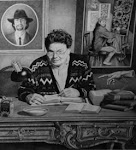
"I am 3/4ths Canadian, and one 4th New Englander - I had ancestors on both sides in the Revolutionary war." - Elizabeth Bishop
____________________________________________

Tuesday, June 29, 2021

A Poem


for Sandra Barry

Tears, clouds, tides, crumbs, birds -- 
disturbed, crossbred, simulcast --
recognizable.

29 June 2018


[For some years now I have been exploring the possibilities of anagram haiku.  In this one the title is a quotation from Elizabeth Bishop's poem "The Moose." So is the third line. The first line of the poem is a quotation from an unpublished piece by my senior partner in crime for this venue, Sandra Barry; hence the dedication. The second line is an anagram of the first one. -- JAB]


Sunday, June 20, 2021

A Poem --


Last Year on the #8 Bus

Never to be seen
again the woman berates
the stolid driver. 

The boneset veneer
of resigned solicitude
is showing its seams:

her anathemas
meanwhile begin new eras --
two entirely new

ones, but short-lived, tired,
much-tried,  yellow divider 
lines for throstle beaks,

like the two now left
half-open in the asphalt
behind the stopped bus.

JAB
Sunday, June 20, 2021

Thursday, June 10, 2021

Breaking news about Sarah Ruhl’s play Dear Elizabeth

On Thursday, June 17, at 8 PM, EDT, none other than Meryl Streep and Kevin Kline will be playing Elizabeth Bishop and Robert Lowell in a livestream and on demand performance of Sarah Ruhl’s play Dear Elizabeth, which is based on Words in Air: The Complete Correspondence Between Elizabeth Bishop and Robert Lowell (Thomas Travisano principal editor). As Travisano writes: “Meryl Streep has always been my dream Elizabeth Bishop and Kevin Kline is also one of my favorite actors, so this is very exciting indeed.”

Information on how to get tickets—with proceeds benefiting the Actors Fund—is in the link below. Tickets purchased before June 15 receive a discount. If you can’t watch when the event goes live, it can be viewed on demand (or re-watched) until 6 PM, June 21. The online performance appears in the streaming series Spotlight on Plays.

 https://www.stellartickets.com/o/spotlight-on-plays/events/dear-elizabeth/occurrences/c97cdbff-9c70-4973-8e5f-d0042830d9fc


Friday, June 4, 2021

Exhibit at Fraser Cultural Centre

In April, I posted a note about Nova Scotia artists Joy Laking and Susan Paterson’sresidency at the Elizabeth Bishop House in Great Village in February, and the lovely paintings they did during a wintery week. I am excited to report that these paintings will be exhibited at the Fraser Cultural Centre in Tatamagouche, N.S., from 18 June to 7 July. It is wonderful that these beautiful images of this beloved house and village will have an in-person airing, to be enjoyed and admired directly, not just virtually. By the end of June, Nova Scotia will be further out of lock-down, so I hope lots of folks will get out to visit the centre and see these paintings.

(Joy Laking, Bells in the window, EB House)

(Susan Paterson, Front Hall, EB House)


Sunday, May 16, 2021

A Pocket of Time update


 (Tulips at the back door of the EB House,

Great Village, N.S. Photo by Janet Maybee)

Author Rita Wilson has sent me several links, all of which go to a video of a reading of her wonderful book A POCKET OF TIME: THE POETIC CHILDHOOD OF ELIZABETH BISHOP (Nimbus Publishing), done by Rita and her granddaughter Rose. You also see many of the brilliant illustrations by Emma FitzGerald. This delightful video has been posted by the Halifax Regional Library on its virtual library site. I think it is absolutely wonderful to have this version of Rita’s lively, tender, insightful story of Bishop’s childhood in Great Village. Thank you, Rita. Thank you, Rose.

Here are the links:

YouTube

Facebook (you need to log in)

Instagram (the Halifax libraries virtual library – again, you need to log in)

Almost at the same time, EBSNS board member and author Janet Maybee sent me the above photo, and the one below, of tulips in bloom right now at the EB House in Great Village. Spring is finally here.

(Tulips by the barn, EB House, Great Village,
N.S. Photo by Janet Maybee)

Janet also sent this photo below of the feat of engineering at the back of St. James Church in Great Village. The new owners will have a café and a concert venue that will be bustling, I am sure, once the covid-19 public health restrictions are eased. Let us hope for a busy summer of gatherings. Perhaps Rita Wilson will be able to read in that venue sometime in the future. Hope so!


Monday, May 10, 2021

Elizabeth Bishop’s House in Key West, Florida

Illustrator, friend and EB fan Emma FitzGerald recently shared a link to a site with photos of Elizabeth Bishop’s Key West house taken by Florida photographer Mark Hedden. You can check them out by clicking here. This house is now owned by the Key West Literary Seminar. You can learn more about their good work with this important house by clicking here.


 (Elizabeth Bishop in Key West, late 1930s)

Sunday, May 9, 2021

Clacton remembered for different reasons

I follow a blog, Ernest Blair Experiment, presented by Bob Maher – with a wide range of subjects, including a special focus on geography and the idea of place. In a recent post, which you can see by clicking here, Bob shared a photo of Clacton on the east coast of England, taken in 1938. It was quite a bustling resort community and this photo shows some of the attractions that drew people there in gret numbers. Bob was born and raised in England, but lives now in Nova Scotia. I am always interested in what Bob offers, but this post intrigued me because Elizabeth Bishop’s great-uncle, the painter George Wylie Hutchinson lived in Clacton. George was born in 1852 and died in 1942. During the last couple decades of his life, Clacton (I have also seen Clacton-on-sea and Greater Clacton, which is where George is buried, in the Bulmer family archive, housed at Acadia University) was his home.

In any case, I was delighted to see the image below of this community, where I have never been, at that time, a time when George was very much alive. He was still painting, but also had become a photographer. He and his second wife, Lily Yerbury, lived in a snug bungalow that they had named “Thelma,” and George also grew roses. Indeed, roses were a passion for him. You can see a photo of George, circa 1921, standing in the yard of Thelma, by clicking here. I know it is well over a decade before the photo Bob shared, but George was a stalwart of Clacton in his day, long retired from the active illustrating career he had at the turn of the twentieth century. I asked Bob if I could post his photo and he kindly gave me permission. 

(Clacton, England, 1938)

Saturday, April 10, 2021

At the Elizabeth Bishop House Great Village, Nova Scotia

Nova Scotia artists Joy Laking and Susan Patterson sent a week together at the Elizabeth Bishop House in early February 2021. In their own very distinctive styles, they captured the week in paintings. They painted out of the windows, as well as the interior of the historic old house. To learn more about both painters, go to their websites.

*********************************


Susan Paterson (https://susanpaterson.ca) obtained a Bachelor of Fine Arts degree from Mount Allison University in 1980 and has been a practicing artist ever since. She has exhibited extensively across Canada, is represented in private and corporate collections around the world, and has won many awards for her work, including a Purchase Award in Art Renewal Center’s 15th International Salon; second place, Still Life, in Art Renewal Center’s 14th International Salon, and second place, as well as finalist in several BoldBrush online art competitions. She was awarded an Elizabeth Greenshield grant, several Artist‘s Residencies, Nova Scotia Arts council grants and a scholarship to study at the Academy of Realist Art in Toronto. She is a juried member of the Canadian Society of Painters in Watercolour and has been featured in various publications, including International Artist magazine. Her work was included in “Terrior, a Nova Scotia Retrospective” at the Art Gallery of Nova Scotia in 2016; ‘Capture2014, Nova Scotia Realism’, juried by Tom Smart, and ARC 14th Salon Live Exhibit in Barcelona, Spain, 2019. 

“I was so pleased to be able to spend a week with my good friend Joy Laking at the Elizabeth Bishop House last winter. We were quite lucky to arrive just before a major snowstorm which provided us with beautiful views from the house. We painted from inside looking out, because it was extremely cold that week, too cold to work outside. Besides the landscapes I was very inspired by the house itself. Early in my career I did a lot of paintings of my grandmother's house and being in the EB house reminded me of that. It brought back memories of the warmth, coziness and history of an old, well-loved home. I loved the light in the house and painted it coming through lace curtains, reflecting off glass, hardwood floors and papered walls. Joy and I worked long hours and the week went by quickly, but it was such a joy to spend time in the home and, through drawing and painting it, come to know it better.”

 ************************************************************************

Joy Snihur Wyatt Laking (www.joylakinggallery.com) graduated from the University of Guelph with a Fine Art Major in 1972. Since that time, she has lived and painted professionally in Nova Scotia. Joy has had a solo exhibition at the Art Gallery of Nova Scotia which subsequently toured for a year and was an instigator and a part of Capture 2014, an exhibition of realism curated by Tom Smart at Dalhousie Art Gallery 2014. She has exhibited nationally and internationally. She received the Queen’s Diamond Jubilee Medal 2012, the Halifax Woman of Excellence Award 2009, and a Lifetime Achievement Award from the Marigold Centre 2020/2021.She has been featured in many magazines and books, Including International Artist.
In 2020, Joy’s book The Painted Province, Nova Scotia through an artist’s eyes was published. Joy’s play “Invisible Prisons” has been performed around the world, and in 2020 was performed virtually by the Zucker School of Medicine in New York. ““The Elizabeth Bishop House in Great Village is a cultural treasure, and I am proud that I am a volunteer on the committee to help make it sustainable. Although it is only ten kilometres from my home, it was an absolutely wonderful experience to spend a week there painting with my friend Susan Paterson. We started early and painted late and enjoyed the surrounding of the old house, the window views and the friendship. Artists are generally solitary people, and it is always a special treat for me to have time to chew the fat with Susan.”


Saturday, April 3, 2021

Nova Reads Elizabeth Bishop

The Writers' Federation of Nova Scotia will host a Zoom reading of Elizabeth Bishop's poetry by Nova Scotia writers on 14 April. You can find out more and how to register and attend by clicking here. One of the principals involved is Brian Bartlett, well-known and prolific Halifax writer and big EB fan. Nice to see the WFNS doing this for National Poetry Month.


Tuesday, March 30, 2021

Beach on Gioia ... with Bishop

It has been some time since the last post, but I am delighted to share a review done for us by our correspondent in Tacoma, Washington, who also happens to be the newest member of the EBSNS. It is a delight to be able to offer something so substantial, after a lengthy hiatus. Happy Spring!

**********************************************************************

On Leading Literary Lives: A Review of Dana Gioia’s Studying with Miss Bishop

By Tristan Beach


Gioia, Dana.
Studying with Miss Bishop: Memoirs from a Young Writers Life. Paul Dry Books, 2021. 186 Pages.

Every reader has two lives—one public, the other secret. The public life is the one visible to teachers, friends, and families… But every true reader has a secret life, which is equally intense, complex, and important. The books we read are no different from the people we meet or the cities we visit. —Dana Gioia 

So begins “Lonely Impulse of Delight,” the first essay of Dana Gioia’s witty and sagacious memoir collection, Studying with Miss Bishop. Throughout the book, Gioia presents “portraits” of important “teachers” in his growth from reader to college student to rising ad executive enmeshed in a secretive literary life. These teachers loom grand yet kind (Robert Fitzgerald), polite yet frank (Elizabeth Bishop), troubled yet authentic (John Cheever), and intimidating yet human (James Dickey). The more obscure, but arguably most important teachers, neither of whom Gioia had ever met, bookend the collection. And each teacher provides Gioia with important examples of how to read, how to write—how to critique writing and talk about it—and how to live one’s life resolutely on one’s own terms.

I.

Gioia’s first great literary teacher was his Mexican uncle, Ted Ortiz, a Merchant Marine and “proletarian intellectual” who died in a plane crash when Gioia was only six. Gioia never knew his uncle but nonetheless inherited his vast library. As Gioia relates, this library of numerous authors, painters, poets, philosophers, and composers presented a gateway to a wonderous, reading-fueled inner life that laid the foundation for his literary pursuits. However, Gioia’s upbringing in a working-class Sicilian/Mexican immigrant community in Hawthorne, CA, contextualizes much of his enduring efforts to lead both a public life—one of material prosperity—and a secret literary life—as a future revolutionary figure in contemporary poetry.

He writes, “By the standards of Hawthorne, a rough and ugly industrial town, my love of books was clearly excessive, indeed almost shameful… I needed to hide it, if only to keep it pure. A private passion is free from public pressure.” Presenting, candidly, this double life to the reader complicates Gioia, the literary giant—while paradoxically deepening the reader’s sense of relation. This sense of relation perhaps speaks to the strangeness and the loneliness of literary life, especially one lived in secret. Gioia acknowledges that those of us who pursue such beautiful lives as these will typically hide from shame or out of self-preservation.

Gioia’s upbringing also influenced his resistance to treading the same narrow paths many of his Harvard classmates embraced in the 1970s. In the preface he writes, “The professions we enter change the ways in which we look at the world and ourselves. I recognized my sense of being a poet was changing in ways alien to my sense of the art, which was neither cerebral nor elitist. I didn’t want to write in ways that excluded people, especially the people I came from. … I wanted my poems to be moving, memorable, and accessible.” To him, Harvard “was training me to be a research university professor of literature”—and not the poet he wanted to be. Thus, he left the academic world of literature to “figure things out on [his] own” and returned to Stanford, his undergraduate alma mater, eventually achieving an MBA and embarking on a new path in business. He followed the examples of T.S. Eliot and Wallace Stevens, both of whom juggled business and writing throughout their lives.

 However, Gioia was more immediately and directly encouraged through his numerous encounters at Harvard with Robert Fitzgerald, related in “Remembering Robert Fitzgerald,” who had already led a literary life prior to academia. While at Stanford, Gioia’s interactions with John Cheever, as related in “A Week with John Cheever,” left a deep impression on him: Cheever had never attended college, but was held in high esteem, especially following his late career resurgence. Yet among these examples that informed and affirmed Gioia’s resolve in cutting his own path, his tutelage under Elizabeth Bishop is probably the most surprising.

 II.

Although she graces the cover (and title) of this collection of memoirs, Elizabeth Bishop’s “portrait,” which was previously published in The New Yorker, in 1986, constitutes fewer pages than expected. However, her presence carries throughout, and Gioia’s experiences in her classroom provide rare insight into a side of the late poet that few readers glimpse—Bishop, the teacher.

 Early in her modern poetry class, Bishop matter-of-factly states, “I’m not a very good teacher.” This disarming frankness in admitting one’s shortcomings is enough to sour many people’s confidence. Thus, by the second day of class, the roster had dwindled to five students, Gioia still among them. Yet, Gioia’s description of Bishop’s personality and pedagogy feel surprisingly progressive. He characterizes her as “politely formal, shy, and undramatic… She wanted no worshipful circle of students and got none.” At the same time, his first encounter with the poet, whom he had known only through her books (and he had read them all), is palpable, even strange: “It was an odd, almost uncomfortable sensation to have the perfect world of books peer so casually into the disorder of everyday life.”

In the essay, Gioia describes Bishop teaching her students to love and find pleasure in reading poetry through memorization, recital, discussion, and reading closely—for effect and craft versus critical analysis. Bishop focused more on accessing poets such as William Carlos Williams, Wallace Stevens, and Robert Lowell as humans laboring to produce works of the soul. This was a far cry from the rigorous, unsparing critiquing that Gioia had previously encountered. Bishop’s approach greatly appealed to Gioia’s own sense of writing for readers—rather than critics. And his respect for her sincere humility as well as her life outside of the academic establishment (beginning teaching at 60) further provided important examples for Gioia as a writer at a crossroads, in 1975. Gioia’s essay provides a wry, luminous, and unadorned portrait of Bishop.

 III.

Possibly the most affecting essay of the collection, “Letters from the Bahamas: Memoir of a Poet I never Met,” pays tribute to and preserves the memory of Ronald Perry, whom Gioia describes as “a forgotten poet.” Gioia first encountered Perry through his poetry, reviewing Perry’s National Poetry Series-winning collection, Denizens. Gioia describes the book as “technically brilliant” and “surprising,” as the ambiguous, sensual poems that comprise the collection engage the reader, leading through uncertain and unexpected turns. In reviewing Perry’s book, Gioia accidentally began a prolific correspondence with an obscure yet extremely generous and intelligent friend. Perry’s presence in the final essay of the book casts a long shadow over the rest. On the day the two were scheduled to meet in New York, in 1982, Gioia was informed that Perry had suddenly and mysteriously passed away the night before.

 As the essay continues, Gioia relates biographical information about Perry, detailing his upbringing, his literary struggles, and his own double life as a poet. Being outside of the academy, Perry was unconnected from most literary circles. Among his handful of independently published pamphlets, he had produced two full collections of poetry, spaced twenty-one years apart. The latter collection, Denizens, subsequently revitalized his career for a short time and connected him with other contemporary writers and critics, including Gioia. Yet his death cut short what might have been.

 The lesson that Perry imparted is not lost on Gioia, who admits that his literary career, like Wallace Stevens’s before him, “had been marked by silences,” stating that by the time he encountered Perry, he had been “[living] in the future tense.” His brief friendship cut short, Gioia resolved to make a change—“I, who had so carefully avoided human drama, found myself in the midst of one.” Practically overnight, Gioia joined a small number of Perry’s friends, including the poet Donald Justice, in working to preserve and sustain Perry’s literary legacy.

 By Way of Conclusion

If there is an arc in Studying with Miss Bishop—a book written over the span of decades and published, at last, in the 21st century—it is an arc of agency, of taking the reins of one’s life and participating in the lives of others. As the book is organized chronologically, Gioia begins modestly as an introspective and curious child, a receiver of a vast treasure trove of literature. He progresses into adulthood, encountering teachers and mentors, and critics—adapting to circumstance while building his own literary life. In the final essay, we observe Gioia taking part in managing Perry’s affairs, connecting mutual friends together, and celebrating the deceased poet’s gift to the world: poems, letters, and confessions now sitting “undisturbed in boxes in the University of Miami library.”

 Amid this tragedy, Gioia reveals a sobering maturity, recognizing the frustrating blocks, long silences, and quiet, constant defeats of literary life—whether lived solely or in secret. He remarks that literary life is “a fragile existence made tolerable, sometimes even redeemed, by the intoxication of creation and the intensity of literary friendship.” By framing his literary teachers and forebearers in “portraits,” Gioia presents a collective mirror of himself and his experiences, reflecting candid, firsthand lessons and inviting his readers to commune within a richly storied, multidimensional inner life, revealed.

**********

Tristan Beach is a student in the PhD in English program (Rhetoric and Composition emphasis) at the University of Nevada, Reno (beginning Fall 2021). He is an English lecturer at Saint Martin’s University, in Washington state, and has taught college EFL across China, 2014–2017. He received his MFA in Poetry from Goddard College in 2013. Tristan is also the Poetry Editor of Pif Magazine and was recently elected to Olympia Poetry Network’s board of directors. His poems, creative nonfiction, and commentary appear in Pitkin Review, rawboned, Pif Magazine, The Writer in the World, and Shantih. He frequently collaborates with other writers in the Olympia-Tacoma-Seattle area.

Thursday, February 18, 2021

Helena Bonham Carter reads Elizabeth Bishop

A correspondent in Germany, who is a fan of both Elizabeth Bishop and Helena Bonham Carter just sent me a link to the latter offering a truly delightful reading the former's "Letter to NY." Check it out here. Stay safe and well.

Monday, February 15, 2021

Sanderlings and Sandpipers

Belfast’s Mary Montague is a poet, naturalist and writer for The Guardian. In a recent piece she describes an encounter with sanderlings, akin to semipalmated sandpipers, marvelous shore birds that are mesmerizing to watch. Mary is a big Elizabeth Bishop fan and has been to Nova Scotia and Great Village. When she was writing this piece, Mary wrote me to ask if the bird Bishop saw that inspired “Sandpiper” might have been a sanderling, and it could have been; but I have always been under the impression that she was seeing semipalmated sandpipers. In her Guardian piece, Mary evokes EB’s “Sandpiper” as she watches the fascinating birds inhabit the shoreline. Bishop is turning up in so many places these days. It is nice to see her words resonate with so many people, on so many levels. Her relevance continues to intensify.

You can find out more about Mary Montague on her website, and read all her pieces in The Guardian by clicking here.


Thursday, February 11, 2021

Moya Pacey’s new poetry collection

Australian poet Moya Pacey has published a new collection, Doggerland, evocative poems about her childhood in England. Each poem is a memory gem, as vibrant as it is unsettling, as resonant as it is mysterious.

Moya was the winner in the adult category of the Elizabeth Bishop Centenary Writing Competition in 2011 and is featured in our Echoes of Elizabeth Bishop collection (2012). Indeed, one of the poems in her new collection, “I Feel You Breathing,” is a poetic version of the story which won her first place. This collection is one that Bishop herself would appreciate, filled as it is with particular and peculiar details, and the child’s perspective.

(Moya Pacey from her Facebook page)

Monday, February 8, 2021

"Second Load of 110" --

-- was the bus I took home from Lyndon School when I was in Primer Class -- we had to wait until the First Load had been safely delivered before we could embark on our quotidian trip home. I have spent this morning watching the 1936 Japanese film "Mr. Thank You," based on Yasunari Kawabata's short story of the same name, a depiction of a bus covering a route of some eighty kilometers through rural Japan to Tokyo, its driver as famous along his route for expressing his gratitude to every person he passed and flock of chickens he scattered as Abner Packer was on the road to Mobile for exchanging waves with Buddy and Miss Sook in Truman Capote's "Christmas Memory"; just the other day I was reading C. S. Lewis's The Great Divorce, with its bus journeying from Hell to Heaven, and its own curious driver. These disparate vehicular peregrinations combine for me with the bus in Bishop's "Cape Breton" and thence with its Doppelganger journeying west in "The Moose" -- all these embodying some vast archetypal microcosm, the universality of which in literature I find appropriately paralleled in mathematics by the computational universality of one of the simplest one dimensional cellular automata, "Rule 110" (wouldn't you just know it would be 110...) in Wolfram's numbering scheme for such objects. Looking out the window of this Bus of Buses, I can just make out now, for once, then, something -- 

Apostles.  Lupins.
Admonitory fingers.
Their sole suppliants.

for Elizabeth Bishop
on her one hundred tenth birthday.


I am so grateful to my partner in crime, Sandra Barry, for providing the First Load of 110 earlier this morning, making this second load possible, and to her partner in crime, Emma Fitzgerald, for having generously shared with me some time ago a photograph she took of lupins in the garden of Casa Mariana in Ouro Preto, which convinced me of the universality of correspondences between Nova Scotia and Minas Gerais.  

Happy Birthday Elizabeth Bishop!

On this stormy day in Nova Scotia (we have already seen over 30cm of snow where I am situated) which marks Elizabeth Bishop's 110th birthday, I share a bright, cheerful and sunny drawing from Emma FitzGerald, the illustrator of Rita Wilson's wonderful book about EB, A Pocket of Time (Nimbus 2019).


Of this image, Emma writes:

"I am attaching 'Bike and Bloom' which I sketched in Great Village in October 2013 during my first residency at the Bishop house, a few days after the anniversary of her death. It is currently being reworked into a largescale 'mural'/wall art for a financial institution in downtown Halifax at King's Wharf on the water, (my deadline for refining the drawing is Feb 8 - Bishop's Birthday) so it will have a new life in a new form."

Emma will let us know when her mural gets underway -- probably not for some time, but even so, something to look forward to when the snow is swirling outside and the wind howling.

Happy Birthday Elizabeth Bishop!

Thursday, February 4, 2021

Elizabeth Bishop Day in Key West


This proclamation just in from Malcolm Willison. Nice to see the folks in Key West will mark EB's 110th birthday, even amid a global pandemic. Thanks Malcolm for sharing this news with us. (click to enlarge the image)

Tuesday, February 2, 2021

Brainpickings on "One Art"

The poetry blog "Brainpickings" calls "One Art" "the ultimate pandemic poem" and "a haiku in the higher mathematics of meter." Read more effusions here.

Thursday, January 21, 2021

Dana Gioia and Elizabeth Bishop, et al.

Just out, a new memoir by the American poet Dana Gioia, reprising his delightful New Yorker piece about Bishop, which appeared in the 1990s, as well as encounters with a number of other famous writers who influenced him. I am delighted to write that we will be featuring a review of this book by American poet, scholar and educator Tristan Beach. His review will appear sometime in February. Stay tuned!

 “Wonderfully evocative of the literary world in the 1970s and 1980s, these essays are fascinating snapshots of remarkable encounters which, when brought together, chart a delightfully unusual path to literary success.”―Booklist

 “In deft, graceful essays, poet, literary critic, and librettist Gioia recalls six 'people of potent personality' who shaped his vocation . . . An appealing literary memoir.”―Kirkus Reviews

  “Reading Studying with Miss Bishop is like being at one of those memorable dinner parties, attended by the best and brightest, sparkling with wit and excellent conversations.” ―Julia Alvarez, author of In the Time of the Butterflies and Afterlife

 “Gioia has been uncommonly lucky in meeting many major poets, among them Elizabeth Bishop. His portrait of her in these pages is shrewd and subtle. The famously elusive poet quivers into life here.”―Jay Parini, author of Borges and Me: An Encounter

 In Studying with Miss Bishop, Dana Gioia discusses six people who helped him become a writer and better understand what it meant to dedicate one’s life to writing. Four were famous authors―Elizabeth Bishop, John Cheever, James Dickey, and Robert Fitzgerald. Two were unknown― Gioia’s Merchant Marine uncle and Ronald Perry, a forgotten poet. Each of the six essays provides a vivid portrait; taken together they tell the story of Gioia’s own journey from working-class L.A. to international literary success.

 PUBLICATION DATE: January 12, 2021

ISBN: 9781589881518

CLASSIFICATION: Memoir

SIZE: 5 in. x 8 in.

FORMAT: Trade Paper

PAGES: 184 pp.

PRICE: $16.95

DISTRIBUTED BY: Consortium Books Sales & Distribution 800.283.3572 www.cbsd.com

******************************

Thanks to John for welcoming in 2021. As he wrote, I will be returning to Letters to Aunt Grace, sometime in the near future. Bishop would turn 110 on 8 February, were she alive -- with the pandemic still raging around the world, celebrations on this anniversary will have to be mostly virtual. The EBSNS has set a date for its 2021 AGM -- Saturday 19 June, in Great Village, N.S. Let us hope it can happen this year! Again, stay tuned and thanks for reading the blog.

Friday, January 1, 2021

WELCOME, 2021!

 It hardly seems possible that a decade has now passed since Nova Scotia marked Elizabeth Bishop's centenary year in 2011.  This year, as we continue to follow Sandra Barry's detailed presentation and explication of Bishop's correspondence with her Aunt Grace, we will also from time to time look back on some of the beautiful moments of the centennial celebration, filled as it was with the contributions and original works of so many writers, musicians, composers, artists, readers, scholars, and people from so many other walks of life.  

Welcome, 2021!  Come into the kitchen of EB House and have a cup of tea and a slice of cake with us, and then settle back for a nice long chat.


Sunday, December 20, 2020

Happy Holidays

On the eve of the solstice and as the holidays approach, the EBSNS extends warmest best wishes to one and all. Few of us will be sorry to see 2020 end. Let us all hope that 2021 will be safer and better.

(Looking over the back field towards the river
from the verandah of the EB House. Photo by Brenda Barry)


(Looking through an upstairs window in the EB House
at St. James Church. Photo by Brenda Barry)

Wishing for peace and health for each of us and for the world. Blessings of the season.