"I am 3/4ths Canadian, and one 4th New Englander - I had ancestors on both sides in the Revolutionary war." - Elizabeth Bishop
____________________________________________

Saturday, May 5, 2012

Nova Scotia Connections: A Day in the Life of Great Village: A Modern Age


With the coming of the war, most folks in Great Village, like most people throughout the Dominion and Empire, sense that the world is changing, that they are entering a new age, a modern age. The sensation is not entirely unfamiliar. Indeed, at the turn of the century, and especially with the death of Queen Victoria in 1901 (ending the longest reign of any monarch in British history), people began to expect change as a matter of course. Many folks recognize this change in the forward march of industry and technology. New-fangled inventions are coming along with increasing frequency, marvellous machines which are changing the way folks live their daily lives, entertain themselves, communicate and travel.

Some of the change has been recorded in photographs. Photography has been around for decades. It is such a common matter that most people take it for granted. Many folks not only go to the photographic studios to have portraits done J.E. Sponagle(1) in Truro is one of the best and busiest professional photographers around but more and more people are taking to the lens themselves, carrying cameras around with them, recording their daily lives.(2)

Barely a decade ago these pictures began to move and in the few years since the first motion picture show arrived in Halifax (Edwin Porter’s Wormwood’s Dog and Monkey Theatre set up shop in 1897), most of the larger towns in Nova Scotia quickly built cinemas. Truro’s Princess and Orpheum Theatres are among the busiest places in town and show a steady stream of motions pictures. The world opens up in new ways to the cinemas’ patrons, and the theatres are crowded nearly every night, except on Sunday, of course.

Motions pictures are not the only wonder of new entertainment technology. Though they may never be as common as pianos, gramophones and phonographs are gaining popularity, especially among the young people. With their love of music Great Villagers have been quite interested in this new mode of listening to favourite songs. The heavy cylinders, and most recently, thick flat discs, are also introducing new kinds of music. Many of the older folks look askance at the noise of what is called jazz and swing, but the lads and lasses seem to take to it. Some people are even suggesting that it won’t be long before motion pictures will merge with recorded music and voices!(3) Imagine, talking pictures!


Telegraph communication appeared in Nova Scotia in the late 1840s, and the telegraph poles and lines have stretched from Truro along the shore to Amherst and beyond for decades. The wonder of Mr. Marconi’s experiments in wireless telegraphy excite many people as much as Mr. Bell’s invention of the telephone.(4) But for now, the hum of the telegraph wire is still heard by the farmers as they trundle along the road in their hay wagons. The telephone has long since vanquished the strangeness of hearing a real voice without seeing a real person, but even so, some of the old folks in the village mistrust such disembodied voices, and feel that the proliferating poles and wires in town are ugly. Many others, however, see them as markers of progress, show that Great Village is not behind the time, which is moving so quickly into a modern age.


The first telephone system in Nova Scotia appeared in the late 1870s. Great Village was not too far behind (villagers like to claim that they are never far behind in adopting any good advance), a system being set up in the late 1880s. For many years the local switchboard of the Central Telephone office was in the Londonderry Hotel. It was moved to Amelia Spencer’s house just before the hotel burned in 1898. Miss Spencer continues to connect up folks, a growing number of which sign on every year to have telephones installed in their homes and businesses. Today over a dozen people in Great Village have telephones. Some of these progressive folks are: the Elmonte House, Rev. William Gillespie, Jenks’ Garage, Laytons store, Hill’s store, Albion Kent, Dr. T.R. Johnson, Capt. Albert Mahon, Edward G. McColough, Amos B. Geddes, T.D. Blaikie, G.W. Blaikie, J.A. Blaikie, William E. Spencer and Arthur Bulmer. The Laytons and Hills are always willing to let folks use the telephone in the stores when the need arises. These needs are arising more and more, so it is supposed by many that more telephones will appear in village homes.

Electricity has not yet reached Great Village in any general way, but folks believe it is not too far in the future, that soon the village will become illuminated in this way. Oil lamps still provide the principal lighting for all homes and businesses, but the Hill brothers have set up their own generation system to run the new refrigerators they recently installed, and they are talking about establishing an electric light company to supply the village with this modern convenience. They say that the only way for farmers and businessmen to advance is to have access to electricity, that the larger towns and cities have been electrified for some years now, and the village needs to be as progressive. T.D. Blaikie agrees and is keen to get a steady supply of electricity for the creamery. Several farmers in the village have built windmills to help in the operation of their farms, but the Hill brothers say that only a central generating station will be economical.(5)

Indeed, the advent of refrigeration is a new convenience looked on with much interest not only by business, but also by the housewives in the village. Cold cellars and ice houses are the norm, but during the hot dry summers ice is a scarce commodity. What cook wouldn’t want to have at her fingertips a machine to keep produce, milk and butter cold. Mr. Ralph Smith has been at Hill’s store regularly these days examining the new refrigerators and considering the possibility of getting similar ones set up at the Elmonte House.

These new machines, means of communication and sources of power are impressive in themselves, but the most amazing advances in this modern age is transportation. For short distances folks still rely on their trusty horse and wagon, and cyclists are seen wheeling around the village in large numbers during warm summer days. The vast distances are given to steam ships and locomotives. Train travel is the most popular and quickest way to cross the Dominion, and the wonderful huge ocean liners take travellers to the far reaches of the world.(6) However, two upstart modes of transportation seem to be pressing themselves on people everywhere. Some say automobiles and aeroplanes will not replace ships and trains, but others say don’t be so sure.

Horseless carriages and flying machines have been around for decades, but with the coming of the new century inventors of all description have been experimenting and advancing the technology at a great rate. Already folks are choosing automobiles to travel not just around town, but even long distances. Motoring is becoming so common many don't give automobiles a second glance.(7) Mr. Bell and a number of engineers in Canada and the United States have been experimenting with flying machines of all descriptions. The flight of the Silver Dart in Cape Breton in 1909 stunned the world, coming as it did a mere six years after the Wright Brothers historic flight experiment at Kitty Hawk. For certain, Nova Scotia is in the forefront of aviation advance. The pilot of the Silver Dart was J.A.D. McCurdy, one of our brave men now fighting in France. He set a number of flying records before the war called him to duty overseas. His expertise as a pilot is being well used by the Empire.


The Silver Dart, Baddeck, N.S.

The war has brought into focus the benefits and necessity of motorized transportation on land and in the air. Trucks and automobiles are being used as supply vehicles and ambulances. Motorcycles have appeared and are proving to be an efficient mode of transportation for couriers to and from the front. In the air, dirigibles fill the skies over the trenches in France, for reconnaissance and as bombers. So, too, are aeroplanes increasingly used for both these purposes. The newspapers carry more and more accounts of terrifying air battles and many young Nova Scotian men are learning how to fly these amazing machines in the midst of combat.(8)

Many folks read the newspapers with both sadness and wonder these days, learning about the ultimate sacrifice many of Canada’s brave young men are making for King and Country, and learning about the amazing advances which are taking place, pushed forward by the demands of the war. For some people change is happening too fast, for others, not fast enough. On this day in Great Village, as the first day of summer dawns, evidence of the strong traditions of a close-knit community and the march of progress in a bustling town exist side by side, the balance tips back and forth. Only time will tell where the scales will finally settle.(9)

Modern technology for writers

Notes

1. J.E. Sponagle (1883-1961) was a long-standing recorder of life in Colchester Co. When he died suddenly in 1961, the Truro Daily News gave an account of his place in the community: “J.E. ‘John’ Sponagle one of Truro’s best-known citizens, died at Colchester County Hospital Friday morning from injuries received in a car accident at Brookfield last Sunday. He was 78....An outstanding portrait photographer, Mr. Sponagle was in business on Inglis Street for more than 50 years, retiring about five years ago. His files of prints and negatives were a pictorial history of the persons and events of 20th century Truro. A native of West Dublin, Lunenburg Co., he began dabbling in photography in his youth and later attended the Guerin School of Photography in St. Louis, Missouri. One of his earliest subjects was the famous Col. William ‘Buffalo Bill’ Coady, a friend of the school’s operator. Mr. Sponagle came to Truro following completion of his course and opened Sponagle's Studio while still a teenager. He won a number of awards for his work, the most recent in 1942 when he won the Maritime Photographers’ Association award for best entry submitted. Mr. Sponagle had a natural talent for the piano and performed at functions of the Kiwanis Club, fire brigade, curling club and other social occasions. He joined the Truro fire brigade in 1909, the Truro Curling Club in 1912, later becoming president. He was a charter member of the Truro Kiwanis Club and was a former member of the Masonic Lodge, No. 43, and was a past president of the Maritime Photographers Association....The funeral services, under auspices of the Truro fire brigade, will take place at 2:30 p.m., Rev. George P. Allen officiating.” (November 4, p. 21)

J.E. Sponagle was an important recorder of the Bulmer family, and photographed Elizabeth Bishop on a number of occasions.

2. The Bulmer family was one such group taking up the camera in their daily lives. The Bulmers had numerous formal portraits done during the 1910s (in both Nova Scotia and New England), but Grace Bulmer had her own camera and recorded many moments in her personal and professional life as a nurse. The Bulmer-Bowers-Hutchinson-Sutherland family fonds at Acadia University Archives contains the contents of two of Grace Bulmer’s photograph albums from the 1910s and 1920s.

3. Arthur Bulmer was one of the Great Villagers to embrace the new technologies, being one of the first in the village to own an automobile, to have a telephone installed in his house, and to buy a phonograph. Elizabeth Bishop remembered this device in her memoir about her uncle, “Memories of Uncle Neddy”: “The other chief attraction in Uncle Neddy’s parlor was an Edison phonograph, very old, that still worked. It had a flaring, brown-and-gold horn and played thick cylinders. My girl cousins were allowed to play it. I remember only two out of the box of cylinders: a brief Sousa march that could have marched people about fifty yards, and ‘Cohen on the Telephone,’ which I loved. I knew that it was supposed to be funny, and laughed, although I hadn’t any idea who or what a Cohen was or what I was laughing at, and I doubt that Uncle Neddy entirely understood it, either.” (Collected Prose, p. 246)

4. Alexander Graham Bell (1847–1922) was a scientist and inventor. The list of Bell’s inventions and scientific interests (he supported work of colleagues) is impressive: speech therapy for the deaf, telephone, steam-powered and gasoline-powered aircraft, atomic research, the photoelectric cell, the iron lung, desalination of seawater, the phonograph, genetics, horticulture, and hydrodromes or hydrofoils. In 1890 Bell built Beinn Bhreagh, his estate in Baddeck on Cape Breton Island. He conducted many of his experiments there (Canadian Encyclopedia, 1, pp. 199-200). Guglielmo Marconi (1874-137) was a physicist and inventor of radio telegraphy (1896), and later worked on the development of shortwave wireless communication. In December 1901 Marconi succeeded in receiving the first signals transmitted across the Atlantic from Cornwall, England, to St. John’s, Newfoundland. Marconi later moved his operations to Cape Breton Island where he established facilities for regular trans-Atlantic telegraphy (Britannica, 7, p. 826).

5. It took several years before Barry and Lucius Hill established the Village Light & Carbon Co. Limited, incorporated in 1922. A generating plant was set up beside the Great Village River near the bridge and provided electricity to the village between 6:00 and 11:00 p.m. Elizabeth Bishop remembered this plant, which was not far from her grandparents’ house: “We did not have electricity in our house, but at the time of which I am writing [early 1920s] I think two houses in the Village did, and there were two electric lamp-posts: one on the corner where the road turned off to go to the station....The other was in front of the smallest of the three general stores....There was also an electric light hung in the middle of the bridge from the iron-work overhead, under a frilled metal shade; but this had never lighted as far as I can remember. The ice-cream parlor had electricity, and the post office and the town hall.” She goes on to say: “The electric light plant was a small barn-like building shingled and already turning gray.... Outdoors, at its back, was a large, black round boiler, covered with mysterious holes. One man, Charlie Devereux [sic: Fred Hill] ran the whole affair; and every summer evening we’d see him puttering around the buildings and boiler about seven o’clock, carrying arm-loads of firewood from the wood-pile at the side. It took him a long time to get the engine started and sometimes it would not work at all. Just before it grew dark there would be a few puffs of blue smoke, just a shade deeper than the air, then a hiss and cloud of steam, and then, if it were a fortunate evening, the engine would begin to work, at first noisily, later a sort of clicking, and then nothing but a vibration you could soon forget.” (“Reminiscences of Great Village” at Vassar College Library, Special Collections)

In the early 1930s the Cobequid Power Company was established and operated for many years before Nova Scotia Light and Power bought it, in a process of consolidating the generation and supplying of electricity in the province.

6. The increased comfort and luxury of train and ship travel reached its epitome in 1912 with the launch and maiden voyage of the Titanic, which tragically sunk off Newfoundland in April of that year. The Titanic was an especial fascination for Bishop’s uncle, Arthur Bulmer, who, according to his niece, never “went anywhere in his life.” Bishop remembered: “It was obvious that Uncle Neddy had been strongly affected by the sinking of the Titanic; in his modest library there were three different books about this catastrophe, and in the dining room, facing his place at the table, hung a chromograph of the ship going down: the iceberg, the rising steam, the people struggling in the water, everything in full color.” (Collected Prose, pp. 245-6)

7. By 1922 bus service between Halifax/Truro/Parrsboro/Amherst had been established, adding another mode of transportation to the repertoire.

8. It is hard to say when Great Villagers might have seen their first aeroplane. It could have occurred before 1916, but more likely it was sometime in 1918 or 1919. Capt. L.E. De Vere Stevens opened the De Vere Aviation School in Truro right after the war ended, training a number of pilots and attempting that first circumnavigation by air of Nova Scotia. In June 1919 he and another pilot, Lt. I.L. Barnhill, R.A.F., took off from Truro to deliver issues of The Atlantic Leader newspaper to towns throughout the province. Their aviation experiment came to a sudden end when, attempting to take off after landing in Halifax, the plane hit a parked car and fence and flipped over. Neither man was hurt. 1919 was one of the most important years in aviation history and Nova Scotia played a pivotal role in the year’s events. Undoubtedly Great Villagers motored to Parrsboro in July 1919 to take a look at the Handley-Page bomber, the Atlantic, which crashed near the town while en route from Newfoundland to New York. It took months to repair the Atlantic, but when it took off on October 2, 1919, it was an international news story. Several other men from Truro also had distinguished air careers in World War I, William Munroe Archibald and Stuart Graham among them. In 1919 Lt. Stuart Graham and his wife Madge made a successful non-stop flight from Halifax to Saint John, N.B.; then they flew on to Québec, setting a record for the longest overland flight by a seaplane in Canada. Though not the first Canadian woman to fly, Madge Graham, who served as her husband’s navigator, was the first woman to make a long-distance flight in Canada.

9. 1916 was an important, in many ways a pivotal, year for Great Village, when the pull of tradition and the push of modernity was most active. The village (province, country, empire) was poised to move from one era to another. Traditions persisted, of course, well into the twentieth century; but industrial and technological advances had begun in earnest and were unstoppable. Elizabeth Bishop was aware of the dialogue between these two forces of tradition and modernity. She embodied it most directly in her poem “Manners,” which sets her grandfather and his horse and wagon (a mode of transportation he never abandoned) next to the increasingly prevalent automobile. Bishop admired the tradition of her grandparents’ generation and often expressed regret for the dying out of local culture; but she recognized the inevitability of progress and even welcomed certain aspects of it. Her maternal family was itself poised between tradition and modernity her grandparents representing the faithfulness of the past while her aunts and uncle moved fully and willingly into the future.

Sunday, April 29, 2012

Elizabeth Bishop on BBC Radio 4


Today (Sunday, 29 April 2012), BBC Radio 4 is set to broadcast “A Foreigner Everywhere,” which looks at Elizabeth Bishop’s life in Brazil. Narrated by the poet Paul Farley, who explores how Bishop tackles questions of travel, and how she challenged approaches to other cultures in the early days of mass tourism. Bishop met the love of her life in Brazil, became deeply involved in the Brazilian political tumult of the 1960s, and made the trip of her life up the Amazon river. But her Brazil years also ended in tragedy. For more information about the broadcast, check out the BBC Radio 4 site for this documentary: http://www.bbc.co.uk/programmes/b01gnjwf. The programme will be broadcast a second time on Saturday, 5 May 2012.

Nova Scotia Connections: A Day in the Life of Great Village: Home-Made, Domesticity

Housecleaning is perennial universal endless, according to housewives the world over. The ladies in Great Village have long ago finished the intensive whirlwind called spring cleaning, when every carpet is hung on the line and beaten fiercely to discharge as much winter's dust as possible; when every quilt, blanket, sheet and pillow slip is washed; when every corner of every room, high and low, is scrubbed and swept; when ever cupboard is cleared of every dish and cup and everything is washed; and often a fresh coat of paint is applied to sills, frames, doors, even floors, and new wallpaper is hung on the walls to spruce things up after the accumulation of smoke from lamps and stoves lit continuously through the long, cold, dark winter. At spring cleaning time, which stretches from April into May, houses in Great Village all along the shore, in Truro, across the province hum. On lucent early spring mornings the percussion of the carpet chore sounds like a military march.

Spring cleaning is a very serious matter, a major operation. Women prepare for it all winter, just as the farmers prepare for the spring ploughing and planting they plan their strategies, repair equipment and lay in supplies. Like the planting, spring cleaning is a time regarded with resolution (or resignation) and anticipation. However, unlike the farmers and their planting, women have been housecleaning all winter, so the resignation is stronger. Still, it is something which must be done and most of the ladies say, “The sooner the better.”

By this first day of summer the spring cleaning is well past, though this is often the time when men decide to start the big jobs of building: a porch, a verandah, an ell. The women think of all the mess that it will create, workmen tracking in dirt. But all the ladies say that is the nature of housework, “It is never done.” Death and taxes might be the two certainties of this world, but ask a woman and she will add, “So are dirty dishes and laundry.”

Housework has its own conventions and rhythms, followed more or less by Great Village ladies. Monday is wash day a rainy Monday is a frustrating day indeed. On a clear windy morning the village clotheslines are adorned with blouses and skirts, shirts and trousers, towels and tablecloths, bibs and diapers and pinafores the flapping, slapping clothes are festive and heartening. A good line of laundry, hung just right (everyone has a theory about which items to hang where) is a matter of pride for each laundress. Indeed, Great Village ladies casually or deliberately assess each other’s laundry achievement, offering critical admiration or disdain, as if it is a work of art. There is a rivalry among them in the same way as there is a rivalry among the horse owners in the village: friendly but exacting. This rivalry extends to house cleaning in general. Keeping a clean house is an aim or a burden for all housewives. The ladies of Great Village are so often in each other’s homes that they have many opportunities to assess each other’s successes or failures. Some say too many opportunities.(1)

Laundry is one of the most physically exacting chores. Kettles of water are heated and poured into large wash tubs. Scrubbing is done on washboards with large cakes of soap. The hardest part is wringing out the heavy wet clothes. A few of the village ladies have wringers which attach to the tubs, a roller machine through which the clothes are fed, which squeezes out the water. These ladies are the envy of the others.


Monday being wash day, Tuesday and Wednesday tend to be devoted to ironing. This chore is the most tedious and tiresome, but one of the most necessary. In the summer, when starched linens are most necessary, ironing is a wearying task. Flat irons have to be kept hot on the stove, and on the sticky, close July or August days having the stove fired up, standing for hours over frills and hems, creases and lapels is monotonous. The stove tends to be fired up all summer anyway, for cooking and baking. Many village homes set up summer kitchens, rooms or ells which are more airy than the closed in winter kitchens. Even so, most women try to do their baking and cooking as early in the morning as possible during the summer. The end of the work week (Thursday or Friday) is when the ladies do most of their baking for the week: bread, rolls, biscuits, pies, squares, cookies, cakes and cooking the roasts of beef, lamb, veal, pork or chicken. Winter cooks offer steaming hot soups, stews and casseroles, summer cooks offer cold sliced ham or chicken salad. Even at the dining table summer meals tend to be picnics, unlike the more formal feasts of winter's piping bowls. Already, because the late spring weather has been so pleasant, the young folks have begun picnicking. The ladies have put out their chaise lounges and little tables on verandahs and lawns and look forward to the less hectic afternoons when the serious indoors cleaning is done (before the tea time tasks must be started) and they can sit down and take up their sewing.

Most women in the village still make most of their family’s clothes, and sewing is another of those endless tasks. By the first day of summer the seersucker suits and the cotton frocks have already been made or mended and spruced up with new buttons or a new lace collar. That work is done during the winter. At this time of year women are thinking about fall and winter garments, taking out each flannel and worsted, each vest and chemise, each coat and cape, and deciding what new is needed, what can be repaired. Since summer is a time for weddings, not a few women in the village are also busy putting final touches on trousseaus and bridal gowns.


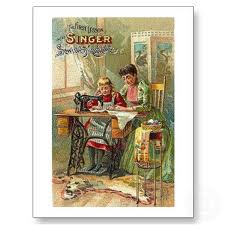
Of course, not every woman in Great Village makes her family’s clothes, or makes all of them. There has always been a tailor and several seamstresses in Great Village. They are patronized sufficiently to earn quite a decent living. More and more women are choosing to order from the Eaton's catalogue or to buy ready made clothes at Layton's, or drive into Truro to the specialty shops. Still, sewing is one of the most pressing chores women in the village have on their housework plate. Girls learn to sew as soon as they can hold a needle and thread, and many ladies in the Village are experts at seams, hems, darts and button holes. Many have their own Singer sewing machines (they are almost as common as pianos). The ladies of Great Village also excel at the needle arts: crochet, embroidery, needlepoint, knitting, rug hooking and quilting. One of the favourite gatherings for women is the quilting bee. The Great Village Sewing Club has been around for years and many a lass received her total immersion in the fine needle arts amidst the gossiping ladies around the quilting or hooking frame, or in a circle with the knitting needles clicking. The war has added another layer of work to this part of daily life. The village ladies are prodigiously productive in making surgical gowns and knitting socks, mittens ad scarves. The older and younger ladies tend to do most of this work because wives and mothers still have to attend to torn overalls and wee ones growing too fast out of their jumpers. Yet just about every woman in the village contributes at least a bandage to the Red Cross Knitting and Sewing Society.

While the farmers are off ploughing and planting the big fields of grain, most homes in the Village have kitchen gardens. The men often help with the planting and tending of these vegetable and flower plots, but the housewife is mostly responsible. Children are often conscripted to do the endless weeding. Though too early in the season for most crops, already there has been lettuce, and the fine weather is bringing along the seeds and seedlings, especially for those who guessed right and got a start of planting. Some village farmers use cold frames, starting plants as far back as March. And window sills throughout the village have also been sprouting herbs and tomatoes, as well as flowers, for months.

The ultimate work of these kitchen gardens starts later in the season when the pickling, preserving and canning gets underway. Even this early in the growing season thoughts have turned to these tasks. What everyone loves of the first strawberries, cherries, raspberries and vegetables is the freshness. The jars and bottles of preserves in cold cellars have dwindled and the anticipation of fresh produce is keen for everyone. Yet the ladies cannot indulge only in providing the first tender beans or peas. They must prepare for next winter. Canned goods might be more plentiful in the general store, but most folks still want home-made. And every cook in Great Village has some specialty which is regarded as the best version. Preserving season is still some time away though, and for now, fresh fruits and vegetables are on the menu.

Besides all the cooking, washing and sewing for their own families, village women also keep busy year round baking and sewing for society meetings, bake sales, fund-raising dinners, bazaars. Invariably, when baking or cooking for their own tables there is an event coming up to be supplied, so an extra pan of squares or a second casserole is made. More often than not the ladies are meeting in someone’s parlour or having ladies in of an afternoon to discuss some pending activity (a party, a wedding, a fair, a concert). Afternoon is the time for calling on neighbours anyway. All these are reasons to have a tidy house. Every hostess wants to serve at least a ginger snap with tea.

The celebrations surrounding Dominion Day will be given extra attention this year, as several organizations will be raising money for the war effort: a bazaar with a pie sale and fancy tables, an auction and strawberry supper have been organized. So the ladies have been and will be busy. The missionary lecture this evening will offer tea and a sweet table, and donations will be accepted in support of the work of the Mission Bands.

It is rare to find Elizabeth Bulmer on a weekday morning sitting in her rocking chair by the widow. The breakfast dishes are done and the kitchen swept, though she needs to make a pan of biscuits and tidy up the everyday parlour, finish straightening up the bedrooms. All the ironing was done yesterday, a long session of it to get Gertie’s clothes ready. Gertie is so fond of her nice clothes. They weren’t sure how many dresses Gertie would be able to keep with her at the hospital, but they got as many ready and packed as would fit in one of the small steamer trunks. Will and the girls were up early and off to Londonderry Station. Mary went off early too, fishing with her friends. It will mean some work upon her return, to clean the fish. Elizabeth knows Mary will bring an ample supply for she is almost as good a fisherman as Art. But it also means that tea is taken care of, nice fresh pan-fried trout, a lettuce salad (her leaf lettuce is good this year), and the fresh biscuits. Lunch time will be some egg salad sandwiches, which reminds her that she must go check the hens. As she rocks in her rocking chair, Elizabeth stares out the window at the busy street. Everyone coming and going. She’ll sit there, she thinks, until Elizabeth comes back from Chisholm's pasture and they can do some gardening together. The wee child loves to dig in the earth, and is so proud of the little patch all her own. Elizabeth doesn’t really want to go to the lecture tonight, but Will says they should try to do it. He’s so hopeful that Gertie will be home soon, but Elizabeth sees the sorrow in his eyes, behind his gentle smile. Like her, he is worried. Elizabeth doesn’t want to use the word doubt. Nobody knows, she thinks, picking up her knitting, watching the road up Scrabble Hill for her granddaughter. God’s will is so difficult to fathom. It is not up to us to do so, she thinks.


 Panoramic view of Great Village

When Will arrives back he stays outside busying himself with the wagon. Elizabeth serves the sandwiches on the verandah, a treat her granddaughter delights in like a picnic. In the afternoon Will goes off to Glenholme with Arthur and Billy and two of the Spencer boys, to install a furnace. It is hard to convince the child that she must stay home, hard to say no; but the men will be too busy to tend to her. Elizabeth convinces her granddaughter that it is better to remain with the promise that she can help clean the fish Mary will bring home. Elizabeth marvels at the curiosity of her wee granddaughter, always full of questions, and she's inherited the family's fascination with fish and fishing. Besides, Elizabeth tells her, she needs to fetch Nelly, who would be lonely without her company on the walk home from Chisholm's pasture.

Notes

1. Elizabeth Bishop remembered the keen commitment of her Aunt Mabel Bulmer’s housekeeping, in a memoir about her Uncle Arthur Bulmer, “Memories of Uncle Neddy.” In this memoir she called Mabel, “Aunt Hat”: “Mondays, Aunt Hat energetically scrubbed the family’s clothes, summers, down below, out back. On good days she occasionally burst quite loudly into song as she scrubbed and rinsed:

Oh, the moon shines tonight on pretty Red Wing,
 The breeze is sighing,
 The night bird's crying.
Oh, far beneath the sky her warrior's sleeping
 While Red Wing’s weeping
 Her heart awa-a-y...

This song is still associated in my mind not with a disconsolate Indian maiden and red wings but with a red blouse, red hair, strong yellow laundry soap, and galvanized scrubbing boards (also sold in Uncle Neddy’s shop; I forgot them). On other weekdays, Aunt Hat, as I have said, cleaned house: it was probably the cleanest house in the county. The kitchen linoleum dazzled; the straw matting in the upstairs bedrooms looked like new and so did the hooked rugs; the ‘cozy corner’ parlor, with a red upholstered seat and frilled red pillows standing on their corners, was never disarranged; ever china ornament on the mantelpiece over the airtight stove was in the same place and dustless, and Aunt Hat always seemed to have a broom or a long-handled brush in her hand, ready to take a swipe either at her household effects or at any child, dog, or cat that came her way. Her temper, like her features, seemed constantly at a high temperature, but on bad days it rose many degrees and she ‘took it out,’ as the village said behind her back, in cleaning house. They also said she was ‘a great hand at housework’ or ‘a demon for housework’; sometimes, ‘She’s a Tartar, that one!’” (Collected Prose  239-40).

Saturday, April 21, 2012

Nova Scotia Connections: A Day in the Life of Great Village: Boy Scouts

Imagine you are a young boy standing by the post office watching your brother, your uncle, your cousin, your neighbour, clad in full highland regalia, march in a battalion parade, the piper leading the soldiers to the big truck to take them to Truro ─ then off to Aldershot, Valcartier, England, France.... Imagine how excited you are at the spectacle and how much you want to go. But you are too young. You must stay home.


Boy Scout Manual 1914

Rev. William Gillespie watched these Great Village boys entranced by the military parades and realized that they needed some focus for their energies. Though a grown man, he too watched his younger brother Robert go off to war, and had seen how determined he was to do his duty. Rev. Gillespie had heard about the Scouting movement, which had started in England in 1907, and had reached Canada almost immediately. In 1912 the Boy Scout Association was granted a royal charter throughout the Empire by King George V. The Canadian General Council of the Boy Scout Association had been incorporated on June 12, 1914.(1) Rev. Gillespie talked to several of his parishioners and in mid-May 1916 they gathered together some of the boys from Great Village and Glenholme and formed a Boy Scout Band.

Rev. Gillespie is the Scout Master and several other men agreed to be patrol leaders. Though the Boy Scout Band has only been in existence in Great Village for just over a month, they are already very active. They have set up a club room and meet every Saturday evening, beginning their meetings with a prayer and “The Maple Leaf Forever,” and ending with “God Save the King.” Their first fundraiser was a bean supper at the Temperance Hall on May 20 to raise money to buy uniforms. The evening was a big success for them; they raised about $40. On May 24, the boys hosted a visit from the Truro Scout Band. Both Bands joined together and paraded to Londonderry — a pretty long walk (actually, several wagons went along and carried them part way), where they attended a concert and had a rousing hay ride back to the village. The next big event to raise funds was on June 10, when they hosted an ice cream social, and Villagers had a taste of the first strawberries of the season, quite early this year.

During their regular meetings the Scouts practice drills, woodcraft, signalling, tracking and other useful skills. This past Sunday the Scouts paraded to the Baptist church for the afternoon service. They looked smart and proud in their new uniforms. The boys are excitedly preparing to go to a Scout Camp at Stewiacke in July. They will spend about three weeks under canvas with bands from all across Eastern Nova Scotia. And later in August they are planning several picnics and bacon fries at Spencer’s Point

Boy Scout Manual 1919

Though today not a regular meeting day, several of the patrol leaders are taking some of the Scouts to Mount Pleasant this evening to practice tracking skills. Rev. Gillespie is not able to join them because of the missionary lecture at the Presbyterian church. But he'll be there on Saturday for the regular meeting, when the leaders have a surprise planned for the boys, an excursion to the cinema in Truro, which is showing a film about the Empire’s war effort.

At this time of war, with all its organized and heightened activity, it is good for the young boys to have a purpose to meet and learn new things, and have some fun too.(2) Even the smallest boys, like Arthur Bulmer’s Billy and Lucius Hills’ Seth, inseparable lads who ache to be part of the pack, are excited about the Scouts. There is talk of setting up a group for the smallest boys. Today Arthur and Lucius have decided to take their sons to Truro with the rest of the troop. Everyone knows Arthur has been very sad about Gertie’s trouble; he has always been protective of his younger sisters, even as he’s teased them mercilessly sometimes. Lucius convinced him that another run to Truro, even after yesterday’s election trip, would be a good distraction.

Notes

1. The Canadian General Council of the Boy Scouts Association, incorporated in 1914, remained a branch of the Boy Scouts Association until it became an independent member of the Boy Scouts World Conference on October 30, 1946. The name was changed to Boys Scouts of Canada and then to Scouts Canada in 1976 (Canadian Encyclopedia, p. 2122).

2. The Great Village Boy Scout Band disbanded in 1919 with the departure of Rev. W.M. Gillespie. It was not until 1928 that another band was formed, NO. 27, headed by Rev. L.B. Wright, the Baptist minister. The Scouts remained active in Great Village for the next several decades and enjoyed camping trips to Folly Lake in the summers. In 1932 a Wolf Club Pack was organized, and it too remained active for decades. Hundreds of Great Village boys participated in the Scouts and Wolf Club groups over the years.

Monday, April 16, 2012

Nova Scotia Connections: A Day in the Life of Great Village: Elmonte House

In a bustling place like Great Village, a good hotel is a must. There are people coming and going all the time, lots of tourists and travelling salesmen; regular Sunday School Association conferences or Teachers’ Institutes, which bring in folks from near and far. Great Village is fortunate to have one of the most efficiently run hotels in Colchester County, Elmonte House, operated by Mrs. Smith, with able assistance from her husband, Ralph, who divides his time between the hotel and his passion for inventing. Indeed, the Elmonte is one of the largest, most up-to-date hostelries in the county outside of Truro. Broderick’s Hotel at Five Islands is a close rival, but most of the folks around think that the Elmonte is superior.

Elmonte House and the "Sample Room" (right)


Elmonte House has all the modern conveniences including a telephone, well equipped livery stables, as well as an automobile to take people to and fetch them from the stations in Londonderry and Truro. The hotel is three storeys high and its office, parlours and rooms are large, airy, elegantly furnished and scrupulously clean. Mrs. Smith also offers excellent cuisine, and many of the societies in the village hold their anniversary banquets in its fine dining room.

One of the interesting features of the Elmonte is the “Sample Room,” a long, low building between the Elmonte and W.W. Peppard’s store, where salesmen bring samples of their goods and display them. Merchants from miles around stop by, view the goods and place their orders. When a salesman arrives word spreads quickly along the shore and for the next several days the salesman conducts a bustling business. The merchants are able to order clothing, boots and shoes, dishes of all kinds and even farm implements. Eventually, the goods arrive by train at Londonderry Station.

The Elmonte was built in 1899 to replace the Londonderry Hotel, which was destroyed by fire on December 5, 1898. The Londonderry Hotel had served Great Village and its visitors since 1861, when it had been built by Adam Chisholm. The Londonderry had been run well by Mrs. Captain James Wilbur Johnston for years. She had the central telephone office at the hotel for some time before it was removed to Miss Amelia Spencer’s home in 1898, just a week before the awful fire, which villagers still talk about whenever they pass by the Elmonte, which was constructed more or less on the same site.

There has been a public house or inn in the area as far back as 1807. With each new road put in some enterprising fellow tried his hand at a hostelry. There was the Post Road Inn on the corner of the Post Road and the Cross Road, a half mile from the village. Then the Riverside Hotel was built on the road connecting Great Village with the railway. In 1860, when a new road to Acadia Mines was made, which ran along the Great Village River, Mr. Chisholm built the Londonderry Hotel, and it served the community for nearly forty years.

The Elmonte is busy all year round, but now that summer is coming, there are more travellers and one can always see interesting people going in and coming out, all day long. Villagers faithfully read the Newsy Notes of Great Village in the Truro Daily News, as the Elmonte regularly sends a list of its guests for the week. Mrs. Smith is busy today, she had nearly a full house overnight and just about as many guests tonight. A few of them have come in specifically for the missionary lecture in the evening. Her dining room will be hosting folks from as far away as New York and Boston, Montreal and Halifax; as near as Parrsboro, New Glasgow and Economy. She has a few tables left for supper and promises several wonderful fresh strawberry desserts, as well as some fine trout, and her famous sirloin. Even without reserving a table, Mrs. Smith always tries to accommodate anyone who stops by.(1)

Mrs. Smith is out early in the morning sweeping off the verandah. She sees Angus Johnson open up the Post Office. She sees Dr. T.R. Johnson hurry by in his automobile, off on some house call, she supposes. A number of the guests are up early having breakfast, to be ready to head to the station in Londonderry. She’s about to go inside to tend to some check-outs when she sees Will Bulmer’s wagon come up over the hill from the bridge, with Gertie and Grace on board. Mrs. Smith shakes her head sadly and wonders how things will go. It will be a long trip down to Halifax, she thinks. Perhaps Grace will stop in as she sometimes does, when she’s back home, and let her know how Gertie is doing.

Notes

1. The Elmonte House served Great Village and its visitors until March 1932, when it, too, burned to the ground. Though the contents of the hotel were saved and the building was insured, it was not rebuilt, and Great Village remained without a hotel. Today, the Blaikie House Bed & Breakfast and the Willie Ed Bed & Breakfast welcome visitors from all over the world.


The Elmonte House on fire

Wednesday, April 11, 2012

Nova Scotia Connections: A Day in the Life of Great Village: Temperance Societies

Can you imagine it! Great Village a den of iniquity, a time when our prosperous, sober citizens faced the scourge of the demon rum, and the rum had the upper hand. Read this account from the Colchester Sun, September 26, 1877, and wonder at how things have changed: “With pleasure we note the many scenes of drunkenness and concomitant evils of intemperance, with which we regret to say our beautiful village was polluted, are becoming things of the past, and the flag of temperance is proudly waiving in the breeze of popular sympathy, the dens of iniquity which infested the place have become focused, thanks to the efficient Clerk of License, and a determination on the part of a few that intoxicating liquors shall not be sold in our midst. As a result we find our temperance societies reaping the benefit. The Lodge of Good Templars is increasing in membership and if I am rightly informed nearly 40 new names have been sent to the Division Sons of Temperance the first of the month.”

In pioneer days there were several wayside inns and taverns in and near Great Village where alcohol flowed freely. The tide began to turn in the late 1870s when the Scott Act laws came into effect in the Dominion.(1) Though the bad old days are now long before the memory of most Great Villagers, some of the old folks remember a time when the temperance society had its work cut out for it. But the temperance forces were up to the task and have more or less prevailed.

The Degree Lodge of Colchester County, Good Templars, were around for many years; but no group has had more longevity and been more active than the Sons of Temperance. This organization was first formed in Washington D.C. in 1848. Only two years later Great Village organized its own Sons of Temperance. On January 25, 1850, the Iron Age Division of the Sons of Temperance was established by some of the leading citizens, such as A.W. McLellan, R.N.B. McLellan and Amos Hill.

The Sons of Temperance motto


The Iron Age has been a vigorous institution in the village ever since. Oh, sometimes activity has waned a bit, ebbing and flowing like tide; but this January the Iron Age celebrated its 66th anniversary with a big banquet in the Temperance Hall. After the appetizing supper the members presented a lively programme of music and readings, and the requisite speeches.

Iron Age built its hall in 1860 in partnership with the School Trustees, and it has stood at the centre of the community for over 45 years, a location not only for Division meetings, but also for every kind of lecture, social, supper, play and concert imaginable. For over ten years the lower floor was used as the school house, until the number of scholars outgrew the premises and a new school was built on Hustler Hill.

The Temperance Hall in Great Village. It was used as the I.O.O.F. Hall for awhile and today it is the Community Hall.

Since the first days of the Iron Age, its membership has been steady, averaging 80 (meetings averaging around 50, so the occasions are truly social events). The Iron Age did not admit women until 1871, though prior to this time women could attend as visitors. The admittance of women was controversial, and some members withdrew rather than submit to “petticoat government.” But now women are full members, holding many of the offices, and no one thinks anything of it. Indeed, many of the men acknowledge that without women the Iron Age Division would not be as active as it is now.

The Sons of Temperance also supports the Band of Hope for the children and young people. Great Village has always had an active band pointing youth in the community in the right direction.(2)

The Iron Age is more than just a temperance organization. It has always strived to be a social and educational force in Great Village. There is a good deal of socializing with other divisions in the area ─ the Steel Edge Division at Acadia Mines, the Riverside Division at Portapique, or the divisions from Bass River, Glenholme and Truro. Great Village has also hosted meetings of the District Division and the Grand Division of Nova Scotia. One of the most popular activities is for members to pile into a sleigh or hay wagon, or, in these days of modernization, to motor to a neighbouring town where the local division will host a supper or an evening musicale. Such invitations are always reciprocal.

In 1878 the Iron Age established a newspaper, The Stray Sunbeam, which was filled with interesting matter, composed of “prose, poetry and funnyisms.” In the 1890s, it published a weekly newspaper called The Iron Age Intelligencer, a successor to another short-lived journalistic effort, The Cork Screw, which the division published in 1888-1889. The division no longer publishes a newspaper, but it sponsors many lectures and debates at the hall. This evening the members have organized a series of spelling matches for the young folks who do not want to go to the missionary lecture at the Presbyterian church. Spelling bees are so popular in Great Village that some of the best, most competitive spellers in the county live here. The division’s weekly meetings, Thursday nights, are suspended for the summer; but it will continue to have special events, like this “bee” until fall resumes the regular schedule.

In November 1889 a branch of the Women’s Christian Temperance Union was organized in Great Village. While women are active members and officers of Iron Age, the W.C.T.U. has not wanted for members of its own, and has been a steady organization since its founding. While its focus takes in temperance issues, the W.C.T.U. also engages in charitable activities. One of its programmes is the Flower Mission, and the attention to the sick and shut-ins of the community is laudable. The W.C.T.U. also has close ties with the Women's Missionary Societies of both the Baptist and Presbyterian churches and often co-sponsor lectures from visiting missionaries. The W.C.T.U. usually meets Wednesday afternoons, but because of the lecture this evening, the ladies have decided to waive the gathering until next week, and support the lecture with as many of their members as possible.

Temperance in Great Village continues to flourish. There are no establishments in the area which sell liquor. The Elmonte House is respectably dry.(3) There are bootleggers and moonshiners in the mountains around, and drinking has not vanished completely. Indeed, even some of the most abstemious Baptists will have a hot toddy on cold winter nights, strictly for medicinal purposes, of course; and sometimes on a hot summer afternoon, when the ladies gather for this or that meeting, a raspberry cordial or dandelion wine is served. But with the Iron Age and the W.C.T.U. doing its steady work, drunkenness is the exception rather than the rule in the village.

Notes

1. The Canada Temperance Act or Scott Act (so named because of its sponsor, Secretary of State R.W. Scott) became federal statute in 1878. It provided the framework for communities to hold elections to bring the act into force. The act was quickly adopted by many Maritime municipalities, though enforcement was always problematic and inconsistent (Davis, 46-7).

2. In her memoir, “Memories of Uncle Neddy,” Elizabeth Bishop remembered the pledge of the Iron Age Band of Hope, which her uncle, Arthur Bulmer (called Uncle Neddy), could recite to her from memory, “although he had broken it heaven only knows how many times by then”:

Trusting in help from heaven above
We pledge ourselves to works of love,
Resolving that we will not make
Or sell or buy or give or take
Rum, Brandy, Whiskey, Cordials fine,
Gin, Cider, Porter, Ale or Wine.
Tobacco, too, we will not use
And trust that we may always choose
A place among the wise and good
And speak and act as Christians should.


Bishop wrote, “but why ‘Iron Age’? Uncle Neddy didn’t know and I never found out” (Collected Prose, 234-5).

3. The Royal Canadian Legion in Great Village is a dry legion even today.

Friday, April 6, 2012

Nova Scotia Connections: A Day in the Life of Great Village: Musical Notes, The MacLachlan Family

Far and wide in Colchester County and beyond, Great Village has a well-founded reputation as a musical place. Music is part of nearly every gathering of villagers from church services to temperance society meetings. “The Maple Leaf Forever” and “God Save the King” are sung every morning in the school; military bands, Boy Scouts and Foresters have filled the streets with patriotic airs on parade; and of an evening the strains of a violin or piano can be heard in many a home. It could be a musicale or simply one of the youngsters practising their lessons. Many of the children and young people in Great Village take piano lessons, and one of their favourite teachers is Alberta E. MacLachlan (née Layton). Mrs. MacLachlan has been giving piano and voice lessons in the village for some years. She also directs the choirs of the Presbyterian and Baptist churches ─ and her success is attested by the congregations, which some say have swelled because of the guarantee of fine hymn singing. Under Mrs. MacLachlan’s able tutelage the fame of the village as a centre of musical talent and expression has certainly grown.

The MacLachlan family is a highly musical one. Mrs. MacLachlan’s husband, Donald, is a violinist and fiddler much in demand for concerts and square dances all along the shore. He also has a fine tenor voice which all audiences enjoy. With Mrs. MacLachlan’s own advanced accomplishment as a pianist, this household, with its flock of bairns, is festive indeed. The oldest children, Thomas, Annie and Margaret, are all well on their way to mastering the piano, showing definite signs of having inherited the musical ability of their parents, and nothing less is expected of the younger children.(1)

Don and Bertie, as their friends call them, were married in December 1899, and friends and family rejoiced not only in the couple’s happiness, but also in their own delight that two such musical young people were joined together, a perfect duet. Mr. MacLachlan operates a small but busy farm on Scrabble Hill road and Mrs. MacLachlan oversees their bustling household and growing family of six children: Thomas, Annie, Margaret, Harland, Muir and Donalda.(2)

The MacLachlan family in Great Village

Even in the midst of all the tasks and chores such an active farm and family demand during the day, the MacLachlans regularly find time to attend neighbours’ musicales and to host musicales in their own home. On Monday next Mrs. William DesBrisay (Bertie and Annie are related) has invited them to her final gathering before she leaves for the West in July. A grand musical night it will be as Mrs. DesBrisay is a fine pianist herself. The MacLachlans are planning to have some friends in for an evening’s entertainment to mark Dominion Day in two weeks’ time. Rev. Gillespie’s brother James will be in town. James Gillespie is another accomplished violinist who villagers have got to know well since Rev. Gillespie arrived. James and Mr. MacLachlan have great fun performing together, and everyone present benefits, too! Tonight Mrs. MacLachlan is playing the organ in the church before Miss Harrison’s lecture. As is Mrs. MacLachlan’s way, she took time to ask Miss Harrison for a list of her favourite hymns so she could put together a programme to complement this much anticipated talk. It is not surprising that Mrs. MacLachlan is also in demand to play at all the Great Village weddings, and she obliges as often as she can, her rendition of Lohergrin’s Wedding March being one of the most frequent requests.(3)

Mr. MacLachlan is up bright and early this morning, as he always is, in the barn getting the chores done. He reminds himself that he must go check the new windmill he has built. Later in the morning he goes to Hill’s store, Ruth Hill having told him that the new rakes and a scythe he ordered have arrived. A trip to Truro and the hubbub of the election yesterday kept him from picking them up. He also knows Ruth will have heard how things are at the Bulmers. Though there is quite a difference in their ages, Mr. and Mrs. MacLachlan are good friends with Will and Elizabeth Bulmer. Will has always been willing to give him a hand with extra work which comes up on the farm, and that is often. Mrs. MacLachlan has given Mary Bulmer many piano lessons over the years, and Mary can always be counted on to help out with the younger children when Mrs. MacLachlan has a full slate of piano students at the house.

The MacLachlan family home

Ruth tells him that Mr. Bulmer, Gertrude and Grace left early for Londonderry Station. Indeed, as Mr. MacLachlan puts his rakes and scythe in the back of his wagon, he sees Will Bulmer drive down the hill and across the bridge. Mr. MacLachlan walks over to the yard and gives Will a hand unharnessing the horse. Will says the train was a few minutes late and very full, but Gertie and Grace got off okay. He doesn’t say much else, but Mr. MacLachlan doesn’t expect him to. They chat about the election, the weather, the horses.

Towards tea time as he comes from the barn, Mr. MacLachlan sees Elizabeth, Gertrude’s daughter, marching proudly behind the Bulmer’s cow Nelly, bringing her home from Chisholm's pasture. Mr. MacLachlan knows the cow could just as easily find her own way down the hill, but he thinks the Bulmers are wise to give the wee child something purposeful to do. He already has Harland and Muir help him out in the barn. He smiles and waves at her. She waves back with a big smile of her own, and runs quickly to keep up with the cow. As he washes up at the sink he talks quietly to Bertie who is setting the table. Margaret is in the parlour practising on the piano. Annie helps her mother with the cooking. Thomas is in his room studying for his exams. Mark has Harland and Muir in the hallway playing “farm” with their toy wagons and horses. Wee Donalda is in her highchair waiving a spoon, like a conductor, he thinks and smiles to himself. Looking around at this little tribe he grows thoughtful and says to Bertie that he hopes Gertie will soon get better.(4)

Notes
1. Thomas MacLachlan went on to a career as a composer, musician and music teacher in the United States, living for most of his life in New York State.

2. Muir MacLachlan was an exact contemporary of Elizabeth Bishop. When Bishop entered Grade Primary in the Great Village school in September 1916, Muir was one of her classmates. She wrote of their encounter in “Primer Class”: “When I went home the first day and was asked who was in Primer Class with me, I replied, ‘Manure MacLaughlin [sic],’ as his name sounded to me. I was familiar with manure ─ there was a great pile of it beside the barn ─ but of course his real name was Muir, and everyone laughed. Muir wore a navy-blue cap, with a red-and-yellow maple leaf embroidered above the visor” (Collected Prose, 8-9). In 1973, on another visit to Great Village, Bishop encountered Muir again. She wrote to Loren MacIvor, “Nova Scotia was awfully nice. We went to Great Village and Muir MacClachlan [sic] in the MacClachlan General Store remembered me and he looks just as he did, aged 6 in ‘Primer Class,’ except for being bald” (One Art, 582). One son, Mark, had died of whooping cough in 1908, at the age of fourteen months. One more MacLachlan, Malcolm, was added to this lively family in 1917.

3. Though he continued to farm, in 1919 Donald MacLachlan opened a store on the east side of the Great Village River in partnership with his brother-in-law A.G. Benson. Donald’s wife also helped out in the store over the years. In 1920 Donald took over the business entirely and operated it until 1930, when Muir MacLachlan took the helm, and, along with his wife Helen, steered a prosperous course until he retired in 1981. The building which housed the MacLachlan’s store still stands in Great Village, and is now a convenience store. In his old age Donald was a familiar figure on the streets of the village riding his bicycle to the store. Donald MacLachlan died in 1955. Alberta MacLachlan died in 1968.

Donald and Muir's store


4. Elizabeth Bishop was deeply fond of the MacLachlans, though she never seems to have been able to spell their name correctly. She includes them in “In the Village” (under the name McLean, an easier one to spell): “We pass the McLeans’, whom I know very well. Mr. McLean is just coming out of his new barn with the tin hip roof and with him is Jock, their old shepherd dog, long-haired, black and white and yellow” (Collected Prose, 263). The story of the deaf dog, which comprises much of the “In the Village” encounter, may have had a contemporary source (i.e., in 1916); but in 1946, when Bishop visited Great Village, she encountered the MacLachlans and their dog and wrote about it to Marianne Moore in a letter dated August 29. This encounter came only a few years before Bishop wrote “In the Village” and clearly influenced that story: “I went to call on a family in the Village, the MacLaughlins [sic], and as I can up Mr. Mac was coming out of the barn with another farm collie ─ a very old one, his face was all white. He came up to me wagging his tail and barking in a very loud rather hollow-sounding way and Mr. Mac said to him, ‘Stop it, Jackie!’ and then to me, in a sort of polite aside behind his hand, ‘He’s stone deaf.’ We went in the house and as soon as I sat down Jackie promptly brought in a very old small bone and dropped it at my feet. Mrs. Mac shouted at him, ‘That’s very hospitable of you, Jackie, but take it away!’ and then said to me in the same polite aside, in a lowered voice, ‘He’s stone deaf.’ I asked how old he was and they said about fifteen. ‘Yes,’ said Mrs. Mac. ‘Last winter they said we’d never keep him through the winter. But he has a very good winter, yes, a very good winter, didn’t he, Don? He went to the woods with Don every day, and he only had rheumatism in one leg.’ And they both sat back and looked at him admiringly” (One Art, 140).

Sunday, April 1, 2012

Nova Scotia Connections: A Day in the Life of Great Village: Great Village School

“Me thinks that any person who was in Great Village last Saturday, would have said that the small boy, who wrote the essay on Great Village and said that the principal exports were school teachers, spoke truly.” So quipped an observer in January 1899, noting the names of a baker’s dozen of young people heading off to take up their posts at schools near and far.

Great Village has had a school since the early 1810s, and so good has been the pedagogy conducted in them that dozens and dozens of its students have gone into the teaching profession. It has been generally believed by villagers and many other folks that no township with the same population in Nova Scotia can boast sending out more well-qualified teachers than Great Village.

Every July a new crop of students write the license exam and go out among communities far and wide to teach another generation. In July 1899 the same observer noted, “We think that it is creditable to our Village that we can send out in the neighbourhood of twenty teachers every year.” Their quantity and quality has not diminished in recent years, though, of course, the war has taken away some of the lads who might embark on the teaching path; but the young ladies keep up the statistics.(1)

This year a number of young folks are trying for their licenses: Misses Marion Williams, Isabel Blaikie, Martha Peppard, Irma Geddes, Annie Starritt, Edna and Mamie Robinson, and one lad, Tom MacLachlan, son of Mr. and Mrs. Donald MacLachlan. At the moment, the students are preparing to write the Provincial High School exam. In July they go to Truro for the license exam. The success of the teachers in Great Village speaks to the excellence of the education which has been available to them for decades.

The school house in the village has been as mobile as the teachers themselves. In the early 1810s the first school house was built of logs and stood opposite where the Presbyterian manse now stands, on the land now owned by Isaac McKim, on the Old Cumberland Road. This spot became known as “School House Hollow.” Later on, this building was moved up the road a bit and became an ell on the house now owned by Mr. and Mrs. MacLachlan. As the village grew two schools were needed and in the 1830s one was placed on the hill near the present home of Mrs. James Corbett, and the other near the property now owned by Mrs. Henry Trott. In 1860 the hall now owned by the Iron Age Division Sons of Temperance was built, the lower part being used for a school of two departments, and the upper part used for a Town Hall and public meeting place. At one time, there was also a school at the end of the road leading to Spencer’s Point.

In 1874 a new school was built on Hustler Hill opposite the Baptist church, and students from the nearby communities came to the village for their lessons. This school was a lively, active place for decades, establishing the strong tradition of concerts, theatricals and pageants which continues in the new consolidated school, which was built in 1904. The Hustler Hill school became too small and inadequate, so in 1903 tenders were issued for the construction of the lovely, big building which now houses the students. The contract was given to John Adams, and the work employed many men in the area. Dr. J.L. Peppard was the Chairman of the District School Board and it was his indefatigable zeal which proved the key in Great Village getting such a fine school. This new school opened on November 8, 1904, with much pomp and ceremony. The festivities commenced early in the afternoon and concluded at 10 o’clock in the evening. Revs. Miller and Crawford participated as well as Dr. Peppard, F.A. Lawrence, M.P., Revs. G.A. Lawson and J.L. Dawson, Dr. A.H. MacKay, the Superintendent of Education, Mr. L.C. Harlow, Inspector Craig, Mr. Percy Shaw, R.C. Hill, and a host of others.

The New Great Village School and its students, circa 1905

In 1914 the students of the school produced their first High School Annual. Miss Mary Bulmer wrote a history of the school and it is only right that we let her describe the benefits of the current building: “The school-house is situated in the centre of the village and is a very pretty locality, being near Mr. Peppard’ mill pond, which in the winter affords good skating. From the upper windows there is a good view of the Great Village River and the marshes. The school-house is a square, two-storey building, painted white. It is well finished throughout, the floors being of oiled hardwood. It has four rooms, two on each floor. These are well lighted and well ventilated. On the second floor there is a small library and a chemical laboratory, three of the rooms are in use for class purposes, while the other is used for Manual Training and Basket Ball. The basement is concrete and is under the entire building. The heading is done by two large wood furnaces. At the front of the school-house is a large play-ground, while at the back is the school garden and tool-house.”(2)

This year the students are planning to have a new edition of the Annual ready for distribution at the Christmas concert.

Great Village High School Annual, 1916

The school has three excellent teachers this year. The principal and head of the Advanced Dept. is Mr. R.N. Bagnell. The Intermediate Dept. is overseen by Miss Ruth Peppard. The wee tots of the Primary Dept. are taught by the capable Miss Georgie Morash.(3) Nova Scotia teachers are kept up to date with Institutes, held regularly during the year. The Great Village school is the site of the Institute for West Colchester and Great Village teachers often are asked to give the lessons. This October Mr. Bagnell is going to conduct the chemistry class and Miss Peppard will give the lessons in arithmetic and commercial geography.

The Great Village teachers are enthusiastic and encouraging and keep their students busy with all sorts of activities besides the regular reading, writing and arithmetic. The students love to get up concerts. One of the most enjoyable is the spring concert with its drills. In March an especially good drill concert occurred. The Primary Dept. did a Doll Drill, the Intermediate Dept. did the Maple Leaf and Scarf Drills, and the young ladies of the Advanced Dept. performed a Flower Drill. There is also a public presentation by the school children on Empire Day in May. This presentation is part of a programme put on by other groups in the community. This year the students marched in costume to the Temperance Hall and gave recitations and songs. The big concert, however, is the one at Christmas, and it takes months to prepare and practice the tableaux, skits, readings and songs. The students are able to raise money for books for the library or equipment for the laboratory with this event.

At this time of year, school work is winding down as the students prepare for the Provincial and license exams. With the warm weather of late the students have been spending lots of time outside in their school garden and also at their physical education activities. There is not only a keenness for theatricals among the students, but also for sports. And one can always see some of the lads and lasses practicing track and field or playing baseball in the yard.

Great Village Graduation Class, 1906. Grace Bulmer, standing third from right. Una Layton, standing, second from right. Georgie Morash, seated, centre. Courtesy of Acadia University Archives

Mary Bulmer is one of the most popular young ladies in the school. Like her classmates, she is preparing for exams. Today is different though. It is a difficult day for Mary, upset and embarrassed about Gertie’s leaving for the hospital. She decides to take a day off school and study and go fishing. Just after the wagon with her father, Gertie and Grace leaves for Londonderry Station, an automobile drives up to the front of the Bulmer house and Mary hurries out with a basket of food and a fishing pole. She’s off with Wendell Anderson, Harold Firman and Leslie Geddes. They are heading to Isaac’s Lake to catch their maximum allotment of trout, if they can. It is a day’s outing for the young folks. Her friends know that it will help cheer Mary up to be casting her line in the calm waters of the lake. She competes with the lads for the most trout, and usually wins easily. After all, she has taken lessons from her brother, Arthur, who can find trout in any puddle.

Notes

1. The History of Great Village, printed in 1960, lists 115 Great Villagers who entered the teaching profession. The heyday of teachers in Great Village was from the 1890s to the 1920s. A good number of young women also went into nursing, the other principal profession for them in the late 19th and early 20th centuries. The History of Great Village lists nearly 40 women from the village who become nurses, including five women from the Bulmer family: Gertrude, Grace and Mary, and their nieces Eleanor and Hazel.

2. In 1997 the Great Village School was designated a Provincial Heritage Property. It is still used as a school today, one of the only buildings of that era operating as such.

3. Georgie Morash, a contemporary of Elizabeth Bishop’s beloved Aunt Grace, was Bishop's Primary teacher in 1916-1917. Bishop’s memory of Georgie was vivid, as revealed in her memoir about this inaugural pedagogical experience, “Primer Class”: “That was our teacher’s name, Georgie Morash. To me she seemed very tall and stout, straight up and down, with a white starched shirtwaist, a dark straight skirt, and a tight, wide belt that she often pushed down, in front, with both hands. Everything, back and front, looked smooth and hard; maybe it was corsets. But close to, what I mostly remember abut Miss Morash, and mostly looked at, were her very white shoes, Oxford shoes, surprisingly white, white like flour, and large, with neatly tied white laces....Miss Morash always carried her pointer. As she walked up and down the aisles, looking over shoulders at the scribblers or slates, rapping heads, or occasionally boxing an ear, she talked steadily, in a loud, clear voice. This voice had a certain fame in the Village. At dinner my grandfather would quote what he said he had heard Miss Morash saying to us (or even to me) as he drove by that morning, even though the schoolhouse was set well back from the road” (Collected Prose, 7-8).

Tuesday, March 27, 2012

Nova Scotia Connections: A Day in the Life of Great Village: Commerce and Contemplation: The Laytons and the Hills

The heart of Great Village lies just beyond the bridge, the spot where, as some villagers say with a smile, “all roads meet.” Actually, it is just three roads. It is the spot where the road from Truro and the road from Parrsboro link up. It is known as the Old Post Road, the principal highway for over a hundred years. Here, too, the Old Cumberland Road begins. This road takes folks up Scrabble Hill and through the Cobequid Mountains. At this convergence of roads is the common or green, the hub of village life ─ especially worship and business. The Presbyterian church towers over all activities, reminding people what is vital for well-being; but it has its say only one day a week. All around it the hustle and bustle of commerce is conducted the other six days.

Much of this commerce is conducted by two prominent families in Great Village: the Laytons, staunch Baptists, and the Hills, strong Presbyterians. The Laytons and Hills operate successful mercantile firms, providing villagers with just about everything they need and want, from apples to zippers.

The Layton store is located right at the corner, where the Old Post Road makes its right angle turn from Truro to Parrsboro. The Hill store is across the common, near the church on the Old Cumberland Road. With Arthur Bulmer’s tinsmith shop opposite it (on the corner of the Old Post and Old Cumberland Roads ─ a spot once known as Tan Bark Corner, when his father William Bulmer ran his tannery), the hub of Great Village is a lively place.

Both these firms have been operating for over forty years, and one could say Great Village wouldn’t be the same without them. Nearly every villager takes time out of his or her day to stop by the stores ─ they might drop off some eggs for credit, buy some thread or shoe polish, or inquire of the latest news, or gossip. Like the post office, the stores are the places to get the most up-to-date information on just about anything. Today everyone is talking about the election. Whatever the reason, rarely does anyone pass by the stores without stopping, even if it is just to say Hello.

L.C. Layton & Sons Limited

The year is 1774 and a hardy band of Yorkshire settlers, aboard the ship Two Friends, lands in Halifax. On board is Francis Layton, his wife and infant son. Also on board is John Bulmer, his wife and three brothers. Though they settle in different areas of Nova Scotia, the Layton and Bulmer families continue to have strong ties with each other, and eventually, branches of these families come together again in Great Village.

Francis Layton settled his family at Mount Denson, Hants County. In 1801 his son, also named Francis, married Abigail Stevens of Onslow, Colchester County, and they moved to Great Village. Francis Layton (2nd) was a blacksmith and farmer and the Layton home, situated on Layton’s Hill, was a stopping place for travellers. Francis and Abigail were Baptists and it is said that the first Baptist services in Great Village were held in their home.

Francis and Abigail had thirteen children. While many of them remained in Great Village, one of their sons, Jacob, moved to Upper Stewiacke (an area where some of the Bulmers also settled). Jacob raised his family there. As an old man, however, in the late 1860s, he returned to Great Village, bringing two of his sons, L.C. and A.N. Layton.

Mr. L. Carson Layton was born in Upper Stewiacke in 1848, so when he arrived in Great Village he was a young man with energy and ambition. He attended school in Upper Stewiacke and Truro, after which he began in the business world as clerk with the late Sheriff L.J. Crowe of Truro. He gave up this work to teach for a couple of years at Upper Stewiacke and Lornevale. Following this he spent a year with B. Douglas & Co., general dealers, of Amherst. By 1870, when he reached Great Village, he set up shop for himself as a merchant. In 1870 Great Village was a bustling community with shipbuilding reaching its height, employing many men and bringing continuous prosperity to the area. Mr. Layton began his business with a ready market and he prospered too.

Mr. Layton’s first premises were located in the building which now is occupied as a residence by Arthur Bulmer and his family, right next door to the tinsmith shop. But soon Mr. Layton moved across the common to the building the store now occupies. Mr. Layton opened his store in May 1870. In 1874 he joined in partnership with his brother-in-law, J.A. McDorman, and Layton & McDorman operated until 1898, when Mr. McDorman retired. In 1912 Mr. Layton brought into the business his three sons, Max, Raleigh and Welsford, and L.C. Layton & Sons Limited was born.

L.C. Layton's Store

From the beginning Mr. Layton not only exported and sold local produce (potatoes, apples, lumber), but also imported an extensive range of dry goods and merchandise. One of his early handbills announced, “We are now receiving from English, American and Canadian Markets a well selected stock of general goods, suitable to the country trade comprising dry goods, French merinos, lustres, winceys, cotton, flannels, fancy woolen goods, hats, hat and bonnet flowers, and a good assortment of fancy small wares.” This advertisement also announced that the firm accepted butter, eggs, pork, feathers, oats, cloth, yarn and other local products in exchange for goods. Barter was alive and well in the country trade of the day. Today, these goods are exchanged for credit, an amount of money which is used towards the purchase of other goods in the store. Wanting only the best and most relevant merchandise for his customers, Mr. Layton himself made regular trips to England to buy his wares. He also regularly visits the “Sample Room” at the Elmonte House.

From the beginning Mr. Layton’s motto was always “a square deal” ─ and his honesty and integrity have earned him the best respect of his many patrons. One amusing story which he still tells is that in the early years of the business a man gave a hearse as payment on his bill. Mr. Layton thought the hearse was worth $2.00, but he was offered only $1.00 for it by another fellow. After some discussion they agreed to split the difference and Mr. Layton got $1.50!

Ever the entrepreneur, Mr. Layton offers the market what is most in demand. One of the most popular additions to the store was a millinery shop, which Miss Eleanor Spencer has been operating for some years, in a cosy room off the main part of the store. Many a fine hat has walked out of Layton’s store. There has always been a tailor and shoemaker in the village, and the ladies’ heads cannot be neglected. Mr. Layton was also one of the first in the village to install a telephone in his store in the 1880s. In 1898 he modernized his home with the same convenience. Moreover, Mr. Layton was a firm believer in the power of advertising, and continues to be a liberal user of the printer's ink, his advertisements being regular features in the columns of all the local newspapers.

Mr. Layton has not only been an active businessman but he has also been a dedicated citizen. He has been a deacon in the Baptist church since his arrival in the village, and superintendent of its Sunday School for almost as many years. He immediately joined the Iron Age Division, Sons of Temperance, and has held numerous offices in that organization. He is one of the staunchest supporters of its principals. He was involved in the Reform Club when it was active in the late years of the last century. Mr. Layton is ever ready to assist his friends, neighbours and customers when they are in need. His own family of three sons and two daughters (Una and Elsee) are equally generous and active. Una is a nurse and has spent time in Boston training and working. She is home right now, but intends going back to the States soon. Elsee is going to Acadia College in September. Both are lively and bright young women with promising futures. The Laytons own one of the few automobiles in the Village and it is a common sight to see Welsford or Max motoring about with one of their sisters. Invariably, they are accompanied by friends or neighbours, who need a ride.

The Laytons are often involved in raising money for the Baptist church and its various organizations. Some of the most anticipated events in the village are the musicales and concert nights held at the large Layton house. As with most other folks in the village, music and song are never far from any gathering at their hospitable home.

The Layton family home

Mr. Layton is always keen to keep his business au courant. Earlier this year he did considerable concrete work around the store ─ clearly L.C. Layton & Sons Limited is a solid establishment which is here to stay for awhile. He also painted the inside of the store, a fresh sparkling white, which makes it look cheery and bright.(1)

Mr. Layton is always at the store bright and early, but this morning he is a bit behind schedule. The excitement of the election yesterday kept him up later than usual, and last evening he also paid a visit to the Bulmers. The Laytons and the Bulmers have a long standing connection. The Two Friends, which brought their ancestors from Yorkshire, speaks aptly of their relation ─ these families are friends. When Jacob and his sons returned to Great Village, L.C. met William Bulmer and Elizabeth Hutchinson, who married only a few months after the young entrepreneur set up shop. L.C. himself was not long a bachelor. And their families grew up together. The store being right next door to the Bulmer house meant daily contact. And Sundays saw the families worshipping and socializing at the Baptist church. Mrs. Bulmer and Mrs. Layton were active in the Missionary, Sons of Temperance and W.C.T.U. societies, and entertained each other frequently in their homes. Their children ─ five in each family ─ are close, especially the daughters. Una and Grace are especially good friends, and have shared the experience of nurse’s training in Boston.

During this past winter, when Gertrude was so ill, Mr. Layton was called to the Bulmer house on a number of occasions to help try to calm her down. Gertrude is very fond of Mr. Layton and responds to his gentle but practical manner. He is a no-nonsense sort of fellow. Mr. Layton is also very fond of Gertrude, having watched her grow up. She was always running into the store to say hello, and more than once he’d give her a humbug, her favourite candy. Mr. Layton doesn’t sell as much candy these days, but he always takes Gertrude some humbugs. That’s why he went last night, to give her a bag to take on the train. Just after the polls closed and before the results started coming in, he went over to the house with Elsee. Gertrude was calm, but he could tell she was interested in the election and wanted to discuss it. But he knew it would only agitate her. So they didn’t stay long.

This morning he keeps checking out his office window, which looks towards the bridge, to see when William, Gertrude and Grace set off for Londonderry Station. Along with the humbugs, Mr. Layton took a little doll for Gertrude’s daughter. The wee Elizabeth would be upset to see her mother leave. But Mr. Layton knows well that the Bulmers are the kindest of people, and she will be well cared for.

Amos A. Hill Limited

There has been a store where the Hill brothers operate their establishment since before the 1850s. It was first owned and operated by R.N.B. McLellan. In 1859 Amos A. Hill and Suther Spencer joined the firm and McLellan, Hill and Spencer did business until 1872. At that time Mr. Hill took sole ownership of the store, and Amos A. Hill Limited has been operating ever since. This business conducted a busy trade especially with the farmers in the area, not surprising since Mr. Hill’s sons, Barry and Lucius, who took over the business in the 1890s, along with their sister Ruth, are two of the most active farmers in Great Village. Hill’s store offers a wide range of grocery and dry goods, but they also retail in hardware and farm equipment.

Hill's Store

Barry P. Hill is one of the most active breeders of Guernsey cows in the area, having caught T.D. Blaikie’s fever for these productive bovines. The cream from his herd of a dozen cows goes directly to the Blaikie creamery, but his biggest trade is in buying, breeding and selling stock. Like Mr. Blaikie, Barry Hill is winning lots of prizes for his Guernseys. Lucius Hill spent two years in California at the end of the 1890s, but couldn't stay away from home for long. He is more involved in the operation of the store than his brother, but he is also busy with animals. His love is horses and horse racing. One of his best is Captain Purdy by Captain Aubrey. Lucius Hill is always talking horses with the fellows who stop into the store. Miss Ruth Hill works as the main clerk at the store. She and her brother Barry live in the old family home, just behind the store and church, the lovely rambling Hill house, up on the little hill. Lucius, who was married in 1905, lives in a cosy cottage on Pleasant St.

Ruth is a friendly, pleasant woman. She attended the Ladies College in Sackville, N.B., and her gentle manner brings a touch of real class to the store. She is active in many community organizations. One of her favourites was the Literary Society. She hosted many meetings of this merry band when it was at its height just before the war. She also helps out regularly at the church. Barry and Lucius Hill are active with the I.O.O.F, Barry serving as treasurer for this secret brotherhood.

Like Layton’s, Hill’s store is experiencing prosperous times. The business went through a rough patch at the turn of the century, but the brothers turned things around. They have been busy with renovations to the building. They added a concrete platform for unloading goods, and put an extension on the back for storage. There was real excitement when they installed a large refrigerator, a still uncommon machine in the village. Lucius Hill has also built a new barn, which he painted as green as his fields. Barry Hill made extensive renovations on the barn at the home place, and has one of the finest farms in the village, rivalling Will Bowers’s place. Everything in the Hill barn is 20th century.(2) The Guernseys even have their own individual cups for feed and water.

The Hills are also very close neighbours and friends with the Bulmers. Indeed, Ruth and Gertrude are the same age and are best friends. They sat together in school all the while they were growing up. Lucius’s son Seth is the best friend of Arthur Bulmer’s only boy Billy. They are almost inseparable. Like the Laytons, the Hills have been concerned about the troubles the Bulmers have had lately. Ruth has been in to see Gertrude nearly every day for some weeks.

Gertrude Bulmer Bishop standing in front of the Hill family home

Ruth herself opens up the store in the morning. All the hubbub about the election has left the front stoop littered, so she’s out sweeping up the debris. She sees Mr. Layton open up. They wave. Ruth knows he too is only partly paying attention to his usual morning tasks, because William is outside getting his horse and wagon harnessed. Ruth notices Dr. Johnson’s automobile out front. She thinks to herself several times during the busy day that she will write to Gertrude while she is at the hospital. Surely they will allow letters. And surely Gertie won’t be there very long. She has much reason to get well ─ not the least of which is that darling little girl of hers, who is always lingering at the store windows, curious about the displays Ruth puts there, a new one every week in the summertime.

Notes

1. Layton’s store was designated a Provincial Heritage Property in November 1989. A celebration of this designation took place in Great Village in August 1990. The store received national heritage recognition a few years later.

2. The Hill brothers set up the first electric light company in G.V. in 1922, the Village Light & Carbon Co. Limited.