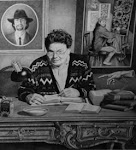
"I am 3/4ths Canadian, and one 4th New Englander - I had ancestors on both sides in the Revolutionary war." - Elizabeth Bishop
____________________________________________

Sunday, June 30, 2019

Elizabeth Bishop Re-imagined: a novel approach

Recently, a friend gave me a copy of Liza Wieland’s new novel, Paris 7 A.M. (Simon & Schuster, June 2019), her re-imagining of Elizabeth Bishop’s life during a sojourn in France in the mid-1930s. 
Wieland’s is not the first fictionalized rendering of an important time and place in Bishop’s life. Michael Sledge’s The More I Owe You (Counterpoint), his version of Bishop’s life in Brazil and relationship with Lota de Macedo Soares, was published in 2010.
Sledge’s novel is by and large a linear narrative with flashbacks, its 328 pages span Bishop’s Brazil years in a comprehensive manner, offering his take on the personal intimacies and political intrigues of this transformative time in her life. It has been years since I read it and I can’t in all honesty remember much of it, that is, remember Sledge’s version of the events, personalities, relationships. What I do remember is that early on he lost my willingness to accept his fiction, on page 49 with the following (a moment when Bishop remembers something about her mother): “How many evening meals had they endured with forced cheer while Gertrude lay on the couch emitting little squeaks and gurgles, one arm over her eyes while the other dangled to the floor, the fingers of her white hand moving as slowly as the claws of a dying crab.” “Squeaks and gurgles”; “the claws of a dying crab”? Really?
I have spent many years encouraging artists of all disciplines to read and respond to Bishop (filmmakers, photographers, painters, musicians and, yes, poets and novelists). These artists needed little prodding. Bishop is one of those gifted creators who quickly gets under one’s skin and almost compels a response. She often gets incorporated obliquely or directly into the art created in that response. In principle, I am all for artists offering their versions of Bishop, or their response to something Bishop has written. Indeed, as a biographer of Bishop, I have my own version of her too. And Bishop has influenced some of my own poems.
After the above quotation in Sledge’s book, a substantial narrative unfolds, rendering not only a view of Bishop and the people in her life, but also ample invisibles: emotions, ideas, memories, dreams. Should I judge this substantial effort by one unfortunate description? I’m afraid that I did and even after all these years, I can’t quite get past it.
Sledge is, however, in good company. Many Bishop scholars and biographers have taken the easy and/or sensational path where her mother and their relationship are concerned. I have written about these liberties on this blog and elsewhere. It is not that I believe I know better, but any careful reading of Bishop’s work (all of it: poems, memoir stories, letters, journals) reveals that Bishop’s understanding of her mother’s life and its impact on her daughter was nothing if not complex and shouldn’t be summed up in the one word that attracts so many scholars: “mad.”
Wieland’s novel is a different kettle of fish. Its focus is a very specific, finite period in Bishop’s life: a couple of years during her early adulthood, when she ventured forth into the world for the first time. Wieland’s style is also markedly different. Her novel is comprised of many short chapters, vignette-like glimpses or “tableaux” (a term that appears at one point). The word that kept coming to me was “impressionistic,” not relentlessly narrative, as Sledge’s story. There is a forward trajectory, a plot; but the novel is not rigidly anchored to it. Moreover, Wieland leaves as much out as she puts in (unlike Sledge who packs in as much as possible). It strikes me that this modus operandi bespeaks a brave novelist.
When I opened the book for the first time, I was not inclined to like it, just on principle. But I found myself intrigued immediately because the prose is deeply poetic (the right approach, it seems to me, for the subject: a profound poet). Indeed, I might argue that each of the chapters is a prose poem: elegant, precise, densely associative, self-contained.
Wieland weaves many allusions from Bishop’s work carefully, cleverly and often seamlessly into the lines. One thing I began to do instantly was identify from which poems and stories the allusions came.
Being a Bishop biographer, however, makes it difficult for me to read Wieland’s novel as fiction. That is, I resist reading it as fiction, which isn’t fair, I suppose, to the writer. The biggest fiction in this novel is a dangerous adventure the young Bishop gets caught up in: helping an older woman, who echoes her mother in many ways, to save two Jewish infants from the looming wave of Nazi oppression and violence overtaking Europe in 1936‒1937, an effort to which she is sworn to secrecy. In the midst of all this intrigue, Bishop has a brief affair with a German woman, who is also fleeing this intensifying, expanding oppression. If you are going to create events in Bishop’s life, these two are certainly interesting and have a logic about them.
These two fictions take place amid actual events: for example, the suicide of Robert Seaver (though that happened before Bishop’s first trip to Europe) and the car accident that resulted in Margaret Miller losing her arm, both profoundly traumatic events for all concerned. It seems to me Wieland handles these tragedies well and the thoughts she gives to Bishop (some of which come from journals and letters) feel authentic.
Overall, I actually enjoyed reading this novel, primarily because of Wieland’s style and form, her often exquisite language. You had better be adept at metaphor and turn of phrase if you want to write artistically about Bishop, and Wieland clearly has a gift.
All this said, I still come back to “mother” — I can’t help myself.
Gertrude Bulmer Bishop appears in this novel entirely as memory; her life and illness torqued out of its factual trajectory. Wieland did a lot of research for this book, but clearly, she didn’t read a lengthy manuscript about her mother (which later got compressed and transformed into “In the Village”) that Bishop worked on in the early 1930s. While Gertrude does have some substance as an actual person in these pages, Wieland does what nearly everyone else writing about this relationship does, reduces Gertrude to a caricature. How sensational it is to latch onto (and repeat, p. 14, 56) something Bishop wrote to Robert Lowell: that she was told her mother had wanted to kill her, something Bishop knew was not true. In the end, Wieland, can’t help but bring in that word all scholars believe so thoroughly applies to Gertrude: mad. She concentrates “that truth” on page 219, writing it five time, equating this madness with Clara, the most important character in the novel besides Bishop. I thought this paragraph was a hammer, a tool Wieland rarely uses to craft her refined prose. Even in her early 20s, Bishop knew that things with her mother were more complex than they seemed. Bishop was working through a great deal at this time of her life, exploring the shadows in her dreams, journals, poems and stories. The open-endedness Wieland affords the mysterious fictional characters and relationships seems denied to Gertrude and Elizabeth.
I have thought more than once of trying to write a novel about Gertrude. I won’t, however, because I have tried to explain things in biography, a limited enough genre, for sure. Still, the urge to reclaim Bishop’s mother (someone the poet endeavoured to understand her whole life) is strong.
Being a biographer, I suppose it is clear that I find fact more interesting than fiction. The truism that fact is stranger than fiction does have validity. All this said, I somehow felt I could overlook this same-old characterisation in Wieland’s novel because it is so well written. At least I tried to. But I do wish Americans would stop calling Halifax Harbour a “bay” (page 13)! And, sadly, no passenger train would have passed “one hundred yards to the north of the psychiatric hospital in Dartmouth” (p. 13; a provincial institution, not a “state” facility). And if there was ever a “pier” at Economy Point, it would have been a wharf and existed in the Age of Sail (19th century), not during Bishop’s childhood. Such infelicities (and there are others) made me smile and sigh.
Then, Wieland incorporates Bishop’s poem “A Drunkard,” which describes her memory of the Great Salem Fire in 1914 after which Gertrude reprimands her three-year-old daughter for wanting to pick up a piece of detritus on the beach. Wieland transports this fire to Nova Scotia: “There is a fire in Great Village. Many people have lost their homes.” Bishop described a fire in Great Village in “In the Village,” but all that burned was a barn. I think Great Village would remember a conflagration as severe as that which claimed Salem, Massachusetts. Would Bishop, even a fictional Bishop, make or mix up such events? Wieland’s Great Village fire is evoked a couple of times (pp. 253, 258) and allows Wieland to intensify Gertrude’s sinister quality, describing her “scolding voice” as “cruel” and “vicious and desperate,” strong adjectives given the wider context of Europe in 1936 — Gertrude as Nazi. She turns Gertrude into a “wounded animal,” to explain Bishop’s state of mind and choices made.
I had to keep repeating: this is fiction. But the fact is, more people will learn about Elizabeth Bishop by reading this novel than those who read the literary criticism and biography, which continues to be published. People will take this fiction to be fact because the novel is about a real person in a historical context and contains many real people as characters.
And to be really nit-picking, I found a few typos: “paying” for playing (p. 139); “though” for through (pp. 145, 222); one too many “a”s (p. 266). I did wonder why Wieland chose “1953” as a chapter title describing an encounter Bishop had with her old friend Clara at Grand Central Station in New York City. Bishop was living in Brazil at that time. Her visits to NYC happened in 1952, 1957 and 1961. Why not just write: “1952” instead? Finally (I have made my point), I wondered about the following: “I’m jealous of how peaceful she looks. Here they’d say she was comfortable in her skin. In Canada, you would say she was in her skirt.” Never in my life have I heard that latter phrase, but perhaps it is an Upper Canadian saying?
Wieland’s penultimate chapter/vignette/prose poem is, appropriately enough, a list of losses (echoing “One Art,” of course, the poem that has become Bishop’s signature, a sort of anthem for our age). The things Wieland states that Bishop has lost have inner logic for the novel, but it struck me as a rather sad conclusion. Bishop surely suffered many losses, but she persevered and wrote poetry and stories that haunt people forty years after her death, so much so that novelists write novels about her. The final chapter, entitled “1979,” the year Bishop died, is another list of things that remain in Bishop’s final home, Lewis Wharf in Boston. This list is also logical and poignant, yet it left me at a loss. Where was the literary legacy of this young woman involved in serious events in Europe in the 1930s, during the lead up to war? Well, Bishop did believe objects were sentient, so perhaps I’m being too demanding in my expectations. And perhaps Wieland intends her compressed, quiet list, the form itself, to be the answer to my question. Bishop’s death was sudden, unexpected, a great loss for all who loved and knew her. So perhaps in the end what is left of her, of any of us, is this kind of list of small objects, with all their secrets and silences.

Friday, June 28, 2019

Reminder about an exciting exhibit in Halifax

Next week is the opening of an exciting exhibit at ViewPoint Gallery in Halifax, N.S. Photographs of the Elizabeth  Bishop House in Great Village, N.S., by photographers Kathleen Flanagan and Roxanne Smith. Check it out!


Monday, June 24, 2019

EBSNS hosts successful Annual General Meeting

On a cool, rainy Saturday afternoon, 22 June 2019, the EBSNS hosted its Annual General Meeting and 25th anniversary celebration in St. James Church, Great Village, N.S. We welcomed several wonderful special guests: Rita Wilson, Penny Lighthall, Margo Wheaton and Harry Thurston. After the business and program concluded, the assembled removed to the Great Village Legion to enjoy refreshments provided by the Fire Brigade Auxiliary. These refreshments included an anniversary cake. Thanks to all the folks who attended, from near and far. The EBSNS is deeply grateful to all who continue support the work of telling Nova Scotians and the world about Bishop's deep and abiding connection to Great Village. Here are some photos of the event.

People begin to gather in St. James Church. Photo by Sandra Barry.


"Sestina," my favourite EB-poem inspired hooked rug in Penny Lighthall's exhibit.
Photo by Sandra Barry.


John Barnstead looking at Penny Lighthall's exhibit. Photo by Sandra Barry.


The assembled in St. James. Photo by Susan Kerslake.

Fabric Artist Penny Lighthall. Photo by Susan Kerslake.
Writer Rita Wilson spoke about her upcoming book:
A Pocket of Time: Elizabeth Bishop's Poetic Childhood,
due out with Nimbus in the fall. Photo by Susan Kerslake.
Our wonderful readers: NS poets Harry Thurston
and Margo Wheaton. Photo by Susan Kerslake.
The Anniversary Cake! With opening lines
from "The Moose." Designed and made
by Cheryl Slack. Photo by Susan Kerslake.

The reception at the Legion. Photo by Susan Kerslake.
Outgoing President Patti Miller (r) and new Vice President 
Laura Sharpe (l). Photo by Susan Kerslake.

Bishop scholar Vicki Harrison and her husband Peter, 
all the way from California. Photo by Susan Kerslake.
Painter Joy Laking and photographer Roxanne Smith. Photo by Susan Kerslake.

Three of the founding members of the EBSNS:
left to right -- Sandra Barry, Meredith Layton and Lois Bray.
Photo by Joy Graham.

Tuesday, June 18, 2019

Another EB society in Nova Scotia

The Elizabeth Bishop Society is not the only "EB" society in Nova Scotia. The Ernest Buckler Literary Event Society in the Annapolis Valley, centred around Bridgetown (where I grew up). It has been around for a decade or so. A week after the EBSNS holds its Annual General Meeting and 25th anniversary (on 22 June in Great Village), the EBLES is hosting a literary and musical evening, "Reading Where We Live," in Bridgetown. Bob Maher, a member of the EBLES organizing committee writes a most interesting blog and he has given the EBSNS AGM a shout out in today's post. Thanks Bob! So I want to return the favour and share the wonderful poster the EBLES has created for what will be a lively gathering on Saturday 29 June (click on the image to enlarge it). Lots of local writers will be participating and the two special guests are John Demont and Whit Fraser. I think it is pretty close to sold out already, but there might be some tickets left.

I also want to thank Bob Maher for his always interesting blog posts that look closely at the idea of local and rural and how important these ideas are to those of us who have left city life for the country.


Monday, June 17, 2019

EBSNS AGM on Saturday 22 June 2019, 1:00 p.m. at St. James United Church

The EBSNS and its special guests hope to see you in Great Village this coming Saturday to help us celebrate our 25th anniversary. Everyone is welcome! (Click to enlarge image.)

Saturday, June 15, 2019

Photographs of the Elizabeth Bishop House: an exhibit

During my tenure as steward of the Elizabeth Bishop House (2004-2015), many wonderful photographers spent time exploring the space-time of that dear old place. Two of these were Halifax photographers Roxanne Smith and Kathleen Flanagan. They took quite different approaches to this subject and some of their intriguing and beautiful work will be exhibited in Halifax at ViewPoint Gallery in July. I am thrilled about this exhibition and urge you to go see it if you live in Halifax or happen to visit the city during that month. Bishop herself was interested in photography – an interest she came by honestly, because her maternal family took to picture-taking early on. Indeed, several Bishop scholars have explored her connection to this old technology and artform. Most recently U.K. scholar Sophie Baldock was in touch to tell me that she is writing an essay about the exchange of photographs in the letters between Bishop and Robert Lowell. I look forward to reading Sophie’s take on thisexchange. In the Bulmer family collection at Acadia University Archives, there are a handful of photos that Bishop sent to her aunt and cousin over the years. Bishop often had her portrait done by professional photographers, something that started in her childhood at the instigation of her mother and grandparents. Well, one can imagine that Bishop would be interested in this upcoming exhibit, exploring her grandparents’ home, where so much happened that would affect the rest of her life. Here is the poster Roxanne sent about this exhibit.


Thursday, June 13, 2019

Elizabeth Bishop at the ALA, by Kay Bierwiler

The 2019 American Literature Association annual meeting was held in Boston in late May.  Several sessions were devoted to Elizabeth Bishop’s poetry and prose.  Most of the sessions were in a panel format. Presenters and attendees were from Canada, the United States and England.

The first session focused on research done at the Bishop archive at Vassar College.   Bethany Hicok moderated, and each panelist presented a paper.   The papers were:  “Too Shy To Stop:  Elizabeth Bishop and the Scene of Reading” presented by Heather Tressler; “I Miss All That Bright, Detailed Flatness: Bishop in Brevard” presented by Charla Hughes; “All The Untidy Activity: Travel and the Picturesque in Bishop’s Writing” presented by Yael Schlick; and the” Matter of Bishop’s Professionalism” presented by Claire Seiler. This was one of my favorite presentations.
The second session was titled “Bishop and Humor.”  Sponsored by the Elizabeth Bishop Society, it focused on humorous and witty aspects in Bishop’s writings.  It was chaired by Angus Cleghorn of Senaca College in Toronto.
Panelists included Thomas Travisano who highlighted humorous examples from Bishop’s letters to Robert Lowell. Jonathan Ellis focused on “Humorous Elbowings:  Funny Turns in Bishop’s Poems and Stories.” Rachel Trousdale discussed “Love and Comical Inadequacy.”
The third session was titled “Swenson and Bishop:  Influence, Intimacy, and Empathy.” Joel Minor discussed “In the Bodies of Words: Curating the Swenson and Bishop Letters.”  The second paper by David Hoak discussed “Swenson and Bishop in Conversation: Efforts of Empathy and Intimacy.” The last presentation by Paul Crumbley focused on Swenson’s “Attitude and Questions of Influence”.
The poet Frank Bidart was celebrated with a roundtable discussion of his works.  Later in the evening he gave a poetry reading. Bidart was a friend of Bishop and one of her literary executors. His latest book is “Half-Light:  Collected Poems.”  He was awarded the Pulitzer Prize for poetry in 2018.
(Kay Bierwiler on left, with Sandra, at EBSNS 2018 AGM.)

Tuesday, June 11, 2019

Letters to Aunt Grace, Part 113: Gatherings

The next paragraph of Bishop’s 18 January 1962 letter settled into their recent domestic activities. Before this update, however, Bishop hoped Grace would “get away to Florida, too, if you really want to go.” Grace occasionally spent time with her sister-in-law Mabel, who often spent time with her daughter Hazel, who lived in Hollywood, FL. Bishop assumed that was where her aunt would stay, though she couldn’t help but add, “I think you need to get somewhere restful, too,” knowing well that time with Mabel was not likely to be restful. 
(Grace and Mabel in Florida, 1960s. AUA.)
She wished “to goodness this [place] weren’t so far away – or that I was living in the country all the time and not all this going back & forth.” Yet having said that, Bishop suspected that Grace would likely be “bored there” (in the country) because “there is so little to do and it is SO quiet.” If a visit was not possible, Bishop was also at a loss how to “help with this trip” financially, because she was “still waiting to get paid finally for my job.” She suggested that perhaps when Grace was done with her visiting, and if she got “stuck or anything,” to “let me know.” She felt that she “could certainly help” Grace, at the very least “get back home again!” Grace had been visiting Mary in Montreal and was next off to visit with her son Rod, all before going to Florida. Bishop wondered: “How do you get from Montreal to Brantford, and where is it.” She wished she “had an atlas handy.” Bishop hadn’t seen Rod for years and wondered how many children he had, “two, hasn’t he – or just one?” This subject brought up Miriam again, Phyllis’s daughter. Grace had clearly been giving Bishop updates about the child’s progress and Bishop declared herself “feeling hopeful” about “little Miriam,” saying that “maybe all will go well” in any case. Echoing something the always-loving Grace said, Bishop wrote, “And as you say – loving care makes an awful lot of difference.” She also noted the benefit of the “attention of other children,” meaning Miriam’s older brothers, noting “they do develop faster when there are older children around.”

Bishop’s characteristic “//” signaled her shift, finally, to “Monica,” who Bishop declared “is a darling.” She was already starting to talk: “she says ‘Mama’ at last.” And Bishop noted that this doted on child “loves to give kisses,” particularly when they were all driving together: “she will suddenly lean forward to Mary,” and say, “Ê»Mama, Mama.’ and give her lots of smacks – mostly in the air.” Bishop echoed a word she’d used previously to describe this child: “cunning” – quite an adjective for a person who was “about 15 months” old.

Another “//” shifted things to Elizabeth Naudin, who “is spending six weeks up in Teresopolis.” This proximity meant that “they are all coming to lunch with us in Petropolis this Saturday – if it doesn’t storm again.” Bishop had visited her cousin “before she left.” Elizabeth Naudin was pregnant with her third child and Bishop, “thinking she was lying down, housebound, etc.” was surprised when she “walked in on a bit feijoada – a black-beans-and-rice-party – for three or four couples, children, etc.!” This signaled to Bishop that her cousin was “feeling a lot better.” Clearly, Elizabeth Naudin had settled into her life in Brazil.

Yet another “//” signaled an account of a gathering of their own: “We gave a luncheon last Saturday for Lota’s co-workers on the park.” Bishop observed that this gathering was “about time.” She also reported that she had done “all the cooking,” moaning the fact that “our Maria can’t cook and never will learn anything.” As an aside, she noted that they were “finally giving up and looking for another couple” to help at the Samambaia house. Even though they liked “them pretty well still in other ways … they spoil so darned easy!” By which she meant that with Lota and her away so much all they had “to do is air the house and feed the cats and water the garden most of the time.” When Lota and Elizabeth returned, she noted, “they think we’re expecting too much” when they “want[ed] a little cooking and washing done.” Bishop reminded Grace about Maria’s miscarriage and observed that “although we … did everything we possibly could about that poor little baby – (and if we hadn’t been there what would she have done? – died, probably,” Bishop reported that “they are so ignorant that now they are sort of blaming us because it died.” Bishop’s response to all of this was “Oh dear.” Bishop not only described them as “ignorant,” but also as “babes in the woods,” which, she noted “they don’t even see … of course.”

After that digression she returned to the gathering of Lota’s colleagues, with Bishop cooking “all Saturday” for “18 people … and it was hot as hell.” The menu included “iced cucumber and mint soup.” Main course was “Beouf Bourguignon – a sort of de-luxe stew of steak, mushrooms, all kinds of things – cooked for two days, almost.” 
(Beef Bourguignon)
In addition, there were “little carrots and onions fresh from the garden.” To top it all off, “Brazilian style – two desserts – or three,” including “a huge chestnut pudding, all decorated with nuts and cream.” As well as “sliced pineapple with liqueur.” And, finally, “a large chocolate cake.” In Bishop’s view it was “much too much, I thought, but it vanished like snow.” To accommodate all these people, they “set up four card-tables.” And as if Mother Nature was collaborating (during a time of stormy weather), “the rain held off until they had left.” The gathering dispersed “about 6 o’clock.” And Bishop concluded this account with, “we were all naturally exhausted by then.”

No more “//s” but Bishop shifted gears again. The next post will conclude this newsy letter.


Friday, June 7, 2019

EB-inspired hooked rug exhibit in Great Village

Truro artist Penny Lighthall is creating a series of hooked rugs inspired by Elizabeth Bishop poems. Some of these rugs have been hung in the Echoes of EB Art Gallery in St. James Church in Great Village. The EBSNS will be unveiling them at our Annual General Meeting on 22 June. EB board member Laurie Gunn helped Penny with this exhibit and took these photos. We hope to see you at the AGM when we'll also be celebrating our 25th anniversary. Other special guests include Rita Wilson, Margo Wheaton and Harry Thurston. See you "In the Village" on 22 June. (Click on the images to enlarge.)

Sunday, June 2, 2019

Cookies — the kind you eat: an update

If you remember, in the Letter to Aunt Grace #111, I wrote about a cookie recipe Bishop found in Life magazine, which she highly recommended to her aunt. I found the issue from which that recipe came and posted the cover, but didn’t pursue the matter further. John Barnstead, however, located the recipe in that issue and send me a copy of it, which I included as an addendum. John also took it upon himself to make the cookies and he promised me he would send me some, which he most kindly did, along with a delightful tray that displayed the Brazilian and American flags. John was not the only person to try their hand at these cookies. My Utah friend Laurel Cannon Alder also made these cookies and sent me some photos of the results. Her mother, my dear friend Helen Cannon, reported that they are delicious (Bishop certainly thought so, too) and now that I have tasted them, I can say first hand that they are delightful, not too sweet but very flavourful. I have always thought that there should be an Elizabeth Bishop cookbook, based in part on the recipes she shares with her aunt in her letters. I suspect Grace sent Bishop a few recipes of her own, even though Bishop didn’t regard Grace as a good baker!

I thought you might like to see photos of the two batches of actual (not electronic!) cookies, well worth the effort to bake them.
Laurel’s cookies.
 
John’s cookies artfully displayed on the tray.

Saturday, June 1, 2019

Letters to Aunt Grace, Part 112: Worst and First

Bishop’s next letter to Grace was dated 18 January 1962, just over two weeks after the first one for the year. It was not as long, but offers a glimpse of their split domestic life, the “back and forth” between the house as Samambai and the apartment in Rio, as Lota’s job with the park intensified.

This epistle started off, however, with a concern over Bishop’s previous communication. After they had got “back to P[etrópolis] for the weekend” (Bishop had mailed the 3 January letter in the city), Bishop reported she had “got your note of the 3rd.” They had written to each other on the same day (space-time is an interesting phenomenon). This note told Bishop that her aunt was gallivanting again, that she was “off to Montreal.” This made Bishop wonder when Grace would receive “that BOOK I mailed you,” by which she meant, as she scribbled above “BOOK”: “(big letter).” Bishop had sent that long letter “registered mail, one day last week, from Rio,” but she was “afraid it had to be forwarded to you at Mary’s.” That was where Grace was headed, “‘by car’ you say.”

Driving from anywhere in Nova Scotia to Montreal at any time of year is no small trek (according to Google the distance is 1,128 km and takes 10 hours and 46 minutes on the Trans Canada Highway — in 1962 there would not have been much of this highway built, if any); but doing so in the dead of winter was adventurous, to say the least. Bishop wondered if Grace was “driving with someone” and hoped “the roads are good — better than here, certainly.” Since, as far as I know, Grace did not drive, she was surely being driven there by someone.

Grace’s road trip triggered one of Bishop’s lively stories about her and Lota’s own recent “trip down to Rio Tuesday,” from which they were “just recovering.”

They set off in a “terrific storm,” which had started Monday, “the worst every recorded, I think.” [Note: I went looking for such a storm and found mention of it on a blog which listed natural disasters in Rio de Janeiro. According to this site, 242 mm, nearly 100 inches, of rain fell during this storm. No wonder they encountered what they did on this trip.]

Bishop recounted that rain made the roads “almost impassable.” She conceded that they “really shouldn’t have” gone “in the little Volkswagon.” They encountered “rocks almost as big as the car,” which were “scattered over the mountain road.” In addition, there was “thick fog — stranded trucks all along the way.” They made it “down” the mountain but found “the highway into the city was flooded.” They “had to wait about two hours” to do the final leg into Rio. Needless to say, there were “many accidents.” One in particular was slightly surreal: “one load of cotton had been upset — we saw all this white stuff through the fog, and a crowd, and couldn’t imagine what it was.” It was “the bales burst open — the truck wrecked, of course.”

After having survived that treacherous trip, “that night there was a small earthquake — the first ever recorded here — very slight.” Bishop reported that they were “reading in our beds” when they felt something. Bishop, who had “felt worse in Massachusetts!” immediately “said to Lota, ‘That’s a quake.’” Lota “pooh-poohed the whole thing,” but the next morning “the papers” reported it. Bishop was “glad” to have her sense confirmed, the proof that “it hadn’t been just my poetic imagination but a real tremor.”

Again, I attempted to find something online about this minor seismic incident, but couldn’t. Still, we can trust Bishop and the papers in both these accounts of the worst rainfall recorded to that date and the first tremor ever detected. An eventful day.
(It is hard to find images of torrential rain and rock slides
or minor earthquakes!Instead, I offer a poor scan of a photo
in Carmen Oliveira's Flores Raras e Banalisimas,
of the beginning of Lota's park in the early 1960s.)

After this dramatic beginning, the letter turned fully to family updates and Bishop’s report about their own domestic issues. These will be taken up in the next post.


Friday, May 31, 2019

EBSNS AGM and 25th Anniversary celebration on 22 June 2019

All are welcome to attend the EBSNS Annual General Meeting and 25th Anniversary celebration in Great Village, N.S., on 22 June 2019. We've got some wonderful guests to share in our festivities and there will be great food and refreshments, too. The EB House will be open for viewing. Looking forward to seeing you there! (click on the poster to enlarge)

Tuesday, May 28, 2019

Story and Song for the EBSNS

On 26 May 2019, Halifax storyteller Claire Miller presented her “Swan song” gathering with a group of musical friends, in her gracious south-end home. After years of offering highly successful, well-attended storytelling salons, Claire has decided to turn her creative energies to other activities.
 (The performers performing. Photo by Janet Maybee.)
The free-will offering that Claire requested at this event was designated for the EBSNS, a most generous gesture.
 (Photo by Janet Maybee.)
EBSNS Board member Janet Maybee attended and reported that the event was “marvellous.” She noted that “35 devoted listeners” were present and “Claire made a point at the beginning to tell them why they should contribute to preserving the Bishop legacy.” This lively gathering garnered $380 for the society. Thank you so much Claire, and all your wonderful guests. The EBSNS is deeply grateful for such generosity.
(L. to r.: The performers: Margo Carruthers, Claire Miller,
Clary Croft, Heather-Anne Pentz, Vanessa Lindsay-Botton.
Photo by Shannon Chisholm.)

Wednesday, May 22, 2019

Letters to Aunt Grace, Part 111: A bit of gossip, finally

Bishop was slowly getting to the “gossip” she wanted to share with Grace in her 3 January 1962 letter. She was almost at the end of the fourth page of this densely typed letter and the penultimate paragraph of that page, which focused on the holiday just past: Christmas. But before that description, she had to express her sympathy to her aunt: “I am so sorry to hear about the ribs, are they getting better?” Grace must have injured herself as the letters that had recently come to hand must have reported. Then, without a pause, Bishop wondered, “where you did spend Christmas finally?” Grace would have had several options.

Then came the account of Elizabeth and Lota’s holiday, which was not their usual visit to “Cabo Frio, that beach place we like.” The friends who lived there “had other visitors,” and, after all, they had just returned from their slog in NYC. So, they “just went home for three days and ate roast pork,” meaning they went to the house at Samambaia, the Brazilian place that was “home” for Bishop.

To mark the festive season, Bishop told her aunt that they had “set up a toy village just for our own amusement.” The child in the household, Monica, was “much too young to enjoy it.” This decorating happened because “Lota bought a lot of little figures, etc in N Y — lovely.” They arranged this village “on the hall chest of drawers,” putting “green stuff in the back.” When I first read this account, I was surprised, as Lota seems to be the last person one would think of liking such Christmas kitsch, let alone collecting a whole scene of it.

To augment this activity and the “roast pork,” Bishop reported that she “made a batch of something called Dutch Christmas cookies,” a recipe she found in “LIFE magazine,” one perhaps Grace had also seen, the issue “with Xmas recipes in it.” In the margin Bishop scribbled a further description of these cookies, “Butter Slices.” She noted that they were “marvellous, I must say!” because they were “full of poppy-seeds and filberts (or do you call them Hazel Nuts). “On Christmas Eve,” she reported, “we had a traditional Brazilian dish — French Toast!” This delicacy was served with “your maple syrup. I still have almost a quart.” Bishop surely made that most welcome gift from her aunt last a long time.
(The cover of the 8 December 1961 LIFE magazine cover.
It is probably the issue to which Bishop refers as there is
a section on holiday recipes.)
Finally, Bishop reached the point where she revealed, “I wanted to gossip about Mary and her family … horrid of me!” But if we can’t talk about family, who can we talk about? Her first statement was that “They all seem so RICH to me!” She wondered how they got that way. Mary had spoken about “going to Europe!” That reminded Bishop about her “fellowship,” which  had “to be used for travel,” and told Grace she would go to “Peru and Bolivia” and “another trip to N Y,” echoing what she had been saying for some time: “this time I’ll really get to N S.” To that end, she asked Grace to suggest “the pleasantest place to visit?” And “(while I think of it),” Bishop asked her aunt to “give me Aunt Mabel’s address.” Declaring with a bit of exasperation, “I do hope you get all this now!”

Then back to Mary and her family. Bishop noted that she “didn’t really have much chance to talk to Joanne.” Bishop got the impression that this young woman was “the athletic type” and saw that “she really loves animals.” The former would not have mattered much to Bishop, but the latter inclination gave them something in common. Bishop then mentioned “the little monkey” about which “she was crazy to take back.” If she had “known sooner,” she noted, “I could have arranged it, probably,” meaning she could have got all the papers in place. In any case, it didn’t happen, but the monkey had found a home, which Bishop had reported earlier in the letter.

Clearly, though, Bishop was fondest of Mary’s son John: “I love his looks and that nice grin.” This brief account was the warmest of all her observations about these young people.

When they had been given the opportunity to talk without the Naudins present, Bishop reported that “we all agreed that Ray shouldn’t complain about Brazil the way he does all the time.” Bishop had made this observation before to Grace, so would have been pleased that his in-laws could see the issue themselves. Bishop found this habit “very annoying.” She realized that he was “undoubtedly a clever young man at his business, but I don’t think he has a very nice character.” To her he was “kind of mean,” though quickly she said, “not to E or the children — he’s a good father.” Still, she found him “petty, and always grumbling.” He behaved like “he knows more than he does,” and made “tactless remarks.” Bishop assured her aunt that she “never attempt[ed] to argue with him about anything,” partly because “he knows it all — or so he thinks.”

Then a real piece of gossip: “I got the feeling that Mary wished E had married someone else — although she never said so.” Mary was nothing if not “very polite and discreet.” But, as Bishop suggested, nothing else by way of confessions could be expected because “after all we hadn’t seen each other for thirty years!” (Perhaps the last time Bishop had seen Mary was in 1930 when she and Maude and George went to Montreal to visit the Rosses because Elizabeth Bulmer was there, recently widowed and unwell.)

All this said, Bishop declared that “it was fun having her — she seemed to be interested in everything and enjoys things and that’s what makes a good guest.” Wistfully, however, Bishop noted that “all the time I wished it were you, I’m afraid.” Which made her turn to that next prospective visit to N.S. and them “meet[ing] in Halifax and spend[ing] a few days there” in a hotel.

Suddenly, after over four pages of letter, Bishop declared, “Now I must rush.” She had to “call up LIFE here to cable N Y and ask them where the hell are the proofs they promised for ten days ago.” That dreadful job was still plaguing her. She confessed to her aunt that she thought “they are double-crossing me and the thing is going to appear without any corrections — any last ones, I mean.” Again she wrote, “I spent five weeks doing nothing but fight with them in N Y over their idiotic changes — Not one of them had ever seen Brazil,” Yet these “17 people” believed they “all knew more than I did, — and I’ve lived here ten years and they hired me, after all!” Her final declaration: “They’re mad.”

The well-known story about this book, when it finally was published, is that she made those “last” corrections in green ink in those copies she received and dispersed.

This rambling letter concluded with an extra measure: “Much much love” and an admonition for Grace to “please take care of yourself and forgive me for not getting there.” It seems that it was Bishop who had to forgive herself. She pleaded that she “wasn’t really in my right mind that N Y stretch.” Concluding finally with the fact that she “couldn’t remember anything or see anything, just that damned little book.”

Bishop didn’t wait quite so long to write again to Grace. Her next letter is just over two weeks later and will commence with the next post.


********
Addendum: 23 May 2019. Leave it to John Barnstead,who found the precise recipe EB mentions in that issue of LIFE.
And a photo of the cookies, which are on the bottom tier of the plate on the right.
John tells me he is going to make the cookies and send me some in the mail!! When I get them, I'll take a photo and post it!!!

Tuesday, May 14, 2019

Letters to Aunt Grace, Part 110: Gifts

Bishop began the ”just for you” part of her 3 January 1962 letter to Grace with a declaration, “Oh dear, I am dying to have a good gossip with you.” Even though she had finally received letters from both aunts, she still wondered if Grace had got “my check safely?” that is, her Christmas gift. And she admonished her aunt, “Please spend every penny on  yourself.” Then, without even a pause, she shifted to, “I do hope that Miriam [Phyllis’s daughter] may turn out to be all right.” Grace had clearly updated Bishop on this new member of the family, now about six months old, which prompted Bishop to respond, “what you say sounds quite hopeful.” Phyllis had also been in touch and Bishop asked her aunt to let her cousin know the “card” came “last week — and I’ll write her soon.” Having been so busy in December meant that Bishop “didn’t send out any cards” because she “didn’t have time.” She paused and clarified, “no I did send two,” which she “stole” from “my friend Loren’s supply” (she and Lota stayed in Loren MacIver’s apartment in New York). One of those cards went “to [Aunt] Mary and one to Aunt Florence.”

She returned to the subject of Phyllis about whom she felt “sorry … so much work” with Miriam. In contrast, Bishop wrote, “this poor little illegitimate baby our friend Mary [Morse] adopted — Monica — is so bright.” In Bishop’s mind, the whole thing “just isn’t fair.” She continued describing Monica as “so gay … always grinning and laughing.” She noted how much she had “missed her … while I was in N.Y. — I never remember missing a baby before!” She wished Grace “could see her — you’d love her.” Monica was “about 14 months and can sing (a little).” She was getting active and mobile, able “almost [to] climb out of her play-pen.” Bishop described her acrobatics, hanging “over the top” of the bars, and feared that “in a few days she’ll fall out and break her nose.”

This doted on child still “isn’t very pretty — big mouth, big teeth — and her ears stick out — but she has lots of curls.” The latter feature was “a pleasant surprise to everyone because … as a baby” her hair “was straight as a string.” Clearly, Monica was a delight in Bishop’s life at this time.

Another shift back to the vagaries of communicating had Bishop declare, “I am so sorry about my presents” — meaning gifts Grace had tried to send to her niece. Just what happened is unclear, but somehow they were returned. In any case, Bishop quickly said, “I’d love to have the table linen” (perhaps some of her mother’s. Grace had sent Bishop some of her mother’s embroidery one other time.) Bishop asked her aunt to “please keep it for me.” And suggested that Grace “Just send me the book, sometime.” She noted that “Books do come safely” and advised her aunt to “Leave an end a little open so they can see it’s a book,” and to improve the odds of delivery to “write BOOK — LIVRO — on it, good and big.” Doing so meant it would come “book rate — slow, but cheap.” Whatever the book was, Bishop assured Grace, “I’d love to have it.”

Then she made a request: “if ever you happen to see a cook-book of Nova Scotia recipes — if there is such a thing — I’d like to have one — and I’ll pay for it, of course.”*

Going back to the table linen, Bishop noted there was “an old lady near us in the country who earns a little money by doing some embroidery.” She could “get her to finish the set” because she does quite nice work.” Unfinished table linen does sound like it could have been something of her mother’s work, never finished. “In the Village” refers to Gertrude’s beautiful embroidery, some of which was incomplete, still in the embroidery hoop.

Grace had also offered a “pitcher and basin and soap dish,” which Bishop remembered “very well — save them, too!” Mailing such items was not possible, but Bishop once again said, “I really think we may be getting back next year.” If that happened, they would “have another five or six weeks” and if she was “not earning money,” she could “stay even longer,” at least so she thought. She trailed off this part of the letter wistfully, “I’ll really get to see you —”

This “just for you” part continues on for quite a bit longer. The next post will finally get to the core of the “gossip.”


**********
*Note: The most famous Nova Scotia cookbook was Out of Old Nova Scotia Kitchens by Marie Nightingale, but it wasn’t published until 1970. It went through dozens of printings. Bishop surely would have loved it.
The Nova Scotia Archives has a wonderful site containingdigitized versions of over a dozen old N.S. cookbooks and also digitized images of hundreds of hand-written recipes found in various collections. Bishop for sure would have loved this site.

Sunday, May 5, 2019

Letters to Aunt Grace, Part 109: Rio in 1962

Bishop began winding down the joint part of her 3 January 1962 letter to Aunts Grace and Mary with a brief account about the state of things in Brazil. She first noted that “Lota is hard at work again,” on the big park project, though Bishop also observed that “nothing much happened while she was away.” Then “Poor Brazil” comes into the equation. Bishop described it as “in awful shape.” The best way she felt she could convey the situation to her aunts was a rather indelicate joke, revealing that as fastidious as Mary was and as respectable as Grace was, Bishop felt that both women wouldn’t mind a bit of off-colour, though she presents it in as discreet a way as possible.

Bishop began this “favourite joke at present …. a very Portuguese joke,” in a classic way: “two men talking to each other about the situation, very gloomy.” Finally, one of them “says to the other — ‘Well, times are so bad — we’re all going to end up eating sh-t.’” Of course, the punch line is: “The other replies, ‘Yes — and there isn’t even enough sh-t to go around.’”

{Check out this link to a wonderful b&w, 8 minute film about Rio in 1962. I was fascinated by the whole thing. This profile of Rio hardly make it looks “awful,” but rather shows quite a glamorous city. Watch to the end, and you will see why I’ve chosen the more recent images below. Great to get a sense of the atmosphere there in that year.}
 (Iconic Rio in 1999. Photo by Sandra Barry.)
After having been in Samambaia for Christmas, Bishop told her aunts that they can gone “to Rio — Jan 2nd — and I got 2 letter from Aunt Grace.” This explains how Bishop learned that Grace had feared she had been on the airplane that crashed late the previous year. One of these letters was “dated Dec 10th and one on the 17th.” That she was only now getting them proved “how slow the mails still are.” However, she defended her adopted country by noting, “I really think that’s YOUR ‘rush’ not Brasil’s fault for once.” She had also received one from Aunt Mary “dated the 27th,” which was a more “normal time” coming.

One of Grace’s letters revealed something Bishop did not know: “I didn’t think you had a telephone, Aunt Grace, in G V.” So she had missed not only a trip to Nova Scotia, but an easier chance to talk to her aunt, on the phone. All this made her wistful again about not following through on the one thing she really wanted to do: “I am so terribly sorry not to have got there [Nova Scotia].”  Wishing she had had “a little more time,” and second guessing herself, she continued that if she “hadn’t gone to see Mr Blum,” she “bet he could have fixed it up with the income tax people afterwards!” But in the moment, in the context of the book work, Bishop did not have time to think out the all possibilities.

The final short paragraph of this joint part of her letter ended with a few final updates. After asking her aunts to “please give my love to everyone,” she noted that she was “going to call on Elizabeth [Naudin] this afternoon, I think.” Then she reported that she had been sick for “three days … last week” with “bronchitis, coughing my head off.” But she was planning to go out anyway, even though it was “fearfully hot.” In the midst of all the domestic troubles and struggles, she finished her joint letter on a positive note, telling Mary particularly that “at least I earned enough money to paint this apartment … we’re going to start right away.” Mary would know first hand how much the painting was needed. Her “much love to you both and Happy New Year” was typed vertically on the thin left margin because the next page was for only Grace. As she “add[ed] a bit more just for” Grace, she noted that her favourite aunt would now understand “why I am sending you the carbon — it is clearer than the 1st copy.” Before getting to the real reason for the separate Grace-only part, Bishop explained that the carbon was clearer than the original letter because “I need a new ribbon.” It is apparent even in the photocopy that the addition is more faded in the photocopy of the carbon, clearly revealing the ribbon issue.

Further more, Bishop reiterated that she “must hurry out to pay the gas and light bills before the office closes down.” This office was “away on the other side of the city.” It was a “special office, because no one paid” the bills while they “were away, and now they are threatening to cut off the service.” One of the practical issues was that they could  not use “checks,” which would have made “life so much easier.” Checks were used “for some things, but just between friends, apparently — not for bills or utilities.”

Ultimately, Bishop’s reason for the separate section was to “gossip about Mary and her family.” But before she got to that subject, she got side-tracked with more reiterations and catching up with things Grace had written. These diversions will comprise the next post.
(To prove I was actually in Rio in September 1999,
here is me standing beneath that breath-taking statue with
N.S. poet Brian Barlett, left, and Bishop scholar Gary Fountain, centre.)

Wednesday, May 1, 2019

New book about Elizabeth Bishop

Bishop scholar and editor Jonathan Ellis has sent word of a new book of essays about EB published by Edinburgh University Press, which he has edited: Reading Elizabeth Bishop. Congratulations Jonathan!


Suzie LeBlanc singing Bishop songs

We are excited to share the news that renowned soprano Suzie LeBlanc (EBSNS Honorary Patron) will perform some of the EB poem settings she commissioned in 2011 for the Bishop centenary, and two new settings by Alberta composer Stephen Smith, along with other repertoire, at a concert on 4 May in Vancouver with the Elektra Women’s Choir.

Monday, April 29, 2019

Letters to Aunt Grace, Part 108: Domestic matters

The next part of Bishop’s 3 January 1962 letter to her aunts shifted to being back home, to domestic matters, in particular to their cook at the house at Samambaia. Elizabeth and Lota returned to Rio, but as Bishop noted, they “went up to the country for the 24th& 25th of December. On Christmas Day night their “cook began to have her baby… — two months too early.” Before the actual birth, they “got her off to the hospital” in Petrópolis on the morning of the 26th, where “the baby was born.” Bishop noted that in the midst of this “great excitement,” their friend “Mary Morse was on hand and helped give it [the baby] oxygen.” Even though it was put “in an incubator and had the best care,” this tiny infant, “about 6½ months,” did not survive, “but only lived three days.”

The cook was married to their “butler,” who was, as Bishop observed, “broken-hearted.” This tragedy was the most recent in a long line of “seven or so miscarriages.” Truly sad. Elizabeth and Lota were, on the other hand, “relieved.” Bishop uncharitably noted that “the poor girl is so dumb,” adding parenthetically to Aunt Mary that she “will remember her — Maria?” Bishop felt that Maria “couldn’t possibly take care of a normal baby, much less a premature one.” Being an obstetrics nurse early in her career, Grace would have known her share of premature babies.

Elizabeth and Lota’s relief was tempered by the fact that this couple were “going to keep on trying.” In the face of such determination all Bishop could ask was, “what do we do in the meantime?”

Bishop tended the unwell Maria, “spent all last week-end up there cooking.” This thwarted mother spent her time “in bed eating chicken and refusing to comb her hair, etc.” Part of the reason for this behaviour was “Superstitions.” One of these, as Bishop related, was “the lard she ate (just the thing, of course — should be from a male pig, not a female, nor a castrated pig ….)”

Ever the cosmopolitan modernist, “Lota just  blows up.” Having come from a rural childhood with devout grandparents, superstitious ancestors and an abundance of community folklore, Bishop noted that she was “more patient, but it is pretty hopeless.” She also conceded that even with these troubles on both sides, “they have their good points,” which included “never leav[ing] the place, even for an afternoon.” Elizabeth and Lota were less and less often in Samambaia and the cook and butler “take good care of the cats.” And what was more, “they both can shoot — in case of burglars!”

After this saga, Bishop shifted again, assuring Aunt Mary that she “got the snapshot of Pouchie [Mary’s cat] and have it right here on my desk.” She had to admit that this feline was “handsomer than Tobias,” one of their three cats, the other two being Suzuki and Mimosa. All the cats “were so glad to see” them when they returned on the 24th. On Christmas Day they “all rushed to have breakfast in bed” with Bishop.
Elizabeth Bishop and Tobias. Source:
Carmen Oliveira, Flores Raras e Banalíssimas 
(Rio de Janeiro: Rocco, 1996), between pp. 64–5.
Then Bishop declared that she had also written Aunt Mary, “a long letter just after [Mary] left” in October, and “before I went to N.Y.” Bishop seemed to think her aunt has not received that letter in which she had related “how we found a good him for the little marmoset,” that had so charmed Mary’s younger daughter Joanne. Bishop observed that she had “loved him, too,” but could not “keep a monkey in the house” because “he was giving me asthma.

The next part of this long letter winds down the joint part of the epistle, after which Bishop added over a page just for Grace. To be continued in the next post.

Saturday, April 27, 2019

John Scott's documentary film about Elizabeth Bishop: Update

This "one sheet" just in from producer Walter Forsyth, who is working with film-maker John Scott on his documentary about Elizabeth Bishop, "The Art of Losing." Delighted to share it.


(Click on images to enlarge.)