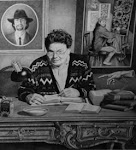
"I am 3/4ths Canadian, and one 4th New Englander - I had ancestors on both sides in the Revolutionary war." - Elizabeth Bishop
____________________________________________

Thursday, October 10, 2019

From Pen to Hook: Part 20

The final image in this series is Lighthall's response to Bishop's early poem "Chemin de Fer." This strange, fable-like poem is one of the first in her first book North & South. It shows a view from a train (as opposed to a bus in the late poem "The Moose") and offers an odd aggressive act when a hermit shoots off a gun, though the act seems more like just making a noise than any sort of violence, because the hermit shouts one of Bishop's strong but mysterious declarations: "Love should be put in to action." Slight as this poem seems, it contains layers of meaning and many images that reappear in Bishop's work throughout her life. She is signalling that an essential character of her work is "an echo." I have enjoyed presenting Lighthall's images, which are themselves like visual echoes of Bishop's words, but they are of course much more than that. Lighthall has put her love of Bishop's art into action, into her own art, which is a pleasure to contemplate. Again, I want to thank Susan Kerslake for providing me with all the images used in this series.

Wednesday, October 9, 2019

From Pen to Hook: Part 19

"Well, we have come this far." is the ending of "Cirque d'Hiver," the early Bishop poem that inspired this delightful rug. The poem is about a mechanical toy: a cantering horse with a twirling dancer on its back -- an object that seems both inanimate and animate at the same time. It is the penultimate image I will post. We have come quite far in this series and this charming image is one of my favourites. Seemingly purely descriptive, this poem carries with it a good deal of mystery, evoked in the very motion of the object, which moves in the poem without any apparent assistance from a human hand. I love that big key under the horse's belly.

Tuesday, October 8, 2019

From Pen to Hook: Part 18

Bishop loved to cook, a skill she began to learn during her childhood. This delightful rug is based on a funny little poem Bishop wrote about Fanny Farmer's cookbook, a gift she gave her friend, the poet Frank Bidart and to whom she dedicated the poem. Yesterday Penny Lighthall gave a talk about her rugs at the Halifax Central Library. Wish I could have been there. Susan Kerslake attended and sent these images. Tahnks, Susie. And thanks Penny for creating such delightful works of art!


Monday, October 7, 2019

From Pen to Hook: Part 17

This rather dramatic rug is a response to EB's poem "Trouvee" (apologies for no accent on the first e.). This odd little poem, dedicated to her friends Wheaton Galentine and Harold Leeds, is about a hen that was killed on West 4th Street in NYC. EB knew many hens during her childhood. Great Village would have been full of them. But the disjunct of seeing one killed on a busy city street clearly struck her. The poem is essentially a question about why things happen where and when they do, for which we often seldom have full or even partial answers. It is interesting to me that Lighthall has chosen not only the most famous or iconic poems to interpret, but also some of Bisbop's more obscure poems.


Sunday, October 6, 2019

From Pen to Hook: Part 16

Today is the fortieth anniversary of Elizabeth Bishop's death. I wonder if she could have imagined the global interest in her life and work in 1979. She had received many awards and had some sense of the interest in her poetry, but the stature and status of Bishop has only continued to rise since her death. This lovely rug is inspired by Bishop's early poem "The Man-Moth," triggered by a misprint she saw in a newspaper (the word was supposed to be mammoth). This poem appeared in North & South and is one of her most mysterious. I love the simplicity of this rug and that strange shadow figure behind the poet.

Saturday, October 5, 2019

From Pen to Hook: Part 15

This intricate rug is inspired by Bishop's poem "First Death in Nova Scotia," about the death of one of her little cousins, son of Arthur and Mabel Bulmer. Lighthall said she felt uncertain about depicting a scene that was common in the early 20th century -- the laying out of bodies at home. But I think this rug captures the poem beautifully, with the chromographs of the royal family on the wall, the loon on the table, Bishop's mother lifting her to see her cousin and the deep snow outside. Bishop wrote this scene with both profound mystery and serious humour. It was a moment in her life that shaped how she saw the fragility reality. She was both confused and comforted in the midst of this common ritual of her childhood.

Friday, October 4, 2019

From Pen to Hook: Part 14

I was quite interested to see that Lighthall chose to do a rug based on Bishop's poem "Five Flights Up." This rarely remarked upon poem is the last one in her final collection, Geography III. This poem has a little bird and a little dog being observed by the "poet," who ponders our sense of self and time. The final lines in this poem are: "-- Yesterday brought to today so lightly! / (A yesterday I find almost impossible to lift.)" They are important to me because I took the title of my book from them: Lifting Yesterday: Elizabeth Bishop and Nova Scotia. We all lift and carry "yesterday" with us, and sometimes it is a heavy burden. Bishop lifted and carried her yesterday by writing transcendent poems that speak to many people "today."


Thursday, October 3, 2019

From Pen to Hook: Part 13

This rug is inspired by Bishop's late poem "In the Waiting Room," set in Worcester, MA, in February 1918, when she was seven years old. It is the one poem where she names herself directly and writes about her realization of how she was both connected to and separate from the people and world around her. Lighthall has caught the sense of the crowded feel of the waiting room that so unsettled Bishop. Not sure why she chose to insert the smiling tooth, but Bishop was always one for injecting humour into even the darkest or most shadowy moments, so it is not out of place.

Wednesday, October 2, 2019

From Pen to Hook: Part 12

This rug could be inspired by only one poem, "The Moose," which is now perhaps Bishop's second most famous poem, after "One Art." The origin of this poem was a bus ride in 1946 from Great Village back to Boston. Bishop dedicated the poem to her beloved Aunt Grace, who, incidentally painted a portrait of a bull moose (the one in "The Moose" is female) when in her 80s. Here is a very poor scan of a photo of this painting, which used to hang in the sunporch of Elmcroft, the Bowers' family farm, in Great Village. The house has been recently renovated and the sunporch removed, and I have no idea where this painting is now. I love the way Penny has coalesced that long descriptive poem into this one clear and iconic image.
(Photo taken by Phyllis Sutherland in the
kitchen of Elmcroft, circa early 1990s).

Tuesday, October 1, 2019

From Pen to Hook: Part 11

This dramatic rug is inspired by Bishop's early poem "The Ballad of the Subway Train," written when she was about sixteen at Walnut Hill School. This poem is her re-telling of the Biblical fall, but with dragons rather than humans, dragons that live and play freely in the cosmos until one day they eat a "swarm of stars new made" and God banishes them to the depth of the earth where they become subway trains. A truly precocious piece of juvenilia, an omen of her capacity to bring together strange elements and make them seem deeply familiar. I love Lighthall's wondrous dragon and all those humans who are rather unaware of the mystery of their mode of transportation.

Monday, September 30, 2019

From Pen to Hook: Part 10

This rug is inspired by Bishop's late poem "The End of March," set on a beach in Duxbury, MA. Littoral spaces were generative for Bishop, places between the mysterious ocean and the enigmatic continent. In this poem she is walking the beach looking for a perfect place to rest, to "be," which she knows to be "impossible." I like how Lighthall has rendered the most famous images of this poem, the kite string and the "big, majestic paw-prints" of "the lion sun."

Saturday, September 28, 2019

Letters to Aunt Grace, Part 127: Medals, Money, Markets

After her lengthy account of the disastrous end to Robert Lowell and Elizabeth Hardwick’s visit, Bishop turned to other matters in her 22 September 1962 letter. The next news to report concerned Lota. Bishop noted that she and Lota were finally “going up to the country this weekend” (the last word was crossed out and scribbled above it was “afternoon”). They had not been there for “a month.” Bishop wanted to “stay longer” than just the weekend, “but Lota has to work and I think I have to be here with her.” The work on the park was “going awfully well,” so much so that “last week she was given a medal.”* This honour was something of a big deal, something Bishop “knew about beforehand.” Her task was to ensure Lota got “off to work well-dressed that day.” She boasted in a scribbled line in the margin, “she didn’t suspect anything.” In bestowing this medal, Bishop noted “there were photographers … speeches.” Further celebration was “a cocktail party for all her work-group, in the big shed in the park where they work.” This shed had “two rooms, like a barn, full of draughting boards.” Bishop reported that this event gathered “thirty or more people.” Once again, Bishop was responsible for the fare: “I made all the food and drinks.” She “acted as barman.” She had taken along “our maid, and another friend brought a maid,” someone Bishop unkindly described as “useless but decorative”). The work-group’s janitor, “a Negro man,” also helped and Bishop “taught him now to shake cocktails, etc!” She declared this event “quite successful — at least the last people didn’t leave till almost ten.” Afterwards, “we had to carry everything back and forth.” Bishop and Lota finally “fell into bed about midnight and ate the last of the hor d’oeuvres [sic] in bed, for dinner!”

A break in this account so that Bishop could declare, “Next week I must take up my normal life somehow or other.” She had to go to the dentist and visit “Elizabeth [Naudin] and her baby.” She noted that Patricia was now “over four months old.”

The next subjects Bishop tackled were politics and the economy. She had been writing about “coups” and other unrest and noted that likely Grace had “seen in the papers” that “Brazil has been through crises after crises lately.” On that front at least, “things seem pretty calm at the moment.” The bigger issue was that “the country is bankrupt.” Bishop was hoping that the calm atmosphere would continue as there were “elections October 7th.” She noted that “there was supposed to be a big general strike last week,” but it appears it didn’t happen. She observed that they got prepared anyway, laying “in supplies.” Though in those days, this effort wasn’t exceptional, as Bishop observed that as a rule “I always keep stocked up with coffee, sugar, biscuits in tins, flour, etc.,” because “one never knows when” such staples might “vanish from the markets completely.” Bishop also confessed that she kept “some $$$ hidden away all the time — in case of any real emergency.”

She quickly added, to reassure her aunt, that they were “all right, of course.” She noted that it was really “the poor people who are suffering.” She described them as “incredibly patient,” wondering “why there isn’t a revolution every month, really.” She concluded this account with an observation that rings true nearly sixty years later: “And all the politicians except one or two are knaves and fools.” Her go-to description kicked in: “Poor Brazil!”
(Macumba worshippers gather in Rio, 1962.)
But, as bad as things were in that beleaguered country, she felt that “things look even worse elsewhere.” Take, for example, the “U S A [which] may be awfully rich — but their problems are worse, really, then [sic] any here.”

This letter was beginning to wind down, but there was still some news to report, which will comprise the next post.


*******************

*Note: I don’t know exactly what medal. Carmen Oliveira reports it in her book, but only notes that “it wasn’t the recognition this woman wanted.” Lota wanted “Carlos [Lacerda, Governor of Guanabara] to take a bigger interest in the Aterro [the park]. (p. 73)

Friday, September 27, 2019

From Pen to Hook: Part 9

We know from Bishop's letters that the poem that inspired this rug, "The Owl's Journey," was one that Bishop lived with for a long time. She believed the idea came to her in a dream when she was a child, but she wasn't sure. She tried for decades to finish it, but could never find the path to that conclusion. She shared versions of it with friends, including Katharine White, her editor at The New Yorker, but she never published any during her life. Her university friend, the artist Margaret Miller was the first to render the image of the owl riding on the rabbit's back. Alice Quinn finally put it into print in Edgar Allen Poe & the Juke Box (2006). Lighthall's rendition of this fable-like idea and poem is faithful to what Bishop imagined, and looks wonderfully child-like, like an image from a child's dream.

Thursday, September 26, 2019

From Pen to Hook: Part 8

This delightful rug is inspired by Bishop's poem "Cape Breton," which begins by invoking the Bird Islands (Hertford and Ciboux). Countless puffins nest on these islands during the summer. Bishop visited Cape Breton in 1947, spending some weeks there. She went for the landscape, of course, but also because her mother had taught school in Cape Breton. I visited the Bird Islands once, myself, in the early 2000s, with friends from Texas. The ride out on the tour boat was choppy and I was queasy. Unlike Bishop, I am no seafarer!

Wednesday, September 25, 2019

From Pen to Hook: Part 7

This charming rug is inspired by Bishop's poem "Manners," which is a memory of riding with her maternal grandfather William Bulmer on his wagon. Bishop believed deeply in courtesy, in daily life and in her art. She gave her readers a good deal of credit in their ability to understand her work and felt she didn't need to spill out all the emotions inherent in her poems. Some critics felt this made Bishop aloof or reserved, but she might have said, in the spirit if this poem, that she had "good manners," a rather old-fashioned practice which we seem to be losing more and more in our fast-paced world. William (Pa) Bulmer was a kind, genial, gentle, courteous man and Bishop was an apprentice to his philosophy of interacting with family, friends, and strangers. And my manners require me to once again thank Susan Kerslake for taking the images I am using in this series.

Tuesday, September 24, 2019

From Pen to Hook: Part 6

One of the things I like about Penny Lighthall's choice of poems is that she doesn't always pick the most famous ones. This adorable rug is inspired by "Lullaby for a Cat," an homage to Bishop's cat Minnow. Bishop had a number of cats during her life, starting with cats at her grandparents' home. She especially mentions Nanny. Her most famous cat, however, was her Brazilian cat Tobias. Below are two images of Bishop with Tobias from Carmen Oliveira's book. She seems to have preferred black and white cats.

Monday, September 23, 2019

From Pen to Hook: Part 5


This Lighthall rug is quite different from all the others and was inspired by Bishop's poem "The Reprimand," which I have argued is about her relationship with her mother. Bishop's mother struggled with various illnesses and ended up spending eighteen years at the Nova Scotia Hospital in Dartmouth, N.S. This poem is about the damage overwhelming grief can exact on one's mind. It was said Bishop's mother never recovered from her grief over losing her beloved husband when Bishop was only eight months old. Tears are a central motif in the poem. Lighthall will be giving a talk about her rugs at the Central Library on 7 October. To find out more click here.

Sunday, September 22, 2019

From Pen to Hook: Part 4

This rug is inspired by Bishop's early poem "The Imaginary Iceberg," which appeared in her first collection North & South. Brett Millier notes that Bishop had never seen an iceberg at the time of writing the poem in the early 1940s, but I wonder if she had not heard stories about encountering them from her grandmother, who would have heard them from George W. Hutchinson, who spent a lot of time on board ship travelling between England the Nova Scotia. He spent time in Newfoundland and Labrador, the best place in Canada to see icebergs. I love this vibrant image, Lighthall's own imaginary rendering of what Bishop imagined in her poem.

Saturday, September 21, 2019

From Pen to Hook: Part 3

This vivid rug is Lighthall's interpretation of "The Fish," which for years was Bishop's most anthologized poem, to the point that she got rather tired of it. Bishop learned to fish from her Uncle Arthur Bulmer, who could more or less pull trout out of puddles. This poem was triggered by a large fish she caught while living in Florida. I love how the water and sky are more or less of a piece, and she's even got some of that rainbow hue floating around the outboard motor.

Friday, September 20, 2019

From Pen to Hook: Part 2


This delightful image is inspired by Bishop's "Poem," a late work that responded to a painting done by her Great-Uncle George W. Hutchinson. I like the fact that Lighthall has given us a nice sky. Bishop writes in that poem that skies were her uncle's specialty. (Again, photo by Susan Kerslake.)


Here is the original painting, which is a view of Great Village looking east-northeast from the river, or so we think (there is some debate). It would have been painted probably in the 1890s or earlier. It is now owned by Rachel Jacoff, who happens to live in Lewis Wharf in Boston -- at least the last time I heard about her.