Saturday, July 30, 2016

Wednesday, July 27, 2016
Elizabeth Bishop’s Letters to Aunt Grace: Part 17 – House Guest
Bishop’s letters to Aunt Grace, as well as to her writer
friends, were often populated by the guests who were fairly common at Lota’s
house in Samambaia, especially in the 1950s. Bishop’s vivid descriptions of
these people are highly entertaining. One of them even ended up in a poem,
“House Guest,” which Brett Millier says was “based loosely on … the sister of
one of Lota’s aristocratic friends.” (411) This funny poem rarely receives attention
(Millier gives it a sentence), but its existence comes from a fairly constant
experience of Bishop’s Brazilian life. Though “House Guest” is a kind of
caricature, still, it is entirely sympathetic toward “the sad seamstress,” who
might actually be “one of the Fates … Clotho, sewing our lives.”

(Bishop's studio at Samambaia, where
she wrote "House Guest" -- photo by Ann Marie Duggan)
In the 28 August 1956 letter, Bishop offered her aunt a lively
word portrait of another house guest, “an old friend of L’s.” This guest had
been with them for two weeks, “resting up from her husband and mother and
general debility.” She was “a beautiful Rio
‘society lady’,” who was so “delicate” that she made her hosts “feel like
peasants.”
Whereas “the sad seamstress” was obsessed with sewing, the
society lady was obsessed with “deciding what she can eat and can’t eat,”
opting for “tea and dry toast and baked apples.” The rest of her days were
spent “taking a bath, putting on make-up, taking a short walk, [and]
taking a nap.” Bishop’s conclusion is that she was a “hypochondriac.” But “in
spite of it all she’s really a very nice creature, with nice manners.”
Elizabeth and Lota tried to entertain her and persuade her
to do other things: “we’re getting really tough and taking her to a movie
in Petrópolis — I hope she doesn’t collapse on us!” (I wonder what was playing
at the cinema in Petrópolis in late August 1956!)
After all this background, Bishop finally describes this
person, physically, to Grace: “tall, blond, sort of grizzled hair [rather like
Bishop’s], big perfect teeth (I envy my Brazilian friends their teeth …) and —
one blue eye and one brown eye.” Curiously, Bishop never tells her aunt the
name of this striking person.
Bishop’s life-long struggles with asthma, allergies and
other illnesses would perhaps make her a little impatient with a relatively
healthy person believing she was ill, wasting “so much of her life being sick
like that,” with her “five bottles of medicine at her place at the table.” Even
so, Bishop wasn’t entirely unsympathetic.
This house guest was a good Catholic, too, and asked to be
taken to mass. “Lota — who is very anti-church — tried to get out of taking
her.” In the end, other friends provided that service, but Elizabeth and Lota were
required to fetch her at “a little church” near them. They arrived and “went in
and got her off her knees.”
Bishop then tells Grace an interesting fact about their
guest and about the history of Brazil:
“She had a Scotch governess for 27 years.” As a result, “she speaks beautiful
English with a slightly Scotch accent.” Bishop met other Brazilians who had had
this kind of education: “There used to be lots of these brave Scotch and
English governesses here.” One of the remnants of this pedagogy and upbringing
was that “their ex-pupils all still eat oatmeal every morning!”
In “House Guest” the seamstress confessed that “she wanted
to be a nun / and her family opposed her.”
“Perhaps we should let her go,
or deliver her straight off
to the nearest convent — and wasn’t
her month up last week, anyway?”
Tucked in this letter, long vanished, was a sprig of jasmine,
which grew outside on her studio. Scribbled in her nearly indecipherable hand,
Bishop wrote: “Smell this — if it has any smell left.” Brazilian Jasmine blooms
are red, unlike the more commonly thought of white jasmine flower. Perhaps it
was not coincidence that Bishop included a sprig of this exotic flower after
describing their delicate, beautiful, nice house guest.

(Brazilian jasmine blossom)
The next post will introduce Bishop’s letter of 19 October
1956.
Tuesday, July 19, 2016
Letters to Aunt Grace, Part 16: The Voice
The first time I heard Elizabeth Bishop’s voice was in the
early 1990s. I went to Special Collections at Dalhousie
University in Halifax and borrowed an lp record done at the
Library of Congress (you could take things out from S.C. at that time). The lp
was translucent red! I took it home and listened to a young Bishop reading “Jerónimo’s
House” and a couple other early poems. Bishop made this recording at the
invitation of Robert Lowell, then Poetry Consultant, in October 1946. It was,
however, not her first recording. Brett Millier notes that Bishop made a
recording at Harvard
University in September
1945, but it wasn’t very good. (194)
For someone as shy as Bishop, there is a remarkable archive
of audio recordings of her reading, particularly from the 1960s and 1970s. So
many are there that Random House included her in its “Voice of the Poet”
series, which is still available, if one is able to play cassettes.

The Library of Congress has recently launched an online
digital archive of many of its recordings of poets. Bishop is included, but interestingly,
the 1946 recording is not listed. The recordings are of events at which Bishop read with other poets in 1969 and 1974.
It appears that Bishop made another recording at Harvard in1947. You can hear it on Harvard’s “Listening Booth” website. Along with a
number of other recordings connected to Bishop.
Bishop’s next extant letter to Grace is dated 28 August
1956. Bishop noted, “I’ve been very busy the last few weeks.” She had made a
number of trips to Rio, mostly to see the
dentist and the doctor; but one thing she did during the previous week’s visit
was spend “a horrible day making a recording of poems” in a recording studio at
the U.S. Embassy. The recording was for “a commercial company in N.Y.” — what
would that have been and why? Bishop doesn’t say. She says that the embassy let
her use the studio and her friend Rosinha went with her “and held my hand,
figuratively speaking….Lota couldn’t get away.” The recording took all day, “10
to 5, with lunch out.” Bishop’s assessment: “I record abominably, but sort of
felt I had to [do the recording].” This commercial outfit did “make a little
money,” but Bishop couldn’t “imagine anyone buying them, really.” By the end of
the day, she, Rosinha and the sound-engineer were “exhausted.”
One of the Rio trips took
her to see the young allergy doctor, whom she had mentioned to Grace a number
of times. It is in this letter we learn what gift Bishop decided to give him,
since he would not take any money from her: “so I gave him a copy of my book,
and now I’m trying to get someone in New
York to buy me some sort of very elegant brief-case.”
Such items were not easily bought in the Rio
of the 1950s. She was quite determined to find some way to repay him for all
the “tests and serums etc.,” which he had been giving her for a couple of
years. “I hate to think what I would have paid a doctor in N.Y. for it all.” It
was this young doctor who had “hit on the infection or whatever it was.” And
she happily declared to her aunt that she hadn’t had “asthma for months, for
the first time in 15 years or so.”
In Rio she also was getting
some clothes made: “a suit and two dresses” because of her weight loss. These
new outfits were tailored with such precision that if she gained “an ounce” she
wouldn’t “be able to get into them; they’re like the paper on the wall.”
One of the wonderful things about these letters is the way
Bishop writes to her aunt as if she is simply talking to her, as if they were
chatting over coffee and not thousands of miles apart, with weeks, even months
between the letters. Clearly, Grace was a vivid presence in Bishop’s mind, and
staying connected was a priority between aunt and niece.
The next post will introduce a house guest.
Saturday, July 9, 2016
Elizabeth Bishop’s Letters to Aunt Grace: Part 15 Odds and Ends
Following is the final post about Bishop’s letter of 5 July
1956. Bishop didn’t write only about finances, health and world events to
Grace, she was also eager for Grace to learn about her literary successes. At this
moment in time that included the Pulitzer Prize, which she received in May for
her collection Poems: North & South—A
Cold Spring.

(Pulitzer Prize medal)
Bishop had informed her aunt about this prestigious award
(which, she said helped convince Lota’s many friends that she {Bishop} really
was a poet) in an earlier letter; but that letter is no longer extant. She
asked, “I don’t think you got the funny clippings about the Pulitzer P that I
sent you from here, did you?” Bishop noted that she had sent the same package
of clippings to Aunt Florence, “and she never mentioned them either.”
Resignedly, she observed that a batch of eight letters sent at the same time
seemed to have “got lost.” But just as well, she added, as the photos of her
were “far from flattering, but Lota’s library came out pretty well.” She sent
them not only to “amuse” Grace, and to let her aunt see “what a sylph I am…118
lbs — 115 is my goal”; but also because it deeply mattered to Bishop that her favourite aunt
know of this success.
Grace’s most recent letter must have contained a response to
a poem of Bishop’s that she had recently read. Her niece replied, “The poem you
saw must have been ‘Manuelzinho’ — about L’s kind-of-a-gardener — wasn’t it?
It’s all completely true.” So, Grace was keeping track of things on her own,
too.

("Manuelzinho," published in The New
Yorker on 26 May 1956)
Bishop recounts a few stories about Betty (the cook’s
daughter): “She’s almost 18 months old now, has 10, almost 12 teeth, and is
‘into everything’.” Bishop offers another lengthy disquisition about
child-rearing to her expert aunt (“but they say NO all day long, when
it’s much easier to put the carving knife where it belongs…”), concluding,
“Well, all this about babies isn’t exactly news to you, I’m afraid.”
She gets around to Aunt Florence, too: “Your dinner party
with Aunt F sounds rather grim!” One can only imagine the things Florence said
to Bishop during her childhood and adolescence to make Bishop observe over and
over that “she is really absolutely impossible, poor thing,” because she always
managed to “say the most unkind thing of all.” One of those things, as
Bishop remembered was: “One of her favorite cracks to me is that being a writer
makes a woman coarse, or masculine…!”
In spite it all, Bishop continued to correspond with Florence, and when her
aunt died in the early 60s, she left her niece a bequest. It would be
interesting to know what Bishop did with this money.
This letter also mentions several of her cousins: 1. two
Bishop cousins, Kay and Nancy, who had the unenviable task of dealing with Florence; 2. Phyllis, Grace’s
daughter, who was about to have her second child; and 3. Elizabeth, Mary’s
oldest daughter, who ended up living in Brazil for several years. Family (that
is, relatives) were not distant abstractions for Bishop. She kept in continuous
contact with her aunts and cousins, and seemed genuinely keen to hear about
their activities, especially Grace’s children. As Ellie O’Leary recently wrote
in an essay about Bishop and her childhood, Bishop was an orphan but not
abandoned. No one can replace parents and siblings, of course, but Bishop’s
ties with family were complex and enduring (just like they are for most of us).
As solitary as Bishop was, like her “Sandpiper,” on many
levels, she adhered quite persistently to her family, even as they were
difficult to deal with, even as they were far away when she lived in Brazil.
The next post will look at a letter Bishop wrote in late
August 1956.
Tuesday, July 5, 2016
From Our Correspondent in Minsk --
-- comes this delightful visualization of an incident that occurred when EB was complecting the marvellous Cornell Box which in fractal transmogrification graces our masthead. Natalia Povalyaeva quotes EB:
«The
pacifier was bright red rubber. They sell them in big bottles and jars
in drugstores in Brazil. I decided it couldn’t be red, so I dyed it
black with India ink. A nephew of my Brazilian friend, a very smart
young man, came to call while I was doing this. He brought two American
rock-and-roll musicians and we talked and talked and talked, and I never
thought to explain in all the time they were there what I was doing.
When they left, I thought, "My God, they must think I’m a witch or
something!"» (Conversations with Elizabeth Bishop, p. 120).

Thank you, Natalia!
Thursday, June 30, 2016
Elizabeth Bishop’s Letters to Aunt Grace: Part 14 “These new drugs”
Bishop’s letter of 5 July 1956 contains an addendum dated 16
July. The first part got “mislaid” and she went to Rio
for several days. The letter turned up again in her studio at Samambaia and
Bishop finished and mailed it, with a cheque for $15, for the maple syrup Grace
was commissioned to obtain and send (an amount which Bishop hoped would cover
the postage — these days, that amount wouldn’t even cover a fraction of the
postage!)
In the initial part of the letter, Bishop had updated Grace
about her boils, giving her aunt an account of how they came to manifest. She
had “an infected gum, first,” which infection decided to move to her knee,
where erupted enough boils that walking was not possible. As always, Lota’s
“tender care” kicked in and that with the help of “Antiphlogistine” and vitamin
B, she began to feel better quickly, even though the boils persisted: “God
knows what it is.” She noted that she would see a doctor in Rio
about this situation, “as soon as I can.”
That consultation happened while she was visiting Rio in the days between 5 and 16 July, so Bishop was able
to provide a second update in the same letter. As it turned out, the boils were
“a bad reaction to penicillen” [sic]
which she had taken for the gum infection (three shots of it). “Fortunately,”
she noted, “I take metacorten [sic]
all the time anyway, for asthma, and that’s just what I should have taken.”
Once the penicillin was out of her system, the boils turned to red lumps, then
to bruises.

chemical formula for penicillin
“When someone is allergic like me, you never know what may
happen, apparently,” she wrote to Grace, who understood well enough these
causations. Just like the “ghastly” plane crashes she wrote about, Bishop
observed what we all know (and even more so today, with even more reason), “These
new drugs are fearful & wonderful, aren’t they.”
To further reassure Grace, Bishop noted that she had a good
allergy doctor, “the best in Rio, a young man,
a friend of a friend, and he won’t take a cent.” Even as Bishop argued with him
about this generosity, he would not relent, so she told Grace that she’d now
have to figure out some sort of present to give him. Stay tuned. Her next
letter reveals what gift she chose, and I will let you know when we get there.
Fast forward over four decades: On 2 February 1998, I gave a
talk to members of the History of Medicine Society in Halifax, Nova Scotia:
“‘In the Waiting Room’: Elizabeth Bishop’s History of Medicine.” Like finances/money,
health/medicine were foundational forces in Bishop’s life, affecting every
aspect of it. In Grace, she had a correspondent who not only cared about her
health issues, but also understood them deeply, having spent most of her early
adult life tending to the sick and injured. Doctors and hospitals were present
in Bishop’s life from the beginning and they played important roles in shaping
her world view. And her letters to her aunt contain many references to all
things medical (one of their main subjects).
Thus, it seemed logical to talk to a room full of doctors
about Bishop’s close relationship with the medical world. After all, at one
point, Bishop almost gave up poetry to become a doctor.
I don’t remember giving the talk, alas, at least not any
particulars. But I do remember the q&a was lively and the doctors were
surprised and impressed by Bishop’s knowledge of drugs and medical procedures. (If
anyone is interested in this talk, I can send a pdf — just make a comment to
the blog with your email address.)

Nova Scotia Hospital (N.S. Archives)
I puzzled for awhile over an appropriate image for this post
(how does one show “these new drugs.” But then I thought of the above image of perhaps
the most important hospital in Bishop’s life: The Nova Scotia Hospital (a.k.a. Mount Hope),
in Dartmouth, N.S., where her mother Gertrude spent 18
years of her life. If you start looking for hospitals, nurses, doctors and
other medical elements in Bishop’s poetry and prose, you find quite a
population of them, and no surprise. Medical and health issues were not just
daily things that happened to Bishop, she pulled them into her art, too, and looked
at them from all angles, transformed them into symbols, metaphors, emblems,
which resonate for us all.

St. Elizabeth's Hospital
The image above is of St. Elizabeth’s Hospital in Washington D.C.
One of Bishop’s official duties when she was Poetry Consultant at the Library
of Congress in 1949–1950 was to visit Ezra Pound, incarcerated there. Out of
those experiences came “Visits to St. Elizabeths,” a somewhat controversial
poem. What is fascinating and little known is that the woman responsible for
establishing St. Elizabeth’s Hospital, Dorothea Dix,
also played an instrumental role in the creation of the Nova Scotia Hospital.
I have written in detail about this connection in my book Lifting Yesterday. Bishop was quite aware of Dix’s involvement with
both hospitals and said to her friend Dorothee Bowie that the only biography
she ever wanted to write was about Dix because she had helped the mentally
“insane.”

The next post will be the last for the 5 July 1956 letter
and return to poor Aunt Florence and other matters.
Tuesday, June 21, 2016
Elizabeth Bishop Society of Nova Scotia AGM, 18 June 2016
About thirty members and friends gathered at the "In the Village" Cafe in Great Village, N.S., on Saturday afternoon 18 June 2016 for the EBSNS Annual General Meeting. Our guest speaker, Halifax artist Emma FitzGerald, gave a lively talk about her artist residency in Rio de Janeiro, where she worked on a project inspired by Elizabeth Bishop's poems. Here are some images of that day, taken by EBSNS member Susan Kerslake.


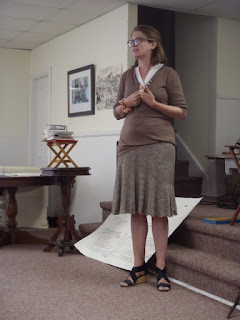


(The business part of the day.)

(l to r) (Life member Lois Bray, our new
Vice President Judith van Duren,
and long-time member Barbara Bell.)

(Emma FitzGerald weaving her tales of Brazil)

(Tea, treats and talk)
Thanks to all who came out to help us celebrate Elizabeth Bishop "In the Village." Go to the EBSNS website to read the minutes of the meeting and the President's Report.Friday, June 17, 2016
Elizabeth Bishop’s Letters to Aunt Grace Part 13: Getting down to business
Even Elizabeth Bishop knew she was “no business-woman.” Her
relationship with money was complex and fraught. She was a fortunate writer in
some ways because she had inheritance from her father, mother and paternal
grandfather. This inheritance provided at least some income for a good part of
her adult life. But she had little interest in managing her finances, perhaps
because she professed to have little ability to do so. Indeed, from her
earliest childhood, until she came of age, her inheritance was managed by her
mother, then her grandfather and then her paternal uncle.
Even with money in hand, and increasing success as a writer
(being published, receiving awards, fellowships and other prizes), Bishop
always seemed to worry about money, about having enough to live on. Her
life-long health issues and their attendant costs were certainly enough to keep
her at least concerned about finances. Though, as she admits in her Depression
era memoir “The U.S.A. School of Writing,” she didn’t really have to work in a
conventional way, until much later life.
Bishop disliked teaching, but in the late 1960s and
throughout the 1970s, she taught because she needed the money. She did
readings, an activity she disliked even more than teaching, for the money. She
sold the Robert Lowell and Marianne Moore letters in her possession in the 1970s
because she needed the money. She was always very direct about this motivation.
In her letters to Grace in the early 1970s, worry about money is a regular
theme, especially as she approached retirement.
Money is even a subject in her poems and stories. Perhaps
her first awareness about money as a force in daily life came in Great Village
during her early childhood. Her memoir “In the Village” contains several
fascinating references to money.

For example, it refers to a five-cent piece Bishop
receives as a gift, with the image of King George V on it. The above image is not of a nickel,
but this gives you the idea. This coin dates 1916, the year of “In the
Village.”
And much later in her life, one thinks of “Poem” where art
and money are directly linked, the little painting having never earned any
money in its life, even though it is the size of an old-style dollar bill.

The "old-style dollar bill" painting by Bishop's Great-uncle George W. Hutchinson.
In her own letters to friends and colleagues, money is a not
infrequent subject. As much as artists want and need to be outside the crass
realm of business and commercialism, unless they are independently wealthy,
artists are often, reluctantly, obsessed with money, or the lack of it.
I have always thought a book, or at least an essay, about
Bishop and money would be well worth the effort and quite revealing. It is a
subject that directly touched every aspect of her life from birth to death; but
it is a subject that seems to be somewhat taboo: too private? too
uncomfortable? too crude?
In her letters to Grace, Bishop wrote about her finances and
business transactions, especially in the 1960s, when Brazil was going through serious
economic upheaval. Such subjects were not central in their dialogue, but they were
present in ways that demonstrates how these issues mattered to Bishop.
In the 5 July 1956 letter to Grace, Bishop tells her aunt
that she is “investing some money here.” She had borrowed from her bank in the
US (I don’t know if anyone has ever figured out what bank(s) Bishop dealt with —
perhaps not much of an issue, but it would be interesting to know) and invested
it in Brazil. The nature of this investment is not revealed in the letter, but
Bishop tells Grace that “interests are fantastically high.” Bishop had help in
this endeavour from “a friend of mine who’s supposed to be a great
money-maker.” The idea was to make “enough to live on here” and “send some more
$$$ back to the U.S.”
Bishop seemed quite sure this plan would work, even though she had “never
thought of doing anything like that before.” She declared that it must be “the
‘Bishop side,’ as Aunt F would say, — the grandpa B side!”

“Grandpa B”: John Wilson Bishop
The Bishop side of her family was decidedly all business.
Her paternal grandfather, John W. Bishop, was a self-made man who had created a
solid construction company in New England,
building landmark buildings such as the Boston Public Library. Grace herself knew the
Bishops well enough and understood their inclination. In her letter, Bishop
declared, “Anything artistic I feel positive couldn’t come from there,
even if my father did do well in high-school.” Bishop’s father, William, might
very well have been the most “artistic” of this family, a well-read, gentle and
thoughtful man, who clearly cared about more than just making one buck and then
another.
Perhaps Bishop’s aversion to dealing with money and finances
came from seeing these forces dominate her paternal side. But even as she
lacked a business acumen, she did have to deal with her “living” at every stage
of her life, and especially so as she aged. I do not know if Bishop's investment paid off as well as she hoped.
The next post will deal with more health and medical
matters.
Friday, June 10, 2016
Elizabeth Bishop’s Letters to Aunt Grace Part 12: The Fear of Flying
The next extant letter for 1956 is dated 5 July, the
promised full response that Bishop mentioned in her postcard. This letter
contains a number of ongoing and new subjects, and the next couple of posts
will focus on them in turn.
Bishop’s dislike of flying was something she mentioned on
more than one occasion to Grace. One of my previous posts introduced the subject of air travel.
Grace’s view of this mode of transportation is unknown, but
it might have been similar to her niece’s because Bishop mentions a recent news
event that clearly unsettled her, something she thought would interest Grace:
“Weren’t those airplane accidents ghastly.” So upsetting were they that Bishop
observed she would not have gone to Diamantina
(a trip she took in April) “after them.”
Of course, I wondered what plane crash had happened, and
thanks to Google and the internet, I learned about a tragic mid-air collision of two aircraft over the Grand Canyon, on 30 June 1956, only a few days before
Bishop’s letter, so indeed a very current event. It was the first airplane
crash in aviation history causing over 100 deaths. 128 people perished.


Commercial transcontinental, transatlantic/pacific flight
was still in its early years, though expanding rapidly. This terrible accident
clearly shocked the world. Bishop noted, trying to lighten what for her was a
dark subject, told her aunt about a painter friend of theirs who had recently
flown to Europe. When, upon arriving, he was
asked how he liked the flight, his said, “It was the longest fright I ever
had.”
Bishop is, of course referring specifically to the Colorado tragedy in her
letter, though it is interesting that she writes “airplane accidents” (plural).
As I searched online, I found a site that lists plane crashes that have occurred
in each year, planecrashinfo.com, and discovered that there were over 50 plane
crashes in the world in 1956, including one on 15 May, when a Canadian air force
plane crashed into a populated area in Orleans, Ontario, and killed over two
dozen people on the ground.
I myself am afraid of flying. Like Bishop, I have flown in
spite of it; but never comfortably. We are told that flying is safer than
driving in a car; but for some reason, it doesn’t feel like that. Well, humans
are quite irrational on many levels. I wonder how many of these 50+ crashes
Elizabeth and Grace heard about in 1956, multiple accidents each month, most
not of the magnitude of the one in Colorado,
but they all added up to a deadly year in aviation.
I am not sure when Bishop’s first flight occurred. From
birth, she was a frequenter of ships and trains, which continued when she began
to travel on her own in the 1920s and 1930s. Her first vivid description of
flight that I have found appears in a journal she kept in August 1951, when she
made a trip to Nova Scotia and Sable Island.
For some reason, Bishop chose to fly, from New York
to Boston and then on to Nova Scotia.
The trip journal begins with a description of this flight,
which seemed to fascinate more than frighten her. On the New York to Boston
leg, she wrote that they saw only one other plane, miles off, and commented in
a way that invokes her poem “Manners”: “It seemed wrong not to hail it, for the 2 planes not to approach
each other & talk over the strangeness of being there at all – It didn’t
seem possible.” The plane landed at an airport in Dartmouth,
“a clearing in the fir woods,” and she took a little ferry across the harbour
to Halifax. For
the Nova Scotia to Sable Island
leg, she boarded the HMCS Cornwallis
(a Coast Guard resupply ship) to make the journey. She approached Sable Island
by sea.
In May
2008, I had the great privilege of going to Sable Island,
thanks to a kind invitation from Zoe Lucas. Along with writer Janet Barkhouse,
we went by air and I felt quite reassured because our pilot was a woman,
Debbie, and very experienced. A regular trip for her. It might have been the
least nerve-wracking flight I’ve ever taken. I wished Bishop had seen Sable Island
from the sky. She would have appreciated its striking appearance way out there
in the vast ocean.

Sable Island by air, May 2008. Photo by Janet Barkhouse

Janet Barkhouse (centre), Sandra (right) and
Sable Island Station Manager Gerry on the South Beach
In her 1951 journal, she was fascinated by the geography
beneath her (the plane flew only 11,000 feet up): “N.S. looked lovely from the air — fresh dark
greens, red outline, glittering lines of rivers — more animated than Maine had
looked — & that amazing cleanness that strikes me every time.” By 1956,
flight was more common, but the skies were becoming more dangerous, too.
The adventure was turning into an anxiety, at least for Bishop.
The next post will look at a subject for which Bishop had
little acumen: business.
Tuesday, May 31, 2016
Elizabeth Bishop’s Letters to Aunt Grace – Part 11: Another Postcard
The next extant communication from Bishop to Grace in 1956
is a postcard dated 3 July, clearly in response to a letter from Grace. Indeed,
the continuation of a series of lost back and forths, since there is a big gap
from the previous letter of January. What happened to all the letters in
between? What we get in this postcard is a glimpse of the continuum, their
ongoing dialogue, but like listening to only one side of a phone conversation.
Bishop packed as much as she could on the verso of this
card. It is amazing how much she managed to type, filling the small space to
the edges. Remember, she did so on a manual typewriter.
She began by instructing Grace to send “some maple syrup”
directly to their post office box in Petrópolis, because “Mr. Liberal has left
customs.” — perhaps someone who helped smooth the way for gifts from the north.
(One wonders what sort of person this fellow was with a name like that!) While
it took longer for mail to reach that destination, Bishop noted that it still
seemed to get through.

Anything “maple” was eagerly and gratefully received by
Elizabeth and Lota. Indeed, Aunt Mary had recently sent “a pound of Red Rose tea” and
some maple sugar. The shipment from Grace was a business transaction, as Bishop
indicates she will be sending a cheque. Grace, however, also begifted such
northern treats on many occasions. And they always triggered vivid memories for
Bishop. July was well past the maple syrup season in Nova Scotia (which is February/March), but
maple products are available year round. Two producers of maple products in Colchester County are: Sugar Moon and Maple Mist.

The verso of this postcard was a view of Glória, Rio de Janeiro.

“Poor Aunt F” is invoked again. It appears that Grace had
finally seen her at some point during this year. Indeed, visited long enough to
be part of a “dinner party.” Grace was gallivanting again. Bishop conceded,
surely based on more reports from her Bishop cousins, that Florence was “getting worse.” Bishop
confessed that she had always stayed away from her “as much as possible,” even
as she “felt rather sorry for her.” Bishop’s biggest objection, declared
emphatically, was that her aunt was a “snob…putting it mildly.”
The item mentioned most briefly in this brief communication
concerned a big subject, Bishop’s health. The correspondence between them
contained many discussions about all things medical and health-related (sadly,
we see only one side of it). This shared interest was of long standing between
them, for all sorts of reasons.
In this particular instance, Bishop tells Grace, “I have a BOIL,
or boils,” one large on her kneecap and “some little ones.” Bishop’s reason for
mentioning this infirmity was: “what do you suggest?” It is easy to imagine
that Grace’s advice was practical and germane, even at a distance. Ever the
person to make a joke, Bishop wrote that she new understood the old saying,
“sore as a boil.”
“How was your trip?” Bishop asked, and promised that she
would “write soon,” asking her aunt where to send her next letter. Bishop did
write very soon after sending this postcard, a long letter dated 5 July 1956.
The next post will begin a pondering of subjects in this epistle.
Tuesday, May 24, 2016
EBSNS AGM, 18 June 2016
Join the Elizabeth Bishop Society of Nova
Scotia on Saturday, 18 June 2016, 1:30 p.m., at “In the Village”
Café in Great Village, N.S. Our guest speaker is Halifax-based
visual artist and architect Emma FitzGerald, who will be speaking about her
artist residency in Brazil
in the fall of 2015, when she visited Bishop’s houses. Her best-selling book Hand-Drawn Halifax (Formac) has been
turned into a colouring book. See the EBSNS Facebook page (https://www.facebook.com/EBSofNS)
to learn more about the society’s activities and interests. Hope to see you in
June!

Tuesday, May 17, 2016
Elizabeth Bishop’s Letters to Aunt Grace – Part 10: Work in progress
"I’m glad you liked the little poem about Pa,” wrote Bishop
in her 18 January 1956 letter to Grace. This poem, “Manners,” appeared in the
26 November 1955 issue of The New Yorker. It doesn’t appear that Grace had a subscription to TNY, so somehow Bishop was
sending them to her aunt. She told Grace that she had “done some more, 3 or 4,”
that is, poems about childhood and children, and hoped “eventually, in a couple
of years, to publish a little book of children’s poems.” She added that another
poem had come out in the 10 December 1955 New
Yorker, “Filling Station,” which she would also send, “you may think it’s
funny. (At least it’s supposed to be.)”

(26 November 1955 cover of The New Yorker)
Bishop never collected and published a book of children’s
poems, but she continued to work on poems that might have fit such a
collection. The poems she directly mentions here, and the 3 or 4 others not
named (likely including “Sestina,” which was published in the 15 September 1956
issue of TNY; “First Death in Nova Scotia,” which was published in the 20 March
1962 issue of TNY; and “Sandpiper,” published in the 21 July 1962 issue of TNY)
ended up in her 1965 Questions of Travel.
As busy as Bishop was helping Henique Mindlin with his book
about Brazilian architecture, and working on new poems, Bishop was, at this
time, well into one of the biggest projects she ever undertook, the translation
of Mina Vida de Menina, a Brazilian
classic. This book is the diary of a young girl who grew up in Diamantina,
Minas Gerais, Brazil.
It had captured Bishop’s imagination and though she knew very little
Portuguese, she embarked on the translation project with enthusiasm. It took
her several years to complete.

Bishop wanted to title this translation “Black Beans and
Diamonds,” but it eventually came to be called The Diary of ‘Helena Morely’, published in 1957.

The author of the diary was Alice Dayrell Caldiera Brant(1880–1970), still very much alive when Bishop began the translation
In letters to friends, she wrote about meeting Dona Alice
and the introduction to the translation is a lengthy essay, which describes
some of her encounters with the latter-day “Helena.” So committed was Bishop to this
project, that she took a trip to Diamantina.
She was disappointed by the mediocre reception of the diary in the US.

(Dona Alice)
Bishop had already told Grace about this project, because in
the letter Bishop notes, “The translation of the girl’s diary is almost
done — about 3 weeks’ more work now.” She told her aunt that a publisher in
England was on board, but she hadn’t “decided on a U.S. one yet,” noting how
different the language in America was from England, which meant “a lot more
work” to make sure idioms were correct: “in the U.S. one[,] I say ‘a can of
candy,’ for example; and in the English one, ‘a tin of sweets,’ etc. etc.”
Bishop eventually went with Farrar, Straus and Cudhay as the
American publisher, agreeing to give them her next poetry collection if they
published the diary.
Bishop was always eager to hear what Grace thought of her
work — poems, stories, reviews and translations. She made sure Grace and her
family had all her books and sought their responses, especially her beloved
aunt’s. She sent Grace a copy of the diary and asked her on a number of
occasions what she thought of it. Grace’s response is, of course, lost. Mina Vida de Menina resonated with
Bishop on so many levels, and she drew directly on her own childhood
experiences to help her translate. She told Grace later on, that when it was
too hard to translate Helena’s
grandmother’s sayings into English, she thought about what Gammie (her maternal
grandmother) would have said in a similar situation, and it worked just fine.
In a small way, Bishop’s translation of the diary was an homage to her own
childhood.

(Pa and Gammie, circa 1920s)
In Part 10, I will write about another postcard, which
introduces a major subject of interest to aunt and niece: health.
Wednesday, May 11, 2016
Elizabeth Bishop’s Letters to Aunt Grace — Part 9: The Babies
One subject that Bishop knew would keenly interest
her aunt was children, particularly babies and toddlers. In the mid- to late 1950s,
the house as Samambaia was a veritable nursery, with several children present
on a regular basis.
In Bishop’s letter of 18 January 1956, she gives an account
of “Lota’s ‘granddaughter’,” Helena, who was the daughter of Lota de Macedo
Soares’s “adopted” son Kylso. Kylso and his wife had several children in close
succession (Helena, Paulinha, Roberto, Lotinha and Patricia). At this point, it
was just Helena and her younger sister. During the late 1950s, these children
spent time with their “granny” on a number of occasions, partly because Kylso
and his family lived in a very small apartment in Rio,
where, Bishop speculated, “they just never go to bed.” January 1956 appears to
have marked Helena’s
first visit, because Bishop is introducing her to Grace.
Bishop observed that she thought Lota was “causing a slight
social scandal” when, in Petrópolis she told anyone who asked, that Helena was “My
grandchild.” “So I imagine,” Bishop wrote, “people are asking each other when
Lota had a child, and if the family hushed it up, or what!” This kind of
speculation was familiar to Bishop because local gossips in Great Village
had said of Arthur Bulmer, Grace's brother, that he “had” to marry Mabel Pigott, though it was
decidedly not true, as their first child was born nearly two years after their
wedding. Being from a small community, Grace would have appreciated Bishop’s
observations on a number of levels, after all, Grace herself had eloped with
the widower William Bowers, a “slight social scandal” in its day.
Bishop told Grace that Lota “would spoil Helena in no time,” thus proving to be “a
real ‘granny’.” Bishop was quite intrigued by Helena, who “is barely three, and so good.”
Yet, “she’s too clean for a child that age — always washing her face and hands,
folding up her clothes and putting them away.” This behaviour made Bishop worry
“a little.” On the trip to Petrópolis, Lota bought Helena
an ice cream: “I came out of a store,” wrote Bishop, “& saw nothing but Helena’s little bottom
sticking up in the air as she leaned over the side of the car to eat it.”
Bishop observed, however, that this spoiling was doing the child good, as she
“is already much fatter and sleeping much more than when she came.”
Helena
was not the first baby to arrive in the household. Lota’s cook had a child on 7
February 1955, the day before Bishop’s birthday. She was named Maria Elizabeth.
As Brett Millier notes, the cook wanted Bishop to be the child’s godmother, but
because she was not baptized, the church would not allow it (Life & the Memory of It, 265). It is
clear from this letter that Bishop had already told Grace about “Betty”
(Millier says she was called “Bettchy”), because she mentions her without much
background, and notes that at just under a year “she already has two teeth…and
is walking a little…pretty good, isn’t that?”

Millier writes, “Elizabeth and Lota supervised the raising
of Bettchy, relying heavily on Dr. Spock.” (265) In the letter to Grace, Bishop
remarks that Lota had studied “child-psychology,” so she had a lot of theory to
draw upon.

(Benjamin Spock himself, 1970s)
Sadly, Bettchy and her parents were gone by 1960 and Bishop
never saw her again. Bettchy’s place was filled in 1961 when Mary Morse (Lota’s
previous partner, who still lived nearby) adopted a baby, Monica. But the
bigger gap was the loss of Kyslo’s family, around this same time, caused by a
rift between Lota and her adopted son. (Millier 266) By 1960, however, preoccupations
with children were quickly replaced by preoccupations with the creation of
Parque do Flamengo, a huge project which became Lota’s true “baby.”

The mid- to late 1950s was perhaps the most conventionally domestic
time of Bishop’s life, and also one of the most creative. Bishop told Grace,
“It’s probably good for us to have babies around.” Elizabeth and Lota seemed
inclined and suited to the roles of aunt and grandmother. They certainly had
definite ideas about child-rearing, which is rather amusing considering they
were never mothers. Grace, on the other hand, was the veteran in this field,
already with a first grandchild and a second one due to arrive that year. It is
sad that Grace’s responses to Bishop’s many stories and theories about these
children are lost. Undoubtedly, they would have been amusing, practical and
insightful. Grace had been such an integral part of Bishop’s own childhood,
right from birth, that it is not surprising Bishop was eager to share details about
their “babies.”
With all these children around, Bishop was thinking a great
deal about her own childhood, and she had begun a translation project directly
connected to the childhood of a famous Brazilian. In the next post, I will look
at the work Bishop was engaged in at this time.
Wednesday, May 4, 2016
Elizabeth Bishop’s Letters to Aunt Grace – Part 8: Ushering in 1956
How long does it take you, in January, to remember to write
the new year, rather than the old one? In January 1956 it took Bishop well into
the first month to make the switch. On the second letter to Grace in the Vassar
folder for 1955 (EBP I, 25.3), Bishop typed “January 18th, 1955.” What she
meant was 1956, as the letter clearly continues the back-and-forth narrative of
the 19 December 1955 letter already discussed in this series. That Bishop
didn’t ink in a correction suggests that it might have been even longer before
she made the switch.
As will be my general method, again, I am going to pick out
various elements of this letter and ponder them in some detail in the next few
posts. Bishop introduces several new subjects (or, rather, continues with ones
that were not mentioned in the December letter — though clearly they are familiar
and on-going topics between niece and aunt). In this post, however, I follow up
with subjects already discussed in previous posts. Bishop ushered in the new
year by updating Grace about these various matters.
This letter was not the first communication written and sent
by either Bishop or Grace. Bishop mentions having written “a hectic little note
the other night,” which she had mailed to Brookline.
But a letter from Grace, written on 9 January and just arrived, informed Bishop
that she was back in Nova Scotia,
staying with her daughter Phyllis: “I am somewhat relieved to hear!” Bishop
wrote, “I didn’t like to think of you off galivanting [sic] with the roads the way they’re apt to be this time of year.”
(One thing clearly evident from their correspondence is that letters between
Bishop and Grace often crossed in the mail, so there was a certain expectation
of delayed reaction. We have forgotten this kind of rhythm in our instantaneous
communication when we are expected to know things before they happen!)
There was a holiday tradition, still in effect when I was a
child, of showing visitors one’s gifts, which were kept under the tree well
into the New Year (on my paternal side, it was until Epiphany). Since Bishop
and Grace were so far apart, Grace did her show and tell in her letter, a list
of the gifts she had received. Bishop responded to this list with, “I read your
last present as ‘two bottles of urine’ the first time.” Perhaps someone can
suggest what this gift might actually have been! Two bottles of wine?

(Not so distant from Bishop and Grace’s 1955
Christmas is
this one from my family in 1959,
with my older sister amid the family’s gifts.)
Bishop also updated her aunt about progress on the
architecture book with Henrique Mindlin. This “enormous undertaking” still
entailed “a staggering amount of work,” for which Mindlin was totally
responsible, “with my ‘editorial’ assistance,” as Bishop described it. She
reported, with relief, that they were “finally getting it into shape.” She said
she had lost eight pounds “so far” and declared “NEVER AGAIN.” She also noted
that the book would be “very de luxe,” and would sell for $12.50 “or even
$15.00” and was “going to be translated into four or five languages.” Bishop
concluded this update with “I’m sure you’re bored to tears” by this subject,
with the defense that she hadn’t been able to think about “anything else for
five weeks now.”
The next update was about Aunt Florence. Bishop had received
a letter from her cousin Kay Orr Sargent, informing that Florence had been difficult over Christmas.
The new apartment was comfortable and spacious, but Bishop felt a nursing home
would have been “better all around.” It wasn’t clear if Grace would be going
back to Massachusetts
to nurse, but Bishop advised that if she did Grace should limit exposure to
“Bishop family fights.” Calling now and then on Florence would be the best approach. Prompted
by Grace’s own declaration, Bishop concluded, “I hate Worcester, too, and don’t
blame you for not wanting to go there — I’ve always thought it was a depressing
city, but maybe just because I have depressing associations with it.”
For good measure, Bishop urged Grace to report the treatment
she had received from Crotched
Mountain Hospital
to the American Medical Association, and hoped that she would “get that pay out
of them.” Perhaps Grace did so. I can’t remember now if future letters refer to
this matter. Time will tell.

(The myth of air travel in the 1950s-1960s)
Finally, Bishop told Grace that Marjorie Stevens was still
“planning to come in March, probably.” Air travel in 1956 was still rudimentary, and the flight to Brazil
took 24 hours. When Bishop and Lota had visited the US in 1952, their return trip was
“16 hours late, so you can imagine what that was like.” Bishop coped by
drinking all her and Lota’s allotment of champagne and cocktails. The myth of glamorous air travel in the 1950s and 1960s did not make its way
into Bishop’s narrative at any point. Indeed, she maintained a dislike of and remained
afraid of flying her whole life.

In the next post I will ponder Lota’s “granddaughter” and the other children in the household at Samambaia at this time.
Friday, April 29, 2016
Great Village colouring book available in May
Nova Scotia artist Andrew
Meredith’s new colouring book, inspired by Great
Village, will appear in Great Village
at the Farm Gate Shop around 9 May, ready for Mother’s Day! It can be
pre-ordered at:

Check out what the MooseJaw Times Herald says about Andre's project. Originally from Great Village, Andrew currently lives in Moose Jaw.

Wednesday, April 27, 2016
Elizabeth Bishop’s Letters to Aunt Grace, Part 7: Keeping track of Grace
Another detail evident in Bishop’s letter dated 19 December
1955, is that Grace was moving around — Bishop’s word for her aunt’s peripateticism
was “galivanting” [sic: Bishop composed
her letters on a manual typewriter, and they contain many misspelled words and
typos, most likely because it was just too difficult to correct them — though
often Bishop inked in corrections].
Grace trained as a nurse in the 1910s and before she was married
held positions in Boston and New York. After her marriage to William
Bowers in 1923, she nursed in Great Village throughout the 20s and 30s; but after she
became a widow in 1947, with her children grown, she hit the road again,
nursing in various places in Nova Scotia and New England. Grace was mainly an obstetrics nurse and
helped to deliver many babies.

(Grace and her nursing colleagues at Boston-Lying-In Hospital, 1910s.
top image: Grace far right; bottom image, Grace centre back row, AUA)
At the time of writing this letter, Bishop had only just
learned that her aunt had left a place where she had been working, a place
called Crotched Mountain Hospital, in Greenfield, New Hampshire, which was
established only a couple of years before, in 1953.
Grace had written to Bishop from this place earlier in 1955
and Bishop, believing her aunt still there, sent a Christmas gift to her, only
to be informed by Grace of her departure too late to recall the gift.
Crotched
Mountain Rehabilitation
Center is a major
institution now (its website is impressive). But in these early days, perhaps it was still finding its
levels because Grace didn’t stay long and, as evident from Bishop’s letter, she
had written to her niece about the issues that triggered the move (Grace was
nothing if not capable, indomitable and determined, so she would have had good
reason for leaving). What these issues were are lost with Grace’s lost letter,
but Bishop’s response was: “I am glad you’ve left. I know I’m rather suspicious
anyway, but I was very much so when you wrote me about the salary and their
going to N.S. for employees — they thought they could get good hard-working
women for nothing, I suppose.”
At the time of this letter, Grace was in Brookline,
MA., perhaps nursing; but she was also
thinking about going to Florida,
where she had never been, and where her niece Hazel Boomer Snow, was living.
Bishop’s response to this idea was: “I really don’t like the state much as a
place to live — I just liked Key West,
the way it used to be.” She refers to “competition” being “pretty stiff,” so
perhaps Grace was looking into another nursing job there. Bishop suggested
Grace go to St. Augustine, St.
Petersburg or Sarasota
to take “care of a nice rich old man!....if you don’t object to that kind of
work.” Grace did spend time in Florida,
though perhaps not at this point. There are images of her visiting her
sister-in-law Mabel and niece Hazel, being a tourist, trips taken after she
finally retired from nursing in the 1960s.
Bishop mentions that Marjorie Stevens was thinking about
visiting Brazil.
Bishop and Stevens had a relationship in the 1940s. Even after it ended, they
remained friends. Stevens went to Nova
Scotia with Bishop in 1947, where she met Grace. They,
too, remained in touch, and Grace eventually visited Marjorie in Florida. Bishop knew
that Grace would be interested in Marjorie’s plan. Bishop noted that “the
flight is awfully expensive,” but since Marjorie worked for the air-force, and
since one of Lota’s uncles “is now Foreign Minister,” they hoped to “be able to
get her trip at a big discount for her.”*

(José Carlos Macedo Soares, 1883–1968, Lota’s uncle)
Grace loved to travel as much as Bishop. When she turned 80
(1969), for example, she went to Chilliwack,
British Columbia, to visit
friends and her cousin Everal Bulmer. Everal had sent Grace photos of “The
Cascades” as early as the 1910s,
which perhaps inspired Grace’s desire to visit. Although it took decades, the
trip finally happened.

Grace spent the early 1970s going back and forth among her
childrens’ homes. Bishop and Grace kept track of each other in their letters
during the 1950s and 1960s. When Bishop returned for good to New England in
1970, one of the first things she did was go to Nova Scotia to see her aunt.
In these days of more than instant communication, it
requires some imagination to understand the pace of this correspondence, the
patience required. By the time news arrived, it often had already changed. Yet,
the leisure of letters allowed each correspondent real space-time to think and move
freely with less insistent, pressing demands than, say, the Facebook,
Instagram, Twitter or texting of today.
********
*Note: It appears that this proposed visit never happened,
though Bishop was still talking about it as a possibility in early 1956. Brett
Millier records no such visit in EB: Life
and the Memory of It. Bishop did visit Stevens in 1957, when back in the US for six
months.
Subscribe to:
Posts (Atom)

 Posts
Posts