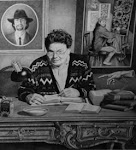
"I am 3/4ths Canadian, and one 4th New Englander - I had ancestors on both sides in the Revolutionary war." - Elizabeth Bishop
____________________________________________

Monday, February 13, 2012

Elizabeth Bishop birthday party, Halifax, N.S., 12 February 2012

On Sunday afternoon, 12 February 2012, a gathering of enthusiastic Elizabeth Bishop fans gathered at the Writers’ Federation of Nova Scotia to celebrate EB’s 101st birthday (her actual birthday is 8 February). In spite of rather unpleasant wintry weather, the atmosphere was warm and convivial. There was the usual wonderful readings by a diverse group of artists, a toast to Miss Bishop and a hearty chorus of “Happy Birthday” lead by our stalwart and melodious John Barnstead, the cutting of the cake and the doling out of door prizes. I was completely surprised by a wonderful and generous gesture of thanks for my small role in instigating and guiding EB100 from the assembled group (along with many who were not able to attend), for which I am profoundly grateful. There was much reflecting on the exciting EB100 celebrations which are still being talked about in Nova Scotia. Many of those present were directly involved in that year of creative tribute to our beloved poet. Thanks to all who braved the city’s icy streets and sidewalks to be part of what is now an ongoing tradition of honouring Elizabeth Bishop’s natal day. Here are a few images from that gathering, courtesy of Susan Kerslake.


The attentive audience


The wonderful readers


Suzie LeBlanc and Jasmine Pannozzo Oddy


The door prizes


Raising our "glasses" in a toast to Miss Bishop


Carol Bruneau, official (and expert) cake cutter


Evidence of indulgence!

Friday, February 10, 2012

Nova Scotia Connections: A Day in the Life of Great Village: Fair and Square, the Provincial Election of June 20, 1916

When big events happen the talk is always lively in Great Village. When the event is politics, villagers are as keen to discuss and debate as anyone. The war has had a strange effect on the provincial election, which was called a few months ago. Some folks worried that it would be too much of a distraction from the war effort, but many felt that it was more important than ever for people to have a say about how they are governed. After all, the boys are fighting in France for this kind of freedom.

The Liberal party has been in power for over thirty years. When Premier George H. Murray (1) called the election, the Conservative party, (2) as you might imagine, were keen to get on the campaign trail and fight a good fight under their leader Charles E. Tanner. (3) The Colchester Co. Conservatives nominated Col. Frank Stanfield and R. H. Kennedy (4) to do battle with the Liberal candidates G.H. Vernon and Capt. Fred B. Schurman. (5) Election day was set for June 20, 1916. As June progressed rallies across the province stirred up excitement and interest, newspapers daily carried advertisements and articles from each party, as well as by individuals and groups wanting to press on all the candidates their concerns about issues. One of the hottest debates was about temperance reform.

The Tory position from the start was to point out the problems of a “Go-as-you-please provincial government (34 years in the Saddle).” The Grits, of course, responded by arguing that this longevity meant experience and demonstrated the trust Nova Scotians had in the government’s policies. The Tories countered this argument of experience and trust with accusations of rampant patronage. The Grits countered by pointing to the Workmen’s Compensation Act, due to become law in October 1916, as evidence that the Murray government cared about ordinary people, not just political “friends.” The debate went back and forth for weeks, while folks attended the rallies, read the newspapers and talked politics on the streets, in their parlours, at post offices, barber shops and general stores.

The people of Colchester Co. take their politics no less seriously than any other place, and that is true of Great Villagers. In Truro the Conservatives held several rallies at the Princess Theatre, the Liberals at the Orpheum. Folks from Great Village regularly drove into town to attend and take their own measure of Messrs Stanfield and Kennedy, Vernon and Schurman, though Capt. Schurman was more or less a candidate in absentia, being away at his war duties for most of the campaign. However, he published several open letters to the people of Colchester County during the campaign, and thus had his say. People were divided as to what the affect both his absence and his war work would have on his chances. He was exhibiting a strong commitment to duty, but not being on the hustings meant that the Liberals were without one of their candidates persuasive voices.

The Truro Daily News had an open door policy to both parties; its pages carried advertisements from both in equal measure ─ its view being that since it is the principal newspaper for the county it must be as impartial as possible. Yesterday, the offices of the News was the hub of activity in Truro, as it was the site for collecting all the information about the results, not only from Colchester Co., but also from across the province. It was the place to be as the evening wore on and it became clear that while Colchester County went with the Conservatives Stanfield and Kennedy, the Murray Liberals were once again re-elected. The Grits would hold the reins of government for at least one more term. The final tally was an impressive one for the Grits:

Provincial Results:
Liberals 31
Conservatives 12
Majority 19

Colchester Co. Results:
Kennedy (Conservative) 2664
Schurman (Liberal) 2154
Stanfield (Conservative) 2756
Vernon (Liberal) 2218

Word spread like wild fire last night as the full picture became clear, though the details followed more slowly. In Great Village and its surrounding communities (Glenholme, Highland Village, Londonderry, Debert, Masstown, Mount Pleasant, Little Dyke, etc.), Messrs Kennedy and Stanfield took the vote but only by slim majorities. Still, it contributed to the overall win for the Tories in the county. However, these gentlemen would take their seats in a sea of Grits in the Legislature in Halifax. What would that mean for the county?

Telephones rang all over the county last night, and as soon as Amelia Spencer got to her switchboard this morning, they began to ring again. Great Villagers one and all wait eagerly today for the Truro Daily News, to read the account of the lively time in Truro:

THE NOVA SCOTIA GOVERNMENT SUSTAINED
The Hon. George Murray has again received the endorsation of his Government and his public policies in all departments by the people at the Polls. The election on Tuesday, though fought in war time, was carried on with much interest and a very large vote was polled all over the Province. There were some surprises as there are in all elections. The Liberal Government will now have 31 supporters in the House of Assembly of 43 members.

Generally, a fare and square election was carried on. There were some appeals that are to be regretted and probably both sides were to blame for these. Where the attacks on personal character was foolishly introduced, the attackers got their answer by a straight condemnation by the people. When will these novices in politics learn that the people take no stock in these personalities on the eve of an election.

Premier Murray is to be congratulated on his victory. The people have spoken out strongly for him and for his further regime, and good citizens all over the province should be satisfied for “Vox populi” is said to be “Vox Dei.”


These general observations were accompanied by a detailed account of the particulars in Truro, and readers always have a thirst for the specifics:

ELECTION RETURNS IN COLCHESTER CO.
As was expected, a rush was made for the Truro News, as soon as the polls closed at 5 o’clock, and the big bulletin board in the News windows were ready for the returns from Colchester Co. The Polls had hardly closed before by telephone came the returns from Five Islands ─ the furthest District from the News office, and yet these returns were the first to be received. Many thanks to the sender; and here we thank very much the Deputy Returning Officers in the county who sent us in prompt and quick returns. We had more trouble in getting the returns from some Polling Districts near Truro, than from those in distant parts of the county. The returns from Upper Londonderry (Debert), and Salmon River and Tatamagouche West were not received without very great exertion on the part of both the News and the Central Telephone.

The figures posted on the News Bulletin Boards soon showed that the Liberal-Conservatives would be elected but few expected such large majorities for Messrs Frank Stanfield and R.H. Kennedy. The losers made a good fight and the candidates themselves carried on a good-natured and fair contest in every way. It is to be said for Capt. Fred Schurman that he put up a fine fight considering the little time he was in the county. He is fighting our battles in khaki and had but little time to consider his own political interests. We congratulate the Colchester winners, and we only wish the Opposition, as long as the Murray Government is sustained, was larger. A strong Opposition always makes good government.

When Colchester was settled, then came returns, largely over Western Union wires, from all over the Province, and the results were such that the cheering Tories in front of the News office by hundreds became sad and silent, and the good Grits began to cheer to “Beat the Band” and crowed louder than the Morning Chronicle’s old rooster, over the glorious results they heard from all over the Province, as the Murray Government was sustained by an increased majority and the “old horse Government” ─ apparently a pretty lively “34 year older” ─ has to bear Provincial burdens for another 4 or 5 years.

Our town returns were either brought in by some of our own Staff, or telephoned in by interested friends, and we extend especial thanks for prompt work. The Central Telephone, the Western Union especially, and the C.P.R. gave as much assistance in getting before the public prompt and accurate returns. The bicycle-mounted messenger boys of the Western Union did their work in fine shape ─ they would make fine scouts for the front, and we can recommend them to Col. Stanfield and Major Innis for fast field work if such are wanted.

By 9.45 the News bid good night to the crowd outside the office building ─ the hundreds departing with the knowledge that the Murray Government had been sustained and that Colchester had continued Liberal-Conservative but by enormously increased majorities.


View of Great Village from Hustler Hill

The dawn of June 21, 1916 ─ the first day of summer, the longest daylight of the year, a breezy, sunny morning ─ brings folks in Great Village much to discuss. As the village wakes up thoughts turn towards the election and the war, towards the many chores and errands, meetings and visits, comings and goings which will fill the day. The day passes in its usual way for most people ─ the Murray Government stays the course, the war continues, the fields are tended, the cows are milked, the clothes washed and tea made. Villagers tip their hats to each other and pause to talk about the recent excitement of the election, about what is playing at the theatres in Truro, about the evening’s missionary lecture. Election fever fades away quickly, when the next telegram arrives at the post office from the War Office.

And inside each house, families live their lives, privately and not so privately. Everyone knows that the wagon crossing the bridge early this morning is a difficult journey for the Bulmers. Will and Arthur Bulmer had taken time to cast their votes yesterday, but their civic conscience was rather distracted by the packing going on inside the house. Gertrude has been so agitated by the election campaign, arguing strongly that women should have the right to vote, hadn’t Manitoba just given them that right!? It was hard to calm her down when she began to talk women’s suffrage, then she’d collapse on the sofa as if she was utterly spent. Will was afraid that she would be agitated again when she heard the results, but she was remarkably quiet when she came downstairs, though she refused to eat breakfast. She already seemed far away. Little Elizabeth knew something was happening, but Lizzie had Mary keep the child occupied outside in the sunshine after she’d had her porridge.

Notes

1. George Henry Murray (1861–1929), barrister, was a member of the Legislative Assembly (MLA) for Victoria Co. from 1896–1923. He was Premier and Provincial Secretary of Nova Scotia from 1896–1923. His services to Belgian Relief during World War I brought to him in 1920 the Grand Order of the Crown of Belgium (Elliott, p. 165).

2. The Conservative party was officially the Liberal-Conservatives, which made for some confusion in the papers. This name was eventually changed to the Progressive Conservatives.

3. Charles Elliott Tanner (1857–1946), barrister, was an MLA for Pictou Co. from 1894–1897, 1900–1908, and again 1911–1916. He was Leader of the Opposition from 1902–1908, then from 1912–1916; and was leader of the Conservative Party from 1909–1916. He was called to the Senate of Canada in 1917, where he served until his death (Elliott, p. 213).

4. Frank Stanfield (1872–1931), manufacturer, was an MLA for Colchester Co. from 1911–1920, and then again in 1925–1930, when he resigned. He became Lieutenant-Governor for Nova Scotia in December 1930, a position he did not hold long, as he died in September the following year (Elliott, p. 208). Frank Stanfield’s son, Robert, became one of Canada’s most prominent politicians. He was an MLA for Colchester Co. from 1949–1967. He was Leader of the Opposition from 1950–1956, and Premier of the province from 1956–1967, when he resigned and entered federal politics (Elliott, p. 208). Robert Hamilton Kennedy (1869–1951), farmer, was an MLA for Colchester Co. from 1911–1920. He was a Captain and quartermaster of the 78th Pictou Highlanders on active service overseas during World War I (Elliott, p. 108).

5. G. H. Vernon and Capt. Fred Schurman never served in the Legislative Assembly of Nova Scotia.

Wednesday, February 8, 2012

Monday, February 6, 2012

Nova Scotia Connections: A Day in the Life of Great Village: Dr. T.R. Johnson

A community is only as good as its citizens, and Great Village is blessed with many fine people. None are finer than the doctor, T.R. Johnson. He is the son of Mr. and Mrs. S.B. Johnson, who came to the Village years ago from Brule, where their son was born. After attending Truro Academy, where he was a top student, Thomas went to Dalhousie University and graduated from the medical school in 1904.

He came back immediately to the area and did a stint doctoring at Economy, but two years later he settled in Great Village and got married. He has been tending to the sick of the Village, indeed to many folks along the shore to Parrsboro, for ten years now.

Being a country doctor is no easy job — the travelling alone is arduous. Though there is an excellent road along the shore, Dr. Johnson often ventures into the mountains and there the going is rough at the best of times. But he goes about his work with enthusiasm and cheer, and a skill which makes him trusted by one and all.(1)

Dr. T.R.’s trusty companion for a number of years has been his magnificent trotter Lord Wallace, which he also races, his best time 2.28. Lord Wallace by Achilles (2.152) won his first race when he was two and a half years old on the track at River John in a five-heat event. Lord Wallace is a small horse, but big gaited, honest and good-headed, and a universal favourite among Dr. T.R.’s racing colleagues and his patients alike. You can say Dr. T.R. is as keen about racing as he is about doctoring.(2) This Saturday he takes Lord Wallace to the track in Truro to run with the other fine trotters in the area. Lord Wallace especially loves ice racing, and has been a consistent winner on the track at Little Dyke.

Ask anyone and they will say that seeing Dr. T.R. driving Lord Wallace is a comforting sight. He also has other race horses and several pure bred Clydesdales on his large farm, which supports his other passion, a prize herd of pure bred Guernseys. The rich milk of the doctor’s herd goes straight to the Great Village Creamery, owned by Mr. T.D. Blaikie. He and Mr. Blaikie have two of the best Guernsey herds in the Village. Mr. Blaikie is also Dr. T.R.’s chief rival in horse racing, though it is a very friendly rivalry.

If all these activities are not enough, Dr. T.R. is also involved in many community organizations and societies, especially the Masons and the I.O.O.F. He is the treasurer for the first and the Noble Grand of the second. Both brotherhoods do much good work for their members and the community generally.(3)

While Dr. T.R. continues to take Lord Wallace on some of his rounds, especially in the winter, in 1910 he moved his practice into the modern age when he bought an automobile. He was one of the first people in the Village to have this means of transportation. Though automobiles are becoming more common, they are still rare enough to cause something of a sensation when they noisily chug through town. Some horses still shy and bolt at these vehicles when they pass by. Dr. T.R. says that at a good head Lord Wallace is faster than any automobile, but he wants to save his pride and joy for the track.


Dr. T.R. in his automobile

On this pleasant late June afternoon, Dr. T.R. plans a run down the shore to Bass River to check on an elderly man who had a bad fall from his wagon last week. On his way home he stops in to see a young wife expecting her first baby in two months, and to see a little girl recovering from a bad case of the measles. Back in the village he visits the druggist to order a new supply of medicine. He meets Dr. Peel Doherty, Great village’s genial dentist, at Layton’s Store, and chats with him about I.O.O.F. business, as they walk back to Dr. Doherty's office. He stops at the post office before heading up Hustler’s Hill to his farm. His wife wants him to take her out to Londonderry Station to meet the evening train heading to Montreal. An old school friend is coming to visit her for a few days. It is a lovely day, not too warm, and the drive will be fine. After an early tea, he heads to the barn to check on the milking and to brush down Lord Wallace. He will take the carriage to the station and give Lord Wallace a good run in anticipation of Saturday’s race. Dr. T.R. is not upset about the drive, even after driving all day, because it means he won’t have to sit through the missionary lecture at the Presbyterian church this evening.

However, before his busy day gets fully underway, Dr. T.R. stops by the Bulmer house rather early. It is a sad call because today Gertrude is going to the Nova Scotia Hospital in Dartmouth. He has known Gertrude for a long time. They went to school together. He was there with Dr. Shatford a couple of days ago making out the papers. He has been to the house a number of times during the past winter and spring because Gertrude has been so upset. The tonic he prescribed for her just hasn’t helped. He was reluctant to write up the papers, but thinks that maybe at the hospital she will get help. Her bad episode last March was deeply disturbing. Her agitation about suffrage hasn’t helped either. He actually feels much the same as Gertie, that women should have the vote. He sees how hard all the women of Colcester County have been working for the war effort. But old ideas are hard to change, and Gertie takes everything so deeply to heart.

He feels sad for Gertrude’s daughter, Elizabeth, a pretty little girl who is quite bright. Dr. T.R. likes to chat with her about her chickens. She likes to tell him about gathering warm eggs.(4) He stops by first thing in the morning to check on Gertrude, to make sure she is calm enough to travel. He is surprised by just how calm she is. He is comforted to know that Grace, who is a capable nurse, is going with Gertrude to the hospital. He spends about half an hour talking with them. He helps Will put the suitcases on the wagon; they chat a bit about old Nimble, the Bulmer’s gentle work horse. Will says he must get Mate to put new shoes on him. They chat about the election. The Dr. is especially enthusiastic because Murray’s Liberals have prevailed in the province, though he would rather have seen a different result in Colchester. Then he gets into his car and heads off up the shore road thinking he will stop in to see Grace in a day or two, as she will be able to give a detailed report on how Gertrude is doing.

Notes

1. Dr. T.R. continued to practice in Great Village until the early 1940s. In 1919 he had a telephone installed in his house, linking him more quickly to his patients. His family grew to include two daughters and three sons. Two of his sons, Aubrey and Arthur, became doctors. Dr. Aubrey returned to the village and practiced there for decades. His third son stayed on the farm and eventually took over operations at the Blaikie creamery. Dr. T.R.’s daughters became teachers and married doctors. It was said that when the family gathered at home it was like a medical convention. Dr. Johnson held the office of the County Medical Health Officer and County Coroner for many years. In 1939 he was elected President of the Colchester-Hants Medical Association and for many years sat on the Executive of the Nova Scotia Medical Association.

2. Dr. T.R. continued to be involved in raising and racing horses. In 1920 the horse owners of Great Village got together and constructed a race track. The Cobequid Driving Club Ltd. was formed with Dr. T.R. as the President and T.D. Blaikie as secretary.

3. Dr. T.R. also had a taste for politics. In 1933 he contested one of the seats in the County in the provincial election. He lost. A life-long Liberal, he was active in the party long after he retired.

4. In February 1917 Elizabeth Bishop was sick with bronchitis, and was attended by Dr. T.R. Years later, she told her friend Frani Blough Muser about one of her encounters with the doctor: “Elizabeth said she always thought that the first time she got the idea of poetry was from a doctor. She was about four or five or something like that. She had the incipient asthma that was going to bother her later. She has suffered from a lot of colds. Elizabeth was in bed with something or other, and the doctor in telling her what was wrong with her or asking her to put out her tongue made a couplet, made a rhyme. It surprised her. She was tiny and she had never heard anything like that. She laughed. Elizabeth said she had never heard something so wonderful in her life. So then she began thinking about words that rhymed.” (Fountain and Brazeau 7)

Wednesday, February 1, 2012

Nova Scotia Connections: A Day in the Life of Great Village: The Post Office and its Postmaster

Angus Johnson is the postmaster in the village. He has been sorting and stamping the King’s mail at the old stand for decades. He took over his duties way back in 1889, helping out now and then as a mail carrier. He’s done the delivery down the shore to Five Islands.

You see, the mail still arrives in Great Village from all directions by coach. Mail from Europe reaches Halifax by steamer and is put on the Maritime bound for Montreal. Mail from all points West travels to Nova Scotia by the Canadian Pacific train. These far away letters and packages reach Londonderry Station and are picked up by Albion Kent, who brings them the nearly four miles to the Village. Mr. Kent is one of the most obliging mail carriers in the county. His father, Daniel, did this route for years before him. The brightly painted two-horse wagon is called the “Ferry.” Mr. Kent will always take passengers for a small fee, 254 a head.

Even mail from Truro makes the trip by team. Though soon, people think, automobiles will replace the trusty horses. After all, Dr. T.R. Johnson has already traded his famous Lord Wallace for a Model T. Mr. Kent, too, bought an automobile a few years ago, but he has not yet turned over his run to it. He says his horses are still more trustworthy, especially in winter.

The post office is a busy place, with mail arriving several times a day; the big deliveries being with the 10:00 a.m. and 4:00 p.m. Halifax bound-trains. Mr. Johnson says that he makes up and opens 22 mails a day. Little wonder, he says, the keys to the mailbags wear out; though he’s had the same keys now for ten years.

Lots of other business is conducted at the post office, money orders being the biggest item. There is also a telegraph service, a telephone and a highly efficient Express Office. All the modern conveniences. Mr. Johnson is also agent for the Nova Scotia Home Underwriters’ Agency. And nearly every week someone stops by to engage his services as an auctioneer. He’s one of the most popular in the area. Mr. Johnson is also a truly civic-minded fellow, active in the Presbyterian church and a long-standing member of the I.O.O.F. He’s always willing to help out with fund-raisers, and finds place in the post office for the notices, posters and fliers announcing the many suppers, concerts, lectures and musicales, which take place not only in the village but all along the shore.

For all the hurry and bustle, it is one of the best kept offices in the Dominion. Now, during war time, mail service is even more important with so many folks waiting for word from the boys training at Aldershot and Valcartier, or those already in England and France. The newspapers also arrive at the office bringing the latest reports on the distant campaigns.

Great Village has had a “way” or post office since the early 1870s. The current building was built in 1903 by Mr. W.E. Adams of Mount Pleasant. It also houses the Savings Bank, though there is talk that the Royal Bank is going to open up a branch here in the Village sometime soon.(1)

The post office is Mr. Johnson’s home away from home. Even his six daughters have regularly helped out, especially Kate; and she’s just as good as her father with all the tasks.

The post office is a gathering place in the village. In the evenings the lads who are not yet old enough to enlist collect here to talk about the day’s events and watch the activity at the Elmonte House across the road. The merchants and farmers stop by after their days’ labours to see what the coaches have brought. Everyone stops to chat with Mr. Johnson, who always has the latest news of the comings and goings. Villagers trust Mr. Johnson to take good care of the precious cargoes entrusted to him, which have journeyed from far and near, bringing news of births, deaths, marriages, and of the war. He is one of the most respected and beloved gentlemen in the community.(2) Though he is 64 years old, Mr. Johnson is hale and hearty, and intends to stay on as postmaster for some years yet, and Villagers are glad about it.(3)

Yesterday was an especially busy day at the post office, because it was the centre for information about the provincial election results. There were even more people around than usual because of the excitement of voting. Several of the lads had motored into Truro late in the afternoon and stayed around the Daily News offices until the polls closed, and came hurrying back around 10:00 p.m. with the news of the Grit victory ─ though the Tories held the day in Colchester.

The excitement of election day over, this morning is still a busy one for Mr. Johnson. The morning’s outgoing mail is heavy with letters and packages for the lads in training and overseas. Mr. Kent is in early to load up the Ferry and be off to Londonderry Station. However, Mr. Johnson is going about his work with more solemnity than is usual for his genial manner. When he opens up the office for business (after the sorting and loading of the Ferry is completed), he looks up at the sound of a wagon coming over the bridge, not unusual in itself. It’s Will Bulmer and his daughters Gertie and Grace. He thinks to himself, “Ah, it’s today she’s going.” As the wagon passes by Mr. Johnson nods quietly to Will. He knows how he would feel if one of his dear daughters was not well. Poor Will and Lizzie. Poor Gertie. He’s known her since she was a wee bairn.

Mr. Johnson wonders how Gertie’s dear little girl will feel, her mother going off like this today. He knows Will and Lizzie are devoted to the child, proud as punch about their bright granddaughter, and will do all they can to comfort her. She is so young that perhaps she doesn’t really understand all that is happening, but with six girls of his own, he well knows how smart little ones really are. Surely, Gertie will get the help she needs and be home soon. Mr. Johnson always smiles when he sees little Elizabeth marching proudly behind the cow when they pass by his house on Scrabble Hill – though that isn’t often because most days he’s at the post office early and leaves late. She is an independent little girl. Mr. Johnson sighs as he watches the wagon trundle off. Every family in the village has trials and troubles these days with the war and so many boys off fighting in the trenches in France, and some of them already never to return. But he knows the hard time Gertie has had since her own Will died five years ago.

When he returns from the Station, Will stops in for the mail and Mr. Johnson chats with him, tries to cheer him up talking about the lively election.

Notes

1. A branch of the Royal Bank opened in Great Village in 1919. The building which housed the bank still stands in the Village, near the Presbyterian church.

2. So beloved was Angus Johnson that in 1930 one of his old friends, Mrs. Peter Hall, composed a poetic tribute to him รก la Robert Burns, and in 1933 he was honoured by a large gathering in the Presbyterian church:

God'’ blessing on ye Pastie man,
Ah Angus ye’er a prince o'man
To sort like you─
A bonnier lad I dinna ken.
God bless ye mon.
...
Ah, Angus, Ye’er a lad o’pairts
Master o’ a’ the winsome airts.
Ye’er deeds by a’ ye’er ain desairts
Will live for aye.
The benediction o’ oor hairts
Ye hae the day.

3. Obituary (Truro Daily News) ─ Angus Johnson died July 12, 1935, in Great Village. Born in River John in 1852, he lived for the last 61 years in Great Village. Mr. Johnson was a public-spirited man, keenly interested in the welfare of the community, and for 34 years he was postmaster there. He is survived by his wife, Mary MacLeod, daughter of the late Robert MacLeod, and by four daughters, Miss Florence of Toronto; Mrs. Neil MacLeod of Cochrane, Ont.; Mrs. James E. Dykens of Upper Economy, and Mrs. Donald Patriquin of Great Village; also by four sisters and one brother. He was predeceased by two daughters. The service at the house was conducted by Thomas Lamot, student minister of the Presbyterian Church, assisted by Rev. Mr. Kirker of the United Church. At the grave the service was in charge of the I.O.O.F. lodge, of which Mr. Johnson was a member for over half a century.


View of Great Village. Angus Johnson's post office is tucked among the buildings on the left; Hustler Hill and the road to Londonderry Station on the right.

Saturday, January 28, 2012

Nova Scotia Connections: A Day in the Life of Great Village, 21 June 1916: Introduction


Great Village seen from the top of St. James United Church

Elizabeth Bishop’s memoir “In the Village” is both deeply personal and transcendently universal, an expression of private, intimate experience and an evocation of the joy and pain that resonates for all of us. It stands alone, ultimately, a self-contained world, drawing a moment in time in astonishing, beautiful detail.

As a poet, I am content to leave it be. As a biographer and historian, however, my curiosity gets the better of me and I want to know more about the foundation, the sources, of this masterpiece. After all, Bishop said of it that it was plain facts, that it actually happened, that all she did was compress time a little. I am compelled to dig deeper not to detract from its sublime wholeness, but to link it more fully to its origins, to understand more broadly what the world was like at that moment in time and what caused the events to happen and allowed Bishop to write about them so movingly.

“In the Village” is, in the end, about the child Bishop was in 1916, when the events happened (even if it is the adult remembering that child and re-imagining, re-creating, re-envisioning her).The other person, though, who was central to the experience and who remained a force in Bishop’s life, was her mother. Bishop searched her whole life for the sources about her mother (within herself and in the world) – her mother always remained a part of Bishop’s life.

I have spent a great deal of time thinking about Bishop and her mother and what Great Village was like for them in the mid-1910s. My thinking led me to an idea of re-imagining “A Day in the Life of Great Village” – a day of great significance to both Bishop and her mother: the day Gertrude Bulmer Bishop went to the Nova Scotia Hospital. We do not know the precise day she boarded the train at Londonderry Station (or, perhaps in Truro) and went to Dartmouth, but we know it was late June. I imagine it was 21 June 1916 (the summer solstice), a date probably very close based on evidence found in documents connected to Gertrude’s hospitalization.

Many years ago, having pondered this day for some time, I decided to write a series of vignettes about Great Village, “A Day in the Life” – set on that day – to create a sort of narrative describing the people who lived “in the village,” and the activities that would have been happening in the community. I did nothing with these vignettes, so I have decided to dust them off and post them on the blog. My aim is to post one a week, for the next several months. Slowly, “A Day in the Life of Great Village” will appear and gradually the story of that day will unfold. Stay tuned!

Monday, January 23, 2012

Sunday, January 15, 2012

First Encounter XXXVII: A Poem by Anne Shifrer

Elizabeth Bishop Scholars Tour Great Village

Bleeding heart, buttercups, and big red-orange poppies
with black, hirsute centers. Sylvia Plath would see them
as hairy tarantulas sizzling on hell flames,
so would Jonathan Edwards. What would you see,

Elizabeth? — something more subtle, the forget-me-nots
tucked in a corner like tiny blue buttons on baby clothes?
wild roses lapping the breeze or the lupins, tangled
in weeds but still standing tall? We all speak your language

so, of course, we say to each other, “lupins like apostles,”
one of your images that startles because you so rarely
permit yourself such grandiloquence. And we all see it,

the strange aptness — yes, lupins line the village roadways,
tall, prophetic silences like the pencil-thin apostles on Chartres,
especially at evening, gathering crystals from the fog.

“Apostles?” You were so much more the stoneworker
Ghiselbrutus – folk-artist donkeys chiseled
in small unexpected places on the cathedral.

Your village is much the same, Elizabeth, it lasted
longer than you hoped, well past your abidance.
But much has softened, the steeple which held
your mother’s scream now has iron curlicues
that look like cartoon-eyes of an owl or the spectacles
of Groucho Marx. It’s no longer sharpened
by irredeemable pain. All of that is dead now.

Our reluctant tour guide, the shy, brilliant fellow
from Britain leads us around quite aimlessly, wondering aloud
what we would like to see. Everything is, as you might expect,
connected only by “and” and “and,” and, just as you said,

nothing coheres. Your animals do not arrive to gather this family
of word-buffs into holiness. But we are, somehow, a family,
an odd dysfunctional one, as we amble along quoting your poems
at salient moments and laughing, as we walk around and around
trying to make our stumbling your whole biography.

Sometimes, I think that each of us is crying somewhere
inside — for you, Elizabeth — for all the ways
in which you couldn’t connect, for all the ways
in which happiness failed you, crying for you,
with you, because look how your world is still here.

Anne Shifrer has taught and written about Elizabeth Bishop’s poetry for more than twenty years. She is currently compiling an anthology of poems about Elizabeth Bishop. If you know of such poems in print or have poems of your own, she would be interested in knowing about them. Contact Anne at Anne.Shifrer@usu.edu. {Ed. Note: we will post more about this anthology project as it evolves – stay tuned!)

Sunday, January 8, 2012

Elizabeth Bishop Centenary Arts Festival Banners for Sale

During the Elizabeth Bishop Centenary Arts Festival in August 2011, the Elizabeth Bishop Society of Nova Scotia created wonderful banners which were installed along Highway 2 (from Masstown through Great Village to Five Islands). On the banners was painter Joy Laking’s “Starry Night in Great Village” – a vibrant and celebratory evocation of Elizabeth Bishop’s childhood home. The banners weathered the summer and early autumn quite well and the EBSNS has decided to sell them, a little fund-raiser for the Elizabeth Bishop Centenary Writing Competition book (containing all the winning entries). For more information, contact EBSNS board member Laurie Gunn at laurieegunn@ns.sympatico.ca . The banners are wonderful souvenirs of the lively and memorable arts festival held in Great Village. You can also order banners from the Elizabeth Bishop Society of Nova Scotia website and pay online.


Thursday, January 5, 2012

First Encounter XXXVI -- Moya Pacey visits Great Village

Elizabeth Bishop crossed borders and hemispheres as I have done to travel to Great Village in Nova Scotia from Australia via Europe and Newfoundland to attend the Elizabeth Bishop Centenary Festival and read my short memoir : “My baby brother is born tonight.” It won First prize in the Open Section of the Elizabeth Bishop Centenary Writing Competition. I can hardly believe I am here in Bishop’s childhood home and tonight, I am alone in the house sitting at the desk reading a manuscript of Bishop’s that Sandra Barry has left with me. The house quietly settles as I listen to a concert from Montreal on the radio. I feel perfectly at home–as if I’ve entered an EB bubble…

The number on the white wooden front door of the Bishop House in Great Village, Nova Scotia is 8740 and there is a capital B wrought into the metal plate fixed to it securely. The house is a surprise. From the road it looks small but inside it opens out and becomes a home not a museum. Bishop’s life and works are everywhere including quirky personal items: a blue coffee pot resting on the old stove, a pair of hickory across-country skis leaning up against the wall of the utility area, a purple drinking glass from Brazil, ornate and heavy, and a red calico fancy shoe bag that Bishop brought from the US across the border into Canada, on one of her frequent visits to her Aunt Grace in Great Village. It contained a piece of raw beef, bleeding blood into the heavy red cloth, for Aunt Grace to cook for their supper.

Art works and photographs crowd the walls including one of Elizabeth aged about four or five-years old smiling out at me. She has a pudding bowl haircut and wears a sailor suit with the tie knotted awkwardly around her neck, but in her Vassar portrait nearby, her smile is less forthcoming and her tie is carefully knotted. Great Village was the centre of Bishop’s childhood universe potent with memories. In her Vassar Year Book she gives Great Village Nova Scotia as her home. “Home made home made aren’t we all” is inscribed on her memorial tablet at St James church.

On my first night, rain falls on the house, but for the rest of my stay it is warm and steamy. I choose to sleep in Bishop’s bedroom, at the front of the house, (how could I not?). It is a child’s room with a single bed pushed up close under the slanting blue wall. Linoleum covers the floor, and there’s a cotton quilt with carefully patched eight-pointed stars all askew like the room itself. Bishop remembered it tilting. Above the bed there’s a small skylight window fixed shut, (once it was kept open by blunt-ended scissors). I catch glimpses of the starry night sky outside and on the night before I leave the Milky Way and the Plough are so close they seem to be in the room with me.

Across the road from the house is “The Esso Station” (now Wilson’s) but no, “dirty dog, quite comfy lying on the wicker sofa,” lies there now. The antique shop next door to the house was once the L.C. Layton Store. Meredith Layton tells me that her family remember going to help Gertrude Bishop on the day she had her final breakdown, after which she was taken to Mount Hope (the Nova Scotia Hospital) in Dartmouth, and Bishop never saw her mother again.

Upstairs from the window of the “Elsie Baker Reading Room,” a blue fish chair waits along with a tin basin, ‘shiny like the moon’ for a writer to sit and look out of the window that frames St James Presbyterian, now United Church, with its distinctive witch’s black hat spire. Here the Festival events are presented during the three days of non-stop activities which include historical tours, author readings and interviews, writing workshops, and concerts, and lots more.

“Speak to everyone you meet,” Bishop’s maternal grandfather instructed her. It is advice the Festival and I take to heart. And it is this generous hospitality and the good manners and huge commitment from the Bishop community that brings Great Village to life for me. That, and the encounters, chance meetings, and the many conversations I have over the days, I spend there. Encounters, such as the one with Bev the Great Village postmistress who introduces me to Stirling Dick a 92 year-old WW2 veteran, who tells me: he’s looking for a wife and doesn’t know who Elizabeth Bishop is or was and asks me, “Why all the fuss?” I meet sisters Jane and Esther at Anne Simpson’s poetry workshop held at a nineteenth-century, elegant, square, yellow house facing the Bay of Fundy. Afterwards, I am invited to share Jane’s birthday picnic with them in the grounds of St James church and I eat Willy Krauch’s smoked salmon for the first time. It’s famous and I am told that Pavarotti asked for it as payment when he sang at the Dalhousie Arts Centre in Halifax. I meet another local, Maxine Ryan, on a buggy ride around the village and she invites me to her home and gives me dinner and I see my first-ever humming bird in her garden. I meet Carmel Cummings, the Irish poet from Kilkenny, who’s staying at the eerily Gothic mansion, The Blaikie House, up the road. Laurie Gunn’s husband speaks so eloquently and movingly on the theme of “Home” at The Old Time Sunday Church Service that I find myself teary (and not alone either) because I’m kept busy dispensing tissues to my companions in the pew with me. Afterwards, at the blueberry tea, Barb and Sandy who seem to be everywhere during the Festival helping out, are beaming in their blueberry hats and their hunt for the elusive “blueberry grunt” recommended to me as “a must have treat” by the ladies from Truro at my table, is hilarious.

When it’s time to leave Great Village, I feel as if I don’t want to cross the iron bridge that “trembles” over the Great Village River where the water runs fast and brown. I am reminded that Bishop didn’t want to either on her way to the post office carrying a brown paper parcel, packed by Gammie with treats for her mother addressed to: “Gertrude Bishop at the Hope Sanatorium in Dartmouth.” But I must return home and leave the EB bubble and all those who were there inside it with me. Sandra Barry, the most generous of hostesses and a wonderful ambassador for the Elizabeth Bishop House and Great Village, Suzie le Blanc whose singing of Bishop’s poems set to music was sublime, Don McKay’s reading of Bishop’s “Sandpiper” at the house, Rosaria who came and spoke quietly to me about poetry on the back porch of the Bishop House are just a few of my many memorable encounters.

As Sandra drives me out of Great Village, I catch a glimpse of Aunt Grace’s house where Bishop caught the bus to New Brunswick – the journey which became after thirty-one years the poem, “The Moose.” She turns the car towards Halifax and leaves Great Village resting on the Bay of Fundy where the “Atlantic drains/rapidly backwards and downwards.” I’ve witnessed its fifty-three feet tides bigger than a four-storey building and its destructive carving through forests, “See those fir trees are not long for this world.” On the beach, Sandra points out a sandpiper looking like a grey stone. Others rise so fast I miss them. I see: “millions of grains… quartz grains, rose and amethyst”– and Sandra finds and gives me two blue stones. As I write, they are sitting on my desk at home in Australia, next to the pen holder complete with “moony Eskimos” stencilled on its surface. These are keepsakes redolent with the memories of my first encounter with the Elizabeth Bishop House in Great Village, Nova Scotia and with the Elizabeth Bishop Centenary Festival but so potent is my first encounter that I do not need these objects to enter once more into that EB bubble. I have only to open Bishop’s poems and prose to cross over and enter: “I recognise the place, I know it…”

{Ed. Note: It was a great pleasure to meet Moya. We could not have had a better winner in the Adult/Open Category of the Writing Competition. She entered into the Arts Festival with gusto and spirit, and became part of the village instantly. We hope she will be able to cross hemispheres and visit us again. Click here to read some of her poems. The Elizabeth Bishop Society of Nova Scotia will be publishing all the winners of the Writing Competition, so you will be able to read Moya's wonderful memoir story eventually -- we will post a notice when that book is published. It looks like that will happen in 2013.}


Moya and Sandra at the Elizabeth Bishop House, August 2011. Photo by Carmel Cummins

Saturday, December 31, 2011

All Good Things Must Come to an End...

... and so today's "Today in Bishop" is the last one of the centenary year and, for the time being, the last one. My thanks first of all to my co-hosts, Sandra Barry and Suzie LeBlanc, who have headed the effort of so many, many people throughout Nova Scotia to make EB100 such an enormous success, and then to you, our faithful readers, for all your interest, encouragement, and support.

Finally, I am grateful for Elizabeth Bishop and for her work, which has given me so much to ponder for so many years. Here, in parting, is EB's translation of a poem by Octavio Paz. -- JB

January 1

The year's doors open
like those of language,
toward the unknown.
Last night you told me:
tomorrow
we shall have to think up signs,
sketch a landscape, fabricate a plan
on the double page
of day and paper.
Tomorrow, we shall have to invent,
once more,
the reality of this world.

I opened my eyes late.
For a second of a second
I felt what the Aztec felt,
on the crest of the promontory,
lying in wait
for time's uncertain return
through cracks in the horizon.

But no, the year had returned.
It filled all the room
and my look almost touched it.
Time, with no help from us,
had placed
in exactly the same order as yesterday
houses in the empty street,
snow on the houses,
silence on the snow.

You were beside me,
still asleep.
The day had invented you
but you hadn't yet accepted
being invented by the day.
--Nor possibly my being invented, either.
You were in another day.
You were beside me
and I saw you, like the snow,
asleep among appearances.
Time, with no help from us,
invents houses, streets, trees
and sleeping women.

When you open your eyes
we'll walk, once more,
among the hours and their inventions.
We'll walk among appearances
and bear witness to time and its conjugations.
Perhaps we'll open the day's doors.
And then we shall enter the unknown.

Cambridge, Mass.,
1 January 1975

A Christmas Present from Japan

Christmas Eve brought me in the post a beautiful gift from Elizabeth Bishop's devoted translator into Japanese, Michiru Oguchi: an album of photographs she made during her visit to Nova Scotia for the University of King's College conference "It Must Be Nova Scotia: Negotiating Place in the Writings of Elizabeth Bishop." I'd like to share it now with you.

[To enlarge the pictures, first click on the image; when the slideshow version appears right click on that image and select "view image"; then click on the resulting image to obtain the enlargement. -- JB]


Friday, December 30, 2011

EB100 comes to a close

As 2011 winds down, it “behooves” us (as Elizabeth Bishop might say) to acknowledge the wonder and delight of the Elizabeth Bishop Centenary celebrations held not only in Great Village, Halifax and many other Nova Scotia communities; but also in Worcester, Boston, New York City, Ouro Prรชto, and many other far flung places. The tributes to Elizabeth Bishop have spanned art forms and have involved an astonishingly wide range of artists from many disciplines. One of the things this comprehensiveness shows is Elizabeth Bishop’s significance. The degree of lively, imaginative creativity bespeaks an influence which proves Bishop’s life and art are generative forces. Do we not believe that when her bicentenary rolls around, people will still be reading “In the Village” or “The Moose”? Surely, it is not saying too much to suppose it will be the case. Not only have many artists paid tribute to Elizabeth Bishop, the many events that have taken place drew good audiences throughout the year. In Nova Scotia, the extensive media coverage EB100 received has, we feel, brought her name to many more people than had previously been aware of her, and introduced many to her art for the first time.


Elizabeth Bishop Centenary exhibit, Truro Library, Truro, N.S.
Photo courtesy of Linda Shears


Though we have not yet decided just how we are going to proceed with this blog, it will stay active. We have so much backlog of material (video, text, photographs, etc.) to post – but with life being as busy as it is, this work will take time. We hope you will continue to visit the blog as 2012 rolls along, as the years to come will bring more EB activities to announce and feature.


Starry Night in Great Village by Joy Laking

The main reason for this little note is to extend heartfelt thanks to John Barnstead, without whom this blog would not have existed and been as lively and important as it is. John is the heart of this effort – his “Today in Bishop” and “Today’s Video” have been an extremely popular part of the blog. The amount of work it has taken for him to sustain these delightful elements cannot really be described. The EB100 YouTube Channel is also an important feature of this site. I, for one, am immensely grateful to John for his devotion to the blog – because of his dedication and effort, this site is now a must see for anyone interested in Elizabeth Bishop. Thank you, John.

As I mentioned, we will be shifting things a bit as 2012 rolls along, but we will continue to post information and material, which we trust will be both relevant and pleasant. Stay tuned. Happy New Year.


Elizabeth Bishop Centenary Arts Festival banner in front of St. James United Church, Great Village, Nova Scotia.
Photo by Laurie Gunn

Thursday, December 8, 2011

Our New York Correspondent Writes --

“Elizabeth Bishop: Objects and Apparitions” is on view at Tibor de Nagy Gallery, 724 Fifth Avenue, from December 8 through January 21. The exhibition will be celebrated with a reading by poets Mark Strand, Tina Chang, Hallie Hobson, and Susan Wheeler at the gallery on December 13 at 6:00 p.m.; for further information visit tibordenagy.com.

"Sandpiper" -- Pink Dog Productions