"I am 3/4ths Canadian, and one 4th New Englander - I had ancestors on both sides in the Revolutionary war." - Elizabeth Bishop
____________________________________________

Saturday, May 19, 2012

Nova Scotia Connections: A Day in the Life of Great Village: Coming and Going, Travellers


It is a truism among folks in Great Village among most Nova Scotians that as much as they are content to stay at home, as dear as home is, so too are they eager to travel, to see the world and all its strange sights. There are folks in the village who have lived here their whole lives, never venturing beyond Truro or Parrsboro (they are just as content for that); and there are many folks who have travelled to far places to settle or just to visit; there are new folks who have recently arrived and plan to make Great Village their home; and always there are stranger passing through. Across Canada and the United States, especially the “Boston States,” Great Villagers and Nova Scotians are to be found in many communities. Sit outside the post office any day in the summer and you will see a pretty large slice of the world go by.

Great Village wharf

No one around here is surprised by all this activity and mobility. People have been coming and going as far back as anyone can remember. Certainly John M. Blaikie can attest to this toing and froing because the wonderful ships he built were responsible for many neighbours and strangers crossing paths on the Great Village wharf. From the earliest days of settlement Great Village was a port: the Port of Londonderry. While lumber and potatoes, fine china and bolts of silk or flannel were the principal cargoes, the ships also carried folks to and from this shore. The port was a direct link to the world, especially in the mid-19th century, when land travel was still arduous. When the railroad finally threaded its way from Halifax to Montreal (indeed, by the late 1870s it spanned the entire Dominion), this mode of transportation began to replace sailing ships as the principal means to leave and arrive. Londonderry Station is one of the busiest spots in the county, often rivalling market day in Truro the hustle and bustle of passengers and freight keeps the truckmen and Mr. Albion Kent’s “Ferry” busy.

More and more automobiles are seen chugging out to the station. They are also seen along all the roads these days. What is still a bit of a surprise is to see a strange automobile arrive at the Elmonte House and to hear that the driver has motored all the way from Fredericton or even Boston! Such journeys are becoming more regular, and many villagers have themselves taken up motoring and long distance trips with enthusiasm; but still most folks prefer to take the train. Some have suggested that after the war a person will be able to get from Truro to Halifax by airplane! That is something most villagers find hard to believe.

With the arrival of the cross-Canada railroad in the late 19th century, which opened up the West, Easterners, including many young men from Great Village, headed off every August on the Harvest Excursions. A special train travels from Halifax, picking up excursionists all along the route. Late in October and early November these young men arrive back home with cash in their pockets, having worked hard, seen this vast Dominion, and met all manner of people. The harvest excursion this year will not see as many young men head off, for they have already departed, or will soon depart, on a more dangerous excursion overseas. The war is taking many of our lads on their first journey. Watching the young men set out on their travels (first to Truro, then to Aldershot or Valcartier, then to England and France), produces mixed emotions among those who wave goodbye: pride in their willingness to do their duty, admiration for their bravery; but already many of them have left never to return, so that watching them depart there is a shadow on many hearts, especially of mothers, sisters and wives.

 Steamships and Railroads, Yarmouth, N.S., 1910

The absence of these young men is keenly felt in the village, but it is, after all, June 21, the first day of summer, and the tourist season is already well underway. This means a steady stream of folks passing through or pausing to enjoy the beautiful views and pleasant weather. The Elmonte House is always busy (for one thing, it has a large regular clientele of travelling salesmen), but in the summer it is positively hectic. Mrs. Smith hires on several extra fellows to help her out in the livery stables, and young ladies to help out in the kitchen and restaurant. There has been a fine hotel in the village since the mid-1800s. Being such a pretty spot on the busy Post Road, which runs along the shore from Truro to Amherst, Great Village has naturally been a stopping place for all kinds of travellers. The Londonderry Hotel was, and now the Elmonte House is a fine establishment the latter’s good reputation extending well past Nova Scotia's border, that tourists come to the village just to experience its amenities: fine service and a fine setting make the Elmonte a popular spot.

Summer also brings home all those villagers who have left and settled elsewhere, but who still have family and friends here. For decades Great Villagers have gone off to further their education or find work; they have settled in far flung places one of the places most frequently chosen is New England, especially Massachusetts. Every summer these teachers, nurses, factory workers, accountants, clerks, doctors, lawyers and musicians return to visit their old haunts. This summer migration has been happening for as long as anyone can remember. And this summer folks expect an even busier time. With the news of the war filling the front pages of every newspaper, ex-villagers want to reconnect with family and friends. Visiting Great Village is a tonic at any time, but in war time it is even more comforting to the extensive diaspora.

Just as the scattered flock of villagers return home in the summer, for a few weeks’ or months’ vacation, so too do villagers themselves head off on vacation. The reverse is often the case here, villagers head to Boston or New York to spend a few weeks with family or friends in the “big city.” Combine all this long distance migration with the daily toing and froing, and the bustle is quite something to see. Looked at from a distance, on a summer day, the village is like a bee hive, people constantly coming and going. The hum is amazing.

The village hosts guests for many reasons. Lecturers, musicians and travelling theatre companies often pass through. Sunday School Conventions and Teachers’ Institutes are regularly held here, bringing teachers from across the province. The many societies in the village also bring in visitors, sometimes in large numbers, from near and far: the Masons, the I.O.O.F., the Foresters, the Sons of Temperance, the W.C.T.U., and the Mission Bands all have district or provincial meetings in Great Village. One and all enjoy the village so much that it is anticipated many more such gatherings will be set for the months and years to come. It is hard to keep track of everyone appearing and disappearing!

Some journeys though are not lively vacations, purposeful business or acts of patriotic duty. The early morning wagon ride of William Bulmer and his daughters Gertrude and Grace is a solemn one. Their wagon trundles through the village stirring into another busy day. They head out to Londonderry Station. The train which stops to drop off and pick up passengers carries the sisters to a sombre appointment in Halifax. Every traveller has a story, and the people come and go in Great Village carrying their stories with them. Some people want to return, some don’t, some never do whether they want to or not. William Bulmer arrives back in the village as the sun is getting hot overhead. He knows what it is like to travel long distances. He remembers his long-ago trek across the Cobequid Mountains when he was a lad. He did that on foot. He remembers his sojourn in Pennsylvania before deciding finally to settle in Great Village. He never regretted that decision. He has watched his daughters go off to the Boston States and build lives for themselves. He has welcomed their return visits. Today he hopes that his dear Gertie will soon journey back home again, well and happy. In the afternoon he climbs aboard Arthur’s wagon and rides out to Glenholme with him, to help install a furnace. This trip has nothing attached to it except practicality, but he likes spending time with Arthur and the young lads who come along.

Several times a week, the columnist for Great Village gives an account of the doings in the village in the Truro Daily News. In the summer the comings and goings of friends and family fill this column. The lists have already started to grow, but Gertrude Bishop’s departure is not noted:


Newsy Notes from Great Village (Truro Daily News):
Mrs. George MacLellan and daughter Annie of Five Islands have been visiting Mrs. Bamford Johnson for a few days. Miss Annie left on Thursday for Calgary where she will make an extensive visit there with relatives.
Mr. and Mrs. Newton, Somerville, Mass., are visiting the latter’s parents Mr. and Mrs. David Spencer.
Miss Adela Fulton of Boston is visiting with friends and relatives in our village.
Miss Lula Creelman of Ottawa is the guest of her cousin Miss Belle Hill.
Mr. Cameron of the firm A.C. Cameron, Amherst, spent Sunday with Mr. and Mrs. Angus Johnson.
Mrs. Tupper of Willow Street, Truro, is visiting her daughter Mrs. Garnet.
Mrs. Horace Cummings and young son Robert of Chelsea, Mass., are visiting the former's parents, Mr. and Mrs. Albion Kent.
Mr. and Mrs. Arthur Mahon and family are spending a few days at the home of Mr. Mahon’s parents, Capt. and Mrs. J.A. Mahon.
Mrs. Charles Neal and daughter Ruth of Revere, Mass., are visiting Mrs. Neal's parents, Mr. and Mrs. Allen Peppard.
Mr. Roy Spencer is home from the West for a vacation.
Mrs. Kent, who spent a few days with her son, W.W. Bowers, returned to Dartmouth last week.
Miss Aggie Spencer, who has been teaching in Vancouver, is spending her vacation with her mother, Mrs. Carrie Spencer.
Mrs. Dr. Johnson returned home last week after visiting in Tatamagouche for some weeks.
Miss Clara Kent of the firm L.C. Layton & Co., is having her vacation.
Miss Florence Johnson of the Amherst Boot and Shoe Co., has returned to Amherst after having spent two weeks with her parents, Mr. and Mrs. Angus Johnson.
Mrs. Douglas of New York is visiting at the home of Mr. And Mrs. William Smith.
Little Miss Hazel MacDonald of Pictou is spending her summer holidays with her grandmother, Mrs. Louisa Corbett.
Pte. Frank Peppard, who was home visiting his parents, Mr. and Mrs. Cyrus Peppard, “The Willows,” has returned to his duties at Valcartier, Quebec.
Mrs. J.G Millward (née Miss Alice Corbett) is home from the States with her daughter Mary, and is visiting her mother Mrs. L.D. Corbett.

And so it goes, back and forth like a weaver's shuttle. Great Village is a departure and a destination, like countless other communities in Nova Scotia, and across this wide Dominion. Time is a tide which takes people away and brings them home.

Friday, May 18, 2012

Great Village (the novel) wins an Atlantic Book Award

Mary Rose Donnelly's wonderful novel, Great Village, published by Cormorant Books of Toronto in 2011, received the Jim Conners Dartmouth Book Award (Fiction) at the Atlantic Book Awards ceremony held in St. John's, Newfoundland, on 17 May 2012. The Elizabeth Bishop Society of Nova Scotia held a launch for this novel at the Elizabeth Bishop Centenary Arts Festival in Great Village in August 2011. Needless to say, I highly recommend this book, as it evokes Great Village vividly and is also just a really good story. Congratulations to Mary Rose!

Friday, May 11, 2012

EB Reads at Harvard

Here is a link to two readings Elizabeth Bishop gave at Harvard, one in 1947, the other -- in memory of Robert Lowell -- in 1978:

http://hcl.harvard.edu/poetryroom/listeningbooth/poets/bishop.cfm#

Thursday, May 10, 2012

Nova Scotia Connections: A Day in the Life of Great Village: Business as Usual, Almost

War is a strange business. The war now raging in the trenches in France has taken away many of the young men of Great Village, and of countless villages, towns and cities across the Dominion. Their absence leaves a gap, an emptiness, which can only be filled by their return ─ and already the village knows of lads whose spaces will never be filled again. But the war has not slowed Great Village down. Duty and necessity have, in fact, sped everything up, just as automobiles are speeding up travel for more and more folks. Great Village has been a prosperous village for longer than its residents can remember. Even Mr. John M. Blaikie, one of the oldest citizens and businessmen, says that Great Village's prosperity is perennial.(1) The war has not diminished this circumstance in the least. Business is good for merchants and manufacturers alike, not only in Great Village but throughout the country.
 
The Laytons and Hills operate the largest mercantile businesses in the village, but several other shopkeepers make a decent living. Mr. W.W. Peppard, general merchant, offers groceries, dry goods, stationary, hardware, boots and shoes. Greta A. Blaikie, John M. Blaikie’s granddaughter, carries on the enterprising tradition of her family in her grocery and confectionary store. The children love to stop by Miss Blaikie’s store after school. She offers a full line of groceries and sweets, including the famous Moirs chocolates. Miss Blaikie also sells school supplies to the scholars, though they are usually not as interested in this merchandise! For the scholars’ fathers she offers tobacco, cigars and cigarettes.(2)

 Royal Bank, Great Village

Miss Blaikie is not the only lady merchant in the village. Miss Amelia Spencer operates in ice cream parlour and candy store in her home. It tugs just as hard as Miss Blaikie’s shop at the sweet tooth of Great Village children. The telephone switchboard is also located in Miss Spencer's dining room, moved there just before the Londonderry Hotel burned down at the end of the last century.(3)

Not all those who have goods to sell do so in a shop. Fergusson Davison is the agent for Rawleigh Products, those specialty medicines, toilet articles, spices and extracts, disinfectants and insect poisons every housewife needs in her cupboards. Mr. Davison is ready to drop by any home to demonstrate his wares ─ just give him a call and he’ll come along with his trunks and cases. He spends many hours of his day driving the shore and up into the mountains visiting homes too remote from the centres for regular shopping. He is one of many travelling salesmen who journey the roads and byways of Nova Scotia. Recently, a fellow came through selling products for the Fuller Brush Company. Many of the ladies and gentlemen were keenly interested in the line of high quality brushes and other toiletry items ─ the ample patronage he received here ensures, he said, his regular return.

Great Village is also a busy place for manufacturing, though many of the busiest industries have ceased operating or have moved elsewhere. When Acadia Mines was at its height and shipbuilding was booming, Great Village had several iron foundries. The busiest was Mr. G.W. Blaikie’s Londonderry Stove Co., which operated in the late 1890s and into the early years of this century. Mr. Blaikie’s foundry turned out a lot of stoves and furnaces during these years, helping to keep Villagers and their neighbours warm during long, cold winters. Many kitchens and basements still display Mr. Blaikie’s handiwork; his products were made to last. Mr. J. Moffat Spencer’s stoves can also still be found in the homes of the area. Like Mr. Blaikie, Mr. Spencer had his own iron foundry. His claim to fame is his design for a stove with an elevated oven, a first in the country, he said.

During the 1890s and 1900s, Mr. Ralph Smith was also active in the manufacture of tin and sheet iron. He had his own foundry and trained a number of fellows, including tinsmith Mr. O.C. Layton. What Mr. Smith’s business is most remembered for, however, is a “steam cooker” device which he made, and which he claimed was the "most valuable and most necessary utensil for the kitchen stove." Mr. Smith is not so busy with this sort of work any more. He puts most of his time and energy into the Elmonte House, which is so ably and efficiently run by his wife Sara. Still, Mr. Smith’s “steam cooker” can be found in a few kitchens in the village, still cooking.

Iron foundries have all but disappeared in Great Village and its surrounding communities, except for the work done by the local blacksmiths; but tinsmithing continues to be an active trade. Arthur Bulmer, who apprenticed with Leander Corbett, is the principal tinsmith in Great Village. He is also an agent for a variety of furnaces and stoves, taking up the task of importing what no longer is made locally. Arthur Bulmer's shop is located at the heart of the Village, at the corner where the Old Post Road and the Old Cumberland Road meet. His shop, sitting next door to his home, is the building which for decades housed his father’s, William Bulmer, tannery. Arthur is kept busy turning out tinware (pails, cups, dishes and countless other practical utensils), which can be found in nearly every kitchen in the village, and many homes along the shore. He sells paint and some hardware on the side. But it is furnace installation which keeps him hopping most days. He is frequently seen with several workmen trundling up Layton’s, Scrabble, or Hustler Hills in a wagon loaded with a furnace for some church, school, business or home. Two of his furnaces keep the scholars warm in winter in the Great Village school.


Mabel, Hazel, Arthur and Eleanor Bulmer with their dog

One of the most established and trusted artisans in the village is Mr. C.B. Spencer, a premier harness maker. He started harness making over thirty years ago and his expertise is unquestioned. He knows his work. Though horses still abound in Great Village and the neighbouring communities, Mr. Spencer saw that with the coming of the automobile there could be a dropping off of his business, so he decided to diversify and set up a barber shop on his premises. This shop has become another of the gathering places for the gentlemen of the village. Mr. Spencer has entertained many a lively discussion in recent days about the hotly contested election. In 1912 Mr. Spencer expanded again and began to offer undertaking services, one of those businesses both difficult and necessary. He is such a fixture in Great Village, known far and wide for his fair and thoughtful dealing, that he is assured success at whatever he puts his hand to.

Mr. Spencer’s harness making skills points to an artisan trade and manufacture which has a venerable history in Great Village, but which has more or less vanished: the tanning business. There have been tanneries in Great Village since pioneer days. Back then just about everything used in the home had to be made at home or in the community. Mr. R.D. McKim and Mr. Silas Corbett were the busiest tanners in Great Village in the mid-1800s. Mr. McKim apprenticed a young lad from River Phillip in the 1860s, and in the 1870s that lad, William Bulmer, set up his own tannery at the centre of the village which he operated for decades, one of the last fully operational tanneries in the area when it closed around the turn of the century. Though Mr. Bulmer has long ago retired, his handiwork of fine leather for all sorts of purposes (including many of the harnesses made by Mr. Spencer, can still be seen in the village.

One of the principal uses for the leather produced by Great Village tanneries was boots and shoes. Shoemakers were prevalent in the village in the last century, and though merchants increasingly import footwear made in the far reaches of the Empire, Great Village still has skilled shoemakers, as there are still many folks who believe the best boots are those made by somebody you know. The busiest shoemaker in Great Village is Mr. Alexander McNeil. Shoemaking is in his blood. His father, R.T. McNeil was a shoe and harness maker. In June 1902, after a successful apprentice, Alexander set up his own business almost opposite the Elmonte House. It has been thriving ever since, though he imports most of his leather now. The farmers especially patronize him, as his work boots are second to none.

Since the appearance of the first automobile in Great Village in the last decade, folks have not been behind in the acquisition of these vehicles. Dr. T.R. Johnson, Messrs Albion Kent and Arthur Bulmer, the Laytons, the Hills, the Blaikies, and a number of other individuals have automobiles and trucks for pleasure and business. Motoring has become so common these days that most people take it for granted. With motorized travel came the need for a new breed of businessman. Mr. A.L. Peppard has just opened a Vulcanizing Shop, right across from W.W. Peppard’s store, to service automobiles. Mr. Peppard has always been in demand as the fellow to call on to fix just about any broken machine or tool. It seems natural that he has put his hand to automobiles and has learned how to repair them. He also supplies tires and tubes. Folks call Mr. Peppard the harness-maker of the modern age, supplying the equipment needed to keep the cars running. He also sells gasoline. His principal competition is Jenks’s Garage, which offers its own full line of car accessories, “Dominion” tires and tubes, motor oils and Imperial Gasoline. Some folks wondered about having two such shops set up, but both owners say they have as much work as they can handle.

 Dr. T.R. Johnson's automobile

There are still folks around who mistrust automobiles and believe they are just the latest fad, but the young people point out that if man can now fly, which the war is demonstrating as fully possible, surely automobiles are here to stay. It is the young people one often sees motoring to and fro ─ though none of them has yet outgrown the sleigh ride. Automobiles do not yet outnumber wagons and carriages in the village, but a trip to Truro shows just how prevalent these vehicles have become. On a busy market day the streets are lined with Fords and Chevrolets.(4)

Great Village also has a drugstore, a jewellery store, a busy livery stable operated on the premises of Elmonte House; and its tailor, several seamstresses and milliner are kept busy year round. The blacksmith and dentist, the creamery and lawyer’s office help to fill the town with folks from near and far. Little wonder Great Village bustles and hums on a weekday. As the sun rises this still cool morning, boding another clear warm day, this first day of summer, the village stirs as it usually does, or almost. As the morning passes the streets fill up, and everyone goes about their business ─ the creamery trucks and wagons abound; the lumber wagons trundle through for Mr. Flemming’s busy mill in Glenholme or for the ships that stop at the wharf; the “Ferry” and supply wagons come in from Londonderry Station with mail and imports of every description; the stores, shops, hotel and post office teem with customers; the children run to and from school.

Arthur Bulmer has been up before daylight working in his shop. He has a furnace to install in Glenholme in the afternoon. It arrived on the train yesterday, so he is assembling the tools and parts he needs. Today he also must canvass for the Foresters’ big supper. He can combine both tasks on his way to and from Glenholme. As he goes about his tasks he pauses now and then, takes a dark bottle from under his work bench and takes a drink. A bit early, perhaps, he thinks, but it is going to be a worrying kind of day, and he needs a little fortitude for the trip. He sets off after lunch, taking a couple of the Spencer lads with him and his father to keep an eye on Billy, who insisted on coming. With all that has been going on Art couldn’t say no to Billy. He and Will talk about the election as they trundle along to Glenholme, the lads sitting at the back of the wagon laughing. But they are both thinking about Gertie and Grace, who will be reaching Halifax around 2:30. On the way back Art stops at various houses to get pledges for the supper. Art’s gentle manner is very persuasive, he never presses, and as a result, often gets more out of folks than they expected to give him. Nearing the village everyone stares quietly, admiringly across the fields towards the Bay, shining in the late afternoon sun. No one in the village tires of this view. No matter how many times they see it, they still gaze in wonder at the vast stretch of water framed by rolling hills and shouldering the wide open sky.

 William Bulmer's tannery/Arthur Bulmer's tinsmith shop, foreground

Notes
1. John M. Blaikie would know, as he was one of the principal contributors to that prosperity for decades. On October 20, 1900, the Truro Daily News provided a list of the ratepayers in Great Village for that year: “The population of Great Village is now estimated at about 800, of whom less than 50 are assessed for nearly one half the valuation of Londonderry District No. 16, which includes, besides Great Village, Folly, Little Dyke and Londonderry Station. The total assessment for the district is $204,347.00, of which 48 of the Great Village ratepayers are assessed for over $98,000.00, as follows:

Archibald, Edson $1,160
Blaikie, John M. $10,170
Blaikie, J.A. $2,655
Blaikie, T.D. $1,300
Blaikie, G.W. $2,700
Blaikie, Mrs. Matilda $4,800
Bowers, W.W. $2,550
Burnside, Stewart $1,705
Chisholm, J.H. $2,600
Congdon, Mrs. Susan $2,120
Currie, John $1,090
Davidson, Geo. W. $1,855
Dickson, M.S., MD $1,100
Delay, Thomas $2,025
Fulton, Cap. Isaac $1,650
Fulton, Arthur $8,000
Guild, Stewart $1,000
Hill, Mrs. Sarah W. $1,800
Hill, J. Allan $1,025
Hill, Robert $1,890
Johnson, Mrs. Margaret $1,650
Kent, A.S. $1,850
Layton, L.C. $6,125
Layton, C.W. $1,245
Maxwell, Robert $1,600
McLean, Rev. J. $1,120
McLellan, Hiram $1,200
McLaughlin, Albert $1,275
McLaughlin, Capt. Thomas $1,010
McKim, Isaac O.B. $1,275
Peppard, Allan $2,075
Peppard, John Sr. $1,000
Peppard, John W. $1,150
Peppard, J.S., MD $1,350
Peppard, Mrs. Margaret $1,800
Peppard, Joseph $2,025
Smith, Mrs. Jeremiah $1,000
Spencer, Suther $3,450
Spencer, Grant D. $2,500
Spencer, D.V. $1,000
Spencer, Mrs. Sarah $1,415
Spencer, W.E. $1,950
Spencer, Fletcher $2,000
Spencer, R.A. $1,400
Taggart, John $1,295
Trott, H.H. $1,300
Urquhart, Capt. William $1,310
Yuill, J.M. $1,500”

2. After the war Greta A. Blaikie married Percy E. Doyle, a Five Islands man, who settled in Great Village and opened a store opposite the Royal Bank, a store they operated for decades.

3. Elizabeth Bishop had vivid memories of Amelia (Mealy) Spencer'’ store. In “In the Village” she recalls, “Mealy has a bell that rings when you go in so that she’ll hear you if she’s at the switchboard. The shop is a step down, dark, with a counter along one side. The ceiling is low and the floor has settled well over to the counter side. Mealy is broad and fat and it looks as though she and the counter and the showcase, stuffed dimly with things every which way, were settling down together out of sight” (Collected Prose, p. 268). 4. An example of how central automobiles had become in daily use in the province in the 1920s was Mr. Edward G. McColough, owner of J.J. Snook Ltd., wholesale hardware, in Truro. Mr. McColough lived in Great Village and must have been one of the province’s original commuters. He drove the eighteen miles to Truro every morning and returned every evening. It was said that people set their clocks by his car, and many along his route thanked him for a drive to Truro.

Saturday, May 5, 2012

Nova Scotia Connections: A Day in the Life of Great Village: A Modern Age


With the coming of the war, most folks in Great Village, like most people throughout the Dominion and Empire, sense that the world is changing, that they are entering a new age, a modern age. The sensation is not entirely unfamiliar. Indeed, at the turn of the century, and especially with the death of Queen Victoria in 1901 (ending the longest reign of any monarch in British history), people began to expect change as a matter of course. Many folks recognize this change in the forward march of industry and technology. New-fangled inventions are coming along with increasing frequency, marvellous machines which are changing the way folks live their daily lives, entertain themselves, communicate and travel.

Some of the change has been recorded in photographs. Photography has been around for decades. It is such a common matter that most people take it for granted. Many folks not only go to the photographic studios to have portraits done J.E. Sponagle(1) in Truro is one of the best and busiest professional photographers around but more and more people are taking to the lens themselves, carrying cameras around with them, recording their daily lives.(2)

Barely a decade ago these pictures began to move and in the few years since the first motion picture show arrived in Halifax (Edwin Porter’s Wormwood’s Dog and Monkey Theatre set up shop in 1897), most of the larger towns in Nova Scotia quickly built cinemas. Truro’s Princess and Orpheum Theatres are among the busiest places in town and show a steady stream of motions pictures. The world opens up in new ways to the cinemas’ patrons, and the theatres are crowded nearly every night, except on Sunday, of course.

Motions pictures are not the only wonder of new entertainment technology. Though they may never be as common as pianos, gramophones and phonographs are gaining popularity, especially among the young people. With their love of music Great Villagers have been quite interested in this new mode of listening to favourite songs. The heavy cylinders, and most recently, thick flat discs, are also introducing new kinds of music. Many of the older folks look askance at the noise of what is called jazz and swing, but the lads and lasses seem to take to it. Some people are even suggesting that it won’t be long before motion pictures will merge with recorded music and voices!(3) Imagine, talking pictures!


Telegraph communication appeared in Nova Scotia in the late 1840s, and the telegraph poles and lines have stretched from Truro along the shore to Amherst and beyond for decades. The wonder of Mr. Marconi’s experiments in wireless telegraphy excite many people as much as Mr. Bell’s invention of the telephone.(4) But for now, the hum of the telegraph wire is still heard by the farmers as they trundle along the road in their hay wagons. The telephone has long since vanquished the strangeness of hearing a real voice without seeing a real person, but even so, some of the old folks in the village mistrust such disembodied voices, and feel that the proliferating poles and wires in town are ugly. Many others, however, see them as markers of progress, show that Great Village is not behind the time, which is moving so quickly into a modern age.


The first telephone system in Nova Scotia appeared in the late 1870s. Great Village was not too far behind (villagers like to claim that they are never far behind in adopting any good advance), a system being set up in the late 1880s. For many years the local switchboard of the Central Telephone office was in the Londonderry Hotel. It was moved to Amelia Spencer’s house just before the hotel burned in 1898. Miss Spencer continues to connect up folks, a growing number of which sign on every year to have telephones installed in their homes and businesses. Today over a dozen people in Great Village have telephones. Some of these progressive folks are: the Elmonte House, Rev. William Gillespie, Jenks’ Garage, Laytons store, Hill’s store, Albion Kent, Dr. T.R. Johnson, Capt. Albert Mahon, Edward G. McColough, Amos B. Geddes, T.D. Blaikie, G.W. Blaikie, J.A. Blaikie, William E. Spencer and Arthur Bulmer. The Laytons and Hills are always willing to let folks use the telephone in the stores when the need arises. These needs are arising more and more, so it is supposed by many that more telephones will appear in village homes.

Electricity has not yet reached Great Village in any general way, but folks believe it is not too far in the future, that soon the village will become illuminated in this way. Oil lamps still provide the principal lighting for all homes and businesses, but the Hill brothers have set up their own generation system to run the new refrigerators they recently installed, and they are talking about establishing an electric light company to supply the village with this modern convenience. They say that the only way for farmers and businessmen to advance is to have access to electricity, that the larger towns and cities have been electrified for some years now, and the village needs to be as progressive. T.D. Blaikie agrees and is keen to get a steady supply of electricity for the creamery. Several farmers in the village have built windmills to help in the operation of their farms, but the Hill brothers say that only a central generating station will be economical.(5)

Indeed, the advent of refrigeration is a new convenience looked on with much interest not only by business, but also by the housewives in the village. Cold cellars and ice houses are the norm, but during the hot dry summers ice is a scarce commodity. What cook wouldn’t want to have at her fingertips a machine to keep produce, milk and butter cold. Mr. Ralph Smith has been at Hill’s store regularly these days examining the new refrigerators and considering the possibility of getting similar ones set up at the Elmonte House.

These new machines, means of communication and sources of power are impressive in themselves, but the most amazing advances in this modern age is transportation. For short distances folks still rely on their trusty horse and wagon, and cyclists are seen wheeling around the village in large numbers during warm summer days. The vast distances are given to steam ships and locomotives. Train travel is the most popular and quickest way to cross the Dominion, and the wonderful huge ocean liners take travellers to the far reaches of the world.(6) However, two upstart modes of transportation seem to be pressing themselves on people everywhere. Some say automobiles and aeroplanes will not replace ships and trains, but others say don’t be so sure.

Horseless carriages and flying machines have been around for decades, but with the coming of the new century inventors of all description have been experimenting and advancing the technology at a great rate. Already folks are choosing automobiles to travel not just around town, but even long distances. Motoring is becoming so common many don't give automobiles a second glance.(7) Mr. Bell and a number of engineers in Canada and the United States have been experimenting with flying machines of all descriptions. The flight of the Silver Dart in Cape Breton in 1909 stunned the world, coming as it did a mere six years after the Wright Brothers historic flight experiment at Kitty Hawk. For certain, Nova Scotia is in the forefront of aviation advance. The pilot of the Silver Dart was J.A.D. McCurdy, one of our brave men now fighting in France. He set a number of flying records before the war called him to duty overseas. His expertise as a pilot is being well used by the Empire.


The Silver Dart, Baddeck, N.S.

The war has brought into focus the benefits and necessity of motorized transportation on land and in the air. Trucks and automobiles are being used as supply vehicles and ambulances. Motorcycles have appeared and are proving to be an efficient mode of transportation for couriers to and from the front. In the air, dirigibles fill the skies over the trenches in France, for reconnaissance and as bombers. So, too, are aeroplanes increasingly used for both these purposes. The newspapers carry more and more accounts of terrifying air battles and many young Nova Scotian men are learning how to fly these amazing machines in the midst of combat.(8)

Many folks read the newspapers with both sadness and wonder these days, learning about the ultimate sacrifice many of Canada’s brave young men are making for King and Country, and learning about the amazing advances which are taking place, pushed forward by the demands of the war. For some people change is happening too fast, for others, not fast enough. On this day in Great Village, as the first day of summer dawns, evidence of the strong traditions of a close-knit community and the march of progress in a bustling town exist side by side, the balance tips back and forth. Only time will tell where the scales will finally settle.(9)

Modern technology for writers

Notes

1. J.E. Sponagle (1883-1961) was a long-standing recorder of life in Colchester Co. When he died suddenly in 1961, the Truro Daily News gave an account of his place in the community: “J.E. ‘John’ Sponagle one of Truro’s best-known citizens, died at Colchester County Hospital Friday morning from injuries received in a car accident at Brookfield last Sunday. He was 78....An outstanding portrait photographer, Mr. Sponagle was in business on Inglis Street for more than 50 years, retiring about five years ago. His files of prints and negatives were a pictorial history of the persons and events of 20th century Truro. A native of West Dublin, Lunenburg Co., he began dabbling in photography in his youth and later attended the Guerin School of Photography in St. Louis, Missouri. One of his earliest subjects was the famous Col. William ‘Buffalo Bill’ Coady, a friend of the school’s operator. Mr. Sponagle came to Truro following completion of his course and opened Sponagle's Studio while still a teenager. He won a number of awards for his work, the most recent in 1942 when he won the Maritime Photographers’ Association award for best entry submitted. Mr. Sponagle had a natural talent for the piano and performed at functions of the Kiwanis Club, fire brigade, curling club and other social occasions. He joined the Truro fire brigade in 1909, the Truro Curling Club in 1912, later becoming president. He was a charter member of the Truro Kiwanis Club and was a former member of the Masonic Lodge, No. 43, and was a past president of the Maritime Photographers Association....The funeral services, under auspices of the Truro fire brigade, will take place at 2:30 p.m., Rev. George P. Allen officiating.” (November 4, p. 21)

J.E. Sponagle was an important recorder of the Bulmer family, and photographed Elizabeth Bishop on a number of occasions.

2. The Bulmer family was one such group taking up the camera in their daily lives. The Bulmers had numerous formal portraits done during the 1910s (in both Nova Scotia and New England), but Grace Bulmer had her own camera and recorded many moments in her personal and professional life as a nurse. The Bulmer-Bowers-Hutchinson-Sutherland family fonds at Acadia University Archives contains the contents of two of Grace Bulmer’s photograph albums from the 1910s and 1920s.

3. Arthur Bulmer was one of the Great Villagers to embrace the new technologies, being one of the first in the village to own an automobile, to have a telephone installed in his house, and to buy a phonograph. Elizabeth Bishop remembered this device in her memoir about her uncle, “Memories of Uncle Neddy”: “The other chief attraction in Uncle Neddy’s parlor was an Edison phonograph, very old, that still worked. It had a flaring, brown-and-gold horn and played thick cylinders. My girl cousins were allowed to play it. I remember only two out of the box of cylinders: a brief Sousa march that could have marched people about fifty yards, and ‘Cohen on the Telephone,’ which I loved. I knew that it was supposed to be funny, and laughed, although I hadn’t any idea who or what a Cohen was or what I was laughing at, and I doubt that Uncle Neddy entirely understood it, either.” (Collected Prose, p. 246)

4. Alexander Graham Bell (1847–1922) was a scientist and inventor. The list of Bell’s inventions and scientific interests (he supported work of colleagues) is impressive: speech therapy for the deaf, telephone, steam-powered and gasoline-powered aircraft, atomic research, the photoelectric cell, the iron lung, desalination of seawater, the phonograph, genetics, horticulture, and hydrodromes or hydrofoils. In 1890 Bell built Beinn Bhreagh, his estate in Baddeck on Cape Breton Island. He conducted many of his experiments there (Canadian Encyclopedia, 1, pp. 199-200). Guglielmo Marconi (1874-137) was a physicist and inventor of radio telegraphy (1896), and later worked on the development of shortwave wireless communication. In December 1901 Marconi succeeded in receiving the first signals transmitted across the Atlantic from Cornwall, England, to St. John’s, Newfoundland. Marconi later moved his operations to Cape Breton Island where he established facilities for regular trans-Atlantic telegraphy (Britannica, 7, p. 826).

5. It took several years before Barry and Lucius Hill established the Village Light & Carbon Co. Limited, incorporated in 1922. A generating plant was set up beside the Great Village River near the bridge and provided electricity to the village between 6:00 and 11:00 p.m. Elizabeth Bishop remembered this plant, which was not far from her grandparents’ house: “We did not have electricity in our house, but at the time of which I am writing [early 1920s] I think two houses in the Village did, and there were two electric lamp-posts: one on the corner where the road turned off to go to the station....The other was in front of the smallest of the three general stores....There was also an electric light hung in the middle of the bridge from the iron-work overhead, under a frilled metal shade; but this had never lighted as far as I can remember. The ice-cream parlor had electricity, and the post office and the town hall.” She goes on to say: “The electric light plant was a small barn-like building shingled and already turning gray.... Outdoors, at its back, was a large, black round boiler, covered with mysterious holes. One man, Charlie Devereux [sic: Fred Hill] ran the whole affair; and every summer evening we’d see him puttering around the buildings and boiler about seven o’clock, carrying arm-loads of firewood from the wood-pile at the side. It took him a long time to get the engine started and sometimes it would not work at all. Just before it grew dark there would be a few puffs of blue smoke, just a shade deeper than the air, then a hiss and cloud of steam, and then, if it were a fortunate evening, the engine would begin to work, at first noisily, later a sort of clicking, and then nothing but a vibration you could soon forget.” (“Reminiscences of Great Village” at Vassar College Library, Special Collections)

In the early 1930s the Cobequid Power Company was established and operated for many years before Nova Scotia Light and Power bought it, in a process of consolidating the generation and supplying of electricity in the province.

6. The increased comfort and luxury of train and ship travel reached its epitome in 1912 with the launch and maiden voyage of the Titanic, which tragically sunk off Newfoundland in April of that year. The Titanic was an especial fascination for Bishop’s uncle, Arthur Bulmer, who, according to his niece, never “went anywhere in his life.” Bishop remembered: “It was obvious that Uncle Neddy had been strongly affected by the sinking of the Titanic; in his modest library there were three different books about this catastrophe, and in the dining room, facing his place at the table, hung a chromograph of the ship going down: the iceberg, the rising steam, the people struggling in the water, everything in full color.” (Collected Prose, pp. 245-6)

7. By 1922 bus service between Halifax/Truro/Parrsboro/Amherst had been established, adding another mode of transportation to the repertoire.

8. It is hard to say when Great Villagers might have seen their first aeroplane. It could have occurred before 1916, but more likely it was sometime in 1918 or 1919. Capt. L.E. De Vere Stevens opened the De Vere Aviation School in Truro right after the war ended, training a number of pilots and attempting that first circumnavigation by air of Nova Scotia. In June 1919 he and another pilot, Lt. I.L. Barnhill, R.A.F., took off from Truro to deliver issues of The Atlantic Leader newspaper to towns throughout the province. Their aviation experiment came to a sudden end when, attempting to take off after landing in Halifax, the plane hit a parked car and fence and flipped over. Neither man was hurt. 1919 was one of the most important years in aviation history and Nova Scotia played a pivotal role in the year’s events. Undoubtedly Great Villagers motored to Parrsboro in July 1919 to take a look at the Handley-Page bomber, the Atlantic, which crashed near the town while en route from Newfoundland to New York. It took months to repair the Atlantic, but when it took off on October 2, 1919, it was an international news story. Several other men from Truro also had distinguished air careers in World War I, William Munroe Archibald and Stuart Graham among them. In 1919 Lt. Stuart Graham and his wife Madge made a successful non-stop flight from Halifax to Saint John, N.B.; then they flew on to Québec, setting a record for the longest overland flight by a seaplane in Canada. Though not the first Canadian woman to fly, Madge Graham, who served as her husband’s navigator, was the first woman to make a long-distance flight in Canada.

9. 1916 was an important, in many ways a pivotal, year for Great Village, when the pull of tradition and the push of modernity was most active. The village (province, country, empire) was poised to move from one era to another. Traditions persisted, of course, well into the twentieth century; but industrial and technological advances had begun in earnest and were unstoppable. Elizabeth Bishop was aware of the dialogue between these two forces of tradition and modernity. She embodied it most directly in her poem “Manners,” which sets her grandfather and his horse and wagon (a mode of transportation he never abandoned) next to the increasingly prevalent automobile. Bishop admired the tradition of her grandparents’ generation and often expressed regret for the dying out of local culture; but she recognized the inevitability of progress and even welcomed certain aspects of it. Her maternal family was itself poised between tradition and modernity her grandparents representing the faithfulness of the past while her aunts and uncle moved fully and willingly into the future.

Sunday, April 29, 2012

Elizabeth Bishop on BBC Radio 4


Today (Sunday, 29 April 2012), BBC Radio 4 is set to broadcast “A Foreigner Everywhere,” which looks at Elizabeth Bishop’s life in Brazil. Narrated by the poet Paul Farley, who explores how Bishop tackles questions of travel, and how she challenged approaches to other cultures in the early days of mass tourism. Bishop met the love of her life in Brazil, became deeply involved in the Brazilian political tumult of the 1960s, and made the trip of her life up the Amazon river. But her Brazil years also ended in tragedy. For more information about the broadcast, check out the BBC Radio 4 site for this documentary: http://www.bbc.co.uk/programmes/b01gnjwf. The programme will be broadcast a second time on Saturday, 5 May 2012.

Nova Scotia Connections: A Day in the Life of Great Village: Home-Made, Domesticity

Housecleaning is perennial universal endless, according to housewives the world over. The ladies in Great Village have long ago finished the intensive whirlwind called spring cleaning, when every carpet is hung on the line and beaten fiercely to discharge as much winter's dust as possible; when every quilt, blanket, sheet and pillow slip is washed; when every corner of every room, high and low, is scrubbed and swept; when ever cupboard is cleared of every dish and cup and everything is washed; and often a fresh coat of paint is applied to sills, frames, doors, even floors, and new wallpaper is hung on the walls to spruce things up after the accumulation of smoke from lamps and stoves lit continuously through the long, cold, dark winter. At spring cleaning time, which stretches from April into May, houses in Great Village all along the shore, in Truro, across the province hum. On lucent early spring mornings the percussion of the carpet chore sounds like a military march.

Spring cleaning is a very serious matter, a major operation. Women prepare for it all winter, just as the farmers prepare for the spring ploughing and planting they plan their strategies, repair equipment and lay in supplies. Like the planting, spring cleaning is a time regarded with resolution (or resignation) and anticipation. However, unlike the farmers and their planting, women have been housecleaning all winter, so the resignation is stronger. Still, it is something which must be done and most of the ladies say, “The sooner the better.”

By this first day of summer the spring cleaning is well past, though this is often the time when men decide to start the big jobs of building: a porch, a verandah, an ell. The women think of all the mess that it will create, workmen tracking in dirt. But all the ladies say that is the nature of housework, “It is never done.” Death and taxes might be the two certainties of this world, but ask a woman and she will add, “So are dirty dishes and laundry.”

Housework has its own conventions and rhythms, followed more or less by Great Village ladies. Monday is wash day a rainy Monday is a frustrating day indeed. On a clear windy morning the village clotheslines are adorned with blouses and skirts, shirts and trousers, towels and tablecloths, bibs and diapers and pinafores the flapping, slapping clothes are festive and heartening. A good line of laundry, hung just right (everyone has a theory about which items to hang where) is a matter of pride for each laundress. Indeed, Great Village ladies casually or deliberately assess each other’s laundry achievement, offering critical admiration or disdain, as if it is a work of art. There is a rivalry among them in the same way as there is a rivalry among the horse owners in the village: friendly but exacting. This rivalry extends to house cleaning in general. Keeping a clean house is an aim or a burden for all housewives. The ladies of Great Village are so often in each other’s homes that they have many opportunities to assess each other’s successes or failures. Some say too many opportunities.(1)

Laundry is one of the most physically exacting chores. Kettles of water are heated and poured into large wash tubs. Scrubbing is done on washboards with large cakes of soap. The hardest part is wringing out the heavy wet clothes. A few of the village ladies have wringers which attach to the tubs, a roller machine through which the clothes are fed, which squeezes out the water. These ladies are the envy of the others.


Monday being wash day, Tuesday and Wednesday tend to be devoted to ironing. This chore is the most tedious and tiresome, but one of the most necessary. In the summer, when starched linens are most necessary, ironing is a wearying task. Flat irons have to be kept hot on the stove, and on the sticky, close July or August days having the stove fired up, standing for hours over frills and hems, creases and lapels is monotonous. The stove tends to be fired up all summer anyway, for cooking and baking. Many village homes set up summer kitchens, rooms or ells which are more airy than the closed in winter kitchens. Even so, most women try to do their baking and cooking as early in the morning as possible during the summer. The end of the work week (Thursday or Friday) is when the ladies do most of their baking for the week: bread, rolls, biscuits, pies, squares, cookies, cakes and cooking the roasts of beef, lamb, veal, pork or chicken. Winter cooks offer steaming hot soups, stews and casseroles, summer cooks offer cold sliced ham or chicken salad. Even at the dining table summer meals tend to be picnics, unlike the more formal feasts of winter's piping bowls. Already, because the late spring weather has been so pleasant, the young folks have begun picnicking. The ladies have put out their chaise lounges and little tables on verandahs and lawns and look forward to the less hectic afternoons when the serious indoors cleaning is done (before the tea time tasks must be started) and they can sit down and take up their sewing.

Most women in the village still make most of their family’s clothes, and sewing is another of those endless tasks. By the first day of summer the seersucker suits and the cotton frocks have already been made or mended and spruced up with new buttons or a new lace collar. That work is done during the winter. At this time of year women are thinking about fall and winter garments, taking out each flannel and worsted, each vest and chemise, each coat and cape, and deciding what new is needed, what can be repaired. Since summer is a time for weddings, not a few women in the village are also busy putting final touches on trousseaus and bridal gowns.


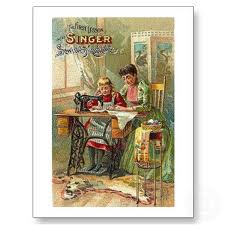
Of course, not every woman in Great Village makes her family’s clothes, or makes all of them. There has always been a tailor and several seamstresses in Great Village. They are patronized sufficiently to earn quite a decent living. More and more women are choosing to order from the Eaton's catalogue or to buy ready made clothes at Layton's, or drive into Truro to the specialty shops. Still, sewing is one of the most pressing chores women in the village have on their housework plate. Girls learn to sew as soon as they can hold a needle and thread, and many ladies in the Village are experts at seams, hems, darts and button holes. Many have their own Singer sewing machines (they are almost as common as pianos). The ladies of Great Village also excel at the needle arts: crochet, embroidery, needlepoint, knitting, rug hooking and quilting. One of the favourite gatherings for women is the quilting bee. The Great Village Sewing Club has been around for years and many a lass received her total immersion in the fine needle arts amidst the gossiping ladies around the quilting or hooking frame, or in a circle with the knitting needles clicking. The war has added another layer of work to this part of daily life. The village ladies are prodigiously productive in making surgical gowns and knitting socks, mittens ad scarves. The older and younger ladies tend to do most of this work because wives and mothers still have to attend to torn overalls and wee ones growing too fast out of their jumpers. Yet just about every woman in the village contributes at least a bandage to the Red Cross Knitting and Sewing Society.

While the farmers are off ploughing and planting the big fields of grain, most homes in the Village have kitchen gardens. The men often help with the planting and tending of these vegetable and flower plots, but the housewife is mostly responsible. Children are often conscripted to do the endless weeding. Though too early in the season for most crops, already there has been lettuce, and the fine weather is bringing along the seeds and seedlings, especially for those who guessed right and got a start of planting. Some village farmers use cold frames, starting plants as far back as March. And window sills throughout the village have also been sprouting herbs and tomatoes, as well as flowers, for months.

The ultimate work of these kitchen gardens starts later in the season when the pickling, preserving and canning gets underway. Even this early in the growing season thoughts have turned to these tasks. What everyone loves of the first strawberries, cherries, raspberries and vegetables is the freshness. The jars and bottles of preserves in cold cellars have dwindled and the anticipation of fresh produce is keen for everyone. Yet the ladies cannot indulge only in providing the first tender beans or peas. They must prepare for next winter. Canned goods might be more plentiful in the general store, but most folks still want home-made. And every cook in Great Village has some specialty which is regarded as the best version. Preserving season is still some time away though, and for now, fresh fruits and vegetables are on the menu.

Besides all the cooking, washing and sewing for their own families, village women also keep busy year round baking and sewing for society meetings, bake sales, fund-raising dinners, bazaars. Invariably, when baking or cooking for their own tables there is an event coming up to be supplied, so an extra pan of squares or a second casserole is made. More often than not the ladies are meeting in someone’s parlour or having ladies in of an afternoon to discuss some pending activity (a party, a wedding, a fair, a concert). Afternoon is the time for calling on neighbours anyway. All these are reasons to have a tidy house. Every hostess wants to serve at least a ginger snap with tea.

The celebrations surrounding Dominion Day will be given extra attention this year, as several organizations will be raising money for the war effort: a bazaar with a pie sale and fancy tables, an auction and strawberry supper have been organized. So the ladies have been and will be busy. The missionary lecture this evening will offer tea and a sweet table, and donations will be accepted in support of the work of the Mission Bands.

It is rare to find Elizabeth Bulmer on a weekday morning sitting in her rocking chair by the widow. The breakfast dishes are done and the kitchen swept, though she needs to make a pan of biscuits and tidy up the everyday parlour, finish straightening up the bedrooms. All the ironing was done yesterday, a long session of it to get Gertie’s clothes ready. Gertie is so fond of her nice clothes. They weren’t sure how many dresses Gertie would be able to keep with her at the hospital, but they got as many ready and packed as would fit in one of the small steamer trunks. Will and the girls were up early and off to Londonderry Station. Mary went off early too, fishing with her friends. It will mean some work upon her return, to clean the fish. Elizabeth knows Mary will bring an ample supply for she is almost as good a fisherman as Art. But it also means that tea is taken care of, nice fresh pan-fried trout, a lettuce salad (her leaf lettuce is good this year), and the fresh biscuits. Lunch time will be some egg salad sandwiches, which reminds her that she must go check the hens. As she rocks in her rocking chair, Elizabeth stares out the window at the busy street. Everyone coming and going. She’ll sit there, she thinks, until Elizabeth comes back from Chisholm's pasture and they can do some gardening together. The wee child loves to dig in the earth, and is so proud of the little patch all her own. Elizabeth doesn’t really want to go to the lecture tonight, but Will says they should try to do it. He’s so hopeful that Gertie will be home soon, but Elizabeth sees the sorrow in his eyes, behind his gentle smile. Like her, he is worried. Elizabeth doesn’t want to use the word doubt. Nobody knows, she thinks, picking up her knitting, watching the road up Scrabble Hill for her granddaughter. God’s will is so difficult to fathom. It is not up to us to do so, she thinks.


 Panoramic view of Great Village

When Will arrives back he stays outside busying himself with the wagon. Elizabeth serves the sandwiches on the verandah, a treat her granddaughter delights in like a picnic. In the afternoon Will goes off to Glenholme with Arthur and Billy and two of the Spencer boys, to install a furnace. It is hard to convince the child that she must stay home, hard to say no; but the men will be too busy to tend to her. Elizabeth convinces her granddaughter that it is better to remain with the promise that she can help clean the fish Mary will bring home. Elizabeth marvels at the curiosity of her wee granddaughter, always full of questions, and she's inherited the family's fascination with fish and fishing. Besides, Elizabeth tells her, she needs to fetch Nelly, who would be lonely without her company on the walk home from Chisholm's pasture.

Notes

1. Elizabeth Bishop remembered the keen commitment of her Aunt Mabel Bulmer’s housekeeping, in a memoir about her Uncle Arthur Bulmer, “Memories of Uncle Neddy.” In this memoir she called Mabel, “Aunt Hat”: “Mondays, Aunt Hat energetically scrubbed the family’s clothes, summers, down below, out back. On good days she occasionally burst quite loudly into song as she scrubbed and rinsed:

Oh, the moon shines tonight on pretty Red Wing,
 The breeze is sighing,
 The night bird's crying.
Oh, far beneath the sky her warrior's sleeping
 While Red Wing’s weeping
 Her heart awa-a-y...

This song is still associated in my mind not with a disconsolate Indian maiden and red wings but with a red blouse, red hair, strong yellow laundry soap, and galvanized scrubbing boards (also sold in Uncle Neddy’s shop; I forgot them). On other weekdays, Aunt Hat, as I have said, cleaned house: it was probably the cleanest house in the county. The kitchen linoleum dazzled; the straw matting in the upstairs bedrooms looked like new and so did the hooked rugs; the ‘cozy corner’ parlor, with a red upholstered seat and frilled red pillows standing on their corners, was never disarranged; ever china ornament on the mantelpiece over the airtight stove was in the same place and dustless, and Aunt Hat always seemed to have a broom or a long-handled brush in her hand, ready to take a swipe either at her household effects or at any child, dog, or cat that came her way. Her temper, like her features, seemed constantly at a high temperature, but on bad days it rose many degrees and she ‘took it out,’ as the village said behind her back, in cleaning house. They also said she was ‘a great hand at housework’ or ‘a demon for housework’; sometimes, ‘She’s a Tartar, that one!’” (Collected Prose  239-40).