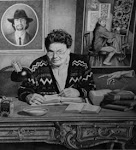
"I am 3/4ths Canadian, and one 4th New Englander - I had ancestors on both sides in the Revolutionary war." - Elizabeth Bishop
____________________________________________

Friday, November 13, 2020

Letters to Aunt Grace, Part 147: Family tensions

Bishop’s next paragraph in the 3 August 1963 letter broached a delicate family matter, but since Grace understood the context (or at least could probably guess it), Bishop was not explicit. Rather, she wrote around it, assuming her aunt understood. 

Bishop confirmed that she had a letter from Grace dated 15 August, “but oh dear the one before that must have got lost.” Bishop’s preoccupation with Lota’s operation and recovery may have been a factor in the lost thread – if the letter had been delivered at all (which is not clear). Bishop hated missing any of Grace’s letters. In that 15 July letter, her aunt had referred to “one in which you spoke about Suzanne” (that is, Elizabeth and Ray Naudin’s oldest child). This reference is what made Bishop realize that one of Grace’s letters had not reached her: “I didn’t get that [one].”

In her May letter to Grace, Bishop had expressed frustration with Elizabeth Naudin. Realizing that Grace had written about her cousin in the last letter made Bishop reflect: “I shouldn’t have said anything, I suppose, even to you.” That said, Bishop respected her aunt and noted that she still would have liked “to know what you think,” that is, she wanted to know what Grace had written about this subject. Sometimes the significant space-time between these exchanges created gaps that could not be bridged. 

Bishop then reported that her cousin “got back in the middle of my hospital stay and called up.” The Naudins had gone to Montreal to attend Joanne Ross’s wedding. Part of the reason Elizabeth Naudin had made contact was because Aunt Mary had sent Bishop something via her daughter (more about this something in the next post). Bishop told her aunt that she wasn’t able “to see her until two days ago.” 

Clearly, the reunion had not gone well, though Bishop does not give the details. All she was willing to share was her feelings, starting by observing that she had “a very high boiling point, you know.” The issues between these cousins had been on-going, Bishop reiterating that “it takes me a long time, years sometimes, to get really angry.” Her tolerance and patience and benefit of the doubt had run out, for some undisclosed reason. Bishop declared that she was now “ANGRY” to the point where she was “not going to see her again and that’s that.” When the high threshold was breached, Bishop noted “I’m afraid I stay that way.”

Grace would surely have wanted to know the details, but Bishop was wary of putting them on paper (and perhaps it was too complicated to explain). She said only that “when I see you I’ll tell you about it.” Even writing this much seemed too sensitive to Bishop, so she asked her aunt to “Please say nothing at all to Mary, naturally.” Bishop had already written Aunt Mary “a note, but said nothing.” Bishop concluded, about her own role in the matter, that she was “weak-minded, that’s all – one of my big troubles!” And ended the subject with “enough is enough.”

Bishop shook off that unpleasant report and for the rest of the letter focused on a range of subjects (all for the next posts). When she reached the end of the letter on the second page, however, she realized she was not quite done with the upsetting subject. She turned the second page upside down and typed a short paragraph about her cousin and their severing. First, she expressed her regret: “I’m awfully sorry about the E business.” She reported to Grace what her aunt likely knew, that the Naudins were “going away from Rio,” that is, moving; in the end, the distance meant “it will be all right.” Most importantly, it meant “Mary need never know.”

Bishop observed that this young cousin “has never really liked me, I feel, -- or something – maybe she doesn’t like anybody.” Something else had happened though, as Bishop then wrote with clear exasperation: “there are some things I just can’t take.” A hint of what might have caused tension from Elizabeth Naudin’s point of view is Bishop assuring her aunt that she “never once said anything critical to her – held my tongue always.” Bishop appreciated her cousin’s children and gently noted, “I did like seeing the little girls.” In the end, Bishop chalks up the division thus: “We have nothing in common, of course.” As Bishop’s letters to Grace reveal she “offered” frequent “invitations, introductions etc.” But her cousin “refused every” one of them, “always.”

Bishop’s benefit of the doubt had her think at one point that her cousin “might be timid – but no – I don’t think its that.” And then the final quick comment that perhaps was a direct clue to the source of the tension: “And he’s always been rude and aggressive – from the start.” That is, Ray Naudin.

(Thomas Travisano, Elizabeth Naudin, Phyllis Sutherland,
Sandra Barry, circa 2000. At Phyllis's home
in Balfron, N.S.)

Decades later, when I met Elizabeth and Ray Naudin, there was no hint of this tension. The Naudins seemed genuinely interested in their famous relative who was getting so much attention in the literary world. Certainly, with respect to her maternal family history, Elizabeth Naudin possessed a significant material part of it: a small gallery of George W. Hutchinson paintings, including “Large Bad Picture.” These paintings were inherited by the “little girls” after the Naudins died. All this said, I did learn from Phyllis Sutherland that the Naudins possessed a sense of their stature in the world, which didn’t always sit well with Phyllis. Well, this kind of dynamic happens in most families. What it says to me is that Bishop remained actively involved in family dynamics throughout her life, even when she was far away in Brazil and could easily have dispensed with it all.

The next post picks up the gift, an important gift, that Mary sent to Bishop.

Click here to see Post 146.

Saturday, November 7, 2020

Letters to Aunt Grace, Part 146: Lota’s operation

Bishop’s 3 August 1963 letter to her aunt is a dense, two-pager, which will require several posts to work through. The subjects are primarily domestic and family, which means complicated. Even though her previous letter was written only a month before (about the average time between letters for Bishop), she noted that it felt “as if I hadn’t written you for a long time.” That feeling was, she determined, “because so much has been happening,” especially in the past two weeks: “Two weeks ago today Lota was operated on for an intestinal occlusion.” She had been discharged only “two days ago.” 

Bishop then offered Grace, a retired nurse, an account of the whole process, which started with “stomach upset.” Bishop observed that Lota had experienced this condition “once or twice lately, vomiting.” They chalked it up to her “being overtired” from all the busy, stressful work on the Rio park. The difference “this time” was “the vomiting didn’t stop.” She went for “X rays the 2nd day” and was “rushed off to the hospital.” This issue was serious, causing the indomitable Lota to be “fed intravenously,” which required “a tube in her poor nose for about eight days.” Bishop’s comment about this intervention: “Poor thing, it was tough.” All was well now: “she’s fine but naturally tired,” and was still sporting “a huge bundle of bandages” and “all the stiches in.”

(Lota on right, at a meeting about the park, early 1960s.)

Bishop had only praise for the hospital, which she described as “excellent and so were the doctors.” It was standard practice to “let someone – or want someone, called the ‘acompaniente’ – to stay – so I stayed, along with the nurse.” Bishop slept in the large room for “a week.” She conceded that the whole ordeal was “an awful scare for a few days.” 

One of her big tasks was “to keep ALL visitors away except me and one or two close friends.” And now that they were back home, at their apartment, this job became even more difficult: “Brazilians treat a sickness like a party – or like a wake.” It kept Bishop and the maid “running all day long fending off callers, serving hundreds of little coffees.” Or so it seemed to Bishop. And all this “getting rid of people” had to be done “tactfully.” 

After the ordeal, Bishop hoped that Lota would be “made to rest for a month.” Bishop reiterated that the cause of it all was “mostly because of overwork, I suspect.” But Lota was already gearing up again, as Bishop wrote, “yesterday she had her secretary here and dictated letters – oh dear.” 

Bishop noted that it had been a “good thing … it happened here instead of in New York – where it would have cost a fortune.” Then Bishop confessed to Grace that she “lied to her [Lota] for 24 hours or so (the Dr. said to),” telling her “she wasn’t going to have an operation.” But barely “half an hour” before the surgery, “the nun came in and asked her, ‘Daughter, do you believe in God?’” The “very anti-church” Lota replied, “More or less, sister.” Then she turned to Bishop and declared, “Well, you can’t fool me any longer, after that!” 

Bishop quickly observed that Lota “was very brave, -- I must say.” Scribbled in the left-hand margin next to this long paragraph, Bishop wrote: “9 people visited with me all through the operation! 2 ½ hrs.” 

They had some support from “our best friend, Mary Morse,” who came to Rio “from Petropolis with her two adopted babies.” Grace would have remembered Monica, who was “almost 3 now.” The second child was only “3 months.” Bishop’s word for these children: “darlings!” As much as she adored these babies, however, she observed to Grace: “I know what you mean about small children!” 

Adding them to the mix in the household when she “was tired from all the hospital business” was a challenge. Monica was active and just as Bishop “had barely got to sleep,” the child “was pounding at the door saying, ‘Open the door, Aunt Elizabeth – I want to say good-morning to the canary’.” Not to mention her “jumping up & down on top of” Bishop. As soon as Lota left the hospital, “Mary went to stay with friends.” Having them all together in the apartment “would be too much for an invalid.” 

After this dramatic and detailed account, Bishop quickly concluded, “all is fine now and everyone recovering.” 

The next subject Bishop broached concerned a stressful and delicate family matter. The next post will pick up this reveal. 

Click here to see Post 145.

Saturday, October 31, 2020

Letters to Aunt Grace, Part 145: A Canadian visitor

The next section of Bishop’s 10 June 1963 letter to her aunt is a long, dense single paragraph, the letter really getting underway with subjects. Before launching on a story, Bishop began with two questions: “How are you and where are you?” She had once again lost track of the elderly traveller, so opted to “send this [letter] to G V – or C/O Phyllis might be better.” Invoking her cousin was on purpose, it seems, because it prompted a third question: “How is Miriam?” (who would have turned two on 4 June). Miriam was clearly on her mind because she then told Grace about a recent encounter, “last week,” with someone who offered some unexpected information that made Bishop think of Miriam. This person was “a visiting Canadian girl who is a great [horse] rider.” Sadly, she does not provide a name for this interesting person who lived “near Paris!” and was “raising horses and teaching riding.” During their “conversations” this young woman “just happened to tell me a long story about how she taught a little girl – 8 yrs old – just like Miriam, apparently – to ride.” She explained that this activity did “wonders” for the child. Lest Grace think she was offering unsolicited advice, she quickly added, “…I’m not suggesting you put the baby on horseback!” Bishop had just found it “interesting to learn that apparently any kind of physical training, sports, etc – helps a lot.” She added that the child’s doctor “had congratulated” the young woman on “the little girl’s vast improvement in coordination, etc.” Bishop assured Grace that the young woman’s story was spontaneous, that she had not mentioned Miriam at all. 

Bishop further explained that this young woman “has been living in Europe a long time.” She was “visiting friends here who brought her to dinner.” The visit of  this Canadian coincided with a culinary treat Bishop had regularly made thanks to “an American friend … who can use the U S Post Exchange (where government, U.S., people buy everything.” This friend had gifted Bishop with “a large hunk of corned beef and some frozen blueberries.” So, the meal Bishop made for their guess was “corned beef and cabbage, and then blueberry fungy (however you spell it).” [Ed. Note: Bishop had spelled it correctly. This traditional N.S. dessert is also called blueberry grunt.] 

She elaborated on the dessert, noting she made “it in the oven with sour cream biscuits.” She noted that she made this treat whenever “this American happens to give me blueberries – which she does once a month or so.” Well, “the Canadian girl couldn’t tell what the dessert was until she took a bite.” Her response: “My God – its’ been twelve years since I tasted a blueberry!” Even though frozen blueberries couldn’t “compare with the good old wild ones, naturally,” the dessert was “not bad” and the “dinner was a great success.” 

Perhaps the visitor and the blueberries were the cause of what Bishop then observed: “I am going through another wave of nostalgia for the NORTH.” Even Lota was in on the pining, asking Bishop “to write about the price of a little old houses we know of in Connecticut.” Bishop knew such thoughts were “just the wildest day-dreaming – but I’d STILL like to own something in or around G V, I think.” Getting there was the question, of course, “but one never knows, these days.” 

Lota was deep in her job creating the park in Rio, but that would end one day and Bishop speculated that they “might leave Brasil for a good long stretch – I don’t know.” Just in case, Bishop asked her aunt to “keep your eyes opened.” She even pondered her grandparents’ house: “Are Norman (is it Norman?) & Hazel [Bowers] still living in the old house? I mean our – your – old house?” She wondered if they might “ever want to sell it?” Quickly, Bishop asked Grace not to “mention me, for heaven’s sake – both sides of my family seem to think I’m a millionaire, I suspect!” Part of the reason for that suspicion was because she lived in “a big house – but it’s somebody else’s!” She was sure her relatives were “all richer than I am.” 

Typed vertically in the left margin of the letter, Bishop asked if there were “oil furnaces in N.S. now?” She assumed there must be and added, “I don’t think I could cope with an old-fashioned furnace.” 

The letter was now winding down. She had tucked in some money apologizing for its belatedness, “I had the idea of sending you this to get a new hat for the wedding – and then I just lost track of the time.” The newspaper clipping that Mary had enclosed in her letter to Bishop, a description of the wedding, noted “that Mary had a hat of blue tulle.” This prompted Bishop to say that “maybe you’d still like a hat – if this [amount] will buy a hat any more! Half a hat, perhaps.” With a final request: “Please write soon,” Bishop closed with her usual “much love.” 

About a month and a half passed before Bishop wrote again to Grace, on 3 August 1963. The next post will take up its epistle. 

Click here to see Post 144.

Saturday, October 24, 2020

Letters to Aunt Grace, Part 144: Back to 1963

The last “Letter to Aunt Grace” that I posted was on 7 April 2020. Months have passed but I was diverted by “Two Arts,” the EBSNS virtual exhibit, our first such exhibit, necessitated because of the pandemic. The exhibit is officially over, but you can still see Natallia Pavaliayeva’s wonderful Bishop inspired drawings by clicking the link in the menu on the right. There are still images for sale, if you are interested, and information about how to purchase can be found on the “Two Arts” page. 

I am glad to be able to turn once again to Bishop’s letters to her aunt. The last post in this series was for the letter dated 16 May 1963. In that letter, Bishop mentions that she had met the writer James Baldwin. Interestingly, recently, a friend sent me a link to an essay by Magdalena Zaborowska, a Baldwin scholar, about his home in the south of France. It resonated with me in many ways because of my own involvement with the Elizabeth Bishop house. I highly recommend this fascinating essay.

 I am hoping to post more regularly again, aiming perhaps for once a week, with a new account of what Bishop wrote to her favourite relative. 

********************

Bishop’s next letter to her aunt is dated 19 June 1963, written in Rio, not quite a month after the previous missive. She begins right off the top reporting to Grace that she had recently heard (“Saturday”) from Aunt Mary, after not hearing “from any of this side of my family for so long.” Mary wrote to report on a family wedding: her daughter Joanne to Frank Eartly. Bishop noted that the report came “with newspaper clipping.” 

Grace had, of course, attended the ceremony and Bishop wrote that Mary “said you were looking awfully well and seemed awfully well.” Bishop was “glad to hear that.” The eighty-four-year-old Grace did a lot of “jaunts” (Bishop’s term, she also referred to Grace’s travels as “gallivanting”), which often “worried” her niece. But Grace was intrepid. 

Mary “had received” a letter Bishop has “mailed at the same time as one to you – in care of her,” probably the 16 May letter; but Mary didn’t indicate if she “had already forwarded it or if it had got lost.” Bishop noted that if Grace hadn’t received this letter, “it wasn’t much of a loss” because she had been “very cranky, as I remember, and gossipy.” 

At that point in the narrative, something went wrong with Bishop’s typewriter (“— 33 Oh dear—” some sort of mysterious code and exclamation). She must have sorted it out and continued, declaring that she was using a “little typewriter,” not her “larger old one,” which was “being repaired.” She wasn’t “used to this one,” but she had “suddenly realized” that the usual one was “covered with RUST,” a result of “the Rio climate.” And concluded that she too was “probably covered with rust, or mildew.”

(EB in Brazil ca. 1960s. Alas, I have no idea
who sent me this photo.)

A pause and a new brief paragraph to let Grace know that Mary had written both “before & after Elizabeth [Naudin, Mary’s oldest daughter] arrived.” Mary had told Bishop that her cousin’s new “baby had no more asthma, I gather,” news that the asthmatic Bishop declared was “good.” 

This letter was just getting underway. The next post offers Bishop’s account of a Canadian visitor.

 Click here to see Post 143. 

Saturday, October 3, 2020

New website for Suzie LeBlanc

"Suzie LeBlanc is a world-renowned interdisciplinary artist. Curious, nuanced and passionate, she sings and conducts to discover and share the beauty and emotional charge of music. Known for her interpretation of baroque, classical, contemporary, and Acadian works, she is acclaimed for her eclectic and original projects."

These sentences begin the “About” on the new website of EBSNS Honorary Patron SuzieLeBlanc. Her connection with Elizabeth Bishop remains strong and active and it is lovely to see all her exciting projects presented. The EBSNS will be keeping track of her creative endeavours, now and in the future, and will share those connected to Bishop when they happen. In these strange, challenging and difficult times, we are “in need of music” and poetry all the more. We thank Suzie and all her colleagues for continuing to bring us joy, solace and inspiration.

Saturday, September 26, 2020

MANNERS: Natallia Povaliayeva -- a response from Moya Pacey

Even though the “Two Arts” virtual exhibit is officially closed, below is a delightful response to one of Natallia’s drawings, “Manners,” by Australian poet Moya Pacey. The exhibit is still in the blog’s archive and you can click onto the “Two Arts” button in the menu on the right to see the images and to learn more about the fund-raiser. There are still prints for sale.

********************

Speak to everyone you meet: Receiving the print in the mail today returns me to my time spent at EB House in Great Village as a guest during the EB Centenary Festival, 2011, and the people I met there.

I leave the EB House and cross the iron bridge on my way to the Post Office, thinking of the five-year-old Elizabeth crossing it clutching a carefully wrapped brown paper parcel, addressed to her mother at the Infirmary in Halifax. Inside, the almonds her mother loved, and a letter from Gammie asking the Superintendent to please take Elizabeth’s mother, Gertrude, out for a drive. Elizabeth pushed the parcel through the post office grille with the quarter coin and left quickly, not waiting for change.

Unlike the young Elizabeth, I linger, and Bev the Postmistress introduces me to Sterling Dick a ninety-two-year-old WW2 veteran. He fought in the Pacific and was in Australia and New Zealand and then at Okinawa. He tells me he’s looking for a wife. Sarah is there from the Blakie House. She’s baking butter tarts for her guests who include Carmel Cummins, the Irish poet, who brings salmon from Kilkenny. It rivals Willy Krauch’s smoked salmon that I eat at the picnic in the grounds of St James Church at the kind invitation of Jane Kennedy, from Economy, and her sister Esther.

I meet Maxine Ryan, another local, on the horse and cart ride around Great Village. We follow the route Elizabeth took with her grandfather that Natallia Povaliayeva the artist captures in her print, “Manners.” April Sharpe dresses as the young Elizabeth and recites some of her poems along the way. I was artist in residence at the EB House in 2018, and was invited to Maxine and Bryden’s Thanksgiving Dinner. I also met up with Sandra Barry and spent a wonderful day with her looking through the Elizabeth Bishop archives at Acadia University, and met Laurie Gunn again at my poetry reading. She has worked tirelessly, with others, to get Municipal Heritage status for the EB House – all this and more returns to me – so many faces, so many memories of my time spent in Great Village @ the EB Centenary Festival.

-- Moya Pacey, September 24, 2020


(Moya and me in EB House dining room, 
looking at EB's 1934 Vassar College yearbook, 
during the EB Centenary Arts Festival in Great Village, 
August 2011)


Monday, September 14, 2020

Anne Stevenson (1933-2020)

 A short time ago, I learned from U.K. Bishop scholar Jonathan Ellis that the poet, biographer and literary critic Anne Stevenson died today (14 September). Stevenson was a “pioneer” in Bishop studies, publishing a book about EB’s poems in 1966. She subsequently published two collections of essays about Bishop’s work. Her final book of poems came out recently with Bloodaxe Books and the publisher has posted a moving tribute to her, complete with a video of her reading some of her poems.

I first met Anne Stevenson in 1995 – September I think – when she and her lovely husband Peter Lucas visited Nova Scotia (it was her first visit to the province). I remember the year because the second Quebec Referendum was happening and she was quite interested in this event. She and Peter stayed at the Lord Nelson Hotel in Halifax and I remember walking around town with her. I can’t remember if I went to Great Village with her, but I might have. Even though I was a total stranger to her, in a most generous gesture, before she left, she handed me a folder containing copies of the correspondence between her and EB in the 1960s. I was stunned and profoundly grateful. This correspondence, some of which is finally published in the Library of America's Elizabeth Bishop: Poems, Prose, and Letters, has been mined by many scholars over the past decades, including myself. Bishop was remarkably forthcoming with Stevenson in this correspondence and revealed all manner of things both personal and poetic.

Anne Stevenson and Peter Lucas, September 1998, 

Acadia University, Wolfville, N.S. (Photo by Laura Menides)

Then I spent a bit of time with Anne and Peter in 1998. Anne kindly agreed to be the keynote speaker at “Divisions of the Heart,” a Bishop symposium at Acadia University (the repository of the Bulmer family archive) in September of that year. I remember an afternoon sitting in the Blomidon Inn interviewing Stevenson about Bishop. I wished we had recorded her keynote talk, which was lively, even feisty, and especially the Q&A afterwards. Subsequently, I had my own exchange of letters with Anne, until the beginning of the new millennium, when our communication dwindled and ceased. I would hear about her now and then from U.K. friends, but our contact became just a pleasant memory. Curiously, this past week, I had been writing about Stevenson to Walter Smart, a friend in Michigan who has become quite interested in Bishop. In the course of our lively correspondence, he mentioned Stevenson (he’s been delving deeply into all that has been written about Bishop in the past 40 years – and Stevenson is important). I wrote him some of my memories and even observed that she was still living but would be elderly by now (Stevenson was 87 – she was born the same year as my mother). And then to hear of her death earlier today – well, I wondered about this interesting convergence. I am grateful for the brief contact I had with her and immensely grateful for her sharing of such vital correspondence. My deepest sympathy goes out to her family and friends. Her passing is a loss to the world of poetry and scholarship. 

Monday, September 7, 2020

New journal to be published

Jonathan Ellis, our correspondent in the UK, has just alerted me to a new development out of Penn State University – the publication of a new journal, Bishop-Lowell Studies. It was only a matter of time before such a project manifested and with its stellar editorial board, this journal will attract the top Bishop/Lowell scholars writing today. As was observed to me from our correspondent, Bishop has become “iconic” – and then some, and not only in the academy. My hope is that there will be a wide definition for contributions, so that not only the hard-core literary criticism will be included, but also deep explorations of the wider interest in Bishop among artists of all disciplines (for example, a serious look at the film treatments of Bishop to date, especially since a new documentary film by Nova Scotian film-maker John Scott, who teaches at Ithaca College, is due out in the near future; also, I was recently asked by poet and playwright Malcolm Willison, of Schenectady and Key West, if anyone has looked closely at how Bishop has been treated in plays and fiction – and I wonder if Lowell has received this kind of attention from the wider artistic community). It will be interesting to watch this endeavour unfold and evolve.

Monday, August 24, 2020

A couple of EB items

It is time for the “Two Arts” virtual exhibit to wind down. I will begin posting other things and slowly the images will settle into the blog’s archive. That said, however, we will keep the separate “Two Arts” page in the menu on the right-hand side, so that if anyone wants to check it out in the future, the links will give easy access to the images. The EBSNS will continue to offer framed and unframed prints for as long as we have them available, so if anyone is interested, they can find out the terms on the “Two Arts” page and see what prints we still have.

The EBSNS wishes to extend deepest gratitude to Natallia Povaliayeva for her generosity in allowing the society to share her whimsical, EB-inspired drawings and to allowing us to raise money through the sale of prints. Her delightful art benefits all who see it and the fund-raiser has benefitted the EBSNS in a substantial way. Thank you.

Below are notices about several new collections of poetry that are inspired to some degree by Bishop’s life and art. I am happy to feature these books and their authors. At the end of this post, there is also an image that is as interesting as it is rare.

********************

Aiden Rooney’s Go There, the Irish poet’s most recent collection, contains three poems that are inspired by his visits to Nova Scotia and his connection to Bishop. In the introduction to this collection, Daniel Tobin describes “Seals,” “In Acadie,” and “Habitation” as “North American poems,” but two of these are deeply immersed in the history of Nova Scotia itself, long before it was part of even British North America. “Seals” is clearly a nod to Bishop’s famous seal in “At the Fishhouses.”

********************

New England poet Jeffrey Harrison’s new collection Between Lakes has just been published by Four Way Books. Jeffrey’s work is elegant and profound, deeply indebted to the natural world that infuses his gestalt. He is also a Bishop fan and the collection contains one poem inspired by a story I told him some years ago about Bishop and The Grateful Dead!

********************

Poet and playwright Malcolm Willison’s latest collection, A House of Her Own (SeaStory Press 2019) has the delightful subtitle: Poems on the Afterlife of Elizabeth Bishop’s House in Key West. Over the course of many years wintering in Key West, Willison walked by Bishop’s home (the first home of her own in her adult life) again and again. He began writing about this experience and in the end realized he had a collection that charted the changes that took place to that house. These poems are by turns intriguing, amusing, elegiac and wonderfully descriptive of the activities or lack there of that he witnessed, as residents came and went. The house is now owned by the Key West Literary Seminar organization, with a mission to restore it and make it available to the public. Willison’s poems are a lovely, literary record of one poet’s longing to ‘get inside’ – and now that will be possible.

**********************

Poet Henri Cole recently send this image of what can only be described as a truly rare pairing. In 1973, The Phoenix Bookshop in New York City brought out a letter press printed chapbook of Bishop’s “Poem.” Only 126 were printed. Henri recently purchased one of the rare signed copies. His friend Rachel Jacoff is now the owner of the small George W. Hutchinson painting that inspired “Poem” – it was a truly inspired gesture to bring these two significant Bishop treasures together. I thank Henri for sharing this image with me.


Saturday, July 4, 2020

What people are saying about “Two Arts”

I love Natallia's ability to capture Bishop's sense of agonised fun (Robert Lowell called it her "sorrowing amusement"). Our awareness of the many sadnesses of Bishop's life sometimes leads us to forget this playful side. But it's alive and well in all of her illustrations, each of which make us aware how important childhood and children's tales were to Bishop's grown-up writing. In fact, looking at these illustrated poems, you realise how much Bishop delights in the silliness of measuring up experience according to scale and size. To grow up is not necessarily to become wiser.

Jonathan Ellis, Sheffield, United Kingdom

Playful, witty, and punchy in black and white, Natallia's drawings are such a lovely visual representation of Bishop's words.

Emma FitzGerald, Victoria, B.C

Right from the first one — the fridge magnet — Awful but Cheerful — I’ve found them delightful and could hardly wait for her next interpretation. I love the leap from one expressive form to another, words to images in this case. There is the occasional dog, lots of birds and a whimsical image for each succinct phrase. Unmistakably Elizabeth Bishop words, the images let us hone in on that moment, linger or take us aback, but all are “us”. All are us, the thin shanked, grinning gal in the polka dot shift.

Susan Kerslake, Halifax, N.S.

Every one of the drawings in the series, Two Arts, makes me smile and remember.  I ended up choosing two, each for its own reason.  Song for the Rainy Season:  this was the poem that introduced me to Elizabeth Bishop, when I was asked to read it at a concert about EB, a concert of song and poetry.  The result was a discovery that has stretched my mind and heart.  And Manners: I’ve always loved this poem for its whimsy and its kindness. Last fall I spent time with a friend as she endured chemo and I would read to her.  One day I selected several of Bishop’s poems.  Manners made my friend laugh out loud and let her forget, even briefly, why she was hooked up to tubes in a big chair.

So yes, smiles and memories, but also I love the way Natallia Povaliayeva has interpreted Bishop’s words. Her own affection for the poetry shines through.  Yet the simplicity of her black and white technique has left room for each viewer to find personal meaning and pleasure.

Claire Miller, Halifax, N.S.

("Dear, My Compass" print hanging in the dining room
of the Elizabeth Bishop House in Great Village, N.S.
Photo by Laurie Gunn.)

I purchased three black and white drawings by Natallia Povaliayeva, each illustrating a poem by Elizabeth Bishop. I “love them all,” but I want to talk about “Manners.” Each time I read the poem, I join the young EB sitting with her grandfather. Now I can read the poem aloud and pause to look at Natallia’s drawing, as we move along. "Thank you," Natallia and EBSNS!

Sally Middlebrooks, Lunenburg, N.S.

These drawings are delightful, each more so than the other! Two of them, “The Moose” and “Manners,” represent poems I know, love and have read many times. My favourite of the three, perhaps, is the third, inspired by “The Filling Station.” I didn’t know this poem. Natallia's image evoked childhood memories, and I knew I wanted to find out more. I read the poem and was taken back to a very vivid memory, driving in the back seat of the family car, early 60's, past the ESSO Station in Bathurst, New Brunswick. My sister and I would sing out E-S-S-O...., S-O..., So.... Thank you EB. Thank you Natallia.

Wenda MacDonald, Halifax, N.S.


{There are still framed and unframed prints for sale. Go to the fund-raiser section below to see how you can purchase them. As more responses come in, I will be posting them here. Thanks to those who have already purchased and responded to Natallia's delightful drawings.}

Tuesday, June 2, 2020

Two Arts – EBSNS Virtual Exhibit 2020 – Part 16 – Fund-raiser

As the EBSNS has already announced, the society has cancelled its 2020 Annual General Meeting because of the public health restrictions in place due to the covid-19 pandemic. As a result, the Echoes of Elizabeth Bishop Gallery exhibit for 2020 has been done virtually. This year’s exhibit, “Two Arts,”  is comprised of twelve Elizabeth Bishop inspired drawings by Minsk, Belarus, artist Natallia Povaliayeva. She has kindly agreed to let the EBSNS offer prints of her drawings as a fund-raiser for the society. All the images are found below this notice. To see the whole list of images together, go to the “Two Arts” page (the link is on the right side of this page).

TERMS OF OFFER

The society offers one framed print of each drawing (12x15 inches) and five unframed (matted) prints of each drawing (10x13 inches). Each framed print costs $50.00. Each unframed (matted) print costs $25.00, plus postage.

Because the cost of mailing the framed prints outside of Nova Scotia would be high, the framed prints are reserved for interested Nova Scotians. The unframed (matted) prints can be mailed anywhere in the world.

If you are interested in purchasing one of the images, please contact Laurie Gunn at laurieegunn@ns.sympatico.ca or Sandra Barry at slbarry@ns.sympatico.ca to discuss payment options and the cost of postage.

Because these times are strange and disrupted for us all, we ask for and deeply appreciate your patience as we work through this virtual fund-raiser process. The prints are quite real, but it will take time for us to get them mailed. We hope that the Nova Scotians who want one of the framed prints might be willing to pick it up at some point, once the pandemic restrictions have eased, but delivery options can also be discussed.

This exhibit would have hung in the church in Great Village until September 2020, so we will keep it and the fund-raiser active on the blog through the summer of 2020.

Thank you for your interest and support.

Addendum: Blogger Bob Maher has made note of "Two Arts" in a recent post on his most interesting blog which covers many subjects, not the least of which is our connection to place and space. He has mentioned Bishop a number of times over the past couple of years and he and his wife attended the EBSNS AGM in 2019. You can read what he writes in this recent post here. Thanks, Bob, for giving "Two Arts" and EB this interesting commentary.

Sunday, May 31, 2020

Two Arts – EBSNS Virtual Exhibit 2020 – Part 15

[ALL UNFRAMED PRINTS SOLD]
[FRAMED PRINT STILL AVAILABLE]

When the residents of Great Village commemorated Elizabeth Bishop’s connection to the village for the first time in 1992 – a bronze plaque on St. James United Church – a line from this late masterpiece was chosen: “Home-made, home-made! But aren’t we all?” This poem is about the quintessential traveller-castaway, who must make his own home while remembering the old one left behind. Bishop probably first learned about Defoe’s Robinson Crusoe in Great Village. And her Crusoe did what she told Alexandra Johnson she had done: she carried her home within, comprised of all the worlds she had ever seen, especially, her childhood home “In the Village.”

This image is the final offering in “Two Arts” and the next post, which will appear soon, will explain the fund-raiser the EBSNS is doing around this exhibit. The EBSNS extends deep gratitude to Natallia for allowing us to share her images in this way and to offer them to the society to help us raise some funds. Thank you, Natallia.

Stay tuned for more details about how you can get one of the images from “Two Arts.”

Friday, May 29, 2020

Two Arts – EBSNS Virtual Exhibit 2020 – Part 14


This late poem has become Bishop’s most famous, most quoted poem – a signature piece. Search for it online, on YouTube, where countless people have recorded themselves reading it. Bishop’s life was filled with loss, but even so, she persevered and created a life and a body of work that was in many ways a triumph. Her work is more important than ever. We can all identify with her partly ironic, partly literal claim that losing is an art that is not hard to master. But, of course, it is the hardest art of all to carry. Natallia has made this “art” – a never ending process – into the epitome of a journey. We are all on that road away from and towards “home” and “elsewhere.” {REMEMBER: YOU CAN CLICK THE IMAGE TO ENLARGE IT.}

Wednesday, May 27, 2020

Two Arts – EBSNS Virtual Exhibit 2020 – Part 13

[FRAMED PRINT SOLD]
Bishop spent over fifteen years in Brazil, but her love of Nova Scotia, her childhood home, remained strong, as she expressed in “Dear, My Compass,” a brief, never published love poem. Her memories of her Nova Scotia childhood were never far from her mind and remained vivid and vital throughout her life. She created what might be called an illuminated manuscript of this poem, writing it out and illustrating it with all the images it mentions, the only poem, it appears, that she visually embellished in this way. Natallia has done justice to Bishop’s own sense of whimsy in her charming drawing.
[FRAMED PRINT SOLD]

Sunday, May 24, 2020

Two Arts: EBSNS Virtual Exhibit 2020 – Part 12


One of Bishop’s favourite places in Brazil was the baroque city of Ouro Preto (now a UNESCO World Heritage Site). She visited there a number of times and stayed at an inn that belonged to her friend Lilli Correia de Araújo. “Under the Window: Ouro Preto” is set at that place. Eventually, Bishop bought and restored an eighteenth-century house that she named “Casa Mariana,” in honour of her friend Marianne Moore and because it was on the road to the town of Mariana. It was not the first house Bishop had owned (that was in Key West, Florida), nor would it be her last (a condo at Lewis Wharf, Boston); but it was one which she loved, even though she spent little time there.

Friday, May 22, 2020

Two Arts – EBSNS Virtual Exhibit 2020 – Part 11

[FRAMED PRINT IS SOLD]

Bishop arrived in Brazil in late 1951. In early 1952 she began her long residency. She lived there for over fifteen years with Lota de Macedo Soares. Lota was building an ultra-modern house in Samambaia, near Petropolis, and one of the first things Lota did for Bishop was build her a studio. “Song for the Rainy Season” evokes the natural landscape (flora, fauna, weather) around the first real “home” Bishop had in her adult life, a home that reminded her of Great Village. Bishop travelled far away from Nova Scotia and New England, a long sea journey, and unexpectedly found a beautiful, inspiring place to settle in. What did she do first? She wrote about her childhood.

[FRAMED PRINT IS SOLD]

Wednesday, May 20, 2020

Two Arts – EBSNS Virtual Exhibit 2020 – Part 10

“Dear Dr. Foster”
[FRAMED PRINT SOLD]


Bishop underwent psychoanalysis with Dr. Ruth Foster in 1945-1946. One of the results of this therapy was a return to Nova Scotia after a sixteen-year hiatus. The trip was difficult, but it was also rewarding because it triggered several breakthrough poems, including “At the Fishhouses.” She knew how important her sessions with Foster had been and while in Halifax, Bishop began to write a poem for her therapist and friend. She never finished it, but as Natallia says in her Artist’s Statement, it was this fragmentary poem that prompted her first Bishop-inspired drawing. Dreams and memories were vital inner forces in Bishop’s poetics. She wrote years latter to Anne Stevenson that she used “dream material” whenever she was lucky enough to have it. And her poems are abundant with memories.

[FRAMED PRINT SOLD]

Monday, May 18, 2020

Two Arts – EBSNS Virtual Exhibit 2020 – Part 9

[FRAMED PRINT SOLD]

This poem, placed in the “Elsewhere” section of Questions of Travel, is perhaps one of the most direct links Bishop makes between Nova Scotia and Brazil. Great Village got its first filling station in the 1930s. Indeed, there were two by 1946 (Esso and Texaco), when she returned to visit after a sixteen-year hiatus. The trigger for this poem, however, was a filling station in Brazil. Both the stations in Great Village were operated by families, including Bishop’s (her Uncle Arthur owned the Texaco). Clearly, the Brazilian version, which she would have seen in the 1950s, took her back to the village’s own versions, where “Somebody loves us all.”

NOTE: IF YOU HAVE TROUBLE SEEING THE IMAGE, JUST CLICK ON IT AND IT WILL ENLARGE.

[FRAMED PRINT SOLD]

Saturday, May 16, 2020

Two Arts – EBSNS Virtual Exhibit 2020 – Part 8

[FRAMED PRINT SOLD]
[ALL UNFRAMED PRINTS SOLD]

One of Bishop’s masterpieces, “The Moose,” took over two decades to complete. It began in 1946 on a bus ride back to Boston from Nova Scotia and was finished for and read at a commencement ceremony at Harvard University in the spring of 1972. This poem is an essential nexus between the ideas of “home” and “travel,” revealing how Bishop could say to Alexandra Johnson in the 1970s that a poet carries home inside. It spans vast space-time with a profound intimacy, a deep sense of history and community, a mature and expansive aesthetic – and the “sweet sensation of joy” of an encounter with an ineffable creature.

Thursday, May 14, 2020

Two Arts – EBSNS Virtual Exhibit 2020 – Part 7

The other place central to Bishop’s childhood was Massachusetts, particularly Worcester and Revere. From the spring of 1918 to the spring of 1930, when she graduated from Walnut Hill School, Bishop was based with her Aunt Maude and Uncle George Shepherdson. There were some dark and difficult issues in their guardianship, including abuse at the hands of George. But there were also vivid and vital memories that made their way into her poems, such as the unfinished “Salem Willows,” which is about an encounter with a colourful carousel, while Maude sat nearby waiting and knitting.