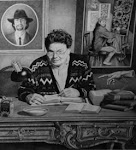
"I am 3/4ths Canadian, and one 4th New Englander - I had ancestors on both sides in the Revolutionary war." - Elizabeth Bishop
____________________________________________

Friday, April 30, 2010

Nova Scotia Connections -- "The War was on." -- Part One

One of the most important aspects about Elizabeth Bishop’s childhood in Great Village was: “The War was on,” that is, the first eight years of her life occurred concurrently with the lead up to, outbreak, progression and conclusion of World War I. This global catastrophe deeply affected her and her maternal family in many ways. The Bulmers did not lose any sons in the trenches in France, but they knew all the young men from Great Village who enlisted, served and died, overseas. Decades later, Bishop described herself to Anne Stevenson as a “late-late post-World War I poet.”

In 1999, I was asked to contribute an essay to a special Bishop issue of War, Literature & the Arts: An International Journal of the Humanities (Vol. 11, No. 1, Spring/Summer 1999). I created a chronology weaving together the events of Bishop’s family’s life with concurrent events of the War, both abroad and on the home front. This juxtaposition reveals a great deal about the complexity of Bishop’s experiences in Nova Scotia in the 1910s, during the most impressionable time of her life, experiences that had a life-long impact on her world view and artistic practice.

As is the way with us all these days, I searched on the internet and, of course, WLA has a website (www.wlajournal.com). In its “Archives” I saw the cover of the issue, which was done by Kathleen Carlton Johnson, based on the cenotaph in Great Village; but the content has not yet been digitized. I decided to excerpt my chronology and offer it here. So much more can be said, and I did say more in the essay; but simply making a list of some events provides powerful evidence of the interconnectedness of public and private realms -- so it was for Elizabeth Bishop living in Great Village, N.S., as war raged in Europe.

The chronology is long, so I will present it in two parts. Part One goes from 1905 to August 1914, the outbreak of the war. This time-line encompasses the marriage of Bishop’s parents, her birth and first three years of life. Part Two goes from 1915 to 1919, which encompasses Bishop’s principle childhood years in Great Village. The works I cite are listed at the end of Part Two. Since writing the essay, more facts about this time in Elizabeth Bishop’s life came to light, some of which have been included.

*****

Chronology: Elizabeth Bishop and World War I

1905-1908 - Incidents in the Balkans and Morocco cause tensions between Germany/Austria and France/Russia/Britain.

22 June 1908 - William Bishop of Worcester, MA, and Gertrude Bulmer of Great Village, N.S., marry in New York; honeymoon in Jamaica and Panama. Bishop wrote Stevenson, “My father had married a poor country girl.” (23 March 1964)

1911 - Second Moroccan crisis. Tensions in Europe increase.

8 February 1911 - Elizabeth Bishop born in Worcester, MA.

13 October 1911 - William dies.

14 April 1912 - Titanic strikes iceberg and sinks. This disaster had no direct bearing on the War, but the ship’s designation as “unsinkable” symbolizes the optimism and arrogance of Europe and North America “still under the tranquil inertias of half a century of peace.” (Wells, 853) Bishop’s family was not involved in the disaster, but it “strongly affected” her maternal uncle, Arthur Bulmer, and through him Bishop, “When I was left alone in the parlor...I could scarcely wait to take out the Titanic books...and look at the terrifying pictures one more time.” (Collected Prose, 245-6)

1912-1913 - Gertrude and Elizabeth travel between Massachusetts and Nova Scotia. Gertrude, in deep mourning, is emotionally stable but restless. Elizabeth’s earliest memories are of learning to walk in her maternal grandmother’s kitchen in Great Village and riding with her mother in a swan boat in the Boston Public Gardens. A swan bites Gertrude’s gloved hand; Bishop told Spires, “The finger was split. Well, I was thrilled to death!” (126).

A “fragile equilibrium of European statecraft” keeps the lid on the “point beyond which none of them could see.” (Stokesbury, 21)

February 1914 - Gertrude appoints her father-in-law, John Wilson Bishop, Sr., conservator of her estate.

Spring 1914 - Gertrude has a breakdown and is hospitalized for about three months in a private sanatorium in Norwood, MA. Elizabeth is cared for by maternal aunts, Maude Shepherdson and Grace Bulmer, who live in Revere and Boston, respectively.

May 1914 - John Wilson Bishop, Sr., petitions court to be appointed legal guardian of Elizabeth Bishop. Gertrude consents.

18 June 1914 - Final account for estate of William Thomas Bishop (Elizabeth Bishop’s father) is rendered. The consequence of all these probate, estate and guardianship actions is to increase tensions between Gertrude and her in-laws concerning custody of Elizabeth.

25-26 June 1914 - Great Salem Fire. Gertrude and Elizabeth, together in Marblehead, witness the blaze across Salem Harbor. Gertrude assists refugees fleeing the burning “Witch City.” “A Drunkard” records Bishop’s memories of this event.

28 June 1914 - Archduke Francis Ferdinand and his wife are assassinated in Sarajevo.

30 July 1914 - Russia mobilizes.

1 August 1914 - Germany declares war on Austria and begins invasion of Luxembourg and Belgium.

4 August 1914 - Britain declares war on Germany. “When Great Britain is at war, Canada is at war” (Craig, 50). Canadian mobilization begins immediately. The First Contingent leaves for England in October 1914 (Mathieson, 3). Canadians no less than the other Allies believe the war will be over by Christmas and “march off to the great adventure.” (Stokesbury, 34)

Fall 1914 and winter 1915 - Gertrude making plans to return to Nova Scotia with Elizabeth.


Harold Spencer in full Highland Brigade regalia, circa 1916. He did not survive the War.

Monday, April 26, 2010

FIRST ENCOUNTER XI: Marvel,
by Andrew Sant

Toy Marvel Stove

On a bedroom wall in the house where Elizabeth Bishop lived as a child hangs a framed poem – on linen paper – that I wrote several months ago. It is about my visit to that house in Great Village in April 2006. The bedroom was little Elizabeth’s.

Let me briefly explain how this came about. Great Village is a long way from where I normally live in Australia. But that April I got lucky. While on a speedy reading tour of the Maritime Provinces – wonderful new territory for me – I met the Halifax-based poet, Brian Bartlett. Our conversation must have drifted to matters relating to EB, especially her relationship with Nova Scotia. I had realised that in all likelihood I might never again be as close to Great Village as I was then but had not entertained the possibility, on this hurried tour, of visiting it, let alone gaining entry to EB’s grandparents’ house. Brian explained how this could be done.

As it happened, in a few days I was to join – via public transport – a couple of Canadian poets, David Manicom and David O’Meara, for a reading in Fredericton, New Brunswick. I learned they had a go-anywhere car which would next take the three of us back to Halifax. Great Village, I’d heard, my eyes widening, would be accessible along the way. Good companions, the two Davids didn’t require any persuading to make the detour. It was such a wonderful thing for me to be in places I’d never previously conceived of visiting that I felt I bore a disproportionate amount of the excitement. I hoped to see a moose somewhere but my luck didn’t extend that far.

The weather was changeable the afternoon we arrived in Great Village. I remember this because I waited for the sun to make its various appearances, through openings in the clouds, to take my photographs. It was drizzling when we arrived, sunny when we left. The three of us were shown into the house by Meredith and Robert Layton, holders of the key and with whom I’d previously made contact. The poem, which I called ‘Marvel’ gives some idea of the intensity of the experience. Here it is:

Unexpectedly, one morning, I’m being driven fast
to Great Village, Nova Scotia, where as a kid
Elizabeth Bishop lived – went into the clapboard house,
went up to the little room where she slept, or tried to,
the sleep of a nascent poet. While, downstairs,
her grandparents snoozed by the Little Marvel Stove.
Now forever gone! I looked down at the narrow bed,
up at the skylight right above it, home
of the travelling Milky Way, while nearby roamed
– or soon would – the moose she’d see from a bus
and, with a trans-continental pen, take a
modest twenty years to make, suddenly, marvellous.

Why I wrote the little poem when I did, I don’t know. I suppose poems find you rather than you find them. The circumstance was unique: I was enjoying a few glasses of wine one evening when I jotted it down. It’s the only poem I’ve written while drinking alcohol. I emailed it some time later to Sandra Barry – who I’d met in Montreal where she explained her connection with the house – and it was her generous idea that it be placed on the bedroom wall. When I recall that it is there, I also recall the overwhelming surprise and delight I experienced on reading Sandra’s reply. Could a poem ever have found a more suitable home?

Andrew Sant

Andrew Sant is an English-born Australian poet. He is the author of eleven collections of poetry, including Tremors, New & Selected Poems (Black Pepper, 2004) and Fuel (Black Pepper, 2009).

Website: www.blackpepperpublishing.com

A short pause in the rhythm

To all our faithful readers and anyone new who might happen upon us today, this note is to say that we are in transit at the moment and will be back tending to things as soon as possible. A new "First Encounter" is imminent from the wonderful poet Andrew Sant -- so stay tuned! "Today in Bishop" will change, too, at some point later today. We are grateful for your understanding and patience.

Friday, April 23, 2010

Nova Scotia Connections -- What's in a name?

One of the themes running through my Nova Scotia Connections is “names”: of places, people, objects, events, activities. As I suggest in the previous installment, graveyards are places where we become keenly aware not only of relationships among people, but also of their names, which do tell us interesting things about them. Elizabeth Bishop had a life-long fascination with names and naming. Undoubtedly, she acquired some of that interest as a child in Great Village, a tiny community with a rather large name!

One of the questions I get asked most frequently about Elizabeth Bishop’s maternal family is about the proper spelling of their name: Bulmer. Elizabeth Bishop’s Bulmer ancestors emigrated from Yorkshire to Nova Scotia in the 1770s. Their history in Yorkshire is long and notorious and I will write about it some other time. Even today, there is still evidence of that ancient family name there, in a community called Bulmer (with, I am sure, residents with that surname). Five brothers arrived in Nova Scotia during that late eighteenth century emigration and eventually spread out across North America.

When one visits the Bulmer family grave site in Great Village, what you see is the issue that puzzles many people. On some of the stones, the surname is spelled “Bulmer” and on others it is spelled “Boomer” — a colloquial phonetic pronunciation. Indeed, in early land grants, probate documents and even in the newspapers, I have come across other variants of the name: Bullmer, Bulmore and Bulmour. Curiously, in the same column of the “Newsy Notes of Great Village” in the Truro Daily News, it could be reported in tandem as both “Bulmer” and “Boomer.”

Today we must identify everyone specifically; bureaucracy and security demand that we are all accounted for (though name mix-ups happen fairly often, as people with the same name are mistaken for each other — and with the internet we can spend endless hours locating all sorts of other people who have our name — I wonder what Elizabeth Bishop would have thought of this new pastime of surfing the net for ourselves in/as others). At the turn of the twentieth century, such rigidity clearly did not exist. That these variants were used was a conscious choice and was talked about by Bishop’s family. Elizabeth Bishop had her own views on the subject, expressed late in life to her Aunt Grace, but clearly something that had been more than a passing thought throughout her life. In a 1962 letter she wrote: “I do wish everyone would go back to spelling the name BULMER. It is a good English name, that way — I HATE BOOMER, which could be Dutch or German, and I think it very ugly-looking anyway.”

This strong feeling and view did not keep Bishop from naming the hermit in “The Sea & Its Shore” Edwin Boomer, a cypher for Elizabeth Bishop!

Monday, April 19, 2010

FIRST ENCOUNTER X: Happy Birthday, EB
by Binnie Brennan

It was Sandra Barry who introduced me to Elizabeth Bishop’s work. I know Sandra as an ardent supporter of Symphony Nova Scotia, and a dedicated audience member who listens deeply to the music we play from her seat in the second row. When the situation merits, she leaps to her feet, arms held aloft and hands clapping, often leading standing ovations.

In 2008 I took a year’s leave-of-absence from my position with the Symphony to pursue my writing interests. In no time at all, Sandra introduced me to Elizabeth Bishop, and infected me with her enthusiasm. As a prose writer, I was initially interested in reading Bishop’s fiction, but soon I was equally taken by her poetry, letters, and essays.

Sandra invited me to attend the 2009 Elizabeth Bishop Birthday Bash, which was terrific good fun. On February 10, 2009, I wrote the following blog post:

“I am in awe of Elizabeth Bishop’s writing, since reading her Collected Prose. Her story, In the Village, is as perfect a work as any I have read, performed, listened to, or looked at, and it had the same effect as any masterpiece of any genre. There are images and emotions that simply will not leave me, nor do I particularly want them to.

“At the Elizabeth Bishop Birthday Bash I closed my eyes and listened, enraptured, as people took turns reading her poetry. If the Elizabeth Bishop Society newsletter is anything to go by (and it is), the publication of EB’s Library of America volume, Poems, Prose, and Letters (2008) is something for readers to celebrate. In addition to being a first-rate poet and prose writer, EB is touted as one of the greatest letter-writers of the twentieth century. This alone makes me put the new volume at the top of my birthday wish list. The wait-time on the library reserve list is far too long for my impatient heart.” (February 10, 2009)

Indeed, I was fortunate to have my birthday wish list honoured. The Library of America volume rests at the top of the pile on my book table. I return to it often, and always find a treasure within.

Binnie Brennan
2 April, 2010
www.binniebrennan.com

Thursday, April 15, 2010

Nova Scotia Connections -- Graves and Gwendolyns

“The favorite memorial for small children was a low rectangle of the same coarse white marble as the larger stones, but with a little lamb recumbent on top. I adored these lambs, and counted them and caressed them and sat on them. Some were almost covered by dry, bright-gold lichen, some with green and gold and gray mixed together, some were almost lost among the long grass and roses and blueberries and teaberries.” (Elizabeth Bishop, “Gwendolyn,” The Collected Prose.)


My first visit to Great Village was in the late summer of 1990. I had lived most of my life in Nova Scotia, but had never visited that part of the province. At Acadia University in the early 1980s, one of my roommates was from nearby Londonderry, but that was as close as I ever got to the area.

Like many other Bishop pilgrims, I went that first visit clutching my copies of The Complete Poems, 1929-1979 and The Collected Prose. It was easy to locate many of the buildings and places Bishop wrote about, especially the school, the churches, Hill’s store, Uncle Arthur’s house, the filling station (in 1990 it was still ESSO). And, of course, her childhood home. I knew by this point who lived in the house: Hazel Bowers, an elderly woman who was the widow of Norman Bowers, the step-son of Grace Bulmer Bowers. I knocked on the front door, which is done in Nova Scotia only if you are being very formal or tentative (or if you are selling something) — back doors are the way most people enter homes in the Maritimes. Hazel answered and invited me in. She was most definitely aware of Elizabeth Bishop. Indeed, she had some of Bishop’s books in her home. She had met Bishop on a number of occasions. I did not stay long. I visited her two more times with her step-niece, Grace’s daughter Phyllis Sutherland, but I did not get to know Hazel, who died in 1996, well into her nineties.

The other thing I did that day was go to the Mahon Cemetery, in search of the Bulmer family grave site. The cemetery is at the top of Layton’s Hill. As the car crested the hill there was a field of wheat or barley glowing golden in the afternoon sunlight and the waters of Cobequid Bay off in the distance were the very colour Bishop describes in “Gwendolyn”: “dreaming lavender-red.”

The cemetery is well back off the highway, at the end of a narrow dirt lane. Turning into this little road, two elegant old houses sit on either side and two rows of large maples arc a canopy across the sky. Driving beneath them, it feels, quite literally, as if you are going back in time.

The cemetery itself is rimmed by conifers on the bay side and open fields on the highway side. It is a quiet and still place. Bishop wrote, “It is as if evening were always in the graveyard.” If you have ever gone searching in cemeteries, even small ones, you know that it can be oddly difficult to find a particular stone without directions. However, I found the Bulmer grave site fairly quickly. Many things are interesting about this site, but one of the most interesting is two tiny heart-shaped stones for the infant children of Arthur and Mabel Bulmer. These infants (a girl and a boy) died in 1909 and 1915. The boy is the subject of Bishop’s haunting poem “First Death in Nova Scotia.”

Graveyards are fascinating places and where Bishop is concerned, the Mahon Cemetery is an important site. Her great-grandmother Mary Elizabeth Black Hutchinson Gourley is buried there (Mary’s first husband, Robert, was shipwrecked off Sable Island in the mid-1860s). Bishop’s grandparents, William and Elizabeth Bulmer, are buried there. Her Aunt Maude Bulmer Shepherdson. Uncle Arthur and Aunt Mabel Bulmer. Aunt Grace is nearby (and a number of Grace’s in-laws, including Hazel Bowers, are buried there). There is also a memorial stone for Bishop’s cousin Eleanor Bulmer Shores, who is buried in the United States. These people were the centre of Bishop’s maternal family collective.

During a much later visit to the cemetery (years later, in fact), I was exploring a far corner of the yard and located, totally by accident, a single broken stone marking two more infant deaths: the first child of William and Elizabeth (Lizzie on the stone) Bulmer and the first child of John Robert and Charlotte (Lottie on the stone) Hutchinson, one of Bishop’s great-uncles. Though there is no discernable date on the stone, these infants must have died close in time. The Bulmer child was stillborn in 1872.

Besides all these family members, the Mahon Cemetery is filled with people Bishop knew as a child, whose names populate her memoirs and stories: Chisholms, Peppards, Spencers, Hills, DesBrisays, MacLachlans, MacNeils, and on and on. Perhaps one of the most important people in this communal collective was Gwendolyn Patriquin.

On that first visit I already knew that the little girl in Bishop’s story “Gwendolyn” was a real person. In the story Bishop calls her Gwendolyn Appletree. Gwendolyn died at the age of nine in 1922. I had come across her obituary in the Truro Daily News. Besides finding the Bulmer grave site, I very much wanted to find Gwendolyn’s. However, that first day I looked and looked without any luck, and then it was time to leave.

A few weeks later I returned to Great Village determined to find Gwendolyn’s grave. It was a cool, unsettled October afternoon, but there were still crickets chirping in the quiet cemetery. I parked the car and got out. I had several choices where to start looking and decided to take the path directly in front of me. I walked only a few yards when I saw it. Indeed, it was barely 10 yards from the Bulmer grave site. How could I have missed it that first time?

Gwendolyn is buried there with her parents. Also etched on the stone is a memorial for one of her older brothers, Clyde Patriquin, who was killed in World War I, only a few months before the Armistice.

Many years later, after I became involved with the Elizabeth Bishop House, one day while pruning the little rose bushes out front, Arthur Chisholm stopped by. He handed me a large velvet-covered book and said that someone had left it at the museum in Truro and that the archivist there thought it might be something we would like to have at the house. It was a copy of the Vassarian for 1934, Elizabeth Bishop’s graduation yearbook, for which she was editor-in-chief. Well, I was thrilled, of course! Like graveyards, yearbooks are endlessly fascinating — a visible gathering of a community, a way of learning about people and their relationships with each other. I began leafing through it immediately, looking for the pages with the graduation photographs of all the young women. Imagine my surprise when I turned to the first page of “As” and found that one of Bishop’s classmates was Gwendolyn Appleyard!

Bishop usually used people’s real names in her stories and even in poems, but sometimes she changed them. When she changed names there usually was some organic logic or reason for it. I had often wondered why Bishop had changed Patriquin to Appletree. Coming upon Gwendolyn Appleyard helped explain why. For Bishop, “life and the memory of it” were deeply, intricately intertwined.

One final little graveyard story, told to me by Phyllis Sutherland. During one of Bishop’s Nova Scotia visits in the 1970s, Phyllis took Bishop to an old cemetery up in the hills near Balfron, N.S. They sat there in the sunshine having a picnic, eating sandwiches and drinking beer. At one point Bishop remarked that it was a place where she herself would like to be buried because it was so peaceful and secluded. Well, Elizabeth Bishop is buried in Hope Cemetery in Worcester, MA, next to her parents. It is a gigantic cemetery, but also quite beautiful with many large trees. Considering the diaspora of Maritimers who ended up in the “Boston States,” undoubtedly there are few Nova Scotians and even one or two Great Villagers buried in that enormous cemetery. I have recently learned that one of my own great-grandfathers may very well be buried there (yet to be confirmed).

Bishop remembered with great affection going with her grandfather to cut the grass on the family plot and pick teaberries, which “grew good” in the cemetery, for her grandmother. It would have been the mid-1910s. At that point, the only Bulmer graves there were for those infant children. All around, though, and as time passed, the people of Great Village were laid to rest in this small memorial ground — the people who populate Elizabeth Bishop’s stories and poems. Delightfully, there are still little recumbent lambs on gravestones in the Mahon Cemetery and many of the stones still have that deep gold-crusted lichen.


Gwendolyn Patriquin's obituary, 6 September 1922, Truro Daily News. (Click on image to enlarge.)

Monday, April 12, 2010

FIRST ENCOUNTER IX: Death of a Grudge,
by David Hoak

Before I was a failed poet, I was a failed collector of poets. Obsessed with words and the sound of words as a boy, I would spend hours imagining myself as Robert Frost or e. e. cummings. Later heroes would be Wallace Stevens or Anne Sexton or Sylvia Plath. I collected Bishop, too, and then, like the others, let her slip away. To have been so careless with poets and now to have Elizabeth Bishop so fully in my life is a small miracle.

I was well out of college before my obsession with poets turned into reading their work in any sort of disciplined way. Years before I would enter the world of her poems, I wanted to know more about Bishop, meet her somehow, and maybe even hear her read. In college, I'd gathered certain details of Bishop's life story. I knew she had traveled widely and lived in many places I wanted to visit. Somehow, I had an inkling she might be gay. (A few years later I would visit Key West and fall under the spell of the eccentric, alcoholic, lesbian aunt of a college friend. Another story....or is it?) As a gay man coming out in the seventies, one who had grown up surrounded by independent women, I was drawn to her.

As that decade ended, I was teaching at Occidental College and going to as many readings as I could find. I was a mathematician by day and a word seeker by night. How I wish Bishop had made a trip to read in LA. I'd like to think I would have found her. It wouldn’t be long, however, before any chance of meeting her would vanish forever. I have a vivid memory of a day in October, 1979, when I picked up a newspaper and saw her front page obituary. I'm not sure where I was, or what paper it was, but reading that obituary remains indelible in memory. I can see myself reading through it slowly, as if proofreading it, and feeling something like grief for the lost opportunity of seeing her. Almost twenty years would pass before I encountered EB again, and still it would not be in the poems.

My second “first encounter” with Bishop was through One Art. I had always liked to read collections of letters while on the road and I worked my way through this trove of correspondence over several vacations from the mid to late nineties and beyond. The letters opened a path for me. One Art became a kind of concordance with which I could begin the journey through the poems. I found Brett Millier’s biography and began to search out other Bishop material in earnest. Sometime around 2003, I made the breakthrough that has made so much difference: I realized there must be Bishop communities and that I needed to find one of them. I began a search that led me to the 2003 ALA Bishop conference in Cancun, the way to which was paved by the warmly encouraging ("Don't worry...the Bishop people are fun") and endlessly generous Tom Travisano. Brett was there too, along with many distinguished Bishop scholars and, for good measure, the granddaughter of Robert Frost. My life in a larger Bishop community had begun.

Tom would later tell me about the Great Village house opportunity and I jumped at the chance to join in its ownership. I soon met Sandra Barry for the first time and spent a happy afternoon on the “Moose route.” I count this first visit to Nova Scotia as my final "first encounter" with Bishop. From that day forward, I would discover and rediscover her on a journey with others.

I smile now at "failed poet," but I did bear life a grudge for many years for giving me the heart of a poet and the head of an actuary. Bishop's poems might have fed this grudge. After all, just when you've got the hang of that "mind thinking" thing and inhaled all that "naturalness of tone" you start to believe: I could write this way. But then Bishop creates something so flat out of this world that your brain trips up. You have to stop and take a breath. It happens in a poem as early as "The Map":

These peninsulas take the water between thumb and finger
like women feeling for the smoothness of yard-goods.


Not a month goes by that I don't dwell on that image and savor the sibilant pleasures of those peninsulas and the feel of those goods. The other day, I was having some dishwasher work done and completely unbidden the following thought floated in:

like plumbers feeling for the smoothness of pipe threads.

See. You can do it. Bishop makes you believe you can do it. Just take these poems between thumb and finger and you too can make out the rigging of a schooner, you can write salt, clear, moving, utterly free, cool as from underground springs like one long carded horse's tail ... even if your mind is an ignorant map.

But here the existence of a small difficulty must be faced: You can't. Well...if you're me you can't anyway. Bishop is just so flowing and flown that you can't write that way. And yet you love her for it and you always will because she struggled so hard and the untidiness never ended: The poet so battered; the work so shiny. You sing the poems all day long and know that you are an overwhelming success at finding and loving Elizabeth. You almost lost her for good so many times. But you didn't, and now she is yours and will be until the journey ends.

Friday, April 9, 2010

CBC Radio 2 - This is my Music

Sitting in "Sweet Indulgence" Café in Lunenburg with Sandra on a foggy afternoon. We wanted to let you know that tomorrow morning, Saturday, April 10th at 10 AM, on CBC Radio 2, you can hear "This is my music" where I'll be talking about my favorite recordings and also about the Elizabeth Bishop Centenary. The show was recorded a week ago in Toronto, in the very hi-tech studio normally used for "Hockey night in Canada"! Springtime is the central theme, starting with David Greenberg's violin from the CD "Spring any day now". From there, an excursion to the sea with Debussy's La Mer (conducted by Yannick Nezet-Seguin) and Faure's "Melisande's song", sung by Lorainne Hunt-Lieberson. You'll later hear Lorainne and Brazilian Jazz singer Luciana Souza sing settings of Elizabeth Bishop's poems "Breakfast song" and "Sonnet". For the gypsy lovers, David Greenberg returns with the Ensemble Caprice (Montreal) in a frenzied Baroque Gypsy dance. The rest of the music is a collection of eclectic pieces which reflect the many collaborations I have enjoyed in the past 20 years. Hope you enjoy them too.


[Here is a link to the CBC-2 Broadcast, which begins at 10 a.m. Eastern Time (11:00 a.m. Atlantic Time)].

Wednesday, April 7, 2010

Nova Scotia Connections -- "Nate" the Blacksmith


Mayhew (Mate) T. Fisher (right) standing in the doorway of his blacksmith shop. One of the photographs Shirley MacLellan gave me during my visit with her.

“Nate sings and pumps the bellows with one hand. I try to help, but he really does it all, from behind me, and laughs when the coals blow red and wild.” Elizabeth Bishop, “In the Village” (The Collected Prose, Farrar, Straus, Giroux, 1984)

Elizabeth Bishop referred to “In the Village,” arguably her most important work about her childhood in Great Village, as “completely autobiographical,” saying that she had only “compressed” time a bit. This masterpiece of imaginative remembering is endlessly fascinating on both macroscopic (world view) and microscopic (“no detail too small”) levels.

In this story, which is so particular yet so universal, it does matter that every inhabitant of “that Nova Scotian village” was real. But, as real as they were, this lyrical “prose poem” (another way Bishop consistently described it) also renders them mythic. No more archetypal a figure is there than Nate the blacksmith. “In the Village” requires no outside, historical knowledge by any reader. Indeed, it is such a whole universe unto itself, that we know all we need to know, even in the great silences it holds. I am, however, trained as an historian and archivist, and part of my compulsion has always been to link art to life — not reduce art to a mere reflection of life, but truly to understand the dynamic, mysterious and synchronous connections between these two powerful and uncontainable realms.

I do not remember when I realized that “Nate” the blacksmith was Mayhew “Mate” T. Fisher. I suppose that connection was made when a friend gave me my first copy of the Women’s Institute’s History of Great Village, sometime in 1991 or 1992. Bishop received hers from Aunt Grace the year it was published, 1961 (the year I was born). Bishop sometimes changed names, sometime did not change names (for example, the Mr. MacLean in “In the Village” was Donald MacLachlan — I think Bishop changed his name because she never could remember how to spell MacLachlan. I have come across several variants of it in her letters. So, MacLean was easier and close enough.) Perhaps Bishop thought “Nate” was right, mis-remembering “Mate.” But, clearly, Nate and Mate are one and the same.

The section entitled “Blacksmithing” in the History of Great Village contains the following: “To the average youngster of today the blacksmith is an extinct individual of the past whose greatest contribution to society was providing inspiration for Longfellow’s poem, ‘The Village Blacksmith’….” Without a doubt Bishop knew this poem (and others of Wordsworth; his Evangeline was part of the Bulmer family library).

In the late 1990s I learned that Mate Fisher’s son Donald lived in Bass River, just up the road from Great Village. I tried several times, in several ways, to connect with Mr. Fisher (a letter, phone calls, even knocking on his door), but I never succeeded in making contact. Again, I do not remember exactly what year it was, perhaps 2005, when my dear friend Donalda Nelson (Donald MacLachlan’s daughter) one day mentioned, in the midst of one of our wide-ranging conversations about Great Village and its history and people, that Mate Fisher’s daughter, Shirley MacLellan, lived in Truro and she was sure that Shirley, who was in her 80s, would be happy to meet me. Donalda got me her phone number and I called to introduce myself and ask if it would be possible to visit. A very lively, sprightly voice greeted me and without hesitation said “by all means” (not her exact words, but the gist of her meaning).

I bought a copy of The Collected Prose and one sunny afternoon (was it spring or fall? I cannot remember), I arrived at 103 Queen St. in Truro. Shirley was a totally with-it woman, gracious and most interested in what I had hinted I had to tell her. She did not know who Elizabeth Bishop was and had no idea that this poet had written about her father, indeed, had immortalized him for eternity in a masterpiece! She was amazed and thrilled, but, as I learned, she was not surprised that her father had affected Bishop so deeply.

As I listened to Shirley tell me about her father, I grew more amazed myself. As a young man, Mayhew Fisher set up his first blacksmith shop in Great Village in the early 1910s (he moved to Bass River before the 1920s arrived and worked his forge there until he retired). He and his wife were newly married and expecting their first child. She told me that her father had come from a somewhat large family, the siblings all of whom were artistic. There were poets and musicians in this family. For a few years he and his wife lived in a large house right beside the bridge in Great Village (a house which later was owned by the Patriquin family, of “Gwendolyn” connection). The blacksmith shop sat right next to the Bulmer house, both of which were just across the river from the Fisher home.

Shirley told me that her mother had recounted how on 9 December 1917 she was hanging clothes on the line just after 9:00 a.m. and felt a strange contraction of the air and heard an unearthly noise, frightening and mysterious. Shortly after, word came via telegraph of a terrible explosion in Halifax: the Halifax Harbour Explosion. It was an experience her mother never forgot and a story Shirley never forgot.

As Shirley talked about her father, it was instantly clear that she adored him, that he meant a great deal to her. Imagine my amazement when she said that one of her most vivid memories was of him at his forge singing and reciting poetry! She said he always did so as he worked. Here was a living embodiment of Longfellow’s “village blacksmith” She could even remember some of the poems he recited and songs he sang. Sadly, my memory is not so good, and since I did not have the foresight to bring a tape recorder (but in my defence, I did not want to be pushy in a first visit and had no idea the kind of story I would hear), her words are now only in my faulty mind.

One of the most touching things she said about her father was that whenever she ran into the shop after school, her father always stopped what he was doing and asked her about her day. She said (and I paraphrase), “My father was keenly interested in children, in their lives, in what they were doing and how they were feeling.” For Shirley, this deep interest and concern was a force of good in her life. And it was a glimpse into the reason why Bishop includes him so prominently in “In the Village” — Nate’s welcoming of the child into his shop, his allowing her to work the bellows, his making a ring for her, is both literal fact and transformative art. Not only that, Mate Fisher and his wife would have known about Elizabeth Bishop’s circumstances, so his interest in her (and Bishop is very aware of that interest, it is why she hides the address to the sanitarium) would have been doubly solicitous.

Nate is an iconic figure, who stands for himself and for the powerful healing capacity in humanity. Actually, this figure/character is many things and many scholars and critics have written about him. I wanted to write something about the actual Nate: Mate, especially when I learned how poetic he was in real life. Interestingly, Mayhew Fisher lived into his 90s — he had gone blind by that time— and died in 1977 (only two years before Bishop!). Throughout almost her entire adult life, this man lived quietly in Bass River. I wonder if she ever heard about him again when she visited Nova Scotia in the 1940s and early 1970s.

Sadly, I never followed through with my intention to visit Shirley MacLellan again and do a taped interview with her. I am sure she would have agreed. I delayed too long and she died in 2007, 30 years after her father. Donald Fisher died a year or so later, so the direct links to this fascinating man and artisan, who played such an important role in the formation of Elizabeth Bishop’s poetic aesthetic, have disappeared.

Monday, April 5, 2010

FIRST ENCOUNTER VIII: Notes from a Retreat at the Elizabeth Bishop House, by Cheryl Harawitz

Elizabeth Bishop House
Great Village, Nova Scotia

I first learned of Elizabeth Bishop through my good friend singer/songwriter Susan Crowe, who invited me to the Elizabeth Bishop birthday celebration poetry reading at the Writer’s Federation in Halifax in February. A few days later, Susan invited me to spend time on a retreat at the Elizabeth Bishop House. She contacted Sandra Barry on my behalf. I am sure anyone who has met or been involved in any way with Sandra knows the rest of the story…

I felt like a child in wonderland as I pulled into the driveway at the house and locked myself out within half an hour of arriving. Thanks to Grant at the Antique store and Meredith, who lives up the road, that situation was easily remedied. Right from the start, I felt welcome and secure.

I had come to write of my own childhood in another village on the shores of the St. Lawrence River during the 1940s and ’50s. I like writing with pen and paper so I kept a daily handwritten journal. I also wrote on a computer that I had set up on the desk in the library and kept a notebook on the little table by the bed. I am not sure what woke me during nights — it could have been the trucks whizzing by — but I think it more likely that the new memories flooding in while I was there caused me to stir.

I set up breakfast and lunch in the dining room; the table in the center of the dining room immediately bringing to mind the women who “…bent in the twilight like sea plants, around their little dark center table hung with cloth like seaweed-covered rock” from Bishop’s story “The Baptism.” At first I turned on the radio or played music on the portable radio/CD player. But I found I could hear the past better in silence. I never felt lonely in the house.

The three birdhouses perched on top of tree trunks as if waiting for spring and new babies inspired me to sing Happy Birthday out loud at one point. Sounds corny but it sure felt good imagining those little birds peeping out of their little houses singing. I look at birds from our kitchen window at home and enjoy their busyness. But this was different. For one thing there were no birds in these little houses. These houses were empty like this house, waiting for life to enter. The house itself made me stop and listen that way, in a kind of pregnant silence.

One afternoon I walked over the little bridge to the post office that still “sits on the side of the road like a package once delivered by the postman,” (from “In the Village”). I wanted to buy stamps and post two birthday cards, one to Halifax and the other to England. Finding it closed I went next door to the convenience store, bought two stamps, went back and dropped the cards into the little slot on the front of the post office wall. As they slipped out of my grasp I realized there was not enough postage on the card going to England! The next morning, I returned to the post office and explained my dilemma to the postmaster. She retrieved the card, sold me the correct postage, removed the “return to sender sticker” from the envelope, and re-mailed the card. “Can’t beat that for convenience and efficiency” I thought and felt sad about post offices closures in other villages.

Another day I drove down to Spencer’s Point on the Cobequid Bay. Maybe it’s just my fairy tale memory, but the blueberry patches I visualize now as I recall the drive there were like deep violet carpets on golden fields against navy blue distant hills. The basin was empty that morning. I thought about the missing water swishing back and forth connecting Atlantic shores. The chill and fresh salt-smell reminded me of my first encounter with the ocean just before I was ten in December, 1954. My family had boarded the Empress of France passenger ship at Montreal crossing the ocean to England to live in a small seaside resort on the south west coast. My first morning there I had raced up the street from where we lived and seen magnificent waves leaping up and over the stone seawall bordering the promenade. When I returned a few hours later the ocean had gone. In its place, sand was spread like a wet tablecloth across the bay for as far as I could see. Growing up near a canal and river I had not been prepared for the disappearance of such a vast quantity of water. The village we had left in 1954 was flooded permanently in1958 to make way for the St. Lawrence Seaway. When I was there a few years ago there were few physical reminders to trigger childhood memories.

While at the house I read Elizabeth Bishop’s The Collected Prose, Sandra Barry’s Elizabeth Bishop’s Village: A Self Guided Tour, (a gift I thank her for), poetry, of course, and notes in a file about Bishop’s life that I discovered at Sandra’s invitation, in the drawer in the desk in the library. It’s impossible for me to find and assemble the words needed to capture my profound experience of her writing. I can say that reading, eating, sleeping, preparing food in the little pantry or sitting in a wooden rocking chair by a window helped me light up corners of my mind not visited in more than fifty years. On one occasion I found myself weeping as I remembered a small kindness from my mother and its cost amid the hardships and challenges she faced as a single parent raising four children in the 1940’s, alone with little support. I was truly amazed at how much detail a small child can remember — neighbours’ names and their characters, exchanges, tensions, smells, sounds, so many details of so long ago. Through writing about these memories I felt somehow released from the images and feelings fixed in place by a child’s view. I had rediscovered a past made more complete with adult understanding.

Elizabeth Bishop left behind gifts to be opened again and again, now part of my life. I am reminded of a phrase from Pearl S. Buck in her book Pavilion of Women, “To know how to read is to light a lamp in the mind, to release the soul from prison, to open a gate to the universe”; I believe writing has the same effect. The house is also a gift — maintained by other loving and generous hearts. I feel deeply thankful to its owners for the privilege of staying there.

Friday, April 2, 2010

Nova Scotia Connections -- Great Village School

“The school was high, bare and white-clapboarded, dark-red-roofed, and the four-sided cupola had white louvers. Two white outhouses were set farther back, but visible, on either side.” Elizabeth Bishop, “Primer Class,” The Collected Prose, (New York: Farrar, Straus, Giroux, 1984).

[click picture for more detailed image]
Great Village School circa 1910

The Great Village School was built in 1904, a shining example of the push for consolidation taking place in Nova Scotia at the turn of the twentieth century, as many of the one-room school houses vanished. The Ulster Scots and Yorkshire immigrants who settled in Colchester County in the late eighteenth century, brought with them a high regard for education, and once established as a community, Great Village continuously had a school. It moved around throughout the nineteenth century, but in 1904 found its permanent home. The impressive building served the grades from Primary to Eleven, after which ambitious students headed to Truro, Halifax and abroad to acquire post-secondary education.

The only Bulmer child to be educated in this particular building was Mary, the youngest daughter. She was in senior high by the time her niece Elizabeth arrived in Great Village and attended Grade Primary in 1916–1917, an experience which imprinted deeply on her imagination. One of her most charming published reminiscences is “Primer Class,” written late in life but with a vividness which belies the passage of time.

Many things about this memoir are memorable. One of my favourite parts is Bishop’s portrait of her teacher, Georgie Morash. What is not clear from the memoir is that Georgie had been a schoolmate and friend of Bishop’s Aunt Grace. I read the description of the Amazon-like Georgie in her straight up and down shirtwaist and startling white Oxford shoes, with her projecting voice, long before I saw a picture of her with her classmates, including Grace, taken during her graduating year in 1906.

[click picture for more detailed image]

Photograph of the Great Village School graduation class, 1906. Georgie Morash is the young woman in the middle of the seated row. Aunt Grace is standing, third from the right. Next to her is her dear friend Una Layton. There seems to have been a disproportionate number of young women to young men in Great Village! (Acadia University Archives, Wolfville, N.S.)

Georgie’s face was open and intelligent. Her close connection with the Bulmer family would have made her privy to the sorrow that surrounded the tiny Elizabeth Bishop. One of the interesting things is that while Georgie’s sympathy was clearly engaged with this child, she still aimed to keep the precocious student focused on her work, with a rap on the head with her pointer, when the student started to day-dream. Bishop also remembered how understanding Georgie was when she was late one day because Aunt Mary had been teasing her: “She [Georgie] said in a very kindly way, not at all in her usual penetrating voice, that being only a few minutes late wasn’t really worth tears, that everything was quite all right....”

The level of education this and similar schools in Nova Scotia offered was advanced. Throughout its history, Great Village itself offered to the world dozens of teachers, doctors, nurses, lawyers — even parliamentarians. And, of course, a Pulitzer Prize winning poet. For all her subsequent education in the United States, especially at Walnut Hill and Vassar College, this early brief experience was the one Elizabeth Bishop chose to immortalize in print.

While some modernization has taken place: the ubiquitous outhouses of pre-World War II rural Nova Scotia — indeed, my grandmother still had an outhouse in the 1960s as supplement to her indoor plumbing — are gone and computers and plastic chairs inhabit the rooms; but the school has changed very little since Bishop’s time there. The school has been designated a Provincial Heritage Property.

The school now serves only Grades Primary to Three, but the fact that it still survives in tact, being used for its original purpose, is a testament to the commitment and dedication of the community. The children learn about Elizabeth Bishop and have participated in Bishop events in Great Village. In October 2009, as part of the “Brazil in Great Village” day, the teachers read them “Armadillo” and had the children draw their response to it. Below is part of the lively art exhibit which was the result.

[click picture for more detailed image]

Is an artist born or made — or some combination in between? What role does pedagogy play in artistic development? These are big questions. Answers are complex, but some of the understanding comes by knowing the details of an artists’ life. These “Nova Scotia Connections” are meant, in part, to point to answers for some of these questions related to Elizabeth Bishop.

Wednesday, March 31, 2010

Wednesday Wonder Question III: "The End of March"

Stones (and an oystercatcher egg) on Duxbury Beach
I had intended to mark the end of March with remarks on "The End of March," but in researching them I came across an article so comprehensive in its discussion of the poem that I felt abashed by what I'd written so far. Since it appeared just last November and may not have been seen by at least some our readers, I've decided simply to provide this link, and express my gratitude to its author, Joelle Biele, for considerably enlarging my appreciation of the poem.

Monday, March 29, 2010

FIRST ENCOUNTERS VII: John Plant

My first encounter with Elizabeth Bishop took place when I was a high school student in New Jersey, either in Oscar Williams’ A Pocket Book of Modern Verse, or the Caedmon LP which included her reading of “The Fish.” The Williams anthology, a tiny well-packed book whose green cover was dotted with miniscule photographs or paintings of the poets represented, was a lovingly assembled book, one which made it possible to plunge in at random and find something irresistible. As for the recording, what I remember is that her gentle, straightforward, unostentatious reading – the very opposite of Dylan Thomas! – made the triple rainbow at the end so moving, powerful and expressive, filling the room the way they fill the boat.

My encounter with Bishop must coincide with my first visits to Nova Scotia – our family vacationed in Petite Rivière, in the summers of 1961 and 1962, and I am certain that the Williams anthology accompanied me on these trips. I wish I could say that I made the connection of place and poet then, but this does not seem to be the case. However, Nova Scotia imprinted itself on me powerfully. Six years later I dodged the American military draft, and in 1970 my parents bought a cabin by the ocean in West Jeddore, as a place where the whole family could be together. This is where my wife Jocelyne and I live now. The intensity of my first impressions of Nova Scotia remains with me, raising the question: did Bishop set me up for Nova Scotia, or did Nova Scotia set me up for Bishop?

[To learn more about composer John Plant and his work, please visit his website.]

Saturday, March 27, 2010

Nova Scotia Connections -- The Christophian Literary Society

On January 14, 1903, the “Newsy Notes” of Great Village, in the Truro Daily News, reported: “An evening with the Christophian Literary Society ... speaks for our literary taste and culture.” In 1961, Elizabeth Bishop received the Women’s Institute’s newly printed History of Great Village from her Aunt Grace. The item that most intrigued her was about “The Literary Society”:

In the early 1900̓s the Great Village Literary Society was formed. Rev. and Mrs. W.M. Crawford were active in the Organization and fortunately Mr. Crawford’s successor, Rev. A.L. Fraser, brought to the Group a literary interest and knowledge which assured its continuance ....The Society met fortnightly in the homes of the members, to spend the evening reading and discussing great literature. A winter each was spent on Keats, Ruskin, Mrs. Browning, Milton, Shakespeare, Dante, and two winters on Browning and Tennyson ....The Society did not long continue after Mr. Fraser left in 1914, but for ten years at least, each winter the Group had lived with great writers.


After reading this passage, Bishop was prompted to write Grace, “And did you see the item about the old ‘Literary Club’ — I’d like to know how many people in G[reat] V[illage] ever read Browning or Tennyson these days ... and it happens everywhere — culture is dying out completely in small places.” (20 February 1962, Vassar College) Shortly afterwards, she wrote to Robert Lowell:

The saddest thing is the Literary Society (my mother and aunts belonged) in the early 1900̓s .... I imagine no one in that village has opened a Milton or a Browning for years now, and TV aerials rise from the shingles. The dying out of local culture seems to me one of the most tragic things this century — and it’s true everywhere, I suppose — in Brazil, at any rate. (One Art, 407–8)

Why this literary society was called “Christophian” (the Truro Daily News spelled it several different ways, including Kristosophian, Kritisphian, etc.!! – apparently, the locals couldn’t quite figure it out either) is a mystery. Its guiding light was Rev. Alexander Louis Fraser, Presbyterian minister in Great Village from 1905–1914. In his day, Fraser was a well-known and beloved poet, who published many books. Though living elsewhere during Bishop’s childhood in the village, he continued to summer there during the 1910s. Without a doubt, Bishop would have known him, as he was a friend of her grandparents, mother and aunts. Even Uncle George Shepherdson had been treasurer of the society for a couple of years.

The society’s members did not only gather in parlours and sitting rooms for quiet evenings of reading, discussion and reflection, they also organized concerts. An especially popular event was the annual Robbie Burns’ night.

Even though the society was defunct by the time the four-year-old Bishop arrived with her mother in Great Village in 1915, its residue persisted. She had vivid memories of her Aunts Maude and Grace reciting Browning and Tennyson to her throughout her childhood. She remembered her grandfather sitting at night in the parlour reading to the family from Burns, “He had a way of reading Burns — he neither wrestled with the Scotch dialect nor ignored it — he conceded wherever necessary. There was just enough to give it a Scotch flavour ... a drop of red wine into the clear yellow of the lamp-lit evenings.” (Vassar College) Those quiet private readings also brought the memory of her mother’s favourite Burns poem: “O wert thou in the cauld blast,” which Mendelssohn had set, which she requested that her father read in that lamp-lit parlour. Might she have heard it, too, during one of those Burns’ nights? In February 1910, as the Daily News reported, the literary society hosted “A Burns’ Night at Great Village” and part of the ambitious programme was a “Duet & violins” rendering of this wrenching poem:

O, wert thou in the cauld blast
On yonder lea, on yonder lea,
My plaidie to the angry airt,
I’d shelter thee, I’d shelter thee;
Or did misfortune’s bitter storms
Around thee blaw, around thee blaw,
Thy bield should be my bosom,
To share it a’, to share it a’.

Or were I in the wildest waste,
Sae blaek and bare, sae blaek and bare,
The desert were a paradise,
If thou wert there, if thou wert there:
Or were I monarch o’ the globe,
Wi’ thee to reign, wi’ thee to reign,
The brightest jewel in my crown
Wad be my queen, wad be my queen.

Did the daughter understand more of the mother’s (and widow’s) pain hearing these lines spoken quietly by the (grand)father?

Reflecting on the affect of the society in the lives of Great Villagers, Rev. Fraser noted: “We found the little club worth while. We had college graduates, teachers, doctors of medicine, housewives, merchants, school girls. It gave color to their lives, and there are people from Halifax, N.S., to Vancouver, B.C., to recall with pleasure and profit the discovery of great lines and the hearing of great music.”

Elizabeth Bishop’s fear about the dying out of local culture is a valid one even today. However, perhaps she would not be too dispairing. While not many people in Great Village are reading Browning’s or Tennyson’s poems these days, they are more and more reading Elizabeth Bishop’s. In the literary and musical gatherings held now at the Elizabeth Bishop House and in public spaces in Great Village (the church, the legion, the school, the community hall), we not only honour Elizabeth Bishop, a modern-day Keats or Shakespeare, but we also reflect back on the tradition of the Christophian Literary Society. As the Elizabeth Bishop centenary approaches, as many artists of all disciplines prepare to honour and celebrate her continuing relevance and influence, it behooves us all to think about the importance of “great literature” in our lives.

Wednesday, March 24, 2010

Wednesday Wonder Question II: Bishop and Nabokov?

...not Nicholas Nabokov, by the by, who was Vladimir Vladimirovich's cousin, a musician and composer somewhat-more-than-noddingly acquainted with our Bishop (not Morris Bishop, chair of the Department of Romance Literature at Cornell University when Nabokov taught there, "known on campus for his wit and his oratorical panache," [Boyd, 135] nor even M. B.'s wife, Alison Bishop, "a talented painter in a style not unlike the wittier style of Benois or Somov," [Boyd, ibid.] -- both of them close friends of Nabokov (V.) and his wife Vera). No. I have in mind Vladimir Vladimirovich Nabokov himself, author of the notorious Lolita and the notarial Pale Fire. I'd like to speculate here a bit on what Bishop (henceforward "E.") may have found in Nabokov ("V.")'s work, and how that work intersects with hers.

The two writers met, insofar as I have been able to determine, only once in corpore. It happened (if it happened -- it was a large gathering, we are told, so perhaps this was an Akhmatovian non-meeting, two looks exchanged as if by chance across a crowded room, a sea of heads) on Friday, May 25, 1951, sometime between five and eight p.m. The enchanted evening was a ceremony held by the National Institute of Arts and Letters, at which E., V., Brendan Gill, and Randall Jarrell were awarded grants of one thousand dollars apiece. Jarrell describes it in a letter to Sara Starr, inviting her to attend:
You'll probably never see more prominent-authors-sculptors-painters-and-musicians all together; and you'll also get given refreshments and have to listen to an organ prelude by Henry Cowell, a speech by Mark van Doren, and an organ postlude by Virgil Thomson. [Jarrell, 249]
E., Gill, and Jarrell are reported to have read from their work: I wonder what poem or poems E. might have chosen? Later, riding a bus with Jarrell after the ceremony, V. was nonplussed to find that Jarrell did not speak about poetry, but only about the reputations of other poets. [Boyd, 198].

Mentions of V. in E.'s published correspondence are few; of E. in V.'s non-existent. She harrumphs a bit to Robert Lowell about the 1960 elections to the American Academy of Arts and Letters:
Yes, I saw that Mary and Randall got in -- and Levin! -- and Nabokov refused -- and Calder's in, too. I think we might have some quite funny dinners in our old ages, don't you? [Travisano/Hamilton, 318]

A few years later E. writes Lowell about reading Pale Fire with Lota and Mary McCarthy's review of the novel:
PALE FIRE is great fun -- much better to read it first and Mary's review afterwards. Her review is clever, but seems meant for those who don't intend to read the book -- she tells so much! Lota is now working on PALE FIRE -- so much of it depends on plays on words, etc. that she has to get my help once in a while. [Travisano/Hamilton, 418]
In March, 1970, Lowell mentions V.'s novel Ada in his account to E. of accepting the National Book Award in her stead:
Ah, the award! I like to make a cut at boldness occasionally, this I think I had to do. The rather curious jury, due to Rexroth, left Pound off the listings of poets to be considered (Meredith put him on). No one even noticed the omission, but there was a great clamor about Ada and Portnoy not being listed. [Travisano/Hamilton, 669]
While Lowell was indignant about Rexroth's omission of Pound, he may not have been too concerned about the failure to include Ada, in which V. had included a parody of Lowell as the character "Lowden" (Lowell's mother's name was Ada); the two men had previously exchanged swipes in letters to the editor of Encounter, who did not publish any of of them. Lowell's included an attack on Pale Fire; V.'s were counter-thrusts claiming that Lowell was an incompetent translator:
The couplets that Mr. Lowell refers to are not at the end but at the beginning of Pale Fire. This is exactly the kind of lousy ignorance that one might expect from the mutilator of his betters -- Mandelstam, Rimbaud, and others."[Nabokov/Bruccoli, 385]
V. then improved upon this four days later in a substitute reply:
To the Editor:

I do not mind Mr. Lowell's disliking my books, but I wish he would stop mutilating his betters -- Mandelstam, Rimbaud, and others. I regret not having entitled my article "Rhyme and Punishment" [Nabokov/Bruccoli, 386]
E. had tried to spare Lowell just such attacks five years earlier, when she suggested revisions to Imitations, his collection of free translations: "I don't think you should lay yourself open to charges of carelessness or ignorance or willful perversity..." [Travisano/Hamilton, 356]. I wonder if she would have caught the parody of Lowell in Ada -- we know from a letter to Randall Jarrell that she had read both it and Portnoy's Complaint. [Giroux/Schwartz, 867].

I wonder, too, where E. began her reading of Pale Fire. With the Foreword, perhaps? I don't suppose that readers acquainted with her biography can do anything but pause in astonishment when they reach this passage of Kinbote's apologia:
Another tormentor inquired if it was true that I had installed two ping-pong tables in my basement. I asked, was it a crime? No, he said, but why two? "Is that a crime, I countered, and they all laughed. [Nabokov 1962, 7].
Of course, E. had only one ping-pong table, and it was in her dining room, not in the basement. Perhaps, though, E. skipped the Foreword and plunged immediately into the poem itself. What might her reaction have been as she made her way through the poem portion of Pale Fire? Would lines 20-21 have evoked "Trouvée"? Would she have tasted a swift sweet moment of recognition in lines 30-31 ("My eyes were such that literally they / took photographs [...]")? What would she have made of line 86, I wonder ("I was brought up by dear bizarre Aunt Maud")? Would the objects in Aunt Maud's room have brought Marianne Moore to mind? -- Maud's room, like Moore's eventually was to be, has been kept intact:

"[...] Its trivia create
A still life in her style: the paperweight
Of convex glass enclosing a lagoon,
The verse book open at the Index (Moon,
Moonrise, Moor, Moral), the forlorn guitar,
The human skull; and from the local Star
A curio: Red Sox Beat Yanks 5-4
On Chapman's Homer
, thumbtacked to the door." [lines 91-98]

Manners and morals, morals as manners... Moore might well have come to E.'s mind again when she reached lines 243-244: "[...] LaFontaine was wrong: / Dead is the mandible, alive the song." V.'s fictive poet John Shade, or his persona in the poem, had a clockwork toy that brings to my mind at least the one portrayed in "Cirque d'Hiver" -- Shade's is a tin boy trundling a tin wheelbarrow, who comes to life in the poem's final lines. Did the 'trk' at the end of line 470 recall the 'slp' of the river in "In the Village"? Did the 'Click. Clunk.' of the horseshoes being tossed (in line 991), the last one described as "leaning against its lamppost like a drunk" (in line 992), summon the click of the dredge in "The Bight", and perhaps a vision of Nate, a parodic echo of the Clang from "In the Village"?

These, though, are only some bezeled pebbles on the End of March beach that is Pale Fire. I think what would most have struck E.'s fancy would have been the poem's central conceit: Shade's near-death vision of a white fountain, his excitement when his vision seems confirmed in a newspaper article; alas, the confirmation vanishes when the 'white fountain' of the report turns out to have been a misprint for 'white mountain' -- or does it?

Life EVerlasting, based on a misprint!
I mused as I drove homeward: take the hint,
And stop investigating my abyss?
But all at once it dawned on me that this
Was the real point, the contrapuntal theme;
Just this: not text, but texture; not the dream
But a topsy-turvical coincidence,
Not flimsy nonsense, but a web of sense.

It was just such a newspaper misprint that gave E. her Man-Moth. Did she think of her moon, the Man-Moth's moon, -- so battered and shiny when Lota, her hair freshly washed, asks for help with a word in the poem ("What's grimpen?") from the next room, -- but now in "The Man-Moth" just battered, just a small hole at the top of the sky, as E. comes to lines 464-474 of Pale Fire, and listens to the trk-trk-trk of the moon-shaped channel changer, and then

Oh, switch it off! And as life snapped we saw
A pinhead life dwindle and die in black
infinity.

-- and did she think of her "Chemin de Fer" and its dirty hermit when she read the next words:

                   Out of his lakeside shack
A watchman, Father Time, all gray and bent,
Emerged with his uneasy dog and went
Along the reedy bank. He came too late.


----------------------------------------------------

REFERENCES

[Boyd]. Brian Boyd. Vladimir Nabokov: the American Years. (Princeton: Princeton University Press, 1991).

[Giroux/Schwartz]. Robert Giroux and Lloyd Schwartz, (eds.). Elizabeth Bishop. Poems, Prose, and Letters. (New York: Library of America, 2008).

[Jarrell]. Mary Jarrell, (ed.) Randall Jarrell's letters: an autobiographical and literary selection. (Boston: Houghton Mifflin, 1985).

[Nabokov/Bruccoli]. Dmitri Nabokov and Matthew Bruccoli (eds.) Vladimir Nabokov: Selected Letters, 1940-1977. (San Diego: Harcourt, Brace, Jovanovich, 1989).

[Nabokov 1962]. Vladimir Nabokov. Pale Fire. (New York: Putnam, 1962).

[Nabokov 1969]. Vladimir Nabokov. Ada, or Ardor: a Novel. (New York: McGraw Hill, 1969).

[Travisano/Hamilton]. Thomas Travisano with Saskia Hamilton (eds.) Words in Air. The Complete Correspondence between Elizabeth Bishop and Robert Lowell. (New York: Farrar, Straus, Giroux, 2008).

I'm grateful to my colleague, Yuri Leving, for help locating the letters associated with the Nabokov/Lowell Encounter tiff, and for the reference to Boyd's account of the 1951 awards ceremony. I'd also like to thank Susan Lemcke, who gave me my copy of Words in Air, and has been the source of innumerable kindnesses.

Monday, March 22, 2010

FIRST ENCOUNTERS VI: Upon being asked about first encountering Elizabeth Bishop

by Janet Baker


I feel like the narrator of "I Stand Here Ironing" saying "What you ask moves tormented through my mind." I first encountered Elizabeth Bishop's work when I was in my late twenties. I am now almost the age she was when she died. We have had a long association.

Being an academic as I was in the late 1960's, my reading was largely dictated by the requirements of course work. I was doing a doctorate in Canadian literature, and was therefore struggling through some pretty mediocre stuff. (My supervisor had discouraged my initial interest, Virginia Woolf, as being too insignificant for "advanced study" as he put it. So instead, I was reading Isabella Valency Crawford, who presumably was suitably significant. To say I was experiencing academe as surreal is to understate.)

A colleague arriving from cutting edge Ann Arbor during this time of draft avoidance knew Bishop's work, knew she had spent time in N.S., said she was the real thing and was shocked that I had never heard of her. One reading of "First Death in N.S." and I knew he was right. My next question, to myself and to my academic handlers, was why was she not better known in Canada? In Nova Scotia? To which I never ever received an answer.

In short: EB schooled me in "canons" and their ephemeral nature, in categories generally, in the buffoonery of the male dominated academic enterprise of the time, and in the dumbed down political correctness that followed. Her voice goes on and on, into eternity, in my fibres.

[Janet Baker is the author of Archibald MacMechan, Canadian Man of Letters. (Lockeport, Nova Scotia: Roseway Publishers, 2000).]

Wednesday, March 17, 2010

Wednesday Wonder Question I: Bishop and Orwell?

Monday’s “Today in Bishop” quotation from her poem “Varick Street” has prompted me to wonder whether George Orwell happened to read it when it was published in The Nation in the March 15, 1947 issue: there is a striking similarity between its haunting refrain “And I shall sell you, sell you, sell you of course, my dear, and you’ll sell me” and the lyric quoted more than once in his Nineteen Eighty-Four:

“Under the spreading chestnut tree
I sold you and you sold me.”

Orwell scholars have traced this couplet back to the lyrics of a song made popular by Glenn Miller in April, 1939, a few months before the beginning of the Second World War; the music was by Hal Kemp, the words by J. And H. Kennedy:

“Underneath the spreading chestnut tree
I loved him and he loved me
There I used to sit up on his knee
´Neath the spreading chestnut tree
There beneath the boughs we used to meet
All his kisses were so sweet
All the little birdies went „tweet-tweet“
´Neath the spreading chestnut tree
He said „I love you“, and there ain’t no if‘s or but’s
I said „I love you“, and the blacksmith shouted „Chestnut!“
Underneath the spreading chestnut tree
There he said he’d marry me
Now you oughta see our family
´Neath the spreading chestnut tree."


One can imagine that this scat on Longfellow’s famous “Village Blacksmith” would have appealed to the Bishop who was to write “In the Village.” Might not both Orwell and Bishop have been drawing upon it as a subtext?

Bishop mentions Orwell at least once in her correspondence, in a letter to Kit and Ilse Barker from May 24, 1953, in the midst of an account of her reading of Charles Dickens:
“Well, while you read Lorna Doone I’ve been here in bed reading Dickens. I really never had, very much, and I have polished off Martin Chuzzlewit, Great Expectations, Oliver Twist, his U.S. travels (guaranteed to raise my fever). How can Orwell say he was just being fair? – but then Orwell was never in the U.S., and Edmund Wilson says he asked if it wasn’t true that English had deteriorated so much there that we had no separate words for insects but called them all ‘bugs’ – and now am in A Tale of Two Cities.”
[One Art, Letters Selected and Edited by Robert Giroux, (New York: Farrar, Straus, Giroux, 1994), p. 265].

Presumably Bishop is referring to Orwell’s essay on Dickens, first published in Inside the Whale & Other Essays (1940):
“It would be an exaggeration to say that he nowhere pokes fun at foreigners, and of course like nearly all nineteenth-century Englishmen, he is untouched by European culture. But never anywhere does he indulge in the typical English boasting, the ‘island race’, ‘bulldog breed’, ‘right little, tight little island’ style of talk. In the whole of A Tale of Two Cities there is not a line that could be taken as meaning, ‘Look how these wicked Frenchmen behave!’ The only place where he seems to display a normal hatred of foreigners is in the American chapters of Martin Chuzzlewit. This, however, is simply the reaction of a generous mind against cant. If Dickens were alive today he would make a trip to Soviet Russia and come back to the book rather like Gide's Retour de L'URSS. But he is remarkably free from the idiocy of regarding nations as individuals.”

A second mention of Orwell in Bishop’s correspondence is not something she wrote, but something which was written to her, by Robert Lowell, in a letter from August 23, 1968:
“Things worked out much better with Mary [McCarthy], but her guests are almost as dull and as many as the Eberharts: I faint at the thought of what has passed through here: American common market people with French names and American fortunes; all summer, the sweet, drunken, never silent widow of George Orwell; [...]”
[Words in Air, the Complete Correspondence between Elizabeth Bishop and Robert Lowell, edited by Thomas Travisano with Saskia Hamilton, (New York: Farrar, Straus, Giroux, 2008), p. 645].

“Sweet, drunken, never silent”... I wonder what passed through Bishop’s mind as these words passed beneath her gaze?

Monday, March 15, 2010

FIRST ENCOUNTERS V: Reunion with EB,
by Linda Rae Dornan


In 2008, when Suzie LeBlanc described her love of Elizabeth Bishop's poetry to me, it had been many years since I had read any. I soon rectified that, quickly dipping into a phrase here and an image there on a regular basis. Bringing her poetry into my life again has been a very happy event. Sharing it has been another. In August 2008, Suzie and I walked across the Avalon Peninsula, from St. John's to Norman's Bay, retracing the path which Bishop and her friend, Eva, walked in 1932. Bishop's Newfoundland journal, though brief, mentioned people and places, and some of her impressions. We were able to meet several descendants of people mentioned in the journal which was a lovely surprise. We also met many incredibly generous people who invited us into their homes, helped us with whatever we needed, and who were interested in our project. We read poetry to them and invited them to read it as well. I was carrying a video camera and recorded our trip through highway and byway, beach, bog, mountains and blueberries amongst many various landscapes. This movie documentary will be shown during the centenary celebrations in 2011.

Following Bishop's path gave us both time to think, to get to know each other, to become physically stronger, and to meet some fantastic Newfoundlanders. One of the main characters in this story is, of course, the landscape. I have been to Newfoundland many times since 1979 and each time I have felt a binding connection to the land. This trip was even more intense since I was immersed in the landscape every day as we placed one foot in front of the other travelling from community to community. I found myself wondering about the changes placed upon the land since 1932. In Bishop's journal there are fewer people, less cars, more sickness (tuberculosis), less sanitation, less education, but still great hospitality. She and Eva went swimming and jigging, Suzie and I went swimming and on a boat tour (jigging is no longer legal). We did have the traditional jig's dinner though, courtesy of the Byrne's family in Holyrood. The air is still delicious outside of major urban centres and the sea has not stopped being overwhelmingly beautiful. I can only imagine the effect on EB of the wilderness she was in. She was a young woman in 1932 storing her impressions and life's experiences for more mature poetic insights.

Where once there were dirt roads and paths through forests and along the shore, there were now highways and private shore properties so whenever we could, we walked to a beach and hiked through the forests. Seeing the land while on foot instead of speeding through the landscape was about experiencing its smells and textures, and being seduced by what I came to call the Moss World, all green and red and varied. It also made us more open to meeting people along the way. From Cheryl (coincidentally, a cousin of the Byrne Family) who we met on the way to Conception Bay, and who offered to drive us a short distance but instead took us to her favourite spot in the world which was a huge waterfall in a rock cliff way out in the middle of nowhere; to Vera in Chapel Arm whom we met on a stony beach after an all day hike over a boggy mountain, who took us home for tea and cake and chat. Elizabeth brought us here, that is what we were thinking, through all of our individual re-evaluations and life issues and tired muscles. There is value in following what is a tenuous connection—this retracing of a dead poet's journal; reading her poetry on the moors above Brigus; meeting people and reading Bishop's poetry to them and with them; celebrating the re-enactment of her youthful adventures; reaching our own insights.

The video camera had not recorded the sound as well as I wanted that August, so we returned in August 2009 to gather better sound recordings and more footage. Again, we were struck by the hospitality of the people and the amazing landscape. I had been in touch with people ahead of time and many graciously became poetry readers...Poets Mary Dalton and Don McKay, artists Marlene Creates and Pam Hall, musician Christine Smith and radio producer Chris Brookes all read while the Byrne family once again opened their doors to us, read Bishop's poetry and shared history and food.

As I begin the long editing process for the documentary of our trip about EB, the Avalon Peninsula, the walking experience, the landscape and people, and having adventurous spirits, I am once again immensely pleased to have Bishop's poetry in my life. For that is what motivated me to begin this particular adventure and which has opened new pathways in my own artwork.

At the suggestion of Suzie and Sandra Barry, I am organizing a short film festival for the Centenary Celebrations in 2011. For anyone out there who is interested in making a short film/video about EB's poetry and writings, her life, and anything about her, please make one and send us a copy of it. There will be a screening in 2011, the time and place to be announced at a later date. Stay posted for the deadline and further updates. It will be an amazing year! You can contact me with any questions at lrdornan@yahoo.ca. Cheers!

[To learn more about Linda Rae Dornan and her work, please visit her website.]

Saturday, March 13, 2010

EB100 and Symphony Nova Scotia

On Friday 12 March 2010, a couple hundred people gathered at the Rebecca Cohn auditorium in Halifax, N.S., for the launch of Symphony Nova Scotia’s 2010-2011 season. I have been a subscriber to SNS for many years. For me, SNS is one of the great benefits of living in Halifax. SNS is one of our cultural gems. The programming for the upcoming season is fantastic. You can find out more about it on their website: www.symphonynovascotia.ca

If you read my February post “The Origins of an idea: the theory of a centenary” and Suzie’s “First Encounter,” you will remember that my first idea for celebrating Elizabeth Bishop’s centenary was to commission settings of her poems by Canadian composers, which would be premiered by SNS. I hoped this idea could become a reality, but I did not really think it was possible. A series of convergences occurred to bring Suzie and me together, both of us holding the same idea, she with the capacity to make it happen. The Bishop realm is like this — serendipity and synchronicity everywhere.

I am thrilled to say that on 12 March 2010, such a premiere concert of settings of Bishop’s poems to mark her centenary was announced as part of SNS’s 2010-2011 season. Before you read any further, mark THURSDAY, 10 FEBRUARY 2011, in your calendars and join us for “Elizabeth Bishop in Words and Music,” featuring our own Suzie LeBlanc. This concert will mark the official start of our EB100 celebrations — and what a kick-off it will be!!

In the days to come, Suzie herself will write more about the commissions, the concert and her collaboration with SNS. We will even have some of the composers and members of the orchestra of SNS contribute to the blog. For now, however, I wanted to be the first to announce this exciting project to the Elizabeth Bishop world.

For me, personally, this concert is a dream come true. Bishop’s poems have been set by a number of American and Brazilian composers: Elliott Carter, Ned Rorem, John Harbison, Luciana Sousa, and others. Bishop herself heard some of the settings: she attended the premiere of the Carter suite, “A Mirror on Which to Dwell,” and knew Ned Rorem and heard some of his settings. But, as far as I know, until now, no settings have ever been done by any Canadian composer.

Bishop herself was so passionate about music — her taste was eclectic, ranging from traditional hymns to Brazilian samba, from early (indeed sixteenth and seventeenth century) music to opera and jazz; from Purcell to Webern. She studied music at Vassar. Her instrument was the clavichord. She owned one made by the Dolmetsch company and carted it around with her for decades. She said more than once that she always wanted to write song lyrics. Her “Songs for a Colored Singer” were written with Billie Holiday in mind (she knew Holiday in New York in the 1930s).

The EB100 celebrations include a number of music projects (from concerts to kitchen parties) throughout the year — stay tuned to learn more about them; but the Symphony Nova Scotia/Suzie LeBlanc collaboration is a special one for me. I want to thank Suzie and the composers (I will let Suzie tell you who they are – and they are fabulous!) for their commitment to this idea. I also want to thank the Music Director of SNS, Bernhard Gueller for being open to this idea from the start and working to make it happen.

Besides the wonderful EB songs being offered on 10 February 2011, Maestro Gueller’s own birthday gift to Elizabeth Bishop is Beethoven’s Fifth Symphony. I have had the privilege of seeing Maestro Gueller conduct a number of major Beethoven works, and when I learned that his choice for the second half of the concert was this piece, I was thrilled. He is a passionate Beethoven interpreter. One of the principal philosophies of our EB100 celebrations is that artists of all disciplines pay tribute to Bishop in their own way — through their own creative process and medium. There is no better way for Maestro Gueller to honour Elizabeth Bishop’s 100th birthday than to conduct one of the greatest symphonies of all time, to conduct the music of a composer with whom he has a long-standing and profound connection. I think EB would appreciate the range of music which will be offered by SNS on 10 February 2011. It will be another magical convergence.

I also want to thank Erika Beatty, the CEO of SNS, and Adrian Hoffman, Chair of SNS’s programming committee. Both have been enthusiastic supporters of this idea from the beginning. I also want to thank, again, Peggy and Shimon Walt for their pivotal role in facilitating the convergence which lead to these new works and this exciting concert.

Well, you can imagine, I will be at the Rebecca Cohn on Thursday, 10 February 2011 — with bells on!!!

Monday, March 8, 2010

FIRST ENCOUNTERS IV: How I first met Elizabeth Bishop, by Joy Laking

Many years ago I was driving along near Great Village and suddenly a very old fashioned Acadian Lines Bus came the other way. “Wow,” I thought, “I just can't believe the old buses they put on our route.” A day or two later, I heard through the grapevine that PBS was making a film on Elizabeth Bishop. I had never heard of Bishop. Being an avid reader, I was intrigued that I had lived in this area for ten years and nobody had mentioned her to me. I quickly found a copy of her poetry and prose. My three children were small and I thought I could read her short stories to them. All went well until I read “The Baptism” and the little girl dies of pneumonia. Quickly, I changed the ending, much as I always did with Cinderella. In my version of Cinderella, she meets the prince, they become friends and go off to University together. In my version of “The Baptism,” the little girl soon recovered.

Elizabeth Bishop's name kept popping up. I went into Truro one evening for a Bishop talk by Peter Sanger at the Truro Historical Society. There I also met Sandra Barry. Sandra is a wonderful woman who is so full of enthusiasm for EB that one can't help admiring her tenacity. Later, I was approached to support the Elizabeth Bishop Society. I happily donated one of my serigraphs called aptly “In the Village.” When the fundraising draw was held, Sandra Barry won the print (perhaps she bought all of the tickets). In any event, none of us could imagine a better winner.

"In the Village" by Joy Laking


Over the years, Elizabeth Bishop has gradually crept into my life. When I was on the board of Ship's Company Theatre, one of our summer plays was about Elizabeth Bishop's adult life, written by Donna Smyth. It was a powerful play with an amazing set, and I can still see “Bishop” swimming in real water towards the shore. Just prior to Jim and I going to South America last year, we had an Elizabeth Bishop scholar, visit the gallery from Brazil. This new friend put us in touch with another friend and we ended up with perfect accommodations in SĂŁo Paulo.

Then last June, Jim and I went to breakfast on Saturday morning in Great Village as we always do. I was approached to be on the EB Society Board. I wanted to say, “No. I am on too many boards.” However, I gave it some thought and decided that working on the EB centenary is something that I have to support. And so jump right in I did. The centenary celebration is right on many different levels. Hopefully, most Nova Scotians will finally know who Elizabeth Bishop is. The centenary will also draw attention to the value of poetry and prose and encourage more creative folk to write. Our area of rural Nova Scotia is depressed because of declining population and declining jobs. Church closures and school closures are always being debated. The centenary will not permanently change the economic climate of this area but we are already filled with community pride as we work on this wonderful party celebrating Elizabeth Bishop's birth!!

[To view more of Joy's work please visit http://www.joylakinggallery.com/]