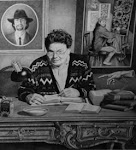
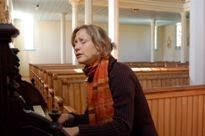
A correspondent in Germany, who is a fan of both Elizabeth Bishop and Helena Bonham Carter just sent me a link to the latter offering a truly delightful reading the former's "Letter to NY." Check it out here. Stay safe and well.
Thursday, February 18, 2021

Monday, February 15, 2021
Sanderlings and Sandpipers
Belfast’s Mary Montague is a poet, naturalist and writer for The Guardian. In a recent piece she describes an encounter with sanderlings, akin to semipalmated sandpipers, marvelous shore birds that are mesmerizing to watch. Mary is a big Elizabeth Bishop fan and has been to Nova Scotia and Great Village. When she was writing this piece, Mary wrote me to ask if the bird Bishop saw that inspired “Sandpiper” might have been a sanderling, and it could have been; but I have always been under the impression that she was seeing semipalmated sandpipers. In her Guardian piece, Mary evokes EB’s “Sandpiper” as she watches the fascinating birds inhabit the shoreline. Bishop is turning up in so many places these days. It is nice to see her words resonate with so many people, on so many levels. Her relevance continues to intensify.
You can
find out more about Mary Montague on her website, and read all her pieces in
The Guardian by clicking here.

Thursday, February 11, 2021
Moya Pacey’s new poetry collection
Australian poet Moya Pacey has published a new collection, Doggerland, evocative poems about her childhood in England. Each poem is a memory gem, as vibrant as it is unsettling, as resonant as it is mysterious.

Moya was the winner in the adult category of the Elizabeth Bishop Centenary Writing Competition in 2011 and is featured in our Echoes of Elizabeth Bishop collection (2012). Indeed, one of the poems in her new collection, “I Feel You Breathing,” is a poetic version of the story which won her first place. This collection is one that Bishop herself would appreciate, filled as it is with particular and peculiar details, and the child’s perspective.

(Moya Pacey from her Facebook page)
Monday, February 8, 2021
"Second Load of 110" --
-- was the bus I took home from Lyndon School when I was in Primer
Class -- we had to wait until the First Load had been safely delivered before we
could embark on our quotidian trip home. I have spent this morning watching the
1936 Japanese film "Mr. Thank You," based on Yasunari Kawabata's short story of
the same name, a depiction of a bus covering a route of some eighty kilometers
through rural Japan to Tokyo, its driver as famous along his route for
expressing his gratitude to every person he passed and flock of chickens he
scattered as Abner Packer was on the road to Mobile for exchanging waves with
Buddy and Miss Sook in Truman Capote's "Christmas Memory"; just the other day I
was reading C. S. Lewis's The Great Divorce, with its bus journeying from Hell
to Heaven, and its own curious driver. These disparate vehicular peregrinations
combine for me with the bus in Bishop's "Cape Breton" and thence with its
Doppelganger journeying west in "The Moose" -- all these embodying some vast
archetypal microcosm, the universality of which in literature I find
appropriately paralleled in mathematics by the computational universality of one
of the simplest one dimensional cellular automata, "Rule 110" (wouldn't you just
know it would be 110...) in
Wolfram's numbering scheme
for such objects. Looking out the window of this Bus of Buses, I can just make
out now, for once, then, something --
Apostles. Lupins.
Admonitory fingers.
Their sole suppliants.
for Elizabeth Bishopon her one hundred tenth birthday.
I am so grateful to my partner in crime, Sandra Barry, for providing the First Load of 110 earlier this morning, making this second load possible, and to her partner in crime, Emma Fitzgerald, for having generously shared with me some time ago a photograph she took of lupins in the garden of Casa Mariana in Ouro Preto, which convinced me of the universality of correspondences between Nova Scotia and Minas Gerais.
Happy Birthday Elizabeth Bishop!
On this stormy day in Nova Scotia (we have already seen over 30cm of snow where I am situated) which marks Elizabeth Bishop's 110th birthday, I share a bright, cheerful and sunny drawing from Emma FitzGerald, the illustrator of Rita Wilson's wonderful book about EB, A Pocket of Time (Nimbus 2019).

Of this image, Emma writes:
"I am attaching 'Bike and Bloom' which I sketched in Great
Village in October 2013 during my first residency at the Bishop house, a few
days after the anniversary of her death. It is currently being reworked into a largescale 'mural'/wall
art for a financial institution in downtown Halifax at King's Wharf on the
water, (my deadline for refining the drawing is Feb 8 - Bishop's Birthday) so
it will have a new life in a new form."
Emma will let us know when her mural gets underway -- probably not for some time, but even so, something to look forward to when the snow is swirling outside and the wind howling.
Happy Birthday Elizabeth Bishop!
Thursday, February 4, 2021
Elizabeth Bishop Day in Key West

This proclamation just in from Malcolm Willison. Nice to see the folks in Key West will mark EB's 110th birthday, even amid a global pandemic. Thanks Malcolm for sharing this news with us. (click to enlarge the image)
Tuesday, February 2, 2021
Brainpickings on "One Art"
The poetry blog "Brainpickings" calls "One Art" "the ultimate pandemic poem" and "a haiku in the higher mathematics of meter." Read more effusions here.
Thursday, January 21, 2021
Dana Gioia and Elizabeth Bishop, et al.
Just out, a new memoir by the American poet Dana Gioia, reprising his delightful New Yorker piece about Bishop, which appeared in the 1990s, as well as encounters with a number of other famous writers who influenced him. I am delighted to write that we will be featuring a review of this book by American poet, scholar and educator Tristan Beach. His review will appear sometime in February. Stay tuned!

“Wonderfully evocative of the literary world in the 1970s and 1980s, these essays are fascinating snapshots of remarkable encounters which, when brought together, chart a delightfully unusual path to literary success.”―Booklist
“In deft, graceful essays, poet, literary critic, and librettist Gioia recalls six 'people of potent personality' who shaped his vocation . . . An appealing literary memoir.”―Kirkus Reviews
“Reading Studying with Miss Bishop is like being at one of those memorable dinner parties, attended by the best and brightest, sparkling with wit and excellent conversations.” ―Julia Alvarez, author of In the Time of the Butterflies and Afterlife
“Gioia has been uncommonly lucky in meeting many major poets, among them Elizabeth Bishop. His portrait of her in these pages is shrewd and subtle. The famously elusive poet quivers into life here.”―Jay Parini, author of Borges and Me: An Encounter
In Studying with Miss Bishop, Dana Gioia discusses six people who helped him become a writer and better understand what it meant to dedicate one’s life to writing. Four were famous authors―Elizabeth Bishop, John Cheever, James Dickey, and Robert Fitzgerald. Two were unknown― Gioia’s Merchant Marine uncle and Ronald Perry, a forgotten poet. Each of the six essays provides a vivid portrait; taken together they tell the story of Gioia’s own journey from working-class L.A. to international literary success.
PUBLICATION DATE: January 12, 2021
ISBN: 9781589881518
CLASSIFICATION: Memoir
SIZE: 5 in. x 8 in.
FORMAT: Trade Paper
PAGES: 184 pp.
PRICE: $16.95
DISTRIBUTED BY: Consortium Books Sales & Distribution 800.283.3572 www.cbsd.com
******************************
Thanks to John for welcoming in 2021. As he wrote, I will be returning to Letters to Aunt Grace, sometime in the near future. Bishop would turn 110 on 8 February, were she alive -- with the pandemic still raging around the world, celebrations on this anniversary will have to be mostly virtual. The EBSNS has set a date for its 2021 AGM -- Saturday 19 June, in Great Village, N.S. Let us hope it can happen this year! Again, stay tuned and thanks for reading the blog.
Friday, January 1, 2021
WELCOME, 2021!
It hardly seems possible that a decade has now passed since Nova Scotia marked Elizabeth Bishop's centenary year in 2011. This year, as we continue to follow Sandra Barry's detailed presentation and explication of Bishop's correspondence with her Aunt Grace, we will also from time to time look back on some of the beautiful moments of the centennial celebration, filled as it was with the contributions and original works of so many writers, musicians, composers, artists, readers, scholars, and people from so many other walks of life.
Welcome, 2021! Come into the kitchen of EB House and have a cup of tea and a slice of cake with us, and then settle back for a nice long chat.
Sunday, December 20, 2020
Happy Holidays
On the eve of the solstice and as the holidays approach, the EBSNS extends warmest best wishes to one and all. Few of us will be sorry to see 2020 end. Let us all hope that 2021 will be safer and better.

(Looking over the back field towards the river
from the verandah of the EB House. Photo by Brenda Barry)

(Looking through an upstairs window in the EB House
at St. James Church. Photo by Brenda Barry)
Wishing for peace and health for each of us and for the world. Blessings of the season.
Tuesday, December 8, 2020
Suzie LeBlanc appointed to new post
EBSNS Honorary Patron Suzie LeBlanc is making history on the West Coast of Canada with Early Music Vancouver. Congratulations Suzie!!

(Suzie sitting in dining room of the Elizabeth Bishop House
in Great Village, N.S. Photo by Laurie Gunn.)
December 7, 2020
Lauded Canadian Soprano and Early Music Specialist Suzie LeBlanc Appointed
EMV Artistic and Executive Director
A charismatic and tireless champion of early music and Acadian culture, LeBlanc is an internationally celebrated Canadian soprano, an early music specialist and educator who is admired by artists and administrators alike. Born in New Brunswick, but currently residing in Montreal, she has managed a globe-spanning career for 35 years, has served as Director of Cappella Antica at McGill University since 2018, and was the Founder and Artistic Director of Le Nouvel Opéra from 2005-2019. LeBlanc has been awarded four honorary doctorates for her immense contributions to music and music education, and was named a member of the Order of Canada in 2015.
"I
am tremendously excited to be joining an organization I have long admired - and
with whom I have a deeply personal connection - having first performed with EMV
in 1984. As I lead EMV in its next chapter, I approach this opportunity with
great enthusiasm and a profound sense of responsibility,” says LeBlanc. “We are
in an unprecedented time fraught with challenges, but also with great
opportunity. I look forward to building on the strong foundations of EMV and
its excellent reputation to create meaningful and inspiring experiences for
performers and audiences alike. Throughout my career, it has been important to
me to uncover the work of women composers and amplify undervalued voices in
historical music.
Recently,
it has been my pleasure to provide mentorship to young Indigenous artists
working to include an Indigenous narrative within the early music community. I
look forward to collaborating with like-minded artistic and community
organizations in Vancouver to foster sustainability, diversity and inclusion.”
LeBlanc’s very first professional
engagement was for Early Music Vancouver in 1984, performing with the
Montreal-based Musica Secreta ensemble.
She has performed on main stages throughout Europe (1987-1999) including Het
Concertgebouw, De Nederlandse Opera, The Vienna Konzerthaus,Wigmore Hall, and
the Proms in London. She has toured the globe with world leading Early Music
ensembles and worked with conductors and collaborators Ton Koopman, Sigiswald
Kuijken, Richard Egarr, John Toll, Emma Kirkby, Rachel Podger, and Stephen
Stubbs. Returning to Montreal in 2000, she performed with major symphony
orchestras on both sides of the border. Her 70 professional recordings have
received international praise including a GRAMMY Award for Lully's Thésée, a CINI award (Italy) for the
opera Orfeo by Sartorio, and an East
Coast Music Award (ECMA) for Best Classical Recording of the album “I am in
need of music”, set to the poetry of Pulitzer-Prize recipient Elizabeth Bishop.
In 2005, she founded the Montreal-based
company Le Nouvel Opéra - alongside Alexander Weimann, also Artistic Director
of Pacific Baroque Orchestra (PBO), who will become her collaborator once again
through EMV. Le Nouvel Opéra produces baroque opera and contemporary works in
its home city, as well as Vancouver and Berlin - and has recorded several
albums. Under LeBlanc’s guidance, the organization possessed a strong education
mandate, offering mentorship and running workshops via Lunenburg Academy of
Music Performance, the Orford Art Center and Mount Allison University. LeBlanc
has always been a devoted early music educator, currently serving on McGill
University’s Faculty of Voice.
“I first got to know Suzie as
a fan of her recordings and then had the honour of working with her on stage
many times over the years. She is an internationally renowned artist who brings
decades of experience working at the very top of the field of early music,” says Matthew White, former EMV Executive and
Artistic Director, and current CEO with Victoria Symphony. “A uniquely creative
and innovative thinker, I am confident that Suzie will help to further expand
the definition of what encompasses historically informed performance practice
and grow EMV’s audience and impact both regionally and internationally. I’m
excited to see the ways in which Vancouver will be made richer by her
contributions.”
LeBlanc succeeds Executive and Artistic
Director Matthew White, who assumed the role in 2013 after the retirement of
long-time Artistic Director José Verstappen and Managing Director Sarah
Ballantyne.
LeBlanc will oversee the remainder of
EMV’s 2020/21 Season, a series of professionally produced, pre-recorded
concerts broadcast online via EMV’s Digital Concert Hall.
About Early Music Vancouver (earlymusic.bc.ca)
Early
Music Vancouver (EMV) has a long-standing international reputation for the
presentation, production and study of classical and traditional repertoires
using “historically informed performance practices.” Historically informed
performance is based on two key aspects: the application of the stylistic and
technical aspects of performance, known as performance practice; and the use of
period instruments which may be reproductions of historical instruments that
were in use at the time of the original composition.
EMV
now offers the largest programme of its type in North America, presenting and
producing an average of 50 to 60 concerts per year featuring internationally
renowned local, regional, and guest artists. EMV has a Main Season that runs
through the Fall, Winter, and Spring, as well as a growing annual summer
festival that was rebranded as the Vancouver Bach Festival in 2016. In 2019,
EMV began the Pacific Baroque Series in Victoria, BC. It also has substantial
education and outreach programmes including the Baroque Orchestra Mentorship
Programme and BC Scholarship Programme. Most recently, EMV launched its
Passport Series, a series of concerts that explore the diversity of music from
different musical cultures on different continents, in their unique historical
context.
-30-
_________________________________________________________________________
For further media information, contact
Laura Murray | C. 604.418.2998
Friday, November 27, 2020
Letters to Aunt Grace, Part 149: Houses, poems & more
After the two deeply personal family issues that comprise the bulk of Bishop’s 3 August 1963 letter to her aunt, she began a slow wind-down, still focused on various family and domestic matters.
Grace had taken to heart Bishop’s query in a previous letter about possible houses available in Great Village and had sent along “information about the houses,” for which Bishop thanked her aunt. Bishop had already indicated to Grace that this desire for a house in Nova Scotia was “just a wild day-dream of mine,” reiterating it again. That said, Bishop thought “several of them sounded good,” good enough that she was “awfully tempted to write about them.” But concluded quickly, “it’s crazy.” She felt that one day she would “get back again,” and then she would “go there and look around.” She was especially interested in “the old Angus Fulmore house!” Her preference was for “something old, and with one of those heavenly peaceful views.” She also wanted “as much land as possible – I’d want a cow, some ducks! – and a pig or two.”

(Great Village from Hustler Hill, with St. James Church
in centre of view.)
As unlikely as it might be, Bishop still thought “it may happen yet” because they were “getting fed up with Brazil in many ways.” She couldn’t say “what will happen politically.” She was thankful to her aunt for sending the information, “it is nice to have those places to think about.” Indeed, she told Grace that she remembered “most of them, I think.”
With only a dash for a pause, she then reported, “I have three N S poems on the fire now – and a new short one about the painting – IF it turns out all right,” revealing that indeed the receipt of the painting had instantly triggered not only the idea for but the actual start of “Poem.”
As nice as all this poetry was, Bishop quickly noted that she was “too hard up again to be dreaming about real estate,” confessing that she had “dug into that fellowship that was supposed to be for travel only,” guessing “they’ll be lenient.” This fellowship was likely from the Chapelbrook Foundation. She was awarded one in 1960, so she had held onto it for some time.
Then a quick gear shift to one of her perennial concerns: “What you say about Miriam sounds awfully good to me.” Bishop asked the child’s age (just over two) and editorialized, “In the world as I see it right now – rather gloomily, I’m afraid – being slightly retarded [“oh dear,” as Bishop was wont to say] won’t make the slightest difference.” In Bishop’s view, “no one will ever notice at all!” Indeed, she felt that Miriam “may even catch up, or be very good at one thing – who knows.” It must be remembered that it was 1963 and cultural views of people with learning and cognitive challenges were significantly different. Bishop’s unfortunate language and assessment was, sadly, the norm. She quickly added, “I’m sure Phyllis is a good ma.”
The remainder of the letter was a series of short paragraphs that flitted about various subjects. A brief commentary on the weather and seasons followed. It being August, Bishop wondered if it was “strawberry season” in Nova Scotia (a bit past by that point). In Brazil it was, of course, winter, one that hadn’t been cold, only “a few cold spells, but since we’ve been in Rio all the time we’ve scarcely noticed it.” Indeed, Bishop observed that she had “been swimming off and on all ‘winter’.”
The next two-line paragraph asked, “What’s the matter with Hazel’s back?” meaning her cousin Hazel Bulmer Snow. Bishop then asked Grace to “remember me” to this cousin, “Aunt Mabel, wherever she is,” and also to “the Leightons [sic: Laytons] and Ruth Hill.” The latter was her mother’s best friend in childhood.
Grace had told Bishop about a new “fur jacket,” which sounded “very swell,” to her niece. When Bishop had been last in New York, she wrote, “I borrowed a fur coat,” which “had been a beautiful one, but was falling apart.” She remembered that “once in a restaurant I threw it back over the chair and revealed two huge safety pins holding the sides together.”
The penultimate paragraph shifted to her paternal side by observing that she had yet to hear “a word about Aunt Florence’s ‘estate’ – if any – for months.” When she had last heard, “in early June,” from her Bishop cousin Nancy, her “husband was very sick in the hospital.” Since then, “not a word.” She reported to Grace that “they are all fighting … about whether what is left of the Bishop Co. should fold up or not.” She observed with no irony and much relief that she was “glad I’m far away,” and noted that she was “the only B[ishop] left,” scribbling in the margin, “(thank goodness).”
The final paragraph quickly concluded with Bishop’s plan to “write lots of notes telling people why I haven’t written.” Elizabeth Naudin had passed on Aunt Mary’s observation that Grace was ‘looking awfully well” when they had seen each other. So, Bishop hoped that her beloved aunt was actually “feeling that way.” She urged Grace to “please write soon and repeat anything I should have known from the missing letter.” Concluding, as usual, with “Lots of love.”
Bishop’s next letter, a substantial epistle, was not written until late September. The next post will begin to account for it.
Friday, November 20, 2020
Letters to Aunt Grace, Part 148: “Poem”
Bishop’s late July encounter with Elizabeth Naudin – which triggered her account of the tensions between them in her 3 August 1963 letter – had been prompted by a gift from Aunt Mary that Naudin was commissioned to deliver: “Mary sent me a little painting by Uncle George [Hutchinson] (I’m sure – It isn’t signed, but it must be).” This painting was none other than that which is now routinely called the “Poem” painting. Bishop was always open to receiving any and all family treasures that her aunts were willing to part with. The receipt of this special gift immediately triggered a response, the language of which formed a core of the poem she wrote years later: “tiny, a long shape – adorable – Do you remember it?” It is as if the poem was already starting to clarify, in proto-form: “it is really awfully good – just a little sketch.” Bishop acknowledged unequivocally: “I am crazy about it.” Then added more prescient poem phrasing: “I think it must be Nova Scotia – there is a brown house, the other white.” For Bishop it “looks like N S” because she had never seen “that kind of brown house anywhere else!” she was clearly thrilled, this painting cutting through all the frustration and disappointment she had felt because of her cousin’s behaviour. Bishop asked Grace: “Do you know anything about it?”

It must be remembered that this painting would have initially been in her grandparents’ home – a painting done by George W. Hutchinson perhaps in 1898 when he spent nearly a year in NS. The Bulmer family home, humble as it was, was filled with artwork done by GWH and Maude Shepherdson (as well as other painters – e.g., the portraits of Arthur and Gertrude that hung there were done by a now unknown itinerant painter). Bishop grew up looking at walls covered with this kind of creativity. Mary was not known for being generous, so that she passed on one of Hutchinson’s painting was, in a word, a big deal. Mary had inherited a number of Hutchinson paintings after Elizabeth Bulmer died in 1931. The person who ended up with most of them after Mary died was Elizabeth Naudin (which makes me wonder if she was a bit annoyed that her mother was giving away some of her family inheritance).
Bishop declared to her aunt: “I am awfully glad to have it.” And she noted that the only thing connected to George Hutchinson that she had was “that photograph of him and ‘dear Lily’ you sent me.” Lily was Lily Yerbury, Hutchinson’s second wife. Bishop knew something of Hutchison’s life, knew he had returned to Nova Scotia from England at some point. Scrawled in the left margin of the letter was another question: “Do you know what year G.H. was back in N.S.? – around 1900?”

(George W. Hutchinson and Lily Yerbury Hutchinson,
circa 1920s. AUA.)
Having this little painting made her want more: ‘I’m wondering if sometime I could have the one Aunt Maud [sic] used to have over the bookcase for so long.” This painting was also likely of Great Village: “a bigger, rectangular one – a stormy sky, trees, water, too – remember it?” She imagined that “Uncle George [Shepherdson] has it.” It was a painting she “always liked very much.” Though she wondered if George Shepherdson had “given it or promised it to someone else.” Quickly, she added, “I don’t want to be greedy – but I have nothing of his [GWH], (until M sent this one) nor of Aunt Maude’s.”
Shortly after this yearning, Bishop typed: “I wonder how Uncle George [Shepherdson] is?” Even after all the years that had passed, even after all the abuse she suffered from his hand, Bishop still wondered about this problematic relative. She thought “perhaps [Grace] said in the letter that got lost” how he was doing. In the end, Bishop simply labelled him, with some small degree of pity, if not sympathy, “poor old guy.”
Before she moved on to the next part of the letter, she reported to her aunt that while the Naudins were in Montreal for the family wedding, “they found out …. What was ailing little Patricia – cortisone taken the wrong way”. Bishop hoped that “maybe now she’ll be all right.” And then she told Grace that the Naudins were heading “to Porto Alegre to live, next week sometime.” She told her aunt that this “big city” was “south quite a way,” a place she had “never been,” and concluded, “perhaps a better climate for the baby.”
The next post will pick up the final subjects of this important letter, including more nostalgia for the North.
Friday, November 13, 2020
Letters to Aunt Grace, Part 147: Family tensions
Bishop’s next paragraph in the 3 August 1963 letter broached a delicate family matter, but since Grace understood the context (or at least could probably guess it), Bishop was not explicit. Rather, she wrote around it, assuming her aunt understood.
Bishop confirmed that she had a letter from Grace dated 15 August, “but oh dear the one before that must have got lost.” Bishop’s preoccupation with Lota’s operation and recovery may have been a factor in the lost thread – if the letter had been delivered at all (which is not clear). Bishop hated missing any of Grace’s letters. In that 15 July letter, her aunt had referred to “one in which you spoke about Suzanne” (that is, Elizabeth and Ray Naudin’s oldest child). This reference is what made Bishop realize that one of Grace’s letters had not reached her: “I didn’t get that [one].”
In her May letter to Grace, Bishop had expressed frustration with Elizabeth Naudin. Realizing that Grace had written about her cousin in the last letter made Bishop reflect: “I shouldn’t have said anything, I suppose, even to you.” That said, Bishop respected her aunt and noted that she still would have liked “to know what you think,” that is, she wanted to know what Grace had written about this subject. Sometimes the significant space-time between these exchanges created gaps that could not be bridged.
Bishop then reported that her cousin “got back in the middle of my hospital stay and called up.” The Naudins had gone to Montreal to attend Joanne Ross’s wedding. Part of the reason Elizabeth Naudin had made contact was because Aunt Mary had sent Bishop something via her daughter (more about this something in the next post). Bishop told her aunt that she wasn’t able “to see her until two days ago.”
Clearly, the reunion had not gone well, though Bishop does not give the details. All she was willing to share was her feelings, starting by observing that she had “a very high boiling point, you know.” The issues between these cousins had been on-going, Bishop reiterating that “it takes me a long time, years sometimes, to get really angry.” Her tolerance and patience and benefit of the doubt had run out, for some undisclosed reason. Bishop declared that she was now “ANGRY” to the point where she was “not going to see her again and that’s that.” When the high threshold was breached, Bishop noted “I’m afraid I stay that way.”
Grace would surely have wanted to know the details, but Bishop was wary of putting them on paper (and perhaps it was too complicated to explain). She said only that “when I see you I’ll tell you about it.” Even writing this much seemed too sensitive to Bishop, so she asked her aunt to “Please say nothing at all to Mary, naturally.” Bishop had already written Aunt Mary “a note, but said nothing.” Bishop concluded, about her own role in the matter, that she was “weak-minded, that’s all – one of my big troubles!” And ended the subject with “enough is enough.”
Bishop shook off that unpleasant report and for the rest of the letter focused on a range of subjects (all for the next posts). When she reached the end of the letter on the second page, however, she realized she was not quite done with the upsetting subject. She turned the second page upside down and typed a short paragraph about her cousin and their severing. First, she expressed her regret: “I’m awfully sorry about the E business.” She reported to Grace what her aunt likely knew, that the Naudins were “going away from Rio,” that is, moving; in the end, the distance meant “it will be all right.” Most importantly, it meant “Mary need never know.”
Bishop observed that this young cousin “has never really liked me, I feel, -- or something – maybe she doesn’t like anybody.” Something else had happened though, as Bishop then wrote with clear exasperation: “there are some things I just can’t take.” A hint of what might have caused tension from Elizabeth Naudin’s point of view is Bishop assuring her aunt that she “never once said anything critical to her – held my tongue always.” Bishop appreciated her cousin’s children and gently noted, “I did like seeing the little girls.” In the end, Bishop chalks up the division thus: “We have nothing in common, of course.” As Bishop’s letters to Grace reveal she “offered” frequent “invitations, introductions etc.” But her cousin “refused every” one of them, “always.”
Bishop’s benefit of the doubt had her think at one point that her cousin “might be timid – but no – I don’t think its that.” And then the final quick comment that perhaps was a direct clue to the source of the tension: “And he’s always been rude and aggressive – from the start.” That is, Ray Naudin.

(Thomas Travisano, Elizabeth Naudin, Phyllis Sutherland,
Sandra Barry, circa 2000. At Phyllis's home
in Balfron, N.S.)
Decades later, when I met Elizabeth and Ray Naudin, there was no hint of this tension. The Naudins seemed genuinely interested in their famous relative who was getting so much attention in the literary world. Certainly, with respect to her maternal family history, Elizabeth Naudin possessed a significant material part of it: a small gallery of George W. Hutchinson paintings, including “Large Bad Picture.” These paintings were inherited by the “little girls” after the Naudins died. All this said, I did learn from Phyllis Sutherland that the Naudins possessed a sense of their stature in the world, which didn’t always sit well with Phyllis. Well, this kind of dynamic happens in most families. What it says to me is that Bishop remained actively involved in family dynamics throughout her life, even when she was far away in Brazil and could easily have dispensed with it all.
The next post picks up the gift, an important gift, that Mary sent to Bishop.
Saturday, November 7, 2020
Letters to Aunt Grace, Part 146: Lota’s operation
Bishop’s 3 August 1963 letter to her aunt is a dense, two-pager, which will require several posts to work through. The subjects are primarily domestic and family, which means complicated. Even though her previous letter was written only a month before (about the average time between letters for Bishop), she noted that it felt “as if I hadn’t written you for a long time.” That feeling was, she determined, “because so much has been happening,” especially in the past two weeks: “Two weeks ago today Lota was operated on for an intestinal occlusion.” She had been discharged only “two days ago.”
Bishop then offered Grace, a retired nurse, an account of the whole process, which started with “stomach upset.” Bishop observed that Lota had experienced this condition “once or twice lately, vomiting.” They chalked it up to her “being overtired” from all the busy, stressful work on the Rio park. The difference “this time” was “the vomiting didn’t stop.” She went for “X rays the 2nd day” and was “rushed off to the hospital.” This issue was serious, causing the indomitable Lota to be “fed intravenously,” which required “a tube in her poor nose for about eight days.” Bishop’s comment about this intervention: “Poor thing, it was tough.” All was well now: “she’s fine but naturally tired,” and was still sporting “a huge bundle of bandages” and “all the stiches in.”

(Lota on right, at a meeting about the park, early 1960s.)
Bishop had only praise for the hospital, which she described as “excellent and so were the doctors.” It was standard practice to “let someone – or want someone, called the ‘acompaniente’ – to stay – so I stayed, along with the nurse.” Bishop slept in the large room for “a week.” She conceded that the whole ordeal was “an awful scare for a few days.”
One of her big tasks was “to keep ALL visitors away except me and one or two close friends.” And now that they were back home, at their apartment, this job became even more difficult: “Brazilians treat a sickness like a party – or like a wake.” It kept Bishop and the maid “running all day long fending off callers, serving hundreds of little coffees.” Or so it seemed to Bishop. And all this “getting rid of people” had to be done “tactfully.”
After the ordeal, Bishop hoped that Lota would be “made to rest for a month.” Bishop reiterated that the cause of it all was “mostly because of overwork, I suspect.” But Lota was already gearing up again, as Bishop wrote, “yesterday she had her secretary here and dictated letters – oh dear.”
Bishop noted that it had been a “good thing … it happened here instead of in New York – where it would have cost a fortune.” Then Bishop confessed to Grace that she “lied to her [Lota] for 24 hours or so (the Dr. said to),” telling her “she wasn’t going to have an operation.” But barely “half an hour” before the surgery, “the nun came in and asked her, ‘Daughter, do you believe in God?’” The “very anti-church” Lota replied, “More or less, sister.” Then she turned to Bishop and declared, “Well, you can’t fool me any longer, after that!”
Bishop quickly observed that Lota “was very brave, -- I must say.” Scribbled in the left-hand margin next to this long paragraph, Bishop wrote: “9 people visited with me all through the operation! 2 ½ hrs.”
They had some support from “our best friend, Mary Morse,” who came to Rio “from Petropolis with her two adopted babies.” Grace would have remembered Monica, who was “almost 3 now.” The second child was only “3 months.” Bishop’s word for these children: “darlings!” As much as she adored these babies, however, she observed to Grace: “I know what you mean about small children!”
Adding them to the mix in the household when she “was tired from all the hospital business” was a challenge. Monica was active and just as Bishop “had barely got to sleep,” the child “was pounding at the door saying, ‘Open the door, Aunt Elizabeth – I want to say good-morning to the canary’.” Not to mention her “jumping up & down on top of” Bishop. As soon as Lota left the hospital, “Mary went to stay with friends.” Having them all together in the apartment “would be too much for an invalid.”
After this dramatic and detailed account, Bishop quickly concluded, “all is fine now and everyone recovering.”
The next subject Bishop broached concerned a stressful and delicate family matter. The next post will pick up this reveal.
Saturday, October 31, 2020
Letters to Aunt Grace, Part 145: A Canadian visitor
The next section of Bishop’s 10 June 1963 letter to her aunt is a long, dense single paragraph, the letter really getting underway with subjects. Before launching on a story, Bishop began with two questions: “How are you and where are you?” She had once again lost track of the elderly traveller, so opted to “send this [letter] to G V – or C/O Phyllis might be better.” Invoking her cousin was on purpose, it seems, because it prompted a third question: “How is Miriam?” (who would have turned two on 4 June). Miriam was clearly on her mind because she then told Grace about a recent encounter, “last week,” with someone who offered some unexpected information that made Bishop think of Miriam. This person was “a visiting Canadian girl who is a great [horse] rider.” Sadly, she does not provide a name for this interesting person who lived “near Paris!” and was “raising horses and teaching riding.” During their “conversations” this young woman “just happened to tell me a long story about how she taught a little girl – 8 yrs old – just like Miriam, apparently – to ride.” She explained that this activity did “wonders” for the child. Lest Grace think she was offering unsolicited advice, she quickly added, “…I’m not suggesting you put the baby on horseback!” Bishop had just found it “interesting to learn that apparently any kind of physical training, sports, etc – helps a lot.” She added that the child’s doctor “had congratulated” the young woman on “the little girl’s vast improvement in coordination, etc.” Bishop assured Grace that the young woman’s story was spontaneous, that she had not mentioned Miriam at all.
Bishop further explained that this young woman “has been living in Europe a long time.” She was “visiting friends here who brought her to dinner.” The visit of this Canadian coincided with a culinary treat Bishop had regularly made thanks to “an American friend … who can use the U S Post Exchange (where government, U.S., people buy everything.” This friend had gifted Bishop with “a large hunk of corned beef and some frozen blueberries.” So, the meal Bishop made for their guess was “corned beef and cabbage, and then blueberry fungy (however you spell it).” [Ed. Note: Bishop had spelled it correctly. This traditional N.S. dessert is also called blueberry grunt.]

She elaborated on the dessert, noting she made “it in the oven with sour cream biscuits.” She noted that she made this treat whenever “this American happens to give me blueberries – which she does once a month or so.” Well, “the Canadian girl couldn’t tell what the dessert was until she took a bite.” Her response: “My God – its’ been twelve years since I tasted a blueberry!” Even though frozen blueberries couldn’t “compare with the good old wild ones, naturally,” the dessert was “not bad” and the “dinner was a great success.”
Perhaps the visitor and the blueberries were the cause of what Bishop then observed: “I am going through another wave of nostalgia for the NORTH.” Even Lota was in on the pining, asking Bishop “to write about the price of a little old houses we know of in Connecticut.” Bishop knew such thoughts were “just the wildest day-dreaming – but I’d STILL like to own something in or around G V, I think.” Getting there was the question, of course, “but one never knows, these days.”
Lota was deep in her job creating the park in Rio, but that would end one day and Bishop speculated that they “might leave Brasil for a good long stretch – I don’t know.” Just in case, Bishop asked her aunt to “keep your eyes opened.” She even pondered her grandparents’ house: “Are Norman (is it Norman?) & Hazel [Bowers] still living in the old house? I mean our – your – old house?” She wondered if they might “ever want to sell it?” Quickly, Bishop asked Grace not to “mention me, for heaven’s sake – both sides of my family seem to think I’m a millionaire, I suspect!” Part of the reason for that suspicion was because she lived in “a big house – but it’s somebody else’s!” She was sure her relatives were “all richer than I am.”
Typed vertically in the left margin of the letter, Bishop asked if there were “oil furnaces in N.S. now?” She assumed there must be and added, “I don’t think I could cope with an old-fashioned furnace.”
The letter was now winding down. She had tucked in some money apologizing for its belatedness, “I had the idea of sending you this to get a new hat for the wedding – and then I just lost track of the time.” The newspaper clipping that Mary had enclosed in her letter to Bishop, a description of the wedding, noted “that Mary had a hat of blue tulle.” This prompted Bishop to say that “maybe you’d still like a hat – if this [amount] will buy a hat any more! Half a hat, perhaps.” With a final request: “Please write soon,” Bishop closed with her usual “much love.”
About a month and a half passed before Bishop wrote again to Grace, on 3 August 1963. The next post will take up its epistle.
Saturday, October 24, 2020
Letters to Aunt Grace, Part 144: Back to 1963
The last “Letter to Aunt Grace” that I posted was on 7 April 2020. Months have passed but I was diverted by “Two Arts,” the EBSNS virtual exhibit, our first such exhibit, necessitated because of the pandemic. The exhibit is officially over, but you can still see Natallia Pavaliayeva’s wonderful Bishop inspired drawings by clicking the link in the menu on the right. There are still images for sale, if you are interested, and information about how to purchase can be found on the “Two Arts” page.
I am glad to be able to turn once again to Bishop’s
letters to her aunt. The last post in this series was for the letter dated 16
May 1963. In that letter, Bishop mentions that she had met the writer James
Baldwin. Interestingly, recently, a friend sent me a link to an essay by Magdalena Zaborowska, a Baldwin scholar, about his home in the south of France. It
resonated with me in many ways because of my own involvement with the Elizabeth
Bishop house. I highly recommend this fascinating essay.
********************
Bishop’s next letter to her aunt is dated 19 June 1963, written in Rio, not quite a month after the previous missive. She begins right off the top reporting to Grace that she had recently heard (“Saturday”) from Aunt Mary, after not hearing “from any of this side of my family for so long.” Mary wrote to report on a family wedding: her daughter Joanne to Frank Eartly. Bishop noted that the report came “with newspaper clipping.”
Grace had, of course, attended the ceremony and Bishop wrote that Mary “said you were looking awfully well and seemed awfully well.” Bishop was “glad to hear that.” The eighty-four-year-old Grace did a lot of “jaunts” (Bishop’s term, she also referred to Grace’s travels as “gallivanting”), which often “worried” her niece. But Grace was intrepid.
Mary “had received” a letter Bishop has “mailed at the same time as one to you – in care of her,” probably the 16 May letter; but Mary didn’t indicate if she “had already forwarded it or if it had got lost.” Bishop noted that if Grace hadn’t received this letter, “it wasn’t much of a loss” because she had been “very cranky, as I remember, and gossipy.”
At that point in the narrative, something went wrong with Bishop’s typewriter (“— 33 Oh dear—” some sort of mysterious code and exclamation). She must have sorted it out and continued, declaring that she was using a “little typewriter,” not her “larger old one,” which was “being repaired.” She wasn’t “used to this one,” but she had “suddenly realized” that the usual one was “covered with RUST,” a result of “the Rio climate.” And concluded that she too was “probably covered with rust, or mildew.”

(EB in Brazil ca. 1960s. Alas, I have no idea
who sent me this photo.)
A pause and a new brief paragraph to let Grace know that Mary had written both “before & after Elizabeth [Naudin, Mary’s oldest daughter] arrived.” Mary had told Bishop that her cousin’s new “baby had no more asthma, I gather,” news that the asthmatic Bishop declared was “good.”
This letter was just getting underway. The next
post offers Bishop’s account of a Canadian visitor.
Saturday, October 3, 2020
New website for Suzie LeBlanc
"Suzie LeBlanc is a world-renowned interdisciplinary artist. Curious, nuanced and passionate, she sings and conducts to discover and share the beauty and emotional charge of music. Known for her interpretation of baroque, classical, contemporary, and Acadian works, she is acclaimed for her eclectic and original projects."

These sentences begin the “About” on the new website of EBSNS Honorary Patron SuzieLeBlanc. Her connection with Elizabeth Bishop remains strong and active and it is lovely to see all her exciting projects presented. The EBSNS will be keeping track of her creative endeavours, now and in the future, and will share those connected to Bishop when they happen. In these strange, challenging and difficult times, we are “in need of music” and poetry all the more. We thank Suzie and all her colleagues for continuing to bring us joy, solace and inspiration.
Saturday, September 26, 2020
MANNERS: Natallia Povaliayeva -- a response from Moya Pacey
Even though the “Two Arts” virtual exhibit is officially closed, below is a delightful response to one of Natallia’s drawings, “Manners,” by Australian poet Moya Pacey. The exhibit is still in the blog’s archive and you can click onto the “Two Arts” button in the menu on the right to see the images and to learn more about the fund-raiser. There are still prints for sale.
********************
Speak to everyone you meet: Receiving the print in the mail today returns me to my time spent at EB House in Great Village as a guest during the EB Centenary Festival, 2011, and the people I met there.
I leave the EB House and cross the iron bridge on my way to the Post Office, thinking of the five-year-old Elizabeth crossing it clutching a carefully wrapped brown paper parcel, addressed to her mother at the Infirmary in Halifax. Inside, the almonds her mother loved, and a letter from Gammie asking the Superintendent to please take Elizabeth’s mother, Gertrude, out for a drive. Elizabeth pushed the parcel through the post office grille with the quarter coin and left quickly, not waiting for change.

Unlike the young Elizabeth, I linger, and Bev the Postmistress introduces me to Sterling Dick a ninety-two-year-old WW2 veteran. He fought in the Pacific and was in Australia and New Zealand and then at Okinawa. He tells me he’s looking for a wife. Sarah is there from the Blakie House. She’s baking butter tarts for her guests who include Carmel Cummins, the Irish poet, who brings salmon from Kilkenny. It rivals Willy Krauch’s smoked salmon that I eat at the picnic in the grounds of St James Church at the kind invitation of Jane Kennedy, from Economy, and her sister Esther.
I meet Maxine Ryan, another local, on the horse and cart ride around Great Village. We follow the route Elizabeth took with her grandfather that Natallia Povaliayeva the artist captures in her print, “Manners.” April Sharpe dresses as the young Elizabeth and recites some of her poems along the way. I was artist in residence at the EB House in 2018, and was invited to Maxine and Bryden’s Thanksgiving Dinner. I also met up with Sandra Barry and spent a wonderful day with her looking through the Elizabeth Bishop archives at Acadia University, and met Laurie Gunn again at my poetry reading. She has worked tirelessly, with others, to get Municipal Heritage status for the EB House – all this and more returns to me – so many faces, so many memories of my time spent in Great Village @ the EB Centenary Festival.
-- Moya Pacey, September 24, 2020

Monday, September 14, 2020
Anne Stevenson (1933-2020)
A short time ago, I learned from U.K. Bishop scholar Jonathan Ellis that the poet, biographer and literary critic Anne Stevenson died today (14 September). Stevenson was a “pioneer” in Bishop studies, publishing a book about EB’s poems in 1966. She subsequently published two collections of essays about Bishop’s work. Her final book of poems came out recently with Bloodaxe Books and the publisher has posted a moving tribute to her, complete with a video of her reading some of her poems.
I first met
Anne Stevenson in 1995 – September I think – when she and her lovely husband
Peter Lucas visited Nova Scotia (it was her first visit to the province). I
remember the year because the second Quebec Referendum was happening and she
was quite interested in this event. She and Peter stayed at the Lord Nelson Hotel
in Halifax and I remember walking around town with her. I can’t remember if I
went to Great Village with her, but I might have. Even though I was a total
stranger to her, in a most generous gesture, before she left, she handed me a
folder containing copies of the correspondence between her and EB in the 1960s.
I was stunned and profoundly grateful. This correspondence, some of which is
finally published in the Library of America's Elizabeth Bishop: Poems, Prose,
and Letters, has been mined by many scholars over the past decades,
including myself. Bishop was remarkably forthcoming with Stevenson in this
correspondence and revealed all manner of things both personal and poetic.

Anne Stevenson and Peter Lucas, September 1998,
Acadia University, Wolfville, N.S. (Photo by Laura Menides)
Then I spent a bit of time with Anne and Peter in 1998. Anne kindly agreed to be the keynote speaker at “Divisions of the Heart,” a Bishop symposium at Acadia University (the repository of the Bulmer family archive) in September of that year. I remember an afternoon sitting in the Blomidon Inn interviewing Stevenson about Bishop. I wished we had recorded her keynote talk, which was lively, even feisty, and especially the Q&A afterwards. Subsequently, I had my own exchange of letters with Anne, until the beginning of the new millennium, when our communication dwindled and ceased. I would hear about her now and then from U.K. friends, but our contact became just a pleasant memory. Curiously, this past week, I had been writing about Stevenson to Walter Smart, a friend in Michigan who has become quite interested in Bishop. In the course of our lively correspondence, he mentioned Stevenson (he’s been delving deeply into all that has been written about Bishop in the past 40 years – and Stevenson is important). I wrote him some of my memories and even observed that she was still living but would be elderly by now (Stevenson was 87 – she was born the same year as my mother). And then to hear of her death earlier today – well, I wondered about this interesting convergence. I am grateful for the brief contact I had with her and immensely grateful for her sharing of such vital correspondence. My deepest sympathy goes out to her family and friends. Her passing is a loss to the world of poetry and scholarship.
Subscribe to:
Posts (Atom)

 Posts
Posts