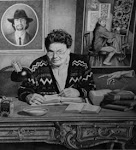
"I am 3/4ths Canadian, and one 4th New Englander - I had ancestors on both sides in the Revolutionary war." - Elizabeth Bishop
____________________________________________

Sunday, September 26, 2010

Sunday Wonder Question V: Bishop and Wordsworth? Bishop and Washington Irving??

Many scholars have noted the role Wordsworth plays in Bishop's poetry, but I wonder if anyone of our readers hears the echo of "Tintern Abbey" that I do in "The Shampoo"? I have in mind the line "The shooting stars in your black hair," which for me brings to mind the phrase "the shooting lights / Of thy wild eyes" [lines 118-119 of "Tintern Abbey."] David Kalstone in Becoming a Poet discusses one of Robert Lowell's drafts in which Lowell writes:

One reads his "Dearest friend, my dear, dear friend,"
and weeps for Wordsworth, yes, and Dorothy --
All that dry, horselike, Viking energy --
How soldierly their Northumberland reserve
Defied the Walsung's incest! ... I will serve
England's true genius, I desire to bend
With humorous awe to love's contingency,


Yet cringe disloyally from their fierce joy --
Even Victoria in all her glory
is less Olympian. Poor Wordsworth's sorry
Lightning-rod figure and sublimity
Say little after forty... The marvelous boy,
Still (thirty) guides his sister to the sylvan Wye,
Mirrors the shooting lights in her wild eye!

Kalstone asks "Were Dorothy and William meant to be prototypes of the young Bishop and Lowell?" [p. 183] I think it more likely, on the basis of the echo I hear of "Tintern Abbey" in "The Shampoo," that Lowell had in mind Bishop as William and Lota Soares, (whom Bishop addresses as "dear friend," in her poem) as Dorothy.

Kalstone doesn't mention "The Shampoo" in his discussion of Lowell's draft. Neither does Henry Hart in his extended essay "Robert Lowell: the Politics of the Sublime," (Twentieth Century Literature, vol. 37, no. 1 (Spring, 1991), pp. 105-129). Hart's analysis (pp. 123-125) posits the same pairing as Kalstone's: "In this tangled psychodrama, Lowell casts himself as the egotistically sublime Wordsworth, characteristically aligns himself with the mad, despotic King George, and casts his friend as Wordsworth's adoring sister, Dorothy. While Lowell represents the imperial father, he acts as Bishop's brother. In either case, possible sexual relations smack of incest." [p. 123] Hart goes on to assign to Bishop the words in Lowell's draft that begin "I will serve England's true genius," but it seems more plausible to me that it is Lowell himself (or his persona) who is speaking here.

* * *


A great deal more fancifully, I wonder, too, if Bishop's conjunction of "precipitate and pragmatical" draws upon the following passage from Washington Irving's The Art of Book-Making in which the two words are, it is true, somewhat more distant the one from the other, but in which, too, the mention of the frizzled and then grizzled wig might have been irresistible as a private subtext:

"But the personage that most struck my attention was a pragmatical old gentleman in clerical robes, with a remarkably large and square but bald head. He entered the room wheezing and puffing, elbowed his way through the throng with a look of sturdy self-confidence, and, having laid hands upon a thick Greek quarto, clapped it upon his head, and swept majestically away in a formidable frizzled wig.

"In the height of this literary masquerade, a cry suddenly resounded from every side, of "Thieves! thieves!" I looked, and lo! the portraits about the walls became animated! The old authors thrust out, first a head, then a shoulder, from the canvas, looked down curiously for an instant upon the motley throng, and then descended, with fury in their eyes, to claim their rifled property. The scene of scampering and hubbub that ensued baffles all description. The unhappy culprits endeavored in vain to escape with their plunder. On one side might be seen half a dozen old monks, stripping a modern professor; on another, there was sad devastation carried into the ranks of modern dramatic writers. Beaumont and Fletcher, side by side, raged round the field like Castor and Pollux, and sturdy Ben Jonson enacted more wonders than when a volunteer with the army in Flanders. As to the dapper little compiler of farragos mentioned some time since, he had arrayed himself in as many patches and colors as harlequin, and there was as fierce a contention of claimants about him, as about the dead body of Patroclus. I was grieved to see many men, to whom I had been accustomed to look up with awe and reverence, fain to steal off with scarce a rag to cover their nakedness. Just then my eye was caught by the pragmatical old gentleman in the Greek grizzled wig, who was scrambling away in sore affright with half a score of authors in full cry after him. They were close upon his haunches; in a twinkling off went his wig; at every turn some strip of raiment was peeled away, until in a few moments, from his domineering pomp, he shrunk into a little, pursy, "chopp'd bald shot," and made his exit with only a few tags and rags fluttering at his back.

"There was something so ludicrous in the catastrophe of this learned Theban that I burst into an immoderate fit of laughter, which broke the whole illusion. The tumult and the scuffle were at an end. The chamber resumed its usual appearance. The old authors shrunk back into their picture-frames, and hung in shadowy solemnity along the walls. In short, I found myself wide awake in my corner, with the whole assemblage of bookworms gazing at me with astonishment. Nothing of the dream had been real but my burst of laughter, a sound never before heard in that grave sanctuary, and so abhorrent to the ears of wisdom, as to electrify the fraternity.

"The librarian now stepped up to me, and demanded whether I had a card of admission. At first I did not comprehend him, but I soon found that the library was a kind of literary "preserve," subject to game-laws, and that no one must presume to hunt there without special license and permission. In a word, I stood convicted of being an arrant poacher, and was glad to make a precipitate retreat, lest I should have a whole pack of authors let loose upon me."

I suppose this is going rather too far...

Saturday, September 25, 2010

Successful launch of Elizabeth Bishop Centenary Writing Competition, 2011

The Elizabeth Bishop Society of Nova Scotia wishes to extend a heartfelt thank you to all those who participated in and attended the launches of “In the Village”: The Elizabeth Bishop Centenary Writing Competition, 2011.

Two lively gatherings were held, one at the Elizabeth Bishop House in Great Village, N.S. (Wednesday 22 September 2010) and one at the Writers’ Federation of Nova Scotia in Halifax, N.S. (Thursday 23 September 2010). The enthusiasm expressed and shared by all those who gathered helped to send this activity off into the world with the right tone.

The Writing Competition officially opened on 15 September 2010 and will close on 15 March 2011. For all the information about the competition (including entry form and guidelines) see the Elizabeth Bishop Society of Nova Scotia website.

We thought that you might like to see a couple photographs taken at the launches.


Launch at EB House, Great Village, N.S. Left to right: Claire Miller, Karen Casey, Paul Zann (photo courtesy of Donez Xiques)


Launch at EB House, Great Village, N.S. Left to right: Rosaria Campbell, Joy Graham, Laurie Gunn, Creston Rudolph (Photo courtesy of Donez Xiques)


Launch at Writers' Federation of Nova Scotia, Halifax, N.S. Left to right: Claire Miller, John Barnstead, Lenore Zann, Joy Laking, Binnie Brennan, Sandra Barry. The image between Lenore and Joy is "In the Village," the serigraph by Joy Laking that is 1st Prize in the Writing Competition. (Photo courtesy of Laurie Gunn)

Saturday, September 11, 2010

"In the Village": The Elizabeth Bishop Centenary Writing Competition, 2011 -- Launch

The Elizabeth Bishop Society of Nova Scotia
(www.elizabethbishopns.org)
officially launches
“In the Village”: The Elizabeth Bishop Centenary Writing Competition, 2011

Date: September 22, 2010
Time: 3:30 p.m.
Place: Elizabeth Bishop House, 8740 Great Village, N.S.
&
Date: September 23, 2010
Time: 3:30 p.m.
Place: Writers Federation of Nova Scotia, 1113 Marginal Rd., Halifax, N.S.


*****

LEARNING TO READ AND WRITE

“I was five. My grandmother had already taught me to write on a slate my name and my family’s names and the names of the dog and the two cats. Earlier she had taught me my letters, and at first I could not get past the letter g, which for some time I felt was far enough to go. My alphabet made a satisfying short song, and I didn’t want to spoil it…. By the time school started, I could read almost all my primer, printed in both handwriting and type, and I loved every word. First, a frontispiece, it had the flag in full color, with ‘One Flag, One King, One Crown’ under it. I colored in the black-and-white illustrations that looked old-fashioned, even to me, using mostly red and green crayons.”

[from Elizabeth Bishop, “Primer Class,” The Collected Prose, New York: Farrar, Straus, and Giroux, 1984.]


Photograph by Laurie Gunn

Learning to read and write is arguably the single most important primary education for any writer. Elizabeth Bishop had a particularly vivid recollection of the process which brought her to this uniquely human accomplishment. Her earliest memories of learning to read and write are set in her maternal grandmother’s kitchen, her childhood home in Great Village, Nova Scotia, quickly followed by her first formal pedagogical experience at the Great Village School. Both buildings still stand and continue to foster the language and literary arts.
*****

THE VISION

The Elizabeth Bishop Society of Nova Scotia’s mission is to raise awareness of Elizabeth Bishop’s connection with Nova Scotia, and to encourage young people to read Bishop’s work. Part of the vision of the Elizabeth Bishop Centenary celebrations in Nova Scotia is not only to mark this important anniversary and honour Elizabeth Bishop’s life and art and continuing legacy, but also to encourage Nova Scotian artists of all ages and disciplines to pay tribute to Bishop with the creation of new work.

As the EBSNS discussed what projects it would sponsor to mark Elizabeth Bishop’s 100th birthday, a writing competition, with a focus on Nova Scotia students from Elementary to Senior High, quickly became the first choice. The society felt a writing competition was an appropriate way to fulfill its mission and the centenary’s vision to bring more young people to Bishop’s poetry and stories and foster creativity and artistic excellence.

*****

YOU ARE INVITED TO THE LAUNCHES

You are invited to join us on 22 and 23 September in Great Village and Halifax to help us launch this exciting EB100 event.

There will be special guests and a chance to talk with EBSNS members about the competition and all the other Elizabeth Bishop Centenary events being planned for 2011.


Photograph by Laurie Gunn

*****

VITAL STATISTICS

“In the Village”: The Elizabeth Bishop Centenary Writing Competition opens for submissions on 15 September 2010 and closes on 15 March 2011. Winners will be announced in June 2011 and awards will be presented at an Arts Festival to take place in Great Village, 19-21 August 2011. Stay tuned for exciting announements about this festival!

Much more information, including Guidelines and Entry Form, about the writing competition can be found can be found on the EBSNS website: www.elizabethbishopns.org – click on the “Writing Competition” link in the menu. Also on the website, you can listen to Halifax storyteller Claire Miller read Elizabeth Bishop’s story “In the Village” (click the audio file link provided on this page).


Photograph by Laurie Gunn

*****

The EBSNS will also be making a preliminary annoucment about “In the Village”: The Elizabeth Bishop Centenary Arts Festival, 19-21 August 2011. An exciting line up of writers and musicians will be attending and performing at the festival. So come and learn what else is in store for the EB100 celebrations!!

Thursday, September 9, 2010

Nova Scotia Connections: Commemoration

The first act of public commemoration of Elizabeth Bishop in Nova Scotia occurred, if my memory serves me, in the summer 1992. The Elizabeth Bishop Society of Nova Scotia was formed in 1994, so it was essentially the people of Great Village, along with some scholars, academics and writers (myself included), who got together and decided to put up a marker of some kind acknowledging Bishop’s connection to her childhood home. (The idea of forming the EBSNS was being discussed by a number of individuals as early as 1992, but it was nearly two years later when the society came into existence – I’ve been looking at the incorporation papers for the EBSNS and it became official in April of 1994 – where has the time gone?)

I remember attending quite a few meetings and having lots of discussions with people in Great Village, but I do not remember the specific moment when the choice of the type of commemoration was made. It was decided to erect a bronze plaque with her name and dates and a line from her poetry. I do not want to take more credit than is due (the process was a group effort all the way), but I think it was me who brought forward the line from “Crusoe in England”: “Home-made, home-made! But aren’t we all?”

The committee that had been formed decided that the plaque should be cast at the Lunenburg Foundry, in Lunenburg, N.S., a storied business that has been in existence for decades, and was involved in casting hardware for our famous schooner, Bluenose, as well as for the replica, Bluenose II.

I would have to go back to the old files to find out who designed the plaque – a company in Halifax – and they arranged for the casting. I am not sure who suggested St. James Church as the site for the plaque. At that time, the owner of Elizabeth Bishop’s childhood home was an elderly woman named Hazel Bowers, so placing the plaque there was not an option. Besides, we all wanted it to be completely accessible to the public. The church seemed an obvious choice, situated as it is right next to the EB House and smack in the middle of the village. The church was a site of great significance for Bishop, so much so that she turned it into a powerful iconic image in her writing.

The unveiling of the plaque was a day of celebration and drew quite a few people to the village. We had put together an exhibit of the wonderful Bulmer family material which is now at Acadia University (see the permanent link to the digital archive of this material on this blog) – at that time, the collection was still in Bishop’s maternal family’s hands.


Photograph by Laurie Gunn

The plaque is still on the church – there are now other public commemorations of Bishop (a few years ago the EBSNS erected two large panels about Bishop which are displayed in the summer on a beautiful pergola structure by the Great Village River – see the EBSNS website for a closer look at the panels, which are digitally reproduced there).

Public commemoration can be a controversial activity – we all have our ideas of what is important and what should be acknowledged. Commemoration in Nova Scotia tends to focus on history, and usually political, military and economic history. Being a historian, I don’t object to this kind of commemoration, but rarely do we honour our artists in such permanent public ways. Somehow, in 1992, a group of people from Great Village and from around the province in general recognized the importance of Great Village and Nova Scotia to Elizabeth Bishop, recognized the importance of Elizabeth Bishop to Nova Scotia, and recognized the importance of poets and poetry in our lives (historically, culturally and personally) and decided to make a statement about this importance in a quiet but definite way. Bronze is remarkably enduring.

We will be commemorating Elizabeth Bishop in many ways in 2011, marking her centenary and marking her continuing influence in the world today. As we embark on this year-long celebration, I wanted to remember this initial act of commemoration because it was genuine and farsighted.

Monday, September 6, 2010

First Encounter XXVIII: In the Village, by Cathy Fynn

I learned about Elizabeth Bishop from a writer friend who had spent a week at the house in Great Village. I assumed it was a sort of halfway house for writers – a place to kick start the writing habit. I was ripe for rehabilitation, having been hooked on trying to write the same story for 20 years.

I met with Sandra Barry at the Bridge Street Café in Sackville. Over a 2-cup pot of Earl Grey, Elizabeth Bishop came to life. How had I missed such poetry? Where had Elizabeth (and Sandra) been all my life? (I’m sure every EB newbie says this.)

Now I was really excited, and intimidated. I hadn’t had a poem published since mom sent my 27 stanzas of rhyming couplets about the Kennedy assassination to the Telegraph Journal. It got rave reviews, but that was 1963 and I was 8 years old.

And did I mention that I was afraid of being alone in a strange house? Having grown up with eight siblings, many of us sleeping in the same bed, I never got used to sleeping solo (which did get me into trouble growing up, but that’s another story).

EB was an astonishing poet, but she was also a Maritimer. She would have understood my reticence (and my preoccupation with place) and welcomed me graciously. So I pack up my MacBook and a package of index cards and head east.

Forty-five minutes later, I’m standing in the driveway, feeling like an interloper. The man staring at me from the service station across the street doesn’t help. Now he’s walking towards me, wild hair flying out from under his ball cap. I jump in my car and lock the door. (I know, I really ought to get out more.)

He knocks on my window. “I’m Rick. Do you want me to mow the lawn?” I resume breathing. Rick is looking for odd jobs, assuming that I was a caretaker of the house. He tells me about the community, the history of the place, and introduces me to the two guinea hens, known as the village idiots.

Priding myself on surviving the first crisis, I pick some tulips from a bed along the verandah and go in to make tea. I fall instantly in love (with the house – the tea isn’t bad either). I immerse myself in the shelves of books by and about Elizabeth Bishop. My writing can wait; this is real treasure.

I stop reading at midnight and vow to start my writing in the morning. I spread out my index cards on the dining room table and climb the steep, shallow stairs. I go directly to the big bedroom at the end of the house, glancing sideways into EB’s room, half-expecting her to be sitting up in bed reading under her skylight.

For some reason, I’m not afraid at all. The house hums, the furnace grunts and I settle into an easy sleep.

The next day I make an obligatory visit to the antique store behind the house. (When one is faced with a pile of blank of index cards and a three-story barn of old things, there really isn’t a choice.) In one of the back rooms, a 1940’s chiffon wedding gown hangs in the corner.

A man about my age (I think everyone is my age and my height) is bent over a glass cabinet of military medals. “Do you think that will fit me?” I ask him, nodding at the dress. Absurd question. He replies: “Planning on getting married are you?” Fair question. “No, I’ve already done that twice.” “Well,” he says, “Then you’re all practiced up.” He winks and I take the dress.

As I get out my credit card, I ask the storeowner about the gown (he’s definitely younger than I am.) “Things come and go here,” he says, “but I think it’s from Schubenacadie. Yeah, I remember now. This gown was never worn. The lady’s fiancé was drowned and she never married. Never left the house again.”

Back to the house to stare down my demons. My mother also suffered from mental illness when I was a child. And although I didn’t lose her, she was lost most of the time – hospitalized, drugged or depressed. Maybe that’s why I kept going over the same story – trying to find some clue I missed that could have changed things.

In this house I don’t sense any of the desperation, fear or loneliness that Elizabeth must have experienced – none of the detached, other-worldliness of her poetry. I imagine the horror of her mother’s scream but there is no echo of it in the walls. Perhaps even houses have selective memories.

By the end of my stay I have become unstuck – learned to separate the life from the story. The life may be sad, but the story can be good, the writing rich and resonant. Elizabeth Bishop is a testament to triumphing over ‘tiny tragedies’.

By the way, the wedding dress fits (well, close enough). I went back to the antique store to thank the gentleman of the military medals for his help. His name is Walter Millen, or Water Melon as his friends call him. He said he would perform the ceremony, but I think both the dress and I are happy with where we’ve landed.

****
Cathy Fynn is a writer who lives in Sackville, New Brunswick.

Friday, September 3, 2010

Nova Scotia Connections -- Picture Worth A Thousand Words

During her life, Elizabeth Bishop had photographic portraits done by a number of well-known photographers: Josef Breitenbach, George Platt Lynes and Rollie McKenna, to name just a few. For someone as shy, reticent and private as Elizabeth Bishop, there are a remarkable number of photographs of her at every stage of her life, including from her childhood.

Indeed, Elizabeth Bishop’s family started to record her life in this visual medium almost from birth. Two of the earliest photographs of Bishop are found at Acadia University Archives — AUA has a large collection of Bishop’s family material which it has digitized; to see this collection go to the permanent links section of this blog and click on “Elizabeth Bishop’s Nova Scotia Family at Acadia University.”

One of the things immediately apparent when one looks at this family material is not only how many photographs there are (hundreds), but how vast the range of years of their creation. This family material (officially called “The Bulmer-Bowers-Hutchinson-Sutherland family fonds,” which is a list of the names of the creators and custodians of this material) begins in the mid-1800s with early ferrotype/tintype photos of Elizabeth Bishop’s maternal ancestors. The formats for the photographic images range from Victorian carte-de-visites, postcards, and early film prints and extend right up to those dreadful instant polaroid snapshots from the 1970s and 1980s, the ones that developed right before your eyes. What one sees when looking at this family material is a sort of history of photography in microcosm.

Bishop’s maternal family members clearly enjoyed having their picture taken. They not only sat for many studio portraits throughout their lives, they also were avid amateur photographers, recording their own daily lives in ways that are rather remarkable. Photography was an established technology by the 1910s and 1920s, but cameras were not as ubiquitous as they are today (and there was no such thing as Facebook!). However, the Bulmer family devoted a good deal of time recording themselves on film.

Elizabeth Bishop was born into a family quite serious about pictures. The first images of her that I mention above were essentially snapshots, not professional studio portraits. As far as we can tell, these pictures were taken only a few weeks after she was born, taken by her own parents. But, as a baby she was also the subject of formal portraits. The first such portraits were taken in Worcester, MA. When Bishop came to live in Nova Scotia in 1915, her maternal family also arranged to have her portrait done, in Truro, N.S. (near Great Village, the largest town in the county). The photographer that the family chose to do the portrait was a fascinating man named J.E. Sponagle.

As a young man, Sponagle had gone off to the American mid-west where he attended the Guerin School of Photography in St. Louis, Missouri. Fitz W. Guerin is still a controversial figure in the history of photography – having produced elaborate genre-photographs which today seem heavily Victorian, filled with drama and bathos and innocent erotica. Just what a young boy from Nova Scotia took away from his experience with Guerin might be a mystery, but Sponagle came back a dedicated photographer. He returned home and set up Sponagle’s Studio in Truro, which he operated for 50 years. He became one of the most respected and “best-known” citizens of the town, involved in all manner of community activity. His photographic archive, a good deal of which is found at the Colchester Historical Society Museum in Truro, is said to be “a pictoral history of the person and events of twentieth century Truro.” Sponagle died in a car accident in 1961 at the age of 78.


J.E. Sponagle (Courtesy of Colchester Historical Society Museum)

According to his obituary, one of Sponagle’s “earliest subjects was the famous Col. William ‘Buffalo Bill’ Coady,” who was a friend of Fitz Guerin. Well, another of his early subjects was the famous poet Elizabeth Bishop, long before she was a poet or famous. (I wonder what she would have thought about being in Coady’s company.)

Sponagle had a way with his young subject, something clear from the charming portrait of Bishop he created around 1916, when she was five. He would not have been long home from his Missouri sojourn when he took this photograph, a young man just starting to establish himself as a respected artist and businessman.


Elizabeth Bishop by J.E. Sponagle, 1916

The five year old Bishop was already very familiar with cameras. As she grew, she herself became interested in taking her own pictures (she and her Vassar classmates were know to experiment with photography in the 1930s; she often sent photographs of Brazil to her aunt and cousin in Nova Scotia during the 1950s; there is a delightful photograph of her holding her camera, taken by Ashley Brown in 1965 in Salvador, Brazil). She wasn’t always happy with the photographic portraits done of her, even by well-known photographers, but, like her family, she knew that having her picture taken was expected and necessary – it was an old, established practice, something most of us submit to with varying degrees of acceptance.

I wonder what J.E. Sponagle would think if he knew that the little girl who sat for him in his studio in 1916 became a world-famous writer, that by capturing this image of Bishop at such a tender age, he was helping to hold onto her for posterity. The old saying, “A picture is worth a thousand words,” does have validity – what this portrait of Bishop means might very well be different for each person who looks at it. Someone recently said to me that in Bishop’s poems she is observing so acutely, embodying observation so accurately, that it is as if her poems themselves are staring back you. I thought this observation most profound.

In the photographs of Bishop still in existence, like this delightful and expressive image, we have a chance to look directly into her eyes – sort of – and wonder about what we see there, and what she sees, as her direct gaze looks back out at us.

Monday, August 30, 2010

FIRST ENCOUNTER XXVII: Reading Elizabeth Bishop, by Mark Hamilton

Uncle Keith with his Bus

I grew up on the north shore of Nova Scotia, and one could be forgiven for thinking that a family trip “down shore” —to Moose River, Parsborro and so on—would be a bit of a busman’s holiday. One would have to be forgiven, because to think that would reveal one as having come from away. The two areas share the rolling granitic spine of the old Cobequid Hills, but otherwise vary as much as the tea-like Northumberland Straight does from the heart-stoppingly frigid Minas Basin.


We went because my mother was from Moose River. I told her on one trip that I’d always felt like ‘down shore’ was haunted, and I was trying to remember something there that was always just out of my mind’s reach. She smiled and said it was a racial memory, something genetic. The other memories she supplied: of her family piling out of the Model “T” so it could climb Economy Mountain while they walked up, or stories of grandfather Dave Smith building a five-mile long logging sluice with only his wits and a handlevel.(The deal wood for the Empire State Building scaffolding would come down that sluice.)


As kids we picked fossilized tree branches from the upended shales at the mouth of Moose River. I’ve always been of the opinion (later strengthened by the the Joggins fossil finds) that this is where life began. It’s not hard to imagine if you stand on the shore, cliffs disappearing into the distance to right and left, while at your feet the ancient, indifferent ocean and pebbles swap places as they always have. Standing thus at night beside the dark and moving water is a good inventory of your spiritual state. (George Cooke, my grandfather, floated his cart back from the fish weir as the horse swam and he threw weight overboard. Misjudging the tide makes for a good spiritual inventory too.)


This is all to say some places are in your bones.


My first reading of Bishop was “The Moose”. I apologize; I don’t remember the date, the place, what I wore….any of that, but I will never forget the sense of “rightness”—the being home in it—that “The Moose” is for me. It’s a perfect poem technically (of course) but that’s not its importance to me. It is rather that she remembered for me—well, for all of us—remembered and said that racial memory I had sensed in my youth; the inheritance of place of people who eat dulse. Even if Bishop, being away so long, never quite mastered the sharp inhaled “yes”, the accomplishment of that poem reveals her as part of the family here.


I sent “The Moose” to my mother via email soon after I read it. She has never been a person given to unseemly displays of sentiment, but her response was a line of gratitude for having a son who would send her such a poem. So I am indebted to Bishop again.


My uncle Keith Cooke was a bus driver for Acadian Lines during the era of “The Moose” (late 1940s), driving the route from Halifax to Amherst via the Parsborro shore. When passengers got to Amherst, they switched to another bus line—SMT—to travel to points west. Keith never rolled his “Rs” like the driver in “The Moose”, but by that stage of the poem the traveller would have been on an SMT bus, so I’ll just hang on to my notion that Keith was driving for at least part of “The Moose”!


He was of that generation required to memorize poetry as part of his rural schooling, and my mother told me how, on cresting Economy Mountain of an evening and seeing the lights of the settlement below, he would recite from Longfellow:


“The day is done, and the darkness
Falls from the wings of Night,
As a feather is wafted downward
From an eagle in his flight.

I see the lights of the village
Gleam through the rain and the mist,
And a feeling of sadness comes o'er me
That my soul cannot resist:


A feeling of sadness and longing,
That is not akin to pain,
And resembles sorrow only
As the mist resembles the rain.

Come, read to me some poem,
Some simple and heartfelt lay,
That shall soothe this restless feeling,
And banish the thoughts of day.

Not from the grand old masters,
Not from the bards sublime,
Whose distant footsteps echo
Through the corridors of Time.

For, like strains of martial music,
Their mighty thoughts suggest
Life's endless toil and endeavor;
And to-night I long for rest.

Read from some humbler poet,
Whose songs gushed from his heart,
As showers from the clouds of summer,
Or tears from the eyelids start;

Who, through long days of labor,
And nights devoid of ease,
Still heard in his soul the music
Of wonderful melodies.

Such songs have power to quiet
The restless pulse of care,
And come like the benediction
That follows after prayer.

Then read from the treasured volume
The poem of thy choice,
And lend to the rhyme of the poet
The beauty of thy voice.

And the night shall be filled with music
And the cares, that infest the day,
Shall fold their tents, like the Arabs,
And as silently steal away.”


I have a fantasy that Elizabeth might have sat a row or two behind Keith, smiling to herself. If any of my scholarly friends know better, please don’t tell me.


[Poet, painter, essayist, and champion parade float architect Mark Hamilton is presently sunlighting at the Nova Scotia Museum of Natural History. We have been working for over fifteen years on a joint translation of Mikhail Kuzmin's volume of poems Нездешние вечера (Evenings Elsewhere). With luck it will be finished later this year (I haven't found that folder with the drafts yet, Mark -- I swear you're the one who has them...) -- JAB]

Monday, August 23, 2010

FIRST ENCOUNTER XXVI: A Moose and A Mouse, by Jonathan Ellis

My first encounter with Elizabeth Bishop was through a letter, or rather a series of letters. As an undergraduate at Oxford I attended one of the smallest colleges at the university. Established by the Franciscans in the thirteenth-century, its students were first exiled from Oxford during the Reformation. In the early twentieth-century the friars were allowed back again. Initially only men were admitted to study Theology. In my day the college was mixed though we still only studied arts subjects. And there were only thirty of us, ten or so in each year. There was just one proper academic, a Capuchin friar who taught (no surprise) Theology. As an English undergraduate, I was thus permanently “farmed” elsewhere, usually onto brilliant but completely overworked postgraduate students.

In my final year, fed up of not being allocated a tutor until week three or four of each semester, I decided to find my own supervisor for a dissertation on American poetry. I contacted the poet Tom Paulin who replied that he was “too busy” but recommended a fellow poet, Jamie McKendrick. In a short letter he agreed to take me on and suggested we meet in a pub in town to discuss my ideas. I recall talking a lot about Emily Dickinson and Sylvia Plath. A few days later another letter followed. “Have you ever read Elizabeth Bishop?” I’d never even heard of Elizabeth Bishop at that point. So off I dutifully went to the library to borrow the Complete Poems.

I remember reading the poems not in Oxford but in my grandmother’s house near Liverpool where I was staying for a week over the Christmas holidays. Like most reading experiences, the place where I first read Bishop was an important feature of my response to her writing. Some fourteen years later, reading Bishop has always in some ways meant remembering my Nan who died the summer after.

I read the Complete Poems in one, or at most two sittings. I found North & South intriguing but, as the title warns, also a little cold to the touch. My favourite book was certainly Geography III. Every poem seemed perfect there. I don’t think I’ve changed my mind on that score. I’m not sure what I loved most about Bishop’s poetry first, probably the sound of her mind thinking. As someone who often speaks before or even as I am making my mind up, I was amazed by a poet who was able to do so in sonnets and sestinas.

When I got back to Oxford I looked to see what other writings by Bishop I could find. On a day trip to Stratford-upon-Avon to watch Midsummer Night’s Dream, I remember buying The Collected Prose in a bookshop. I read it on a train ride to and from Durham. One Art had also just been published a few years earlier. It felt like a very expensive book to me then but by that point I had to keep reading. I devoured it in bed at night.

Before handing in the dissertation, we were allowed to give our supervisor two or three drafts. For some reason, I kept referring to “The Moose” as “The Mouse.” This was in the days when essays were still mostly handwritten, so the error could not be blamed on an eccentric computer spellchecker. Somehow, I don’t think the poem would work as well with a mouse… The animal in question certainly wouldn’t be as “high as a church.” “Moose NOT Mouse,” my supervisor scribbled in the margin with I like to think amusement.

I was awarded an A-- for the dissertation. When I was an undergraduate, each grade could have three pluses or minuses attached, from A + + + down to D ---. I hope the two minuses were not for further animal mistakes. Following Jamie McKendrick’s advice not to study contemporary poetry at Oxford, I moved to do a PhD at Hull University. Generous support there allowed me to encounter Bishop in other places, in Brazil and Nova Scotia particularly. In 2008, my college at Oxford closed again for the second time in its history, the Catholic Church in Britain deciding the running of a college to be too much of a burden.

My first encounter with Bishop was not there, however, or even in the library where I first saw her book, but on a grey December day on my grandmother’s bed, the rain falling as in “Sestina” like the sound of a “teakettle’s small hard tears.” Each time I read or write about Bishop, I wonder whether I am simply redrawing and remembering another version of that (now) inscrutable house. Encountering Bishop my own Nan’s voice is certainly “recognizable, somewhere.”

It goes without saying that my favourite poem is “The Moose”, NOT “The Mouse.”

[Jonathan Ellis is the author of Art and Memory in the Work of Elizabeth Bishop (Ashgate). He lives in Sheffield, England, an hour or so from Bulmer (North Yorkshire) where Bishop’s Nova Scotian relatives must have lived once upon a time (Bulmer, like Great Village, once had a blacksmith’s). He is currently organising a series of talks on letter writing, including one on Bishop and Lowell by Irish poet Paul Muldoon.]

Friday, August 20, 2010

Nova Scotia Connections: Artists in the House

Is an artist born or made, or some combination of the two? Will any natural inclination (artistic or otherwise) survive even if there is nothing in a person’s environment to foster that inclination? Reading the biographies of artists, one tends to come away thinking, probably — as many artists have struggled in the face of great obstacles to pursue their art (in a way, overcoming is a necessary rite of passage for artists, part of the definition of what an artist is). But artists who garner biographies are the famous, “successful” ones, or those who crashed and burned spectacularly, awesome in their failures or tragic in their short lives.

Are there others who possess ability but cannot rise above the many immense forces that impinge on our lives, forces often beyond our control? Thinking for a moment of how many people have lived and now live on the earth, one would also tend to think: probably. Sometimes even highly evolved and conscious natural inclination is not enough to push through the difficulty.

From all the reading I have done about Elizabeth Bishop, from all research I have done about her childhood and family, I believe that she was a born artist. This view may seem simple-minded and obvious, but a question then arises (the answer to which is beyond scientists, philosophers, psychologists, theologians …): what is the origin of innate ability? (pure genetics? divine gift? utter chance?) Who knows. Does it matter?

We know that Elizabeth Bishop faced great obstacles, deep trauma, at far too early an age: the death of her father when she was eight months old; the illness and permanent hospitalization of her mother when Bishop was five; a dramatic removal from Nova Scotia, the only place she had known as home, when she was six, which resulted in her own serious illness when she was seven. If anything could prevent someone from fulfilling the promise of an innate ability, such trauma certainly could (indeed, the residual affect of these and other events and circumstances was a life-long struggle with alcohol and serious depression). But, in the end, it did not happen. Why? Again, probably an unanswerable question.

In the midst of, in spite of and, even, because of all the obstacles, Elizabeth Bishop managed to create lasting art, art that continues to affect lives in profound and positive ways. Her “tiny tragedies and grotesque grieves,” as she called them in “To a Tree,” a poem written in 1927 when she was sixteen, somehow did not prevent her from building on her innate ability and creating an artistic legacy of such influence that she herself would be surprised to see it, surprised because she more than once referred to herself as “a poet by default.”

For over twenty years I have looked into the events, circumstances and environment of Elizabeth Bishop’s early childhood and tried to trace how that time in her life affected her adulthood, and how that time in her life affected her art. My effort has been only partial and fragmentary because the mystery of any life cannot be fully reconstructed after death; the mystery of all art is definable only to a certain point. One of the things I have recovered from the extant record of Elizabeth Bishop’s life and art is the fact that on her mother’s side there was a rich artistic inheritance that, in my view, contributed both to her innate inclination and to the environment in which she grew up. As the saying goes, Elizabeth Bishop came by her artistic ability and interest in the arts honestly.

My “Nova Scotia Connections” contribution to this blog is one small way of showing something of this context and process. I have, however, not yet really addressed Elizabeth Bishop’s maternal family, the Bulmer-Hutchinsons, a multi-generation collective about which she was highly aware from the first years of her life. In this collective were a number of artists and she knew them directly or heard stories about them. This born artist had active precedence in her ancestral and immediate family — that is, there were artists in her house from the very beginning. Indeed, there were a number of professional artists who had fascinating, adventurous, even controversial lives. Elizabeth Bishop may be the most famous artist in her family, but she emerged from a lineage lively with all manner of creative and expressive endeavour. Her good education at Walnut Hill School and Vassar College built on a foundation that had been laid long before she was born.

Elizabeth Bishop held conflicting views about the artists in her family and sometimes spoke ambivalently about them, but she also held them in her mind for her entire life. Their lives were examples to emulate or cautionary tales to heed. The most prominent of these artists were her Hutchinson great uncles, her grandmother’s brothers: George Wylie Hutchinson, John Robert Hutchinson and William Bernard Hutchinson. Over time, I will share some of the stories about them, stories Bishop heard (indeed, I learned some of them from her remaining family in Nova Scotia, stories still being told) and stories that were uncovered in my research. In their day, these men had some stature and notoriety. The latter quality in particular fascinated Bishop; she, not disparagingly, called them “eccentric.” Their artistic lives were filled with intensity and mystery. They were three Victorian men who did not live what we might think of as typical Victorian lives.

For now, I will begin by introducing John Robert Hutchinson (a Baptist missionary who lived in India for some years, a translator, novelist, historian and bookseller — a writer with a dark secret that will be revealed in time), introduce him by copying out a poem he wrote in 1882, while a student at Acadia University in Wolfville, Nova Scotia, published in The Acadia Athenaeum in April that year.

Elizabeth Bishop owned several of John Robert’s novels, which she once referred to as “bad” — perhaps in the same way that she described one of Great Uncle George’s paintings as “Large Bad Picture.” She may have thought the same thing about this poem, if she had read it, though its theme is one she thought and wrote about many times. Its direct invocation of the natural world, especially to “The Sea & Its Shore” (one of her titles), would have resonated deeply. Besides, she was a not infrequent user of “O” (her most famous use, perhaps, even includes an exclamation mark and italics: “an oh! of pain”). It is also worth noting that John Robert’s father (Bishop’s master mariner great-grandfather, Robert Hutchinson) was lost at sea in 1866, when his son was only eight years old.


To Solitude
by Rev. John R. Hutchinson
Jan. 28, 1882

Within the shadow of the rocky land
I went my way beside the sober main,
And trace my tardy steps along the sand,
And seek thee, seek thee, solitude in vain.

Across my view the bending vessels fly
While sea-gulls battle with the quickening gale,
The Clouds scud quickly o’er the leaden sky,
The lightning flash reveals the billow pale.

On me the moaning, moaning, of the deep
Rolls now instinctively a chilling fear;
Awed earth, wild sky, made sea together creep
Affrighted by the unseen Presence near.

Old Ocean knows no care whose murky light
Can form a suited covering for thy face:
In all the mansions of Eternal night
For thee, O Solitude, is found no place!

***

I reach a sombre wood, and far intrude
Into its shady depths with aimless feet;
“Within this leafy temple, Solitude,
Sure though inhabitest with influence sweet.”

The greenest moss invites to soft repose;
Un-numbered leaves their breathless voices raise;
While mellowed light reveals a sad days’ close,
And all combine to hymn thy lovely praise.

Down yonder bank a lengthening shadow creeps,
Then o’er the book and up the gentle hill;
The light has died; that shadow never sleeps,
But falls on me when all the trees are still –

The gloomy shade of thought knows no rest
But whirls and maddens like an angry sea,
And in the cavern of my aching breast
Leaves no abode, O Solitude, for thee.


John Robert (above) and his first wife Charlotte (below), with their missionary colleagues, are seated on the far right. My thanks to Acadia University Archives for this photograph, which is found in a publication called The Beacon Light. This photograph was taken only a few years after John Robert wrote this poem.

Wednesday, August 18, 2010

Bishop in Russia

Did you have your reservations from the start?
Questions of travel (whether South or North)
two most intentional cities (Brasilia dowagered
St. Leninburg some time ago in this regard)
and two rivers - one where
almost no one rows,
the other where, when
blessing the fleet,
iced stork
priests stand, the jetty
droning Good
Samaritan Death -
were, you wagered,
all too close to being
in fine straits -
the sort of stark places
Finland (or Newfoundland inland) looks
pretty triste (like Nova Scotia) on the way
over to but utterly beautiful
on the way back from
a flower of cultivation or civilization
salt licks,
the last frozen rose
had you arrived
six months to either side
or ten years to the month before,
when in the pre-Hecuban thaw
lamp-high drifts imploded
in Akhmatovian loaves
and balls of frostbound,
spellbound snow.
Mandelstam, floundering
on its cadaverous macadam sidewalks,
called it Petropolis, transparent, green,
the city where that "we will bury you"
referred not to Nikita and the West,
but to an erstwhile lover and the sun.
"One almost envies them a bit - who feel
that they are so important, and perhaps
they are, those Russian poets. Anyway,
the party seems afraid of them, whereas
I doubt that any poet (maybe Pound -
poor wretched Pound! - ) has ever really bothered
the US government, or all that much..."
It's been a kind of blessing, I expect,
that though we taught for two years in the same
brick building in the Yard (albeit you
went to the basement, not the second floor)
we never met. Imagine my chagrin,
if you had thought I just might be the "John"
you'd gotten such perturbing letters from!
And as your plane wrote slant across the sky
disturbing letters that a wedge of cranes
you saw when craning backward seemed to match
in contre-jour against witch-hazel branches
the stewardess brought supper on a tray:

Puddled pillows
stepping stones became
steep in tardy snow:
discarded after-dinner mints
in two linen rows
where spilt milk flows.
Subtle? Silly? Who knows
to what laughable lengths we'll go
to make a point.
All the same -
huddled weeping willows,
moths, flame -
we still make sense:
the sort that hints
some larger joint
adventure than chance
governs events.

February 1996

Monday, August 16, 2010

Antiques in Great Village

While spending the weekend with the author of our next "First Encounter" and his lovely family, I had the good fortune to picnic in Great Village with them on the banks of the river just below the filling station and the pergola with its panels devoted to Elizabeth Bishop and the history of Great Village. After our lunch Mark and I scoured the antique shops -- there are three in close proximity, one (Great Village Antiques) right next door to Bishop House, one right next door to it (Clair's Classics), and one just across the street (Pete's Place Antiques, otherwise known as the Onslow Trading Company) -- and acquired the components that have gone into our first Cornell Box. We've decided to call it "...And Looked and Looked Our Infant Sight Away."

Here are three pictures:


Thursday, August 12, 2010

Nova Scotia Connections: Roads and Cars


"Welcome to Great Village" sign on Highway 2

One of Elizabeth Bishop’s most famous poems is “The Moose,” about a bus journey from Great Village to Boston, which began on a road (Highway 2) that runs along the shore of Cobequid Bay and Minas Basin at the extreme eastern end of the Bay of Fundy. This highway eventually shifts to one which crosses the Isthmus of Chignecto, the land mass that prevents Nova Scotia from being an island, that connects the province to New Brunswick. The route continues into New Brunswick where the iconic “homely as a house” moose is encountered. The poem ends with the bus starting off again into the night — and we know from two fragmentary, unfinished poems (“Back to Boston” and “Just North of Boston” – both found in Edgar Allan Poe and the Juke-Box: Uncollected Poems, Drafts, and Fragments, pp. 166-167) that Elizabeth Bishop took this long drive on a number of occasions (in later years, she more often departed from Maine, where she spent time in the 1970s).

Elizabeth Bishop arrived in and left Nova Scotia in a variety of ways during her lifetime. Early on, she and her family came and went via steamers, which plied the waters between Boston and Yarmouth and in those early days, they would have taken the train through the Annapolis Valley to Halifax and then from the city to Londonderry Station. They could also travel the entire route by train, from Boston through Maine and southern New Brunswick, again, stopping at Londonderry Station. From the station, a horse and wagon or a Model T provided transportation to Great Village.

Bishop wrote about this final leg of these long trips (the ride in from Londonderry Station) in an unfinished novel she began in the 1930s: “They went down, down, with a hairpin turn into the village proper, past the lit-up post office and across the large new bridge over the river. This was the river…and once over it the “village” began….”

By the 1970s, the steamers were replaced by ferries, which left from Portland and arrived in Yarmouth. Bishop took this route at least once during this decade, and while she could have taken the train through the province, she in fact drove the highways from Yarmouth to Great Village, along the French Shore, through the Annapolis Valley and the central part of the province.

During her visits to Nova Scotia in 1946 and 1947, when she spent time on the South Shore and Cape Breton Island, driving the roads and highways was the way she reached her destinations (specifically, Lockeport and Breton Cove). Likely, she took the bus to both destinations.

During her childhood years in Great Village, Bishop would have known the roads in and around Great Village quite well — an evocative description of one of those roads is found in “In the Village,” where she recounts the task of taking Nelly, the family cow, to pasture, along a road locally knows as “Scrabble Hill Road.” This route was an intimate pathway for Bishop and she retained vivid memories of it (she hadn’t seen it for over 20 years when she wrote “In the Village”).


Scrabble Hill Road, circa 1920s


Scrabble Hill Road continues on into the Cobequid Mountains, into Cumberland County, to places such as Williamsdale and River Philip, where her maternal grandfather and his family were from. Bishop remembered that when she was a child her grandfather’s cousins would appear like magi, descending out of the hills, once or twice a year with bear meat and venison in the back of their trucks.

While living in Brazil, Bishop often wrote in her letters about the wild drives with Lota on the roads from Rio to Petrópolis and Ouro Prêto. When she went back occasionally to the United States during the 1950s and 1960s, she was shocked by the proliferation of “clover leafs” — that is, the emergence of interstate and other major highways. As a child she bore witness to the beginning of the shift away from traditional ways of travel (wagon, ship, train), to the ubiquity of the automobile, which eventually brought the scars of asphalt and concrete.

Among many other things, her poem “Manners” speaks quietly about the “motoring craze” that was starting to take hold of the wider culture, even at the time of World War I — she was witnessing the onset of this transformation and knew it meant something significant, even if she wasn’t quite sure what it was.

When people visit Elizabeth Bishop’s childhood home in Great Village, many are surprised by how busy the road is. The house sits right on Highway 2, which is the route described in “The Moose.” For decades it was the only road directly to the northern part of Nova Scotia. In the 1960s and 1970s a leg of the “Trans Canada Highway” was constructed, but even that became obsolete and now a big divided toll highway spines its way across the top of the mountain.


Great Village seen from the top of St. James United Church. Elizabeth Bishop's childhood home on right, behind lilac bush.

Though long superseded, Highway 2 remains a busy route, especially in the summer. What must be remembered is that in Bishop’s day, this road was also busy. It might have been dirt, the traffic might not have been much motorized; but it was the main land artery to the north. Bishop would sit at the window in the parlour looking out at the village, watching all the traffic go by.

Bishop herself owned cars during her life: a sporty MG in Brazil, a Volkswagon Bug in San Francisco. Her letters, stories and even poems are sprinkled with comments and complaints about bad drivers, traffic, roads and automobiles. She was in car accidents — one of them, in France in the 1930s, was especially tragic. Living so close to a busy road, her maternal family had tales of accidents and unexpected visitors — one story told of a fellow who crashed right outside the door, his injuries severe enough that her grandparents took him in and nursed him back to health. Her story “A Trip to Vigia” must be one of the most delightful “road trip” stories ever written. Her poem “Filling Station” nods to an early manifestation of that other ubiquity connected to cars. How often does one encounter “gasoline” in Bishop? If you start looking, you will be surprised (it closes “The Moose”).

Bishop understood the romance and the dangers of cars and roads. Her sense of place allowed not only for the wonders of geography and natural landscape, but also for the presence and affect of humanity in and on the environment — and while she often despaired of the blight of highways (the constant threat that four-lane highways would dissect Lota’s Flamenco Park in Rio made them both deeply angry), roads are everywhere in Bishop’s actual and imagined world, perhaps in part because from her earliest years, right outside her door in Great Village, was a busy road that took her to and from home.


Aerial view of the centre of Great Village

Monday, August 9, 2010

FIRST ENCOUNTER XXV: Waiting...? by Jane Finlay-Young

I was introduced to Elizabeth Bishop twice. The first time, briefly, seven or eight years ago when a friend of mine, Annie Jacobsen, loaned me a copy of Geography III. That very same copy sits beside me as I type — one of the many books I inherited from Annie after she died. Her name is printed distinctly in black ink on the first blank page.

That first encounter, I turned the page past her name and looked at the list of books that Bishop had published. Seven books! How did I not know this poet? Was she still alive? I scanned front and back, but there was no author blurb, no hint of her origins or nationality or age. I turned the page again, past the picture of globe and compass and book and inkwell and the prestigious stamp of Farrar, Straus and Giroux. Past the Copyright page — this was the 9th printing! Past ‘For Alice Methfessel’. Past the ‘Contents’ page — ten poems over fifty pages. And into the “First Lessons in Geography”. Which was not a poem. It was an excerpt from a child’s geography book.

I thought to myself: well, this woman is surely preoccupied with place, with direction, with location. And perhaps with childhood, too.

And then I turned the page again and stumbled into the waiting room. In that first encounter, “In the Waiting Room” was the only poem I could absorb. I read it over and over and over trying to get at what was moving me, drawing me in. It was a whole world, the world of the child, full of wonder and fear and mystery.

I knew that world completely — I had spent four years writing my first novel in that world, a novel for adults whose narrator was a child. From the simple language, to the mysterious meandering of the child-mind where the inside and outside of little Elizabeth are intertwined, to the beautifully simple yet profound questions about self, to the fear of loss of self, to the wonder of the universe around her — all of it so honest, so true.

I knew nothing of Bishop then, but I could sense loss in the poem. Loss as a child experiences it, completely and without rationalization. Loss that disorients and breeds fear and dislocation.

Many years later, not long after I had moved to Halifax I met Sandra Barry. Sandra was my second introduction to Bishop.

We met, on a late Fall day, so that Sandra could give me the key to Bishop House. My friend Anne (another Anne bringing me close to Bishop!) and I were going for a few days to write. Sandra and I arrived bundled in coats and hats and mitts (arctics and overcoats!), our glasses fogged with cold. We shook hands, sat down, and Sandra said: so, you know about Bishop? I was embarrassed; I was going to be a house guest and I knew nothing about my host. I knew one of her poems, I said, but admitted reluctantly, I knew nothing about her.

Well.

What ensued was the most fascinating of conversations — about Bishop and specifically about Bishop and her mother, Gertrude.

Bishop lost her mother, to mental illness, when she was five years old, just as I had lost my mother, also to mental illness, when I was six — that is what I recognized; loss at an early age, loss of a mother.

We talked about many things, but what I remember most is talking about Bishop being taken from Great Village, the place she last saw her mother, and about the effect that would have on a child. How would her mother find her upon her return if she wasn’t where her mother last saw her!

I said goodbye to Sandra, key in hand, and headed to EB House eager to be within the walls of the place Bishop last saw her mother and no doubt waited, and waited in vain, for her to return. As I had waited for years for my own mother — in the waiting room trying to stop the sensation of falling off the round, turning world into cold, blue-black space.

****

Jane Finlay-Young is a writer of fiction and non-fiction and a lover of poetry. She is the author of the novel From Bruised Fell, and co-author (along with the aforementioned Annie Jacobsen) of Watermelon Syrup. She is working on a memoir about her foray into Orthodox Judaism. She lives in Halifax, N.S.

Thursday, August 5, 2010


An Afternoon with Binnie Brennan


A fund-raiser for the Elizabeth Bishop House


Where: Elizabeth Bishop House, Great Village, N.S.

(8740 Highway # 2, right across from Wilson’s)


When: Sunday 29 August 2010, 1:00-4:00 p.m.


Spend the afternoon talking about writing, music, photography, about life and art with Halifax author and musician


Binnie Brennan


Space is limited to 15 people so don’t wait.


Suggested gift $30.00

Reservations will be taken on a first come basis, and they will go fast!!

Light refreshments (tea, coffee, punch, savouries and sweets)

RSVP ASAP to reserve a place

Sandra Barry, slbarry@ns.sympatico.ca 902-429-6385


*****


Binnie Brennan received her earliest musical training at age five. A graduate of Queen’s University’s School of Music, Binnie also pursued studies at the Vienna Hochschule für Musik. Her teachers include Tibor Vaghy, Susan Lipchak, and Siegfried Fuehrlinger. Binnie has been a member of Symphony Nova Scotia since 1989; she is also an enthusiastic chamber musician.

Co-winner of the 2009 Ken Klonsky Novella Contest, Binnie has been published in several literary journals. Her novella, Harbour View, was published by Quattro Books in the fall of 2009; in 2010 it was shortlisted for an Atlantic Book Award. Binnie has attended the Humber School for Writers and other Canadian writing workshops, where she has worked with writers such as Alistair MacLeod, MG Vassanji, and Sheree Fitch. In 2007 Binnie’s story A Spider’s Tale was adapted for the stage in Halifax, where it received critical and popular acclaim.

Although born and raised in Toronto, Binnie’s Maritime roots stretch over many generations, and they deeply inform her writing. Binnie lives in Halifax with her husband and two children.

(Binnie maintains a website at www.binniebrennan.com where she keeps a blog mostly to do with her writing life, with occasional peeks at her musical life and other bits and bobs that catch her interest.)

Sunday, August 1, 2010

Where the Old Filling Station Was

My but it's clean!
Streamlined, its signs truncated
like the elm next door – ATM -
("atmosphere?" you might’ve speculated) --
but at least there's COFFEE left,
white weave on an oval of Delft blue weft,
its first syllable looming
soft as in "CA-sa Mariana",
Walcott soft, softer even than rumours
relayed in Lowell's pseudo-southern drawl,
softer certainly than the cot somebody left
against the wall in your old bedroom,
where the skylight's secured from the wind
with a pair of snub-nosed scissors
left by some roomer put to rest at last here.

Signs of the times left about just everywhere.
The yellow diamond for CAUTION you'd swear
from a distance was meant to say YIELD
to agnostics: black arrow picking out the plaque
on Saint James's Church, or maybe the church itself,
with its dentil moulding, and still somewhat hopefully spired.
Caddy-corner from here and off in the shade
the Great Village & District Volunteer Fire Brigade
has CIVIC NO SIGNS FOR SALE. Just PHONE
668-2314. But perhaps you'd as soon Myles left
you alone? Is he the letter carrier, too, on foot since the last
of three loved autos went? Or has he been put out
to pasture? Was all this heaven-sent?
Anyhow, last Sunday morning he played the Lord God
in The Potter and the Clay -- an experiment: a mod-
ern service, "not something we normally do," said the pastor.
Coming here is like coming to your senses, only faster:
sight striated by the parlour window's chequerboard
of bubbly, wavy glass, with certain panes too perfect, flat,
clear; sounds of central heating but lately acquired.
"Feel free to make an entry" on the cover of the house journal
somebody left on a shelf, this house once hauled
from Scrabble Hill and left now across from --

My but it's clean!
Like the view of a sky from the kitchen window
or E. M. Forster's Machine --
WILSONS GAS STOPS -- a windrow of tire-tracked snow
where somebody left a portasign of that No Name yellow
repeated evidence has proved you can't not look at.
It was cold when poor Tony was left without his jacket
to set its black block letters, one by one.
Fetch from its battered tin bucket the squeegee
left there to do the windshield of Mrs. Layton's car,
or later (so, so, so much later), leaving all that aside,
stare out over Minas Basin and the dikes the French
left behind, their outskirts defeated yellow,
dim against the bright sky of a high window.

Great Village – Halifax
19 February – 9 March 2005

[from John A. Barnstead, And Other Poems, (Bedford: Peregrination Press, 2007), pp. 99-100.]

Saturday, July 31, 2010

Nova Scotia Connections: The Elmonte House


The Elmonte House in Great Village was built in 1899 to replace the Londonderry Hotel, which was destroyed by fire on 5 December 1898. The Londonderry Hotel had stood on the same site since 1861. Indeed, there had been public houses and inns in the Great Village area since 1807. The convergence of roads in Great Village made it a stopping place for many travellers.

The Elmonte, built and operated by Mr. and Mr. Ralph Smith, was a gracious establishment, three stories high, with large airy, elegantly furnished rooms. Its dining room rivalled the best hotels in Truro and Halifax. One of the hotel’s unique features was the “Sample Room,” a long, low building where travelling salesmen brought their wares to display. Merchants from miles around stopped in to view these wares and place orders. The Elmonte also burned, in 1932 – and with it went a long tradition of hoteliers in Great Village. This tradition was revived when the Blaikie House Bed and Breakfast was established.

In mid-September 1917, Elizabeth Bishop’s wealthy paternal grandparents, John and Sarah Bishop, arrived in Great Village intent on taking their granddaughter back to Worcester, MA. Being the standard to which they were accustomed, the Bishops resided at the Elmonte for several weeks before departing with Elizabeth in October.

Elizabeth Bishop never directly mentions the Elmonte House in her published writing, but, because she was an inveterate traveller her entire life, she spent a good deal of time in hotels in many locations. Often when in New York City, she stayed in residential hotels. In her fable-like story “In Prison,” which explores the idea that we all inhabit some kind of prison and that the key to a productive life is to find the right kind of prison to inhabit, the narrator notes, “The hotel existence I now lead might be compared in many respects to prison life, I believe: there are the corridors, the cellular rooms, the large, unrelated group of people with different purposes in being there that animate every one of them; but it still displays great differences.” (Collected Prose, 182)

The narrator’s catalogue of the kinds of “decorations” that adorn hotel rooms (“unattractive wallpaper,” “Turkey carpets,” “brass fire extinguishers,” and so on) might have been inspired by the New York City hotels she frequented in the 1930s, when she wrote this story. For example, one of Bishop’s extant visual images is a drawing of her room at the Murray Hill Hotel in New York City, done on hotel stationary, with its elegant stamp, around which Bishop has drawn the picture (so that the ornate stamp looks like an ornament on the dresser). The picture is dominate by a large upholstered chair and a floor lamp. The close perspective of the drawing gives a sense of confinement, such as the narrator seeks in “In Prison,” in those “cellular rooms.”

However, one can’t help but wonder if the Elmonte House was an essential prototype for the idea of “hotel” in Bishop’s iconography, especially given that a major part of its clientele were those travelling salesmen, who brought all manner of wares from the four corners of the world to merchants and customers in Great Village. Bishop encountered a similar hotel in Ouro Prêto, Pouso do Chico Rey owned by her friend Lilli Correia de Araújo. It was from a window in this hotel that Bishop watched and overheard passers-by stop at a fountain: “The seven ages of man are talkative / and soiled and thirsty.” (Complete Poems 154). The thirst at the Elmonte would have been quenched with water, too, as Great Village was a strong temperance town!

One other aspect about the Elmonte which would have intrigued Bishop was that it burned. Many buildings burned in Great Village over the decades (which was not that unusual in Nova Scotia): the first Presbyterian church, one of the early filling stations, various barns, and various hotels, including the Elmonte. Fire is another central image in Bishop – it arcs a trajectory across her entire life from the Great Salem Fire in 1914 and the fires following the Halifax Harbour Explosion in 1917, to the fires caused by fire balloons during Carnaval in Brazil in the 1950s and 1960s. Bishop was not in Nova Scotia the year the Elmonte burned, but she would have heard about it from her Aunt Grace, who was living there at the time.

Most of us pay little heed to hotels, but for Bishop, with her “no detail too small” obsession, even places of transience – or especially places of transience – always caught her attention. And when those places of transience had existed for years, or eons (the Elmonte, Murray Hill, Chico Rey and its fountain), all the more intriguing to her restless eye “looking, looking, looking” for some place of permanence.


****

Ed. note: I have added links for the Blaikie House and the Murray Hill above. I assume the latter link is to the same building Bishop knew, though these days it is what is called a "boutique hotel." Lilli's Pouso do Chico Rey is no longer operating, but there is a hotel called Pouso do Chico Rei in Ouro Preto, and I link to it, simply to give a sense of that glorious city, which I had the privilege of visiting in 1999. The little inn in which I stayed during that trip, which was just down the road from Bishop's own house, Casa Mariana, was delightful, but unfortunately I have forgotten its name.