"I am 3/4ths Canadian, and one 4th New Englander - I had ancestors on both sides in the Revolutionary war." - Elizabeth Bishop
____________________________________________

Sunday, June 24, 2018

Another successful EBSNS AGM

Yesterday, an enthusiastic group of EB fans gathered in Great Village for the EBSNS AGM 2018. If you are interested in the business side of things, you can check out the EBSNS website events page by clicking here. This post will offer some of images of the lively gathering.
 
(Photo by Susan Kerslake)
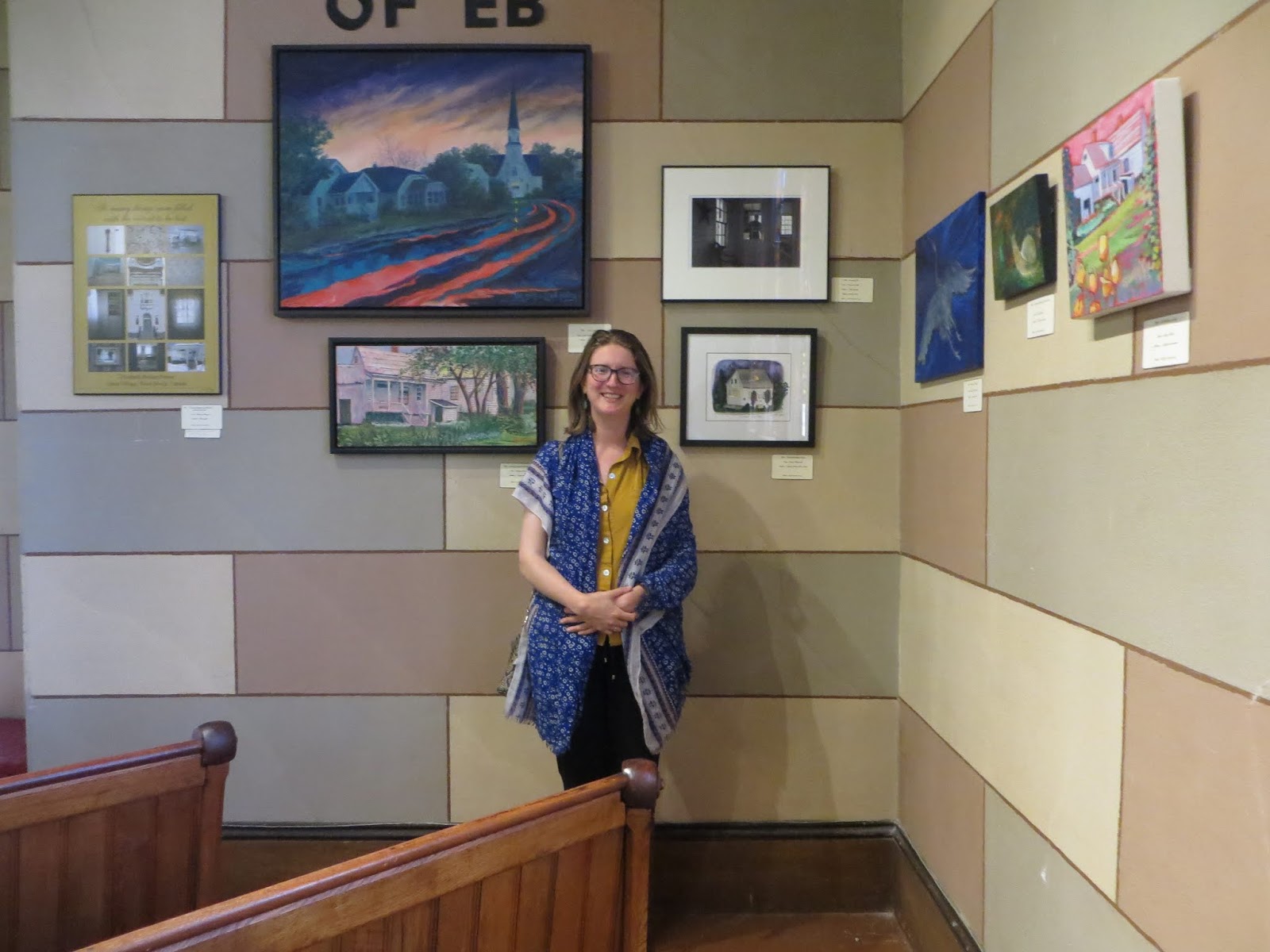
This image shows some of those gathered looking at the new "Echoes of EB" and "Elizabeth Bishop's Beginning's" exhibits. The new art display includes paintings and photographs by: Taiya Barss, Emma FitzGerald, Kathleen Flanagan, Mary Lou Payzant, Richard Rudicki and Susan Tooke. Here is Emma beside her contribution (to her left):
(Photo by Sandra Barry.)
Our guest speaker was Halifax poet and soon to be retired Saint Mary's University professor Brian Bartlett.

(Photo by Susan Kerslake)
After Brian's lively reading from his recently published Ripples Over Branches, the assembled walked to the Elizabeth Bishop House where a brief ceremony took place to mark the designation of the house as a Municipal Heritage property.
(Photo by Susan Kerslake)
The ceremony was presided over by Laurie Gunn (right) and the unveiling done by Colchester County mayor Christine Blair (left). It is exciting to have the house now part of the county's heritage program.
After the ceremony, everyone walked to the Legion for the usual delicious sandwiches and sweets provided by the Fire Brigade Auxiliary.
(Photo by Susan Kerslake)
(Photo by Sandra Barry)
Thank you to all the volunteers who helped make this AGM happen and to all those members and friends who attended. Perhaps the person who came from furthest away was Kay Bierwiler (left), who lives in Massachusetts and was visiting Great Village for the first time. Sandra Barry on the right.
(Photo by Susan Kerslake)
Thank you to the St. James Church of Great Village Preservation Society and Laurie Gunn for their stewardship and care-taking of the Elizabeth Bishop House.

Monday, June 18, 2018

Elizabeth Bishop Society of Nova Scotia AGM -- A Reminder

On Saturday, 23 June 2018, the EBSNS will hold its Annual General Meeting in Great Village. We are excited that besides the business and program outlined on the poster below, a significant and exciting addition to the day's events will be a brief ceremony to mark the designation of the Elizabeth Bishop House a Municipal Heritage Property. The EB House received a provincial heritage designation in the mid-1990s, but this new designation reinforces the importance of Bishop and her childhood home to the village, the county and the province. We hope you can join us on Saturday for the festivities.

Tuesday, June 12, 2018

EB House Featured on CTV

Here us a link to a CTV News segment from June 10, 2018 about the Elizabeth Bishop House, featuring Laurie Gunn and Brian Bartlett: https://atlantic.ctvnews.ca/video?clipId=1415235 [Please note that the video clip may be preceded by a thirty-second commercial. To restore sound, move the cursor to the bottom of the video frame -- the controls will appear, and you can click on the little loudspeaker icon to adjust the sound to your liking.]

Sunday, June 10, 2018

Letters to Aunt Grace, Part 70: Lota’s house and family

The next subject of Bishop’s letter of 18 October 1960 was a packed paragraph about Lota’s Samambaia house, with a few observations about Lota’s family, in this case, her sister.

Bishop began this paragraph by reminding Grace about their recent trip to “Paratí,” adding they had also recently returned from a second trip: “then we went away for a week again to Cabo Frio, where we go Christmases.” Bishop had regaled her aunt about these holidays on a number of occasions, a place where they could “stay in a friend’s beach house.” The reason for this trip, so outside of their usual routine, was because “Lota was very much in need of a rest, having such troubles with her family, her lawsuit, etc.” Bishop didn’t elaborate, except to say that “Lota’s sister” was “now here, (arguing!).” The tensions with this sibling came in for more comment at the end of this long letter, but other matters dominated this paragraph.

The week away had been pleasant, even if it “was a little too soon in the season, and windy.” They had gone “swimming every day and had an awfully nice time.” But “the minute we got back people started arriving” and not just siblings, but “friends of friends, from São Paulo” and then “a bus load of German architects.” The reason for this group was Lota’s house: “it is a famous piece of ‘modern’ architecture, you know.” What Bishop did not tell her aunt, but which she told Robert Lowell in a letter written at the same time was: “Their bus driver mutinied at our mountain road and Lota made trip after trip — but a good many of them came up on foot, straight up, for about a mile, and arrived panting and red and bowing and heel-clicking and hand-kissing — fascinating long hair-dos — about 3 female architects among them — I lost track in the hubbub. Some were very nice.” (Words in Air, 344)
(Lota's house at Samambaia.)
When I read this account in the letter to Lowell, it immediately took me back to September 1999, when I and a busload of Bishop fans reached the foot of that same mountain in a tourist bus. Our bus driver “mutinied” too, refusing to take the vehicle any further. Our host, Zulieka Borges Torrebla, drove the few who couldn’t walk up that steep incline, but the rest of us walked, just as these architects had done 39 years before.
(Bishop scholars beginning the walk to the house
under the mountain, September 1999. Photo by Sandra Barry.)
Word had clearly got out because not only were the Germans arriving, but also “another bus load, American architects this time, coming this week.” One wonders if they performed the same ritual of shuttling and hoofing.
(Poet Jeffrey Harrison (left) and Bishop scholar Gary Fountain (right)
part way up the road to the house under the mountain,
September 1999. Photo by Sandra Barry.)
A guest of a different sort was also expected: “tomorrow an unknown young American poet” was due to arrive for lunch, “and I think his poetry is so bad that I’m rather dreading that!” Bishop discreetly does not offer his name. Nor did she yield it in the letter to Lowell. What she does tell Lowell is that this “young man who sent me the bad poetry” had “called up to say he couldn’t come.” (Words in Air, 344) Undoubtedly, they did connect, as he was a “Fulbright, teaching at the University,” so he would be around for awhile. Brett Millier does not identify him in her account of October 1960. His pending visit had triggered in Bishop a kind of existential weariness in the face of “so much adequate poetry all sounding just alike and so boring …. And no one really feeling anything much.” (Words in Air, 344)

Part of the reason why they were beset by company was because “‘Summer’ is beginning and there are always too many people coming and going.” But competing with all this activity, and offering some solace, was the fact that “the flower garden has never looked better.” The list of flowers was impressive: freesias (“absolutely beautiful … all colors of the rainbow”; lilies; agapanthus blooming “all up the hillside, about three feet tall, white or blue.” Bishop could always find relief in the natural world around her.

Along with the flowers, the vegetable garden was producing: “for the first time in my life I am sick of artichokes” because they had “been eating [them] every night for dinner.”

Finally, the last report in this dense paragraph declared that the beehive oven they had been constructing was finished: “it is very picturesque and in a day or two I’ll try it — and probably burn the break black the first time.” The fellow who had done the actual construction produced “some of his wife’s bread” because “when Lota showed him mine he said ‘Too much yeast!’” Bread making clearly has a competitive element., even though Bishop was confident enough in her newfound bread-making skill to dismiss this critique: “because it isn’t the size or kind of bread they use.” To each his or her own.

Winding down this particular track, Bishop observed that if they stayed home over Christmas (having had their Cabo Frio trip early), “I think we’ll try roasting a suckling pig” in the oven. Ever the pragmatist and economist, she noted however that  “food, particularly meat, is getting so expensive here now maybe we can’t afford such luxuries.”

Bishop then turned back to her own family, not an ancestor, but her cousin Elizabeth, who was still very much nearby. This subject for the next post.

Friday, June 8, 2018

A few more photographs

Laurie Gunn recently sent these images of the exhibits set up this year by the EBSNS in St. James Church in Great Village, N.S. Come to our AGM on Saturday, 23 June 2018, starting at 1:30 p.m., in the church and see the displays for yourself. The EBSNS is excited to announce that after the AGM a brief ceremony will be held at the Elizabeth Bishop House, by the Preservation Society and the Municipality of Colchester County, when the house will receive a Municipal Heritage designation. Let us hope for some sunshine and warmth for that day!

(Elizabeth Bishop's maternal family.)

(Echoes of Elizabeth Bishop art gallery exhibit, above and below.)


Thursday, June 7, 2018

A little souvenir

This image just in from Ingrid Jejina, who visited Great Village and attended the Elizabeth Bishop Arts Festival in August 2015. Thanks Ingrid.
Happy writing one and all!

Sunday, June 3, 2018

Elizabeth Bishop's Beginnings exhibit

On 2 June 2018, members of the board of the EBSNS gathered at St. James Church in Great Village to install this year's "Elizabeth Bishop's Beginnings" exhibit and "Echoes of Elizabeth Bishop" gallery exhibit, which will officially open at the AGM on Saturday 23 June. Here are a few photos of what this year's exhibit looks like (we will share photos of the art gallery works at a later date):
(An overview. Photo by Sandra Barry.)
(Some details. Photo by Sandra Barry.)
(Laurie Gunn's lovely "Sandpiper" hooked rug. Photo by Sandra Barry.)

Below is a reminder of the details of the AGM, which will take place in the church at 1:30 p.m., Saturday, 23 June. All are welcome.


Saturday, May 26, 2018

Letters to Aunt Grace, Part 69: Great-Uncle George

Bishop’s next letter to her aunt was typed on 18 October 1960. She opened with an acknowledgement of receipt of a letter from Grace, the day she had send her previous letter: “Did you notice on the back of the envelope of my last letter that I’d written I’d just got yours at the P.O.?” This back and forth was not always in sync, but for Bishop, it didn’t matter when her aunt’s letters came, they were always welcome. Even so, it took her a couple of weeks to settle again to write to Grace.

The letter from Grace contained more “family-tree” material. Bishop was delighted and told her aunt that she was “going to try to put it in tying” (clearly Grace had sent more holograph) “and maybe even use some of it in a couple of N.S. stories I’ve been working away at slowly.” This batch of family material must have focused on the Hutchinson side of things because Bishop next expressed her delight in a photo that was included: “I loved the photograph of great-uncle George and dear Lily before the war.” This was of course George W. Hutchinson, the painter of “Large Bad Picture” and the “Poem” painting. Lily was George’s second wife, Lily Yerbury.
(George W. Hutchinson and Lily Yerbury Hutchinson, circa 1920s.)
George was still very much alive when Bishop began to travel to Europe in the late 1930s (he lived until 1942, dying just shy of 90). Twice, Bishop had been in England, near enough to visit, but never managed to do so. “I am so sorry I didn’t get to see him the two times I was in London before the war.” These visits to the land of all her ancestors were both brief and she noted that “the first time I was sick in bed most of the time.” So, she lost her chance to see one of her most intriguing relatives.

Bishop remembered a “nice photograph … of him seated outside his rose-covered cottage” and asked Grace if she still had it. That cottage was “Thelma” in Clacton-on-sea. In is later years, George loved growing roses. Bishop wondered, “who has all the paintings now?” These paintings have dispersed all over, some remaining with the extended Bulmer family, a good number of them in the possession of Pat and Graham Kench in England, some remaining with George’s direct descendents, particularly his great-grandson Matthew Hutchinson (the grandson of George’s son Ben and Ben’s son Marty). Some of George’s paintings are in the archives at Acadia University and some in the Art Gallery of Nova Scotia. Bishop would perhaps be amazed by how widely dispersed his legacy is.

Bishop also remembered “one [Hutchinson painting] Aunt Maud[e] had — a sort of swampy scene with a gray and white sky — remember it?” Two paintings similar to this one, are located in the archives at Acadia. These ponderings prompted her to say, “Sometime I’d love to have one of his paintings if I could.” She was already in possession of “one tiny water color he did very late in life — not as good as the earlier ones.” Just what this painting might be is a mystery. It cannot be the “Poem” painting, which was done early in his life and is a tiny oil (this painting was sold in 2011 to Rachel Jacoff of Boston). As far as I know, it was not in Bishop’s estate when she died.

Perhaps it was the “Poem” painting that Grace sent to Bishop, to fulfill this request. In any case, Bishop noted, “as you can see — I’m in the market for any old souvenirs and I love photographs.” Her concern, however, was that she was “so far away and it isn’t very safe to send things.” And certainly, she wouldn’t want precious family mementos to go missing. She concluded that it might be best to wait until “when I do get to visit you….”
(George W. Hutchinson, circa 1890s.)
Before shifting gears to update life in Samambaia, Bishop asked one more question, about another uncle: “How is Uncle George?” meaning George Shepherdson, Maude’s husband. Bishop had somehow heard enough about him in Grace’s letters to remark: “I do hope he has given up driving!” In parenthesis she added, “And I want that watch, damn it.” She was referring to a watch that had belonged to her father that George Shepherdson was in possession of. This watch surfaces again, so perhaps Grace made the effort to act on this declaration. With such distance between them, it always took real time for exchanges to occur.

After all this family talk, Bishop turned to daily life up in the mountains, which will comprise the next post.

Wednesday, May 16, 2018

Letters to Aunt Grace, Part 68: Fire

After her lively account of the Partay trip, Bishop jumped right into her next subject in the 23 September 1960 letter: bread. In a previous letter, Bishop had announced to her aunt that she had “been going in for bread-making” and had found that she was, to her surprise, pretty good at it. She reiterated that she had thought bread “was much harder to make” than it turned out to be, and she boasted, “now I make oatmeal bread, raisin bread, wheat germ (wonderful for toast) etc etc.”

She had also mentioned that she asked Lota to build her an outdoor oven for the task, because it would help conserve the bottled gas they had to use for the regular oven. With this letter, Bishop was able to report much progress in this matter. She wrote, “We are starting our outdoor oven.” She even drew a little picture in the margin for Grace, to accompany her description: “bricks and mortar — ours is right on a flat rock that happens to be near the kitchen, so it doesn’t need any floor, even — just waist-high.” They could “buy the oven door” already made.
Much to Bishop’s delight, a friend had loaned her “an old copy of the famous ‘Mrs Beeton’s’ cookbook,” and she found “that in 1897 she said that an oven exactly like the one we’re building make the best bread of all.”
Bishop explained further, “You put in a stack of wood, let it burn up, then scrape the ashes out with a hoe, and put the bread in.” All of this was, delightfully, “very primitive,” a condition Bishop approved of immensely.

If they needed to be to conserve the bottled gas, on the other hand “we have plenty of wood around,” and even better “a man to do the cleaning out!” Finally, when completed, the oven would be “white-washed” and Bishop proudly declared it would look “very quaint indeed.”

If fire in the oven wasn’t enough, Bishop then tells Grace, “This is what they call the ‘month of fires’ here because it is always so dry.” As a result there were “so many brush fires — I dread it.” This dangerous season had “so far” not taken any of Lota’s trees, but Bishop noted that the fires had come “awfully close and every night we can count five or six fires burning on the mountains around us.” Dreadful indeed! The other concern for Bishop during this was her asthma “from all the dust and smoke.”

Bishop again sent this letter on the same day she wrote it because, as she told her aunt, “today’s the big marketing day.” Their provisions had been depleted because “last Sunday we had five people here, and five more came unexpectedly for tea,” so she had “a list a mile long” to replenish.

Ever keen to write about food, Bishop told Grace that this large gathering of company were served “a big beef and kidney pie” with “stewed tomatoes (we had too many to use up!)” and for dessert “caramalized pears.” In case Grace did not know this particular delicacy, Bishop sent her an “easy to make” recipe: “cut them up in eighths and put them in a very hot oven” (though perhaps not the beehive version) “with a lot of sugar on top, and a little butter.” After “about fifteen minutes,” when “they are beginning to burn and get caramel-y, then you throw on a cup of cream — or you can skip that.” Simple indeed, but Bishop noted that “everyone thinks they are something fearfully difficult to do.”

Bishop began to wind down at this point, asking, as usual, “how is the leg? — and how is the diet, etc.?” This prompted Bishop to note that “Lota has been gaining a bit and I am very severe with her.” Bread, beef and kidney pie, caramalized pears — no wonder she was having trouble getting “into her city clothes.” Bishop assured her dieting aunt that she enforced “only a salad for lunch, and beef and vegetables for dinner, plus an orange or two” for their regimen, except, of course, when company came! Scribbled in the margin, “(& 1 piece of toast for breakfast)” – hard to do with multiple kinds of bread coming out of that new oven!

The final quick paragraph asked, as always, “Please let me hear from you.” Bishop also told her aunt, “I’m sending some cards to Ruth Hill.” Ruth Hill was one of Gertrude Bulmer Bishop’s best friends, who appears in “In the Village”: “Miss Ruth Hill gives me a Moirs chocolate out of the glass case. She talks to me: ‘How is she [Bishop’s mother]? We’ve always been friends. We played together from the time we were babies. We sat together in school. Right from primer class on. After she went away, she always wrote to me — even after she got sic the first time’.” (The Collected Prose 265–66)

Even though she was well over a decade away from Nova Scotia, Bishop not only stayed in touch with her family, but even her mother’s closest friend.

Bishop quickly noted, “I have another poem about to appear in the New Yorker”: “Song for the Rainy Season.” “It’s about the house here where I live — I think you’ll like it.” Admonishing her aunt to “take care of yourself,” she closed as always, “With much love.”

Only a few weeks passed before Bishop wrote another even longer letter to her aunt. The next post takes up her October news.

Friday, May 11, 2018

Letters to Aunt Grace, Part 67: Paraty

Bishop’s letter of 23 September 1960 really got underway after she had dispatched all the updates. The next subject warranted a long paragraph: “We went to explore a place we’d heard about, called Paratí.”(or Paraty). It appears Lota had never gone there herself prior to this visit. In her inimitable way of engaging place/geography, Bishop offered Grace a description and account that prefigures her late poem “Santarém.”

She explained to her aunt that it was “a small port that hasn’t changed a bit for about 200 years.” This continuity appealed to Bishop, though one wonders if Lota, ever the modernist, enjoyed it as much as Elizabeth. While she knew change was inevitable, for Bishop, virtue inhered in tradition and the past.
Paraty (as Wikipedia prefers), Bishop wrote, “is right on the end of a long bay — in fact at high tide the water comes right up the ends of the streets; and at very high tide, in May, they put planks across the streets from sidewalk to sidewalk.” (I wonder if that is happening this month! One can’t help but wonder what affect is sea level rise having?)

Bishop recounted that “a friend of ours went there in May and went out for a walk at night, carrying a candle … and crossing the planks.” Perhaps it was this romantic, adventurous story that prompted their visit.

At the time of Elizabeth and Lota’s visit, “they [the residents] had had electricity for exactly one month … and everyone was still very excited about it.” Bishop related that “at night there were circles of children under every lamp post, just like moths.” From what I see online, Paraty is now a very popular tourist destination, so the electricity stayed and expanded, probably exponentially. But in 1960, Bishop noted that “we were the only car in town, except for one broken down one, and a few trucks.” “Everyone comes and goes by ferry, twice a week,” Bishop reported. There was also a bus, “twice a week.” 

This place, almost out of time, was small enough so that “you can walk around” all of it in “ten minutes.” What impressed Bishop most was that “every single house is perfectly beautiful — but so run down and poor.”

Interestingly, Bishop noted that one could “buy a huge house, perfect 18th century —  three floors, beams two feet square, etc — for about $2,000 — huge garden and palm trees, too.” Does this sound familiar? Five years later, Bishop did buy an 18th century house in Ouro Prêto, when timing and circumstances were better; but perhaps here she was already on the look out. Or, perhaps, encountering this real estate possibility helped trigger the idea that would come to fruition in the middle of the decade. Millier notes that Bishop paid $3,000 for the house in Ouro Prêto (370), a city that eventually would be designated a UNESCO World Heritage site.

Not only did Bishop see the value in buying a house, but she confessed to Grace, “I’d like to buy the whole town, just to preserve it.” Loving the ocean and shoreline so much, one might think Bishop might have acted on this urge, but she noted, “unfortunately, the bay is too shallow, no good swimming, and I’m afraid it would be hot, etc.” No place is perfect, after all, even in paradise.

Elizabeth and Lota stayed for a few days. “Our ‘hotel’ was something,” she observed, an “18th century mansion all divided up by wooden partitions.” This meant you could “hear everyone sneeze and snore — the travelling salesmen and us, that was.” Knowing Grace would find it both funny and charming, Bishop wrote that “the travelling salesmen strolled through the dining room in their pajamas and brushed their teeth, etc, at a sink in the corner.” For added effect, Bishop observed: “and the bathroom. Words fail me.”

Ever the take-command-kind-of-person, Bishop noted that “Lota put up a good fight, but we never managed to get it repaired.” The hotel’s “landlady — ‘dona Zezé’” eventually gave them “a bucket of water a few times a day and we’d flush it.” In spite of these plumbing and privacy inconveniences, Bishop declared, “But everyone was perfectly charming!”

Not forgetting the cuisine, Bishop observed that she “ate nothing but fish and bananas for three days” and that the fish was “excellent.” She was also smitten with the churches: “adorable.” The only downside, the thing that “ruined” the visit for them, was “the town’s one loud speaker — (elections are approaching here, too).” Even so, Bishop concluded that “it was worth the effort,” ending her typed account with a scribble in the margin, “a long long drive, over dirt roads,” a scribble looking perhaps something like the dirt roads on which they drove.

Paraty’s eighteenth century heritage and delights, its village atmosphere, clearly appealed to Bishop even at this stage, and perhaps helped seed her desire to find her own historic home. Curiously, she did so far inland, in land-locked Ouro Prêto. Millier notes that it was the “backwardness and inefficiency [of Ouro Prêto that] charmed her, the way Brazil had charmed her after her struggles with New York.” (370).

Bishop hadn’t finished all her local colour. More of it in the next post.

Sunday, May 6, 2018

EBSNS Annual General Meeting, 23 June 2018

Come join us for all the activities at this year's Elizabeth Bishop Society of Nova Scotia AGM, on Saturday, 23 June 2018. (Click on poster to enlarge.)

Saturday, May 5, 2018

Letters to Aunt Grace, Part 66: Hot weather and iced tea

Bishop wrote her next letter to Aunt Grace on 23 September 1960, about a month and a half after the August missive. The serious news of this letter gets going in the third paragraph, but before getting to it, Bishop worked through where she was in her back and forth with her aunt, and updated Grace on the usual things. This post will deal with these routine matters, at the beginning of the letter and will save her fascinating description of a trip she and Lota took for the next post.

Though not visible in the photocopy of this letter, Bishop once again apologized for “this awful paper.” Making do was a modus operandi that she had carried with her from the very place this letter was going, Great Village (the envelope once again has “Box 21” on it, so Grace was back at the farm). Better stationary had to wait until her “next trip” to Rio, where she could “lay in a supply.” Poor writing paper was accompanied by a dramatic shift in the weather, “It has suddenly grown HOT here … much too early,” Bishop noted, “so I hope it won’t last.” This sudden heat had sent them to “our little pool,” which they had just “cleaned up.” After their swim, Bishop reported, they “then drank iced matté [sic]” (she had to add the accent by hand).
 
She wondered if her aunt knew about this “South American tea — they drink an awful lot of it, particularly in Argentina.” Assuming that Grace would not be familiar with it, Bishop noted, in her inimitable way, “it doesn’t taste exactly like tea — a bit more like hay, I think — but one gets quite fond of it.”
Bishop wrote this letter at the house at Samambaia. The recent back and forth between there and Rio meant, Bishop confessed, that she couldn’t “seem to find your last letter here perhaps I left it in Rio.” Added to this toing and froing, Bishop and Lota had recently gone “away for a few days trip” (more about it in the next post), followed by more time in Rio. The travelling wasn’t finished, “I’ll have to go back once more next week.” The reason for this return was dental work, “I have to have a tooth pulled — I’ve been stalling for ages.” Indeed, it appeared Bishop was doing more than stalling, but seriously avoiding this necessity.

The final update concerned Elizabeth Naudin. Bishop reported that she had not managed to see her the last time they were in Rio, “I was too rushed.” But she was “going to call her up today.” They had connected before the little trip and Bishop could report that her cousin “seemed much happier, in the apartment — even if it’s only temporary.” Clearly, the Naudins were still rather unsettled and continued to resist acting on the repeated invitation from Bishop to visit Samambaia. “They haven’t been up here yet,” Bishop noted, that underline adding a bit of force to that tiny word. Bishop lists reasons: 1. “waiting until they get moved”; 2. “or have a car”; 3. “or have someone to leave the children with,” even though Bishop had “invited the children, too!” Her bafflement and, perhaps, frustration barely concealed. Their household was usually host to all manner of “infant guests,” who “play in the brook all day.

Bishop did say with some relief that “Suzanne was much more friendly, very talkative — I think she’s quite bright; and the little one is very funny.” Perhaps it really was that they had been seriously disrupted and required time to find their bearings. Bishop added that “Suzanne already has a little Brazilian boy to play with and is speaking a few words of Portuguese.”

South America would be an adjustment for any Canadian, used to a very different climate, and Bishop ended this round of updates with an observation that could have explained further the Naudins’ hesitancy to plunge into too much socializing: “I think poor E is going to hate this heat.”

Bishop and Lota often escaped the heat with travel and the next post will be her account of the “few days trip.”

Saturday, April 28, 2018

Letters to Aunt Grace, Part 65: Productivity and Domesticity

The final dense paragraph of Bishop’s 5 August 1960 “hurried” letter to Grace was another running list of activities, which were more or less related and dealt with domestic matters. Bishop make a quick leap from the “family tree” to baking, without any transition.

Because of “the bad inflation here,” she told her aunt that the price of bread was “getting worse and worse.” As a result, Bishop took it into her mind to “try to do two or three big loaves once a week.” Bread making must have been a rare task for her prior to this time because she happily declared to her aunt, “I’ve just discovered that I can bake a very good loaf of bread.” This plan wasn’t as straight forward as it might seem because “we use bottled gas up here and hate to use the oven very much for fear we run out.” Ever the Robinson Crusoe, wanting to make this do for that, Bishop was trying to convince Lota (who was herself someone keen on invention — after all, they had designed their own stove for the living room) “to build me an outdoor oven, of mud, the kind they use here — very picturesque, bee-hive shaped.” If such an oven could be constructed, Bishop felt that she could then “bake lots of things.”

Bishop had already decided on one of her favourite loaves: “Do you know a New England bread called ANADAMA bread”? This traditional bread contained “a little cornmeal and molasses.” Bishop declared, “It’s delicious.” She offered to send her aunt the recipe if she didn’t already have it.
Without a pause, Bishop shifted focus to their new “wonderful Portuguese gardener … not a real gardener … but Lota is letting him use several acres of land.” Part of the deal was that Lota paid “for manure” and they split the profits. This ambitious fellow was, in fact, a real farmer who had already grown “900 cauliflower and about half an acre of tomatoes.” He also had “100 artichoke plants, for us, and a lot of endive.” He also planted strawberries, but this crop was not so successful “and the birds ate most of them.” This arrangement meant that they were “having lots of vegetables again.” His industry, “it’s the first time we’ve had anyone any good around,” was challenged by the weather, as Bishop explained: “one week too late and everything rots in the rain.” And this year was a wet one in Brazil. Bishop had been learning from this “gardener”: “celery for example,” she wrote to Grace, “can’t be banked unless you have a roof over it to keep the rains out.”

All this produce had triggered more preserving: “3 dozen jars of marmalade” (they ate an awful lot of marmalade!), plus “a dozen of mustard pickles (all those cauliflowers!).” After all that labour, Bishop noted, “now I am resting on my laurels for awhile.”

With the update about the gardener/farmer, Bishop thought she should report on the maid again, the “newest maid … imported from the interior.” This young woman “had never seen a flush toilet before.” In spite of her ignorance of modern amenities and lack of experience, Bishop noted that “she is very willing and quiet and works awfully hard.” Then she quoted, “as Lota says, ‘in twenty years she’ll be awfully good’.”

Amid all this domesticity, Bishop told Grace that she had “been working hard” at her writing, and reported that she had “sold several poems lately, and have a long long story almost done.” Millier (313) notes that Bishop’s poems “Trollope’s Journal,” “The Riverman,” “Electrical Storm,” and “Song for the Rainy Season,” all appeared in 1960, the latter being published in October, so perhaps at the time of this letter, it was something Bishop had just placed. I am unsure what the story was, but perhaps “The Country Mouse,” which was published in 1961.

All this productivity and domesticity suited Bishop just fine and she observed, “If it weren’t for the dental and financial worries everything would be rosy with us.” This general contentedness would not last, when Brazilian politics intervened later in the year, pulling Lota into public life and ushering in a major shift in their daily activities. But neither of them could see that yet.

They were, as always, watching what was happening in the world: “Meanwhile,” Bishop wrote, “the world goes from bad to worse, doesn’t it … the Belgians reaping what they sowed, in the Congo, and the U.S. reaping what it sowed, in Cuba.” Bishop is referring to the independence of Congo in June of that year and the beginning of a civil war there. And, of course, all the fall out from the Cuban Missile Crisis.
Quickly, Bishop signed off with “lots and lots” of love for her aunt and “Phyllis and family,” asking Grace to “please write soon.” Then off she would have gone to Petrópolis to the market and to post her letter.

Bishop’s next letter was written towards the end of September, a less hurried epistle with lots of news.


Thursday, April 26, 2018

Rosalee Peppard to perform in Middleton, Nova Scotia

Rosalee Peppard, a beloved member of the Elizabeth Bishop family in Nova Scotia will be performing in Middleton, N.S., in support of the Old Holy Trinity Charitable Trust. Rosalee is a marvellous songwriter and singer who celebrates and honours Nova Scotia's "herstory." I've got my ticket already!

Tuesday, April 24, 2018

Letters to Aunt Grace, Part 64: More Gifts

After dispatching the news and responses around family, Bishop turned to incoming matters in her letter of 5 August 1960. First, she expressed her frustration with the delay in getting one very special treat that Grace had sent via Elizabeth Naudin. They were still waiting for this treat to appear, even though the Naudins had been in Rio for a couple of months: “I do wish E would get their things out of customs — we are dying to get that maple syrup.” The prospect of this Nova Scotia gift and “a clipping from the newspaper” had sparked Lota want to purchase an appliance: “a second-hand waffle baker,” and not just any waffle baker. Bishop observed, “it sounds like a HUGE one, for a restaurant.” So enticing was the advent of maple syrup that Lota was going “to see it [the waffle baker] in Rio!” Bishop was not so enthusiastic. Preferring always the small over the large, Bishop declared that she was “against this idea,” since they had a serviceable “little old one, good enough.” One of her concerns was that “a big one might blow out all the fuses, anyway.”

Whether or not Lota closed the deal on this industrial waffle baker is not known. But it would be a couple more months before Bishop and Lota could sate their thirst for this northern liquid. The conclusion to this particular gift isn’t resolved until the end of October! It is a good thing maple syrup keeps for a long time!

Grace’s welcome letter, however, did bring another gift that clearly Bishop appreciated as much as the flavour of maple syrup: “I am delighted to have the family tree — but now I want more.” This “tree” in question was for Bishop’s beloved Pa’s ancestors.
(First page of the Bulmer family tree sent by Grace.)
What is immediately nice about this document is that it is in Grace’s handwriting, a glimpse of her open, loopy holograph. She would have written letters to Bishop, not typed them.

The page lists William Bulmer’s parents — Bishop’s great-grandparents (Horatio Nelson Bulmer and Mary Ann Maxfield) — and his siblings. Bishop would have heard about some of these people (indeed, she would have met some of Pa’s siblings during her childhood), but the names and stories attached to them were a bit hazy in her memory: “I’m not quite sure how this one goes,” wondering if Horatio and Mary were Pa’s parents or grandparents. She leaned to the former. Her confusion was because “I don’t know how old Mary M was when she came over in 1813, etc.”

Grace was fairly accurate, though also a bit vague, compiling this list by memory. While this generation provided Bishop with some ancestral context, it made her want to have some more facts: “Can you tell me what year Pa and Gammie were married, for example?” [8 September 1871]. Then she asked her aunt: “sometime I wish you’d write me out all the dates of your generation — Aunt Maude and all of them.” As good as Bishop’s memory was for things and people, her memory for dates was as iffy as the rest of us.

Bishop was quite taken with Grace’s account of Mariner Bulmer “went to Salt Lake City — Taking 32 head of cattle to city to sell was murdered, supposed, for his money.” On the second page of this “tree,” Grace concluded with the tantalizing tidbit that one of Horatio Nelson’s sisters “married Long John Johnson, who went away on horseback & never returned.” These facts prompted Bishop to observe, “Heavens — we seem to be given to being murdered, and mysterious disappearances! I certainly think there is a wandering streak, as well.”

If the Bulmer ancestors wandered (and a number of them did), the Hutchinsons were the real globe-trotters, and Bishop had heard stories about them during her childhood. Bishop didn’t want to stop with the Bulmers, so she also asked Grace, “Can you get anything on Gammie’s side?” She had heard about “that Tory ancestor of Gammie’s who had a farm in New York state.” She wanted to know “what the names were and where they came from — and where did ‘River Philip’ fit in — was that where Pa lived?” That Tory ancestor was, in fact, part of the Bulmer line: Horatio Nelson’s mother was Sarah Meade (his father John Bulmer’s second wife). It was her father, James G.F. Meade, Horatio Nelson’s grandfather, who was from New York state and who died in the American Revolution. Bishop eventually got the clarification she wanted, including the fact that River Philip, N.S., is where William (Pa) Bulmer’s grandfather settled and where his father was raised. Pa was born and raised in nearby Williamsdale (now a dispersed community deep in the heart of the Cobequid Mountains).

Any of us venturing back even two generations will find the number of ancestors increasing exponentially, and keeping track of everyone is a daunting job. Bishop was no genealogist, or historian for that matter. Her interest in her ancestors was more, it seems, connected to their stories (“we seem to be given to  being murdered…”), the personal stuff, rather than only who was related to whom and when people were born and died.

Over the years, Grace continued to send Bishop information about her ancestors, in various forms. Each such gift was always welcomed and appreciated by her niece. In the end, Bishop declared, “Anything you can hand on I’d like to have…”

The next post concludes this letter with some more talk about cooking and baking.

Tuesday, April 17, 2018

Letters to Aunt Grace, Part 63: Word from Aunt Grace

Finally, Bishop heard from her aunt, a welcome letter arriving on Tuesday, 2 August. Bishop sat down to respond on “Friday, August 5th, 1960.” Why the brief gap, especially for a letter that was so welcome, Bishop did not say. And since Fridays were “marketing day and we must soon start off for Petrópolis,” she noted right off the top that “this has to be hurried.” Oddly, though, this letter ended up being nearly two dense pages. If she typed it in a hurry, she managed to compose the longest letter to her aunt in some time.

Once it was sent, this letter would have taken weeks to reach Grace. So Bishop’s urgency was because she wanted to take it with her to mail in Petrópolis. Perhaps she had intended to write only a note, but the need to “speak” to her aunt took over. One wonders if Lota had to wait longer than she expected, before driving down the mountain and into the city. Bishop “wanted to tell” her aunt “how glad and relieved” she was to hear from her “at last. — I’d been getting worried.”

What followed was a rather chaotic letter, with Bishop’s thoughts leaping from subject to subject, another indication of her hurry.

Upon receiving the letter, Bishop reported that she “called up Elizabeth yesterday to tell her — no, the day I got it, Tuesday — but she was out and hasn’t called back.” This observation triggered a little sidebar about how things were going with her cousin. Bishop explained that Elizabeth “has never telephoned me once although I’ve left messages, etc.” Trying to account for this silence and giving Elizabeth the benefit of the doubt, Bishop offered: “I think perhaps she is afraid of the telephone here!” Surely, Bishop knew this reason was as silly as it sounded (perhaps that was her intention, knowing her aunt would get her meaning). Then she added, “Or [afraid of] trying to talk to our maids, etc.,” admitting “it is hard at first.”

Even with this lack of communication, Bishop was intent on fostering a connection, telling Grace that when she and Lota go “down to Rio next week,” she would “go to see E again.” The Rio run was for more dental work: “both Lota and I have to have a tooth pulled, one each that is, next Friday.” In spite of a standing invitation, Elizabeth and Ray Naudin had not yet ventured to Samambaia for a visit: “so far, they’ve had to spend their Saturdays and Sundays apartment hunting, I think.” That “I think” is perhaps another hint Bishop was detecting resistance from her cousin. Even so, Bishop and Lota still wanted “them to come for a day soon.”
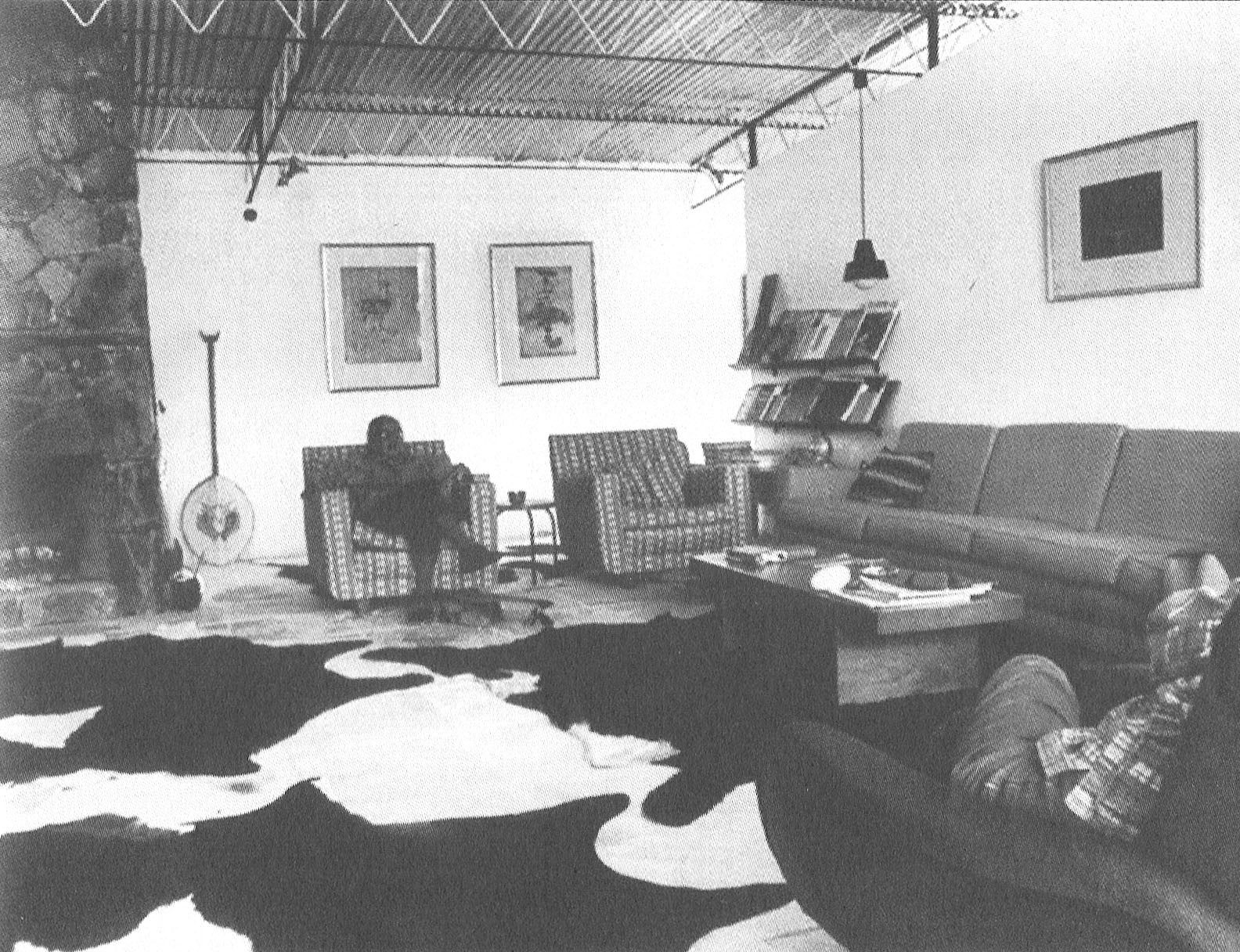
(The living room in the house at Samambaia.)
Bishop also reported that “there’s been no milk in Rio for two or three weeks (one can get powered milk, though) and I wonder how she’s liking that!” Bishop had heard something from her cousin, enough to tell Grace that she “seemed very pleased with her cook when I spoke to her.” Cooks were of interest to Bishop, who had been sending her aunt a running commentary on their cook travails. Bishop noted that Elizabeth boasted that her cook “just didn’t go in the kitchen but took what was put on the table.” Bishop was a bit envious of such good fortune, declaring to Grace, “I don’t think she knows how extremely lucky she is — she might have had to try ten cooks!” Then she updated her aunt on their own cook situation: “And we have such a nice girl who can’t cook a bit but we’re trying to hold onto her and her husband because they are such good workers.” Clearly, the training of this young woman continued, with, seemingly, limited success. Bishop noted that on the “weekends when we have company it seems to me I spend all the time in the kitchen cooking and never have a chance to talk to the company…”

After this diversion and update, Bishop got to the primary subject of her letter, though she did not linger on it: “I was glad to hear your heart is all right.” Grace must have had the cardiogram test that Bishop had asked about in an earlier letter. If Grace’s heart was okay, she still needed “medicines for the artery business.” Bishop, ever interested in all things medical, observed “they seem to be learning more about that all the time.” Besides the arteries, Grace’s leg remained an issue and Bishop urged her aunt to “take it easy and keep off your leg as much as you can.”

Knowing that Grace enjoyed a drink now and then, Bishop passed on some advice given by “one older friend of mine,” who “was ordered by her doctor to have two old-fashioned cocktails before dinner each night, to slow down hardening arteries — maybe you’d like to try that!”

All this talk about health prompted Bishop to offer another update: “Poor old Aunt Flossie [that is Florence] — her new home was all too good to last, of course.” Florence was still resident in this nursing home, found for her by her nieces, but Bishop’s cousin Nancy had written that she was “starting to get complaining and full of fight again… She is so difficult.” That said, Bishop surmised that “they are all treating her with more respect, though, since they found all that money hidden away (I told you about that didn’t I?).” Not in any letter that has survived. Though likely Grace would not have been surprised. Bishop “suspect[ed] she [Florence] even did it on purpose, just to show them!” Bishop just couldn’t give Florence a break, concluding, “she is awfully silly, but she has a certain hard-headed streak at the same time — from Grandpa [Bishop], probably!”

Thus ended the first two paragraphs of this hurried letter, which will require two more posts to complete. The next post will focus on gifts.

Tuesday, April 10, 2018

Letters to Aunt Grace, Part 62: Getting acquainted

Bishop’s next extant letter to Grace is dated “Fourth of July, 1960.” She had written at least two others in the almost month that had passed since the one on 8 June, one “care of Phyllis” and another “a card to the Village.” Neither of these exist any more. Phyllis was living in New Glasgow, N.S., and Bishop hoped that the address she had “940 East River Road?” was correct. She sent the current letter to Great Village, “Box 21” (the same box that belonged to her grandparents, as she remembered in “In the Village”), but someone had scribbled over it another New Glasgow address: “486 Chisholm St.” This one did not go astray, finding its way to Grace, eventually.

Evidently, Bishop had not received anything from Grace since sending the June letter, which caused her some concern, because Elizabeth Ross Naudin had conveyed the news that Grace “hadn’t been all that well in Montreal.” Bishop confessed that she was “getting worried.” The main issue was Grace’s leg, “the worst trouble.” All Bishop could do was “hope”: that her aunt “all right” and that she was “taking it easy.”

Bishop reported that she was going “to Rio again, by bus,” that very day. The reason for this trip was “the dentist — a damned dying tooth with nerves to be removed, etc.” The deed required her presence for “three or four days,” Bishop confessing that she was “getting awfully sick of it but it can’t be helped.” She would be joined by Lota “tomorrow to drive back — and get one of her teeth attended to!”

After these preliminaries, Bishop got to the meat of this short letter: “I’ve seen Elizabeth very briefly two or three times,” and updated her aunt on their settling in: “yesterday they moved into a furnished apartment,” still a temporary situation, “some friend went to Europe for two months,” because even though the ship carrying their belongings had arrived, “everything (including the maple syrup!) is waiting on the docks.” Their stuff hadn’t yet cleared customs. At the bottom of the letter in her characteristic scrawl, Bishop added: “How much do I owe you for the syrup?” Grace’s answer, which was undoubtedly “nothing,” has not survived.
Getting acquainted with her cousin and family was proving to be a bit more difficult than perhaps Bishop expected. Their invitation to the Naudins to visit Samambaia would be accepted only when they could find “someone to leave the children with — (called a babá, here).” Usually a big hit with little ones, Bishop reported that “the children seem scared to death of me — I don’t’ think I’ve ever had such an awful effect on small children before!” Elizabeth Naudin reasonably argued that “they were upset by the trip and by all the strangeness.” Bishop, dubious, wrote, “She’s probably right.” But their response to her surprised and puzzled her: “the little one finally got to the point of smiling at me last time — but Suzanne just looks like thunder.” Bishop conceded that this move required “a big ‘adjustment’, I suppose, particularly if one has never travelled before, or lived in tropical countries.” Being such an inveterate traveller, perhaps Bishop couldn’t quite empathize with the disruptive nature of travel and moving to a new place. She observed that she “was more or less prepared for Brazil, after Florida — they’re a lot alike.”
(Worcester, 50th anniversary WPI, 2004)
Bishop wondered if they might be “baffled by the Negroes — I suppose they don’t see many in Montreal!” As wary as the little girls were, Bishop reported to Grace that Elizabeth herself was “getting along fine and meeting all [Ray’s] friends and relations.”

After these reports and musings, Bishop quickly shifted gears, “I must pack, see about lunch, and take a bath,” before heading to Rio. She concluded her letter with the usual series of closings: “I do hope you are all right” — urging Grace to “Please don’t go working, now, or gadding about.” Bishop hoped Grace had a good doctor and she wanted her aunt to write “what the doctor says.”

The final short paragraph was a brief list: “Remember me to Phyllis and Ernie and everyone”; “is Buddy going to get married now?”; “How is the weather?”; “The strawberries?” (it was the height of strawberry season in NS). And the final wistful: “Wish I cold fly up for a visit — the fares are fearful, though.” She ended with a little extra stress this time: “With much love.” And her hurried name scratched in pen.

Bishop sent this letter on the day she wrote it (not always the case). Her next epistle, a much longer one, was exactly a month later, and will be taken up in the next post.

Wednesday, April 4, 2018

Letters to Aunt Grace, Part 61: Meeting her cousin

Bishop typed her next letter to Grace just over two weeks later, 8 June 1960. This letter was written in Rio, where Bishop had just arrived to tend to various matters, including “the dentist again.” Upon her arrival, “night before last,” she was surprised to find “a note from Elizabeth [Ross Naudin],” who was already in Brazil, arriving a few weeks sooner than expected. Bishop told Grace that it was only “just luck” that she got her cousin’s letter because, “I NEVER use this address — that’s why I sent both you and Mary my telephone numbers and said for her [Elizabeth] to be sure to call me up, or use the Petrópolis mail box.” Bishop noted that Elizabeth, Ray and their daughters were “just up the street, at the Copacabana Hotel and has been here two weeks already.” Elizabeth Naudin had written to Bishop before they left New York to “say they were coming sooner than expected,” but that letter “never did reach me.” So, not the best start to getting acquainted.
Even before all this explanation, Bishop launched her letter with the news that mattered most to her: “Elizabeth tells me that you haven’t been at all well.” If you recall, Grace had spent some considerable time with her sister Mary in Montréal, after Mary’s husband died. But at this point, Elizabeth reported to Bishop that “she thinks you are staying with Phyllis now.” Bishop was deeply concerned about her aunt, hoping that “you’ve been to the doctor and had the cardiogram made and everything.” She urged her aunt to write, “please tell me — and how the leg is, too.”

Then Bishop offered an account of visiting her cousin, probably for the first time: “I went to see her yesterday — both she and the babies have had a touch of the flu.” Bishop assured Grace that in spite of that, they “seemed to be all right.” Her first observation was about the children, “They are very cute, aren’t they — particularly Suzanne.” She had also met Ray Naudin, briefly: “nice-looking, isn’t he, and seems very bright.”

The next big task for the Naudins was finding an apartment, which Bishop said might prove difficult. She had already “asked a couple of friends of mine who are in the real estate business.” She then confirmed what Grace already knew, “they seem to have plenty of money and that’s always a help!” Ray Naudin worked for the Otis elevator company.

Then Bishop finally got around to assessing her cousin, who “looks so much like Mary, doesn’t she — at least the upper part of her face does,” concluding “she just missed being a real beauty.”


Bishop told her aunt that she would “try to get in again before we go back, today or tomorrow.” And noted that she and Lota had invited “them to come up for a day with us soon.” Ever practical, Bishop observed that it was “a pity they didn’t bring their car.” Having moved there to live for some time meant “Ray had the right to being one.” Expensive as that might have been, Bishop observed that cars “cost 3 or four times as much here as at home.”

As mentioned before, Ray was a Brazilian, but he had been living in the US for some time. Bishop reported Ray’s astonishment of the changes to Rio during “the 13 years he’s been away,” so much so “that he had to buy a map of the city to find how way around!”

Even though the bulk of the Naudins’ possessions had not arrived, her cousin’s arrival had brought some gifts from Grace for Bishop and Lota: “Thank you so much for the ‘Export A’ cigarettes — I am smoking one right now.” Bishop excitedly wrote, “E says there are more goodies coming — wonderful.”

With all of this taken care of, Bishop offered an update about Aunt Florence, who if you remember, had a “cracked leg.” Bishop reported that the injury was “getting better very fast — she was already walking around in a ‘walker’.” More significantly, the cousins on that side had “found a Rest Home for her, not very expensive, considering.” Concluding, “I think it all to the good, really — she shouldn’t be living alone.” She had heard this news from her cousin Kay Sargent who had written: “keep your fingers crossed.” The caution being that she might not “stay put” and might “fight with everyone! Poor old thing.”

As this short letter began to wind down, Bishop returned to Grace’s health: “I do hope you are feeling better and than you have good medical care, etc.” And urged her to write again, “let me hear from you.” She worried that Grace had “over-done [things] at Mary’s” Then the first notice of the weather, “It has been very cold, for here.” But the stalwart Canadian Elizabeth Naudin and her two little daughters already “had been in swimming.” Quickly signing off, Bishop noted that she had “hundreds of things to do while in the city,” but didn’t forget to say “Remember me to Phyllis and Ernie.” With her usual “much love,” she scribbled her name at the bottom of this one-pager.

Bishop’s next extant letter was written in early July. It will comprise the next post.