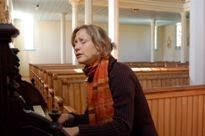
"I am 3/4ths Canadian, and one 4th New Englander - I had ancestors on both sides in the Revolutionary war." - Elizabeth Bishop
____________________________________________

Thursday, February 8, 2018

First Encounters

1.
Strange appearances,
full of serendipity
and charm. Newfoundland.
2.
Awful but cheerful,
looking for something something
something. Then: the House.
3.
Meetings, non-meetings
almost Akhmatovian
-- I mean my ego.
4.
Ten years I lived here --
nobody had mentioned her
to me. Intriguing.
5.
Newfoundland Journal.
Many generous people
invited us in.
6.
I stand here, iron.
What you ask moves tormented
through my mind. Then. Now.
7.
A green-covered book,
tiny, well-packed, straightforward,
unostentatious.
8.
-- Blueberry patches.
Like a child in Wonderland,
I came here to write. ---
9.
Once a failed poet,
now failed collector of them,
I love how words sound.
10.
As perfect a work
as any I have looked at,
a treasure within.
11.
Now forever gone,
it hung on a bedroom wall
in the Poet's House.
12.
As a choir member, --
"Song for a Rainy Season"
-- I could feel the damp.
13.
Chateau Frontenac,
an old and ornate hotel,
knows our language well.
14.
Completely gob-smacked
I have no recollection
no link letter left.
15.
Under the window
new and abiding desire,
age-old saudade.
17.
Less than meaningful
Dead White Protestant Males rule
and -- unknowing -- reign.
18.
Vanadous, uranic,
bluebell tunicates blossom,
vain, but not raucous.
19.
Where mint grows by brooks,
the Bay of Fundy's sheer tides
crumbling ribs of marl.
20.
On the syllabus --
"Post-Modern American
Poetry" -- her name.
21.
Who was this poet
becoming canonical
in America?
22.
Find her reticence
grounded in Nova Scotia:
in burnt hawkweed.
23.
I contributed
one poem to Canticle.
Being drawn closer.
24.
Bike rides, afternoon
naps, silence, asparagus --
like so many things.
25.
Printed distinctly
in black ink on the blank page --
the first one -- her name.
26.
In my final year,
and then the summer after,
the sound of her mind.
27.
Down shore is haunted.
"It's a racial memory --
something genetic."
28.
Fear or loneliness --
detached otherworldliness
-- this separate life.
29.
Enthusiastic,
spoiled, quick to judge, insecure,
I grew my hair out.
30.
Behind tall locked doors,.
wondering what it could mean,
The Manuscript Room.
.
31.
Sable Island trip.
Maud's painting of Great Village.
A challenge. A spark.
32.
Living the so-called
simple life, in an old home
amidst old patterns.
33.
On a dim column
the image of a cock carved:
porphyry and bronze.
34.
Lo que no sabe
una niña huérfana,
saben las olas.
35.
A delicious chat,
wafting around my psyche,
tossed on Fundy tides.
36.
Crossing hemispheres
as I have done to travel
perfectly at home.
37.
Something more subtle?
Lupins, say, -- all pencil-thin,
prophetic, silent.
38.
There's my confession,
but I've made up for it since:
wet red mud glazed blue.
39.
Reaching for the Moon.
Deceptive simplicity
drawing the drawing.
40.
Ask each sophomore
to memorize one poem.
The meadows unfold.
41.
Enter the unknown
fascinated by the doors'
handles and latches.
42.
"Reaching for the Moon"
(in German "Die Poetin") --
always out of place.


9 January 2018
DON DU POÈME

И слабым голосом страданий и любви 
Шепнешь ли бедному творению: «Живи»?

(1.) XIII


Land lies in water.
Mendacious and envious,
it is shadowed green.

(2.) XVII


Tired Seawall Inn:
its sign maker knew too well
land lies in water.

(3.) XVIII


A wedding's theories
are like this old brass rubbing:
it is shadowed green.

(4.) L

餵鳥

Balcony breakfast
(thimble of coffee and crumb),
A scabby lakefront.

(5.) LI

旅行問題

Freighter. Towelette lef
t (the little we get for free)
moist on the tea tray.

(6.) LXII

一個藝術

Where it was, you meant
to travel: were it only
a YMCA,
the wryest Athenaeum
still left in all Wyoming.

(7.) LXXXIV

拂晓

Its otherness ahead,
moonlight on a tidal pool,
the sea and its shore.

(8.) XCIII


If A cheats whomever,
B shares the consequences.
We have come this far.

(9.) XCIV

螺旋桨豆豆

Another drab day.
This year our hats will need a
rotary headband.

(10.) CIV


The true Everglades
spread far beyond the bounds of
regulated verse.

(11.) CXVI

誤讀的地圖

The sea level map's
netted surfaces, red as
the maple's leaves.

(12.) CXLVI

冬季馬戲團

The Winter Circus,
elephant withers cinctured,
ends with its season.

(13.) CXLVIIIa

朝の曲

Occasional verse.
But aren't we all? Homemade.
Laconic. At sea.

(14.) CCLII

千鳥

Bright faery hue: rose-
edged amethyst at dawn,
February eighth.

(15.) CCLVIII

一個藝術
for M.A.D.

Was the day chosen?
Wound afresh with red birthday
ribbon, frozen creeks.

(16.) CCLXXXIII

松島

Valid otherness:
a white violet's hardness
over the islands.

(17.) CCXCIII

伊丽莎白·毕肖普
in memory of Elizabeth Bishop

So many the hats
she exchanged for essentials:
asthma, honesty.

(18.) CCCVIII

美国国会

Quockerwodgers all,
hanging on words they dangle
from their tangled strings.

(19.) CCCXII

哲学

Zen gets you nowhere.
Poetry? No more than a
wheezy song en route.

(20.) CCCLXVIII

兔子

The deft horned owl
sinks its talons in my back.
The end of the world.

(21.) CCCLXXXV


Now the mourning doves,
renowned once for moving South,
return North unknown.

(22.) CD

旅行問題
in memory of Elizabeth Bishop

And here, or there... No.
One herder meets another,
their cattle mingle.

(23.) CDXVII

捕夢網
In memory of Elizabeth Bishop

Fraught with art and creed
handcrafted, aught, Writer, but
your sonnet. Caught. Freed.

(24.) CDLXIV

工人

Puddles of moon fish,
an inch of dim smoke swabbing
the main deck gunnels.

(25.) CDLXXIV

騷客

Perfectly useless,
the amputee's shoemaker
doesn't give a fig.

(26.) CDLXXXII

沙錢

Sand dollar bezels
scant steps from the horizon:
cold stars and planets.

(27.) DVII

在青苔
for EAAB

Slow-witted, owlish
eyes half-veiled in the moonlight.
Wild white violets.

(28.) DVIII

for EAAB

Ale house. Weepy remorse.
Lying awake and knowing
somewhere you're asleep.

(29.) DXIV

布雷顿角高地国家公园

How unlike Borglum's
narcosynthesis these rocks,
lichens, gray moonbursts.

(30.) DXVI

西門·馬吉斯

Helen's valley forge.
Golden apple smell once more,
lovely hell-green flames.

(31.) DXXXVI

三次

Cockerel checklist
digged out of the bight's sea chest.
Click. Click. Goes the dredge.

(32.) DXXXVIII

遲來的感謝

The bromeliads
long gone, I don't dare write you
in herbalist mode.

(33.) DLVIII

文音
電報

"RIVER VERY BIG"
(any verb very rigid)
"MISS YOU VERY MUCH."

(34.) DCXXIII

冷泉

This spring, too, is flawed:
now tumbling over itself,
now slinking forward.

(35.) DCXLVI

极光

Bubbles intersect:
the sensible BBC
utters foxfire truths.

(36.) DCXCI

物の哀れ

Solitary clouds,
each aware of the others
covering its sky.

(37.) DCCLXXIV

旅行的問題

Never to have heard
the sound of your heart beating —
surely a pity.

(38.) DCCCVIII

多毛海棠

Putative doily,
all too thick with grey crochet —
Life is a taboret.

(39). CMXXXVII

羅盤點

Jay North, Clint Eastwood,
Robert Southey, Adam West:
"Dear, my compass still — "

(40.) CMXLII

夏季雪

Gouts of Bishop's Weed:
ivory-edged, green-centred,
Snow-on-the-Mountain.

(41.) CMLXXIX

大帳篷

Ample-roofed bandstand,
shielding the politicians'
abandoned platforms.

(42.) CMLXXX

Дар ума

Life is a gömböc:
homogeneous, convex,
mono-monostatic.

(43.) CMLXXXII

晶洞

Ladders. Lattices.
Let us let ice floes crumble,
faceted within.

(44.) M

常識

We have come this far:
the senses are five heartaches,
meadows mown too close.

(45.) MLXVI


World of our knowing
our knowledge tastes of window
sills, panes, and rain drops.

(46.) MCXXV

喘息

The cool damp night mist
leaves me gasping for my breath,
hanging on my words.

(47.) MCXXXIII

おくのほそ道

Just after breakfast
— book half-unread, coffee drunk —
a trail of bread crumbs.

(48.) MCLIII

一藝術

One last narrative.
One final journey elsewhere.
Travel is an art.

(49.) MCLIX

討論會

The rain goes on and on,
but which inane waterfall
is it speaking of?

(50.) MCXCI

我们去哪

Questions of travel
fall — soft, stolen, aquiver —
by the wayside now.

(51.) MCCCXV

Три бабушки

"It is what it is."
"It has always been this way."
"What will be, will be."

(52.) MCCCXVII


A dim, acrid smell
of skunk in Ontario,
a Maritime laugh.

(53.) MCCCXLVII

Après nous le déluge

Conjunction Junction
barely made the connection
between and and and

(54.) MCDIII

邏輯學家

From all the dangers —
either/or and neither/nor
— in reason save us.

(55.) MCDXXXII

沒有

Buds and bells and stars:
whether or not we know them,
they know their own names.

(56.) MCDXXXV

О Благодати

At ten after ten
breakfast on the balcony.
Why am I so blessed?

(57.) MDXXIX

歡樂

Sandra will be here soon.
Coffee with friends, Great Village,
lots to talk about.

(58.) MDXXXI

樺樹陰影
for Sandra Barry

Rude lattice of leaves,
their shadows the true Citadel's
true dialectic.

(59.) MDXL

太晚了

Lighter ironies,
these fish lore elegances,
esprits d'escalier.

(60.) MDXLV

万葉集

A myriad leaves
poets shiftless as ever
too lazy to count

(61.) MDXCIV

一成不變

They have not changed much:
the moon, the stars, these poems —
Still, I look at them.

(62.) MDCXXIII

約翰·柯川

Making the music
entrance from inside the heart
two bronze lions flank.

(63.) MDCXLIII


Never to have pressed
an ear to chest to listen
to a heart beating.

(64.) MDCXLV


They are never real,
however they might wind up,
tangled or dangling.

(65.) MDCCLXXXIX

評論
for Tom Hastings

Who would not be pleased
as punch drunk from a haiku
plastered paper hat?

(66.) MDCCCLXX

義眼

We have come so far:
"This you may not see or say."
Now we would give up
our eye teeth to hear once more:
"Look your infant sight away."

(67.) MCMXXXIV

鯖魚的天空

Scissors. Window pane.
A dazzling dialectic
facets tin-roofed sky.

(68.) MCMXXXVIII

Plus ça change
for Sandra Barry and Laurie Gunn

New old kitchen stove:
the power has been shifted,
the oil is ordered.

(69.) MCMLII

千羽鶴

Flatfooted union
of pinion, wing, and beak —
sleeping standing up.

(70.) ENVOI

Yes

Birth and life and death:
wherever situated,
the same indrawn breath.

Saturday, February 3, 2018

Letters to Aunt Grace, Part 50: Jelly

Having dispatched the lizards in the opening paragraph of her 12 November 1959 letter, Bishop shifts a major gear, returning to one of their favourite subjects: food — more specifically, the making of it. Before settling into the serious details, she remarks on a technical matter about the letter Grace was holding in her hands: “I am so delighted to have these new black typewriter ribbons.” The quality of the type of this letter is significantly clearer than the previous one, so many months ago. It is easy for us with our computers, tablets and devices to forget how “manual” Bishop’s typing was. The new ribbons were brought back by “our friend Mary Morse,” who had returned from time in the “U.S. and brought us presents.” The new typewriter ribbons were a boon to her letter writing, but “another friend” (perhaps May Swenson) had sent an even more prized gift, via Morse: “a pair of binoculars — I’m quite overwhelmed,” something she had longed for, but didn’t think she “could afford.” She would use them “to watch birds here [that is, at Samambaia] and ships in Rio.” Bishop noted that they were “Japanese and very good.”

After this introduction Bishop signalled the real shift: “—//” and introduced the next subject of this paragraph with a query: “I had an English bookshop send you two little cookbooks a while ago — I wonder if you got them yet?” Bishop is referring to two little volumes that Grace had in fact received. Bishop had sent them sometime in early 1957 (she mentioned her intention to do so in a letter dated 10 January 1957, which I discussed in blogpost, #26 of this series).

Clearly, Grace was remiss in not only letting Bishop know she’d received them, but in thanking Bishop for them. No matter. Bishop brought them up because she wanted to talk about jelly: “the jelly one is the one I use all the time and it is awfully good.” The second one, she noted, “I haven’t seen myself yet, but it sounded good!” These books are located in the Bulmer family archive at Acadia University and are described in the finding aid for this collection thus:

I.v.33. Jams, jellies and preserves: how to make them / Ethelind Fearon. – London: Herbert Jenkins, 1956. – 96p. Dust jacket slightly torn. – Gift from Elizabeth Bishop to Grace Bulmer Bowers.
I.v.34. Biscuits and American cookies: how to make them / Ambrose Heath. – London: Herbert Jenkins, 1953. – 96p. Dust jacket slightly torn. – Gift from Elizabeth Bishop to Grace Bulmer Bowers.

Bishop then launched into a technical aspect of jelly-making, as if she and Grace were in medias res of a serious discussion: “I made jelly for years without using the alcohol test for pectin — now find it is so easy and makes the whole thing so fool-proof I don’t know why I didn’t do it sooner.” Bishop then goes on to explain how to do this test: after “extracting the juice,” “put a spoonful in a cup and cover it with another spoonful of alcohol — rubbing alcohol is good enough.” If the juice “jells, more or less, or at least sticks together, in 5 minutes — it’s ready to add the sugar.” Bishop noted that the little book she’d begifted her aunt “tells this” test, but referred to “alcohol as ‘methylated [sic] spirits’ in the English way.” She didn’t know if this term would confuse Grace, or if “in Canada” such a term was also used.

After this little treatise on fool-proof jelly, Bishop boasted to her aunt that she had “made 34 jars of JABOTICABA jelly last month.”
I guess you would want a fool-proof method when making that kind of quantity! Undoubtedly, Grace had no idea what Jaboticaba was, but Bishop writes as if her aunt did, noting that it was “a wonderful year for them,” meaning the fruit of this strange tree.
As if all this production wasn’t enough, she also wrote, “and a few more of PITANGA,” yet another exotic fruit that Grace would never have seen. Well supplied with jelly, Bishop was also “trying Jaboticaba liquer [sic],” but the results of that experiment were not yet known. This beverage “comes out rather like grape,” she observed, whereas “Pitangas are bright orange, semi-transparent, like little six-sided lanterns, lovely things — we have one tree.”
When I went to Brazil in 1999, I had one meal at a rather posh restaurant in Oscar Niemeyer’s Grande Hotel in Ouro Prêto. I don’t remember the main course, but I do remember the dessert. My companions and I chose a plate of various preserves and conserves (with cheese and biscuits, I think), including jaboticaba jelly. It was an almost black purple, vibrantly sweet with a real zing to it. At least that is how I remember it. I suspect there was Pitanga preserve, too.
(Grande Hotel, Ouro Preto)
Bishop’s November letter shifted gears again in the next paragraph, this time to sorrowful news about the death of a friend, someone Grace also knew. More of that in the next post.
 
(Jaboticaba tree!)


Friday, February 2, 2018

Sunday, January 28, 2018

Letters to Aunt Grace, Part 49: Lizards

"The lizards scarcely breathe; all eyes
are on the smaller, female one, back-to,
her wicked tail straight up and over,
red as a red-hot wire."
            “Brazil, January 1, 1502”

Brett Millier says that the above poem was part of a “second-wave of poems about her adopted country” (300), which Bishop began to write in 1959. “Brazil, January 1, 1502” appeared in The New Yorker on 2 January 1960. (Millier 301)

I start this post about Bishop’s next letter to Grace with these lines and facts because this letter, dated 12 November 1959, commences with a lively account of lizards at Samambaia.

As I mentioned last time, this November letter breaks a long gap, the previous letter being dated August. It is clear that the letters between them had continued, but what happened to them is unknown. Bishop begins this one with a declaration, “I’m not sure who owes whom a letter now.” This bespeaks of a steady exchange, not a three month silence, because Bishop also thought that their last epistles “crossed.”

Without any more preliminaries, Bishop launched right into her exotic account, one I’m sure she knew would make Grace laugh.

She started with a brief weather report: “a quick rain and hail storm with the sun shining at the same time.” One result: “everything looks dazzling.” Another result: “the lizards have started to come out again.”

It is her account of the lizards’ activities that relate directly to what she was writing at the time. “Watching the lizards’ love-making is one of our quiet sports here!” She tells Grace about the ritual: “the male chases the female, bobbing his head up and down and puffing his throat in and out like a balloon.” One wonders if Grace could imagine this courting display (the only place she might have seen it was on the pages of a National Geographic). Bishop observed that the males were “much larger and uglier” than the females. In this chase, Bishop notes, “the female runs ahead and if she’s feeling friendly she raises her tail up over her back like a wire — it is bright red, almost neon-red, underneath.” All this chasing was often for naught, as Bishop reported: “He hardly ever seems to catch up with her.”

These shenanigans were not always confined to outside. Bishop informed her aunt that “sometimes the cat will pursue a huge one right through the living-room.” Imagining that might be even harder! This pursuit “usually” happened “when we have squeamish lady guests, who shriek.” The main instigator of this race was Bishop’s cat Tobias, whom, she thought, probably did “it on purpose, really.”

When you Google lizards and Brazil, you get hundreds of possibilities and thousands of images. Even when I narrowed it to mating rituals, I could find nothing to match Bishop’s description. I asked Carmen Oliveira, the author of Flores Rares e Banalíssimas, if she had any idea which lizard Bishop described. She sent me the photo below and told me that in Portuguese, lizard is legarto. Even if it is not exactly correct, it is a nice lizard that looks like it has attitude!
The 12 November 2018 letter is as wide-ranging as all the others Bishop wrote to her aunt. The next paragraph, and next post, brings in one of their favourite subjects: food.

Tuesday, January 23, 2018

Letters to Aunt Grace, Part 48: Concluding Miscellany

The final few paragraphs of Bishop’s letter of 25 August 1959 offered a wide range of topics. First, there was the usual observation about the weather: “It is starting to get hot again; ‘winter’ seems to be over already,” at least, she said, in Rio. It was still “cold up in the mts.”

As concerned as Bishop was about Grace’s health, not all the news had been bad. Bishop congratulated her aunt “on losing 15 pounds — that’s a good bit.” There was no segue to the next comment: “Isn’t it surprising about the Queen?” What could she mean? Undoubtedly, she was thinking of Her Majesty’s pregnancy. That summer Queen Elizabeth and Prince Philip were in Canada, on the longest royal tour to this country in its history. By this time it was known she was pregnant again, with the baby who would become Prince Andrew. Andrew was born on 19 February 1960, so the Queen was in the early stages of her pregnancy by this time. Perhaps Grace’s declaration of weight loss made Bishop think of the Queen, who would be gaining weight (perhaps there was an announcement while they were in Canada?).
 (The expecting Queen Elizabeth, 1959.)
All this thought about weight led Bishop to her next leap: “There is a bad meat shortage here.” This statement was accompanied by a brief story of her going out that very morning at seven a.m., and standing “in the line with all the maids, and managed to get a pound of liver for the cat!” She explained further that she and Lota would “manage on eggs, or buy a chicken,” but the little cat, who was about to have kittens, needed the meat.

The food shortage might have been connected to inflation, which Bishop noted “is terrific,” observing the huge rise in the cost of “beans and rice — the national diet of the poor here.” The price of these staples had risen “500 percent since last year — if you can believe it.” Then Bishop editorializes with the comment that this development “might change the food habits,” which she felt was “a good idea”; but she did not elaborate on this observation.

Keeping on the subject of food, though not for the poor, she told Grace that they “went to a dinner-party last night — buffet, which they call here ‘American style’.” The ten who gathered at this repast included “a couple of dull scientists, one of them a friend of mine from N.Y., in town for a congress.” The main course was roast loin of pork. Clearly, no meat shortage here. One of the desserts at this buffet was “Angel’s crops”: “the kind of crop a hen has — at least I think that’s more or less what it means!” Bishop knew how much Grace enjoyed hearing about desserts, though perhaps not quite as much now with her successful effort to lose weight. Bishop described this sweet delicacy: “wet little cakes, very sweet and full of eggs, floating in syrup.”

The next segue was more logical. Bishop wrote that she would send her aunt the recipe for another Brazilian dessert, “Blessed Mothers,” assuring Grace that they weren’t hard to make “if you can get a coconut?” She was sure that if Grace attempted them, they “would impress Mrs. Max L[ayton] very favorably!”

Still not done with desserts (Bishop clearly had a sweet tooth), she asks Grace if she made “baked custards?” A Brazilian twist on this common dessert was “orange custard — made exactly like any baked custard except instead of milk you use orange juice.” Further instructions were offered with the added hint to bake it “slowly” and “caramelize the mold first.”

Turning back to Grace’s letter, Bishop wrote, “Your garden makes us envious.” Bishop noted that all they had in their garden at the moment was “too much lettuce.”

Having run the length of her time and subjects, Bishop concluded: “Now the housekeeping column will come to an end.” She concluded with her usual regards to Phyllis, “if you are with her,” and signed off “With much love.”

Then there is a significant gap before a letter dated 12 November 1959 takes up the narrative. That will be for the next post.

Wednesday, January 17, 2018

Letters to Aunt Grace, Part 47: Dogs and Cats

After having addressed her concerns over Grace’s health in the first paragraph of her letter of 25 August 1959, Bishop turned to an account of a different sort, though one she clearly thought would interest Grace. Bishop informed her aunt that she and Lota “have had a very sad time of it lately — both our dogs died, within four days.”

If one had to label Bishop in terms of her animal preference, one would probably choose “cat person.” Yet she had many creatures as pets during her life (including a number of birds) and her closest childhood pet was Betsy, her Great Village dachshund. Dogs were also a significant part of her life.

She clarified the status of these canine companions telling Grace that one of them was Lota’s, while the other was “actually our friend Mary Morse’s.” Bishop described Lota’s dog as “a darling old mongrel probably about 14.” Lota, it seems, was more a dog person. Bishop observed that this female member of their family “had had a beautiful dog’s-life,” stating that she “probably had a hundred children”!! Even with such a productive life and so many progeny, Bishop noted that her death was hard and they “felt dreadful about it.” They blamed themselves for having been away so much in Rio, especially the most recent ten-day visit. This kind of guilt is common. They believed that if they had been home they “might have saved her.” Knowing Grace, the obstetrics nurse and former farm wife, would be interested in the details, Bishop gave them to her: “she was in heat and seemed rather old for such carryings-on and when we got back she just seemed rather tired, etc., and bleeding a bit — but we didn’t realize for a day or two it was anything worse, and then she just lay down and died.”

Mary Morse’s dog, “another female, about 9 or 10,” was clearly bonded with Lota’s matriarch, and Bishop recounts that she “was heart-broken and wouldn’t eat or drink water — cried and cried.” They did a consultation on this one, calling a vet in Rio, who told them to watch out for “pneumonia and infection and sure enough the next day she began to show the symptoms.” Bishop concluded that she had caught whatever she had from her elder. Lota and Bishop tried to save this one by administering “penicillin injections and medicines, etc.,” and they even gathered her up and headed back to Rio to see the vet. But all this effort was too late because it was “a violent infection of some sort, plus ‘melancholia’, plus her age, plus bad weather.” Sometimes the forces in the world are really stacked against us. Lota and Bishop held vigil for two nights, “and then she died, too.”

Not to be left out, Mary Morse’s cat, which Lota and Elizabeth were also tending, “(Mary is in the US for the summer)," was also having problems. As Bishop explained, “the cat isn’t supposed to have kittens because she is very tiny and had rickets, BUT — she is about to have them!” They had brought the cat to Rio, too, on their mission to save the dog and in some exasperation Bishop declared, “Now we are here in Rio again with the cat, again, waiting for the kittens…and scared to death for fear the little cat will die, too.”

Bishop reminded her aunt that she and Lota had spent May and June waiting for their maid to deliver her baby, Patricia (who had arrived by this letter and was “a lovely baby — very pretty, quite fair so far (both parents are dark) but with brown eyes, of course, and laughing already”), and now she was holding vigil again, “waiting for four kittens (the vet says there are four).” Again, Bishop reports a detail that Grace, who had helped deliver many babies, would find interesting: “He can’t do a Caesarian on the cat because you can’t keep them still enough afterwards.” With relief, Bishop said that the vet had agreed to come for the delivery, but Bishop was “afraid” that he would be removing “the kittens in little pieces or something,” a grim outcome indeed. All that mattered to Bishop was that they save the cat’s life. Still, Bishop reported that this tiny cat, which had “never been away from the country,” had immediately taken “to the apartment and used the pan of sand like a perfect lady.” Her preferred spot was “the terrace,” where she watched “the swallows and seagulls with big eyes.” Her letter does not reveal the outcome of this delicate situation.

Not all their animals were in such dire straits: “My own cat [Tobias] is blooming,” she wrote, “bigger and fatter and more spoiled than ever.”

When I read this letter many years ago, with her description of their troubles with the dogs, the first thing that leapt into my mind was her poem “Pink Dog.” Brett Millier says that Bishop began this poem during “the Carnival season of 1963” (343), though she did not finish it until 1979 (kind of like the temporal trajectory of “The Moose” — though not quite as long a creation period — these masterpiece creature poems clearly needed a great deal of contemplation, meaning many things, of course, not the least of which was she identified with these creatures in some way that took time to understand). In any case, one of the things this letter tells me is that when Bishop came to write “Pink Dog,” undoubtedly triggered by seeing such an actual dog, it was not just some distant spectacle that caught her attention. She had her own quite intimate relationship to draw on, for surely she would have remembered the death of Lota’s dear little, promiscuous female mongrel, which had happened only a few years before the stranger appeared that got her started on a new poem.

After this lengthy account of creature troubles (“deaths, deaths and sicknesses”), Bishop switched gears and concluded her letter with a mish-mash of odd and interesting items about life in Rio and even a hint at some world events. These are for the next post.

Bishop would be delighted to know that Nova Scotia has its own well-known “Pink Dog” in the form of Pink Dog Productions. This company created a wonderful video for “Sandpiper” as part of the EB100 celebrations in 2011.
 

Monday, January 8, 2018

Letters to Aunt Grace, Part 46: Returning to 1959

My last “Letters to Aunt Grace” post was on 17 March 2017 (#45). I had become a little discouraged about the point of the whole series, even as I had a really fun time writing it (indeed, it was the most fun I ever had writing about Bishop). So I decided to take a break for awhile. Now we are well into 2018. The good news about the EB House has lifted my spirits and makes me want to re-start these epistolary meditations. I do believe Bishop’s letters to her favourite aunt are important, even if it is not the grand literary correspondence that gets all the attention. I am going to start slowly, but I hope to post an item every week or so.

I stopped at a letter in July 1959 and begin with one dated “Rio, August 25th, 1959.” This was a time when Elizabeth and Lota were going back and forth between Samambaia and Rio on a fairly regular basis (the harbinger to the big change that happened in 1960–1961, when Lota began work on the park). As this letter starts, Bishop reports than she and Lota were in the big city “for another stretch,” having been there only a short time before. Bishop had been accumulating Grace’s letters, “(no 5),” without being able to respond, because of the travelling.

Just where Grace was, we do not know, but likely at home in Nova Scotia, because her most recent epistle brought alarming news: “I am so sorry to hear you’ve been sick and in bed with phlebitis.” As with all letters, the gap between writing and reading was considerable, so Bishop wrote what most correspondents in that era did, declaring, “I do hope you are better now.”

Like Bishop, Grace had an issue with penicillin. Neither could take it safely, though Bishop, ever up on all things medical, noted: “there are one or two forms of it one can take, apparently.” All medications carry risks (listen to any drug ad on television these days), and Bishop pondered, “if one is really sick enough it is worth the bad reaction, I suppose — to save one’s life!” Indeed. But what a choice to have.

Bishop and Grace not only loved each other, they also empathized deeply. From the time Bishop was a child, this empathy and kinship with Grace was a central part of their bond. Bishop’s often lengthy disquisitions about her and Grace’s health issues and medical treatments emerged from this deep concern and shared interest, not to mention knowledge. Bishop knew Grace was just as interested in such things as she was.

Bishop wondered if there was not “something they can do to cure it [the phlebitis] permanently.” And she again urged Grace to go to Halifax for a cardiograph (a subject that had come up a number of times in previous letters), because it was the only way to know “what you’re doing.” Besides, such tests were “reassuring.”

Bishop’s final comment in this opening paragraph, which covered a lot of ground in a few lines, was an editorial comment on what we today call “big pharma”: “These drugs are so damned expensive,” confirming it was so “even here, where things are cheaper as a rule.”

And so began another letter. Those of us who care mostly for the high literary value of correspondence forget that even the most famous people are, in the end, only human and are concerned, preoccupied, even obsessed with issues that obsess us all, especially illness and medicine. Clearly, Bishop did not find this kind of subject boring, rather it was vital and perhaps reflected on and affected her art more than we realize.

Bishop’s next subject in this letter (for the next post) takes this kind of concern about health, illness and medical intervention into a different, but closely related realm. Stay tuned.


(Photo portrait of Elizabeth Bishop that hung in the EB House.
Photo by Brenda Barry)

Saturday, January 6, 2018

From Our Correspondent in Minsk: A New Book by Natallia Pavaliayeva!

Our faithful readers will be delighted to hear of the approaching release of a new book by Natallia Pavaliayeva, whose visions of Elizabeth Bishop's poetry have delighted and inspired so many of us. Details may be found here.  Congratulations, Natallia!

From the Publisher's announcement: "Today many people are depressed. Well, some are. Some people today have depression. They dream ridiculous, disturbing, similar dreams. Their morning is reflected in the old mirror. They are surrounded by the uninitiated (damn, some uninitiated!). Let's get discouraged together, with taste and not without a dollop of fun! Well, not fun, perhaps, but at least some gloomy humor.

"We will be undertaking this with Natallia Pavaliayeva's new book, which is called, enigmatically enough, M.   Just what lies behind this letter, try to guess. Hint: depression, sadness and decay - that is the same for us and for you, whether a lady or a gentleman, whether an adult or a teenager. Or even, perhaps, a grandmother or grandfather - even they have depression. Why don't you stay here and wonder about it a bit, while we finish work on the book. It will be released in our new series 'Awful but cheerful.'"


Elizabeth Bishop House: Applications for September 2018 Residency now being accepted

The St. James Church of Great Village Preservation Society, now in possession of the Elizabeth Bishop House in Great Village, N.S., is setting up an annual two-week residency in September for a deserving artist. This residency is separate from the regular bookings that are being taken by the society for time at the house through the spring, summer and fall of 2018. Below are the terms for and instructions to apply for this residency. This is the first year for such a residency, so the society will assess how to proceed after it sees what this initial offering will bring. The residency is open to any artist, from anywhere; but those from elsewhere will have to cover their own travel to Great Village.
From my perspective, as a former owner of the house, I am once again thrilled that the Preservation Society is making provision to host an artist at the house, establishing a special retreat so that an artist will have space and time for work and also that the community will have the opportunity to connect with an artist. Thank you, Preservation Society, for your thoughtful approach to restoring the EB House Retreat to Nova Scotia and the Bishop world. I am also excited to see the casting call below, the next step in John Scott's much anticipated documentary about Bishop. It is fantastic that a Nova Scotian, with his own strong connections to the United States, is taking on this subject.

Thursday, January 4, 2018

CASTING CALL


Tuesday, January 2, 2018

Elizabeth Bishop House Retreat -- open for business starting spring 2018

I am delighted to pass on this information from Laurie Gunn (the head of the EB House Retreat committee) about how to book time at the house. You can keep up to date on developments at the house on its Facebook page: https://www.facebook.com/ebretreat/


Sunday, December 31, 2017

Happy New Year!

Wishing everyone a good turning of the year and all the best in 2018.

"...and these regions now have little to say for themselves / except in thousands of light song-sparrow songs floating upward / freely, dispassionately, through the mist ..." (EB, "Cape Breton"). (Photo by Brenda Barry)

Thursday, December 28, 2017

Brazil, Indiana: January 1, 1968

 "Brilliant sun and... what?! It's four below!
Steps bare, walk bare, road bare. Any snow
nowhere now in sight or even mind —
save for a pair of cardinals, who find
finding any food a larger chore
than once it seemed — at dawn the day before.
Mama is asleep, and Unk's asleep, —
I'm the only one awake to keep
the faith with baby-back-last-springtime birds.
I pull on day-old socks, mouth age-old words,
look for a coat or anyhow a sweater
but finding nothing closer serving better
head out the door to bait the railing, railing
now against the cold, and now the failing
of man and beast and bird to make provision
for mornings just like this one. 'Lack of vision!'
grumble I, 'or is it lack of gumption...'
— and so I freeze in shirt sleeves, the assumption
being, I assume, that even grapenut
cereal will do, from this old taped-up
dusty cardboard box from back last spring.
 Not my favourite breakfast fare — I take
a cup of them with eggs and milk to make
the grapenut pudding great-grand-daddy liked,
or so I was informed when still a tyke
— not because the fact was that important,
but that I was his namesake. Now this portent
means more to the cardinals than me.
I see them waiting there impatiently
out where the dogwood branches brush the board
the Amish carpenters replaced ("the Lord
be thanked!"), a half-a-dozen years ago.
I spread the nubblets thick on ice as thin
as when, the cream just come to boil, the skin
of grapenut pudding forms and barely trembles
beneath its weight of grain. The birds assemble
in strict pecking order, as if Francis
 never preached to them at all. The dance is
still to be distinguished from the dancer.
And though the Lord we've thanked gives them no answer
(Yeats tells us God has not appeared to them),
they are content with grapenuts now to stem
the rumble in their tummies.

                                               Fifty years
have passed sin-" ...but I see she is in tears!
Yes, tears — but not of sorrow: righteous wrath
as I make way for her (the narrow path
accommodating only one of us)
she's making what I'd once have called "a fuss"
— "You murderer of birds! You ignoramus!
Didn't you know, you fool, you dolt, you same-as-
every-selfish-Boomer-in-the-world
the harm you caused by feeding them?" She twirled
around and like to gave my face a slap!
And then she undertook my Education:
"Grape nuts are like junk food. They're a trap
that keeps the birds from moving on to where
there's food enough for them, and not to share
with folks the likes of you — birds aren't aware
that grape nuts aren't calorie-dense enough
to keep them well and healthy, and they stuff
themselves, and then don't even try to find
the food that serves them better. So the blind
lead on the blind, I guess." She shook her head
and left me there behind, the way the dead
are left behind and out of things. Like bread,
or crumbs of it, or thimblefuls of coffee
served not to birds-on-board but to the lofty
1% who dread the thought of skim
milk or else skim ice, or all the prim
reproaches that the latest like to make
when contemplating all their sins the last.
She's right, of course. I give my head a shake,
as if I'm shaking off the snow. The past.

 JAB
 Oakland City, Indiana, USA: January 1, 2018

Sunday, December 24, 2017

For Christmas Eve --


[From "At the Fishhouses."]

... Cold dark deep and absolutely clear,
the clear gray icy water . . . Back, behind us,
the dignified tall firs begin.
Bluish, associating with their shadows,
a million Christmas trees stand
waiting for Christmas. The water seems suspended
above the rounded gray and blue-gray stones.
I have seen it over and over, the same sea, the same,
slightly, indifferently swinging above the stones,
icily free above the stones,
above the stones and then the world.
If you should dip your hand in,
your wrist would ache immediately,
your bones would begin to ache and your hand would burn
as if the water were a transmutation of fire
that feeds on stones and burns with a dark gray flame.
If you tasted it, it would first taste bitter,
then briny, then surely burn your tongue.
It is like what we imagine knowledge to be:
dark, salt, clear, moving, utterly free,
drawn from the cold hard mouth
of the world, derived from the rocky breasts
forever, flowing and drawn, and since
our knowledge is historical, flowing, and flown.