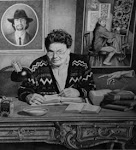
"I am 3/4ths Canadian, and one 4th New Englander - I had ancestors on both sides in the Revolutionary war." - Elizabeth Bishop
____________________________________________

Tuesday, July 23, 2019

Letters to Aunt Grace, Part 118: Lots of water

The second half of Bishop’s 20 February 1962 letter was focused on water in various forms. Before getting to this subject, Bishop asked her aunt if she had “got my last note with the check in it?” That is, the cost of living bonus she’d got from The New Yorker, which she had signed over to Grace to help with her Florida trip. Bishop wondered if her aunt was “there” yet and, if so, how she got there, “by train?”

Bishop had a direct connection to and interest in Florida, and in good Maritimer fashion, she then asked about the weather: “Are you having storms there the way we are?” Bishop had been writing to her aunt about the severe, at times record breaking, weather in Rio and the problems it had been causing; she wondered if Floridians were experiencing the same. She noted that she saw “by this morning’s paper that maybe Glenn will at last take off today so Florida must be clearing up, at least.”

The Glenn she refers to is, of course, astronaut John Glenn, who did indeed take off on that very day and became the first American to orbit the earth on the Friendship 7 mission.* 
The weather had definitely not cleared up in Rio where “the storms” were “terrific.” In her decade living there, Bishop had “never seen anything like them.” The bad weather, especially the rain, had been going on long enough that “we are awfully sick of being wet.” This kind of weather was more than uncomfortable for Bishop, it exacerbated her asthma, which she had “been having … all the time … because of the mildew.”

Not only was water falling in great quantity outside. Bishop continued her water tale with what was falling inside. She told Grace that she and Lota had returned “to Rio on Sunday late P M — broiling hot — and found the plumbers who are completely re-piping the place had left everything looking as though a bomb had hit us.” Bishop’s word for this discovery: “mess.” The only place they could “get cold showers” was in “the maid’s bathroom,” a facility that had been designed by some “devil” because it was basically a “little hole,” a feature that was common enough across the board, prompting Bishop to declare: “poor maids.” The maids had no choice but to use such cramped spaces, but Bishop reported that “yesterday we went to a friend’s down the street to bathe, make pee-pee, etc.” Not only was the plumbing disrupted, they had to do this external toilette “through howling storms all day, too!”

The plumbing inconvenience was but the start of a process to “overhaul” the apartment. Bishop noted, “Next comes the wiring.” One problem for them was timing, for they commenced this necessary work as “prices are soaring,” making her wonder “how we can ever finish it, even paint it, I don’t see.”

The apartment was not without running water, exactly. Bishop told her aunt that she “was awakened by the rain coming in on my face.” She explained that the apartment was on “the top floor and there are awful leaks.” She had complained about this issue before. The leaks were “the management’s responsibility, but they won’t do anything about it.” Scribbled vertically on the left side of the page, to reflect her observation, Bishop wrote: “The bedroom wall is running with water! All the paint peeled off.”

One thinks of “The Rime of the Ancient Mariner,” “water, water everywhere…”

Bishop dried off her face and hands and turned to a more interesting use of water. She reported, “Yesterday at the worst of the storm we saw the winning sail-boat — 80 feet — arrive from Buenos Aires.” This boat, Stromvogel,** won “the annual race from B.A. to Rio,” a 1200-mile route. Bishop declared this boat “beautiful” and noted “how I’d like to be on” it or one of the other boats in the regatta. The second-place boat “was the U S one from Annapolis.”
Wet and asthmatic as she was, Bishop closed her letter with “I must get to work.” Her final words were for and about her beloved aunt (“How are you”?), her hope that when she went “up next week-end” to the country, she would “get a letter” from Grace. In addition to Grace, Bishop sent her “love to Aunt Mabel and Hazel.”

I can’t help but observe here that while academic scholars and biographers focus on the “work” Bishop mentions at the end of this letter, very often Bishop was much more focused on daily life. And when she does report working to Grace, the focus is often about the practical and logistical side of it. It is not wise to ignore all this quotidian matter, which filled most of Bishop’s days, weeks, months, years. Her poetry and prose were conceived and created amid the press and push of tasks, travels and troubles. And Bishop often wasn’t able to write the formal stuff, blocked or busy or both at any given time; but she wrote a mind-boggling number of letters, and one can see in them all the poetic force that ended up in the poems and stories she did complete.

Bishop’s next letter to her aunt is a brief hand-written note accompanying an article that came out in Time, written and sent a little over a month later, the subject for the next post.


******************** 
*Note: Mid-July 2019 marks the fiftith anniversary of the first person to set foot on the moon, astronaut Neil Armstrong (along with Buzz Aldrin). The moon landing was the culmination of years of efforts, which began with Glenn’s orbit.

**Note: Bishop did not know or report the name of this vessel, but the New York Times reported the win which happened on 19 February.

Friday, July 19, 2019

Letters to Aunt Grace, Part 117: History of Great Village

Bishop’s next letter to Grace is dated 20 February 1962, two weeks after her last. It was prompted by a gift Bishop received barely a week after she’d written on 6 February: “the book about G V,” that is the History of Great Village by the Women’s Institute. It was sort of hot off the press, being published in 1961. 
By the time she wrote, Bishop had read it from cover to cover and “enjoyed it very much … and I am finding it very useful …. you’ll be surprised!” To prove this assertion, she immediately noted that she was “writing a poem about the Mill Pond, among other things.” This pond belonged to the Peppard family and was located behind the Great Village School. It was large enough that over the decades it supplied both a lumber and grist mill with water. By Bishop’s time, those businesses were gone, but still vivid in the minds and memories of all the villagers.

It appears that Bishop didn’t get very far with her “Mill Pond” poem. Her papers at Vassar do not contain even a draft of such a piece, at least as far as I know.

Bishop thanked her aunt “very much,” and added, “you couldn’t have found a present I’d like better” (it being a birthday present).

What followed were some of her direct comments about items found in this quaint but informative account of the founding and prospering of the village. As she read through it, she found her maternal family name written mostly as “Boomer.” Bishop had definite views on this choice: “I do wish everyone would go back to spelling the name BULMER.” For Bishop, ever keen about proper nouns, this spelling bespoke “a good English name.” Her feelings about the more popular spelling were categorical: “I HATE BOOMER.” For her, this spelling “could be Dutch or German.” It is quite curious that she expressed such a negative view, thinking the common spelling “very ugly-looking,” when she had chosen this exact spelling for the character, Edwin Boomer, in her fable-like story “The Sea & Its Shore,” written in 1937.

Bishop really did read this local history closely and carefully because she found even the most passing references to her ancestors. First, her great-grandfather Robert Hutchinson, who was included in a list of “Master Mariners.” Bishop expressed disappointment that the name of his “bark or whatever it was” was not listed, but then she thought that perhaps it was because he was not a “ship-owner.” Indeed, Robert Hutchinson never owned a vessel, but he worked on a number of ships out of the Port of Londonderry, and probably reached the rank of captain. But rarely did captains own the vessels they sailed. 
The next ancestor was her great-grandmother, Mary Elizabeth Black Hutchinson (later Gourley), wife and widow of Robert Hutchinson, whose name she found mentioned in an item about the merchant (and fellow Yorkshire immigrant) L.C. Layton, paying said “ʻMrs Hutchinson’ to make ‘2 coats at 40₡ each.” Bishop “bet that was your grandmother, wasn’t it?”
She was fascinated by these “odds and ends,” which she kept listing. Grace would surely have known the contents perfectly, having likely supplied information directly to the compilers, so Bishop’s descriptions are perhaps to show Grace how delighted she was with this present.

Bishop noted that she had “found the list of relatives who became school teachers and nurses,” noting it was “quite impressive!”
Having just gone through her own kind of hell with the Time-Life book about Brazil, Bishop was aware of production matters and noted, “as you said — it’s too bad whoever did it couldn’t have done it just a little better.” The History of Great Village is typical of community histories of the era, an amateur production (or in Bishop’s parlance, “primitive,” which was not a pejorative term for her, but indicative of a “home-made” quality she admired). Still, the writing is ordinary, the scholarship haphazard, the layout/design rudimentary. All this said, such a history is extremely valuable now as the generation that knew first-hand much of what it contains is gone.*

Bishop thought she knew who might have been a key person in its creation: “did ELSEE write most of it, or who?” That is, Elsee Layton, daughter of L.C. Layton, the fellow who paid Mrs. Hutchinson for the coats. Elsee and Grace were good friends and one of those teachers on the list Bishop found.

One item, in particular, intrigued Bishop: “did you see the item about the old ‘Literary Club’.” The Christophian Literary Society was a fixture in the village for several decades just before and after the turn of the twentieth century. Bishop’s mother and aunts all belonged to it at one time or another. I have written about it and one of its best-known members, Alexander Louis Fraser, elsewhere on this blog. 
Reading about the society’s wide-ranging interests, Bishop wondered “how many people in G V ever read Browning or Tennyson these days.” Another section “about ‘ARTISTS’,” also caught her eye, because it included a note about Great-uncle George W. Hutchinson. Indeed, Great Village during her childhood (the 1910s) was a highly cultured place and helped seed Bishop’s love of poetry and painting. But she concluded, “as everyone says — and it happens everywhere — culture is dying out completely in small places.” This culture was being replaced by new technology, so that “no one knows anything any more except what they see on T V, alas.” One wonders what Bishop would think of today when the argument can be made that no one knows anything any more except what they see on the internet! 
Bishop knew she could not reverse this tide, but she did “wish they’d stick to the old spellings of things, and the old names, at least.” Besides hating “Boomer,” she also declared in a scribbled addendum at the end of this paragraph, a parenthetical afterthought, “(I do HATE ‘GLENHOLME’ — UGH!)” Glenholme was the current name of what was originally Folly Village, which even I agree is a much more interesting name.

Reading the History of Great Village made her yearn to return, “I’d love to get back for a trip,” but what with life so busy, she wondered “when and how on earth” she could. Then one final note, “I see your house,” that is, her grandparents’ home, “is insulated with birch bark — that’s nice!”**
   
Bishop’s final paragraph of this letter shifted to quite another matter, the woes of trying to upgrade the plumbing at the apartment in Rio, which will comprise the next post.


************************

*Note: The Great Village Historical Society reprinted the History of Great Village some years ago and added supplementary information, including a brief biography about Elizabeth Bishop herself.

**Note: During some recent work at the EB House, some of this birch bark insulation was found.

Monday, July 15, 2019

Artist talk at ViewPoint Gallery

On Sunday afternoon, 14 July, photographers Roxanne Smith and Kathleen Flanagan gave an artists’ talk about their exhibit “Glimpses of Forgotten Memories” at ViewPoint Gallery in Halifax, N.S. EBSNS supporter Susan Kerslake attended and sent some delightful images of the occasion, which was well attended. I share a few of these photos with you. Thanks, Susan.
(Roxanne and Kathleen.)


(A chair for Elizabeth Bishop.)

Sunday, July 14, 2019

This afternoon at ViewPoint Gallery in Halifax, photographers Roxanne Smith and Kathleen Flanagan will be giving a talk about their exhibit "Glimpses of Forgotten Memories," photographs of the Elizabeth Bishop House. This exhibit has received a lovely review by arts reporter Elissa Barnard. Click here to read it.
This exhibit will be at the gallery until 28 July. Check it out if you are in Halifax.

Saturday, July 13, 2019

Letters to Aunt Grace, Part 116: Coming up clover

Bishop concluded her 6 February 1962 letter to Grace with three short paragraphs, winding things down quickly. She knew Grace was on the move again, heading to Florida to spend time with her sister-in-law Mabel and niece Hazel. Bishop was “glad you can get away,” at least she “hope[d] you did.” February in Nova Scotia was quite different than February in Rio and Bishop knew that “the cold takes too much of your energy, I think.” She had experienced some cold in New York in December and knew about expending energy “just trying to keep warm and going.” Bishop also knew Grace was dealing with another type of cold, too – that is, she had been sick. Even as far apart as they were, and as long away from each other, Bishop’s concern for her aunt never wavered.

She noted that her 6 February epistle was “a reply to your letter,” which Grace had mailed in Montreal (while visiting her sister Mary) “on the 26th,” and which had contained a “birthday card.” Grace, too, rarely missed these occasions to connect, making a particular effort to do so even when she was away from home.

Bishop thanked her aunt for the remembrance, which she “liked especially,” because it had “clover on it.” There was no clover in Brazil and Bishop noted wistfully, “one misses it.” Seeing this representation of something deeply familiar from her childhood, she observed, “I’d like to chew a nice big pink head of clover right now.” If you have ever done such a thing, you know there is an especially sweet taste to it. My italics and bold indicates that Bishop wrote the word in, over top of something she had mistakenly typed.
(Dutch clover in bloom, one of the types Bishop
would have remembered. It is the blooms one chews.)
The day’s mail not only brought Grace’s birthday greetings, but also Bishop’s “annual bonus from the N[ew] Yorker — something mysterious called the ‘Cost of Living Adjustment’.” Bishop explained that the amount of this unexpected adjustment depended “on how much you’ve published there during the year.” Bishop reported that she had received a small windfall: “$153.21.” But rather than keep it, she chose instead to sign it over to Grace and send “it on to you to help out in Florida — or help with your trip back.” Certainly a generous gesture.

This brief letter was quickly coming to a close. The final few observations concerned family, responses to updates Grace had sent along with the birthday card. Bishop once again expressed her concern for “Phyllis and Ernest,” how “sorry” she was for “these awful things [that] have to happen,” meaning their struggles with dear little Miriam, who was nearly nine months old by this point. In the face of such challenges, Bishop urged, “let us keep our chins up and go down fighting,” which she noted was her “motto!” Bishop was not only trying to encourage her aunt and cousin, but also herself. These words were perhaps prescient as Lota’s work with the park began to take a serious toll on both of them in the next couple of years, both women struggling to keep their chins up and in fighting spirit.

Bishop knew Grace’s indomitable spirit, so she felt this motto was one her aunt would practice herself. Knowing that her aunt was spending time in Florida, she concluded with “Remember me to Aunt Mabel and Hazel.” Such a visit would generate “lots of family gossip,” which Bishop urged her aunt to write about next time, noting that she was “always interested” in such news. In good Maritimer fashion, and in light of the rain pouring endlessly outside her Rio window, Bishop hoped “you have good weather there,” and signed off with “Lots of love.”

Only two weeks passed before Bishop’s next letter to Grace, which was prompted by a special gift from her aunt.


Wednesday, July 10, 2019

Letters to Aunt Grace, Part 115: Customs and cooks

Bishop’s third 1962 letter to Grace is dated 6 February, just two days before her 51st birthday. She was in Rio where “it pours and pours and pours.” The sunshine she had mentioned returning in her previous letter didn’t stay around long. Without any preamble, Bishop launched into a tale of woe, declaring that as a result of all the rain “we not only have leaks in our roof up in the country but now we have leaks in Rio.” Lota’s apartment in Leme was “on the top floor and in the last stages of decrepitude.” All their efforts to “get [the leaks] fixed” had brought “no result.” Consequently, “plastic buckets dot the house and the apartment as well.” Bishop hoped that “a plumber is supposed to come today to start a few repairs” at the apartment, but clearly, she was dubious it would happen.

Then a shift of focus: “Also —” brought in another tale of frustration about their “trunks,” shipped from the US when they returned in December from the New York sojourn. Bishop reported that they were “still in the customs.” Because of Lota’s position and connections, they always had help dealing with this agency, but from Bishop’s perspective, it seemed that “the more pull we have the harder a time” they had with customs. In this instance, “we have a Captain from the army, who salutes us,” helping them. This person was provided by Carlos Lacerda, “Lota’s friend.” But he was proving no grease to the wheel. Bishop noted, “we just can’t get things out.” Her frustration was evident, “and I’m getting pretty desperate.” She had packed “a lot of my papers and my real check-book, etc.,” in the trunk because “they all weigh so much.” 
(Carlos Lacerda. Wikipedia.)
Bishop remembered that when they last returned from abroad, “Lota’s Uncle was Foreign Minister and sent somebody important to help.” He, too, was no grease to the wheel. Indeed, he seemed to be a problem because “we ended up paying more than if we hadn’t had any help.” Bishop explained to a probably puzzled Grace (why would they not do better with such important personages intervening for them?): “The customs here are an independent organization, it seems.” Clearly, she concluded, “no one can do anything about it,” and especially no one of importance. All this experience confirmed for Bishop that the “next time” she would “forgo all ‘big shot’ help or ‘pull’ and just do it myself.”

The gap between this paragraph and the next seems to hold a big exhale and sigh, at least one can imagine it so.

She then turned to another subject which was only marginally less frustrating by noting that “Elizabeth [Naudin] is staying up in Teresopolis.” Bishop hoped that all the rain wasn’t making that time “too lonely” for her cousin. But perhaps the presence of “her sister-in-law” mitigated the dreariness. The frustration came with the report that these women “were supposed to come for lunch” “two Saturdays ago,” which did not happen because “it rained so hard” that the drive and visit had to be canceled. Bishop weakly said she would “try again next week-end.” Part of the issue was that they were both, “Lota particularly,” working “so hard here in Rio,” which meant “that when we get up there for two days … we like to take it easy.” That aim “rarely” happened “because there are always people to entertain, it seems.” And the responsibility for the food fell to Bishop because “that cook [Maria] can’t COOK.”
(Rio de Janeiro, 1962. Elenara Stein Leitao.)
Bishop reminded her aunt once again that they were “trying to get another ‘couple’ — but can’t seem to.” As a result, Bishop ended “up cooking all day Saturday usually.” She declared that she didn’t mind such domestic work “when I don’t have other things to do.” At that moment, she was “up to my neck in work — and away behind.” One of the things she was doing was planning to mail copies “of the BRAZIL book,” which was “supposed to appear the end of this month.” (N.B. This “supposed” was the third so far in the opening two paragraphs of this letter, an indication of how uncertain many things were at that moment.)

She told Grace that she would “change the address … on your copy” and send it to Florida. Bishop was still trying to keep track of her elderly aunt, was gallivanting again.

This relatively short epistle wound down quickly after this litany of “supposed” events. The next post will take up the final few matters.

Saturday, July 6, 2019

Glimpses of Forgotten Memories exhibit

On 4 July 2019, ViewPoint Gallery in Halifax, N.S., hosted the opening of Glimpses of Forgotten Memories: The Elizabeth Bishop House, photographs by Halifax photographers Kathleen Flanagan and Roxanne Smith. Roxanne kindly has sent along several photos of the opening and I want to remind everyone, especially our readers in NS and the Halifax area, that the exhibit runs until 28 July. I share the photos Roxanne sent with my heartfelt thanks. There will be more about this exhibit later this month, so stay tuned.
(The assembled listening to our own John Barnstead
holding forth. Photo: Roxanne Smith.)
(Pondering the forgotten memories. Photo by Roxanne Smith.)
(The space looks amazing. ViewPoint moved to Brenton St.
not long ago. Photo by Roxanne Smith.)

This photograph was sent to me by Susan Kerslake, taken when she visited "Glimpses of Forgotten Memories" on Sunday, 7 July. Here photographer Kathleen Flanagan stands in front of her photographs of the Elizabeth Bishop House.


Tuesday, July 2, 2019

Letters to Aunt Grace, Part 114: Domestic matters

The last part of Bishop’s 18 January 1962 letter went from “point to point,” as she wrote, referring to Grace’s busy travel schedule. That is, Bishop closed her letter with a number of subjects, all from the domestic realm.

She returned first to the issue of finding good help, noting to her aunt that it was “almost impossible … to find a couple who are willing to stay off in the country.” Not only did they need help willing to tolerate relative isolation, because Elizabeth and Lota were in Rio so much now, they needed people who would “not leave the house alone,” and who would “feed the cats regularly.” Bishop didn’t feel that it was such a bad situation because there were “neighboring people of their own sort,” by which she must have meant other servants, “around for them to see.” Still, she reported that it was “getting harder and harder all the time.”

Their particular help, “this Maria,” seemed a hopeless case to Bishop, at least in the realm of cooking. After “almost two years,” Bishop noted that “she has learned how to make one thing right: corn meal muffins!” That achievement, according to Bishop, was “only because they like those themselves.” For “everything else,” Bishop moaned, “I have to go and remind her …and taste it.”

All their help was not so problematic. Bishop told Grace that “here in Rio we have a wonderful maid.” This person, “desperate for a room,” had “offered to work for us free”. As a result, she “sleeps here” and “in the morning gives us coffee and milk and the newspapers at 7 A M.” She also “cleans a bit, makes the beds, does a little ironing,” after which she went to “another job at 10:30.” Bishop found her “wonderful — so good and cheerful,” even though she couldn’t “read or write.” And Bishop quickly added, “We do pay her, of course, but very little.” During the day, Bishop noted that she herself got their “lunch and dinner,” which she described as “very skimpy.” But this cheerful person returned after her day job and washed the dishes.

Clearly, Bishop was responsible for most of the cooking regardless, whether in Rio or Samambaia. She noted that “everything here takes so long to do,” unlike in N.Y., where she didn’t “mind cooking … it takes no time at all”; but in Rio “it’s a real job” because “nothing comes cleaned or ready.”

After this account of a circumstance that might be called a “happy problem” (few of us have one maid, let alone several), Bishop must have looked out her window because she quickly shifted to the weather: “the sun is out at last.” After clearly a long stretch of rain, she hoped “things will start to dry out,” and offered that her feet had “been wet for three days I think!”

Another quick shift to: “I am looking forward to my book,” by which she must have meant “that awful LIFE book.” She declared that now she was thinking of writing “one of my own about Brazil,” so she could “say all the things I couldn’t say in it.” To do so would require “more travelling,” so she was thinking she would “use my fellowship just to travel in Brazil.” There went the idea of using it to help her get some place where she could then arrange to see Grace.

Travel led Bishop to the subject of upcoming visitors. She asked her aunt if she had ever met “my old school friend Barbara Chesney.” She was sure Grace had. Bishop reported that “she and her husband — a baby-doctor — are coming here in February.” Bishop had not seen this old friend “for twenty years or so.” Barbara Chesney Kennedy had followed a very different path than Bishop: “She has three sons, pretty grown up now.” Though in a way, Bishop’s life was just as filled with children and grandchildren, even if they were not her own family. 
(Later in life, Barbara Chesney Kennedy became a painter.
To learn more about her, click here.)
The “baby-doctor” triggered her last “//” and the observation that the health authorities “are giving the Sabinanti-polio medicine — by mouth — here now.” Bishop knew Grace would be interested in such developments, even though she was now retired from nursing. Bishop noted that Mary Morse had “brought down Monica, our dressmaker’s grandson, aged 2, and three other children one HOT day last week, to get their 2nd drop.” Transporting this little flock of children on her own in “another tiny Volkswagon,” made Bishop observe rightly, “it must have been quite a trip.” Morse had “a wonderful child-doctor,” who was a friend of theirs, too. He was “in office in Rio now — Public Health.” Bishop observed that “he is really doing wonders.” She admired this positive effort because “just about everything else goes from bad to worse.” 
Having imparted her domestic news, Bishop signed off quickly, asking Grace to “tell me more about the Florida plan,” and to write whenever she was at one of her travel destinations, so Bishop could keep track of her. She urged her elderly aunt to “take care of yourself” and closed “With much love.”

Bishop’s next letter was typed and sent just before Bishop’s fifty-first birthday, 6 February 1962. The next post will take up that epistle.

Sunday, June 30, 2019

Elizabeth Bishop Re-imagined: a novel approach

Recently, a friend gave me a copy of Liza Wieland’s new novel, Paris 7 A.M. (Simon & Schuster, June 2019), her re-imagining of Elizabeth Bishop’s life during a sojourn in France in the mid-1930s. 
Wieland’s is not the first fictionalized rendering of an important time and place in Bishop’s life. Michael Sledge’s The More I Owe You (Counterpoint), his version of Bishop’s life in Brazil and relationship with Lota de Macedo Soares, was published in 2010.
Sledge’s novel is by and large a linear narrative with flashbacks, its 328 pages span Bishop’s Brazil years in a comprehensive manner, offering his take on the personal intimacies and political intrigues of this transformative time in her life. It has been years since I read it and I can’t in all honesty remember much of it, that is, remember Sledge’s version of the events, personalities, relationships. What I do remember is that early on he lost my willingness to accept his fiction, on page 49 with the following (a moment when Bishop remembers something about her mother): “How many evening meals had they endured with forced cheer while Gertrude lay on the couch emitting little squeaks and gurgles, one arm over her eyes while the other dangled to the floor, the fingers of her white hand moving as slowly as the claws of a dying crab.” “Squeaks and gurgles”; “the claws of a dying crab”? Really?
I have spent many years encouraging artists of all disciplines to read and respond to Bishop (filmmakers, photographers, painters, musicians and, yes, poets and novelists). These artists needed little prodding. Bishop is one of those gifted creators who quickly gets under one’s skin and almost compels a response. She often gets incorporated obliquely or directly into the art created in that response. In principle, I am all for artists offering their versions of Bishop, or their response to something Bishop has written. Indeed, as a biographer of Bishop, I have my own version of her too. And Bishop has influenced some of my own poems.
After the above quotation in Sledge’s book, a substantial narrative unfolds, rendering not only a view of Bishop and the people in her life, but also ample invisibles: emotions, ideas, memories, dreams. Should I judge this substantial effort by one unfortunate description? I’m afraid that I did and even after all these years, I can’t quite get past it.
Sledge is, however, in good company. Many Bishop scholars and biographers have taken the easy and/or sensational path where her mother and their relationship are concerned. I have written about these liberties on this blog and elsewhere. It is not that I believe I know better, but any careful reading of Bishop’s work (all of it: poems, memoir stories, letters, journals) reveals that Bishop’s understanding of her mother’s life and its impact on her daughter was nothing if not complex and shouldn’t be summed up in the one word that attracts so many scholars: “mad.”
Wieland’s novel is a different kettle of fish. Its focus is a very specific, finite period in Bishop’s life: a couple of years during her early adulthood, when she ventured forth into the world for the first time. Wieland’s style is also markedly different. Her novel is comprised of many short chapters, vignette-like glimpses or “tableaux” (a term that appears at one point). The word that kept coming to me was “impressionistic,” not relentlessly narrative, as Sledge’s story. There is a forward trajectory, a plot; but the novel is not rigidly anchored to it. Moreover, Wieland leaves as much out as she puts in (unlike Sledge who packs in as much as possible). It strikes me that this modus operandi bespeaks a brave novelist.
When I opened the book for the first time, I was not inclined to like it, just on principle. But I found myself intrigued immediately because the prose is deeply poetic (the right approach, it seems to me, for the subject: a profound poet). Indeed, I might argue that each of the chapters is a prose poem: elegant, precise, densely associative, self-contained.
Wieland weaves many allusions from Bishop’s work carefully, cleverly and often seamlessly into the lines. One thing I began to do instantly was identify from which poems and stories the allusions came.
Being a Bishop biographer, however, makes it difficult for me to read Wieland’s novel as fiction. That is, I resist reading it as fiction, which isn’t fair, I suppose, to the writer. The biggest fiction in this novel is a dangerous adventure the young Bishop gets caught up in: helping an older woman, who echoes her mother in many ways, to save two Jewish infants from the looming wave of Nazi oppression and violence overtaking Europe in 1936‒1937, an effort to which she is sworn to secrecy. In the midst of all this intrigue, Bishop has a brief affair with a German woman, who is also fleeing this intensifying, expanding oppression. If you are going to create events in Bishop’s life, these two are certainly interesting and have a logic about them.
These two fictions take place amid actual events: for example, the suicide of Robert Seaver (though that happened before Bishop’s first trip to Europe) and the car accident that resulted in Margaret Miller losing her arm, both profoundly traumatic events for all concerned. It seems to me Wieland handles these tragedies well and the thoughts she gives to Bishop (some of which come from journals and letters) feel authentic.
Overall, I actually enjoyed reading this novel, primarily because of Wieland’s style and form, her often exquisite language. You had better be adept at metaphor and turn of phrase if you want to write artistically about Bishop, and Wieland clearly has a gift.
All this said, I still come back to “mother” — I can’t help myself.
Gertrude Bulmer Bishop appears in this novel entirely as memory; her life and illness torqued out of its factual trajectory. Wieland did a lot of research for this book, but clearly, she didn’t read a lengthy manuscript about her mother (which later got compressed and transformed into “In the Village”) that Bishop worked on in the early 1930s. While Gertrude does have some substance as an actual person in these pages, Wieland does what nearly everyone else writing about this relationship does, reduces Gertrude to a caricature. How sensational it is to latch onto (and repeat, p. 14, 56) something Bishop wrote to Robert Lowell: that she was told her mother had wanted to kill her, something Bishop knew was not true. In the end, Wieland, can’t help but bring in that word all scholars believe so thoroughly applies to Gertrude: mad. She concentrates “that truth” on page 219, writing it five time, equating this madness with Clara, the most important character in the novel besides Bishop. I thought this paragraph was a hammer, a tool Wieland rarely uses to craft her refined prose. Even in her early 20s, Bishop knew that things with her mother were more complex than they seemed. Bishop was working through a great deal at this time of her life, exploring the shadows in her dreams, journals, poems and stories. The open-endedness Wieland affords the mysterious fictional characters and relationships seems denied to Gertrude and Elizabeth.
I have thought more than once of trying to write a novel about Gertrude. I won’t, however, because I have tried to explain things in biography, a limited enough genre, for sure. Still, the urge to reclaim Bishop’s mother (someone the poet endeavoured to understand her whole life) is strong.
Being a biographer, I suppose it is clear that I find fact more interesting than fiction. The truism that fact is stranger than fiction does have validity. All this said, I somehow felt I could overlook this same-old characterisation in Wieland’s novel because it is so well written. At least I tried to. But I do wish Americans would stop calling Halifax Harbour a “bay” (page 13)! And, sadly, no passenger train would have passed “one hundred yards to the north of the psychiatric hospital in Dartmouth” (p. 13; a provincial institution, not a “state” facility). And if there was ever a “pier” at Economy Point, it would have been a wharf and existed in the Age of Sail (19th century), not during Bishop’s childhood. Such infelicities (and there are others) made me smile and sigh.
Then, Wieland incorporates Bishop’s poem “A Drunkard,” which describes her memory of the Great Salem Fire in 1914 after which Gertrude reprimands her three-year-old daughter for wanting to pick up a piece of detritus on the beach. Wieland transports this fire to Nova Scotia: “There is a fire in Great Village. Many people have lost their homes.” Bishop described a fire in Great Village in “In the Village,” but all that burned was a barn. I think Great Village would remember a conflagration as severe as that which claimed Salem, Massachusetts. Would Bishop, even a fictional Bishop, make or mix up such events? Wieland’s Great Village fire is evoked a couple of times (pp. 253, 258) and allows Wieland to intensify Gertrude’s sinister quality, describing her “scolding voice” as “cruel” and “vicious and desperate,” strong adjectives given the wider context of Europe in 1936 — Gertrude as Nazi. She turns Gertrude into a “wounded animal,” to explain Bishop’s state of mind and choices made.
I had to keep repeating: this is fiction. But the fact is, more people will learn about Elizabeth Bishop by reading this novel than those who read the literary criticism and biography, which continues to be published. People will take this fiction to be fact because the novel is about a real person in a historical context and contains many real people as characters.
And to be really nit-picking, I found a few typos: “paying” for playing (p. 139); “though” for through (pp. 145, 222); one too many “a”s (p. 266). I did wonder why Wieland chose “1953” as a chapter title describing an encounter Bishop had with her old friend Clara at Grand Central Station in New York City. Bishop was living in Brazil at that time. Her visits to NYC happened in 1952, 1957 and 1961. Why not just write: “1952” instead? Finally (I have made my point), I wondered about the following: “I’m jealous of how peaceful she looks. Here they’d say she was comfortable in her skin. In Canada, you would say she was in her skirt.” Never in my life have I heard that latter phrase, but perhaps it is an Upper Canadian saying?
Wieland’s penultimate chapter/vignette/prose poem is, appropriately enough, a list of losses (echoing “One Art,” of course, the poem that has become Bishop’s signature, a sort of anthem for our age). The things Wieland states that Bishop has lost have inner logic for the novel, but it struck me as a rather sad conclusion. Bishop surely suffered many losses, but she persevered and wrote poetry and stories that haunt people forty years after her death, so much so that novelists write novels about her. The final chapter, entitled “1979,” the year Bishop died, is another list of things that remain in Bishop’s final home, Lewis Wharf in Boston. This list is also logical and poignant, yet it left me at a loss. Where was the literary legacy of this young woman involved in serious events in Europe in the 1930s, during the lead up to war? Well, Bishop did believe objects were sentient, so perhaps I’m being too demanding in my expectations. And perhaps Wieland intends her compressed, quiet list, the form itself, to be the answer to my question. Bishop’s death was sudden, unexpected, a great loss for all who loved and knew her. So perhaps in the end what is left of her, of any of us, is this kind of list of small objects, with all their secrets and silences.

Friday, June 28, 2019

Reminder about an exciting exhibit in Halifax

Next week is the opening of an exciting exhibit at ViewPoint Gallery in Halifax, N.S. Photographs of the Elizabeth  Bishop House in Great Village, N.S., by photographers Kathleen Flanagan and Roxanne Smith. Check it out!


Monday, June 24, 2019

EBSNS hosts successful Annual General Meeting

On a cool, rainy Saturday afternoon, 22 June 2019, the EBSNS hosted its Annual General Meeting and 25th anniversary celebration in St. James Church, Great Village, N.S. We welcomed several wonderful special guests: Rita Wilson, Penny Lighthall, Margo Wheaton and Harry Thurston. After the business and program concluded, the assembled removed to the Great Village Legion to enjoy refreshments provided by the Fire Brigade Auxiliary. These refreshments included an anniversary cake. Thanks to all the folks who attended, from near and far. The EBSNS is deeply grateful to all who continue support the work of telling Nova Scotians and the world about Bishop's deep and abiding connection to Great Village. Here are some photos of the event.

People begin to gather in St. James Church. Photo by Sandra Barry.


"Sestina," my favourite EB-poem inspired hooked rug in Penny Lighthall's exhibit.
Photo by Sandra Barry.


John Barnstead looking at Penny Lighthall's exhibit. Photo by Sandra Barry.


The assembled in St. James. Photo by Susan Kerslake.

Fabric Artist Penny Lighthall. Photo by Susan Kerslake.
Writer Rita Wilson spoke about her upcoming book:
A Pocket of Time: Elizabeth Bishop's Poetic Childhood,
due out with Nimbus in the fall. Photo by Susan Kerslake.
Our wonderful readers: NS poets Harry Thurston
and Margo Wheaton. Photo by Susan Kerslake.
The Anniversary Cake! With opening lines
from "The Moose." Designed and made
by Cheryl Slack. Photo by Susan Kerslake.

The reception at the Legion. Photo by Susan Kerslake.
Outgoing President Patti Miller (r) and new Vice President 
Laura Sharpe (l). Photo by Susan Kerslake.

Bishop scholar Vicki Harrison and her husband Peter, 
all the way from California. Photo by Susan Kerslake.
Painter Joy Laking and photographer Roxanne Smith. Photo by Susan Kerslake.

Three of the founding members of the EBSNS:
left to right -- Sandra Barry, Meredith Layton and Lois Bray.
Photo by Joy Graham.

Tuesday, June 18, 2019

Another EB society in Nova Scotia

The Elizabeth Bishop Society is not the only "EB" society in Nova Scotia. The Ernest Buckler Literary Event Society in the Annapolis Valley, centred around Bridgetown (where I grew up). It has been around for a decade or so. A week after the EBSNS holds its Annual General Meeting and 25th anniversary (on 22 June in Great Village), the EBLES is hosting a literary and musical evening, "Reading Where We Live," in Bridgetown. Bob Maher, a member of the EBLES organizing committee writes a most interesting blog and he has given the EBSNS AGM a shout out in today's post. Thanks Bob! So I want to return the favour and share the wonderful poster the EBLES has created for what will be a lively gathering on Saturday 29 June (click on the image to enlarge it). Lots of local writers will be participating and the two special guests are John Demont and Whit Fraser. I think it is pretty close to sold out already, but there might be some tickets left.

I also want to thank Bob Maher for his always interesting blog posts that look closely at the idea of local and rural and how important these ideas are to those of us who have left city life for the country.


Monday, June 17, 2019

EBSNS AGM on Saturday 22 June 2019, 1:00 p.m. at St. James United Church

The EBSNS and its special guests hope to see you in Great Village this coming Saturday to help us celebrate our 25th anniversary. Everyone is welcome! (Click to enlarge image.)